Physics-Informed Neural Network with Transfer Learning for State Estimation in Lithium-Ion Batteries using the Single Particle Model with Electrolyte
Pith reviewed 2026-06-29 04:21 UTC · model grok-4.3
The pith
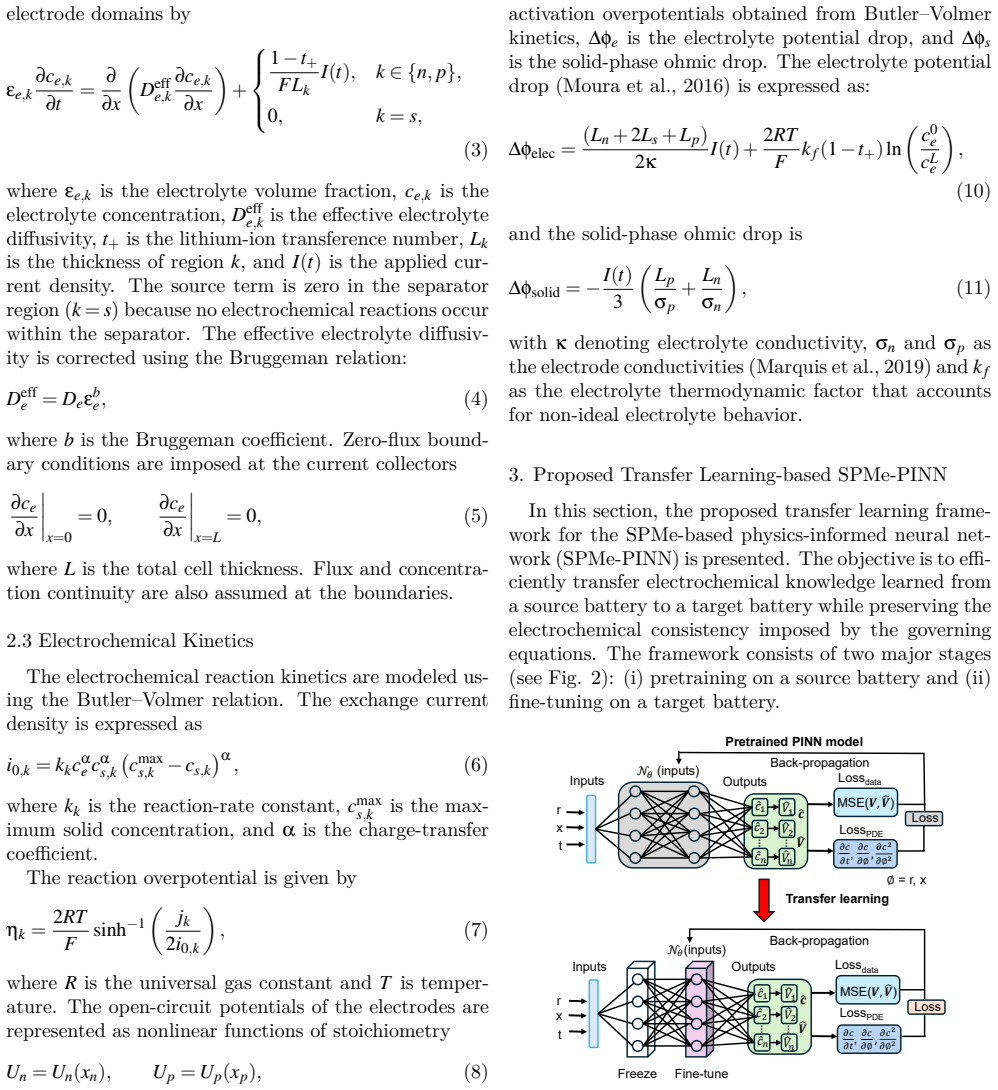
Transfer learning adapts pretrained SPMe-PINNs to new lithium-ion batteries by moving weights, freezing layers, and fine-tuning while preserving physical consistency.
A machine-rendered reading of the paper's core claim, the machinery that carries it, and where it could break.
Core claim
The central claim is that pretraining an SPMe-PINN on general electrochemical dynamics, followed by weight transfer, layer freezing, and targeted fine-tuning, produces accurate voltage predictions for target batteries while preserving electrochemical consistency, shortening training time, and supporting generalization across chemistries and operating conditions.
What carries the argument
The transfer learning framework for SPMe-PINNs that pretrains on general dynamics then transfers weights, freezes selected layers, and fine-tunes remaining parameters to adapt to a target battery.
If this is right
- Accurate voltage prediction holds across different battery chemistries after adaptation.
- Training time decreases compared with training an SPMe-PINN from scratch for each new battery.
- Electrochemical consistency remains enforced through the PINN loss function during and after transfer.
- Generalization to new operating conditions becomes feasible without full retraining.
Where Pith is reading between the lines
- The same pretrain-and-transfer pattern could shorten setup time for other reduced-order electrochemical models beyond SPMe.
- Faster adaptation might support online state estimation tasks where battery parameters drift over time.
- Layer freezing choices could be studied to identify which parts of the network encode chemistry-independent physics.
Load-bearing premise
A model pretrained on general electrochemical dynamics can be adapted to a specific battery by transferring weights, freezing some layers, and fine-tuning the rest without losing physical consistency or accuracy for that chemistry or set of conditions.
What would settle it
Fine-tuning after transfer produces voltage predictions that violate the enforced conservation laws in the loss function or show larger errors than training an SPMe-PINN from scratch on the target battery data.
Figures


read the original abstract
Physics-informed neural networks (PINNs) have emerged as a powerful tool for solving nonlinear partial differential equations (PDEs), including battery electrochemical models. They typically en-force conservation laws within the loss function to ensure physically consistent solutions. Tradi-tional numerical methods such as finite difference, finite volume, and finite element techniques, re-ly on discretization and can be computationally expensive for nonlinear systems. To address this challenge, PINNs offer improved scalability, particularly for reduced-order models like the single particle model with electrolyte (SPMe). The SPMe describes lithium-ion battery dynamics through coupled diffusion, transport, reaction kinetics, and voltage equations. Despite these advantages, training SPMe-based PINNs from scratch for different battery chemistries or operating conditions is demanding and often leads to slow convergence. To overcome this limitation, this work introduces a transfer learning framework for SPMe-PINNs. The model is first pretrained to learn general elec-trochemical dynamics and then adapted to a target battery by transferring weights, freezing se-lected layers, and fine tuning the remaining parameters, including estimating key electrochemical variables. Validation using PyBaMM demonstrates accurate voltage prediction, indicating that the proposed approach preserves electrochemical consistency while reducing training time and ena-bling efficient generalization across batteries.
Editorial analysis
A structured set of objections, weighed in public.
Referee Report
Summary. The manuscript proposes a transfer-learning framework for SPMe-based physics-informed neural networks (PINNs). A model is pretrained on general electrochemical dynamics, after which weights are transferred to a target battery, selected layers are frozen, and the remainder are fine-tuned (including estimation of key electrochemical variables). Validation against PyBaMM is reported to yield accurate voltage predictions, from which the authors conclude that electrochemical consistency is preserved, training time is reduced, and generalization across batteries is enabled.
Significance. If the central claim holds, the work would address a practical bottleneck in applying PINNs to battery models by avoiding full retraining for each chemistry or operating condition. The approach could improve scalability for reduced-order electrochemical models, provided the physics-informed constraints survive the transfer step.
major comments (2)
- [Abstract] Abstract: the claim that 'accurate voltage prediction' indicates preservation of electrochemical consistency is unsupported. Voltage is a single derived output; the SPMe comprises multiple coupled PDEs (solid diffusion, electrolyte transport, Butler-Volmer kinetics). No evidence is presented that the physics-informed loss terms or residuals on these governing equations remain small after weight transfer, layer freezing, and fine-tuning. This verification is load-bearing for the central claim.
- [Abstract] Abstract / Validation section: the manuscript states that PyBaMM validation 'demonstrates accurate voltage prediction' but supplies no quantitative metrics (RMSE, MAE, error bars), no baseline comparisons (e.g., full retraining, other transfer strategies), and no details on how physical consistency was checked beyond the terminal voltage. Without these, the empirical support for the transfer-learning benefit cannot be assessed.
minor comments (1)
- [Abstract] Abstract: the phrasing 'including estimating key electrochemical variables' is ambiguous; clarify whether these variables are outputs of the fine-tuned network or additional supervised targets.
Simulated Author's Rebuttal
We thank the referee for the constructive feedback, which highlights opportunities to strengthen the empirical support for our transfer-learning claims. We address each major comment below and will revise the manuscript accordingly.
read point-by-point responses
-
Referee: [Abstract] Abstract: the claim that 'accurate voltage prediction' indicates preservation of electrochemical consistency is unsupported. Voltage is a single derived output; the SPMe comprises multiple coupled PDEs (solid diffusion, electrolyte transport, Butler-Volmer kinetics). No evidence is presented that the physics-informed loss terms or residuals on these governing equations remain small after weight transfer, layer freezing, and fine-tuning. This verification is load-bearing for the central claim.
Authors: We agree that the abstract's phrasing over-relies on terminal voltage as a proxy. Although the PINN loss includes the full set of SPMe residuals during both pretraining and fine-tuning, the manuscript does not report post-transfer residual norms for the individual PDEs. In revision we will add a dedicated subsection (or appendix) showing the evolution of the physics residuals for solid-phase diffusion, electrolyte concentration, and Butler-Volmer kinetics before and after transfer, thereby directly substantiating that electrochemical consistency is retained. revision: yes
-
Referee: [Abstract] Abstract / Validation section: the manuscript states that PyBaMM validation 'demonstrates accurate voltage prediction' but supplies no quantitative metrics (RMSE, MAE, error bars), no baseline comparisons (e.g., full retraining, other transfer strategies), and no details on how physical consistency was checked beyond the terminal voltage. Without these, the empirical support for the transfer-learning benefit cannot be assessed.
Authors: We concur that the current validation description is insufficient for readers to evaluate the claimed benefits. The revised manuscript will include: (i) explicit RMSE/MAE values with error bars for voltage predictions on the target battery, (ii) direct comparisons against a from-scratch SPMe-PINN baseline and at least one alternative transfer strategy, and (iii) a concise description of the additional consistency checks (residual norms and selected internal electrochemical variables) that will be reported. These additions will be placed in both the abstract and the validation section. revision: yes
Circularity Check
No significant circularity; empirical workflow validated externally
full rationale
The paper describes a transfer-learning workflow for SPMe-PINNs without presenting any derivation chain, equations, or fitted parameters that reduce claimed outputs to inputs by construction. The assertion that voltage accuracy 'indicates' preserved consistency is an empirical inference drawn from PyBaMM simulations, not a self-referential tautology. No self-citations, ansatzes, or uniqueness theorems are invoked as load-bearing steps. The result therefore stands as an independent empirical claim against an external benchmark.
Axiom & Free-Parameter Ledger
Reference graph
Works this paper leans on
-
[1]
Journal of Energy Storage , volume=
Design and optimization of lithium-ion battery as an efficient energy storage device for electric vehicles: A comprehensive review , author=. Journal of Energy Storage , volume=. 2023 , publisher=
2023
-
[2]
Cell Reports Physical Science , year=
State estimation and remaining useful life prediction for lithium-ion batteries , author=. Cell Reports Physical Science , year=
-
[3]
Journal of the Electrochemical society , volume=
Modeling of galvanostatic charge and discharge of the lithium/polymer/insertion cell , author=. Journal of the Electrochemical society , volume=. 1993 , publisher=
1993
-
[4]
IEEE Transactions on Control Systems Technology , volume=
Battery state estimation for a single particle model with electrolyte dynamics , author=. IEEE Transactions on Control Systems Technology , volume=. 2016 , publisher=
2016
-
[5]
Journal of power sources , volume=
Review of models for predicting the cycling performance of lithium ion batteries , author=. Journal of power sources , volume=. 2006 , publisher=
2006
-
[6]
IEEE Access , volume=
Lithium-ion battery state of health degradation prediction using deep learning approaches , author=. IEEE Access , volume=. 2025 , publisher=
2025
-
[7]
Journal of Energy Storage , volume=
A review of lithium-ion battery state of charge estimation based on deep learning: Directions for improvement and future trends , author=. Journal of Energy Storage , volume=. 2022 , publisher=
2022
-
[8]
Journal of Computational physics , volume=
Physics-informed neural networks: A deep learning framework for solving forward and inverse problems involving nonlinear partial differential equations , author=. Journal of Computational physics , volume=. 2019 , publisher=
2019
-
[9]
Batteries , volume=
Hybrid modeling of lithium-ion battery: Physics-informed neural network for battery state estimation , author=. Batteries , volume=. 2023 , publisher=
2023
-
[10]
Journal of Power Sources , volume=
Hybrid physics-informed neural networks for lithium-ion battery modeling and prognosis , author=. Journal of Power Sources , volume=. 2021 , publisher=
2021
-
[11]
Journal of The Electrochemical Society , volume=
Physics-informed neural networks for modeling li-ion batteries: Solving the single particle model without labeled data , author=. Journal of The Electrochemical Society , volume=. 2024 , publisher=
2024
-
[12]
Batteries , volume=
An enhanced single-particle model using a physics-informed neural network considering electrolyte dynamics for lithium-ion batteries , author=. Batteries , volume=. 2023 , publisher=
2023
-
[13]
Electrochimica Acta , volume=
An improved single-particle model with electrolyte dynamics for high current applications of lithium-ion cells , author=. Electrochimica Acta , volume=. 2021 , publisher=
2021
-
[14]
Journal of The Electrochemical Society , volume=
Development of experimental techniques for parameterization of multi-scale lithium-ion battery models , author=. Journal of The Electrochemical Society , volume=. 2020 , publisher=
2020
-
[15]
Determination of parameters , author=
Parameterization of a physico-chemical model of a lithium-ion battery: I. Determination of parameters , author=. Journal of The Electrochemical Society , volume=. 2015 , publisher=
2015
-
[16]
Journal of The Electrochemical Society , volume=
A simplified electrochemical and thermal aging model of LiFePO4-graphite Li-ion batteries: power and capacity fade simulations , author=. Journal of The Electrochemical Society , volume=. 2013 , publisher=
2013
-
[17]
Journal of The Electrochemical Society , volume=
An asymptotic derivation of a single particle model with electrolyte , author=. Journal of The Electrochemical Society , volume=. 2019 , publisher=
2019
discussion (0)
Sign in with ORCID, Apple, or X to comment. Anyone can read and Pith papers without signing in.