REVIEW 4 major objections 5 minor 24 references
Collaborative Split Federated Learning with Parallel Training and Aggregation
T0 review · 4 major / 5 minor · reviewed 2026-08-16 · deepseek-v4-flash
Pith's one-line read A three-way split of the model at clients, helper devices, and the server cuts delay and communication while raising accuracy.
desk verdict A genuine three-way split with per-epoch aggregator-side aggregation is new and worth referee time, but the delay model driving the headline gains has indexing and heterogeneity errors and no empirical validation, so the delay-axis plots are not yet credible. read the letter →
The pith
A machine-rendered reading of the paper's core claim, the machinery that carries it, and where it could break.
The reading
What carries the argument
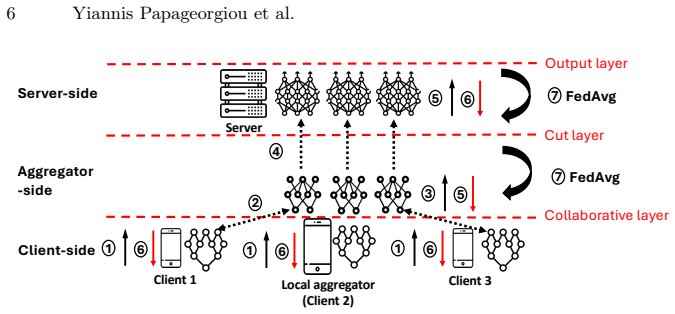
The central object is the split of the deep network into three parts at two named layers: the collaborative layer h and the cut layer v. The mechanism that carries the argument is local-loss parallel training: a small auxiliary network above the aggregator-side model computes the local loss at the cut layer, so weak clients can perform backward propagation without waiting for server gradients, while the local aggregator runs forward and backward propagation on the aggregator-side models and aggregates them per epoch in parallel with the server's update and aggregation. This per-epoch aggregator-side aggregation is what the paper credits for the accuracy gain, and the single aggregated model per aggregator is what cuts communication overhead.
What would settle it
Run C-SFL on a testbed or simulator with 100 clients, 10 local aggregators, and the same MNIST, FMNIST, and CIFAR-10 settings, measure the actual per-round delay and the optimal layers by grid search on measured times, and compare with the values predicted by Eqs. (1)–(5); if the predicted round delays deviate by more than the margins shown in the paper, or if the measured optimal layers differ from the model-selected ones, the paper's delay-gain claim is falsified.
Extended reading notes
Core claim
The paper's central claim is that inserting a tier of local aggregators between weak clients and the server yields all three benefits at once: lower training delay, lower communication, and higher accuracy. In C-SFL, each weak client trains only layers $1 \ldots h$, its assigned local aggregator trains layers $h \ldots v$ for that client and aggregates those aggregator-side models every local epoch, and the server trains layers $v \ldots V$. Because the aggregator-side model is aggregated per epoch rather than per round, the paper argues, accuracy improves over LocSplitFed without the extra communication that frequent client-side aggregation normally costs; and because each aggregator sends one aggregate model to the server, communication drops by roughly a factor of the number of clients per aggregator. Reported accuracies on MNIST, FMNIST, and CIFAR-10 are consistently above both baselines, for example 92.83% versus 91.18% and 83.06% on IID MNIST, and 68.91% versus 66.71% and 65.7% on CIFAR-10.
Load-bearing premise
The load-bearing premise is that the delay formulas in Eqs. (1)–(5) accurately describe the real training pipeline, since those formulas select the collaborative and cut layers and produce the delay-axis comparisons; the paper gives no measurement-based validation and some equations contain notation slips, such as Eq. (2) mixing indices and using $p_n$ where the aggregator's speed is meant.
Editorial extensions
If this is right
- On MNIST, FMNIST, and CIFAR-10, C-SFL reports accuracy one to ten percentage points above SFL and LocSplitFed at matched training delays, under both IID and non-IID data splits.
- At a fixed communication budget, C-SFL reaches materially higher accuracy: about 69% versus 57% to 60% on CIFAR-10 at 0.60 TB, and about 90% versus 77% and 59% on MNIST at 0.06 TB.
- The gains are largest when client heterogeneity is high and transmission rates are low, and they shrink when all clients have equal computing speed and high-rate links.
- The optimal collaborative and cut layers shift with heterogeneity and transmission rate, indicating that the two split points are tunable system parameters rather than fixed architectural choices.
Reading between the lines
- A direct test of the delay model's realism would be to compare measured per-phase times on real hardware with Eqs. (1)–(5); if the measured optimal layers differ from the model-selected ones, the delay-axis gains would need revision, although the accuracy and communication comparisons may still hold.
- The per-epoch aggregation of the middle segment suggests a broader principle: aggregating a shallow shared representation more often can reduce gradient staleness without extra uplink cost, and the same idea could be tested in hierarchical federated learning with more than two intermediate tiers.
- The scheme exposes weak clients' activations at the collaborative layer to local aggregators, so a privacy analysis beyond 'raw data is not shared' would be needed before deployment in sensitive applications; this is not addressed in the paper.
- A testable scaling question is how accuracy, delay, and communication behave as the aggregator fraction and the number of clients per aggregator grow, since the paper fixes one configuration with lambda = 0.1 and equal group sizes.
Signed reviews
Editorial analysis
A structured set of objections, weighed in public.
Referee Report
Summary. The paper proposes Collaborative-Split Federated Learning (C-SFL), a hierarchical split federated learning scheme that partitions a model into three parts: layers up to a collaborative layer h trained at computationally weak clients, layers between h and a cut layer v trained at stronger 'local aggregator' clients, and the remaining layers trained at the server. The scheme trains and aggregates the aggregator-side and server-side models in parallel per epoch, with clients using a local loss at the cut layer to enable parallel backward propagation. The authors derive a delay model (Eqs. (1)-(5)) used both to select the optimal (h,v) by exhaustive search and to produce the x-axis of the delay-vs-accuracy plots, and they report higher accuracy than SFL and LocSplitFed at the same delay and communication overhead on MNIST, FMNIST, and CIFAR-10 under IID and non-IID data, along with a study of the effect of heterogeneity ratio and transmission rate.
Significance. If the reported gains hold, C-SFL is a meaningful contribution to heterogeneous federated learning: the idea of delegating a middle model segment to computationally strong clients and aggregating that segment per epoch is novel, and the claimed communication-overhead reduction by transmitting one aggregated model per aggregator is attractive. The paper also provides a clear system design, a well-motivated delay-based layer selection procedure, and a comparison with two relevant baselines on three datasets. The strengths are the explicit formulation of the (h,v) selection problem and the architectural novelty of parallel aggregator-side and server-side training and aggregation.
major comments (4)
- [Section 3.3, Eq. (2)] The aggregator-side FP delay term writes sum_{j in [h,v]} f_j * sum_{n in N} x_{k,n} / p_n, using the weak client's speed p_n (2 GHz in the experiments) instead of the local aggregator's speed p_k (16 GHz). With the reported heterogeneity ratio gamma = 8.5, this overstates the aggregator's computation time by a factor of 8, which can materially shift the exhaustive search for (h,v). Since the same incorrect term is used to compute the delay-axis values in Fig. 2 and Fig. 4, the central delay and same-delay accuracy claims are not yet established. Please correct the model and re-run the layer selection and experiments.
- [Section 3.3, Eqs. (2)-(3)] The delay model also contains indexing and variable errors: Eq. (2) mixes x_{k,n} and x_{n,k}, uses p_n where p_k is meant, and writes the activation transmission delay as a_h / r_{x_n,n} rather than a_h / r_{k,n} or similar; Eq. (3) has analogous problems, including a max over n and k that does not match the free variables in the inner sums. Because this model determines both the selected layers (Table 5) and the x-axis of the delay plots, the quantitative delay results are not reproducible as written. Please provide a corrected, consistent formulation.
- [Section 4.1 and Fig. 2] The delay model is never validated against measured per-phase delays on the actual hardware, and no delay model is specified for the SFL and LocSplitFed baselines. The same-delay accuracy comparison in Fig. 2 therefore rests on an unvalidated, model-based x-axis for all three schemes. Please either validate the model with wall-clock measurements of each phase or report the delay axes as computed, with the per-phase assumptions stated for each baseline.
- [Section 4.1 and Table 4] All accuracy results appear to come from a single run per configuration, with no error bars or statistical significance tests. Many of the claimed gains are small (e.g., 68.91% vs. 66.71% on CIFAR-10 IID, 83.2% vs. 81% on FMNIST IID), so a single run cannot support the assertion that C-SFL 'improves accuracy.' Please report results over multiple seeds with mean and standard deviation.
minor comments (5)
- [Section 3.2] The local-loss MLP used to compute the loss at the cut layer is not specified: no architecture, number of layers, hidden dimensions, or training procedure is given. Since this MLP is central to the parallel training mechanism, please provide its details or a reference to a specific implementation.
- [Section 3.3, Eq. (4)] Phase 3 describes uploads from clients and aggregators to the server, but Eq. (4) uses download rates r_{s,n} and r_{s,k} in the denominators. Please change these to the corresponding upload rates r_{n,s} and r_{k,s}.
- [Table 3] The C-SFL communication-overhead expression contains malformed notation: one sum is written as P_{j in {1..j}} a_j, which should be {1..h}, and the parentheses are unbalanced. Please fix the expression and verify the resulting formula against the described transmission phases.
- [Section 3.3, Eq. (5)] The definition of B is not given before Eq. (5); the text earlier mentions 'data of B batches' but does not formally introduce B as the number of local batches per epoch. Please introduce B explicitly in Section 3.1 or 3.2 and clarify that D1 and D2 are per-batch delays.
- [Throughout] There are numerous typos and formatting issues: 'commmunication' in the abstract, 'trainind' in Section 2.2, 'the the' in Section 1, 'CIF AR-10' in Table 4, 'Y es' in Table 1, and inconsistent notation for x_{n,k} vs. x_{k,n} across Section 3.1 and Section 3.3. Please proofread carefully.
Circularity Check
No significant circularity: accuracy and communication claims are empirically or analytically grounded, and no fitted input is renamed as a prediction.
full rationale
The paper's central accuracy claims are not circular: test accuracy is measured on MNIST, FMNIST, and CIFAR-10 test sets and compared against SFL and LocSplitFed using publicly available baseline code, with no accuracy-related parameters fitted to the target results. The (h, v) selection minimizes Dround from Eq. (5), a delay model derived from the stated pipeline; this is an optimization over an analytic model, not a fit of the accuracy outcome, so the accuracy comparison does not reduce to the selection criterion. The communication-overhead advantage is an explicit per-round bit count in Table 3, derived from the number of transmitted activations and aggregated models; it is an arithmetic consequence of the architecture rather than a renamed input. There are no author self-citations used as load-bearing justification, no imported uniqueness theorem, and no ansatz smuggled in via citation. The delay model in Eqs. (1)-(5) is unvalidated and contains apparent notation/index errors (e.g., the aggregator-side FP term in Eq. (2) uses p_n instead of p_k), and the baselines' delay model is not specified; these are correctness and reproducibility risks, not circular steps, because the delay curves are outputs of an assumed model rather than predictions that were constructed from the data they claim to explain. Therefore no claim in the paper reduces by construction to its own inputs, and the circularity score is 0.
Assumptions & free parameters
free parameters (1)
- λ, fraction of clients acting as local aggregators =
0.1
assumptions (3)
- domain assumption The delay model in Eqs. (1)-(5) accurately represents the duration of each training phase.
- domain assumption The local-loss MLP at the cut layer has negligible cost and does not distort learning.
- domain assumption FedAvg aggregation of weak-side and aggregator-side models is appropriate when models are trained for different numbers of local steps.
Cite this review
Pith. "Pith review of Collaborative Split Federated Learning with Parallel Training and Aggregation." pith.science (2026). https://pith.science/paper/W6FCC5I6
@misc{pith2026250415724,
  author       = {Pith},
  title        = {Pith review of: Collaborative Split Federated Learning with Parallel Training and Aggregation},
  year         = {2026},
  howpublished = {\url{https://pith.science/paper/W6FCC5I6}},
  note         = {Machine review of arXiv:2504.15724}
}
read the original abstract
Federated learning (FL) operates based on model exchanges between the server and the clients, and it suffers from significant client-side computation and communication burden. Split federated learning (SFL) arises a promising solution by splitting the model into two parts, that are trained sequentially: the clients train the first part of the model (client-side model) and transmit it to the server that trains the second (server-side model). Existing SFL schemes though still exhibit long training delays and significant communication overhead, especially when clients of different computing capability participate. Thus, we propose Collaborative-Split Federated Learning~(C-SFL), a novel scheme that splits the model into three parts, namely the model parts trained at the computationally weak clients, the ones trained at the computationally strong clients, and the ones at the server. Unlike existing works, C-SFL enables parallel training and aggregation of model's parts at the clients and at the server, resulting in reduced training delays and commmunication overhead while improving the model's accuracy. Experiments verify the multiple gains of C-SFL against the existing schemes.
Figures


Figures from the paper (1 more)

Reference graph
Works this paper leans on
-
[1]
Advances in Neural Information Processing Systems 35, 10572–10586 (2022)
Collins, L., Hassani, H., Mokhtari, A., Shakkottai, S.: Fedavg with fine tuning: Local updates lead to representation learning. Advances in Neural Information Processing Systems 35, 10572–10586 (2022)
work page 2022
-
[2]
IEEE Internet of Things Journal (2023)
Fu, L., Zhang, H., Gao, G., Zhang, M.: Client selection in federated learning: Principles, challenges, and opportunities. IEEE Internet of Things Journal (2023)
work page 2023
-
[3]
In: ICML 2021 workshop on federated learning for user privacy and data confidentiality
Han, D.J., Bhatti, H.I., Lee, J., Moon, J.: Accelerating federated learning with split learning on locally generated losses. In: ICML 2021 workshop on federated learning for user privacy and data confidentiality. ICML Board (2021)
work page 2021
-
[4]
IEEE Internet of Things Journal9(1), 1–24 (2021)
Imteaj, A., Thakker, U., Wang, S., Li, J., Amini, M.H.: A survey on federated learning for resource-constrained iot devices. IEEE Internet of Things Journal9(1), 1–24 (2021)
work page 2021
-
[5]
Jiang, Y., Wang, S., Valls, V., Ko, B.J., Lee, W.H., Leung, K.K., Tassiulas, L.: Model pruning enables efficient federated learning on edge devices. IEEE Transac- tions on Neural Networks and Learning Systems34(12), 10374–10386 (2022) 14 Yiannis Papageorgiou et al
work page 2022
-
[6]
In: 2023IEEE Wireless Communications and Networking Conference (WCNC)
Kim, M., DeRieux, A., Saad, W.: A bargaining game for personalized, energy effi- cientsplit learning over wireless networks. In: 2023IEEE Wireless Communications and Networking Conference (WCNC). pp. 1–6. IEEE (2023)
work page 2023
-
[7]
arXiv preprint arXiv:2403.13101 (2024)
Lin, Z., Qu, G., Wei, W., Chen, Cheng, X.: Adaptsfl: Adaptive split federated learning in resource-constrained edge networks. arXiv preprint arXiv:2403.13101 (2024)
arXiv 2024
-
[8]
IEEE Transactions on Mobile Computing (2024)
Lin,Z.,Zhu,G.,Deng,Y.,Chen,X.,Gao,Y.,Huang,K.,Fang,Y.:Efficientparallel split learning over resource-constrained wireless edge networks. IEEE Transactions on Mobile Computing (2024)
work page 2024
Show all 24 references
-
[9]
In: Artificial intelligence and statistics
McMahan, B., Moore, E., Ramage, D., Hampson, S., y Arcas, B.A.: Communication-efficient learning of deep networks from decentralized data. In: Artificial intelligence and statistics. pp. 1273–1282. PMLR (2017)
2017
-
[10]
In: International conference on machine learning
Nøkland, A., Eidnes, L.H.: Training neural networks with local error signals. In: International conference on machine learning. pp. 4839–4850. PMLR (2019)
2019
-
[11]
In: Proceedings of the ACM Web Conference 2022
Oh, S., Park, J., Vepakomma, P., Baek, S., Raskar, R., Bennis, M., Kim, S.L.: Locfedmix-sl: Localize, federate, and mix for improved scalability, convergence, and latency in split learning. In: Proceedings of the ACM Web Conference 2022. pp. 3347–3357 (2022)
2022
-
[12]
one6G, w.p.: 6g technology overview (2024)
2024
-
[13]
Computer Networks218, 109380 (2022)
Samikwa, E., Di Maio, A., Braun, T.: Ares: Adaptive resource-aware split learning for internet of things. Computer Networks218, 109380 (2022)
2022
-
[14]
arXiv preprint arXiv:2310.14579 (2023)
Shin, J., Ahn, J., Kang, H., Kang, J.: Fedsplitx: Federated split learn- ing for computationally-constrained heterogeneous clients. arXiv preprint arXiv:2310.14579 (2023)
2023 arXiv
-
[15]
In: Proceedings of the AAAI conference on artificial intelligence
Thapa, C., Arachchige, P.C.M., Camtepe, S., Sun, L.: Splitfed: When federated learning meets split learning. In: Proceedings of the AAAI conference on artificial intelligence. vol. 36, pp. 8485–8493 (2022)
2022
-
[16]
arXiv preprint arXiv:2402.00208 (2024)
Tirana, J., Lalis, S., Chatzopoulos, D.: Mp-sl: Multihop parallel split learning. arXiv preprint arXiv:2402.00208 (2024)
2024 arXiv
-
[17]
IEEE INFOCOM 2024-IEEE Conference on Computer Communications pp
Tirana, J., Tsigkari, D., Iosifidis, G., Chatzopoulos, D.: Workflow optimization for parallel split learning. IEEE INFOCOM 2024-IEEE Conference on Computer Communications pp. 1331–1340 (2024)
2024
-
[18]
arXiv preprint arXiv:1812.00564 (2018)
Vepakomma, P., Gupta, O., Swedish, T., Raskar, R.: Split learning for health: Distributed deep learning without sharing raw patient data. arXiv preprint arXiv:1812.00564 (2018)
2018 arXiv
-
[19]
IEEE Journal on Selected Areas in Com- munications 40(2), 626–640 (2021)
Wang, S., Zhang, X., Uchiyama, H., Matsuda, H.: Hivemind: Towards cellular native machine learning model splitting. IEEE Journal on Selected Areas in Com- munications 40(2), 626–640 (2021)
2021
-
[20]
Computer Networks 220, 109490 (2023)
Wang, Z., Xu, H., Xu, Y., Jiang, Z., Liu, J.: Coopfl: Accelerating federated learning with dnn partitioning and offloading in heterogeneous edge computing. Computer Networks 220, 109490 (2023)
2023
-
[21]
IEEE Journal on Selected Areas in Communications41(4), 1051–1066 (2023)
Wu, W., Li, M., Qu, K., Zhou, C., Shen, X., Zhuang, W., Li, X., Shi, W.: Split learning over wireless networks: Parallel design and resource management. IEEE Journal on Selected Areas in Communications41(4), 1051–1066 (2023)
2023
-
[22]
Computer Science Review50, 100595 (2023)
Xu, C., Qu, Y., Xiang, Y., Gao, L.: Asynchronous federated learning on heteroge- neous devices: A survey. Computer Science Review50, 100595 (2023)
2023
-
[23]
ACM Computing Surveys56(3), 1–44 (2023)
Ye, M., Fang, X., Du, B., Yuen, Dacheng: Heterogeneous federated learning: State- of-the-art and research challenges. ACM Computing Surveys56(3), 1–44 (2023)
2023
-
[24]
Knowledge-Based Systems 216, 106775 (2021)
Zhang, C., Xie, Y., Bai, H., Yu, B., Li, W., Gao, Y.: A survey on federated learning. Knowledge-Based Systems 216, 106775 (2021)
2021
Reviewed August 16, 2026 · model on record in the stance chip above.
Discussion (0). Continue with ORCID to comment.