REVIEW 4 major objections 5 minor 58 references
Nonlinear Schr\"odinger Equations for Bose-Einstein Condensates
T0 review · 4 major / 5 minor · reviewed 2026-08-14 · deepseek-v4-flash
Pith's one-line read The paper proves global well-posedness for the nonlinear Schrödinger equation with electromagnetic potentials in $L^2(\mathbb{R}^n)$, including the $L^2$-critical case for sufficiently small data.
desk verdict A plausible L^2 wellposedness result for magnetic NLS, but the proof leans on an under-specified imported Strichartz estimate and an unsupported uniformity claim; deserves refereeing, not desk rejection. read the letter →
The pith
A machine-rendered reading of the paper's core claim, the machinery that carries it, and where it could break.
The reading
What carries the argument
The load-bearing object is the maximal Strichartz space $S^0(I)$, defined as the intersection of $L^q_t L^r_x$ over all admissible pairs $(q,r)$, together with the Strichartz estimates for the propagator $e^{-itL}$ imported from [9, 58]. On a short interval $I$, the Duhamel formula defines a map $\Phi$ on a ball in $S^0$; the critical nonlinearity is controlled by the embedding $N^0(I)\supset L^{(2n+4)/n}(I\times\mathbb{R}^n)$ and the bound $\||u|^{4/n}u\|_{N^0}\le \|u\|_{S^0}^{(n+4)/n}$. The contraction constant is made $<1$ by choosing the $L^2$ norm small in the critical case, or the interval short in the subcritical case.
What would settle it
A concrete check would be to compute the constants $c_q$ and $c_{q,\tilde{q}}$ in (15)-(16) for a family of admissible potentials, such as positive quadratic $V$ combined with compactly supported magnetic fields of growing strength; if the constants blow up within the admissible class, the claimed threshold independent of $A$ and $V$ cannot hold, and any choice of $A,V$ satisfying Assumption 1 for which (15) or (16) fails would refute the theorem.
Extended reading notes
Core claim
Theorem 1 is the central claim: under Assumption 1, which requires smooth real $A,V$ with $V$ bounded below, $A$ sublinear, $V$ subquadratic, and the magnetic field $B=\nabla\wedge A$ decaying as $\langle x\rangle^{-1-\varepsilon}$, for $1\le p<1+4/n$ every $u_0\in L^2(\mathbb{R}^n)$ determines a unique solution $u\in C(\mathbb{R},L^2)\cap S^0_{\mathrm{loc}}$; for $p=1+4/n$ the same conclusion holds when $\|u_0\|_2$ is sufficiently small, with the smallness threshold depending only on $n$ and the coupling constant $\mu$. The solution map is Lipschitz from bounded balls of $L^2$ into $S^0$ on short uniform time intervals, and the $S^0$ norm grows at most linearly in time. This extends the earlier fractional-regularity theorem [58, Theorem 3.3] from $H^s$ down to $L^2$ data, so the Cauchy theory now starts at the natural mass-conservation space.
Load-bearing premise
The proof rests on the imported Strichartz estimates (15) and (16) for the propagator $e^{-itL}$ under Assumption 1, which are stated without proof; if these estimates fail for some admissible $A,V$, or if their constants depend on $A,V$ in a way that breaks the contraction argument, Theorem 1 collapses.
Editorial extensions
If this is right
- For the cubic Gross-Pitaevskii equation in one dimension, where $p=3$ lies below the $L^2$-critical exponent $1+4/n$, the theorem gives unconditional global well-posedness with square-integrable data in the presence of admissible electromagnetic potentials.
- In two dimensions the cubic equation is exactly $L^2$-critical, so the theorem yields global well-posedness whenever the initial $L^2$ norm is below the stated threshold.
- Because the flow is Lipschitz on bounded balls in $L^2$, the theorem provides a locally uniform Cauchy theory in the space that the mass conservation law controls exactly.
- Mass conservation upgrades the local fixed point to a global solution, so the critical-case smallness condition cannot be destroyed by time evolution.
Reading between the lines
- A natural test of the theorem's uniformity claim would be to compute the Strichartz constants in Lemma 1 for a family of admissible potentials; if they grow without bound, the stated independence of the smallness threshold from $A$ and $V$ would fail.
- The same $S^0$ fixed-point scheme could plausibly adapt to Hartree-type nonlocal nonlinearities or to NLS with weaker magnetic perturbations, since the proof uses only the Strichartz estimates and the size of the nonlinearity in $S^0$.
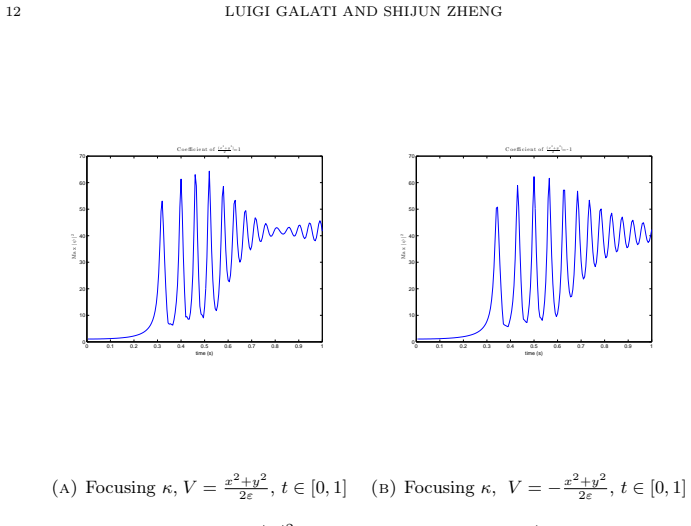
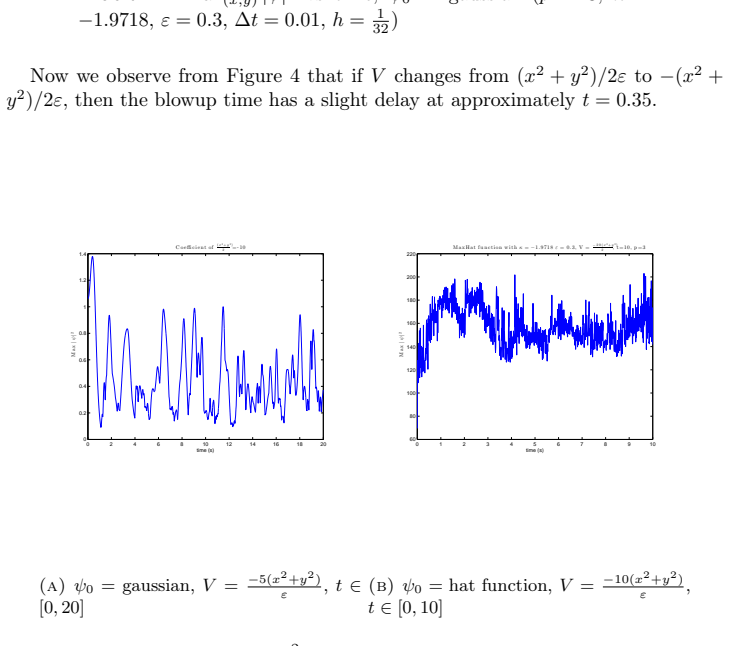
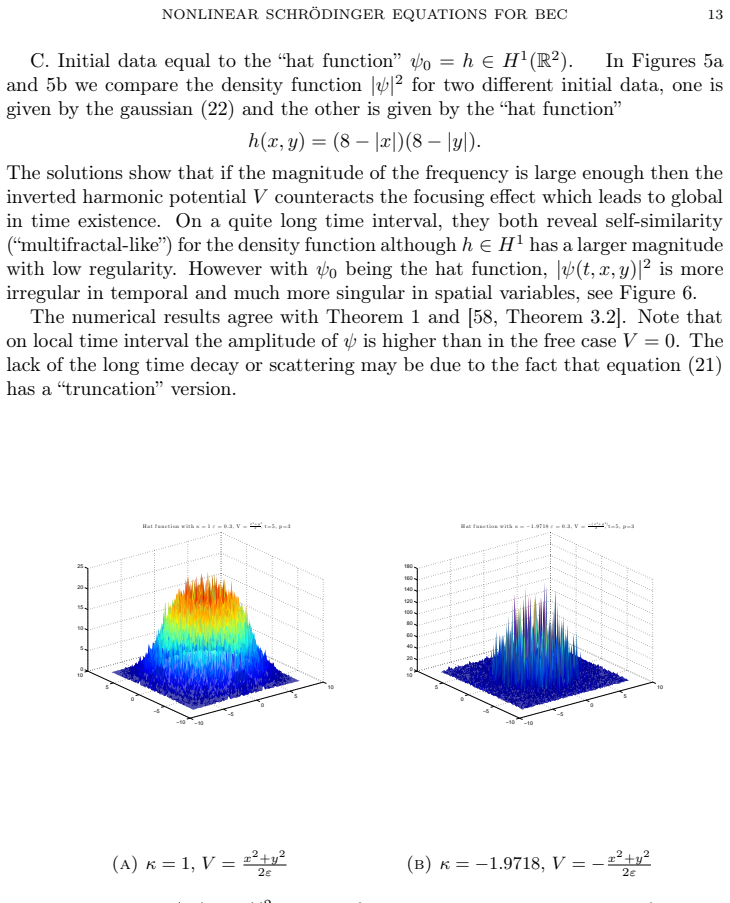
- The numerical observation of more singular behavior for rough initial data suggests that the $L^2$ well-posedness may not be uniformly continuous below $H^1$, a property that could be tested by looking for norm inflation in the focusing critical case.
Signed reviews
Editorial analysis
A structured set of objections, weighed in public.
Referee Report
Summary. The paper studies the Cauchy problem for the nonlinear Schrödinger equation with electromagnetic potentials, i∂t u = −(1/2)(∇−iA)²u + V u + μ|u|^{p−1}u, under Assumption 1 on the smoothness and growth of A and V. Theorem 1 asserts global-in-time well-posedness in L²: for 1 ≤ p < 1+4/n for arbitrary L² data, and for the L²-critical exponent p = 1+4/n for sufficiently small L² data, with a unique solution in C(R,L²) ∩ S⁰_loc and a Lipschitz flow on bounded balls. The proof follows the standard Duhamel/contraction-mapping strategy in the maximal Strichartz space S⁰, using Strichartz estimates for the propagator e^{−itL} that are quoted from [9,58] as Lemma 1. A short final section presents Strang-splitting numerical simulations for the 2D Gross–Pitaevskii equation with anisotropic quadratic potentials.
Significance. If Theorem 1 is correct, it provides a genuine extension of the classical L² theory for nonlinear Schrödinger equations to a class of variable-coefficient electromagnetic Schrödinger operators, and the use of the maximal Strichartz space S⁰ is a suitable framework for such a result. The paper correctly identifies the admissible pairs, uses mass conservation to pass from local to global existence, and the critical case follows the standard contraction argument. However, the central proof relies on an imported full-range Strichartz lemma whose endpoint case is not verified, contains a false embedding statement in the critical estimate, and leaves the subcritical contraction estimate almost entirely unproved. The uniformity claims about the smallness constant ε are not supported. The numerical section is exploratory and does not provide a rigorous convergence analysis. Overall the contribution is potentially useful but needs substantial substantiation before it can be accepted.
major comments (4)
- [§3, Lemma 1, Eqs. (15)–(16)] Lemma 1 states full-range Strichartz estimates for the propagator U(t)=e^{−itL}, including the endpoint pair (2, 2n/(n−2)) for n≥3, but the lemma is merely cited to [9,58] without a statement of the precise hypotheses under which those estimates are proved. Endpoint inhomogeneous Strichartz estimates are delicate for variable-coefficient magnetic Schrödinger operators, and the parametrix bounds from [54] used for (14) do not automatically imply them. If [9] or [58] prove only a non-endpoint range, then the identification of S⁰ with L∞L² ∩ L²L^{2n/(n−2)} and the N⁰ estimate (18) fail, and the contraction estimates in Section 3 collapse. The authors should either prove the needed estimates under Assumption 1 or state exactly which theorem in the cited papers covers the endpoint case.
- [§3, after Eq. (18), critical-case proof] The displayed inclusion 'N⁰(I) ⊃ ∪_{(q,r) admissible} L^q L^r' is false as written; for example, the admissible pair (∞,2) gives L∞L², which is not contained in N⁰(I). The correct statement is that N⁰(I) contains ∪ L^{q′}L^{r′} over admissible (q,r), or equivalently that L^{q′}L^{r′} ⊂ N⁰(I) for each admissible pair. With q=r=(2n+4)/n this yields the bound ‖|u|^{4/n}u‖_{N⁰} ≤ ‖|u|^{4/n}u‖_{L^{(2n+4)/n}′}, which is what the subsequent computation actually uses. The inequality is therefore correct under the dual inclusion, but the statement must be corrected.
- [§3, Proof of (1) in Theorem 1] The subcritical case is compressed into a single displayed estimate whose factors are not derived. In particular, the bound involving (4‖u₀‖₂)^{p−1} is not justified by the preceding equations: one cannot replace max(|u|,|v|) pointwise by a multiple of ‖u₀‖₂. The standard argument would estimate ‖ |u|^{p−1}u − |v|^{p−1}v ‖ in L^{q′}L^{r′} by a Hölder bound with a factor |I|^α and then use ‖u−v‖_{L^qL^r} ≤ ‖u−v‖_{S⁰}; the manuscript does not display these steps. The proof must be completed, including the precise dependence of T on ‖u₀‖₂ needed for the uniform Lipschitz statement on bounded balls.
- [§3, Theorem 1 and proof of (2)] Theorem 1 states that ε and c depend only on n, μ, and ‖u₀‖₂, with T₀ = T₀(A,V). However, in the proof ε is defined as ε = ηγ with η = (2c_n)^{−1}, where c_n comes from Lemma 2 and hence ultimately from the Strichartz constants in Lemma 1. No argument shows that c_n is independent of A and V (or that T₀ from [54] can be chosen so that the constants are universal). If the Strichartz constants do depend on the potentials, the claimed uniformity of ε is not established. The authors should either prove the independence or modify the theorem to allow ε and c to depend on A and V.
minor comments (5)
- [§1, Definition of H^{s,r}] The definition H^{s,r} = {u : ∇^s u ∈ L^r, ⟨x⟩^s u ∈ L^r} uses ∇^s without specifying fractional powers or a precise function-space norm; this should be clarified.
- [§3, Definition 2] The norm on N⁰(I) is defined only for n≥3 via the sum space L¹L² + L²L^{2n/(n+2)}; for n=2 the admissible pairs exclude (2,∞), so the definition should state how N⁰(I) is understood in two dimensions.
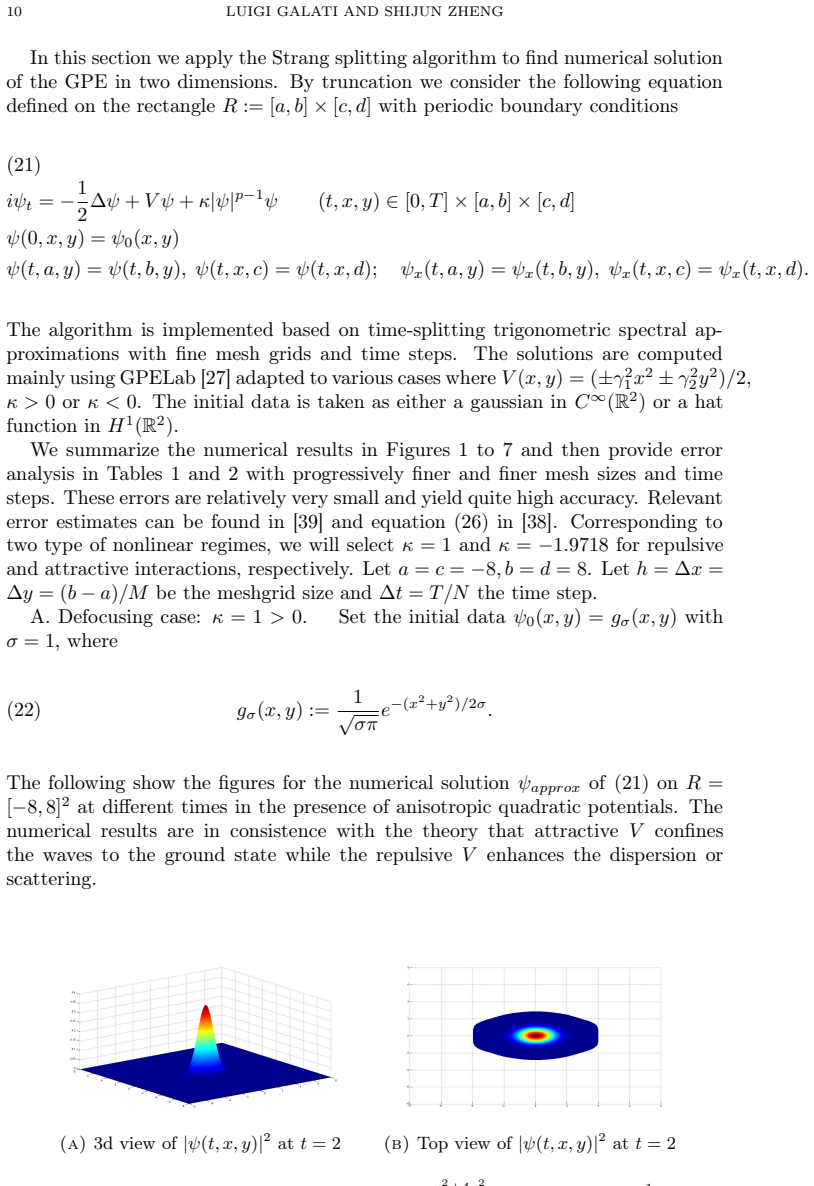
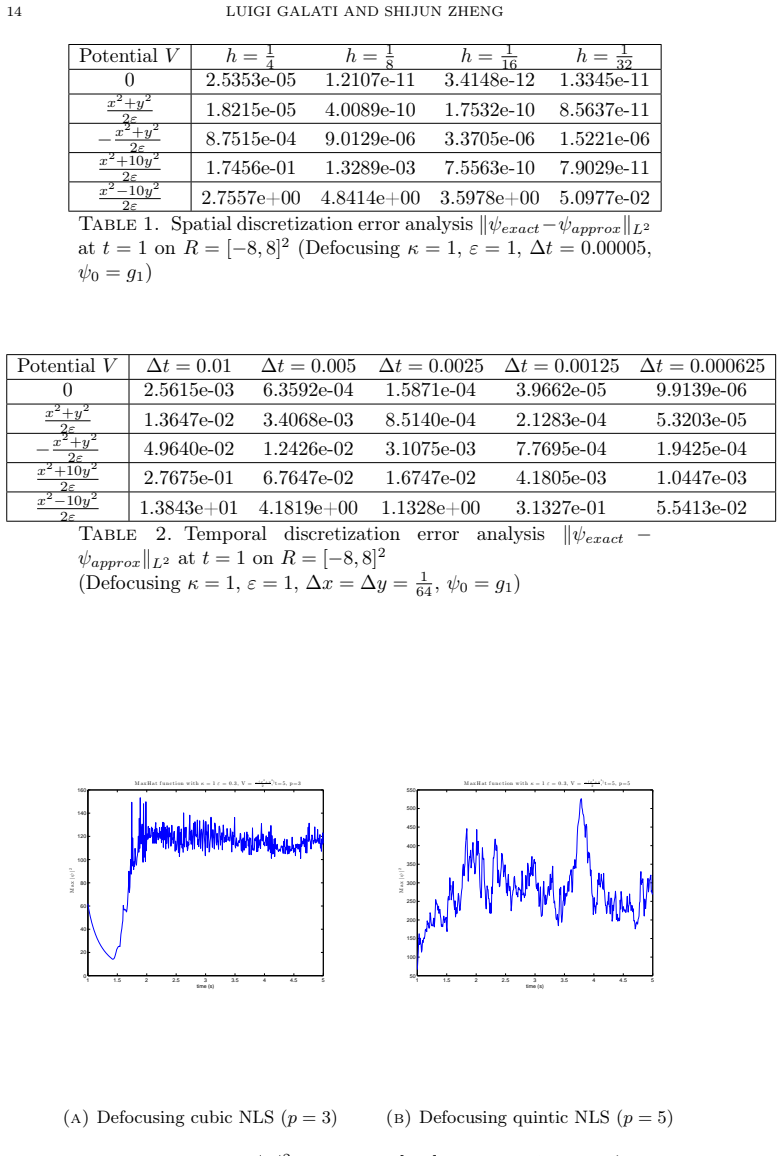
- [§4, Tables 1 and 2] The tables report errors against an 'exact solution' that is never identified; for the strongly anisotropic repulsive case (x²−10y²) the errors do not decrease monotonically as h is refined, so the numerical convergence claim should be stated more carefully.
- [Throughout] There are several typographical and grammatical errors, including 'Bose-Einsten' (p. 4), 'the GPE that decries' (p. 6), and 'ultra-cold temperature' (Abstract); these should be corrected.
- [§4] The numerical section does not provide the code or a complete description of the spectral discretization parameters; for reproducibility the authors should include the scheme or a reference to the exact implementation used.
Circularity Check
No significant circularity: the main theorem is a standard fixed-point argument using external Strichartz estimates, not a derivation that reduces to its own inputs.
full rationale
Theorem 1 is proved by a conventional contraction-mapping argument in the maximal Strichartz space S0. The two analytic inputs, Lemma 1 (homogeneous and inhomogeneous Strichartz estimates for e^{-itL}) and Lemma 2 (maximal Strichartz bound), are imported as external results from [9], [58], and [51]. These estimates concern the linear propagator under Assumption 1 and do not assume the conclusion of Theorem 1, namely global L2 wellposedness of the nonlinear equation. One of the cited sources, [58], is by an author of this paper, but the same lemma is also attributed to [9], an independent work, and the cited theorem is a previously published result about a different class of fractional-regularity wellposedness statements. Thus the self-citation is not load-bearing in a circular sense: the proof does not use [58] to assume the target result, but only as a source of linear estimates. The numerical section is illustrative and does not feed any fitted parameter back into the analytic proof. The only substantive concern is that the proof defines epsilon via constants c_n obtained from the Strichartz estimates and then asserts that epsilon and c depend only on n, mu, and ||u0||_2; the paper does not explicitly show that the Strichartz constants are independent of A and V. That is a uniformity or correctness gap, not a circular derivation, because it does not make the theorem's output identical to its input. Accordingly, no circular step is exhibited, and the honest finding is no significant circularity.
Assumptions & free parameters
assumptions (4)
- domain assumption Assumption 1: A and V are smooth, V bounded below, A sublinear, V subquadratic, and derivatives of the magnetic field B decay as <x>^{-1-epsilon}.
- standard math Lemma 1: Strichartz estimates (15) and (16) hold for the propagator e^{-itL} with L = -1/2 Delta_A + V under Assumption 1.
- standard math Lemma 2: The maximal Strichartz bound ||u||_{S0(I)} <= c_n(||u0||_2 + ||F||_{N0(I)}) holds for solutions of the inhomogeneous equation.
- standard math Conservation of L^2 mass, ||u(t)||_2 = ||u0||_2, holds on the lifespan of the solution.
Cite this review
Pith. "Pith review of Nonlinear Schr\"odinger Equations for Bose-Einstein Condensates." pith.science (2026). https://pith.science/paper/W6IVY3Z6
@misc{pith2026190801921,
  author       = {Pith},
  title        = {Pith review of: Nonlinear Schr\"odinger Equations for Bose-Einstein Condensates},
  year         = {2026},
  howpublished = {\url{https://pith.science/paper/W6IVY3Z6}},
  note         = {Machine review of arXiv:1908.01921}
}
abstract
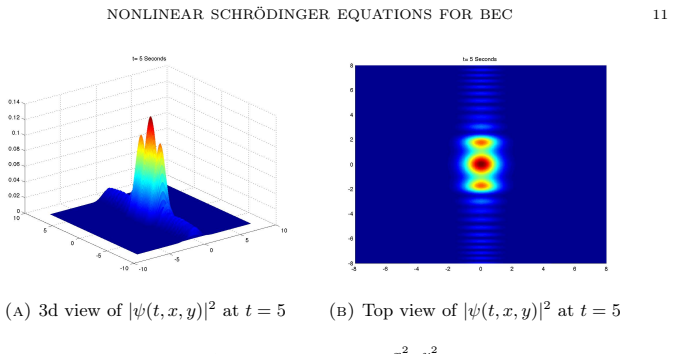
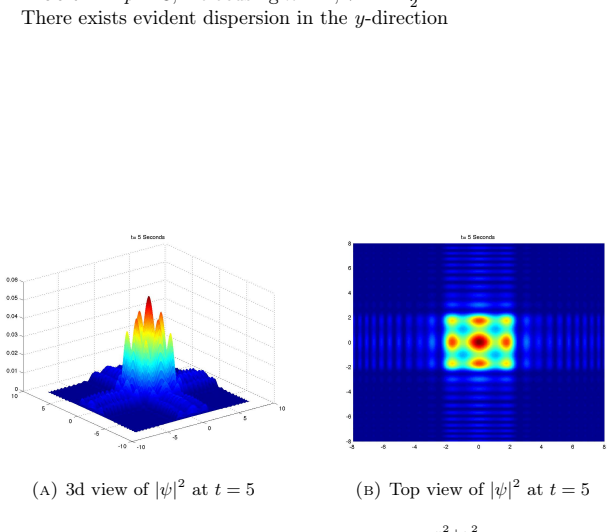
The Gross-Pitaevskii equation, or more generally the nonlinear Schr\"odinger equation, models the Bose-Einstein condensates in a macroscopic gaseous superfluid wave-matter state in ultra-cold temperature. We provide analytical study of the NLS with $L^2$ initial data in order to understand propagation of the defocusing and focusing waves for the BEC mechanism in the presence of electromagnetic fields. Numerical simulations are performed for the two-dimensional GPE with anisotropic quadratic potentials.
Figures
Figures from the paper (4 more)
Reference graph
Works this paper leans on
-
[54]
Yajima, Schrödinger evolution equations with magnetic fields.J
K. Yajima, Schrödinger evolution equations with magnetic fields.J. d’Analyse Math.56 (1991), 29–76
work page 1991
-
[9]
de Bouard, Nonlinear Schrödinger equations with magnetic fields.Diff
A. de Bouard, Nonlinear Schrödinger equations with magnetic fields.Diff. Integral Eq.4 (1991), no.1, 73–88
work page 1991
-
[58]
Zheng, Fractional regularity for nonlinear Schrödinger equations with magnetic fields
S. Zheng, Fractional regularity for nonlinear Schrödinger equations with magnetic fields. Contemp. Math. 581 (2012), 271–285. (LuigiGalatiandShijunZheng) Department of Mathematical Sciences, Georgia South- ern University, Statesboro, GA 30460-8093
work page 2012
-
[1]
A. Aftalion, and Q. Du. Vortices in a rotating Bose-Einstein condensate: Critical angular velocities and energy diagrams in the Thomas-Fermi regime.Phys. Rev. A64 (2001), 063603
work page 2001
-
[2]
M. Anderson, J. Ensher, M.R. Matthews, C.E. Wieman, and E. Cornell, Observation of Bose-Einstein condensation in a dilute atomic vapor.Science 269 (1995), no. 5221, 198–201
work page 1995
-
[3]
J. Anglin, and W. Ketterle, Bose-Einstein condensation of atomic gases.Nature 416 (2002), 211–218
work page 2002
-
[4]
P. Antonelli, D. Marahrens, and C. Sparber, On the Cauchy problem for nonlinear Schrödinger equations with rotation. Discr. Contin. Dyn. Syst.-Ser. A 32 (2012), no. 3, 703–715
work page 2012
-
[5]
Bao,The Nonlinear Schrödinger Equation, Superfluidity and Quantum Hydrodynamics
W. Bao,The Nonlinear Schrödinger Equation, Superfluidity and Quantum Hydrodynamics. Fudan Lecture Notes
Show all 58 references
-
[6]
W. Bao, S. Jin, and P. Markowich, On time-splitting spectral approximations for the Schrödinger equation in the semiclassical regime,J. Comput. Phys.175 (2002), no. 2, 487– 524. 16 LUIGI GALATI AND SHIJUN ZHENG
2002
-
[7]
Berlyand, and V
L. Berlyand, and V. Rybalko, Pinning by holes of multiple vortices in homogenization for Ginzburg-Landau problems. arXiv.math.AP, 2011
2011
-
[8]
S. N. Bose, Plancks Gesetz und Lichtquantenhypothese.Zeitschr. Phys. 26 (1924), 178–181 (German translation)
1924
-
[10]
Cai, and R, Li, Numerical regularized moment method of arbitrary order for Boltzmann- BGK equation.SIAM J
Z. Cai, and R, Li, Numerical regularized moment method of arbitrary order for Boltzmann- BGK equation.SIAM J. Sci. Comput.32 (2010), no. 5, 2875–2907
2010
-
[11]
Carles, Critical Nonlinear Schrödinger equations with and without harmonic potential
R. Carles, Critical Nonlinear Schrödinger equations with and without harmonic potential. Math. Models Methods Appl. Sci. 12 (2002), no. 10, 1513–1523
2002
-
[12]
Carles, Global existence results for nonlinear Schrödinger equations with quadratic poten- tials
R. Carles, Global existence results for nonlinear Schrödinger equations with quadratic poten- tials. Discr. Contin. Dyn. Syst. 13 (2005), no. 2, 385–398
2005
-
[13]
Cazenave,Semilinear Schrödinger Equations
T. Cazenave,Semilinear Schrödinger Equations. Courant Lecture Notes in Mathematics10, 2003
2003
-
[14]
Cazenave, and F
T. Cazenave, and F. Weissler. The Cauchy problem for the nonlinear Schrödinger equation in H 1. Manuscrip. Math. 61 (1988), 477–494
1988
-
[15]
Cazenave, and F
T. Cazenave, and F. Weissler. Some remarks on the nonlinear Schrödinger equation in the critical case. In Lect. Notes in Math., volume1394, pp. 18–29. Springer, Berlin, 1989
1989
-
[16]
Chang, and C.-S
S.-L. Chang, and C.-S. Chien, Adaptive continuation algorithms for computing energy levels of rotating Bose-Einstein condensates.Computer Physics Communications177 (2007) 707– 719
2007
-
[17]
Davis, M.-O
K. Davis, M.-O. Mewes, M. van Andrews, N. Van Druten, D. Durfee, D. Kurn, and W. Ketterle, Bose-einstein condensation in a gas of sodium atoms. Physical Review Lett. 75 (1995), no. 22, 3969–3973
1995
-
[18]
Edwards, M
M. Edwards, M. Krygier, H. Seddiqi, B. Benton, and C. Clark, Approximate mean-field equations of motion for quasi-two-dimensional Bose-Einstein-condensate systems.Physical Review E. 86 (2012), 056710
2012
-
[19]
Einkemmer, and A
L. Einkemmer, and A. Ostermann, Convergence analysis of a discontinuous Galerkin/Strang splitting approximation for the Vlasov–Poisson equations. arXiv.math.NA:1211.2353
-
[20]
Einstein, Quantentheorie des einatomigen idealen Gases.Sitzungsb
A. Einstein, Quantentheorie des einatomigen idealen Gases.Sitzungsb. Preuss. Akad. Wis- sensch. 22 (1924), 261–267
1924
-
[21]
Einstein, Quantentheorie des einatomigen idealen Gases 2.Sitzungsb
A. Einstein, Quantentheorie des einatomigen idealen Gases 2.Sitzungsb. Preuss. Akad. Wis- sensch. 8 (1925), 3–14
1925
-
[22]
Erdös, B
L. Erdös, B. Schlein, and H.-T. Yau, Derivation of the cubic non-linear Schrödinger equation from quantum dynamics of many-body systems.Invent. Math. 167 (2007), no. 3, 515–614
2007
-
[23]
Fanelli, Non-trapping magnetic fields and Morrey-Campanato estimates for Schrödinger operators
L. Fanelli, Non-trapping magnetic fields and Morrey-Campanato estimates for Schrödinger operators. J. Math. Anal. Appl. 357 (2009) 1–14
2009
-
[24]
Fröhlich, and E
J. Fröhlich, and E. Lenzmann, Mean-Field limit of quantum Bose gases and nonlinear Hartree equation.Semin. Equ. Deriv. Partielles(2004), Exp. no. XIX. Ecole Polytechnique Palaiseau
2004
-
[25]
Garcia, Magnetic virial identities and applications to blow-up for Schrödinger and wave equations
A. Garcia, Magnetic virial identities and applications to blow-up for Schrödinger and wave equations. J. Phys. A: Mathematical and Theoretical45 (2012), no. 1, 015202
2012
-
[26]
Ginsberg, J
N. Ginsberg, J. Brand, and L. Hau, Observation of hybrid soliton vortex-ring structures in Bose-Einstein condensates.Phys. Rev Lett. 94 (2005), no.4, 040403
2005
-
[27]
Antoine, and R
X. Antoine, and R. Duboscq,GPELab, web software. Université de Lorraine, Institut Elie Cartan de Lorraine
-
[28]
Grisouard, Quantum vortices in a glass of Bose-Einstein condensate
N. Grisouard, Quantum vortices in a glass of Bose-Einstein condensate. Preprint 2009
2009
-
[29]
Gross, Structure of a quantized vortex in boson systems Il.Nuovo Cimento 20 (1961), no.3, 454–457
E. Gross, Structure of a quantized vortex in boson systems Il.Nuovo Cimento 20 (1961), no.3, 454–457
1961
-
[30]
C.-C. Hao, L. Hsiao, and H.-L. Li, Global well-posedness for the Gross-Pitaevskii equation with an angular momentum rotational term.Math. Meth. Appl. Sci. 31 (2008), no. 6, 655– 664
2008
-
[31]
C.-C. Hao, L. Hsiao, and H.-L. Li, Global well-posedness for the Gross-Pitaevskii equation with an angular momentum rotational term in three dimensions.J. Math. Phys. 48 (2007), 102105
2007
-
[32]
D. Jin, J. Ensher, M. Matthews, C. Wieman, and E. Cornell, Collective excitations of a bose-einstein condensate in a dilute gas.Phys. Rev. Lett.77 (1996), no. 3, 420–423
1996
-
[33]
Kavian, and F
O. Kavian, and F. Weissler, Self-similar solutions of the pseudo-conformally invariant non- linear Schrödinger equation.Michigan Math. J. 41 (1994), no. 1, 151–173. NONLINEAR SCHRÖDINGER EQUATIONS FOR BEC 17
1994
-
[34]
Killip, M
R. Killip, M. Visan, and X. Zhang, The energy-critical nonlinear Schrödinger equation with quadratic potentials.Comm. P. D. E.34 (2009), no. 10-12, 1531–1565
2009
-
[35]
Lax, and B
P. Lax, and B. Wendroff, Difference schemes for hyperbolic equations with high order of accuracy.Comm. P.A.M. 17 (1964), no. 3, 381–398
1964
-
[36]
Li, and X
D. Li, and X. Zhang, Regularity of almost periodic modulo scaling solutions for mass-critical NLS and applications.Analysis and PDE3 (2010), no. 2, 175–195
2010
-
[37]
Liu, and E
H. Liu, and E. Tadmor, Rotation prevents finite-time breakdown.Phys. D 188 (2004), no. 3-4, 262–276
2004
-
[38]
Lu, and J
J. Lu, and J. Marzuola, Strang splitting methods applied to a quasilinear Schrödinger equa- tion. Preprint 2013
2013
-
[39]
Lubich, On splitting methods for Schrödinger-Poisson and cubic nonlinear Schrödinger equations
C. Lubich, On splitting methods for Schrödinger-Poisson and cubic nonlinear Schrödinger equations. Math. Comp. 77 (2008), no. 264, 2141–2153
2008
-
[40]
Matthews, B
M. Matthews, B. Anderson, P. Haljan, D. Hall, C. Wieman, and E. Cornell, Vortices in a Bose-Einstein condensate.Phys. Rev. Lett. 83 (1999), 2498–2501
1999
-
[41]
Michel, Remarks on non-linear Schrödinger equation with magnetic fields.Comm
L. Michel, Remarks on non-linear Schrödinger equation with magnetic fields.Comm. P. D. E. 33 (2008), 1198–1215
2008
-
[42]
Mueller, and T
E. Mueller, and T. Ho, Two-component Bose-Einstein condensates with a large number of vortices. Phys. Rev. Lett. 88 (2002), no.18, 180403
2002
-
[43]
Nakamura, Local solvability and smoothing effects of nonlinear Schrödinger equations with magnetic fields.Funkcial Ekvac
Y. Nakamura, Local solvability and smoothing effects of nonlinear Schrödinger equations with magnetic fields.Funkcial Ekvac. 44 (2001), 1–18
2001
-
[44]
Oh, Cauchy problem and Ehrenfest’s law of nonlinear Schrödinger equations with potentials
Y.-G. Oh, Cauchy problem and Ehrenfest’s law of nonlinear Schrödinger equations with potentials. J. Diff. Eq.81 (1989), no. 2, 255–274
1989
-
[45]
Ólafsson, and S
G. Ólafsson, and S. Zheng, Harmonic analysis related to Schrödinger operators.Contemp. Math. 464 (2008), 213–230
2008
-
[46]
Pitaevskii, Vortex lines in an imperfect Bose gas.Soviet
L. Pitaevskii, Vortex lines in an imperfect Bose gas.Soviet. Phys. JETP 13 (1961), no. 2, 451–454
1961
-
[47]
Ruprecht, M
P. Ruprecht, M. Holland, K. Burnett, and M. Edwards, Time-dependent solution of the nonlinear Schrödinger equation for bose-condensed trapped neutral atoms.Phys. Rev. A51 (1995), no. 6, 4704
1995
-
[48]
Rybin, G
A. Rybin, G. Varzugin, M. Lindberg, J. Timonen, and R. Bullough. Similarity solutions and collapse in the attractive Gross-Pitaevskii equation.Phys. Rev. E62 (2000), no.3, 6224–6228
2000
-
[49]
Squassina, Soliton dynamics for the nonlinear Schrödinger equation with magnetic field
M. Squassina, Soliton dynamics for the nonlinear Schrödinger equation with magnetic field. Manuscrip. Math. 130 (2009), 461–494
2009
-
[50]
Strang, On the construction and comparison of difference schemes.SIAM J
G. Strang, On the construction and comparison of difference schemes.SIAM J. Num. Anal. 5 (1968), no. 3, 506–517
1968
-
[51]
Tao,Nonlinear Dispersive Equations: Local and global analysis
T. Tao,Nonlinear Dispersive Equations: Local and global analysis. CBMS Regional Confer- ence Series in Mathematics106, 2006
2006
-
[52]
Tsutsumi,L2-solutions for nonlinear Schrödinger equations and nonlinear groups.Funkcial Ekvac
Y. Tsutsumi,L2-solutions for nonlinear Schrödinger equations and nonlinear groups.Funkcial Ekvac. 30 (1987), 115–125
1987
-
[53]
Wadati, and T
M. Wadati, and T. Tsurumi, Critical number of atoms for the magnetically trapped Bose- Einstein condensate with negatives-wave scattering length.Phys. Lett. A247 (1998) 287– 293
1998
-
[55]
Zhang, Global wellposedness and scattering for 3D energy critical Schrödinger equation with repulsive potential and radial data.Forum Math
X. Zhang, Global wellposedness and scattering for 3D energy critical Schrödinger equation with repulsive potential and radial data.Forum Math. 19 (2007), 633–675
2007
-
[56]
Zhang, and S
Z. Zhang, and S. Zheng, Strichartz estimates and local wellposedness for Schrödinger equation with the twisted sub-Laplacian. Proc. C. M. A. 44 (2010), 233–243, Australian National University
2010
-
[57]
Zheng, Spectral multipliers for Schrödinger operators.Illinois J
S. Zheng, Spectral multipliers for Schrödinger operators.Illinois J. Math. 54 (2010), no. 2, 621–647
2010
Reviewed August 14, 2026 · model on record in the stance chip above.
Discussion (0). Continue with ORCID to comment.