REVIEW 4 major objections 5 minor 1 cited by
RTFAST-Spectra: Emulation of X-ray reverberation mapping for active galactic nuclei
T0 review · 4 major / 5 minor · reviewed 2026-08-11 · deepseek-v4-flash
Pith's one-line read A neural network emulates the RTDIST X-ray model to ~1% accuracy at 200x speed
desk verdict Useful first emulator for RTDIST with genuinely honest caveats, but the 'drop-in replacement' and 'O(1%) precision' claims are stronger than the tests support; worth sending to a serious referee after revision. read the letter →
The pith
A machine-rendered reading of the paper's core claim, the machinery that carries it, and where it could break.
The reading
What carries the argument
Principal Component Analysis reduces the 2017 energy bins of each log-scaled, standardized spectrum to 200 principal components that preserve correlations between continuum and atomic lines; a 12-layer, 256-node feed-forward network with GELU activations learns the mapping from the 17 RTDIST parameters to these components, trained with a variance-weighted mean-squared-error loss and averaged over a 7-network ensemble. The six physical constraints of Section 3.1.2 shrink the training space to about 1% of the raw parameter volume, which is what makes the accuracy achievable.
What would settle it
Fit a simulated XMM-Newton observation generated from RTDIST with parameters at the edge of the Section 3.1.2 box (coronal height 100 Rg, spin 0.998, electron density $10^{19}$.5 $cm^{-3}$) using RTFAST and the authors' MCMC settings; if the true spin and density fall outside the 3-$\sigma$ posterior, as they do in the paper's central Ark-564-like fit, then the O(1%) spectral precision does not translate into unbiased parameter inference in the regime the emulator was designed for.
Extended reading notes
Core claim
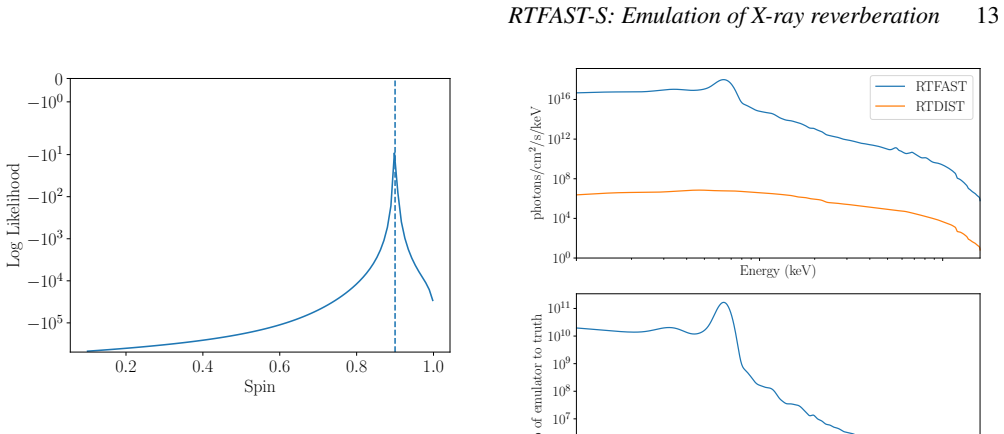
The central claim is that RTFAST-Spectra is a drop-in replacement for the spectral part of RTDIST for AGN: for parameters inside the constrained training box, it reproduces RTDIST's 0.1-20 keV spectra with fractional errors mostly within the 3% systematic calibration limit of XMM-Newton, with a typical O(1%) error and no systematic bias after averaging seven networks. The speed gain is O($10^{2}$) per sequential call and O($10^{4}$) for vectorised batches, so the authors demonstrate an MCMC posterior recovery on simulated XMM-Newton data that would have taken a month and instead runs in hours. They also show that the emulator captures the expected parameter behaviour (steepening continuum with photon index, the relativistically smeared Fe K complex) and that it fails catastrophically outside the training box, which is why users must enforce the Section 3.1.2 constraints.
Load-bearing premise
The central premise is that the six physical constraints in Section 3.1.2 define a box large enough to contain every active galactic nucleus of interest, and that every user will stay inside that box; if a real source falls outside it—say a retrograde spin or a softer-than-allowed soft excess—RTFAST will silently return nonsense while looking like a valid spectrum.
Editorial extensions
If this is right
- A full MCMC fit to one AGN spectrum drops from weeks to hours, because RTFAST evaluates a spectrum in ~1.6 ms versus ~0.32 s for RTDIST, and batched evaluations are ~8000x faster.
- Bayesian users can now map degeneracies such as the distance-mass-ionisation correlation and the height-spin banana with full posteriors rather than point estimates.
- The differentiable emulator makes gradient-based samplers (HMC) and simulation-based inference practical for RTDIST, not just random-walk MCMC.
- Every RTFAST fit must stay inside the Section 3.1.2 constraints; outside them the emulator silently returns unphysical spectra, so results outside the box should always be rechecked with RTDIST.
- The paper recommends validating any RTFAST posterior by re-evaluating draws with the original RTDIST, a hybrid approach that keeps most of the speed gain while catching emulator bias.
Reading between the lines
- Beyond the paper: if the bias is concentrated in the soft excess as the Ark 564 fit suggests, restricting RTFAST fits to 1-10 keV should remove most of the spin and density bias; this is testable with the authors' own simulated data.
- Beyond the paper: the PCA-plus-ensemble recipe is modular, so emulating the reflection spectrum alone or the relativistic illumination profile would cut error by roughly an order of magnitude and make the emulator's accuracy comparable to XRISM resolution.
- Beyond the paper: the six-constraint box acts as a hard prior; a survey of AGN with retrograde spins, extreme densities, or unusual fluxes would show how often real targets fall outside the box, and retraining with relaxed bounds is the straightforward remedy.
- Beyond the paper: the differentiable emulator enables gradient-based inference and simulation-based calibration, which could make hierarchical multi-source fits for the Hubble constant computationally feasible, a goal the authors cite as motivation.
Signed reviews
Editorial analysis
A structured set of objections, weighed in public.
Referee Report
Summary. The manuscript presents RTFAST-Spectra, a neural-network emulator for the spectral component of the RTDIST X-ray reverberation model. The authors train an ensemble of seven feed-forward networks on 1.1e7 RTDIST spectra with 17 free parameters, using PCA to reduce the output to 200 components. They report an O(10^2) speed-up, claim O(1%) precision, and demonstrate MCMC posterior recovery on a simulated XMM-Newton observation. The paper also discusses parameter-space constraints, data generation, preprocessing, network architecture, and robustness tests.
Significance. If the claimed precision were established, this would be a valuable tool: it would make full Bayesian posterior inference for a state-of-the-art relativistic reflection model practical for the first time, with applications to AGN spin and distance measurements. The authors provide a large public training set, open-source code, and a reproducible benchmark pipeline. The ensemble methodology and physical constraints are sensible. However, the current evidence does not fully support the central 'drop-in replacement with O(1%) precision' claim: the residual metric is not in physical flux units, only 71% of bins meet the looser 3% criterion, and the single recovery test shows >3-sigma biases in spin and density. The paper's own Section 5.1 advises checking against RTDIST, which qualifies the drop-in promise. These issues are addressable with additional validation and a revised framing.
major comments (4)
- [Section 3.1.4, Eq. (1)] The residual metric chi_i is defined in the standardized log-flux space after steps (ii)-(iii) of Section 3.1.3, so a value of 0.01 does not correspond to a 1% error in physical flux. Throughout the paper (e.g., Figs. 7, 8, 10, 11 and the Abstract), these residuals are quoted as 'percentage' errors and compared to the 3% XMM-Newton effective-area systematic. This conflates two different quantities. The paper should report residuals in physical flux units (after inverting the log and standardization) for the headline precision claim, and state the actual physical-flux percentile ranges.
- [Section 4.3 and Fig. 10] The paper states that over 71% of individual energy bins satisfy the 3% criterion and that worst-case residuals extend to 15%, yet the Abstract claims O(1%) precision over all 17 free parameters. A 71% pass rate at 3% is not a 1% precision claim, and the 15% worst case is an order of magnitude above the stated precision. The authors should either revise the central claim to match the actual distribution or provide a stronger justification, e.g., showing that the high-residual bins are masked by typical backgrounds or detector responses in the intended use cases.
- [Section 4.4, Table 3 and Fig. 12] In the simulated recovery test, the true spin a=0.9 is recovered as 0.64+0.05-0.06 and the true logNe=17 as 16.41+0.08-0.07, placing the truth outside the 3-sigma posterior intervals. The authors argue this is an upper limit because the chosen parameters are in the worst 5% of emulator performance, but no systematic mapping between spectral residuals and posterior bias is provided. This single example does not establish that the bias is confined to a small, identifiable region of parameter space, and it directly undermines the claim that RTFAST is a drop-in replacement for Bayesian inference. A systematic injection-recovery study across the training box is needed, together with a diagnostic for detecting when the emulator bias is likely to dominate.
- [Section 5.1] The recommendation that users 'should always check the fitted model and plot posterior draws from the original RTDIST' is in tension with the Abstract's claim that RTFAST is a 'drop in replacement' for RTDIST. If final verification with the original model is required, the emulator is better described as an accelerator for exploratory fitting and chain initialization, not a drop-in replacement. The authors should clarify the intended workflow and adjust the central claim accordingly.
minor comments (5)
- [Figure 5 and Section 3.2.1] The text says the best network has 8 fully connected layers with 256 nodes, while the figure caption states 12 hidden layers, an input layer of 20 nodes, and an output layer of 40 nodes; the text also says the input has 17 parameters and the output 200 PCA components. Please reconcile these descriptions.
- [Section 3.2.1] There is a typo: 'Rectified error Linear Unit' should be 'Rectified Linear Unit'.
- [Section 5.1] The phrase 'full full Bayesian' contains a duplicate 'full'; please remove it.
- [Figure 10 caption] The caption reads 'Black indicates an error above%.' The threshold number is missing; please insert the numerical value.
- [Table 2] The prior for distance is labeled 'logU(3.5, 500)' and then described with units '105 kpc', which is confusing; please state the unit explicitly in the prior column or in a footnote.
Circularity Check
RTFAST is a surrogate fit benchmarked against its own target model; the recovery test is a closure test, not a prediction, so no fitted input is disguised as a prediction.
full rationale
The paper's derivation chain is: use RTDIST to generate 1.1e7 spectra under physically constrained priors; apply log-scaling, standardization, and PCA to 200 components; train a feed-forward neural network ensemble; compare the reconstructed output against RTDIST on a held-out 1000-spectrum test set using Eq. 1; and run an MCMC closure fit to a simulated XMM-Newton observation. Every validation step compares RTFAST output directly to RTDIST output for parameter sets not used in training. This is exactly the correct external benchmark for a surrogate model: the surrogate is supposed to reproduce the target code, and held-out test residuals measure generalization, not circularity. The Sec. 4.4 'Recovering parameters' test is a closure test: the simulated data are generated from RTDIST, and the aim is to see whether RTFAST recovers the known inputs, not to claim a new physical prediction. The paper explicitly reports that the truth falls outside the 3-sigma posterior bounds for spin and logNe in this particular case, which is evidence of imperfection rather than of circularity. The load-bearing claims (O(1%) precision, 200x speedup) are measured against RTDIST and wall-clock time, not against any prior model parameters. No self-citation is load-bearing for the core emulation claim; in particular, the paper does not invoke a uniqueness theorem to forbid alternatives. The constrained parameter box of Section 3.1.2 is a modeling choice, not a result derived from RTFAST output. Therefore no step reduces by construction to its own inputs, and the appropriate circularity score is 0.
Assumptions & free parameters
free parameters (5)
- PCA component count K =
200
- Flux floor =
1e-11 photons/cm2/s/keV
- Loss weighting constant =
1
- Ensemble size =
7
- NN hyperparameters (architecture, learning rate, batch size) =
8 or 12 hidden layers, 256 nodes, GELU; LR 1e-4; batch 1024
assumptions (5)
- domain assumption RTDIST output is the ground truth for the spectra being emulated
- domain assumption The six physical restrictions in Section 3.1.2 define the only parameter region relevant for AGN fitting
- domain assumption Prograde black hole spin only
- ad hoc to paper 200 PCA components plus 0.1% reconstruction threshold preserves all scientifically relevant spectral features
- standard math Universal approximation theorem and standard PCA decomposition
Cite this review
Pith. "Pith review of RTFAST-Spectra: Emulation of X-ray reverberation mapping for active galactic nuclei." pith.science (2026). https://pith.science/paper/W7QXFXXT
@misc{pith2026241210131,
  author       = {Pith},
  title        = {Pith review of: RTFAST-Spectra: Emulation of X-ray reverberation mapping for active galactic nuclei},
  year         = {2026},
  howpublished = {\url{https://pith.science/paper/W7QXFXXT}},
  note         = {Machine review of arXiv:2412.10131}
}
abstract
Bayesian analysis has begun to be more widely adopted in X-ray spectroscopy, but it has largely been constrained to relatively simple physical models due to limitations in X-ray modelling software and computation time. As a result, Bayesian analysis of numerical models with high physics complexity have remained out of reach. This is a challenge, for example when modelling the X-ray emission of accreting black hole X-ray binaries, where the slow model computations severely limit explorations of parameter space and may bias the inference of astrophysical parameters. Here, we present RTFAST-Spectra: a neural network emulator that acts as a drop in replacement for the spectral portion of the black hole X-ray reverberation model RTDIST. This is the first emulator for the reltrans model suite and the first emulator for a state-of-the-art x-ray reflection model incorporating relativistic effects with 17 physically meaningful model parameters. We use Principal Component Analysis to create a light-weight neural network that is able to preserve correlations between complex atomic lines and simple continuum, enabling consistent modelling of key parameters of scientific interest. We achieve a $\mathcal{O}(10^2)$ times speed up over the original model in the most conservative conditions with $\mathcal{O}(1\%)$ precision over all 17 free parameters in the original numerical model, taking full posterior fits from months to hours. We employ Markov Chain Monte Carlo sampling to show how we can better explore the posteriors of model parameters in simulated data and discuss the complexities in interpreting the model when fitting real data.
Figures


Figures from the paper (11 more)




Forward citations
Cited by 1 Pith paper
-
Emulation of non-linear 1D spectral models: relativistic X-ray reflection
A modular operator-learning emulator (RTFAST2) reproduces the relativistically convolved reflection spectrum of reltrans to O(0.1)% precision with 4–10× speed-up and unbiased posterior recovery on simulated spectra.
Reference graph
Works this paper leans on
-
[1]
Alsing J., et al., 2020, The Astrophysical Journal Supplement Series, 249, 5
work page 2020
-
[2]
Arnaud K., 1996, in Astronomical Data Analysis Software and Systems V, ASP Conference Series, Vol. 101, 1996, George H. Jacoby and Jeannette Barnes, eds., p. 17.. p. 17
work page 1996
- [3]
-
[4]
S., O’hagan A., 2009, Technometrics, 51, 425
Bastos L. S., O’hagan A., 2009, Technometrics, 51, 425
work page 2009
-
[5]
Bellman R., 1966, science, 153, 34
work page 1966
-
[6]
Bird S., Rogers K. K., Peiris H. V., Verde L., Font-Ribera A., Pontzen A., 2019, Journal of Cosmology and Astroparticle Physics, 2019, 050
work page 2019
- [7]
-
[8]
Buchner J., 2023, Statistic Surveys, 17, 169
work page 2023
Show all 80 references
-
[9]
Buchner J., et al., 2014, Astronomy & Astrophysics, 564, A125
2014
-
[10]
G., Dow E., Wang Q., 2014, SIAM Journal on Scientific Computing, 36, A1500
Constantine P. G., Dow E., Wang Q., 2014, SIAM Journal on Scientific Computing, 36, A1500
2014
-
[11]
Cranmer K., Brehmer J., Louppe G., 2020, Proceedings of the National Academy of Sciences, 117, 30055
2020
-
[12]
T., Bardeen J
Cunningham C. T., Bardeen J. M., 1973, Astrophysical Journal, Vol. 183, pp. 237-264 (1973), 183, 237
1973
-
[13]
W., Falanga M., Fukumura K., Reynolds C
Dauser T., Garcia J., Wilms J., B \"o ck M., Brenneman L. W., Falanga M., Fukumura K., Reynolds C. S., 2013, Monthly Notices of the Royal Astronomical Society, 430, 1694
2013
-
[14]
Dauser T., Garc \' a J., Wilms J., 2016, Astronomische Nachrichten, 337, 362
2016
-
[15]
D., Vaughan S., Lefkir M., Wynn G., 2024, Monthly Notices of the Royal Astronomical Society, 529, 1752
Dias S. D., Vaughan S., Lefkir M., Wynn G., 2024, Monthly Notices of the Royal Astronomical Society, 529, 1752
2024
-
[16]
A., Steiner J
Dong Y., Garc \' a J. A., Steiner J. F., Gou L., 2020, Monthly Notices of the Royal Astronomical Society, 493, 4409
2020
-
[17]
Dov c iak M., Karas V., Yaqoob T., 2004, @doi [ ] 10.1086/421115 , https://ui.adsabs.harvard.edu/abs/2004ApJS..153..205D 153, 205
2004 doi
-
[18]
A., Miller J
Draghis P. A., Miller J. M., Costantini E., Gallo L. C., Reynolds M., Tomsick J. A., Zoghbi A., 2024, @doi [ ] 10.3847/1538-4357/ad43ea , https://ui.adsabs.harvard.edu/abs/2024ApJ...969...40D 969, 40
2024 doi
-
[19]
J., Roweth D., 1987, @doi [Physics Letters B] https://doi.org/10.1016/0370-2693(87)91197-X , 195, 216
Duane S., Kennedy A., Pendleton B. J., Roweth D., 1987, @doi [Physics Letters B] https://doi.org/10.1016/0370-2693(87)91197-X , 195, 216
1987 doi
-
[20]
Ducoffe M., Precioso F., 2015, arXiv preprint arXiv:1511.06412
2015 arXiv
-
[21]
Fabian A., 1989, Monthly Notices of the Royal Astronomical Society, 238, 41P
1989
-
[22]
C., Rees M
Fabian A. C., Rees M. J., Stella L., White N. E., 1989, @doi [ ] 10.1093/mnras/238.3.729 , http://adsabs.harvard.edu/abs/1989MNRAS.238..729F 238, 729
1989 doi
-
[23]
W., Lang D., Goodman J., 2013, Publications of the Astronomical Society of the Pacific, 125, 306
Foreman-Mackey D., Hogg D. W., Lang D., Goodman J., 2013, Publications of the Astronomical Society of the Pacific, 125, 306
2013
-
[24]
L., 2021, The Astrophysical Journal, 919, 16
Freedman W. L., 2021, The Astrophysical Journal, 919, 16
2021
-
[25]
pp 76--87
Freeman P., Doe S., Siemiginowska A., 2001, in Astronomical Data Analysis. pp 76--87
2001
-
[26]
A., Hu M., Malik A
Ganaie M. A., Hu M., Malik A. K., Tanveer M., Suganthan P. N., 2022, Engineering Applications of Artificial Intelligence, 115, 105151
2022
-
[27]
Garc \' a J., Dauser T., Reynolds C., Kallman T., McClintock J., Wilms J., Eikmann W., 2013, The Astrophysical Journal, 768, 146
2013
-
[28]
A., et al., 2018, The Astrophysical Journal, 864, 25
Garc \' a J. A., et al., 2018, The Astrophysical Journal, 864, 25
2018
-
[29]
C., Arzoumanian Z., Okajima T., 2012, in Space Telescopes and Instrumentation 2012: Ultraviolet to Gamma Ray
Gendreau K. C., Arzoumanian Z., Okajima T., 2012, in Space Telescopes and Instrumentation 2012: Ultraviolet to Gamma Ray. pp 322--329
2012
-
[30]
Girolami M., Calderhead B., 2011, Journal of the Royal Statistical Society Series B: Statistical Methodology, 73, 123
2011
-
[31]
XMM-SOCCAL-TN-0018, Calibration status document, ESA-ESAC, Villafranca del …
Guainazzi M., Kirsch M., Haberl F., de Juan Ovelar M., 2013, Technical report, XMM-Newton Calibration Technical Note. XMM-SOCCAL-TN-0018, Calibration status document, ESA-ESAC, Villafranca del …
2013
-
[32]
J., Lawrence E., Wagner C., 2009, The Astrophysical Journal, 705, 156
Heitmann K., Higdon D., White M., Habib S., Williams B. J., Lawrence E., Wagner C., 2009, The Astrophysical Journal, 705, 156
2009
-
[33]
Heitmann K., Lawrence E., Kwan J., Habib S., Higdon D., 2013, The Astrophysical Journal, 780, 111
2013
-
[34]
Hendrycks D., Gimpel K., 2016, arXiv preprint arXiv:1606.08415
2016 arXiv
-
[35]
D., et al., 2022, The Planetary Science Journal, 3, 91
Himes M. D., et al., 2022, The Planetary Science Journal, 3, 91
2022
-
[36]
A., 2019, Monthly Notices of the Royal Astronomical Society, 488, 324
Ingram A., Mastroserio G., Dauser T., Hovenkamp P., van der Klis M., Garc \' a J. A., 2019, Monthly Notices of the Royal Astronomical Society, 488, 324
2019
-
[37]
Ingram A., et al., 2022, Monthly Notices of the Royal Astronomical Society, 509, 619
2022
-
[38]
Jansen F., et al., 2001, Astronomy & Astrophysics, 365, L1
2001
-
[39]
Jiang J., et al., 2019, Monthly Notices of the Royal Astronomical Society, 489, 3436
2019
-
[40]
S., Barret D., Peille P., Willingale R., Dauser T., Wilms J., Guainazzi M., Miller J
Kammoun E. S., Barret D., Peille P., Willingale R., Dauser T., Wilms J., Guainazzi M., Miller J. M., 2022, @doi [ ] 10.1051/0004-6361/202243606 , https://ui.adsabs.harvard.edu/abs/2022A&A...664A..29K 664, A29
2022 doi
-
[41]
Kara E., Fabian A., Cackett E., Uttley P., Wilkins D., Zoghbi A., 2013, Monthly Notices of the Royal Astronomical Society, 434, 1129
2013
-
[42]
Kara E., Alston W., Fabian A., Cackett E., Uttley P., Reynolds C., Zoghbi A., 2016, Monthly Notices of the Royal Astronomical Society, 462, 511
2016
-
[43]
Kaushal N., Villaescusa-Navarro F., Giusarma E., Li Y., Hawry C., Reyes M., 2022, The Astrophysical Journal, 930, 115
2022
-
[44]
E., Vogl C., Buchner J., Contardo G., Williamson M., Van der Smagt P., 2021, The Astrophysical Journal Letters, 910, L23
Kerzendorf W. E., Vogl C., Buchner J., Contardo G., Williamson M., Van der Smagt P., 2021, The Astrophysical Journal Letters, 910, L23
2021
-
[45]
P., 2014, arXiv preprint arXiv:1412.6980
Kingma D. P., 2014, arXiv preprint arXiv:1412.6980
2014 arXiv
-
[46]
Kotov O., Churazov E., Gilfanov M., 2001, Monthly Notices of the Royal Astronomical Society, 327, 799
2001
-
[47]
Kwan J., Heitmann K., Habib S., Padmanabhan N., Lawrence E., Finkel H., Frontiere N., Pope A., 2015, The Astrophysical Journal, 810, 35
2015
-
[48]
Lakshminarayanan B., Pritzel A., Blundell C., 2017, Advances in neural information processing systems, 30
2017
-
[49]
Levinson A., Blandford R., 1996, The Astrophysical Journal, 456, L29
1996
-
[50]
Lewin C., et al., 2022, The Astrophysical Journal, 939, 109
2022
-
[51]
Loshchilov I., 2017, arXiv preprint arXiv:1711.05101
2017 arXiv
-
[52]
Loshchilov I., Hutter F., 2016, arXiv preprint arXiv:1608.03983
2016 arXiv
-
[53]
Ludlam R., et al., 2020, The Astrophysical Journal, 895, 45
2020
-
[54]
Masterson M., et al., 2022, The Astrophysical Journal, 934, 35
2022
-
[55]
Matzeu G., et al., 2022, Monthly Notices of the Royal Astronomical Society, 515, 6172
2022
-
[56]
E., et al., 2011, Classical and Quantum Gravity, 28, 114009
McClintock J. E., et al., 2011, Classical and Quantum Gravity, 28, 114009
2011
-
[57]
D., Beckman R
McKay M. D., Beckman R. J., Conover W. J., 2000, Technometrics, 42, 55
2000
-
[58]
M., Sousa J
Mendes-Moreira J., Soares C., Jorge A. M., Sousa J. F. D., 2012, Acm computing surveys (csur), 45, 1
2012
-
[59]
Nathan E., et al., 2024, Monthly Notices of the Royal Astronomical Society, 533, 2441
2024
-
[60]
S., Georganopoulos M., Guiriec S., Meyer E
Nemmen R. S., Georganopoulos M., Guiriec S., Meyer E. T., Gehrels N., Sambruna R. M., 2012, Science, 338, 1445
2012
-
[61]
\"O zel F., Freire P., 2016, Annual Review of Astronomy and Astrophysics, 54, 401
2016
-
[62]
Pastore A., Carnini M., 2021, Journal of Physics G: Nuclear and Particle Physics, 48, 084001
2021
-
[63]
Paszke A., et al., 2019, Curran Associates, Inc, pp 8024--8035
2019
-
[64]
A., McClintock J
Remillard R. A., McClintock J. E., 2006, Annu. Rev. Astron. Astrophys., 44, 49
2006
-
[65]
P., Verrelst J., G \'o mez-Dans J., Mu \ n oz-Mar \' J., Moreno J., Camps-Valls G., 2015, Remote Sensing, 7, 9347
Rivera J. P., Verrelst J., G \'o mez-Dans J., Mu \ n oz-Mar \' J., Moreno J., Camps-Valls G., 2015, Remote Sensing, 7, 9347
2015
-
[66]
E., Boettcher M., Markoff S., Tavecchio F., 2017, Space Science Reviews, 207, 5
Romero G. E., Boettcher M., Markoff S., Tavecchio F., 2017, Space Science Reviews, 207, 5
2017
-
[67]
Ross R., Fabian A., 2005, Monthly Notices of the Royal Astronomical Society, 358, 211
2005
-
[68]
I., Sunyaev R
Shakura N. I., Sunyaev R. A., 1973, Astronomy and Astrophysics, Vol. 24, p. 337-355, 24, 337
1973
-
[69]
Sobolewska M., Papadakis I., 2009, Monthly Notices of the Royal Astronomical Society, 399, 1597
2009
-
[70]
P., 2022, Monthly Notices of the Royal Astronomical Society, 511, 1771
Spurio Mancini A., Piras D., Alsing J., Joachimi B., Hobson M. P., 2022, Monthly Notices of the Royal Astronomical Society, 511, 1771
2022
-
[71]
Sunyaev R., Truemper J., 1979, Nature, 279, 506
1979
-
[72]
pp 1139--1147
Sutskever I., Martens J., Dahl G., Hinton G., 2013, in International conference on machine learning. pp 1139--1147
2013
-
[73]
S., Price R
Thorne K. S., Price R. H., 1975, Astrophysical Journal, vol. 195, Feb. 1, 1975, pt. 2, p. L101-L105., 195, L101
1975
-
[74]
Uttley P., Casella P., 2014, Space Science Reviews, 183, 453
2014
-
[75]
P., Sabater N., Mu \ n oz-Mar \' J., Camps-Valls G., Moreno J., 2018, IEEE Journal of Selected Topics in Applied Earth Observations and Remote Sensing, 11, 4918
Vicent J., Verrelst J., Rivera-Caicedo J. P., Sabater N., Mu \ n oz-Mar \' J., Camps-Valls G., Moreno J., 2018, IEEE Journal of Selected Topics in Applied Earth Observations and Remote Sensing, 11, 4918
2018
-
[76]
Virtanen P., et al., 2020, @doi [Nature Methods] 10.1038/s41592-019-0686-2 , https://rdcu.be/b08Wh 17, 261
2020 doi
-
[77]
C., et al., 2016, Results in Physics, 6, 1179
Weisskopf M. C., et al., 2016, Results in Physics, 6, 1179
2016
-
[78]
Wilms J., Allen A., McCray R., 2000, The Astrophysical Journal, 542, 914
2000
-
[79]
Xu Y., et al., 2022, Monthly Notices of the Royal Astronomical Society, 513, 1910
2022
-
[80]
A., Johnson W
Zdziarski A. A., Johnson W. N., Magdziarz P., 1996, Monthly Notices of the Royal Astronomical Society, 283, 193
1996
Reviewed August 11, 2026 · model on record in the stance chip above.
Discussion (0). Continue with ORCID to comment.