Splitting methods for Fourier spectral discretizations of the strongly magnetized Vlasov-Poisson and the Vlasov-Maxwell system
Pith reviewed 2026-05-24 22:34 UTC · model grok-4.3
The pith
Splitting methods allow accurate Fourier spectral solutions for strongly magnetized Vlasov-Poisson systems.
A machine-rendered reading of the paper's core claim, the machinery that carries it, and where it could break.
Core claim
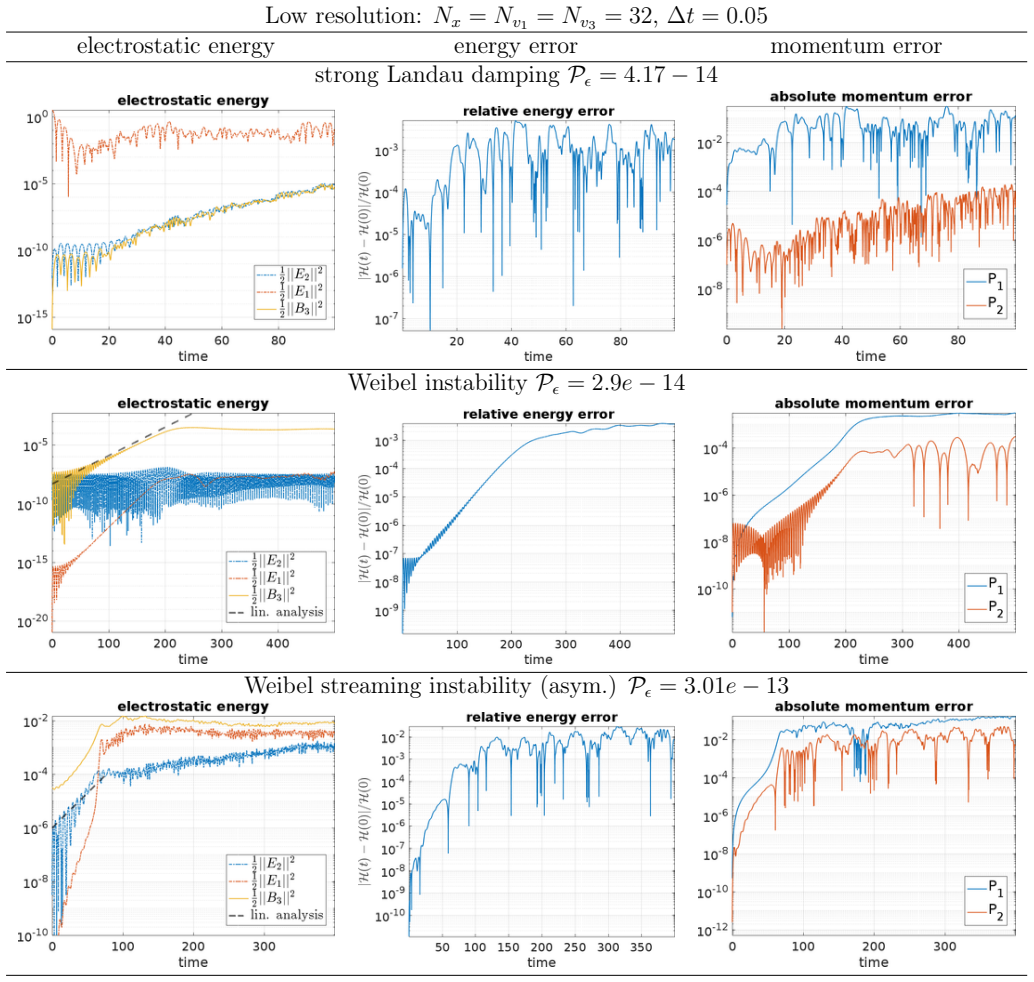
Fourier spectral discretizations extend to the four-dimensional magnetized Vlasov-Poisson system via new splitting methods suited for strong magnetic fields, enabling comparison to the asymptotic fluid model in a turbulent Kelvin-Helmholtz instability. For the Vlasov-Maxwell system, novel charge conserving implementations of a Hamiltonian splitting are discussed and applied to the Weibel streaming instability.
What carries the argument
Splitting methods that divide the evolution operator into substeps solvable by Fourier spectral techniques, adapted to remain effective under strong magnetization while preserving charge in the electromagnetic case.
If this is right
- Kinetic simulations of strongly magnetized plasmas become feasible without prohibitive time-step limits.
- Direct side-by-side comparison of kinetic and fluid models is possible for instabilities such as Kelvin-Helmholtz.
- Charge conservation is maintained throughout Vlasov-Maxwell runs by the new Hamiltonian splitting implementations.
- The Weibel instability results confirm that the methods capture electromagnetic kinetic effects accurately.
Where Pith is reading between the lines
- The same splitting structure could be reused for other wave-particle resonances that appear at strong magnetization.
- If the methods also conserve additional invariants beyond charge, they might enable longer stable integrations than standard approaches.
- Hybrid codes that switch between the spectral kinetic solver and fluid regions could be built around these splittings.
Load-bearing premise
The splitting methods remain accurate and stable for strong magnetic fields and permit a meaningful comparison to the asymptotic fluid model in the Kelvin-Helmholtz instability example.
What would settle it
A Kelvin-Helmholtz instability simulation in which the kinetic results diverge markedly from the asymptotic fluid model predictions at high magnetization would show that the extension does not support useful comparisons.
Figures




read the original abstract
Fourier spectral discretizations belong to the most straightforward methods for solving the unmagnetized Vlasov--Poisson system in low dimensions. In this article, this highly accurate approach is extended two the four-dimensional magnetized Vlasov--Poisson system with new splitting methods suited for strong magnetic fields. Consequently, a comparison to the asymptotic fluid model is provided at the example of a turbulent Kelvin--Helmholtz instability. For the three dimensional electromagnetic Vlasov--Maxwell system different novel charge conserving implementations of a Hamiltonian splitting are discussed and simulation results of the Weibel streaming instability are presented.
Editorial analysis
A structured set of objections, weighed in public.
Referee Report
Summary. The paper extends Fourier spectral discretizations to the four-dimensional magnetized Vlasov-Poisson system via new splitting methods adapted to strong magnetic fields, enabling a comparison against the asymptotic fluid model for the turbulent Kelvin-Helmholtz instability. It also introduces novel charge-conserving implementations of Hamiltonian splittings for the three-dimensional Vlasov-Maxwell system and demonstrates them on the Weibel streaming instability.
Significance. If the stability and accuracy claims hold, the work supplies practical high-order tools for strongly magnetized kinetic plasma problems and supplies concrete, parameter-explicit evidence that the kinetic model recovers the fluid limit in a turbulent setting. The charge-conserving VM schemes, shown to satisfy the discrete continuity equation by construction, strengthen the physical reliability of the electromagnetic implementations.
minor comments (3)
- [Abstract] Abstract: 'extended two the four-dimensional' is a typographical error and should read 'extended to the four-dimensional'.
- [§3] The manuscript would benefit from an explicit statement of the CFL-type stability restriction (or its absence) for the new strong-B splittings in §3 or §4; the current text leaves the time-step selection criterion implicit.
- [Figures 4-7] Figure captions for the KH and Weibel runs should include the precise values of the magnetic-field strength parameter and the number of Fourier modes retained, to allow direct reproduction of the reported agreement with the fluid model.
Simulated Author's Rebuttal
We thank the referee for their positive assessment of the manuscript, including the significance of the stability and accuracy claims for the new splitting methods and the charge-conserving implementations. We appreciate the recommendation for minor revision.
Circularity Check
No significant circularity; derivations are self-contained algorithmic constructions
full rationale
The manuscript develops explicit splitting schemes for Fourier spectral discretizations of the magnetized Vlasov-Poisson and Vlasov-Maxwell systems, together with charge-conserving implementations and numerical demonstrations (Kelvin-Helmholtz and Weibel instabilities). All load-bearing steps consist of direct construction of time-stepping operators, discrete continuity-equation preservation shown by algebraic identity, and parameter-specified comparisons to fluid models. No equation reduces to a fitted input renamed as prediction, no self-citation supplies a uniqueness theorem that forces the central result, and no ansatz is smuggled via prior work. The derivation chain is therefore independent of its own outputs.
Axiom & Free-Parameter Ledger
Reference graph
Works this paper leans on
-
[1]
Charles K Birdsall and A Bruce Langdon.Plasma physics via computer simulation. CRC Press, 2004
work page 2004
-
[2]
GEMPIC: Geometric electromagnetic particle-in-cell methods
Michael Kraus et al. “GEMPIC: Geometric electromagnetic particle-in-cell methods”. In:Jour- nal of Plasma Physics83.4 (2017)
work page 2017
-
[3]
Conservativesemi-Lagrangian schemes for Vlasov equations
NicolasCrouseilles,MichelMehrenberger,andEricSonnendrücker.“Conservativesemi-Lagrangian schemes for Vlasov equations”. In:Journal of Computational Physics229.6 (2010), pp. 1927– 1953
work page 2010
-
[4]
Nicolas Crouseilles et al. “A new fully two-dimensional conservative semi-Lagrangian method: applications on polar grids, from diocotron instability to ITG turbulence”. In:The European Physical Journal D68.9 (2014), pp. 1–10
work page 2014
-
[5]
Conservative numerical schemes for the Vlasov equation
Francis Filbet, Eric Sonnendrücker, and Pierre Bertrand. “Conservative numerical schemes for the Vlasov equation”. In:Journal of Computational Physics172.1 (2001), pp. 166–187
work page 2001
-
[6]
Variational Integrators in Plasma Physics
Michael Kraus. “Variational integrators in plasma physics”. In:arXiv preprint arXiv:1307.5665 (2013)
work page internal anchor Pith review Pith/arXiv arXiv 2013
-
[7]
Numerical integration methods of the Vlasov equation
Glenn Joyce, Georg Knorr, and Homer K Meier. “Numerical integration methods of the Vlasov equation”. In:Journal of Computational Physics8.1 (1971), pp. 53–63. 27
work page 1971
-
[8]
Integration of vlasov equation by a fast fourier eulerian code
B Izrar et al. “Integration of vlasov equation by a fast fourier eulerian code”. In:Computer physics communications52.3 (1989), pp. 375–382
work page 1989
-
[9]
Outflow boundary conditions for the Fourier transformed one-dimensional Vlasov–Poisson system
Bengt Eliasson. “Outflow boundary conditions for the Fourier transformed one-dimensional Vlasov–Poisson system”. In:Journal of scientific computing16.1 (2001), pp. 1–28
work page 2001
-
[10]
Numerical modelling of the two-dimensional Fourier transformed Vlasov– Maxwell system
Bengt Eliasson. “Numerical modelling of the two-dimensional Fourier transformed Vlasov– Maxwell system”. In:Journal of Computational Physics190.2 (2003), pp. 501–522
work page 2003
-
[11]
Bengt Eliasson. “Numerical Simulations of the Fourier-Transformed Vlasov-Maxwell System in Higher Dimensions—Theory and Applications”. In:Transport Theory and Statistical Physics 39.5-7 (2010), pp. 387–465
work page 2010
-
[12]
Hamiltonian splitting for the Vlasov– Maxwell equations
Nicolas Crouseilles, Lukas Einkemmer, and Erwan Faou. “Hamiltonian splitting for the Vlasov– Maxwell equations”. In:Journal of Computational Physics283 (2015), pp. 224–240
work page 2015
-
[13]
Arbitrary-order time-accurate semi-Lagrangian spec- tral approximations of the Vlasov–Poisson system
L. Fatone, D. Funaro, and G. Manzini. “Arbitrary-order time-accurate semi-Lagrangian spec- tral approximations of the Vlasov–Poisson system”. In:Journal of Computational Physics384 (2019), pp. 349 –375.issn: 0021-9991. doi: https://doi.org/10.1016/j.jcp.2019.01.020. url: http://www.sciencedirect.com/science/article/pii/S0021999119300452
-
[14]
A strategy to suppress recurrence in grid-based Vlasov solvers
Lukas Einkemmer and Alexander Ostermann. “A strategy to suppress recurrence in grid-based Vlasov solvers”. In:The European Physical Journal D68.7 (2014), pp. 1–7
work page 2014
-
[15]
A splitting algorithm for Vlasov simulation with filamentation filtration
AJ Klimas and WM Farrell. “A splitting algorithm for Vlasov simulation with filamentation filtration”. In:Journal of computational physics110.1 (1994), pp. 150–163
work page 1994
-
[16]
Vlasov and drift kinetic simulation methods based on the symplectic integrator
T-H Watanabe and Hideo Sugama. “Vlasov and drift kinetic simulation methods based on the symplectic integrator”. In:Transport Theory and Statistical Physics34.3-5 (2005), pp. 287–309
work page 2005
-
[17]
Juris Vencels et al. “SpectralPlasmaSolver: a spectral code for multiscale simulations of col- lisionless, magnetized plasmas”. In:Journal of Physics: Conference Series. Vol. 719. 1. IOP Publishing. 2016, p. 012022
work page 2016
-
[18]
Comparison of eulerian vlasov solvers
Francis Filbet and Eric Sonnendrücker. “Comparison of eulerian vlasov solvers”. In:Computer Physics Communications150.3 (2003), pp. 247–266
work page 2003
-
[19]
A critical comparison of Eulerian-grid-based Vlasov solvers
TD Arber and RGL Vann. “A critical comparison of Eulerian-grid-based Vlasov solvers”. In: Journal of computational physics180.1 (2002), pp. 339–357
work page 2002
-
[20]
Splitting methods for time integration of trajectories in combined electric and magnetic fields
Christian Knapp et al. “Splitting methods for time integration of trajectories in combined electric and magnetic fields”. In:Physical Review E92.6 (2015), p. 063310
work page 2015
-
[21]
https://github.com/ameresj/ FourierSpectralVlasov
Fourier Spectral Vlasov–Poisson and Vlasov–Maxwell Solvers. https://github.com/ameresj/ FourierSpectralVlasov
-
[22]
Fourth order symplectic integration
Etienne Forest and Ronald D Ruth. “Fourth order symplectic integration”. In:Physica 43.LBL- 27662 (1989), pp. 105–117
work page 1989
-
[23]
Why is Boris algorithm so good?
Hong Qin et al. “Why is Boris algorithm so good?” In:Physics of Plasmas20.8, 084503 (2013), pp. –. doi: 10.1063/1.4818428. url: http://scitation.aip.org/content/aip/journal/ pop/20/8/10.1063/1.4818428
-
[24]
A fast algorithm for general raster rotation
Alan W Paeth. “A fast algorithm for general raster rotation”. In:Graphics Interface. Vol. 86
-
[25]
Fast Fourier method for the accurate rotation of sampled images
Kieran G Larkin, Michael A Oldfield, and Hanno Klemm. “Fast Fourier method for the accurate rotation of sampled images”. In:Optics communications139.1 (1997), pp. 99–106. 28
work page 1997
-
[26]
An almost symmetric Strang splitting scheme for nonlinear evolution equations
Lukas Einkemmer and Alexander Ostermann. “An almost symmetric Strang splitting scheme for nonlinear evolution equations”. In: Computers & Mathematics with Applications 67.12 (2014). Efficient Algorithms for Large Scale Scientific Computations, pp. 2144 –2157.issn: 0898-1221. doi: https://doi.org/10.1016/j.camwa.2014.02.027 . url: http://www. sciencedirect.co...
-
[27]
The Vlasov–Poisson system with strong magnetic field
François Golse and Laure Saint-Raymond. “The Vlasov–Poisson system with strong magnetic field”. In:Journal de mathématiques pures et appliquées78.8 (1999), pp. 791–817
work page 1999
-
[28]
Long time behavior of the two-dimensional Vlasov equation with a strong external magnetic field
Emmanuel Frénod and Eric Sonnendrücker. “Long time behavior of the two-dimensional Vlasov equation with a strong external magnetic field”. In:Mathematical Models and Methods in Ap- plied Sciences10.04 (2000), pp. 539–553
work page 2000
-
[29]
Francis Filbet and Luis Miguel Rodrigues. “Asymptotically Stable Particle-In-Cell Methods for the Vlasov–Poisson System with a Strong External Magnetic Field”. In:SIAM Journal on Numerical Analysis54.2 (2016), pp. 1120–1146
work page 2016
-
[30]
Asymptotically preserving particle-in-cell methods for inhomogenous strongly magnetized plasmas
Francis Filbet and Luis Rodrigues. “Asymptotically preserving particle-in-cell methods for in- homogenous strongly magnetized plasmas”. In:arXiv preprint arXiv:1701.06868(2017)
work page internal anchor Pith review Pith/arXiv arXiv 2017
-
[31]
A two-level implicit scheme for the numerical solution of the linearized vor- ticity equation
Magdi M Shoucri. “A two-level implicit scheme for the numerical solution of the linearized vor- ticity equation”. In:International Journal for Numerical Methods in Engineering17.10 (1981), pp. 1525–1538
work page 1981
-
[32]
Explicit integrators for the magnetized equations of motion in Particle in Cell codes
L Patacchini and IH Hutchinson. “Explicit integrators for the magnetized equations of motion in Particle in Cell codes”. In: (2008)
work page 2008
-
[33]
Comment on “Hamiltonian splitting for the Vlasov–Maxwell equations
Hong Qin et al. “Comment on “Hamiltonian splitting for the Vlasov–Maxwell equations””. In: Journal of Computational Physics297 (2015), pp. 721–723
work page 2015
-
[34]
Hamiltonian time integrators for Vlasov-Maxwell equations
Yang He et al. “Hamiltonian time integrators for Vlasov-Maxwell equations”. In:Physics of Plasmas 22.12 (2015), p. 124503
work page 2015
-
[35]
Computing the action of the matrix exponential, with an application to exponential integrators
Awad H Al-Mohy and Nicholas J Higham. “Computing the action of the matrix exponential, with an application to exponential integrators”. In:SIAM journal on scientific computing33.2 (2011), pp. 488–511
work page 2011
-
[36]
Nineteen dubious ways to compute the exponential of a matrix, twenty-five years later
Cleve Moler and Charles Van Loan. “Nineteen dubious ways to compute the exponential of a matrix, twenty-five years later”. In:SIAM review45.1 (2003), pp. 3–49
work page 2003
-
[37]
On the numerical integration of ordinary differential equations by sym- metric composition methods
Robert I McLachlan. “On the numerical integration of ordinary differential equations by sym- metric composition methods”. In:SIAM Journal on Scientific Computing16.1 (1995), pp. 151– 168
work page 1995
-
[38]
Discontinuous Galerkin Methods for the Vlasov–Maxwell Equations
Yingda Cheng et al. “Discontinuous Galerkin Methods for the Vlasov–Maxwell Equations”. In: SIAM Journal on Numerical Analysis52.2 (2014), pp. 1017–1049
work page 2014
-
[39]
Gyroaverage operator for a polar mesh
Christophe Steiner et al. “Gyroaverage operator for a polar mesh”. In:The European Physical Journal D 69.1 (2015), pp. 1–16
work page 2015
-
[40]
Vlasov simulation of kinetic shear Alfvén waves
Tilman Dannert and Frank Jenko. “Vlasov simulation of kinetic shear Alfvén waves”. In:Com- puter physics communications163.2 (2004), pp. 67–78
work page 2004
-
[41]
A massively parallel semi-Lagrangian solver for the six-dimensional Vlasov–Poisson equation
Katharina Kormann, Klaus Reuter, and Markus Rampp. “A massively parallel semi-Lagrangian solver for the six-dimensional Vlasov–Poisson equation”. In:The International Journal of High Performance Computing Applications(2019),p.1094342019834644. doi: 10.1177/1094342019834644. 29
discussion (0)
Sign in with ORCID, Apple, or X to comment. Anyone can read and Pith papers without signing in.