REVIEW 4 major objections 5 minor 24 references
SocialDF: Benchmark Dataset and Detection Model for Mitigating Harmful Deepfake Content on Social Media Platforms
T0 review · 4 major / 5 minor · reviewed 2026-08-07 · deepseek-v4-flash
Pith's one-line read This paper claims that real-world deepfakes on social media are best caught by fact-checking what the speaker says, not by analyzing lip-sync artifacts, and backs this with a new benchmark and an LLM pipeline that reaches 90.4% accuracy.
desk verdict The SocialDF dataset is a real new artifact, but the paper's central claim—that its 90.4% accuracy detects deepfakes—collapses because the labels come from uploader self-disclosure and the pipeline scores factual plausibility, not manipulation. read the letter →
The pith
A machine-rendered reading of the paper's core claim, the machinery that carries it, and where it could break.
The reading
What carries the argument
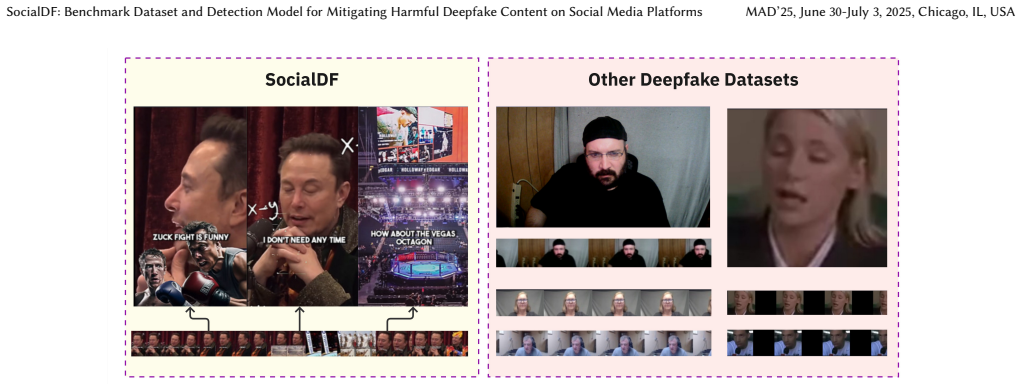
The load-bearing mechanism is the two-stage fact-checking pipeline, powered by the multi-agent LLM. Stage 1 extracts two clean signals from noisy video: the identity of the speaker (YOLO face detection, FaceNet 512-dimensional embeddings, cosine similarity against a database of 869 influential people) and a transcript (Whisper large-v3-turbo ASR). Stage 2 gives that identity-plus-transcript pair to LLM agents with web-search access: one evaluates whether the attribution is plausible, one evaluates factual and ethical soundness, and a final agent consolidates both into a real/fake probability. The design deliberately avoids leaking sample metadata: the agents see only the transcript and identity, not titles or descriptions, because short-form clips are rarely indexed in top web results. This mechanism is what lets the method sidestep the visual noise that breaks lip-sync detectors.
What would settle it
Take a random sample of the 1,055 videos labeled 'fake' in SocialDF and run independent forensic verification—for example, face-artifact detection, generation-model fingerprints, or source tracing to a known deepfake tool. If a substantial share show no evidence of manipulation, the 90.4% accuracy measures agreement with uploader intent rather than detection of tampering, and the benchmark's central claim would need revision.
Extended reading notes
Core claim
The central discovery is that a transcript-and-identity fact-checking pipeline can detect manipulated videos on SocialDF with 90.4% accuracy and 0.93 F1, while the state-of-the-art lip-sync model LipFD plateaus at 51.24% accuracy with a false-negative rate near 99% on the same benchmark. The paper attributes the gap to the dataset's realism: SocialDF videos contain scene changes, occlusions, multiple speakers, and graphical overlays, so any method that relies on continuous close-up lip visibility collapses, whereas semantic plausibility and factual consistency of the spoken claims remain evaluable. The framework that achieves this first maps faces to identities with YOLO and FaceNet and transcribes audio with Whisper, then runs a multi-agent LLM pipeline—one agent checks whether the identified speaker could plausibly have made the statements, another checks factual correctness and ethical implications via web search, and a final agent consolidates the analysis into a probability of manipulation. The paper presents this as evidence that for misinformation-spreading deepfakes of public figures, what is said matters more than how the pixels are rendered.
Load-bearing premise
The dataset's real/fake labels come from uploader-provided hashtags, captions, and tool mentions plus viewer comments, with no forensic verification that the media was actually manipulated, so every reported accuracy depends on those self-reported cues being correct.
Editorial extensions
If this is right
- Lip-sync deepfake detectors that assume a single, close-up, continuously visible speaker will keep failing on short-form social media content; SocialDF provides a benchmark where this failure is measurable.
- Platforms can deploy open-source LLM fact-checking pipelines that use only identity and transcript to flag manipulated celebrity videos with above-90% accuracy, without proprietary forensic models.
- The LLM choice and temperature matter: DeepSeek R-1 at temperature 0.5 outperforms Llama 3.3 and Qwen, indicating that chain-of-thought reasoning and self-verification are valuable for this task.
- The dataset's metadata—comments, sentiment scores, popularity indicators—can support context-aware detection systems that go beyond pixel-level artifacts.
Reading between the lines
- Going beyond the paper: the reported accuracy should be read as conditional on label quality; a forensic re-verification of a random subset of SocialDF labels would tell how much of the 90.4% is real detection and how much is agreement with uploader self-disclosure.
- A testable extension suggested by the method is to apply the same identity-plus-transcript pipeline to non-celebrity subjects or breaking-news events, where web evidence is scarce; the drop in accuracy would measure how much the approach depends on public-figure knowledge.
- If label noise is symmetric, the LipFD near-chance baseline may itself be understated or overstated; a cleanly verified subset would also recalibrate the comparison between lip-sync and fact-checking approaches.
- The framework's success implies a broader editorial direction: semantic consistency checks trained on language and world knowledge may generalize across modalities, from deepfake video to synthetic audio and AI-generated text, because they target the claim rather than the medium.
Editorial analysis
A structured set of objections, weighed in public.
Referee Report
Summary. The paper introduces SocialDF, a dataset of 2,126 short-form Instagram videos (1,071 real, 1,055 fake) of 869 public figures, with labels inferred from uploader self-disclosure and comment sentiment. It proposes a two-stage detection framework: face recognition (YOLO/FaceNet) and ASR (Whisper) followed by a multi-agent LLM pipeline that checks plausibility of attribution and factual correctness via web search, and a final LLM judge. On SocialDF, the LipFD baseline plateaus at roughly 51% accuracy, while the proposed pipeline with DeepSeek-R1 reaches 90.4% accuracy and 0.93 F1.
Significance. If the reported performance were valid, the paper would make a useful contribution: it addresses an under-explored regime of noisy, multi-speaker, edited social media videos and demonstrates that transcript-based reasoning can supplement lip-sync features. The paper's strengths include its attempt to collect ecologically valid social media content, the use of publicly available components (Whisper, FaceNet, open-weight LLMs, DuckDuckGo), and the release of metadata and annotations. However, the evaluation does not establish the claimed detection of manipulation because the labels and the method both target textual factuality and uploader signals rather than audiovisual synthesis artifacts.
major comments (4)
- [Section 3, Section 8] Ground-truth labels are derived from uploader self-disclosure (hashtags, captions, tool mentions) and comment sentiment, with no forensic verification that the media was actually manipulated. The paper explicitly states 'we relied on uploader-provided cues... as primary indicators' and 'cross-verified through consensus review' without any technical analysis of the media itself. Consequently, every accuracy figure in Section 5 measures agreement with uploader intent and commenter perception, not detection of synthetic media. A video flagged as 'fake' by uploader may be real, and vice versa; the reported 90.4% accuracy cannot be interpreted as deepfake detection accuracy.
- [Section 4.2, Section 5] Agent-2 performs web search on the transcript, and for widely shared deepfakes the search results typically include news coverage and social media discussions that explicitly identify the video as fake. The claim in Section 4.2 that 'short-form social media videos rarely appear in top-ranked web results' is unsubstantiated and contradicted by the paper's own motivational example of the Zelenskyy video in Section 2. This creates a circularity: the final LLM can read the ground-truth label from search results. An ablation without web search, or a search restricted to a pre-crawl corpus dated before the video's release, is necessary to rule this out.
- [Section 5, Table 2] The LipFD baseline has FNR near 99% and FPR of 0%, meaning it essentially predicts the majority class (real) on the balanced test set. A baseline that collapses to a constant classifier cannot anchor the claim that a 'broader fact-checking pipeline is better suited.' The paper should include a state-of-the-art artifact-based deepfake detector (e.g., a lip-sync model with class-balanced training or recent forensic detector) and report performance on standard benchmarks such as DFDC or Celeb-DF to calibrate the difficulty of SocialDF.
- [Section 5, LLM comparison] The evaluation protocol is under-specified. The test set size is not stated; no confidence intervals or significance tests are reported; and the selection of the best LLM and temperature (0.5) appears to be done on the same data used for the reported accuracy. Differences of one to three accuracy points among the LLMs may be within noise. The paper should report multiple runs, standard deviations, and a clear train/validation/test split, and state whether the temperature was tuned on a held-out set.
minor comments (5)
- [Section 3, Figure 4] The caption refers to 'category labels for Deepfake and Real samples across different topics' but the topics/categories are not defined in the text.
- [Section 4.1] The cosine similarity formula is rendered with misplaced parentheses; it should be A·B / (||A|| ||B||).
- [Section 5] LipFD is described as 'current state-of-the-art (SOTA) lip-sync detection model,' but the cited paper focuses specifically on lip-syncing forgeries rather than general deepfakes; the SOTA claim is not supported by the cited reference.
- [Section 8, Section 10] The ethical statement says only URLs and annotations are released, while Section 10 links to a GitHub repository; the paper should clarify whether video files or only metadata are distributed, since reproducibility depends on data availability.
- [Throughout] There is a repeated sentence in Section 4.2 ('Each LLM agent... web search tool') and several grammatical errors; the paper would benefit from careful copyediting.
Circularity Check
Detection claim conflates factuality with manipulation: labels come from uploader self-disclosure and the pipeline's web-search leg can retrieve the same public cues, so the reported 90.4% accuracy is not an independent test of manipulation detection.
-
fitted input called prediction
[Section 3, Data Collection Process]
"To refine the labels (real/fake) beyond our initial suspicion, we relied on uploader-provided cues such as hashtags like #deepfake, mentions of tools like Parrot AI, or captions explicitly stating the video was generated or altered. These signals were treated as primary indicators of fake content. Real videos were collected from credible or verified accounts with no mention of synthetic content."
The benchmark's ground-truth 'fake' label is defined by public uploader hashtags, captions, and comment sentiment, with no forensic verification that the media is actually manipulated. The paper then evaluates a detector that 'detects' these same videos. Because the pipeline's web-search leg can retrieve public discussion around a video, the reported classification is not an independent detection of manipulation; it can be agreement with the very cues used to generate the label. The 90.4% accuracy therefore cannot be separated from label self-disclosure.
-
self definitional
[Section 4.2, 2nd Stage]
"Instead, the LLM assesses only the transcript and identity match to determine whether the spoken content aligns with what the individual could plausibly say or whether it is factually accurate. ... the final module determines whether the video content is authentic or a deepfake."
The paper defines the detection target as 'authentic or a deepfake,' but the only content cues fed to the final LLM are identity plausibility and factual accuracy of the transcript. Factual inaccuracy and manipulation are not the same: a real video can contain a false claim, and a manipulated video can contain a true statement. By construction, the system's 'deepfake' output is a fact-checking verdict, not a media-manipulation verdict. The reported accuracy therefore measures transcript plausibility against the label source, not detection of synthetic media.
1 more flagged steps
-
other
[Section 4.2, 2nd Stage]
"Since the system uses only the transcript and identified individuals as input, and short-form social media videos rarely appear in top-ranked web results, there is no risk of inadvertently retrieving metadata such as video titles or descriptions during web search."
Agent-2's web search can return news articles, captions, and comments about a viral deepfake—precisely the public signals from which SocialDF's labels were built. The paper's assurance that short-form clips are 'rarely indexed' is an unverified empirical claim, and it is at odds with the paper's own motivating example (a fabricated Zelenskyy video) and with the dataset's focus on celebrities, whose deepfakes are widely discussed and indexed. When search results identify the video as fake, the final LLM is effectively reading the ground-truth label rather than analyzing audiovisual manipulation, so the 90.4% result is not an independent prediction.
full rationale
The reported 90.4% accuracy is not an independent measure of media-manipulation detection. SocialDF's labels are constructed from uploader hashtags, captions, and comment sentiment (Section 3), with no forensic verification that flagged media are actually manipulated; the Ethical Statement repeats this dependence. The proposed detector's Agent-2 performs web search, and the final LLM decides authenticity from transcript plausibility and factual correctness (Section 4.2). For celebrity-targeted deepfakes—the dataset's stated focus—public web pages, captions, and comments identifying the video as fake are exactly the signals used to build the labels, so the web-search leg can retrieve the ground truth and the 90.4% figure can reduce to agreement with label-generating discourse rather than detection of manipulation. The paper's claim that short-form clips are rarely indexed is unverified and contradicts its own motivating Zelenskyy example. Separately, the system defines 'deepfake' operationally as 'factually inaccurate or implausible statement,' which conflates fact-checking with manipulation detection: a real video with false content or a fake video with true content will be mislabeled by construction. The LipFD baseline is degenerate (always predicts 'real', FNR near 99%, FPR 0%), so it provides no external anchor. The dataset may be useful after forensic re-labeling, but the central empirical claim as presented is partially circular.
Assumptions & free parameters
free parameters (2)
- LLM temperature =
0.5
- LLM model selection =
DeepSeek R-1 Llama 8B selected as final
assumptions (5)
- domain assumption Uploader-provided cues (hashtags like #deepfake, tool mentions, captions) and user comments indicate whether a video is a deepfake.
- domain assumption Authenticity of a video can be assessed by whether the spoken content is plausible and factually correct.
- domain assumption Web search results during evaluation do not reveal the ground-truth label of the test video.
- domain assumption The 90/10 stratified split yields independent test samples.
- domain assumption Standard components (YOLO, FaceNet, Whisper, LLMs) behave as documented.
Cite this review
Pith. "Pith review of SocialDF: Benchmark Dataset and Detection Model for Mitigating Harmful Deepfake Content on Social Media Platforms." pith.science (2026). https://pith.science/paper/W7UK42XI
@misc{pith2026250605538,
  author       = {Pith},
  title        = {Pith review of: SocialDF: Benchmark Dataset and Detection Model for Mitigating Harmful Deepfake Content on Social Media Platforms},
  year         = {2026},
  howpublished = {\url{https://pith.science/paper/W7UK42XI}},
  note         = {Machine review of arXiv:2506.05538}
}
read the original abstract
The rapid advancement of deep generative models has significantly improved the realism of synthetic media, presenting both opportunities and security challenges. While deepfake technology has valuable applications in entertainment and accessibility, it has emerged as a potent vector for misinformation campaigns, particularly on social media. Existing detection frameworks struggle to distinguish between benign and adversarially generated deepfakes engineered to manipulate public perception. To address this challenge, we introduce SocialDF, a curated dataset reflecting real-world deepfake challenges on social media platforms. This dataset encompasses high-fidelity deepfakes sourced from various online ecosystems, ensuring broad coverage of manipulative techniques. We propose a novel LLM-based multi-factor detection approach that combines facial recognition, automated speech transcription, and a multi-agent LLM pipeline to cross-verify audio-visual cues. Our methodology emphasizes robust, multi-modal verification techniques that incorporate linguistic, behavioral, and contextual analysis to effectively discern synthetic media from authentic content.
Figures


Figures from the paper (3 more)


Reference graph
Works this paper leans on
-
[1]
AI@Meta. 2024. Llama 3 Model Card. (2024). https://github.com/meta-llama/ llama3/blob/main/MODEL_CARD.md
2024
-
[2]
Sarah Barrington, Matyas Bohacek, and Hany Farid. 2024. DeepSpeak Dataset v1.0. arXiv:2408.05366 [cs.CV] https://arxiv.org/abs/2408.05366
arXiv 2024
-
[3]
Zhixi Cai, Shreya Ghosh, Aman Pankaj Adatia, Munawar Hayat, Abhinav Dhall, Tom Gedeon, and Kalin Stefanov. 2024. AV-Deepfake1M: A Large-Scale LLM- Driven Audio-Visual Deepfake Dataset. arXiv:2311.15308 [cs.CV] https://arxiv. org/abs/2311.15308
arXiv 2024
-
[4]
Zhixi Cai, Kalin Stefanov, Abhinav Dhall, and Munawar Hayat. 2022. Do You Re- ally Mean That? Content Driven Audio-Visual Deepfake Dataset and Multimodal Method for Temporal Forgery Localization. In 2022 International Conference on Digital Image Computing: Techniques and Applications (DICTA). Sydney, Australia, 1–10. doi:10.1109/DICTA56598.2022.10034605
arXiv 2022
-
[5]
Zhixi Cai, Kalin Stefanov, Abhinav Dhall, and Munawar Hayat. 2023. Do You Really Mean That? Content Driven Audio-Visual Deepfake Dataset and Mul- timodal Method for Temporal Forgery Localization. arXiv:2204.06228 [cs.CV] https://arxiv.org/abs/2204.06228
work page Pith review arXiv 2023
-
[6]
Hanna Chemerys. 2023. Deepfakes and synthetically reproduced media content as a form of disinformation in the context of the russian aggression against Ukraine. 41–45. doi:10.32782/PPSS.2023.1.8
-
[7]
DeepSeek-AI, Daya Guo, Dejian Yang, Haowei Zhang, Junxiao Song, Ruoyu Zhang, Runxin Xu, Qihao Zhu, Shirong Ma, Peiyi Wang, Xiao Bi, Xiaokang Zhang, Xingkai Yu, Yu Wu, Z. F. Wu, Zhibin Gou, Zhihong Shao, Zhuoshu Li, Ziyi Gao, Aixin Liu, Bing Xue, Bingxuan Wang, Bochao Wu, Bei Feng, Chengda Lu, Chenggang Zhao, Chengqi Deng, Chenyu Zhang, Chong Ruan, Damai D...
arXiv 2025
-
[8]
Brian Dolhansky, Joanna Bitton, Ben Pflaum, Jikuo Lu, Russ Howes, Menglin Wang, and Cristian Canton Ferrer. 2020. The DeepFake Detection Challenge Dataset. arXiv:2006.07397 [cs.CV]
arXiv 2020
Show all 24 references
-
[9]
European Commission. 2022. The 2022 Code of Practice on Disinformation. https: //digital-strategy.ec.europa.eu/en/policies/code-practice-disinformation Ac- cessed: 2025-05-12
2022
-
[10]
Vinaya Sree Katamneni and Ajita Rattani. 2024. Contextual Cross- Modal Attention for Audio-Visual Deepfake Detection and Localization. arXiv:2408.01532 [cs.SD] https://arxiv.org/abs/2408.01532
2024 arXiv
-
[11]
Hasam Khalid, Shahroz Tariq, Minha Kim, and Simon S. Woo. 2022. FakeAVCeleb: A Novel Audio-Video Multimodal Deepfake Dataset. arXiv:2108.05080 [cs.CV] https://arxiv.org/abs/2108.05080
2022 arXiv
-
[12]
Yuezun Li, Xin Yang, Pu Sun, Honggang Qi, and Siwei Lyu. 2020. Celeb-DF: A Large-Scale Challenging Dataset for DeepFake Forensics. In 2020 IEEE/CVF Conference on Computer Vision and Pattern Recognition (CVPR) . 3204–3213. doi:10. 1109/CVPR42600.2020.00327
2020
-
[13]
Weifeng Liu, Tianyi She, Jiawei Liu, Boheng Li, Dongyu Yao, Ziyou Liang, and Run Wang. 2024. Lips Are Lying: Spotting the Temporal Inconsistency between Audio and Visual in Lip-Syncing DeepFakes. In The Thirty-eighth Annual Conference on Neural Information Processing Systems ....
2024
-
[14]
Humza Naveed, Asad Ullah Khan, Shi Qiu, Muhammad Saqib, Saeed Anwar, Muhammad Usman, Naveed Akhtar, Nick Barnes, and Ajmal Mian. 2024. A Comprehensive Overview of Large Language Models. arXiv:2307.06435 [cs.CL] https://arxiv.org/abs/2307.06435
2024 arXiv
-
[15]
Alec Radford, Jong Wook Kim, Tao Xu, Greg Brockman, Christine McLeavey, and Ilya Sutskever. 2022. Robust Speech Recognition via Large-Scale Weak Supervision. arXiv:2212.04356 [eess.AS] https://arxiv.org/abs/2212.04356
2022 arXiv
- [16]
-
[17]
Joseph Redmon, Santosh Divvala, Ross Girshick, and Ali Farhadi. 2016. You Only Look Once: Unified, Real-Time Object Detection. arXiv:1506.02640 [cs.CV] https://arxiv.org/abs/1506.02640
2016 arXiv
-
[18]
Florian Schroff, Dmitry Kalenichenko, and James Philbin. 2015. FaceNet: A unified embedding for face recognition and clustering. In 2015 IEEE Conference on Computer Vision and Pattern Recognition (CVPR) . IEEE, 815–823. doi:10.1109/ cvpr.2015.7298682
2015
-
[19]
Ronit Singal, Pransh Patwa, Parth Patwa, Aman Chadha, and Amitava Das. 2024. Evidence-backed Fact Checking using RAG and Few-Shot In-Context Learning with LLMs. InProceedings of the Seventh Fact Extraction and VERification Workshop (FEVER), Michael Schlichtkrull, Yulong Chen, ...
2024
-
[20]
Harald Steck, Chaitanya Ekanadham, and Nathan Kallus. 2024. Is Cosine- Similarity of Embeddings Really About Similarity?. In Companion Proceedings of the ACM Web Conference 2024 (WWW ’24) . ACM, 887–890. doi:10.1145/3589335. 3651526
2024 doi
-
[21]
Ke Sun, Shen Chen, Taiping Yao, Hong Liu, Xiaoshuai Sun, Shouhong Ding, and Rongrong Ji. 2024. DiffusionFake: Enhancing Generalization in Deepfake Detection via Guided Stable Diffusion. arXiv:2410.04372 [cs.CV] https://arxiv. org/abs/2410.04372
2024 arXiv
-
[22]
Qwen Team. 2025. Qwen2.5-1M: Deploy Your Own Qwen with Context Length up to 1M Tokens. https://qwenlm.github.io/blog/qwen2.5-1m/
2025
-
[23]
Tidler and Richard Catrambone
Zachary R. Tidler and Richard Catrambone. 2024. Effects of Neurodi- vergence on Deepfake-Video Detection: Mild Cognitive Impairment. Pro- ceedings of the International Symposium on Human Factors and Ergonomics in Health Care 13, 1 (2024), 160–162. doi:10.1177/2327857924131023 ...
2024 doi
-
[24]
Minh-Hao Van and Xintao Wu. 2023. Detecting and Correcting Hate Speech in Multimodal Memes with Large Visual Language Model. arXiv:2311.06737 [cs.CL] https://arxiv.org/abs/2311.06737
2023 arXiv
Reviewed August 7, 2026 · model on record in the stance chip above.
Discussion (0). Continue with ORCID to comment.