REVIEW 3 major objections 4 minor 26 references
A Nonmonotone Front Descent Method for Bound-Constrained Multi-Objective Optimization
T0 review · 3 major / 4 minor · reviewed 2026-08-05 · deepseek-v4-flash
Pith's one-line read This paper shows that a front-descent multi-objective method can allow temporary increases in some objectives and still converge along a subsequence to Pareto-stationary sets.
desk verdict A genuinely new nonmonotone front-descent method, but the main convergence theorem relies on an assumption that can be impossible to satisfy. read the letter →
The pith
A machine-rendered reading of the paper's core claim, the machinery that carries it, and where it could break.
The reading
What carries the argument
The central object is the reference set C^k: a set of mutually nondominated solutions that are no better than the current set X^k in objective space, built by selecting the lowest-hypervolume set among the last M iterates, merging it with the previous reference set, and adding points from X^k that are strictly worse in at least one objective. Line searches in Procedure 2 accept steps that improve on some point in C^k rather than on the current point itself, which is what permits temporary objective increases. The proof's engine is hypervolume: the hypervolume of the reference sets is nondecreasing and bounded because all iterates stay in the compact sublevel set L(x0); if a subsequence of le
What would settle it
Run FPD_NMT with sigma_k = 1/k on a smooth two-objective box-constrained problem, recording theta(x) for every point in each X^k. The theorem predicts that along some subsequence the minimum theta over the set goes to zero; finding an infinite subsequence where that minimum stays below a negative threshold would disprove it. Separately, log whether the minimum-hypervolume set chosen in Procedure 3 at iteration k-1 equals the one chosen in Procedure 1 at iteration k; the first observed mismatch shows Assumption 2, on which the proof rests, is not in force.
Extended reading notes
Core claim
The central claim is Theorem 1: under two structural assumptions, if the stationarity tolerance is constant, then along a subsequence the worst stationary point in every generated set eventually satisfies Theta(X^k) >= -sigma; if the tolerance goes to zero, Theta(X^k) tends to 0 along a subsequence, and any sequence of points taken from the generated sets admits accumulation points, all of which are Pareto-stationary. The algorithm, called FPD_NMT, replaces the monotone Armijo line search with a benchmark against a reference set C^k that is no better than the current set X^k in objective space, so accepted steps may worsen some objectives while still making progress relative to the stored re
Load-bearing premise
The proof relies on the assumption that, at every iteration, the minimum-hypervolume set selected when forming the next iterate is exactly the same set selected at the start of the next iteration; if equal-volume ties are broken differently, the reference-set property and the convergence argument can fail.
Editorial extensions
If this is right
- A nonmonotone front-based method can preserve the set-level convergence certificate of monotone Front Descent: stationarity of generated sets is guaranteed along a subsequence even when some objectives temporarily rise.
- With a constant tolerance sigma, users can in principle stop once all generated sets satisfy Theta(X^k) >= -sigma; with vanishing tolerance, every accumulation point of the generated points is Pareto-stationary.
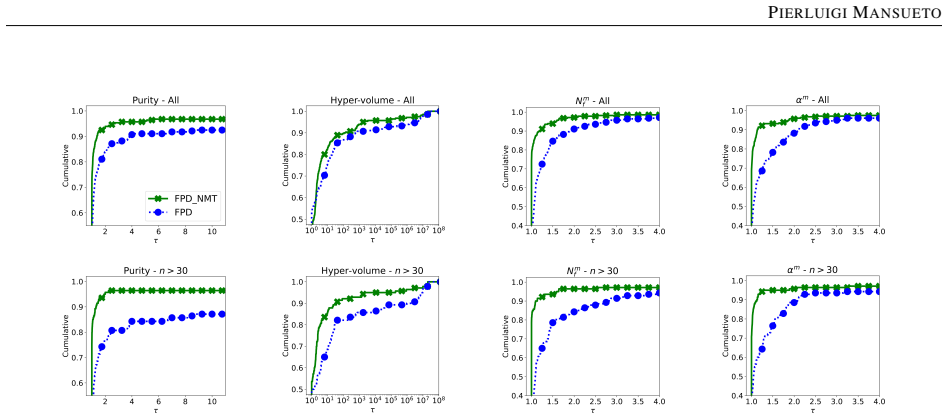
- The numerical evidence indicates that reference-set-based nonmonotone acceptance reduces function evaluations and average line-search steps while improving front purity and hypervolume, most clearly in high-dimensional problems.
- The construction provides a concrete way to define nonmonotone benchmarks for set-based multiobjective descent, a piece that was previously missing.
- The method can serve as a template for adding nonmonotone line searches to other front-generation algorithms without discarding their convergence arguments.
Reading between the lines
- If hypervolume ties are common in practice, implementations that break ties arbitrarily may silently violate Assumption 2; logging the selected minimum-hypervolume sets in Procedure 3 and the next Procedure 1 would show whether the theorem's premise actually holds.
- The subsequence-only conclusion leaves a gap between the theory and the final iterate used in practice; an adaptive forcing term tied to the least-stationary point might plausibly promote the result to a full-sequence convergence guarantee.
- The memory parameter M controls how nonmonotone the search is, so a schedule that starts with large M for exploration and reduces it near the end could exploit larger steps early while cleaning up the front later.
- Because the proof relies on compact sublevel sets, the technique transfers most directly to bounded feasible regions; extending it to general constraints would require a new boundedness argument.
Signed reviews
Editorial analysis
A structured set of objections, weighed in public.
Referee Report
Summary. The paper proposes FPD_NMT, a nonmonotone extension of the Front Descent framework for bound-constrained multi-objective optimization. Rather than requiring monotone decrease with respect to the previous iterate set, the method maintains a reference set C^k and performs Armijo-type line searches against points in that reference set (Procedures 1-3). The authors prove that C^k is a reference set (Proposition 2), introduce Assumption 2 to ensure a certain tie-breaking condition between the minimizers chosen in Procedures 1 and 3, and then prove Theorem 1 and Corollary 2: along a subsequence, the stationarity measure Theta(X^k) tends to 0 (or falls below the tolerance sigma), and accumulation points of generated sequences are Pareto-stationary. Numerical experiments compare FPD_NMT with the original FPD on box-constrained test problems and report gains in purity, hypervolume, evaluations per point, and average line-search stepsize, especially in high dimensions.
Significance. If the main convergence theorem is sound, the paper is a meaningful step: it is apparently the first attempt to combine nonmonotone line-search ideas with a front-descent method that maintains a set of nondominated points, and it comes with a proof structure that extends the recent Front Descent convergence framework. The appendix proofs are reasonably detailed, and the code is publicly available. However, the central theorem is strictly weaker than the abstract's 'analogous to the original framework' claim, and the proof rests on Assumption 2, whose stated justification is not correct under the hypervolume definitions used in the algorithm. These issues are load-bearing and need to be addressed before the convergence claims can be accepted as stated.
major comments (3)
- [Section 3, Assumption 2 and Remark 3] Assumption 2 is not a harmless tie-breaking condition, and Remark 3's justification is invalid because the hypervolume reference point rp_k changes over iterations. In Procedure 1 and Procedure 3, VF is computed with rp_k = max_{x in X_all} f_j(x), where X_all accumulates generated solutions. Remark 3(i) claims that a worst-hypervolume set selected in Procedure 3 will retain that status in the next Procedure 1, but this is only true for a fixed reference point. Example with two one-point candidates: A={(9,0)}, B={(5,5)}. For rp=(10,10), V(A)=10 and V(B)=25, so A is the unique minimizer. If a later nondominated point (100,2) appears, rp becomes (100,10), and then V(A)=910 while V(B)=475; B is now strictly smaller. Thus the previously selected set A cannot be selected by any tie-breaking rule at the new reference point. Since Corollary 1, Lemma 4, Lemma 8, and Theorem 1 all use the equalit
- [Abstract, Theorem 1, and Remark 4] The abstract states that the paper establishes convergence properties 'analogous to the original framework', but Theorem 1 only establishes the existence of a subsequence K such that Theta(X^k) -> 0, not convergence of the whole sequence. Proposition 1 for the original FPD gives lim_k Theta(X^k) = 0. The paper itself acknowledges this in Remark 4, saying that a stronger result would require an additional forcing-function assumption that is 'rarely satisfied in practice'. This is a qualitative weakening of the advertised guarantee and should be disclosed in the abstract and introduction. The claim 'analogous' is therefore an overstatement.
- [Section 4 and Appendix A (implementation)] The numerical section does not report how Assumption 2 was enforced or whether the equality \bar{X}^{l(k-1)} = X^{l(k)} actually held in the experiments. Since Assumption 2 is an algorithmic requirement on tie-breaking and can be impossible to satisfy with the changing hypervolume reference point, the experiments may be testing a method different from the one analyzed. The manuscript should either (i) modify the algorithm so the equality holds by construction (for example, by using a fixed reference point for all hypervolume computations and storing the selected worst set), or (ii) state explicitly that the numerical results are for a variant that may not satisfy the assumptions of Theorem 1.
minor comments (4)
- [Notation in proof of Theorem 1] The notation \hat{l}(k) = l(k)-1 is used without a prior definition; please define it before the proof or state it in the theorem statement.
- [Appendix B numbering] The supplementary lemmas are labelled Lemma 6-9 while the main text refers to Lemma 2-5; the correspondence is only given in parentheses. This makes cross-referencing unnecessarily difficult.
- [Figure 2 caption] The caption uses 'N m f' while the text uses N_f^m and \alpha_m; unify the notation.
- [Remark 1] The phrase 'all the convergence properties listed below are preserved' is imprecise because Theorem 1 only guarantees subsequential convergence; please qualify this statement.
Circularity Check
No significant circularity: the convergence proof is conditional and does not reduce to its inputs; the main caveat is the questionable non-restrictiveness of Assumption 2, which is a correctness concern rather than a circularity.
full rationale
The paper's central derivation is not circular. Theorem 1 is an explicitly conditional statement: it assumes Assumption 2 (equality of the sets selected by Procedures 1 and 3) and then proves Pareto stationarity along a subsequence. The proof does not assume the conclusion; it uses the hypervolume monotonicity of the reference sets, Lemma 1 from [17], and a contradiction argument on the step size. The cited results from the author's prior work ([15], [17]) are auxiliary mathematical lemmas or framework definitions, not restatements of the theorem being proved, so the self-citations do not force the result by construction. There is no fitted parameter renamed as a prediction and no ansatz smuggled in via citation. The substantive weakness flagged in the manuscript is Remark 3's assertion that Assumption 2 is non-restrictive. This justification is questionable: the hypervolume reference point used in Procedures 1 and 3 is recomputed from all generated points as rp_k = max_{x in Xall} f_j(x), so a set that was the unique argmin at iteration k-1 can cease to be a minimizer at iteration k when the reference point changes. That could make the equality in Assumption 2 impossible to satisfy, undermining the applicability of Corollary 1, Lemma 4(b), and hence Theorem 1. This is a serious validity gap, but it is not a circularity: the proof is conditional on the assumption and does not define the assumption in terms of the conclusion. Accordingly, the circularity score is low, reflecting only minor reliance on the author's own prior framework.
Assumptions & free parameters
free parameters (1)
- M (memory parameter) =
4
assumptions (5)
- domain assumption The objective F is continuously differentiable on the box [l,u].
- domain assumption The level set L(x0) = union_j {x in Omega | f_j(x) <= f_j(x0)} is compact for some x0 in X^0.
- domain assumption Assumption 1: at each iteration, the first point processed is the one with minimal theta(x) in X^k.
- ad hoc to paper Assumption 2: \bar{X}^{l(k-1)} and X^{l(k)} (the chosen minimum hypervolume sets in Procedures 3 and 1) are equal.
- standard math The projected direction subproblems (2)-(3) have unique solutions and satisfy the bound in (4).
Cite this review
Pith. "Pith review of A Nonmonotone Front Descent Method for Bound-Constrained Multi-Objective Optimization." pith.science (2026). https://pith.science/paper/W7VZXB63
@misc{pith2026250902409,
  author       = {Pith},
  title        = {Pith review of: A Nonmonotone Front Descent Method for Bound-Constrained Multi-Objective Optimization},
  year         = {2026},
  howpublished = {\url{https://pith.science/paper/W7VZXB63}},
  note         = {Machine review of arXiv:2509.02409}
}
read the original abstract
We introduce a nonmonotone extension of the Front Descent framework for multiobjective optimization. The method uses novel nonmonotone line searches that allow temporary increases in some objective functions. To our knowledge, this is the first descent algorithm employing nonmonotone strategies to generate point sets approximating the Pareto front. We establish convergence properties for the resulting sequences of sets, analogous to the original framework, and present numerical results confirming the approach's consistency in the bound-constrained setting.
Figures


Figures from the paper (1 more)

Reference graph
Works this paper leans on
- [1]
- [2]
-
[3]
A. L. Custódio, J. F. A. Madeira, A. I. F. Vaz, and L. N. Vicente. Direct multisearch for multiobjective optimization. SIAM Journal on Optimization, 21(3):1109–1140, 2011. 13 PIERLUIGI MANSUETO
work page 2011
-
[4]
K. Deb, A. Pratap, S. Agarwal, and T. Meyarivan. A fast and elitist multiobjective genetic algorithm: Nsga-ii. IEEE Transactions on Evolutionary Computation, 6(2):182–197, 2002
2002
-
[5]
E. D. Dolan and J. J. Moré. Benchmarking optimization software with performance profiles. Mathematical Programming, 91(2):201–213, 2002
work page 2002
-
[6]
L. G. Drummond and A. N. Iusem. A projected gradient method for vector optimization problems. Computational Optimization and Applications, 28(1):5–29, Apr 2004
work page 2004
-
[7]
G. Eichfelder. An adaptive scalarization method in multiobjective optimization. SIAM Journal on Optimization, 19(4):1694–1718, 2009
work page 2009
-
[8]
G. Eichfelder. Twenty years of continuous multiobjective optimization in the twenty-first century. EURO Journal on Computational Optimization, 9:100014, 2021
work page 2021
Show all 26 references
-
[9]
N. S. Fazzio and M. L. Schuverdt. Convergence analysis of a nonmonotone projected gradient method for multiobjective optimization problems. Optimization Letters, 13(6):1365–1379, Sep 2019
2019
-
[10]
Fliege, L
J. Fliege, L. M. G. n. Drummond, and B. F. Svaiter. Newton’s method for multiobjective optimization. SIAM Journal on Optimization, 20(2):602–626, 2009
2009
-
[11]
Fliege and B
J. Fliege and B. F. Svaiter. Steepest descent methods for multicriteria optimization. Mathematical Methods of Operations Research, 51(3):479–494, Aug 2000
2000
-
[12]
Grippo, F
L. Grippo, F. Lampariello, and S. Lucidi. A nonmonotone line search technique for newton’s method. SIAM Journal on Numerical Analysis, 23(4):707–716, 1986
1986
-
[13]
Gurobi Optimizer Reference Manual, 2024
Gurobi Optimization, LLC. Gurobi Optimizer Reference Manual, 2024
2024
-
[14]
Y . Jin, M. Olhofer, and B. Sendhoff. Dynamic weighted aggregation for evolutionary multi-objective optimization: Why does it work and how? In Proceedings of the genetic and evolutionary computation conference , pages 1042–1049, 2001
2001
-
[15]
Lapucci and P
M. Lapucci and P. Mansueto. Improved front steepest descent for multi-objective optimization. Operations Research Letters, 51(3):242–247, 2023
2023
-
[16]
Lapucci and P
M. Lapucci and P. Mansueto. A limited memory quasi-newton approach for multi-objective optimization. Computational Optimization and Applications, 85(1):33–73, May 2023
2023
-
[17]
Lapucci, P
M. Lapucci, P. Mansueto, and D. Pucci. Effective front-descent algorithms with convergence guarantees, 2025
2025
-
[18]
Lapucci, P
M. Lapucci, P. Mansueto, and F. Schoen. A memetic procedure for global multi-objective optimization. Mathe- matical Programming Computation, 2022
2022
-
[19]
K. Mita, E. H. Fukuda, and N. Yamashita. Nonmonotone line searches for unconstrained multiobjective optimiza- tion problems. Journal of Global Optimization, 75(1):63–90, Sep 2019
2019
-
[20]
Pascoletti and P
A. Pascoletti and P. Serafini. Scalarizing vector optimization problems. Journal of Optimization Theory and Applications, 42(4):499–524, 1984
1984
-
[21]
L. F. Prudente and D. R. Souza. Global convergence of a bfgs-type algorithm for nonconvex multiobjective optimization problems. Computational Optimization and Applications, 88(3):719–757, Jul 2024
2024
-
[22]
S. Qu, Y . Ji, J. Jiang, and Q. Zhang. Nonmonotone gradient methods for vector optimization with a portfolio optimization application. European Journal of Operational Research, 263(2):356–366, 2017
2017
-
[23]
Zhang and W
H. Zhang and W. W. Hager. A nonmonotone line search technique and its application to unconstrained optimization. SIAM Journal on Optimization, 14(4):1043–1056, 2004
2004
-
[24]
Zhang, A
Q. Zhang, A. Zhou, S. Zhao, P. Suganthan, W. Liu, and S. Tiwari. Multiobjective optimization test instances for the cec 2009 special session and competition. Mechanical Engineering, 01 2008
2009
-
[25]
Zitzler, K
E. Zitzler, K. Deb, and L. Thiele. Comparison of multiobjective evolutionary algorithms: Empirical results. Evolutionary Computation, 8(2):173–195, Jun 2000
2000
-
[26]
Zitzler and L
E. Zitzler and L. Thiele. Multiobjective optimization using evolutionary algorithms — a comparative case study. In A. E. Eiben, T. Bäck, M. Schoenauer, and H.-P. Schwefel, editors,Parallel Problem Solving from Nature — PPSN V, pages 292–301, Berlin, Heidelberg, 1998. Springer ...
1998
Reviewed August 5, 2026 · model on record in the stance chip above.
Discussion (0). Continue with ORCID to comment.