REVIEW 1 major objections 5 minor 70 references
Efficient determination of eigenenergies and eigenstates of $N$ ($N=3$--$4$) identical 1D bosons and fermions under external harmonic confinement
T0 review · 1 major / 5 minor · reviewed 2026-08-05 · deepseek-v4-flash
Pith's one-line read The paper shows that a Lippmann-Schwinger eigenvalue scheme, applied to derivative-delta interactions, yields stable and converged energy spectra for three identical fermions and four identical bosons in a 1D harmonic trap, with the four-bo
desk verdict Solid, well-benchmarked numerical method with first direct FFF and full BBBB spectra; minor convergence-documentation gaps do not undermine it. read the letter →
The pith
A machine-rendered reading of the paper's core claim, the machinery that carries it, and where it could break.
The reading
What carries the argument
The central objects are the Lippmann-Schwinger eigenvalue equations (21), (27), and (32), in which 1/g is treated as an eigenvalue of an energy-dependent matrix. The matrix elements combine the two-body Green's function at zero separation with integrals over harmonic-oscillator states (I^(3B), J^(3F), K^(3F), I^(4B)). These integrals are rewritten, using the Hermite argument-scaling identity (44) and the product-separation identity (52), as linear combinations of the four-index recursion W (37), which is evaluated once and reused for every energy. For the fermion case, an integration-by-parts step (Appendix A) removes the discontinuity of the derivative Green's function so that a smooth inte
What would settle it
Take a low-lying FFF eigenvalue near E = 2.5 hbar omega, such as the one used in the convergence tests, and recompute it with basis ellmax = kmax = 100 and pmax much larger than 2(k+ell) using 50-digit precision; if the eigenvalue moves by more than the line thickness in Fig. 3, the claimed convergence is not real. Alternatively, compare the predicted BBBB tetramer energy at g+ = -10 hbar omega aho with an independent exact-diagonalization or Monte Carlo calculation; agreement to quoted precision would settle it.
Extended reading notes
Core claim
Starting from the Lippmann-Schwinger equation with the harmonic-oscillator Green's function, the authors reduce the three- and four-body problems to finite matrix eigenvalue problems whose energy-dependent matrix elements involve two-body Green's functions and integrals of products of Hermite polynomials. For three identical fermions, the derivative operators in the interaction are handled through an integration-by-parts resolution of the discontinuity at zero separation, giving the eigenvalue equation (27). The paper's central numerical claim is that these equations converge: with cutoffs such as ellmax=kmax=60 and pmax=240 for three fermions, and smax=tmax=kmax=ellmax=32 with pmax=192 for
Load-bearing premise
The spectra are as converged as claimed; the finite basis size and pmax cutoffs, plus the rule that replaces numerically unstable FFF matrix elements with their symmetric partners, are enough to capture every eigenstate shown, and no rigorous error bound is given.
Editorial extensions
If this is right
- Three identical fermions can now be treated directly, without relying on the Bose-Fermi mapping, so the odd-parity pseudopotential is confirmed to give well-defined few-body matrix elements.
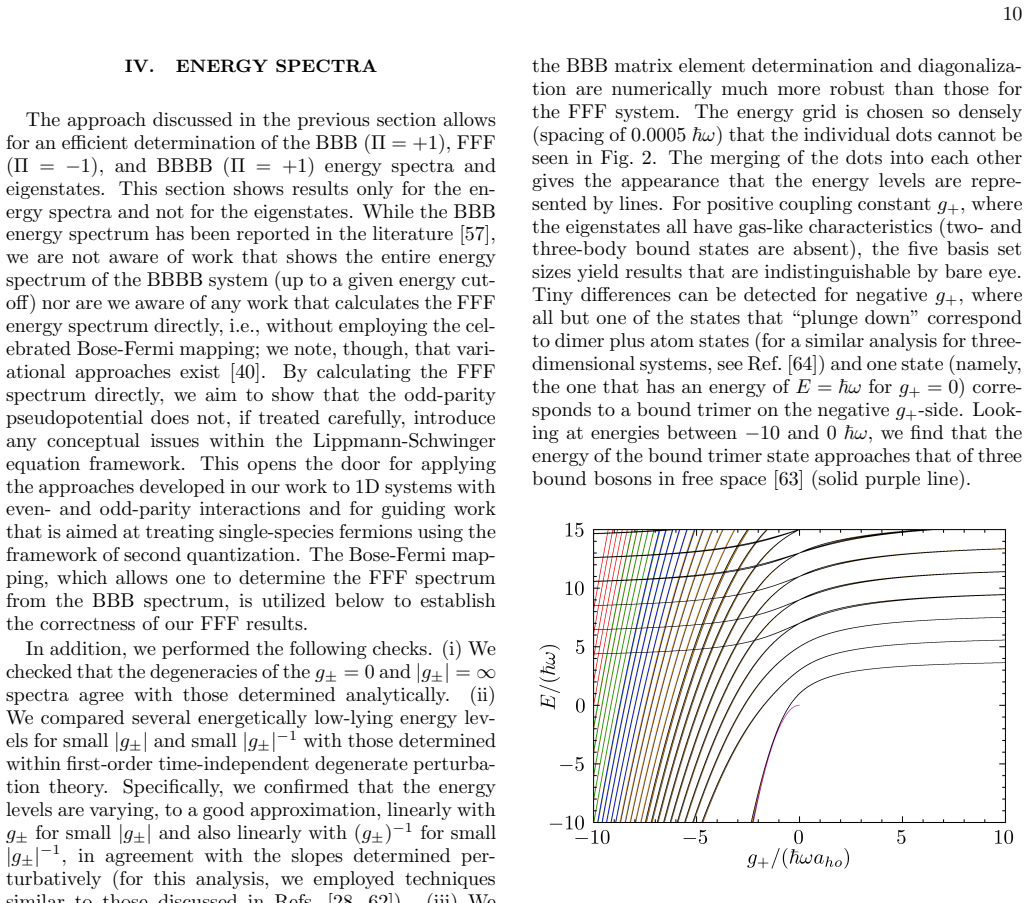
- The four-boson spectrum provides the first such calculation for this system, including a clear tetramer branch that matches the free-space McGuire binding energy on the strongly attractive side.
- Because the energy-independent sums are precomputed, spectra over broad coupling ranges cost minutes to hours on a laptop, making extensions to N=5 plausible.
- The same eigenvalue-equation structure can be reused for other parity sectors, Bose-Bose and Fermi-Fermi mixtures, and anyonic systems via the bosonic-fermionic anyon mappings.
Reading between the lines
- A natural extension the paper does not develop is time-dependent dynamics: since the scheme returns eigenstates as well as eigenenergies, evolving an initial state in this basis would give few-body quench dynamics with the same computational machinery.
- The observed numerical instability in A^(3F) for k>ell, remedied by symmetry replacement, suggests that a more symmetric formulation of the fermion matrix element might eliminate the need for high-precision arithmetic entirely.
- If the convergence heuristic pmax+1 > 2(k+ell) is as universal as the tests suggest, it could be converted into an adaptive cutoff rule for larger N, where full convergence checks become expensive.
- The method's explicit two-body correlations plus full harmonic-oscillator basis appear to capture three-body correlations effectively, as the tetramer match shows; testing this against a dedicated three-body-correlation measure for the trimer branch would sharpen what the basis is actually learning.
Editorial analysis
A structured set of objections, weighed in public.
Referee Report
Summary. The paper derives and solves Lippmann-Schwinger eigenvalue equations for three identical bosons (BBB), three identical fermions (FFF), and four identical bosons (BBBB) in a one-dimensional harmonic trap with zero-range two-body interactions: an even-parity delta potential for bosons and an odd-parity derivative-delta-derivative potential for fermions. The eigenvalue equations are given in truncated harmonic-oscillator bases in Eqs. (21), (27), and (32), and the numerical scheme is built on a recursive evaluation of overlapped Hermite-polynomial integrals (Eq. (37)). The main results are energy spectra as functions of the coupling strength: the FFF spectrum is computed directly without invoking the Bose-Fermi mapping and is benchmarked against the mapped BBB spectrum (Fig. 3); the BBBB spectrum is presented as the first such Lippmann-Schwinger calculation, and its tetramer branch is compared with the McGuire free-space binding energy (Fig. 4). Additional checks include degeneracy counting and first-order perturbative slopes for weak coupling.
Significance. If correct, the paper establishes a stable and efficient Lippmann-Schwinger treatment of a derivative-regularized zero-range potential for more than two identical fermions and provides the first full four-boson trapped energy spectrum by this method. There are no fitted parameters, and the validation is genuinely independent: C++, Python, and Mathematica implementations are cross-checked; the FFF spectrum coincides with the Bose-Fermi-mapped BBB spectrum; low-lying levels follow perturbative slopes; and the BBBB tetramer branch tracks the free-space McGuire energy. These are substantive strengths. The principal caveat is numerical evidence: convergence is demonstrated in detail for the BBB matrix elements and for selected FFF matrix elements, but the BBBB spectrum itself is shown at only one cutoff. This is a missing-support issue rather than a demonstrated internal inconsistency, and it is fixable within the scope of the manuscript.
major comments (1)
- [§IV, Fig. 4] The BBBB spectrum is computed at a single truncation, smax=tmax=kmax=ellmax=32 with pmax=192, and no basis-size or pmax variation is shown for the four-boson eigenenergies. Section III.B asserts that the BBB and BBBB implementations are 'numerically stable and converged', but for BBBB the displayed evidence is one curve. The agreement with the McGuire free-space tetramer energy validates only the lowest bound branch; it does not validate the roughly 20 other eigenenergies claimed in the abstract. Because the BBBB spectrum is a central new result, please add a convergence study (e.g., overlay spectra for two additional cutoffs or provide a table of selected eigenenergies versus cutoff). This is a missing-support issue, not a demonstrated error.
minor comments (5)
- [Appendix A, Eq. (A21)] A summation over j is missing on the right-hand side after the integration by parts; as written the expression depends on an undefined j. Later equations restore the sum, so this is an intermediate typo, but it should be corrected.
- [Title/Abstract and §IV] The title and abstract promise determination of eigenstates, but Section IV explicitly shows only energy spectra. Either add representative eigenstate densities (e.g., for a few BBB/FFF/BBBB states) or soften the wording so the claim matches the presented results.
- [§III.B, Fig. 1] Please state precisely where the rule 'replace A(3F)_{ell,k} for k>ell by the converged A(3F)_{k,ell}' is applied (all off-diagonal pairs, all energies?) and give the tolerance used to judge the matrix elements converged in Fig. 1(b).
- [Eq. (37)] The recursion for W_{ijkℓ} is not accompanied by initial conditions or a statement of how negative subscripts are handled. Adding these details would make the implementation reproducible.
- [Fig. 2] The caption says 'ℓmax/2 eigenenergies are shown'; briefly explain that this is because only even ℓ values are retained in the basis.
Circularity Check
No significant circularity: the spectra are computed from explicit Lippmann-Schwinger equations and benchmarked against external theorems; self-citations are not load-bearing in a circular way.
full rationale
The derivation chain is self-contained. The BBB and BBBB eigenequations follow from the Lippmann-Schwinger equation (Eq. 13) with the stated two-body potentials; the FFF eigenequation is derived in detail in Appendix A using antisymmetrization, integration by parts, and harmonic-oscillator completeness. The one self-citation that enters the FFF derivation is Ref. [18], used for the odd-parity pseudopotential form and for the two-body Green's-function identity Eq. (31). That identity is a parameter-free mathematical relation between the second derivative of the two-fermion Green's function and the two-boson Green's function; it is not the N-body spectral equality and it does not assume the paper's target result. The Bose-Fermi mapping from Refs. [18,32,65] is used only as an external benchmark for the FFF spectrum, not as an input to the construction of the FFF eigenequation; the excellent agreement in Fig. 3 is therefore a nontrivial check. The BBB equation is attributed to Ref. [57], which is standard use of a prior independent result, and the paper's contribution is the efficient numerical scheme and the FFF/BBBB constructions. Convergence checks, perturbation-theory comparisons, degeneracy counting, the McGuire free-space tetramer comparison, and cross-checks against Python/Mathematica and Refs. [53,54] provide independent or implementation-level validation. No parameter is fitted to the predicted spectra; pmax and basis sizes are convergence cutoffs justified by explicit convergence tests. No circular step was found.
Assumptions & free parameters
free parameters (3)
- Harmonic oscillator basis size (ellmax, kmax) for BBB/FFF =
60 (pmax = 240 for FFF spectra)
- Basis sizes for BBBB (smax, tmax, kmax, ellmax) =
32 each with pmax = 192
- Green's function p-sum cutoff (pmax) =
pmax + 1 > 2(k + ell), e.g., 240
assumptions (4)
- domain assumption For the odd-parity pseudopotential V_-(x) = -g_- (d/dx) delta(x) (d/dx), the matrix elements are equivalent to the ordered form of Eq. (7) for functions with f(0) = 0 or second derivative of g at 0 equal to 0.
- standard math The harmonic oscillator eigenstates phi_n form a complete basis for the relative motion and for the contact derivative psi_1(0,y) (Eq. A23).
- domain assumption The Bose-Fermi mapping relation g+ = -2 hbar^4/(m^2 g-) between the bosonic and fermionic coupling constants is exact.
- standard math The recursion relation for W (Eq. 37) and the Hermite polynomial identities (Eqs. 44, 52, 55) correctly compute the required integrals.
Cite this review
Pith. "Pith review of Efficient determination of eigenenergies and eigenstates of $N$ ($N=3$--$4$) identical 1D bosons and fermions under external harmonic confinement." pith.science (2026). https://pith.science/paper/WAEY72AJ
@misc{pith2026250902938,
  author       = {Pith},
  title        = {Pith review of: Efficient determination of eigenenergies and eigenstates of $N$ ($N=3$--$4$) identical 1D bosons and fermions under external harmonic confinement},
  year         = {2026},
  howpublished = {\url{https://pith.science/paper/WAEY72AJ}},
  note         = {Machine review of arXiv:2509.02938}
}
abstract
Few-atom systems play an important role in understanding the transition from few- to many-body quantum behaviors. This work introduces a new approach for determining the energy spectra and eigenstates of small harmonically trapped single-component Bose and Fermi gases with additive two-body zero-range interactions in one spatial dimension. The interactions for bosons are the usual $\delta$-function interactions while those for fermions are $\delta$-function interactions that contain derivative operators. Details of the derivation and benchmarks of the numerical scheme are presented. Extensions to other systems are discussed.
Figures


Reference graph
Works this paper leans on
-
[1]
X.-W. Guan, M. T. Batchelor, and C. Lee, Rev. Mod. Phys. 85, 1633 (2013)
work page 2013
-
[2]
S. I. Mistakidis, A. G. Volosniev, R. E. Barfknecht, T. Fogarty, T. Busch, A. Foerster, P. Schmelcher, and N. T. Zinner, Phys. Rep. 1042, 1 (2023)
work page 2023
-
[3]
T. Sowi´ nski and M. A. Garc ´ ıa-March, Rep. Prog. Phys.82, 104401 (2019)
work page 2019
-
[4]
D. S. Petrov, D. M. Gangardt, and G. V. Shlyapnikov, J. Phys. IV France 116, 5 (2004)
work page 2004
- [5]
-
[6]
S. Dettmer, D. Hellweg, P. Ryytty, J. J. Arlt, W. Ertmer, K. Sengstock, D. S. Petrov, G. V. Shlyapnikov, H. Kreutzmann, L. Santos, and M. Lewenstein, Phys. Rev. Lett. 87, 160406 (2001)
work page 2001
-
[7]
Kr¨ uger, Z
P. Kr¨ uger, Z. Hadzibabic, and J. Dalibard, Phys. Rev. Lett. 99, 040402 (2007)
2007
-
[8]
Kinoshita, T
T. Kinoshita, T. Wenger, and D. S. Weiss, Science 305, 1125 (2004)
2004
Show all 70 references
-
[9]
Haller, M
E. Haller, M. J. Mark, R. Hart, J. G. Danzl, L. Reichs¨ ollner, V. Melezhik, P. Schmelcher, and H.-C. N¨ agerl, Phys. Rev. Lett. 104, 153203 (2010)
2010
-
[10]
D. S. Petrov, G. V. Shlyapnikov, and J. T. M. Walraven, Phys. Rev. Lett. 85, 3745 (2000)
2000
-
[11]
Dunjko, V
V. Dunjko, V. Lorent, and M. Olshanii, Phys. Rev. Lett. 86, 5413 (2001)
2001
-
[12]
Olshanii, Phys
M. Olshanii, Phys. Rev. Lett. 81, 938 (1998)
1998
-
[13]
Bergeman, M
T. Bergeman, M. G. Moore, and M. Olshanii, Phys. Rev. Lett. 91, 163201 (2003)
2003
-
[14]
D. S. Petrov and G. V. Shlyapnikov, Phys. Rev. A 64, 012706 (2001)
2001
-
[15]
B. E. Granger and D. Blume, Phys. Rev. Lett. 92, 133202 (2004)
2004
-
[16]
Pricoupenko, Phys
L. Pricoupenko, Phys. Rev. Lett. 100, 170404 (2008)
2008
-
[17]
J. P. Kestner and L.-M. Duan, Phys. Rev. A 76, 033611 (2007)
2007
-
[18]
Kanjilal and D
K. Kanjilal and D. Blume, Phys. Rev. A 70, 042709 (2004)
2004
-
[19]
Cheon and T
T. Cheon and T. Shigehara, Phys. Rev. Lett. 82, 2536 (1999)
1999
-
[20]
Cheon and T
T. Cheon and T. Shigehara, Physics Letters A 243, 111 (1998)
1998
-
[21]
S. A. Bender, K. D. Erker, and B. E. Granger, Phys. Rev. Lett. 95, 230404 (2005)
2005
-
[22]
Grosse, E
H. Grosse, E. Langmann, and C. Paufler, Journal of Physics A: Mathematical and General 37, 4579 (2004)
2004
-
[23]
Busch, B.-G
T. Busch, B.-G. Englert, K. Rza˙ zewski, and M. Wilkens, Found. Phys. 28, 549 (1998). 17
1998
-
[24]
A. G. Volosniev, D. Petrosyan, M. Valiente, D. V. Fedorov, A. S. Jensen, and N. T. Zinner, Phys. Rev. A 91, 023620 (2015)
2015
-
[25]
Levinsen, P
J. Levinsen, P. Massignan, G. M. Bruun, and M. M. Parish, Science Advances 1, e1500197 (2015)
2015
-
[26]
Chen and X
Y. Chen and X. Cui, Phys. Rev. A 112, 013301 (2025)
2025
-
[27]
N. L. Harshman, Phys. Rev. A 86, 052122 (2012)
2012
-
[28]
S. E. Gharashi, X. Y. Yin, Y. Yan, and D. Blume, Phys. Rev. A 91, 013620 (2015)
2015
-
[29]
L. Yang, L. Guan, and H. Pu, Phys. Rev. A 91, 043634 (2015)
2015
-
[30]
Z¨ ollner, H.-D
S. Z¨ ollner, H.-D. Meyer, and P. Schmelcher, Phys. Rev. A 78, 013629 (2008)
2008
-
[31]
Girardeau, Journal of Mathematical Physics 1, 516 (1960)
M. Girardeau, Journal of Mathematical Physics 1, 516 (1960)
1960
-
[32]
Girardeau, H
M. Girardeau, H. Nguyen, and M. Olshanii, Optics Communications 243, 3 (2004), ultra Cold Atoms and Degenerate Quantum Gases
2004
-
[33]
V. I. Yukalov and M. D. Girardeau, Laser Physics Letters 2, 375 (2005)
2005
-
[34]
C. A. Regal, C. Ticknor, J. L. Bohn, and D. S. Jin, Phys. Rev. Lett. 90, 053201 (2003)
2003
-
[35]
G¨ unter, T
K. G¨ unter, T. St¨ oferle, H. Moritz, M. K¨ ohl, and T. Esslinger, Phys. Rev. Lett.95, 230401 (2005)
2005
-
[36]
Luciuk, S
C. Luciuk, S. Trotzky, S. Smale, Z. Yu, S. Zhang, and J. H. Thywissen, Nat. Phys. 12, 599 (2016)
2016
-
[37]
Zhou and X
L. Zhou and X. Cui, Phys. Rev. A 96, 030701 (2017)
2017
-
[38]
Chang, R
Y.-T. Chang, R. Senaratne, D. Cavazos-Cavazos, and R. G. Hulet, Phys. Rev. Lett. 125, 263402 (2020)
2020
-
[39]
Suppression of three-body loss near a p-wave resonance due to quasi-1d confinement,
A. S. Marcum, F. R. Fonta, A. M. Ismail, and K. M. O’Hara, “Suppression of three-body loss near a p-wave resonance due to quasi-1d confinement,” (2020), arXiv:2007.15783 [physics.atom-ph]
2020 arXiv
-
[40]
Ko´ scik and T
P. Ko´ scik and T. Sowi´ nski, New J. Phys.22, 093053 (2020)
2020
-
[41]
Ko´ scik and T
P. Ko´ scik and T. Sowi´ nski, Phys. Rev. Lett.130, 253401 (2023)
2023
-
[42]
Nishida, S
Y. Nishida, S. Moroz, and D. T. Son, Phys. Rev. Lett. 110, 235301 (2013)
2013
-
[43]
C. Gao, J. Wang, and Z. Yu, Phys. Rev. A 92, 020504 (2015)
2015
-
[44]
D. K. Gridnev, Journal of Physics A: Mathematical and Theoretical 47, 505204 (2014)
2014
-
[45]
A. G. Volosniev, D. V. Fedorov, A. S. Jensen, and N. T. Zinner, Journal of Physics B: Atomic, Molecular and Optical Physics 47, 185302 (2014)
2014
-
[46]
Stock, A
R. Stock, A. Silberfarb, E. L. Bolda, and I. H. Deutsch, Phys. Rev. Lett. 94, 023202 (2005)
2005
-
[47]
Jona-Lasinio, L
M. Jona-Lasinio, L. Pricoupenko, and Y. Castin, Phys. Rev. A 77, 043611 (2008)
2008
-
[48]
Idziaszek and T
Z. Idziaszek and T. Calarco, Phys. Rev. Lett. 96, 013201 (2006)
2006
-
[49]
B. D. Esry, C. H. Greene, and H. Suno, Phys. Rev. A 65, 010705 (2001)
2001
-
[50]
H. Suno, B. D. Esry, and C. H. Greene, Phys. Rev. Lett. 90, 053202 (2003)
2003
-
[51]
Chen and C
Y.-H. Chen and C. H. Greene, Phys. Rev. A 105, 013308 (2022)
2022
-
[52]
E. H. Lieb and W. Liniger, Phys. Rev. 130, 1605 (1963)
1963
-
[53]
S. E. Gharashi, K. M. Daily, and D. Blume, Phys. Rev. A 86, 042702 (2012)
2012
-
[54]
S. E. Gharashi and D. Blume, Phys. Rev. Lett. 111, 045302 (2013)
2013
-
[55]
X.-J. Liu, H. Hu, and P. D. Drummond, Phys. Rev. Lett. 102, 160401 (2009)
2009
-
[56]
X.-J. Liu, H. Hu, and P. D. Drummond, Phys. Rev. A 82, 023619 (2010)
2010
-
[57]
D’Amico and M
P. D’Amico and M. Rontani, J. Phys. B: At. Mol. Opt. Phys. 47, 065303 (2014)
2014
-
[58]
Derivation of recursive formulas for integrals of hermite polynomial products and their applications,
P. Q. Son, T. D. Anh-Tai, L. M. Khang, N. D. Vy, and V. N. T. Pham, “Derivation of recursive formulas for integrals of hermite polynomial products and their applications,” (2024), arXiv:2411.15541 [quant-ph]
2024
-
[59]
Werner and Y
F. Werner and Y. Castin, Phys. Rev. Lett. 97, 150401 (2006)
2006
-
[60]
Digital Library of Mathematical Functions,
National Institute of Standards and Technology, “Digital Library of Mathematical Functions,” https://dlmf.nist.gov (2010), F. W. J. Olver, A. B. Olde Daalhuis, D. W. Lozier, B. I. Schneider, R. F. Boisvert, C. W. Clark, B. R. Miller, B. V. Saunders, H. S. Cohl, and M. A. McCla...
2010
-
[61]
Abramowitz and I
M. Abramowitz and I. A. Stegun, Handbook of Mathematical Functions with Formulas, Graphs, and Mathematical Tables, Natl. Bur. Stand. Appl. Math. Ser. No. 55, (U.S. Government Printing Office, Washington, D.C., 1972), Chap. 22, p. 785, entry 22.12.8
1972
-
[62]
A. G. Volosniev, D. V. Fedorov, A. S. Jensen, M. Valiente, and N. T. Zinner, Nat. Commun. 5, 5300 (2014)
2014
-
[63]
J. B. McGuire, J. Math. Phys. 5, 622 (1964)
1964
-
[64]
K. M. Daily and D. Blume, Phys. Rev. A 81, 053615 (2010)
2010
-
[65]
M. D. Girardeau and M. Olshanii, Phys. Rev. A 70, 023608 (2004)
2004
-
[66]
Z¨ urn, F
G. Z¨ urn, F. Serwane, T. Lompe, A. N. Wenz, M. G. Ries, J. E. Bohn, and S. Jochim, Phys. Rev. Lett.108, 075303 (2012)
2012
-
[67]
Moritz, T
H. Moritz, T. St¨ oferle, K. G¨ unter, M. K¨ ohl, and T. Esslinger, Phys. Rev. Lett.94, 210401 (2005)
2005
-
[68]
S. Will, T. Best, U. Schneider, L. Hackerm¨ uller, D.-S. L¨ uhmann, and I. Bloch, Nature465, 197 (2010)
2010
-
[69]
Universal momentum tail of identical one-dimensional anyons with two-body interactions,
R. Hidalgo-Sacoto, T. Busch, and D. Blume, “Universal momentum tail of identical one-dimensional anyons with two-body interactions,” (2025), arXiv:2505.17669 [cond-mat.quant-gas]
2025 arXiv
-
[70]
Two identical 1D anyons with zero-range interactions: Exchange statistics, scattering theory, and anyon-anyon mapping,
R. Hidalgo-Sacoto, T. Busch, and D. Blume, “Two identical 1D anyons with zero-range interactions: Exchange statistics, scattering theory, and anyon-anyon mapping,” (2025), arXiv:2505.23127 [quant-ph]
2025 arXiv
Reviewed August 5, 2026 · model on record in the stance chip above.
Discussion (0). Continue with ORCID to comment.