REVIEW 5 minor 49 references
Stochastic inflation with an extremely large number of $e$-folds
T0 review · 0 major / 5 minor · reviewed 2026-08-14 · deepseek-v4-flash
Pith's one-line read A shallow local minimum at the top of a hilltop-inflation potential can make a typical single-field slow-roll inflation last $10^{10^{10}}$ e-folds and still match CMB observations.
desk verdict A compact, sound model-building letter showing that a shallow local minimum at a hilltop can stretch the typical e-folding number to absurdly large values via standard stochastic diffusion, with the main gaps being missing numerics/error bars and the uncomputed perturbation spectrum from the long stochastic phase. read the letter →
The pith
A machine-rendered reading of the paper's core claim, the machinery that carries it, and where it could break.
The reading
What carries the argument
The load-bearing mechanism is the shallow local minimum at the top of the hilltop potential, combined with the condition that its curvature is small compared with the Hubble scale ($0<m^2<H^2$). In the stochastic formalism, the mean e-folds follow from the adjoint Fokker-Planck equation (2), whose solution (3) reduces to the classical-drift formula (5) when the classicality parameter $\eta_{\rm cl}=|v''v^2/v'^2|$ is small; this is what traps the field, since the drift pushes the distribution back to the minimum. The escape rate from the trap is the Hawking-Moss-type formula (6), whose exponential factor $e^{1/v(0)-1/v(\varphi_+)}$ is responsible for the very long residence time. After the field passes the local maximum, the same potential behaves as a standard hilltop model and matches CMB observations.
What would settle it
Numerically evolve the full first-passage problem for the potential (7) with the CMB-fixed parameters (8) at $m^2/H^2$ values near the enhancement threshold and compare the complete distribution of escape e-folds with the exponential law implied by Eq. (6); if the median escape time is far shorter than the mean $\langle N\rangle\sim10^{10^{10}}$, then the quoted mean is not the typical duration and the paper's central claim fails.
Extended reading notes
Core claim
The central claim is that adding a shallow local minimum to the top of a hilltop potential turns a standard slow-roll model into one with an exponentially long typical e-folding number. For the $Z_2$-symmetric potential (7) with $0<m^2<H^2$, the origin is a shallow minimum and the surrounding region satisfies $\eta_{\rm cl}=|v''v^2/v'^2|\ll1$ even where the stochasticity parameter $\xi_{\rm sto}$ exceeds one; the classical drift therefore moves the whole probability distribution back toward the minimum, and the field leaves only through accumulated quantum diffusion. The escape rate is given by the Hawking-Moss-type formula (6), and with the CMB-fixed parameters (8), numerical integration of the first-passage formula (3) gives $\langle N\rangle$ as large as $10^{10^{10}}$ for a deep enough minimum. After escape, the same field slow-rolls and generates $A_s=2.1\times10^{-9}$ and $n_s=0.958$, consistent with CMB observations. The scenario thereby combines old-inflation-like long residence with new-inflation-like smooth exit, without bubble nucleation or volume-measure selection.
Load-bearing premise
The calculation assumes the stochastic Fokker-Planck description stays valid throughout the trapped phase, in particular that the inflaton mass-squared remains between zero and the Hubble scale ($0<m^2<H^2$); if it exceeded $H^2$, escape would proceed by tunneling with bubble nucleation instead of by accumulated diffusion, and the Hawking-Moss-type formula would no longer be the relevant description.
Editorial extensions
If this is right
- A single-field slow-roll model can supply $\langle N\rangle\sim10^{10^{10}}$ typical e-folds without any volume weighting, so the long inflation does not rely on selecting rare spatial regions.
- Light scalars such as the QCD axion can reach the Bunch-Davies distribution, since the required condition $N\gtrsim10^{26}(H_{\rm inf}/100\,\mathrm{MeV})^2/(m_a/10^{-5}\,\mathrm{eV})^2$ is easily satisfied.
- After the stochastic trapping ends, the same field slow-rolls in the same potential and produces $A_s=2.1\times10^{-9}$ and $n_s=0.958$, consistent with CMB data.
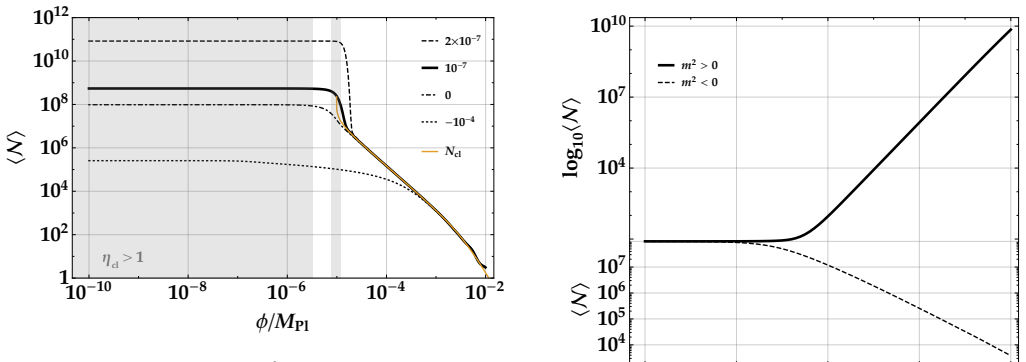
- As $m^2$ is increased from negative values toward $H^2$, the model interpolates continuously from new-inflation-like hilltop behaviour to old-inflation-like trapping, all without bubble nucleation.
Reading between the lines
- The same trapping mechanism would apply to spectator scalar fields during inflation, not only the inflaton, so light fields held near a shallow minimum could be released later and affect isocurvature perturbations or dark-matter abundances.
- The Hawking-Moss-type formula predicts an exponential escape-time distribution; computing the second moment $\langle N^2\rangle$ from the adjoint equation would test whether the quoted mean is in fact the typical duration and not an average dominated by extremely rare long trajectories.
- Because the exponent in Eq. (6) scales with the inverse of the normalized potential, lowering the inflation scale should push the typical e-folds far above $10^{10^{10}}$, which would strengthen the motivation from low-scale axion and relaxion scenarios.
- Radiative corrections to the shallow minimum could spoil the $\eta_{\rm cl}<1$ region; checking the stability of the trap under such corrections is a model-building constraint the paper leaves open.
Editorial analysis
A structured set of objections, weighed in public.
Referee Report
Summary. The manuscript proposes a single-field, slow-roll hilltop inflation model in which a shallow local minimum near the top of the potential greatly enhances the stochastic duration of inflation. Using the Fokker-Planck formulation of stochastic inflation, the authors compute the mean number of e-folds from the first-passage-time solution in Eq. (3), present the analytic escape-time estimate in Eq. (6), and show in Fig. 3 that for positive mass squared (0 < m^2 < H^2) the expected e-folds can be as large as 10^(10^10). They state that with the parameter choices in Eq. (8) the subsequent slow-roll phase yields CMB-consistent values A_s = 2.1e-9 and n_s = 0.958. The paper argues that this scenario combines the long-duration property of old inflation with the natural slow-roll exit of new inflation without invoking the volume measure.
Significance. If the central calculation is correct, the paper provides a simple, explicit mechanism for realizing an extremely large number of e-folds in a single-field slow-roll model, without relying on volume-weighted eternal inflation. The use of the standard stochastic-inflation equation (1), the exact mean-first-passage-time representation (3), and the Hawking-Moss-type escape formula (6) are appropriate, and the numerical integration in Fig. 3 directly supports the claimed enhancement. The main limitations are documentation and presentation: the agreement between Eq. (6) and the numerics is asserted rather than displayed, the identification of the mean as the 'typical' number of e-folds is not justified, and the CMB consistency statement is presented as a parameter choice rather than a derived result. None of these appears to undermine the core mechanism.
minor comments (5)
- [Section 3, Fig. 3] The text says that the analytic estimate (6) 'agrees well' with the numerical integration of Eq. (3), but no comparison is shown in the figure or in a table. Please include a panel or a table that compares Eq. (6) with the numerical result over the m^2 range of Fig. 3, and state the numerical integration tolerances used.
- [Section 2, after Eq. (3)] The paper identifies the mean first-passage time ⟨N⟩ as the 'typical' number of e-folds. Since the mean can be dominated by rare long trajectories if the first-passage-time distribution is heavy-tailed, please either show that the distribution is approximately exponential in the high-barrier regime of interest or cite a result establishing that the mean is representative of the typical value.
- [Section 3, Eq. (8)] The statement that the parameters in Eq. (8) produce A_s = 2.1e-9 and n_s = 0.958 is not accompanied by the relevant slow-roll formulas or a derivation. A brief display of the standard expressions used to evaluate A_s and n_s would make the CMB-consistency claim reproducible.
- [Abstract and Section 1] There are minor grammatical and typesetting issues: 'such the QCD axion' should be 'such as the QCD axion', and the abstract renders 10^(10^10) as '101010', which is confusing without superscript formatting.
- [Figure 2 caption] The caption notes that a slight wiggling near φ ~ 10^(-2) M_Pl is a numerical error, but no numerical method or tolerance is described. A one-sentence mention of the integration scheme in the text or figure caption would allow readers to judge the reliability of the curves.
Circularity Check
No significant circularity: the large e-folds are outputs of an independent first-passage formula, with the mass parameter scanned as an input rather than fitted to the target N.
full rationale
The paper's central derivation is self-contained and non-circular. The mean first-passage time in Eq. (3) is an exact solution of the adjoint Fokker-Planck equation (2), and the escape-rate estimate in Eq. (6) is an analytic saddle-point approximation attributed to the independent works Ref. [33] (Noorbala et al.) and Ref. [34] (Hawking-Moss). Neither of these load-bearing formulas is authored by the present paper's authors, so there is no self-citation chain or uniqueness-imported-from-authors issue. The potential parameters in Eq. (8) are fixed by the CMB scalar amplitude As = 2.1e-9 and spectral index ns = 0.958, which are independent of the target e-fold number; the mass squared m^2 is scanned as an input, and the huge value of <N> shown in Fig. 3 is an output of the numerical integration of Eq. (3), not a fitted parameter renamed as a prediction. The analytic formula (6) is used only to interpret the numerical result, and the paper states that the two agree. The self-citations in Refs. [3,36,37,39,40] appear in motivation, parameter-tuning remarks, and model-building context, and they are not load-bearing for the main calculation. The main caveats are reproducibility-related (the precise agreement between Eq. (6) and the numerics, and the exact CMB normalization, are asserted rather than tabulated) and physical-validity-related (the stochastic description requires m^2 < H^2, which the plotted extreme points still satisfy). These caveats are not circularity.
Assumptions & free parameters
free parameters (4)
- m² =
varied; examples m²/H² = 10^-7 to 10^-2
- Λ =
0.998×10^-4 M_Pl
- λ =
3.39×10^-14
- g =
(Λ² M_Pl^4/g)^(1/6) = 0.1 M_Pl
assumptions (5)
- domain assumption Stochastic Fokker-Planck formalism for the inflaton distribution
- domain assumption First-passage-time moments obey the adjoint Fokker-Planck equation
- domain assumption Slow-roll and light-field conditions hold
- domain assumption Escape from the local minimum is described by the Hawking-Moss rate (6)
- domain assumption The post-escape phase is ordinary slow-roll inflation matching Planck
Cite this review
Pith. "Pith review of Stochastic inflation with an extremely large number of $e$-folds." pith.science (2026). https://pith.science/paper/WAXRAN35
@misc{pith2026190808694,
  author       = {Pith},
  title        = {Pith review of: Stochastic inflation with an extremely large number of $e$-folds},
  year         = {2026},
  howpublished = {\url{https://pith.science/paper/WAXRAN35}},
  note         = {Machine review of arXiv:1908.08694}
}
abstract
We propose a class of single-field, slow-roll inflation models in which a typical number of $e$-folds can be extremely large. The key point is to introduce a very shallow local minimum near the top of the potential in a hilltop inflation model. In particular, a typical number of $e$-folds is enhanced if classical behavior dominates around the local minimum such that the inflaton probability distribution is drifted to the local minimum as a whole. After the inflaton escapes from the local minimum due to the stochastic dynamics, the ordinary slow-roll inflation follows and it can generate the primordial density perturbation consistent with observation. Interestingly, our scenario inherits the advantages of the old and new inflation: the typical $e$-folds can be extremely large as in the old inflation, and slow-roll inflation naturally follows after the stochastic regime as in the new inflation. In our numerical example, the typical number of $e$-folds can be as large as $10^{10^{10}}$, which is large enough for various light scalars such the QCD axion to reach the Bunch-Davies distribution.
Figures

Reference graph
Works this paper leans on
-
[1]
P. W. Graham, D. E. Kaplan, S. Rajendran, Cosmological Re- laxation of the Electroweak Scale, Phys. Rev. Lett. 115 (22) (2015) 221801. arXiv:1504.07551, doi:10.1103/PhysRevLett. 115.221801
arXiv 2015
-
[2]
P. W. Graham, A. Scherlis, Stochastic axion scenario, Phys. Rev. D98 (3) (2018) 035017. arXiv:1805.07362, doi:10.1103/ PhysRevD.98.035017
arXiv 2018
-
[3]
F. Takahashi, W. Yin, A. H. Guth, QCD axion window and low-scale inflation, Phys. Rev. D98 (1) (2018) 015042. arXiv: 1805.08763, doi:10.1103/PhysRevD.98.015042
arXiv 2018
-
[4]
S.-Y. Ho, F. Takahashi, W. Yin, Relaxing the Cosmological Moduli Problem by Low-scale Inflation, JHEP 04 (2019) 149. arXiv:1901.01240, doi:10.1007/JHEP04(2019)149
arXiv 2019
-
[5]
F. Takahashi, W. Yin, QCD Axion on Hilltop by Phase Shift of π (2019). arXiv:1908.06071
arXiv 2019
-
[6]
C. Ringeval, T. Suyama, T. Takahashi, M. Yamaguchi, S. Yokoyama, Dark energy from primordial inflationary quan- tum fluctuations, Phys. Rev. Lett. 105 (2010) 121301. arXiv: 1006.0368, doi:10.1103/PhysRevLett.105.121301
arXiv 2010
-
[7]
A Large Mass Hierarchy from a Small Non-minimal Coupling
C. Ringeval, T. Suyama, M. Yamaguchi, Large mass hierarchy from a small nonminimal coupling, Phys. Rev. D99 (12) (2019) 123524. arXiv:1903.03544, doi:10.1103/PhysRevD.99.123524
work page Pith review arXiv 2019
-
[8]
J. Torrado, C. T. Byrnes, R. J. Hardwick, V. Vennin, D. Wands, Measuring the duration of inflation with the curvaton, Phys. Rev. D98 (6) (2018) 063525. arXiv:1712.05364, doi:10.1103/ PhysRevD.98.063525
arXiv 2018
Show all 49 references
-
[9]
Enqvist, T
K. Enqvist, T. Meriniemi, S. Nurmi, Higgs Dynamics during Inflation, JCAP 1407 (2014) 025. arXiv:1404.3699, doi:10. 1088/1475-7516/2014/07/025
2014 arXiv
-
[10]
Bousso, J
R. Bousso, J. Polchinski, Quantization of four form fluxes and dynamical neutralization of the cosmological constant, JHEP 06 (2000) 006. arXiv:hep-th/0004134, doi:10.1088/1126-6708/ 2000/06/006
2000 arXiv
-
[11]
Susskind, The Anthropic landscape of string theory, in: Carr, Bernard (ed.): Universe or multiverse?, 2003, pp
L. Susskind, The Anthropic landscape of string theory, in: Carr, Bernard (ed.): Universe or multiverse?, 2003, pp. 247–266. arXiv:hep-th/0302219
2003 arXiv
-
[12]
Freivogel, M
B. Freivogel, M. Kleban, M. Rodriguez Martinez, L. Susskind, Observational consequences of a landscape, JHEP 03 (2006)
2006
-
[13]
Higaki, F
T. Higaki, F. Takahashi, Natural and Multi-Natural Inflation in Axion Landscape, JHEP 07 (2014) 074. arXiv:1404.6923, doi:10.1007/JHEP07(2014)074
2014 arXiv
-
[14]
Higaki, F
T. Higaki, F. Takahashi, Axion Landscape and Natural In- flation, Phys. Lett. B744 (2015) 153–159. arXiv:1409.8409, doi:10.1016/j.physletb.2015.03.052
2015 arXiv
-
[15]
G. Wang, T. Battefeld, Vacuum Selection on Axionic Land- scapes, JCAP 1604 (04) (2016) 025. arXiv:1512.04224, doi: 10.1088/1475-7516/2016/04/025
2016 arXiv
-
[16]
Masoumi, A
A. Masoumi, A. Vilenkin, Vacuum statistics and stability in axionic landscapes, JCAP 1603 (03) (2016) 054. arXiv:1601. 01662, doi:10.1088/1475-7516/2016/03/054
2016 doi
-
[17]
T. C. Bachlechner, K. Eckerle, O. Janssen, M. Kleban, The Axidental Universe (2019). arXiv:1902.05952
2019 arXiv
-
[18]
A. D. Linde, NONSINGULAR REGENERATING INFLA- TIONARY UNIVERSE (1982)
1982
-
[19]
P. J. Steinhardt, NATURAL INFLATION, in: Nuffield Work- shop on the Very Early Universe Cambridge, England, June 21-July 9, 1982, 1982, pp. 251–266
1982
-
[20]
Vilenkin, The Birth of Inflationary Universes, Phys
A. Vilenkin, The Birth of Inflationary Universes, Phys. Rev. D27 (1983) 2848. doi:10.1103/PhysRevD.27.2848
1983 doi
-
[21]
A. D. Linde, ETERNAL CHAOTIC INFLATION, Mod. Phys. Lett. A1 (1986) 81. doi:10.1142/S0217732386000129
1986 doi
-
[22]
A. D. Linde, Eternally Existing Selfreproducing Chaotic In- flationary Universe, Phys. Lett. B175 (1986) 395–400. doi: 10.1016/0370-2693(86)90611-8
1986 doi
-
[23]
A. S. Goncharov, A. D. Linde, V. F. Mukhanov, The Global Structure of the Inflationary Universe, Int. J. Mod. Phys. A2 (1987) 561–591. doi:10.1142/S0217751X87000211
1987 doi
-
[24]
A. H. Guth, Inflation and eternal inflation, Phys. Rept. 333 (2000) 555–574. arXiv:astro-ph/0002156, doi:10.1016/ S0370-1573(00)00037-5
2000 arXiv
-
[25]
A. H. Guth, Eternal inflation and its implications, J. Phys. A40 (2007) 6811–6826. arXiv:hep-th/0702178, doi:10.1088/ 1751-8113/40/25/S25
2007 arXiv
-
[26]
Linde, A brief history of the multiverse, Rept
A. Linde, A brief history of the multiverse, Rept. Prog. Phys. 80 (2) (2017) 022001. arXiv:1512.01203, doi:10.1088/ 1361-6633/aa50e4
2017 arXiv
-
[27]
Barenboim, W.-I
G. Barenboim, W.-I. Park, W. H. Kinney, Eternal Hilltop In- flation, JCAP 1605 (05) (2016) 030. arXiv:1601.08140, doi: 10.1088/1475-7516/2016/05/030
2016 arXiv
-
[28]
Assadullahi, H
H. Assadullahi, H. Firouzjahi, M. Noorbala, V. Vennin, D. Wands, Multiple Fields in Stochastic Inflation, JCAP 1606 (06) (2016) 043. arXiv:1604.04502, doi:10.1088/ 5 1475-7516/2016/06/043
2016 arXiv
-
[29]
A. A. Starobinsky, STOCHASTIC DE SITTER (INFLATION- ARY) STAGE IN THE EARLY UNIVERSE, Lect. Notes Phys. 246 (1986) 107–126. doi:10.1007/3-540-16452-9_6
1986 doi
-
[30]
A. A. Starobinsky, J. Yokoyama, Equilibrium state of a self- interacting scalar field in the De Sitter background, Phys. Rev. D50 (1994) 6357–6368. arXiv:astro-ph/9407016, doi: 10.1103/PhysRevD.50.6357
1994 arXiv
-
[31]
Vennin, A
V. Vennin, A. A. Starobinsky, Correlation Functions in Stochas- tic Inflation, Eur. Phys. J. C75 (2015) 413. arXiv:1506.04732, doi:10.1140/epjc/s10052-015-3643-y
2015 arXiv
-
[32]
Pattison, V
C. Pattison, V. Vennin, H. Assadullahi, D. Wands, Quan- tum diffusion during inflation and primordial black holes, JCAP 1710 (10) (2017) 046. arXiv:1707.00537, doi:10.1088/ 1475-7516/2017/10/046
2017 arXiv
-
[33]
Noorbala, V
M. Noorbala, V. Vennin, H. Assadullahi, H. Firouz- jahi, D. Wands, Tunneling in Stochastic Infla- tion[JCAP1809,no.09,032(2018)] (2018). arXiv:1806.09634, doi:10.1088/1475-7516/2018/09/032
2018 arXiv
-
[34]
S. W. Hawking, I. G. Moss, Supercooled Phase Transitions in the Very Early Universe, Phys. Lett. 110B (1982) 35– 38, [Adv. Ser. Astrophys. Cosmol.3,154(1987)]. doi:10.1016/ 0370-2693(82)90946-7
1982
-
[35]
Aghanim, et al., Planck 2018 results
N. Aghanim, et al., Planck 2018 results. VI. Cosmological pa- rameters (2018). arXiv:1807.06209
2018 arXiv
-
[36]
Takahashi, New inflation in supergravity after Planck and LHC, Phys
F. Takahashi, New inflation in supergravity after Planck and LHC, Phys. Lett. B727 (2013) 21–26. arXiv:1308.4212, doi: 10.1016/j.physletb.2013.10.026
2013 arXiv
-
[37]
Nakayama, F
K. Nakayama, F. Takahashi, PeV-scale Supersymmetry from New Inflation, JCAP 1205 (2012) 035. arXiv:1203.0323, doi: 10.1088/1475-7516/2012/05/035
2012 arXiv
-
[38]
T. S. Bunch, P. C. W. Davies, Quantum Field Theory in de Sit- ter Space: Renormalization by Point Splitting, Proc. Roy. Soc. Lond. A360 (1978) 117–134. doi:10.1098/rspa.1978.0060
1978
-
[39]
arXiv:hep-th/0505232, doi:10.1088/1126-6708/2006/ 03/039
2006 arXiv
-
[40]
Czerny, F
M. Czerny, F. Takahashi, Multi-Natural Inflation, Phys. Lett. B733 (2014) 241–246. arXiv:1401.5212, doi:10.1016/j. physletb.2014.04.039
2014 arXiv
-
[41]
Czerny, T
M. Czerny, T. Higaki, F. Takahashi, Multi-Natural Inflation in Supergravity, JHEP 05 (2014) 144. arXiv:1403.0410, doi: 10.1007/JHEP05(2014)144
2014 arXiv
-
[42]
Flauger, L
R. Flauger, L. McAllister, E. Pajer, A. Westphal, G. Xu, Os- cillations in the CMB from Axion Monodromy Inflation, JCAP 1006 (2010) 009. arXiv:0907.2916, doi:10.1088/1475-7516/ 2010/06/009
2010 arXiv
-
[43]
Kobayashi, F
T. Kobayashi, F. Takahashi, Running Spectral Index from In- flation with Modulations, JCAP 1101 (2011) 026. arXiv: 1011.3988, doi:10.1088/1475-7516/2011/01/026
2011 arXiv
-
[44]
Takahashi, The Spectral Index and its Running in Axionic Curvaton, JCAP 1306 (2013) 013
F. Takahashi, The Spectral Index and its Running in Axionic Curvaton, JCAP 1306 (2013) 013. arXiv:1301.2834, doi:10. 1088/1475-7516/2013/06/013
2013 arXiv
-
[45]
A. D. Linde, A New Inflationary Universe Scenario: A Possible Solution of the Horizon, Flatness, Homogeneity, Isotropy and Primordial Monopole Problems, Phys. Lett. 108B (1982) 389– 393, [Adv. Ser. Astrophys. Cosmol.3,149(1987)]. doi:10.1016/ 0370-2693(82)91219-9
1982
-
[46]
Albrecht, P
A. Albrecht, P. J. Steinhardt, Cosmology for Grand Unified Theories with Radiatively Induced Symmetry Breaking, Phys. Rev. Lett. 48 (1982) 1220–1223, [Adv. Ser. Astrophys. Cos- mol.3,158(1987)]. doi:10.1103/PhysRevLett.48.1220
1982 doi
-
[47]
A. H. Guth, The Inflationary Universe: A Possible Solution to the Horizon and Flatness Problems, Phys. Rev. D23 (1981) 347– 356, [Adv. Ser. Astrophys. Cosmol.3,139(1987)]. doi:10.1103/ PhysRevD.23.347
1981
-
[48]
A. A. Starobinsky, A New Type of Isotropic Cosmological Models Without Singularity, Phys. Lett. B91 (1980) 99–102, [,771(1980)]. doi:10.1016/0370-2693(80)90670-X
1980 doi
-
[49]
Sato, First Order Phase Transition of a Vacuum and Expan- sion of the Universe, Mon
K. Sato, First Order Phase Transition of a Vacuum and Expan- sion of the Universe, Mon. Not. Roy. Astron. Soc. 195 (1981) 467–479. 6
1981
Reviewed August 14, 2026 · model on record in the stance chip above.
Discussion (0). Continue with ORCID to comment.