REVIEW 4 major objections 5 minor 26 references
Hybrid Classical-Quantum Sampling for Lattice Scalar Field Theory
T0 review · 4 major / 5 minor · reviewed 2026-08-07 · deepseek-v4-flash
Pith's one-line read The paper argues that quantum annealers can efficiently sample continuous scalar field configurations by rewriting the quartic potential as a quadratic QUBO Hamiltonian and feeding the annealer's output histograms into Metropolis-Hastings.
desk verdict A careful demonstration of annealer-based MH sampling for digitized scalar fields, but the efficiency claim rests on a strawman baseline and the real novelty is in the QUBO reductions. read the letter →
The pith
A machine-rendered reading of the paper's core claim, the machinery that carries it, and where it could break.
The reading
What carries the argument
The load-bearing object is the QUBO encoding of a single-site field potential. The field is digitized with $n_q$ precision bits plus an optional sign qubit, and the quartic term is expanded into products of binary variables; each product $q_m q_n$ is replaced by an auxiliary variable constrained by a penalty function. Method I uses $P(q_1,q_2;z)=q_1q_2-2(q_1+q_2)z+3z$, whose minimum enforces $z=q_1q_2$; Method II uses a two-auxiliary-variable $\tilde P$ invariant under flipping $q_1,q_2$ together, enforcing $q_1+q_2+z\equiv 1 \pmod 2$; Method III uses Method I's penalty on a digitization with an explicit sign bit. The annealer's output histogram $h(\phi)$ serves as the proposal density in a Metropolis-Hastings update whose acceptance probability is $e^{-\Delta S} h_{\rm old}/h_{\rm new}$; when $h$ matches the Boltzmann weight, acceptance is unity, so the measured acceptance rate directly quantifies the fidelity of the annealer-generated distribution.
What would settle it
Run a heatbath Monte Carlo on the same 5-bit digitization used in Method III — drawing each site of a $64\times64$ lattice from $\exp[-S_{\rm local}]$ at $\lambda=10$, $\kappa=0.5$ — and measure the integrated autocorrelation time $\tau_{\rm int}$ of $\langle|\phi|\rangle$ with the same binning as Table III; if $\tau_{\rm int}$ comes out at or below the reported 184.7, the claimed efficiency advantage of the annealer-based sampler over classical simulation does not hold.
Extended reading notes
Core claim
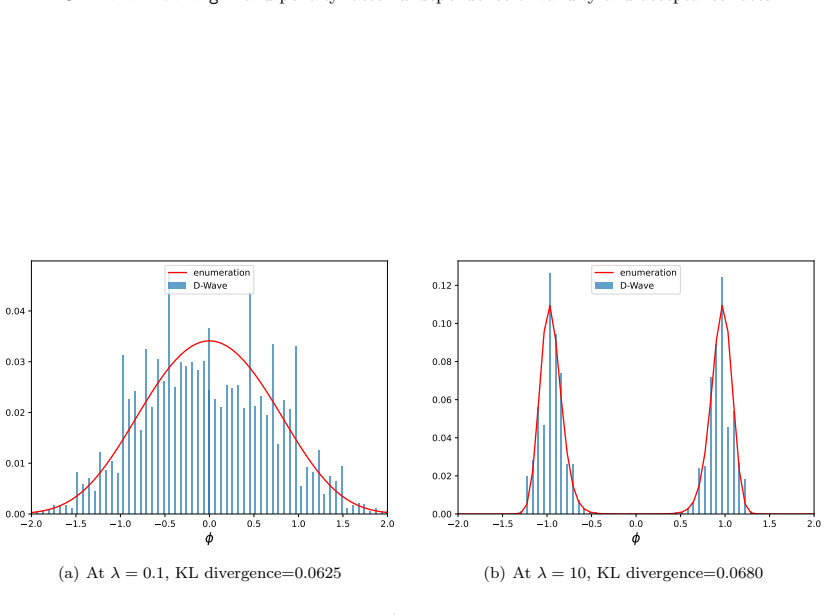
The central claim is that a digitized scalar field can be encoded as a QUBO problem, sampled on an annealer, and then used as a Metropolis-Hastings proposal distribution that outperforms the classical local Metropolis update. The authors find that the standard penalty-based reduction, which replaces products of binary variables by auxiliary variables, explicitly breaks the $Z_2$ symmetry of the action and yields too few valid samples; a two-auxiliary-qubit variant $\tilde P(q_1,q_2;z,s)$ restores the symmetry at the price of $n_q^2$ logical qubits per site; and a third scheme that adds a single sign qubit, $\phi(x) = (1-2s)(\phi_{\min} + \delta\sum_n 2^n q_n(x))$, gives the best fidelity, with Kullback-Leibler divergence below 0.07 against exact enumeration. On this basis the paper reports acceptance rates near 80% where local Metropolis falls to roughly 20%, agreement of $\langle|\phi|\rangle$, susceptibility, and skewness $B_3$ with classical runs, a critical line $\kappa_c(\lambda)$ that interpolates between the Gaussian and Ising regimes, and an integrated autocorrelation time of 184.7 versus 873.6 for classical Metropolis at $\lambda=10$, $\kappa=0.5$ on a $64\times64$ lattice. The authors conclude that, despite current hardware constraints, annealers can generate physically relevant scalar-field configurations efficiently.
Load-bearing premise
The load-bearing premise is that the right classical baseline is a local Metropolis update on continuous variables; the paper never compares against a classical heatbath that draws each site from the exact digitized Boltzmann distribution, which at 5 or 6 bits per site would accept every proposal and have near-zero autocorrelation.
Editorial extensions
If this is right
- Continuous scalar field theories become accessible to annealer-based importance sampling, extending earlier annealing work that was restricted to integer-valued degrees of freedom.
- The hybrid scheme reaches the same statistical precision with roughly one-third the number of samples at $\lambda=10$, $\kappa=0.5$ on a $64\times64$ lattice, because the annealer-generated proposal decorrelates about five times faster than a local Metropolis update.
- The acceptance rate functions as a built-in fidelity check, since a proposal perfectly matching the target distribution would be accepted with probability one; the high acceptance observed across lattice sizes indicates the annealer histograms remain close to the digitized Boltzmann distribution.
- Extending the method to $\kappa\neq0$ by conditioning the annealer on boundary conditions (Table IV) would let quantum sampling operate natively in the interacting regime, rather than reusing $\kappa=0$ histograms as the paper currently does.
Reading between the lines
- The physical-qubit cost of embedding grows near-exponentially with the number of precision bits (Fig. 11), so on current hardware the practical advantage is confined to coarse digitizations; the paper's 50-qubit-per-site scenario is a scaling argument rather than a near-term experiment.
- Method II's $Z_2$-symmetric penalty is the natural building block for studies in which the symmetry is itself an observable, such as magnetization or Binder cumulants (standard symmetry-sensitive cumulants); the paper reserves Method III for the phase-boundary study and does not compare the two on symmetric-phase observables.
- A testable next step the paper itself outlines is to generate the boundary-condition-conditioned histograms of Table IV for $n_q=5,6$ and check whether acceptance stays near 80% for $\kappa\neq0$; only then would the reported $\kappa\neq0$ efficiency gain be genuinely quantum-native rather than inherited from classical Metropolis post-processing.
- The paper's infeasibility argument against classical histogram sampling counts enumerated configurations ($2^{50}$ per site at 50 qubits); classical heatbath or rejection sampling from a stored histogram avoids enumeration entirely, so that argument would need a wall-clock comparison against such samplers to stand.
Editorial analysis
A structured set of objections, weighed in public.
Referee Report
Summary. The paper presents a hybrid classical-quantum sampling framework for 2D Euclidean lattice phi^4 scalar field theory on a D-Wave quantum annealer. Three QUBO reformulations are introduced to reduce quartic interactions to quadratic form via auxiliary qubits; Method III, which adds a sign qubit, achieves the best fidelity. The annealer-generated single-site histograms are used as Metropolis-Hastings proposals, and the resulting observables and phase boundary are compared with classical Metropolis simulations. The central claim is that quantum annealers can efficiently sample scalar field configurations and offer a scalable framework for QFT simulations, supported by acceptance rates above 70%, small KL divergences, and a lower integrated autocorrelation time than local Metropolis.
Significance. If the efficiency claim held, the work would be a useful demonstration of using quantum annealers to generate local Boltzmann weights for continuous-field theories, with the strength of being benchmarked against exact enumeration (Figs. 1, 2, 5) and of using a correct Metropolis-Hastings acceptance correction (Eq. (13)). The explicit KL divergences, autocorrelation analysis, and the proposed extension to nonzero kappa via boundary-condition-dependent histograms are commendable. However, the practical significance is currently not established: at the demonstrated digitization the single-site distribution is classically trivial, and the efficiency comparison omits the exact classical heatbath baseline. The claimed quantum advantage therefore rests on a comparison against a deliberately weak classical algorithm.
major comments (4)
- [Section III, Eq. (13), Table III] The efficiency comparison is against local Metropolis on continuous fields, not against the exact single-site heatbath that is classically trivial at the demonstrated resolution. Equation (13) states that a perfect histogram is equivalent to a heatbath with acceptance 1. For Method III with n_q=5 plus a sign qubit, the single-site distribution has only 64 states and is exactly enumerable, as the paper's own red 'enumeration' lines in Figs. 1, 2, and 5 show. A classical heatbath using those exact weights has acceptance 1 and essentially zero autocorrelation. The reported tau_int=184.7 for the D-Wave proposal versus 873.6 for local Metropolis therefore does not establish an efficiency advantage; the D-Wave-generated histogram (KL~0.068, acceptance~0.8) is strictly less efficient than this exact classical baseline. The claim of 'approximately one-third the number of samples' must be rebenchmarked against the heatbath.
- [Section IV, '50 qubits' paragraph] The infeasibility argument for classical histogram sampling is a strawman. At the demonstrated resolution, the single-site distribution is 64-128 states and is exactly enumerable in microseconds; the paper itself performs such enumeration for the comparison curves. For larger n_q, classical algorithms can sample from the single-site Boltzmann distribution without enumerating all 2^50 states, for example by inverse-CDF or rejection sampling on the continuous field. Moreover, Table V and Fig. 11 show that n_q=50 would require 1+50*51/2=1276 logical qubits per site for Method III and a number of physical qubits orders of magnitude beyond the ~5000 currently available, so the 50-qubit scenario is not a realistic extrapolation of the hardware tested. The exponential-enumeration argument is therefore not relevant to the demonstrated method.
- [Fig. 10] The phase boundary kappa_c(lambda) is presented with no error bars, bootstrap intervals, or other uncertainty quantification, even though it is extracted from a kappa scan with 0.01 resolution using autocorrelated Monte Carlo data. Section III reports that the proposal histograms are generated at kappa=0 and that per-boundary-condition distributions for nonzero kappa were not produced, so the simulations at nonzero kappa use a systematically biased proposal. As a consequence, the claimed nonmonotonic shape of kappa_c(lambda) (rise, plateau, fall) is not statistically supported as presented. Please provide uncertainties and state whether the kappa_c values include any correction for the proposal bias.
- [Appendix A, Table III] The autocorrelation comparison at kappa=0.5 is made using histograms generated at kappa=0, as Section III states that distributions for different boundary conditions at nonzero kappa were not generated. The D-Wave proposal at kappa=0.5 is therefore systematically mismatched to the target distribution, and the reported tau_int improvement may reflect the particular choice of proposal rather than any intrinsic advantage of the quantum-generated distribution. To make the efficiency claim meaningful, report the acceptance rate and integrated autocorrelation time for the actual kappa=0.5 runs, and compare against a classical heatbath that uses the exact kappa=0.5 single-site distributions, which are classically computable for 64-128 states.
minor comments (5)
- [Eq. (12)] The notation in Eq. (12) contains a typo: '2^n q q(x)' should presumably be '2^n q_n(x)'.
- [Figs. 3(b), 7(b)] The y-axis labels in these figures appear as '| |' with the phi symbol missing; they should read '<|phi|>'.
- [Reference [1]] The text identifies the D-Wave Advantage2 prototype as being 'built on the Pegasus topology'; if this prototype uses a different topology, the statement should be corrected or clarified.
- [Table IV and surrounding text] The term 'boundary condition' is used before it is defined; the definition of the nearest-neighbor sum in Eq. (15) should be introduced before Table IV.
- [Conclusion] The statement that 'the scalar field was digitized using only six qubits per site' is ambiguous; clarify whether this refers to total qubits per site (1 sign + 5 precision) or precision qubits only.
Circularity Check
No significant circularity: the QUBO encodings are exact algebraic constructions, the Metropolis-Hastings correction is derived from detailed balance, and the physical benchmarks are external to the fitted hyperparameters.
full rationale
The derivation chain is self-contained. The polynomial reductions in Eq. (6) and Eq. (8) are exact penalty constructions whose zero-minimum conditions enforce the auxiliary-variable constraints; Eq. (10) is an algebraic consequence of Eq. (9), and the paper verifies the truth tables in Tables I and II rather than assuming the target distribution. The digitization in Eqs. (5) and (12) is a standard binary encoding, and no observable is defined in terms of the annealer output. The Metropolis-Hastings acceptance formula in Eq. (13) is the textbook detailed-balance correction, so the use of acceptance rate and KL divergence as fidelity diagnostics is logically derived rather than circular. The hyperparameters w and chain strength are tuned on the device, but the paper does not rename fitted values as predictions; the reported tau_int, observables, and phase-boundary curves are measured outputs benchmarked against classical Metropolis and exact enumeration. The self-citations in Refs. [2-4] are background references for annealer-based importance sampling and are not load-bearing for the current construction. The most serious caveat, that the efficiency comparison omits a classical digitized heatbath baseline (a baseline the paper itself notes in Eq. (13) would achieve acceptance 1), is a fairness/correctness concern rather than a circularity of the derivation.
Assumptions & free parameters
free parameters (4)
- Penalty factor w =
w=50 (Method I), w=10 (Method II), w=3 (Method III)
- Chain strength =
0.4 (Methods I/II); optimized around 0.3-0.5 (Method III)
- Digitization bounds phi_min, phi_max =
[-2,2] for Methods I/II; [0,2] for Method III; phi_max=10 for lambda<2 and 2 otherwise in phase diagram
- Precision qubits n_q =
5-6 for main results; up to 9 for scaling
assumptions (4)
- standard math The penalty function P(q1,q2;z) in Eq.(6) has minimum 0 exactly when z=q1*q2.
- standard math The enhanced penalty function P~ in Eq.(8) has minimum 0 when q1+q2+z is odd, justifying replacement (10).
- domain assumption D-Wave annealer samples approximate the low-energy Boltzmann distribution of the embedded QUBO after validity filtering.
- domain assumption A digitized scalar field with n_q bits per site is a sufficient approximation to the continuous theory for the observables studied.
Cite this review
Pith. "Pith review of Hybrid Classical-Quantum Sampling for Lattice Scalar Field Theory." pith.science (2026). https://pith.science/paper/WBC3DVZX
@misc{pith2026250609514,
  author       = {Pith},
  title        = {Pith review of: Hybrid Classical-Quantum Sampling for Lattice Scalar Field Theory},
  year         = {2026},
  howpublished = {\url{https://pith.science/paper/WBC3DVZX}},
  note         = {Machine review of arXiv:2506.09514}
}
read the original abstract
We investigate lattice scalar field theory in two-dimensional Euclidean space via a quantum annealer. To accommodate the quartic interaction terms, we introduce three schemes for rewriting them as quadratic polynomials through the use of auxiliary qubits. These methods are applied on D-Wave quantum annealer, and their effectiveness is assessed by examining the annealer-generated distributions. Using these distributions, we perform Monte Carlo sampling via the Metropolis-Hastings algorithm and compare the outcomes with those from classical Metropolis simulations.
Figures


Figures from the paper (8 more)



Reference graph
Works this paper leans on
-
[1]
Initialize the field configuration
-
[2]
1+4 (11,11) 121 1+5 (16,16) 249 1+6 (22,22) 505 1+7 (29,29) 1017 TABLE IV
Update even lattice sites: (a) Construct the QUBO for even sites us- ing nearest-neighbor interactions and qubits size of QUBO number of b.c. 1+4 (11,11) 121 1+5 (16,16) 249 1+6 (22,22) 505 1+7 (29,29) 1017 TABLE IV. The list of the QUBO matrix size and the number of distinct boundary conditions for single scalar field with one qubit for sign and other qu...
-
[3]
Update odd lattice sites: Repeat steps 2(a)- 2(e) for odd sites
-
[4]
Store the updated field configuration
-
[5]
Repeat from step 2 for the desired number of iterations. Whenκ= 0, the field variables are completely decoupled due to the absence of nearest-neighbor interactions. As a result, the target distribution does not depend on the boundary conditions, and a single sampling is sufficient to represent all cases. The scalability of the embeddings is shown in Fig.1...
-
[6]
Systems,Pegasus: The Topol- ogy of D-Wave Quantum Processors, Tech
D.-W. Systems,Pegasus: The Topol- ogy of D-Wave Quantum Processors, Tech. Rep. (D-Wave Systems Inc., 2019) https://docs.dwavesys.com/docs/latest/ c_gs_4.html#topology-intro-pegasus
work page 2019
-
[7]
J. Kim, T. Luu, and W. Unger, U(N) gauge theory in the strong coupling limit on a quan- tum annealer, Phys. Rev. D108, 074501 (2023), arXiv:2305.18179 [hep-lat]
work page Pith review arXiv 2023
-
[8]
J. Kim, T. Luu, and W. Unger, Testing impor- tance sampling on a quantum annealer for strong coupling SU(3) gauge theory, in40th Interna- tional Symposium on Lattice Field Theory(2023) arXiv:2311.07209 [hep-lat]
work page Pith review arXiv 2023
Show all 26 references
-
[9]
J. Kim, T. Luu, and W. Unger, Quantum sampling on a quantum annealer for large volumes in the strong coupling limit for gauge group U(3), Phys. Rev. D111, 094504 (2025), arXiv:2412.11677 [hep-lat]
2025 arXiv
-
[10]
A. P. Lund, M. J. Bremner, and T. C. Ralph, Quantum sampling problems, BosonSampling and quantum supremacy, npj Quantum Inf.3, 15 13 0 1000 2000 3000 4000 5000 Volume sweep 0.0 0.2 0.4 0.6 0.8 | | 64x64 Classical 64x64 D-Wave (a) Monte Carlo history 0 200 400 600 800 1000 1200...
2017
-
[11]
Ghamari, R
D. Ghamari, R. Covino, and P. Faccioli, Sam- pling a Rare Protein Transition Using Quantum Annealing, J. Chem. Theor. Comput.20, 3322 (2024)
2024
-
[12]
Vuffray, C
M. Vuffray, C. Coffrin, Y. A. Kharkov, and A. Y. Lokhov, Programmable Quantum Annealers as Noisy Gibbs Samplers, PRX Quantum3, 020317 (2022), arXiv:2012.08827 [quant-ph]
2022 arXiv
-
[13]
M. S. Jattana, Quantum annealer accelerates the variational quantum eigensolver in a triple-hybrid algorithm, Phys. Scripta99, 095117 (2024), arXiv:2407.11818 [quant-ph]
2024 arXiv
-
[14]
Z. G. Izquierdo, T. Albash, and I. Hen, Testing a Quantum Annealer as a Quantum Thermal Sam- pler, ACM Trans. Quant. Comput.2, 7 (2021), arXiv:2003.00361 [quant-ph]
2021 arXiv
-
[15]
D. S. Wild, D. Sels, H. Pichler, C. Zanoci, and M. D. Lukin, Quantum sampling algo- rithms, phase transitions, and computational complexity, Phys. Rev. A104, 032602 (2021), arXiv:2109.03007 [quant-ph]
2021 arXiv
-
[16]
Sandt and R
R. Sandt and R. Spatschek, Efficient low temper- ature Monte Carlo sampling using quantum an- nealing, Sci. Rep.13, 6754 (2023)
2023
-
[17]
Ghamari, P
D. Ghamari, P. Hauke, R. Covino, and P. Faccioli, Sampling rare conformational transitions with a quantum computer, Sci. Rep.12, 16336 (2022), arXiv:2201.11781 [quant-ph]
2022
-
[18]
Shibukawa, R
R. Shibukawa, R. Tamura, and K. Tsuda, Boltz- mann sampling with quantum annealers via fast Stein correction, Phys. Rev. Res.6, 043050 (2024), arXiv:2309.04120 [cond-mat.stat-mech]
2024 arXiv
-
[19]
F. A. Quinton, P. A. S. Myhr, M. Barani, P. C. del Granado, and H. Zhang, Quantum annealing applications, challenges and limitations for optimi- sation problems compared to classical solvers, Sci. Rep.15, 12733 (2025), arXiv:2409.05542 [quant- ph]
2025
-
[20]
Weinberg, M
P. Weinberg, M. Tylutki, J. M. R¨ onkk¨ o, J. Wester- holm, J. A. ˚Astr¨ om, P. Manninen, P. T¨ orm¨ a, and A. W. Sandvik, Scaling and Diabatic Effects in Quantum Annealing with a D-Wave Device, Phys. Rev. Lett.124, 090502 (2020)
2020
-
[21]
A. K. De, A. Harindranath, J. Maiti, and T. Sinha, Investigations in 1+1 dimensional lattice phi**4 theory, Phys. Rev. D72, 094503 (2005), arXiv:hep-lat/0506002
2005 arXiv
-
[22]
N. A. Zemlevskiy, Scalable Quantum Simula- tions of Scattering in Scalar Field Theory on 120 Qubits, (2024), arXiv:2411.02486 [quant-ph]
2024 arXiv
-
[23]
Klco and M
N. Klco and M. J. Savage, Digitization of scalar fields for quantum computing, Phys. Rev. A99, 052335 (2019), arXiv:1808.10378 [quant-ph]
2019 arXiv
-
[24]
Illa and M
M. Illa and M. J. Savage, Basic elements for sim- ulations of standard-model physics with quantum annealers: Multigrid and clock states, Phys. Rev. A106, 052605 (2022), arXiv:2202.12340 [quant- ph]
2022 arXiv
-
[25]
Boros and P
E. Boros and P. L. Hammer, Pseudo-boolean opti- mization, Discrete Applied Mathematics123, 155 (2002)
2002
-
[26]
Wolff (ALPHA), Monte Carlo errors with less errors, Comput
U. Wolff (ALPHA), Monte Carlo errors with less errors, Comput. Phys. Commun.156, 143 (2004), [Erratum: Comput.Phys.Commun. 176, 383 (2007)], arXiv:hep-lat/0306017
2004 arXiv
Reviewed August 7, 2026 · model on record in the stance chip above.
Discussion (0). Sign in to comment.