HERO: Hypothesis-Driven Evidence Retrieval from Omics for Multi-Task Breast Cancer Analysis
Pith reviewed 2026-06-26 14:26 UTC · model grok-4.3
The pith
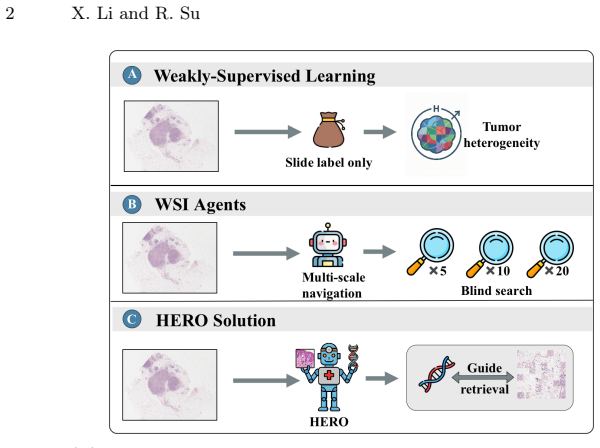
Omics signals can be turned into an explicit morphology hypothesis that guides and audits region retrieval from breast cancer whole-slide images.
A machine-rendered reading of the paper's core claim, the machinery that carries it, and where it could break.
Core claim
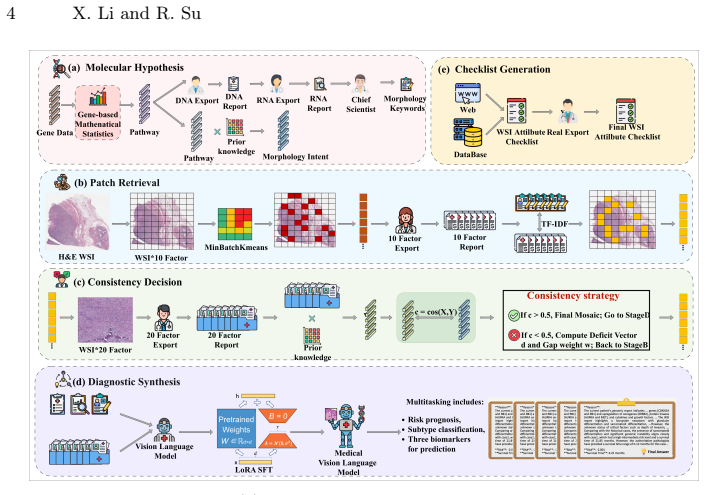
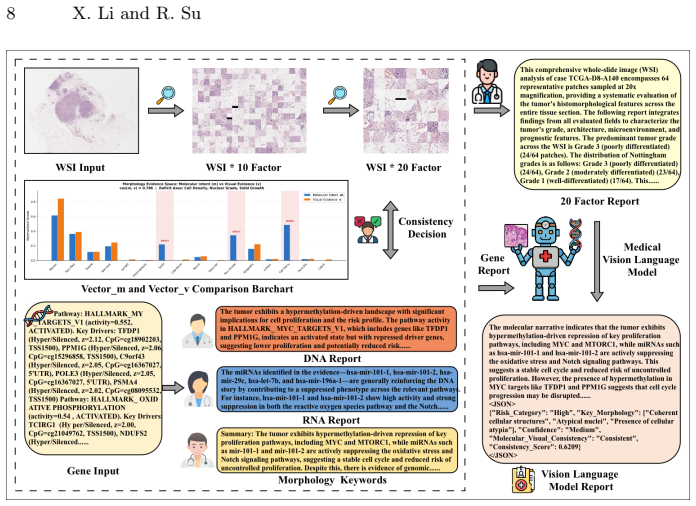
HERO shows that a sparse pathway-to-morphology prior can map DNA methylation and miRNA data into a K-dimensional intent vector m that selects endpoint-relevant image regions via TF-IDF over structured captions and is verified by a cosine gate c=cos(m,v), with deterministic deficit-driven repair triggered when c falls below threshold tau_c; this design produces new state-of-the-art performance across five multi-task prediction endpoints on TCGA-BRCA while keeping all retrieval and verification steps lexically auditable.
What carries the argument
The sparse pathway-to-morphology prior that produces a K=16 dimensional intent vector m from DNA methylation and miRNA, used for TF-IDF caption retrieval and cosine-gated verification with deficit-driven repair.
If this is right
- Every retrieval and verification step becomes lexically auditable.
- Vision-language model calls are bounded by the closed-loop cosine gate.
- Reliance on embedding-based semantic matching is reduced in favor of explicit TF-IDF retrieval.
- State-of-the-art results are obtained on ER, PR, HER2, subtype, and risk prediction under patient-level 5-fold CV.
- The same pipeline can be applied to any endpoint for which structured captions exist.
Where Pith is reading between the lines
- The approach could be tested on additional cancer types that have paired multi-omics and slide data.
- If the prior mapping holds, the method might lower the volume of manual region annotations needed for training.
- The explicit hypothesis step offers a route to insert known biological pathways directly into image retrieval pipelines.
- Performance on new cohorts would test whether the 16-dimensional intent vector generalizes beyond TCGA-BRCA.
Load-bearing premise
The sparse pathway-to-morphology prior accurately maps DNA methylation and miRNA signals into a K-dimensional intent vector that corresponds to observable morphology in the WSIs.
What would settle it
An experiment on the same TCGA-BRCA cohort in which regions retrieved by the omics-derived intent vector produce no accuracy gain over standard embedding-based or random retrieval on any of the five prediction tasks.
Figures
read the original abstract
Matched multi-omics can improve WSI-based biomarker and prognosis prediction, but most existing pipelines use omics as a paral lel feature stream or textual context rather than as an explicit retrieval constraint. HERO asks whether observed omics can be a testable mor phology hypothesis: a sparse pathway-to-morphology prior maps DNA methylation and miRNA into a K-dimensional intent vector m (K=16), TF-IDF retrieval over structured 10 captions selects endpoint-relevant regions, and a cosine gate c=cos(m,v) triggers deterministic deficit driven repair when c<{\tau}c. This closed-loop design bounds VLM calls, reduces reliance on embedding-based semantic matching, and makes every retrieval and verification step lexically auditable. On TCGA-BRCA (930WSIs, patient-level 5-fold CV), HERO sets new state-of-the-art across ER, PR, HER2, subtype, and risk prediction, outperforming both multimodal fusion and VLM-based baselines.
Editorial analysis
A structured set of objections, weighed in public.
Referee Report
Summary. The manuscript introduces HERO, a closed-loop system that treats multi-omics (DNA methylation, miRNA) as a testable morphology hypothesis. A sparse pathway-to-morphology prior produces a K=16 intent vector m; TF-IDF retrieval over 10 structured captions selects WSI patches; a cosine gate c=cos(m,v) with threshold τ_c triggers deterministic repair when similarity is low. On TCGA-BRCA (930 WSIs, patient-level 5-fold CV) the method reports new state-of-the-art results for ER/PR/HER2, subtype, and risk prediction, outperforming multimodal fusion and VLM baselines.
Significance. If the omics-derived m vector demonstrably encodes observable morphological features and the performance gains survive controls that isolate the hypothesis mechanism, the approach would supply an auditable, parameter-bounded alternative to embedding-based fusion. The lexical auditability and bounded VLM calls are potentially valuable contributions if substantiated.
major comments (3)
- [§3.1–3.2] §3.1–3.2 (Prior Construction and Intent Vector): the sparse pathway-to-morphology prior that maps methylation/miRNA to the K-dimensional vector m is asserted to produce morphology-corresponding signals, yet no equations, construction algorithm, or correlation analysis with pathologist-annotated features are supplied. This mapping is load-bearing for the claim that retrieval is hypothesis-driven rather than standard caption matching.
- [§4] §4 (Experiments, Ablations): no ablation replaces the prior-derived m with a random or non-morphology vector while keeping the rest of the pipeline fixed. Without this control, gains over VLM baselines cannot be attributed to the omics hypothesis mechanism (Table 2 and Figure 4 results).
- [§4.3] §4.3 (Statistical Reporting): SOTA claims are presented without p-values, confidence intervals, or paired statistical tests against the strongest baselines, so the magnitude and reliability of reported improvements cannot be assessed.
minor comments (2)
- [Abstract] Abstract contains typographical errors ('mor phology', 'paral lel') that should be corrected.
- [Abstract and §3.3] Notation for the cosine gate threshold is introduced as τ_c in the abstract but later appears as {τ}c; consistent symbol usage is needed.
Simulated Author's Rebuttal
We thank the referee for the constructive comments, which help clarify the presentation of the hypothesis-driven mechanism. We address each major point below and will revise the manuscript accordingly.
read point-by-point responses
-
Referee: [§3.1–3.2] §3.1–3.2 (Prior Construction and Intent Vector): the sparse pathway-to-morphology prior that maps methylation/miRNA to the K-dimensional vector m is asserted to produce morphology-corresponding signals, yet no equations, construction algorithm, or correlation analysis with pathologist-annotated features are supplied. This mapping is load-bearing for the claim that retrieval is hypothesis-driven rather than standard caption matching.
Authors: We agree the construction details were insufficiently specified. The revised manuscript will add the explicit equations defining the sparse pathway-to-morphology prior, the algorithm that produces the K=16 intent vector m from methylation and miRNA inputs, and any available quantitative correlations between m and morphological descriptors. This will substantiate that retrieval is driven by the omics-derived hypothesis rather than generic caption matching. revision: yes
-
Referee: [§4] §4 (Experiments, Ablations): no ablation replaces the prior-derived m with a random or non-morphology vector while keeping the rest of the pipeline fixed. Without this control, gains over VLM baselines cannot be attributed to the omics hypothesis mechanism (Table 2 and Figure 4 results).
Authors: We concur that the current ablations do not isolate the contribution of the morphology prior. In the revision we will add a controlled ablation that substitutes a random or non-morphology vector for m while freezing all other components (TF-IDF retrieval, cosine gate, repair logic, and VLM), and report the resulting performance drop on the TCGA-BRCA tasks. revision: yes
-
Referee: [§4.3] §4.3 (Statistical Reporting): SOTA claims are presented without p-values, confidence intervals, or paired statistical tests against the strongest baselines, so the magnitude and reliability of reported improvements cannot be assessed.
Authors: We will augment the experimental section with 95% confidence intervals, p-values from paired tests (McNemar for classification tasks, Wilcoxon signed-rank for regression), and direct comparisons against the strongest multimodal and VLM baselines in Table 2 and Figure 4. revision: yes
Circularity Check
No circularity: derivation relies on external prior assumption without self-referential reduction
full rationale
The abstract presents the sparse pathway-to-morphology prior as an input that produces the K=16 intent vector m, which then drives TF-IDF retrieval and cosine gating; no equations, parameter-fitting steps, or self-citations are shown that would make the reported SOTA performance on TCGA-BRCA equivalent to the evaluation data by construction. The prior is treated as an independent hypothesis rather than derived from the same patient-level folds or fitted thresholds. Absent any quoted reduction (e.g., m defined via the same cosine similarity used for gating, or thresholds tuned on the test set), the chain remains non-circular and self-contained against the stated benchmarks.
Axiom & Free-Parameter Ledger
free parameters (2)
- K =
16
- tau_c
axioms (1)
- domain assumption Omics measurements can be mapped via a sparse pathway-to-morphology prior into an intent vector that corresponds to observable WSI morphology.
Reference graph
Works this paper leans on
-
[1]
Communications Medicine4(48) (2024)
Arslan, S., Schmidt, J., Bass, C., et al.: A systematic pan-cancer study on deep learning-based prediction of multi-omic biomarkers from routine pathology im- ages. Communications Medicine4(48) (2024). https://doi.org/10.1038/s43856- 024-00471-5
-
[2]
arXiv preprint arXiv:2502.13923 (2025)
Bai, S., Chen, K., Liu, X., et al.: Qwen2.5-VL technical report. arXiv preprint arXiv:2502.13923 (2025)
Pith/arXiv arXiv 2025
-
[3]
Chen, R.J., Ding, T., Lu, M.Y., et al.: Towards a general-purpose foundation model for computational pathology. Nature Medicine30(3), 850–862 (Mar 2024). https://doi.org/10.1038/s41591-024-02857-3
-
[4]
Chen, R.J., Lu, M.Y., Weng, W.H., Chen, T.Y., Williamson, D.F., Manz, T., Shady, M., Mahmood, F.: Multimodal co-attention transformer for sur- vival prediction in gigapixel whole slide images. In: 2021 IEEE/CVF Interna- tional Conference on Computer Vision (ICCV). pp. 3995–4005. IEEE (Oct 2021). https://doi.org/10.1109/iccv48922.2021.00398
-
[5]
In: Proceedings of the IEEE/CVF Conference on Computer Vision and Pattern Recognition (CVPR)
Chen, Y., Wang, G., Ji, Y., et al.: SlideChat: A large vision-language assistant for whole-slide pathology image understanding. In: Proceedings of the IEEE/CVF Conference on Computer Vision and Pattern Recognition (CVPR). pp. 5134–5143 (Jun 2025) 10 X. Li and R. Su
2025
-
[6]
https://doi.org/10.1093/nar/gkx1067
Chou, C.H., Shrestha, S., Yang, C.D., et al.: miRTarBase update 2018: a resource forexperimentallyvalidatedmicroRNA-targetinteractions.NucleicAcidsResearch 46(D1), D296–D302 (Jan 2018). https://doi.org/10.1093/nar/gkx1067
-
[7]
Ding, T., Wagner, S.J., Song, A.H., et al.: A multimodal whole-slide foun- dation model for pathology. Nature Medicine31, 3749–3761 (Nov 2025). https://doi.org/10.1038/s41591-025-03982-3
-
[8]
Ekholm,A.,Wang,Y.,Vallon-Christersson,J.,etal.:Predictionofgeneexpression- based breast cancer proliferation scores from histopathology whole slide images us- ing deep learning. BMC Cancer24, 1510 (2024). https://doi.org/10.1186/s12885- 024-13248-9
-
[9]
arXiv preprint arXiv:2502.02673 (2025)
Fallahpour, A., Ma, J., Munim, A., et al.: MedRAX: Medical reasoning agent for chest x-ray. arXiv preprint arXiv:2502.02673 (2025)
arXiv 2025
-
[10]
In: International Conference on Learning Representations (ICLR 2022) (2022)
Hu, E.J., Shen, Y., Wallis, P., et al.: LoRA: Low-rank adaptation of large language models. In: International Conference on Learning Representations (ICLR 2022) (2022)
2022
-
[11]
In: Proceedings of the 35th International Conference on Machine Learning (ICML)
Ilse,M.,Tomczak,J.,Welling,M.:Attention-baseddeepmultipleinstancelearning. In: Proceedings of the 35th International Conference on Machine Learning (ICML). Proceedings of Machine Learning Research, vol. 80, pp. 2127–2136. PMLR (2018)
2018
-
[12]
Jaume, G., Vaidya, A., Chen, R.J., Williamson, D.F., Liang, P.P., Mahmood, F.: Modeling dense multimodal interactions between biological pathways and histology for survival prediction. In: 2024 IEEE/CVF Conference on Computer Vision and Pattern Recognition (CVPR). pp. 11579–11590. IEEE (Jun 2024). https://doi.org/10.1109/cvpr52733.2024.01100
-
[13]
arXiv preprint arXiv:2404.15155 (2024)
Kim, Y., Park, C., Jeong, H., et al.: MDAgents: An adaptive collaboration of LLMs for medical decision-making. arXiv preprint arXiv:2404.15155 (2024)
arXiv 2024
-
[14]
In: Advances in Neural Information Processing Systems (NeurIPS 2017)
Klambauer, G., Unterthiner, T., Mayr, A., Hochreiter, S.: Self-normalizing neural networks. In: Advances in Neural Information Processing Systems (NeurIPS 2017). pp. 971–980 (2017)
2017
-
[15]
In: Findings of the Association for Computational Linguistics: EMNLP 2024
Li, B., Yan, T., Pan, Y., et al.: MMedAgent: Learning to use medi- cal tools with multi-modal agent. In: Findings of the Association for Computational Linguistics: EMNLP 2024. pp. 8745–8760 (Nov 2024). https://doi.org/10.18653/v1/2024.findings-emnlp.510
-
[16]
In: Proceedings of the IEEE/CVF International Con- ference on Computer Vision (ICCV)
Liang, Y., Lyu, X., Chen, W., et al.: WSI-LLaVA: A multimodal large language model for whole slide image. In: Proceedings of the IEEE/CVF International Con- ference on Computer Vision (ICCV). pp. 22718–22727 (Oct 2025)
2025
-
[17]
Cell Systems 1(6), 417–425 (Dec 2015)
Liberzon, A., Birger, C., Thorvaldsdóttir, H., Ghandi, M., Mesirov, J.P., Tamayo, P.: The molecular signatures database hallmark gene set collection. Cell Systems 1(6), 417–425 (Dec 2015). https://doi.org/10.1016/j.cels.2015.12.004
-
[18]
npj Breast Cancer10(18) (2024)
Liu, H., Xie, X., Wang, B.: Deep learning infers clinically relevant protein levels and drug response in breast cancer from unannotated pathology images. npj Breast Cancer10(18) (2024). https://doi.org/10.1038/s41523-024-00620-y
-
[19]
arXiv preprint arXiv:2602.12441 (2026)
Liu, L., Pan, X., Yuan, Y., et al.: Prototype-driven fusion of pathology and spatial transcriptomics for interpretable survival prediction. arXiv preprint arXiv:2602.12441 (2026)
arXiv 2026
-
[20]
Mondol, R.K., Millar, E.K.A., Graham, P.H., Browne, L., Sowmya, A., Meijer- ing, E.: hist2RNA: An efficient deep learning architecture to predict gene ex- pression from breast cancer histopathology images. Cancers15(9), 2569 (2023). https://doi.org/10.3390/cancers15092569
-
[21]
In: Advances in Neural Information Processing Systems (NeurIPS 2021)
Shao, Z., Bian, H., Chen, Y., Wang, Y., Zhang, J., Ji, X., Zhang, Y.: TransMIL: Transformer based correlated multiple instance learning for whole slide image clas- HERO: Hypothesis-Driven Evidence Retrieval from Omics 11 sification. In: Advances in Neural Information Processing Systems (NeurIPS 2021). pp. 2136–2147 (2021)
2021
-
[22]
In: Findings of the Association for Computational Linguistics: ACL 2024
Tang, X., Zou, A., Zhang, Z., Li, Z., Zhao, Y., Zhang, X., Cohan, A., Gerstein, M.: MedAgents: Large language models as collaborators for zero-shot medical reason- ing. In: Findings of the Association for Computational Linguistics: ACL 2024. pp. 599–621 (Aug 2024). https://doi.org/10.18653/v1/2024.findings-acl.33
-
[23]
arXiv preprint arXiv:2408.09554 (2024)
Wang, Y.K., Tydlitatova, L., Kunz, J.D., et al.: Screen them all: High-throughput pan-cancer genetic and phenotypic biomarker screening from H&E whole slide images. arXiv preprint arXiv:2408.09554 (2024)
arXiv 2024
-
[24]
Image Analysis and Stereology44(3), 159–170 (2025)
Wu, S., Xu, S.: Virtual immunohistochemistry for breast cancer biomarker pre- diction from H&E-stained images using generative network. Image Analysis and Stereology44(3), 159–170 (2025). https://doi.org/10.5566/ias.3613
-
[25]
A whole-slide foundation model for digital pathology from real-world data
Xu, H., Usuyama, N., Bagga, J., et al.: A whole-slide foundation model for dig- ital pathology from real-world data. Nature630(8015), 181–188 (May 2024). https://doi.org/10.1038/s41586-024-07441-w
-
[26]
URL https://doi.org/10.1109/ ICCV51070.2023.00008
Xu, Y., Chen, H.: Multimodal optimal transport-based co-attention transformer with global structure consistency for survival prediction. In: 2023 IEEE/CVF In- ternational Conference on Computer Vision (ICCV). pp. 21184–21194. IEEE (Oct 2023). https://doi.org/10.1109/iccv51070.2023.01942
-
[27]
IEEE Transactions on Medical Imaging (2024)
Zhou, H., Zhou, F., Chen, H.: Cohort-individual cooperative learning for multi- modal cancer survival analysis. IEEE Transactions on Medical Imaging (2024). https://doi.org/10.1109/TMI.2024.3455931, early access
discussion (0)
Sign in with ORCID, Apple, or X to comment. Anyone can read and Pith papers without signing in.