REVIEW 1 major objections 5 minor 5 cited by
Cosmological Inference using Gravitational Wave Standard Sirens: A Mock Data Challenge
T0 review · 1 major / 5 minor · reviewed 2026-08-14 · deepseek-v4-flash
Pith's one-line read A Bayesian analysis of mocked gravitational-wave events recovers an unbiased Hubble constant from incomplete galaxy catalogs, with 4.4% precision in the most realistic setup.
desk verdict A solid, honest validation of the gwcosmo catalog-standard-siren pipeline, with the unbiasedness claim correctly confined to exactly-known selection functions — one unsupported robustness paragraph keeps it from being stronger. read the letter →
The pith
A machine-rendered reading of the paper's core claim, the machinery that carries it, and where it could break.
The reading
What carries the argument
The central object is the per-event galaxy-catalog likelihood, which splits the host into two exhaustive cases, in the catalog ($G$) and out of the catalog ($\bar{G}$): $p(x^{GW}\mid D^{GW},H_0)=p(x^{GW}\mid G,\ldots)p(G\mid\ldots)+p(x^{GW}\mid \bar{G},\ldots)p(\bar{G}\mid\ldots)$. The in-catalog term is a sum over catalog galaxies weighted by their redshifts and, optionally, their luminosities; the out-of-catalog term is an integral over galaxies dimmer than the apparent-magnitude threshold, so catalog incompleteness is corrected exactly rather than approximated. A standard power-law-plus-exponential luminosity function generates the galaxy population, and a Monte-Carlo detection efficiency $p(D^{GW}\mid z,\Omega,H_0)$ corrects for the fact that nearer and more favorably oriented mergers are preferentially detected. The machinery's job is to make both electromagnetic and gravitational-wave selection effects calculable within one posterior over $H_0$.
What would settle it
Re-analyze the same 249 simulated events with deliberately mismatched luminosity-function parameters or a sky-varying magnitude limit, and check whether the recovered $H_0$ shifts by more than the statistical width of the posterior; the paper's own robustness checks only vary these inputs within current measurement uncertainties.
Extended reading notes
Core claim
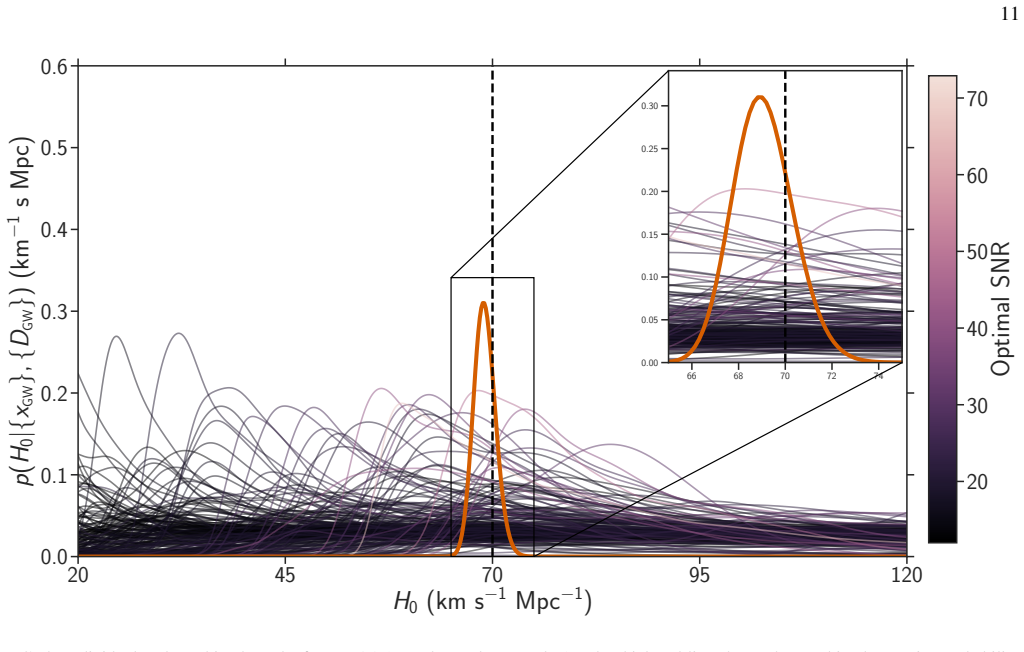
For every simulated data set, the final posterior on $H_0$ contains the injected value of $70\,\mathrm{km}\,\mathrm{s}^{-1}\,\mathrm{Mpc}^{-1}$, even with a catalog that contains only a quarter of host galaxies. The paper's central claim is that combining a detection-efficiency term $p(D^{GW}\mid H_0)$ with an electromagnetic selection term that separates in-catalog and out-of-catalog hosts removes the bias that magnitude-limited catalogs would otherwise introduce. It also claims that weighting candidate hosts by luminosity improves the $H_0$ constraint by a factor of 1.2 for the tested configuration. In the most realistic mock, with a galaxy density about three times the local value and a catalog that contains half the host luminosity to a reference distance, the combined result reaches 4.4% fractional precision using about 249 binary neutron star detections at second-observing-run sensitivity.
Load-bearing premise
The entire unbiasedness result rests on the assumption that the observer knows the galaxy luminosity function and the catalog's apparent-magnitude cutoff exactly, so the out-of-catalog correction is exactly calculable.
Editorial extensions
If this is right
- The method passes every mock data analysis: all combined posteriors are consistent with the simulated $H_0=70\,\mathrm{km}\,\mathrm{s}^{-1}\,\mathrm{Mpc}^{-1}$, so catalog incompleteness alone need not bias standard-siren cosmology once selection is modeled.
- Precision degrades smoothly as catalogs become less complete: the fractional $H_0$ uncertainty grows from 1.13% with known hosts to 3.20% with a 25%-complete catalog, and the catalog-based analyses remain unbiased.
- Weighting host probability by galaxy luminosity tightens the measurement, improving the fractional uncertainty from 5.31% to 4.48% in the most realistic mock.
- The combined posterior converges roughly as $1/\sqrt{N}$ in event count for all mock types once enough events are included, with less informative catalogs taking longer to reach that scaling.
Reading between the lines
- The demonstrated unbiasedness should not be expected to carry over to real catalogs automatically, because the mocks assume exact knowledge of the luminosity function and magnitude limit; a sky-varying selection function or a misspecified luminosity function could convert the out-of-catalog term into a bias.
- If the luminosity-weighting improvement generalizes, catalog-based standard siren cosmology will benefit from using star-formation or stellar-mass tracers rather than a single luminosity band; this is a testable prediction for future mocks with realistic host-property correlations.
- Galaxy clustering, which the mocks deliberately exclude, should help rather than hurt: even when the true host is too faint to be cataloged, a nearby cataloged galaxy can carry redshift information, so real catalogs may perform better than these mock precisions suggest.
- A natural stress test is to rerun the same 249 events with photometric redshift errors and peculiar velocities included; the paper leaves that quantification to future work.
Signed reviews
Editorial analysis
A structured set of objections, weighed in public.
Referee Report
Summary. The paper presents the Bayesian framework of the gwcosmo code for estimating H0 from gravitational-wave standard sirens using both direct EM counterparts and galaxy catalogs, with explicit modeling of GW selection effects (detection threshold) and EM selection effects (apparent-magnitude-limited catalogs). The method is validated through staged mock data analyses (MDA0-3) using 249 simulated BNS detections from the First Two Years end-to-end simulation: known host galaxies, a complete catalog, three incomplete magnitude-limited catalogs with number completeness 75%, 50%, and 25%, and a luminosity-weighted catalog with approximately 50% luminosity completeness at 115 Mpc. In every configuration the combined 249-event posterior on H0 contains the injected value of 70 km s−1 Mpc−1, with fractional uncertainties ranging from 1.13% (known hosts) to 4.48% (the most realistic MDA3 weighted case), and the convergence follows the expected 1/sqrt(N) scaling. The authors conclude that the method produces sufficiently unbiased results for the tested numbers of events, while explicitly acknowledging that the mocks exclude redshift uncertainties, peculiar velocities, and galaxy clustering.
Significance. This is a method-validation paper rather than a new physics result, but it is a valuable one: it exercises a coded implementation that has already been used for published LIGO/Virgo standard-siren measurements (Ref. [24]). Its strengths are the end-to-end simulated GW data with full parameter estimation, the staged MDA design in which each level isolates one selection effect, the analytic derivation in Section II and the Appendix, and the fact that all five analysis configurations recover the injected H0 with the expected 1/sqrt(N) convergence. The MDA0 comparison explicitly demonstrates the bias that would arise if GW selection effects were neglected, and the out-of-catalog treatment in Eq. (9) is exercised down to 25% catalog completeness. The 4.4% precision benchmark for roughly 250 O2-like BNS events with a realistic galaxy density and a 50%-luminosity-complete catalog is a useful planning number. The paper is appropriately transparent about its idealized assumptions; the main weakness is an unsupported robustness claim in Section IV F.
major comments (1)
- [Section IV F (Limited Robustness Studies)] The paragraph asserts that variations of the Schechter function parameters alpha and L* within their current measurement uncertainties produce variations in the final result 'small compared to the statistical uncertainties,' and that the results are 'robust against a small O(1) variation' in the threshold mth, but no table, figure, or numerical statement supporting either assertion appears in the manuscript. This matters because the unbiasedness demonstrated in Sections IV C and IV D relies on the out-of-catalog term in Eq. (9) and the integral in Eq. (A.19) being computed with the true EM selection function (luminosity function and mth known exactly, as stated in the opening of Section III). Section IV F is therefore the only displayed evidence that the method remains unbiased when the selection function is misspecified; the authors should either present the underlying robustness results or temper the claim to match what is actually shown.
minor comments (5)
- [Section III D (MDA3 construction)] The construction of the MDA3 universe should be clarified: the statement that 'half of the original galaxies were denoted as hosts' sits oddly with the MDA1/MDA2 setup in which each of the 50,000 injected events has a corresponding galaxy, and the resulting value of beta after the factor-of-100 density increase is not stated; please specify how host and non-host luminosities were assigned and what value of beta was actually used.
- [Section IV E (Convergence)] The sentence 'Our dataset also allows us to to assess the convergence' contains a duplicated word, and there are minor typographical artifacts elsewhere (for example, 'Completness fraction' in the Figure 1 captions) that should be cleaned up.
- [Section IV A (MDA0 results)] The dashed posterior obtained when GW selection effects are neglected is shown in Figure 2 but is not quantified; quoting its MAP value and credible interval would make the size of the demonstrated selection bias concrete.
- [Table II (Summary of results)] The table reports the MAP and 68.3% HPD interval for each MDA but not the injected value; adding a column indicating whether each interval contains H0 = 70 km s−1 Mpc−1 would make the consistency claim directly readable.
- [Section IV E (Convergence)] The fitted 1/sqrt(N) convergence coefficient is quoted only for the known-host case (about 18%); listing the fitted coefficients for all MDAs would make the convergence comparison reproducible.
Circularity Check
No significant circularity: the mock analyses recover an externally injected H0 and do not recycle any fitted parameter as a prediction.
full rationale
The paper's central claim is that its Bayesian galaxy-catalog and counterpart methods recover an unbiased estimate of H0 when applied to simulated data. The quantity being inferred, H0, is not an input to the inference pipeline: it is the fiducial value used to generate the mock galaxy redshifts, and the analysis recovers it from the simulated GW distance posteriors and catalog redshifts. None of the parameters fitted in the analysis is later relabeled as a prediction; the Schechter luminosity-function parameters, the magnitude threshold mth, and the GW selection function are stated assumptions, and the paper explicitly says they are 'assumed to be known exactly' so that the selection corrections can be computed. Using the same selection model in simulation and analysis is a controlled validation, not a reduction of the target result to its inputs. MDA3's luminosity-weighted analysis does use the same host-weighting assumption that was used to construct the mock, but the paper transparently labels this as 'the correct function of their luminosities, which happens to be known in this case,' and it also runs an unweighted analysis that remains consistent with the injected H0, so the comparison is a legitimate test rather than a construction-forced result. The 4.4% precision figure is a measured width of the 249-event posterior in the most realistic mock, not a claim about real data. The paper contains self-citations (e.g., refs. [6] and [22] share authors with this work) for convergence rates and earlier galaxy-catalog applications, but these are comparisons and background, not load-bearing justifications of the unbiasedness claim; there is no imported uniqueness theorem and no ansatz smuggled in via citation. The robustness assertion in Section IV F, which states without displayed evidence that variations of alpha and L* within measurement uncertainties and O(1) variations of mth produce small variations, is unsupported as presented, and the paper itself concedes that the mocks neglect redshift uncertainties, peculiar velocities, and galaxy clustering. These are limitations and correctness risks, not circularity: an unsupported auxiliary claim does not make the derivation equivalent to its inputs. No step in the derivation chain reduces H0 to a fitted parameter or to a self-cited prior result, so the appropriate finding is no significant circularity.
Assumptions & free parameters
free parameters (3)
- mth (MDA2 apparent magnitude thresholds) =
19.5, 18, 16
- mth (MDA3 apparent magnitude threshold) =
14
- MDA3 galaxy number density =
1 galaxy per 70 Mpc^3
assumptions (7)
- domain assumption The low-redshift linear Hubble relation dL = c z / H0 is used to build the mock universe and to analyze events.
- domain assumption The galaxy luminosity function and the catalog magnitude threshold are known exactly to the analyst.
- domain assumption GW detection efficiency and source population properties are known exactly.
- domain assumption The mock universe has no redshift uncertainties, peculiar velocities, or galaxy clustering.
- domain assumption In MDA3, the probability of a galaxy hosting a GW source is proportional to its luminosity, with p(L, s) proportional to L p(L).
- standard math A scale-free prior on the merger rate, p(R) proportional to 1/R, removes the p(Ndet|H0) term from the posterior.
- domain assumption For the counterpart method, EM counterpart detectability extends beyond the BNS GW horizon, so p(DEM|DGW, H0) is approximately 1.
Cite this review
Pith. "Pith review of Cosmological Inference using Gravitational Wave Standard Sirens: A Mock Data Challenge." pith.science (2026). https://pith.science/paper/WBQJKSJ5
@misc{pith2026190806050,
  author       = {Pith},
  title        = {Pith review of: Cosmological Inference using Gravitational Wave Standard Sirens: A Mock Data Challenge},
  year         = {2026},
  howpublished = {\url{https://pith.science/paper/WBQJKSJ5}},
  note         = {Machine review of arXiv:1908.06050}
}
abstract
The observation of binary neutron star merger GW170817, along with its optical counterpart, provided the first constraint on the Hubble constant $H_0$ using gravitational wave standard sirens. When no counterpart is identified, a galaxy catalog can be used to provide the necessary redshift information. However, the true host might not be contained in a catalog which is not complete out to the limit of gravitational-wave detectability. These electromagnetic and gravitational-wave selection effects must be accounted for. We describe and implement a method to estimate $H_0$ using both the counterpart and the galaxy catalog standard siren methods. We perform a series of mock data analyses using binary neutron star mergers to confirm our ability to recover an unbiased estimate of $H_0$. Our simulations used a simplified universe with no redshift uncertainties or galaxy clustering, but with different magnitude-limited catalogs and assumed host galaxy properties, to test our treatment of both selection effects. We explore how the incompleteness of catalogs affects the final measurement of $H_0$, as well as the effect of weighting each galaxy's likelihood of being a host by its luminosity. In our most realistic simulation, where the simulated catalog is about three times denser than the density of galaxies in the local universe, we find that a 4.4\% measurement precision can be reached using galaxy catalogs with 50\% completeness and $\sim 250$ binary neutron star detections with sensitivity similar to that of Advanced LIGO's second observing run.
Figures


Figures from the paper (7 more)


Forward citations
Cited by 5 Pith papers
-
Hubble constant measurement with 13 bright standard sirens from binary black hole mergers inside active galactic nuclei
Thirteen BBH–AGN bright standard sirens give H0 = 70.50^{+3.37}_{-2.89} (stat) ± 1.56 (cal) km s^{-1} Mpc^{-1} (4.4%), consistent with both Planck and SH0ES with no significant preference.
-
Measuring the cosmic dipole with golden dark sirens in the era of next-generation ground-based gravitational wave detectors
Golden dark sirens from next-generation gravitational-wave networks could constrain the cosmic dipole amplitude to about 10^-3 jointly with H0 and to about 10^-4 if H0 is fixed.
-
A Bright Future? Prospects for Cosmological Tests of GR with Multimessenger Gravitational Wave Events
Simulated bright siren events show LVK-era detections will not competitively constrain Horndeski gravity parameters, while one year of Einstein Telescope observations could detect αM ≠ 0 at over 3σ.
-
Null Stream Based Third-generation-ready Glitch Mitigation for Gravitational Wave Measurements
Using the null stream of a triangular Einstein Telescope, overlapping glitches can be reconstructed and subtracted without signal contamination, preserving parameter estimation accuracy where a two-L-shaped design sho...
-
The Novel Probes Project -- Tests of Gravity on Astrophysical Scales
Astrophysical-scale observations, combined with screening maps and N-body simulations, can test screened modified-gravity theories in a regime complementary to linear cosmology.
Reference graph
Works this paper leans on
-
[24]
M. Fishbach et al. (LIGO Scientific, Virgo), Astrophys. J. 871, L13 (2019), arXiv:1807.05667 [astro-ph.CO]
arXiv 2019
-
[1]
The galaxy catalog method In the galaxy catalog case, the EM information enters the analysis as a prior, made up of a series of possibly smoothened 5 delta functions3 at the redshift, right ascension (RA) and dec- lination (dec) of the possible source locations. As we are in the regime where (especially for BBHs) galaxy catalogs can- not be considered com...
-
[2]
The counterpart method The method outlined above is for the galaxy catalog case, in which no EM counterpart is observed, or expected. We also consider the case where we observe an EM counterpart. The main difference is the inclusion of a likelihood term for the EM counterpart data, mirroring that of the GW data. The likelihood in this case, which is the te...
work page 2000
-
[3]
B. F. Schutz, Nature (London) 323, 310 (1986)
1986
-
[4]
D. E. Holz and S. A. Hughes, Astrophys. J. 629, 15 (2005), arXiv:astro-ph/0504616 [astro-ph]
arXiv 2005
- [5]
-
[6]
S. Nissanke, D. E. Holz, S. A. Hughes, N. Dalal, and J. L. Sievers, Astrophys. J. 725, 496 (2010), arXiv:0904.1017 [astro- ph.CO]
arXiv 2010
-
[7]
S. Nissanke, D. E. Holz, N. Dalal, S. A. Hughes, J. L. Sievers, and C. M. Hirata, (2013), arXiv:1307.2638 [astro-ph.CO]
arXiv 2013
Show all 65 references
-
[8]
H.-Y . Chen, M. Fishbach, and D. E. Holz, Nature 562, 545 (2018), arXiv:1712.06531 [astro-ph.CO]
2018 arXiv
-
[9]
S. M. Feeney, H. V . Peiris, A. R. Williamson, S. M. Nissanke, D. J. Mortlock, J. Alsing, and D. Scolnic, Phys. Rev. Lett. 122, 061105 (2019), arXiv:1802.03404 [astro-ph.CO]
2019 arXiv
-
[10]
Di Valentino, D
E. Di Valentino, D. E. Holz, A. Melchiorri, and F. Renzi, Phys. Rev. D98, 083523 (2018), arXiv:1806.07463 [astro-ph.CO]
2018 arXiv
-
[11]
D. J. Mortlock, S. M. Feeney, H. V . Peiris, A. R. Williamson, and S. M. Nissanke, Phys. Rev. D 100, 103523 (2019)
2019
-
[12]
W. M. Farr, M. Fishbach, J. Ye, and D. Holz, Astrophys. J. Lett. 883, L42 (2019), arXiv:1908.09084 [astro-ph.CO]
2019 arXiv
- [13]
-
[14]
A. G. Riess, S. Casertano, W. Yuan, L. M. Macri, and D. Scol- nic, Astrophys. J. 876, 85 (2019), arXiv:1903.07603 [astro- ph.CO]
2019 arXiv
-
[15]
Macaulay et al
E. Macaulay et al. (DES), Mon. Not. Roy. Astron. Soc. 486, 2184 (2019), arXiv:1811.02376 [astro-ph.CO]
2019 arXiv
-
[16]
Birrer et al., Mon
S. Birrer et al., Mon. Not. Roy. Astron. Soc. 484, 4726 (2019), arXiv:1809.01274 [astro-ph.CO]
2019 arXiv
-
[17]
W. L. Freedman et al. , The Astrophysical Journal 882, 34 (2019)
2019
-
[18]
B. P. Abbott, R. Abbott, T. D. Abbott, F. Acernese, K. Ackley, C. Adams, T. Adams, P. Addesso, and et al. (LIGO Scientific Collaboration and Virgo Collaboration), Phys. Rev. Lett. 119, 161101 (2017)
2017
-
[19]
B. P. Abbott, R. Abbott, T. D. Abbott, F. Acernese, K. Ackley, C. Adams, T. Adams, P. Addesso, and et al., ApJ 848, L12 (2017)
2017
-
[20]
Soares-Santos, D
M. Soares-Santos, D. E. Holz, J. Annis, R. Chornock, K. Herner, Berger, and et al., ApJL 848, L16 (2017)
2017
-
[21]
B. P. Abbott, R. Abbott, T. D. Abbott, F. Acernese, K. Ackley, C. Adams, T. Adams, P. Addesso, and et al. (LIGO Scientific Collaboration and Virgo Collaboration), Nature (London) 551, 85 (2017), arXiv:1710.05835
2017 arXiv
- [22]
-
[23]
B. P. Abbott et al., Physical Review X 9 (2019), 10.1103/phys- revx.9.031040
2019 doi
-
[25]
Soares-Santos et al
M. Soares-Santos et al. (DES, LIGO Scientific, Virgo), Astro- phys. J. 876, L7 (2019), arXiv:1901.01540 [astro-ph.CO]
2019 arXiv
-
[26]
B. P. Abbott et al. (LIGO Scientific, Virgo), (2019), arXiv:1908.06060 [astro-ph.CO]
2019 arXiv
-
[27]
B. P. Abbott et al. (KAGRA, LIGO Scientific, VIRGO), Living Rev. Rel. 21, 3 (2018), arXiv:1304.0670 [gr-qc]
2018 arXiv
-
[28]
Padma, Nature (London) (2019), 10.1038 /d41586-019- 00184-z
T. Padma, Nature (London) (2019), 10.1038 /d41586-019- 00184-z
2019
-
[29]
B. P. Abbott et al., The Astrophysical Journal 882, L24 (2019)
2019
-
[30]
B. P. Abbott, R. Abbott, T. D. Abbott, S. Abraham, F. Acer- nese, K. Ackley, C. Adams, R. X. Adhikari, V . B. Adya, and C. A ffeldt, Astrophys. J. 875, 161 (2019), arXiv:1901.03310 [astro-ph.HE]
2019 arXiv
-
[31]
R. Nair, S. Bose, and T. D. Saini, Phys. Rev. D98, 023502 (2018), arXiv:1804.06085 [astro-ph.CO]
2018 arXiv
-
[32]
L. P. Singer, L. R. Price, B. Farr, A. L. Urban, C. Pankow, S. Vi- tale, J. Veitch, W. M. Farr, C. Hanna, K. Cannon, T. Downes, P. Graff, C.-J. Haster, I. Mandel, T. Sidery, and A. Vecchio, Astrophys. J. 795, 105 (2014), arXiv:1404.5623 [astro-ph.HE]
2014 arXiv
-
[33]
C. P. L. Berry et al. , Astrophys. J. 804, 114 (2015), arXiv:1411.6934 [astro-ph.HE]
2015 arXiv
-
[34]
D. W. Hogg, (1999), arXiv:astro-ph /9905116 [astro-ph]
1999
-
[35]
Maggiore, Gravitational Waves V olume 1: Theory and Ex- periments (Oxford university Press, 2008)
M. Maggiore, Gravitational Waves V olume 1: Theory and Ex- periments (Oxford university Press, 2008)
2008
-
[36]
Veitch, V
J. Veitch, V . Raymond, B. Farr, W. Farr, P. Gra ff, S. Vitale, B. Aylott, K. Blackburn, N. Christensen, M. Coughlin, W. Del Pozzo, F. Feroz, J. Gair, C.-J. Haster, V . Kalogera, T. Litten- berg, I. Mandel, R. O’Shaughnessy, M. Pitkin, C. Rodriguez, C. R ¨over, T. Sidery, R. Sm...
2015 arXiv
-
[37]
S. R. Taylor, J. R. Gair, and I. Mandel, Phys. Rev. D85, 023535 (2012), arXiv:1108.5161 [gr-qc]
2012 arXiv
-
[38]
Messenger and J
C. Messenger and J. Read, Phys. Rev. Lett.108, 091101 (2012), arXiv:1107.5725 [gr-qc]
2012 arXiv
-
[39]
C. M. Springob, C. Magoulas, M. Colless, J. Mould, P. Er- dogdu, D. H. Jones, J. R. Lucey, L. Campbell, and C. J. Fluke, Mon. Not. Roy. Astron. Soc. 445, 2677 (2014), arXiv:1409.6161 [astro-ph.CO]
2014 arXiv
-
[40]
Carrick, S
J. Carrick, S. J. Turnbull, G. Lavaux, and M. J. Hudson, Mon. Not. Roy. Astron. Soc. 450, 317 (2015), arXiv:1504.04627 [astro-ph.CO]
2015 arXiv
-
[41]
Hjorth, A
J. Hjorth, A. J. Levan, N. R. Tanvir, J. D. Lyman, R. Wojtak, S. L. Schrøder, I. Mandel, C. Gall, and S. H. Bruun, Astrophys. J. 848, L31 (2017), arXiv:1710.05856 [astro-ph.GA]
2017 arXiv
-
[42]
Guidorzi et al
C. Guidorzi et al. , Astrophys. J. 851, L36 (2017), arXiv:1710.06426 [astro-ph.CO]. 16
2017 arXiv
-
[43]
Howlett and T
C. Howlett and T. M. Davis, Mon. Not. Roy. Astron. Soc. 492, 3803 (2020), arXiv:1909.00587 [astro-ph.CO]
2020 arXiv
-
[44]
Mukherjee, G
S. Mukherjee, G. Lavaux, F. R. Bouchet, J. Jasche, B. D. Wan- delt, S. M. Nissanke, F. Leclercq, and K. Hotokezaka, (2019), arXiv:1909.08627 [astro-ph.CO]
2019 arXiv
-
[45]
Nicolaou, O
C. Nicolaou, O. Lahav, P. Lemos, W. Hartley, and J. Braden, (2019), arXiv:1909.09609 [astro-ph.CO]
2019 arXiv
-
[46]
De Vicente, E
J. De Vicente, E. S ´anchez, and I. Sevilla-Noarbe, Mon. Not. Roy. Astron. Soc. 459, 3078 (2016), arXiv:1511.07623 [astro- ph.CO]
2016 arXiv
-
[47]
Sadeh, F
I. Sadeh, F. B. Abdalla, and O. Lahav, Publ. Astron. Soc. Pac. 128, 104502 (2016), arXiv:1507.00490 [astro-ph.CO]
2016 arXiv
-
[48]
Fishbach, D
M. Fishbach, D. E. Holz, and W. M. Farr, Astrophys. J. 863, L41 (2018), [Astrophys. J. Lett.863,L41(2018)], arXiv:1805.10270 [astro-ph.HE]
2018 arXiv
-
[49]
Messick, K
C. Messick, K. Blackburn, P. Brady, P. Brockill, K. Cannon, R. Cariou, S. Caudill, S. J. Chamberlin, J. D. E. Creighton, R. Everett, C. Hanna, D. Keppel, R. N. Lang, T. G. F. Li, D. Meacher, A. Nielsen, C. Pankow, S. Privitera, H. Qi, S. Sachdev, L. Sadeghian, L. Singer, E. G....
2017 arXiv
-
[50]
Del Pozzo, C
W. Del Pozzo, C. P. Berry, A. Ghosh, T. S. F. Haines, L. P. Singer, and A. Vecchio, Mon. Not. Roy. Astron. Soc. 479, 601 (2018), arXiv:1801.08009 [astro-ph.IM]
2018 arXiv
-
[51]
D ´alya, G
G. D ´alya, G. Galg´oczi, L. Dobos, Z. Frei, I. S. Heng, R. Macas, C. Messenger, P. Ra ffai, and R. S. de Souza, Mon. Not. Roy. Astron. Soc. 479, 2374 (2018), arXiv:1804.05709 [astro- ph.HE]
2018 arXiv
-
[52]
Schechter, Astrophys
P. Schechter, Astrophys. J. 203, 297 (1976)
1976
-
[53]
L. P. Singer, H.-Y . Chen, D. E. Holz, W. M. Farr, L. R. Price, V . Raymond, S. B. Cenko, N. Gehrels, J. Cannizzo, M. M. Kasliwal, S. Nissanke, M. Coughlin, B. Farr, A. L. Urban, S. Vi- tale, J. Veitch, P. Gra ff, C. P. L. Berry, S. Mohapatra, and I. Mandel, The Astrophysical J...
2016
-
[54]
C. N. Leibler and E. Berger, Astrophys. J. 725, 1202 (2010), arXiv:1009.1147 [astro-ph.HE]
2010 arXiv
-
[55]
W. Fong, E. Berger, R. Chornock, R. Margutti, A. J. Levan, N. R. Tanvir, R. L. Tunnicli ffe, I. Czekala, D. B. Fox, D. A. Perley, S. B. Cenko, B. A. Zauderer, T. Laskar, S. E. Persson, A. J. Monson, D. D. Kelson, C. Birk, D. Murphy, M. Servillat, and G. Anglada, Astrophys. J.76...
2013 arXiv
-
[56]
Cutler and E
C. Cutler and E. E. Flanagan, Physical Review D 49, 2658–2697 (1994)
1994
-
[57]
A. M. Walker, Journal of the Royal Statistical Society. Series B (Methodological) 31, 80 (1969)
1969
-
[58]
C. L. MacLeod and C. J. Hogan, Phys. Rev. D77, 043512 (2008), arXiv:0712.0618 [astro-ph]
2008 arXiv
-
[59]
Madau and M
P. Madau and M. Dickinson, Annual Review of Astronomy and Astrophysics 52, 415–486 (2014). Appendix: Detailed methodology
2014
-
[60]
galaxies
A note on luminosity weighting and redshift evolution The probability for a galaxy to host a GW event is not uniform over all the galaxies present in the catalog. Indeed, brighter galaxies are supposed to have an higher star-formation rate and hence have an higher probability ...
-
[61]
in catalog
A detailed breakdown of the galaxy catalog case This section presents a more detailed look into the galaxy catalog method presented in section II C 1. The approach is sum- marized in Fig. 9, a network diagram which shows how each of the parameters of this extended derivation fi...
-
[62]
The catalog patch case While in general the galaxy catalog method derived in 2 was for use with a galaxy catalog which covers the entire sky, a small modification allows the use of catalogs which only cover a patch of sky, as long as the patch can be specified using limits in ri...
-
[63]
pencil-beam
Direct and pencil beam counterpart cases The “direct” method assumes that the counterpart has been unambiguously linked to the host galaxy of the GW event, such that the redshift and sky location of that galaxy can be taken to be that of the GW event with certainty, see Eq. 10...
-
[64]
8 in section II C can be written as: p(DGW|H0) = ∫ p(DGW|xGW, H0)p(xGW|H0)dxGW
GW selection e ffects Eq. 8 in section II C can be written as: p(DGW|H0) = ∫ p(DGW|xGW, H0)p(xGW|H0)dxGW. (A.22) where p(DGW|xGW, H0) is a binary quantity which is 1 if the SNR of xGW passesρth, and 0 otherwise. Looking at the individual components of Eq. 9 in their expanded fo...
-
[65]
When calculating p(D|H0) the masses are drawn from the priors on source mass, p(M1, M2) and then converted to observed masses through the equation: Mz = (1 + z)M
Prior mass distribution An event’s detectability is dependent on its observed (redshifted) detector-frame mass, Mz, but priors on the mass refer to their source-frame mass. When calculating p(D|H0) the masses are drawn from the priors on source mass, p(M1, M2) and then convert...
Reviewed August 14, 2026 · model on record in the stance chip above.
Discussion (0). Continue with ORCID to comment.