Random Local Stabilizer Codes in Three Dimensions without String or Self-Similar Fractal Logical Operators
Pith reviewed 2026-06-26 17:39 UTC · model grok-4.3
The pith
Random cubic qutrit codes in three dimensions forbid both string and self-similar fractal logical operators.
A machine-rendered reading of the paper's core claim, the machinery that carries it, and where it could break.
Core claim
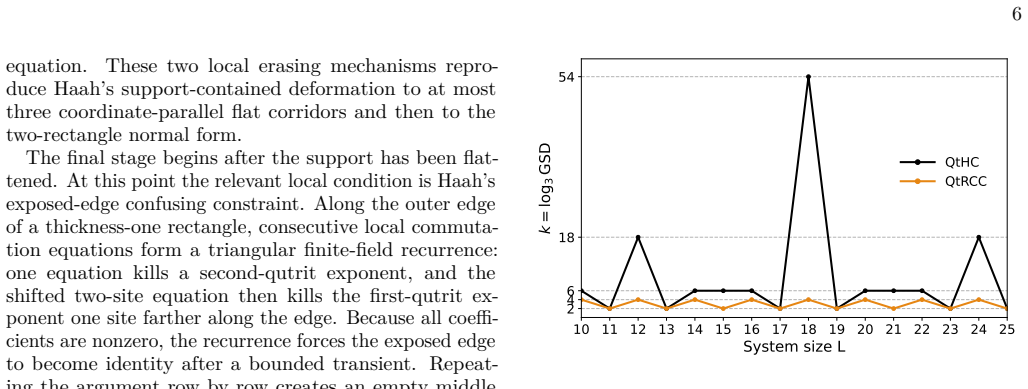
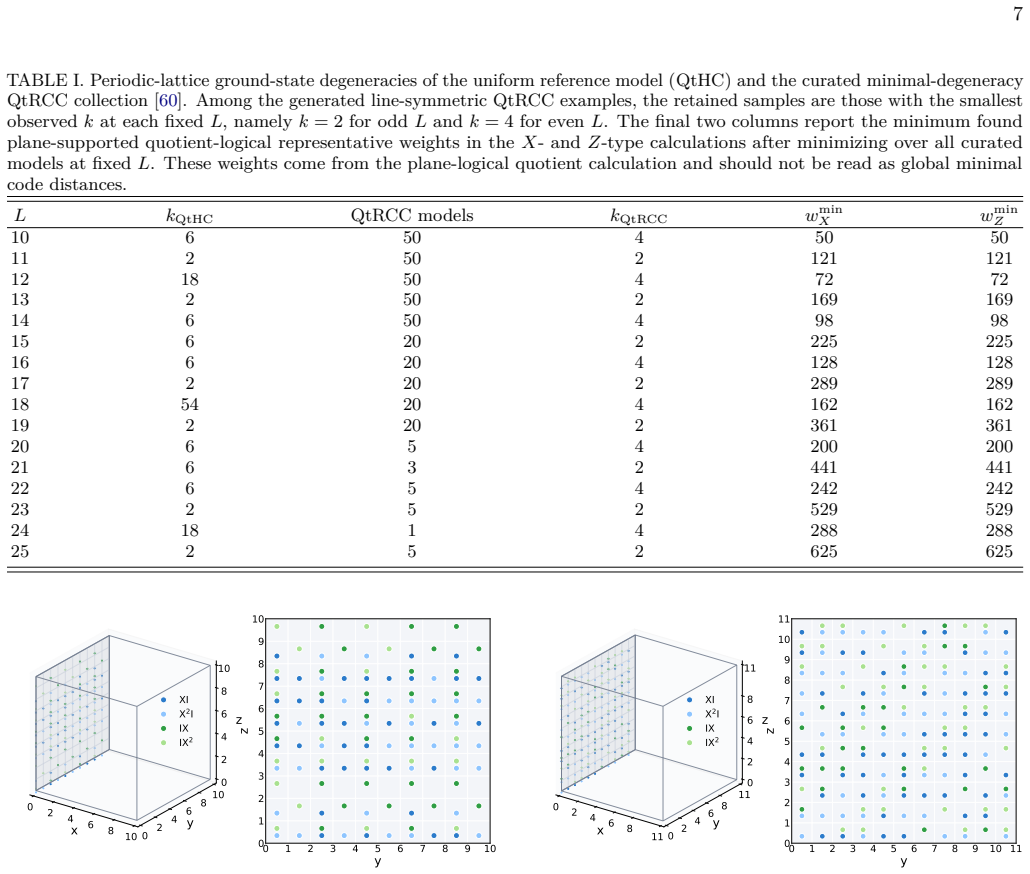
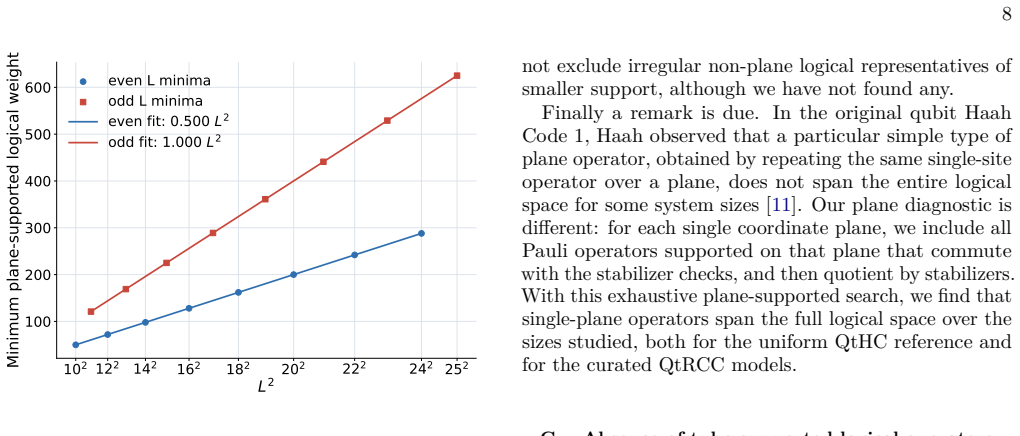
The qutrit random cubic codes are local Calderbank-Shor-Steane stabilizer Hamiltonians whose spatially varying stabilizers retain the no-string property of Haah's Code 1 while eliminating self-similar fractal logical operators; this is established by an analytic proof of the absence of strings together with finite-size numerical diagnostics that the smallest degeneracy exponent is k=2 for odd L and k=4 for even L, that non-contractible plane operators span the logical space, and that charge-push diagnostics find no fractal operators.
What carries the argument
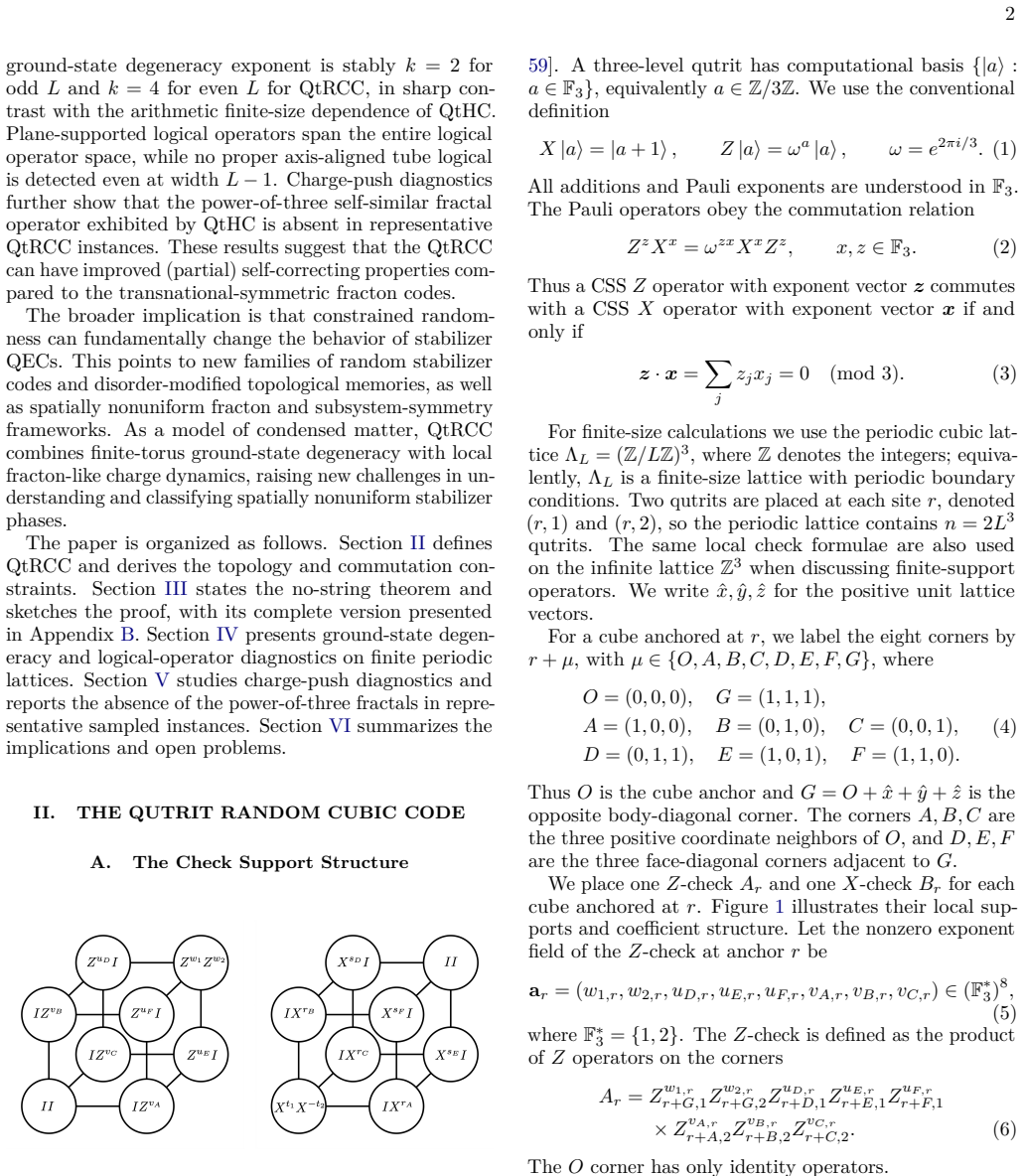
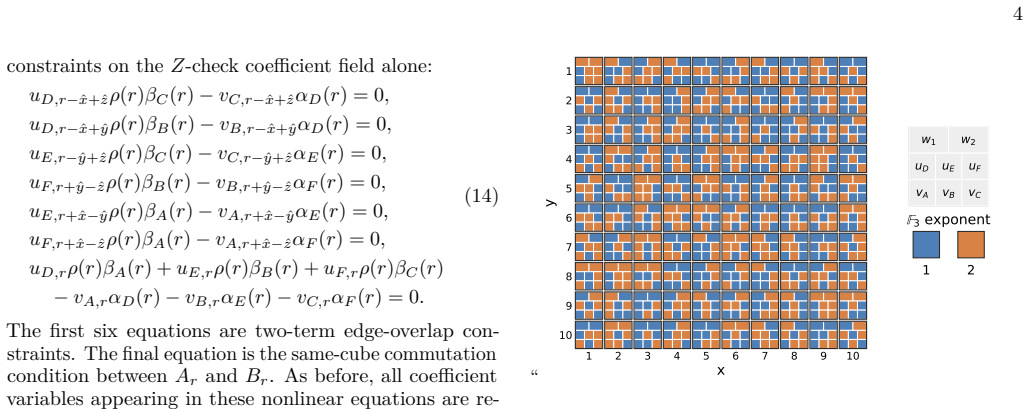
The qutrit random cubic codes: local stabilizer Hamiltonians whose cube-check operators are chosen from a spatially varying but still local set that breaks translation invariance.
If this is right
- The models retain the no-string property, so constant-energy-barrier string processes cannot create logical errors.
- Ground-state degeneracy scales with exponent k=2 for odd L and k=4 for even L, distinct from translation-invariant fracton codes.
- Non-contractible plane-logical operators span the entire logical space.
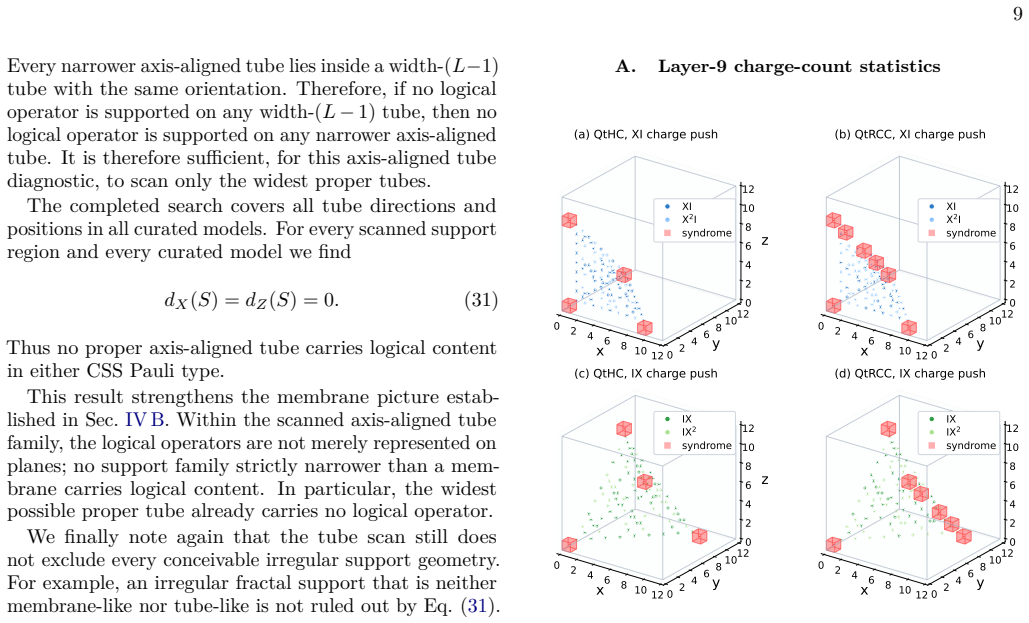
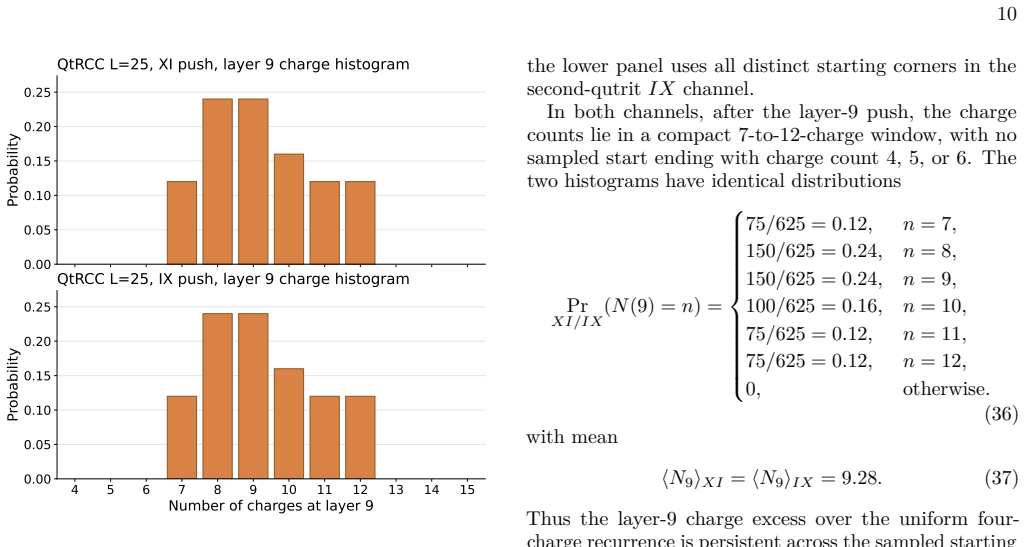
- Charge-push diagnostics detect no self-similar fractal operators, removing the logarithmic energy barrier associated with them.
- Constrained randomness can therefore change the nature of stabilizer codes and improve their self-correction properties.
Where Pith is reading between the lines
- If the numerical absence of fractals survives the infinite-volume limit, these codes would realize a new class of three-dimensional stabilizer models whose logical operators are all plane-like.
- The construction suggests that other spatially varying but still local stabilizer patterns on the cubic lattice may likewise suppress fractal operators while preserving the no-string property.
- Such models could be used to test whether self-correction thresholds improve once both string and fractal processes are removed.
Load-bearing premise
Numerical diagnostics performed on finite periodic lattices of linear size L are sufficient to conclude that self-similar fractal operators are absent in the infinite-volume limit.
What would settle it
An explicit construction or numerical detection of a self-similar fractal logical operator on a single large even-L periodic lattice of one of the random cubic codes would falsify the claim that such operators are absent.
Figures
read the original abstract
Quantum error-correcting codes (QECs) are essential components of quantum computation and have deep connections to quantum phases of matter. A key obstruction to passive self-correcting QECs is the presence of string logical operators, which can generate logical errors through constant-energy-barrier processes. Haah's Codes (fracton codes) showed that three-dimensional stabilizer codes can forbid such string logical operators, but their translation-invariant structure supports self-similar fractal logical operators with a logarithmic energy barrier. We introduce the qutrit random cubic codes, a family of local qutrit Calderbank-Shor-Steane stabilizer Hamiltonians with similar cube-check structure as Haah's Code 1 but built from spatially varying stabilizers. We prove that these models retain the no-string property and numerically observe that they have properties distinct from translation-invariant fracton codes: the smallest ground-state degeneracy exponent is $k=2$ for odd $L$ and $k=4$ for even $L$; noncontractible plane-logical operators span the entire logical space; and charge-push diagnostics show that the self-similar fractal operators are absent. These results demonstrate that constrained randomness can fundamentally change the nature of stabilizer codes and improve their self-correction properties. They further point to broader families of quantum error-correcting codes and quantum phases beyond canonical topological and fracton orders.
Editorial analysis
A structured set of objections, weighed in public.
Referee Report
Summary. The manuscript introduces a family of random qutrit cubic stabilizer codes on the 3D lattice, constructed with spatially varying stabilizers that retain a cube-check structure similar to Haah's code. It proves that these codes have no string logical operators and reports numerical diagnostics on finite periodic L×L×L systems showing degeneracy exponents k=2 (odd L) and k=4 (even L), noncontractible plane operators exhausting the logical space, and charge-push results indicating absence of self-similar fractal operators.
Significance. The explicit proof of the no-string property is a clear strength, establishing that constrained randomness preserves this feature of fracton codes. If the numerical observations on the absence of fractal operators extend to the thermodynamic limit, the work would identify a new class of 3D local stabilizer codes with potentially higher energy barriers for logical errors, expanding the landscape beyond translation-invariant fracton models.
major comments (2)
- [Numerical diagnostics (degeneracy, plane operators, charge-push)] Numerical diagnostics section: the conclusion that self-similar fractal logical operators are absent rests on charge-push diagnostics, degeneracy scaling, and plane-operator spanning on finite periodic systems; no bound or scaling analysis is supplied showing that any fractal operator (whose support can grow with L) would necessarily produce a detectable signature at the accessed system sizes, making the infinite-volume claim load-bearing but under-supported.
- [Degeneracy scaling results] Degeneracy analysis: the reported smallest ground-state degeneracy exponent k=2 for odd L and k=4 for even L is extracted from finite-L data without accompanying details on fitting procedure, error bars, or finite-size extrapolation, which directly underpins the distinction from Haah-type codes.
minor comments (1)
- [Abstract] Abstract: the phrasing 'charge-push diagnostics show that the self-similar fractal operators are absent' presents a finite-size observation as a definitive result without qualification.
Simulated Author's Rebuttal
We thank the referee for the careful review and constructive comments. We address each major comment below, agreeing on the need for greater transparency in the numerical analysis while noting the inherent limitations of finite-size diagnostics for infinite-volume claims.
read point-by-point responses
-
Referee: Numerical diagnostics section: the conclusion that self-similar fractal logical operators are absent rests on charge-push diagnostics, degeneracy scaling, and plane-operator spanning on finite periodic systems; no bound or scaling analysis is supplied showing that any fractal operator (whose support can grow with L) would necessarily produce a detectable signature at the accessed system sizes, making the infinite-volume claim load-bearing but under-supported.
Authors: We agree that the evidence for absence of self-similar fractal operators in the thermodynamic limit is drawn from finite-size numerics (charge-push, degeneracy, and plane-operator spanning) without a rigorous bound guaranteeing detectability for operators whose support may scale with L. In revision we will expand the numerical diagnostics section with additional discussion of the charge-push protocol's sensitivity, results from more system sizes, and an explicit statement of the finite-size limitation together with the scope of our claims. A full scaling bound lies beyond the present work. revision: partial
-
Referee: Degeneracy analysis: the reported smallest ground-state degeneracy exponent k=2 for odd L and k=4 for even L is extracted from finite-L data without accompanying details on fitting procedure, error bars, or finite-size extrapolation, which directly underpins the distinction from Haah-type codes.
Authors: We accept this criticism. The fitting procedure, error estimation, and extrapolation details were omitted. The revised manuscript will include an appendix describing the linear fit to log(ground-state degeneracy) versus log(L), error bars obtained from ensemble averages over random stabilizer realizations, and any finite-size extrapolation performed. This will make the reported distinction from Haah-code scaling fully transparent. revision: yes
- A rigorous bound or scaling analysis proving that any self-similar fractal operator would necessarily produce a detectable signature at the finite system sizes accessed
Circularity Check
No circularity; explicit random construction, stated proof, and finite-size numerics are independent of inputs
full rationale
The paper defines a family of random cubic qutrit CSS codes via an explicit spatially-varying stabilizer construction, proves retention of the no-string property, and reports three separate numerical diagnostics (degeneracy scaling with L parity, plane-logical operator span, charge-push) performed on finite periodic lattices. None of these steps is shown to reduce by definition or by self-citation to the target claim; the numerics are presented as observations on accessible L rather than as fitted predictions or self-referential definitions. No load-bearing self-citation chain or ansatz smuggling is identified in the provided text.
Axiom & Free-Parameter Ledger
axioms (2)
- standard math Stabilizer codes are defined by commuting local Pauli operators whose common +1 eigenspace encodes the logical information.
- domain assumption The cube-check structure can be realized with qutrit operators that remain local even when the specific choice varies spatially.
Reference graph
Works this paper leans on
-
[1]
A. R. Calderbank and P. W. Shor, Phys. Rev. A54, 1098 (1996)
1996
-
[2]
A. M. Steane, Phys. Rev. Lett77, 793 (1996)
1996
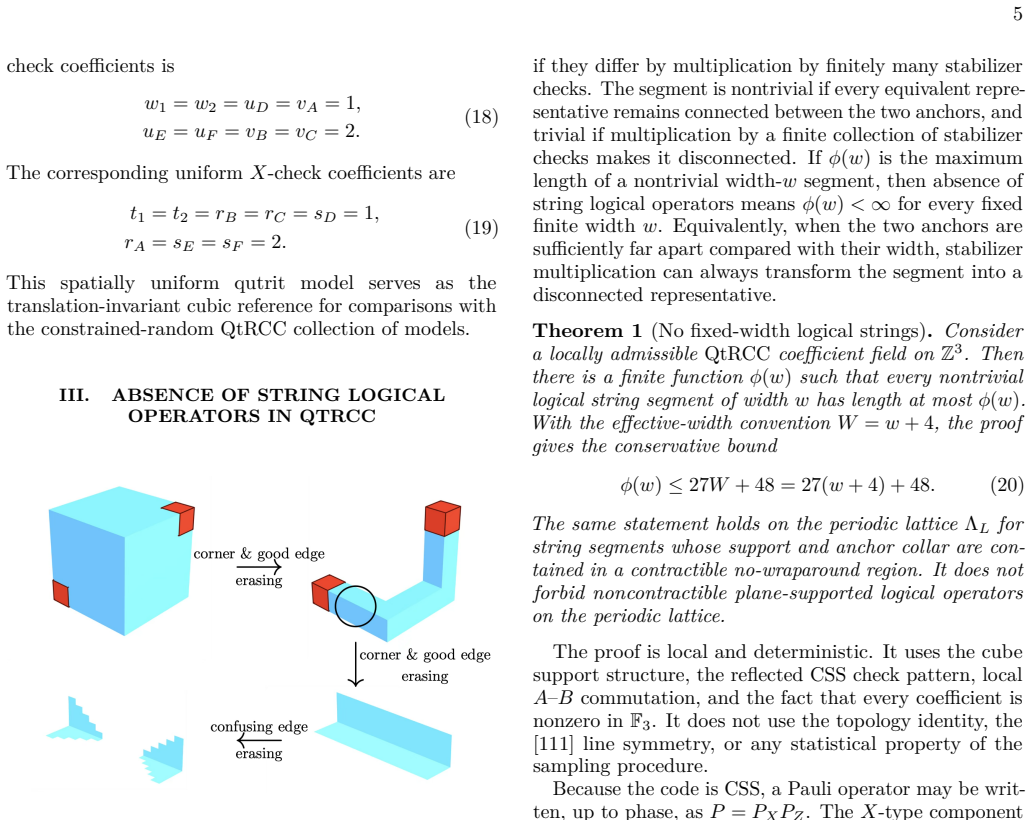
-
[3]
Gottesman,Stabilizer Codes and Quantum Error Cor- rection, Ph.D
D. Gottesman,Stabilizer Codes and Quantum Error Cor- rection, Ph.D. thesis, California Institute of Technology (1997), arXiv:quant-ph/9705052
Pith/arXiv arXiv 1997
-
[4]
V. V. Albert and P. Faist, Handbook of error-correcting codes (2026), arXiv:2606.11484 [quant-ph]
Pith/arXiv arXiv 2026
-
[5]
A. Y. Kitaev, Annals of Physics303, 2 (2003)
2003
-
[6]
Dennis, A
E. Dennis, A. Kitaev, A. Landahl, and J. Preskill, Journal of Mathematical Physics43, 4452 (2002)
2002
-
[7]
Bravyi and B
S. Bravyi and B. M. Terhal, New Journal of Physics11, 043029 (2009)
2009
-
[8]
Bravyi, D
S. Bravyi, D. Poulin, and B. Terhal, Phys. Rev. Lett104, 050503 (2010)
2010
-
[9]
B. M. Terhal, Rev. Mod. Phys.87, 307 (2015)
2015
-
[10]
B. J. Brown, D. Loss, J. K. Pachos, C. N. Self, and J. R. Wootton, Rev. Mod. Phys.88, 045005 (2016)
2016
-
[11]
Haah, Phys
J. Haah, Phys. Rev. A83, 042330 (2011)
2011
-
[12]
Chamon, Phys
C. Chamon, Phys. Rev. Lett94, 040402 (2005)
2005
-
[13]
Bravyi, B
S. Bravyi, B. Leemhuis, and B. M. Terhal, Annals of Physics326, 839 (2011)
2011
-
[14]
Bravyi and J
S. Bravyi and J. Haah, Phys. Rev. Lett107, 150504 (2011)
2011
-
[15]
I. H. Kim, 3d local qupit quantum code without string logical operator (2012), arXiv:1202.0052 [quant-ph]
Pith/arXiv arXiv 2012
-
[16]
Bravyi and J
S. Bravyi and J. Haah, Phys. Rev. Lett111, 200501 (2013)
2013
-
[17]
Haah, Communications in Mathematical Physics324, 351 (2013)
J. Haah, Communications in Mathematical Physics324, 351 (2013)
2013
-
[18]
Haah,Lattice Quantum Codes and Exotic Topological Phases of Matter, Ph.D
J. Haah,Lattice Quantum Codes and Exotic Topological Phases of Matter, Ph.D. thesis, California Institute of Technology (2013), arXiv:1305.6973
Pith/arXiv arXiv 2013
-
[19]
Yoshida, Phys
B. Yoshida, Phys. Rev. B88, 125122 (2013)
2013
-
[20]
D. J. Williamson, Phys. Rev. B94, 155128 (2016)
2016
-
[21]
A. Dua, I. H. Kim, M. Cheng, and D. J. Williamson, Phys. Rev. B100, 155137 (2019)
2019
-
[22]
A. Dua, P. Sarkar, D. J. Williamson, and M. Cheng, Phys. Rev. Res.2, 033021 (2020)
2020
-
[23]
Vijay, J
S. Vijay, J. Haah, and L. Fu, Phys. Rev. B92, 235136 (2015)
2015
-
[24]
Vijay, J
S. Vijay, J. Haah, and L. Fu, Phys. Rev. B94, 235157 (2016)
2016
-
[25]
R. M. Nandkishore and M. Hermele, Annual Review of Condensed Matter Physics10, 295 (2019)
2019
-
[26]
Pretko, X
M. Pretko, X. Chen, and Y. You, International Journal of Modern Physics A35, 2030003 (2020)
2020
-
[27]
C. T. Aitchison, D. Bulmash, A. Dua, A. C. Doherty, and D. J. Williamson, Phys. Rev. B109, 205125 (2024)
2024
-
[28]
H. Ma, E. Lake, X. Chen, and M. Hermele, Phys. Rev. B 95, 245126 (2017)
2017
-
[29]
Slagle and Y
K. Slagle and Y. B. Kim, Phys. Rev. B97, 165106 (2018)
2018
-
[30]
Shirley, K
W. Shirley, K. Slagle, Z. Wang, and X. Chen, Phys. Rev. X8, 031051 (2018)
2018
-
[31]
Shirley, K
W. Shirley, K. Slagle, and X. Chen, SciPost Physics6, 041 (2019)
2019
-
[32]
Aasen, D
D. Aasen, D. Bulmash, A. Prem, K. Slagle, and D. J. Williamson, Phys. Rev. Res.2, 043165 (2020)
2020
-
[33]
Devakul and D
T. Devakul and D. J. Williamson, Quantum5, 438 (2021)
2021
-
[34]
D. J. Williamson and T. Devakul, Phys. Rev. B103, 155140 (2021)
2021
-
[35]
Z. Song, A. Dua, W. Shirley, and D. J. Williamson, PRX Quantum4, 010304 (2023)
2023
-
[36]
Pretko, Phys
M. Pretko, Phys. Rev. B95, 115139 (2017)
2017
-
[37]
Pretko, Phys
M. Pretko, Phys. Rev. B96, 035119 (2017)
2017
-
[38]
Slagle and Y
K. Slagle and Y. B. Kim, Phys. Rev. B96, 195139 (2017)
2017
-
[39]
Bulmash and M
D. Bulmash and M. Barkeshli, Phys. Rev. B97, 235112 (2018)
2018
-
[40]
D. Bulmash and M. Barkeshli, Generalized U (1) gauge field theories and fractal dynamics (2018), arXiv:1806.01855 [cond-mat.str-el]
Pith/arXiv arXiv 2018
-
[41]
Gromov, Phys
A. Gromov, Phys. Rev. X9, 031035 (2019)
2019
-
[42]
C. Lee, Y. Hu, G. Y. Cho, and H. Watanabe, Phys. Rev. B112, 155136 (2025)
2025
-
[43]
I. H. Kim and J. Haah, Phys. Rev. Lett116, 027202 (2016)
2016
-
[44]
A. Prem, J. Haah, and R. Nandkishore, Phys. Rev. B95, 155133 (2017)
2017
-
[45]
Yan, Phys
H. Yan, Phys. Rev. B99, 155126 (2019)
2019
-
[46]
Yan, Phys
H. Yan, Phys. Rev. B100, 245138 (2019)
2019
-
[47]
Yan, Phys
H. Yan, Phys. Rev. B102, 161119 (2020)
2020
-
[48]
H. Yan, O. Benton, L. D. C. Jaubert, and N. Shannon, Phys. Rev. Lett124, 127203 (2020)
2020
-
[49]
Hering, H
M. Hering, H. Yan, and J. Reuther, Phys. Rev. B104, 064406 (2021)
2021
-
[50]
H. Yan, K. Slagle, and A. H. Nevidomskyy, Y-cube model and fractal structure of subdimensional particles on hy- perbolic lattices (2022), arXiv:2211.15829 [quant-ph]
arXiv 2022
-
[51]
Yan and A
H. Yan and A. H. Nevidomskyy, Phys. Rev. B109, 075102 (2024). 14
2024
-
[52]
K. P. Michnicki, Phys. Rev. Lett113, 130501 (2014)
2014
-
[53]
D. J. Williamson and N. Baspin, Nature Communications 15, 9528 (2024)
2024
-
[54]
Y. Tan, B. Roberts, N. Tantivasadakarn, B. Yoshida, and N. Y. Yao, Phys. Rev. Res.7, L032062 (2025)
2025
-
[55]
B. Roberts, J. M. Koh, Y. Tan, and N. Y. Yao, Cored product codes for quantum self-correction in three dimen- sions (2025), arXiv:2510.05479 [quant-ph]
arXiv 2025
-
[56]
S. Balasubramanian, M. Davydova, and T.-C. Lin, A pas- sive self-correcting quantum memory in three dimensions (2026), arXiv:2605.10943 [quant-ph]
Pith/arXiv arXiv 2026
-
[57]
Gottesman, inQuantum Computing and Quantum Communications, Lecture Notes in Computer Science, Vol
D. Gottesman, inQuantum Computing and Quantum Communications, Lecture Notes in Computer Science, Vol. 1509 (Springer, 1999) pp. 302–313
1999
-
[58]
Ashikhmin and E
A. Ashikhmin and E. Knill, IEEE Transactions on Infor- mation Theory47, 3065 (2001)
2001
-
[59]
Ketkar, A
A. Ketkar, A. Klappenecker, S. Kumar, and P. K. Sarvepalli, IEEE Transactions on Information Theory 52, 4892 (2006)
2006
-
[60]
HanYan,DataforthecuratedQtRCCmodelsconstructed in this work., https://github.com/hanyanphysics/ QTRCC(2026), gitHub repository, accessed 17 June 2026
2026
-
[61]
K. T. Tian and Z. Wang, Generalized Haah codes and fracton models (2019), arXiv:1902.04543 [quant-ph]
arXiv 2019
-
[62]
Appendix A: Local commutation equations and reduced construction This appendix records the algebraic commutation constraints used in the periodic finite-size construction
K.T.Tian, E.Samperton,andZ.Wang,AnnalsofPhysics 412, 168014 (2020). Appendix A: Local commutation equations and reduced construction This appendix records the algebraic commutation constraints used in the periodic finite-size construction. Let δ=rB−rA be the displacement from aZ-check anchor to anX-check anchor. 14 of the 27 local overlaps give nontrivial...
2020
-
[63]
A width-w anchor is a cube ofw3 lattice sites
Haah logical string segments We use Haah’s definition of a logical string segment. A width-w anchor is a cube ofw3 lattice sites. LetΩ 1 andΩ 2 be two congruent anchor cubes and letPbe a finite Pauli operator. The triple ζ= (P,Ω1,Ω 2)(B2) is a string segment if every stabilizer check that acts trivially on both anchors commutes withP. Stabilizer violation...
-
[64]
Haah’s Code 1 proof structure Haah’s Code 1 no-string proof is by contradiction: one assumes a nontrivial width-w logical string segment and then constructs an equivalent disconnected representative. The geometric part of the proof is support-contained, meaning that the checks used in the deformation do not create support outside the chosen string region ...
-
[65]
The only local cube corner that cannot serve as an erasing corner is the identity operator corner
Corner erasing for qutrit coefficients Lemma 1(Corner erasing for QtRCC).Every support-contained corner-erasing move used in Haah’s Code 1 proof has a validQtRCC analogue. The only local cube corner that cannot serve as an erasing corner is the identity operator corner. Proof.We prove the statement for anX-type Pauli operator; theZ-type statement is obtai...
-
[66]
Lemma 2(Good-edge kernel for qutrit coefficients).Let anX-type Pauli have endpoint exponents ξ(p) = (a,b), ξ(q) = (c,d)(B21) on a goodZedge with endpointZvectors(0,α)and(β,0)
Good-edge erasing for qutrit coefficients The goodZ edges used to eraseX-type support in the imported Haah deformation are the edges joining a qutrit-2-only Zcorner to a qutrit-1-onlyZcorner: {C−D, C−E, B−D, B−F, A−E, A−F}.(B19) At the two endpoints of such an edge, theZ-corner vectors have the form (0,α),(β,0), α,β∈F ∗ 3.(B20) This is the qutrit version ...
-
[67]
We first discuss anX-type Pauli operator
Confusing constraints on a thin rectangle It remains to generalize the last stage of Haah’s proof: the confusing constraint on the exposed edge of a thickness-1 flat rectangle segment of the operator. We first discuss anX-type Pauli operator. The corresponding statement for a Z-type Pauli operator is obtained by exchangingXandZand using the reflected chec...
-
[68]
Therefore the sitepj+2 carries zeroX exponent
Then the sequence is eventually zero: whenever the shifted equations are available, bj+1 = 0, a j+2 = 0, b j+2 = 0.(B36) Proof.Sinceγj̸= 0, the second equation gives bj+1 = 0.(B37) Shifting the first equation by one site gives αj+1bj+1 +βj+1aj+2 = 0.(B38) Becauseb j+1 = 0andβj+1̸= 0, this implies aj+2 = 0.(B39) Shifting the second equation givesbj+2 = 0. ...
-
[69]
Proof of Theorem 1.First consider anX-type logical string segment
Proof of the no-string theorem Having shown that Haah’s local moves and the confusing constraint all have validQtRCC analogues, we can now complete the proof of Theorem 1. Proof of Theorem 1.First consider anX-type logical string segment. By Haah’s Code 1 support-deformation argument, the segment can be reduced, using support-contained corner and good-edg...
discussion (0)
Sign in with ORCID, Apple, or X to comment. Anyone can read and Pith papers without signing in.