REVIEW 4 major objections 5 minor 18 references
Information-Theoretic Adaptive Cooling for Deterministic MPPI via Entropy Feedback
T0 review · 4 major / 5 minor · reviewed 2026-08-02 · deepseek-v4-flash
Pith's one-line read By feeding the Shannon entropy of its importance weights back into the temperature, deterministic MPPI can be cooled adaptively, with proofs that the temperature reaches zero, the bias to the true optimum vanishes, and a critical entropy fl
desk verdict A practical adaptive-cooling idea for MPPI, but the main convergence theorem is unproven as written—Assumption 1 is false for the paper's own cost. read the letter →
The pith
A machine-rendered reading of the paper's core claim, the machinery that carries it, and where it could break.
The reading
What carries the argument
The central mechanism is the entropy feedback loop: the normalized Shannon entropy of the self-normalized importance weights is used as an online signal that multiplicatively scales both the temperature λ and the exploration covariance Σ by the same factor Γ(Ĥ). The two supporting identities are the free-energy decomposition ζ_λ(q)=E_q[S]+λE_q[−log p]−λH(q), which identifies entropy as the exploration budget that cooling spends, and the Rényi-entropy bound log(ESS)≤H_M, which connects the effective sample size to the empirical Shannon entropy and yields the critical threshold H_c. The smooth sigmoid barrier around H_c is what lets the schedule remain in the admissible class while slowing dow
What would settle it
Construct a deterministic optimal-control problem where the trajectory cost J(V) is genuinely unbounded on the Gaussian sampling support (for example, a linear-quadratic regulator with a nonzero nominal control and affine dynamics), run the ITAC schedule, and check whether the empirical entropy Ĥ can fall to zero at some positive λ, causing λ_j to stall away from 0. If a stall occurs, the claimed almost-sure convergence to the deterministic optimum is false. Alternatively, instrument a standard MPPI run and look for a point below H_c where the Monte Carlo error bound still holds, which would r
Extended reading notes
Core claim
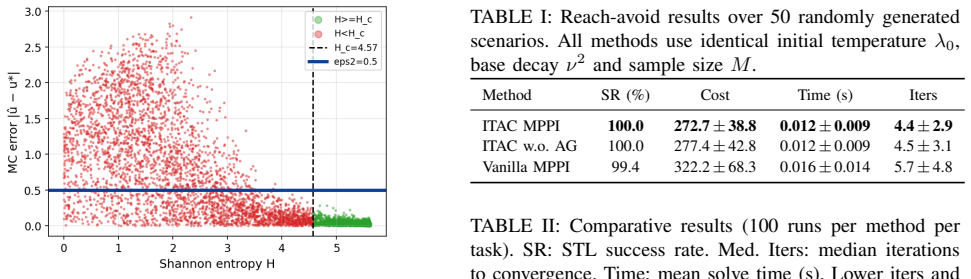
On its own terms, the paper establishes two linked facts. First, define an admissible cooling function Γ: (0,1]→(0,1) with Γ(Ĥ)<1 pointwise. Then the coupled updates λ_{j+1}=Γ(Ĥ_j)λ_j and Σ_{j+1}=Γ(Ĥ_j)Σ_j, where Ĥ is the normalized empirical Shannon entropy of the normalized importance weights, force λ_j→0 almost surely; by the existing optimality bound for deterministic MPPI, the infinite-sample estimate then converges to the true deterministic optimum as O(β_j²) with β_j=sqrt(λ_j/λ_0). Second, using a known sampling-complexity bound, the paper derives a critical entropy threshold H_c = log((1+√2)/(ρ₂ε₂²)) and proves that keeping the empirical weight entropy above H_c is necessary for the
Load-bearing premise
The convergence proof assumes the trajectory cost J(V) has finite oscillation on the sampling support; if the cost is unbounded—as it can be when the quadratic control penalty and Gaussian perturbations are combined—the entropy lower bound δ_ε collapses and the λ→0 argument no longer has a premise.
Editorial extensions
If this is right
- Any deterministic MPPI implementation can replace its hand-tuned geometric cooling schedule with the entropy-feedback rule and inherit the almost-sure convergence to the deterministic optimum, with no added gradient or Hessian computations.
- The critical entropy threshold gives a principled way to set the anti-collapse hyperparameter directly from the desired MC risk ρ₂ and additive precision ε₂.
- Because temperature and covariance are scaled by the same factor, the control-cost weighting R=λΣ⁻¹ stays fixed, preserving the free-energy structure across the whole annealing process.
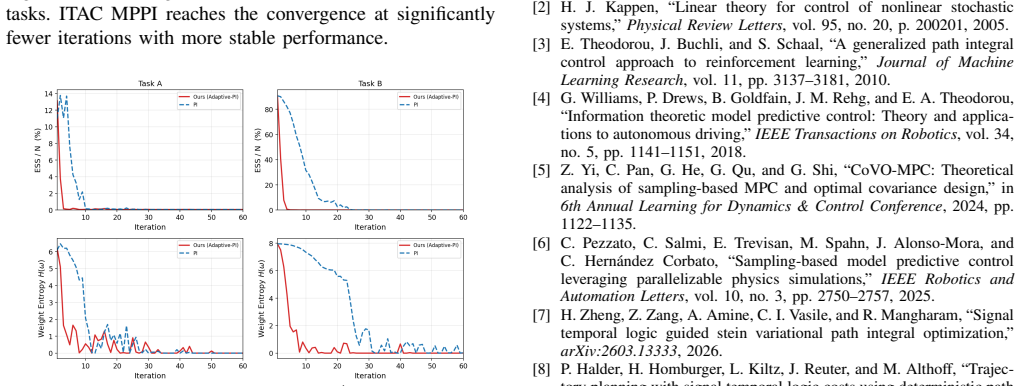
- On nonsmooth STL motion-planning tasks, the adaptive schedule reaches convergence in a fraction of the iterations needed by a fixed schedule, while achieving equal or better success rates.
- The barrier mechanism provides a smooth, entropy-gated protection against premature weight collapse that provably does not compromise the λ→0 guarantee.
Reading between the lines
- The entropy-feedback idea may transfer to other sampling-based optimizers that use an annealing temperature or mutation scale, since the log(ESS)≤H bound is a universal collapse alarm independent of MPPI's specific structure.
- The critical-threshold derivation suggests a two-regime operational picture: above H_c, aggressive cooling reduces bias faster than it increases MC error, while below H_c the error term dominates; an optimal schedule might therefore track H_c rather than follow a time-based curve.
- A natural extension is to use the deviation (H−H_c) as a normalized safety margin to modulate not only λ and Σ but also the sample count M, adaptively buying more rollouts when entering the low-entropy regime instead of only slowing cooling.
- The necessity statement for H_c is worst-case; the paper's own empirical validation shows the threshold is not tight, so a calibrated, problem-dependent threshold could yield faster cooling without violating the MC error bounds.
Editorial analysis
A structured set of objections, weighed in public.
Referee Report
Summary. The paper proposes ITAC, an adaptive cooling scheme for deterministic Model Predictive Path Integral (MPPI) control. The temperature multiplier at each iteration is a function Γ(Ĥ) of the Shannon entropy of the normalized importance weights. The central theoretical claims are: (i) for any pointwise-contractive Γ, the coupled updates λ_{j+1}=Γ(Ĥ_j)λ_j and Σ_{j+1}=Γ(Ĥ_j)Σ_j drive λ_j→0 almost surely, and hence, via [10, Thm 1], the infinite-sample MPPI bias vanishes (Theorem 1); (ii) a critical entropy threshold H_c = log((1+√2)/(ρ_2ε_2^2)) is a necessary condition for the Monte Carlo error bounds of [18] to hold, providing a smooth anti-glassification barrier (Theorem 2). Experiments on nonsmooth STL motion-planning tasks report faster convergence than fixed-schedule baselines.
Significance. The idea of using entropy as an online feedback signal for temperature in MPPI is conceptually attractive and could offer a principled, derivative-free alternative to hand-tuned cooling schedules. The proof of convergence for a broad class of adaptive schedules would be a useful theoretical contribution, as would a design rule for the entropy floor. The experimental results, if reproduced, suggest practical speedups on STL tasks. However, the main convergence theorem rests on an assumption that is internally inconsistent with the algorithm's own cost definition, and the anti-glassification theorem overstates the logical strength of its conclusion. As it stands, the paper's central theoretical claims are not established.
major comments (4)
- [Section IV, Assumption 1 and Eq. (11)] Assumption 1 (Δ_J finite) is violated by the J(V) defined in Section II Step 3. Since v_k ~ N(0,Σ) on all of R^{dK}, the term λ Σ_{k=0}^{K−1} û_k^T Σ^{-1} v_k is an unbounded linear functional in V whenever û ≠ 0. Hence sup J = +∞ and inf J = −∞, so Δ_J = ∞. Consequently the bound δ_ϵ in Eq. (11) degenerates to 0, and Lemma 2's 'non-vanishing drive' step—which requires a uniform δ_L > 0 for λ_j ≥ L—loses its premise. Theorem 1(a), and with it the central convergence claim λ_j→0, is therefore unproven. This is not a minor technicality: the cross term is an essential part of the standard MPPI weight construction, so the fix cannot be a simple redefinition of J without changing the algorithm.
- [Section V, Theorem 2] The theorem claims that H_M < H_c implies the error bounds are 'necessarily violated.' The proof only shows that H_M < H_c implies ESS is smaller than the value (1+√2)/(ρ_2 ε_2^2) required for the [18] bound to be available as a certificate. This does not imply that the actual MC estimation error exceeds ε_2 on any given sample path; the probabilistic inequality could still hold even when this sufficient condition is absent. The correct conclusion is that the [18] bound's condition is not satisfied, not that the bound is necessarily violated. The wording should be weakened accordingly.
- [Figure 1, Section VI-A] The 'empirical validation' of the critical entropy threshold plots MC error against empirical entropy and colors points by whether H_M ≥ H_c. Because H_c is derived algebraically from the same [18] risk formula, the observed separation is a restatement of the derivation rather than an independent test. To validate Theorem 2 empirically, one would need, for example, to estimate P(error > ε_2 | H_M < H_c) and P(error > ε_2 | H_M ≥ H_c) with confidence intervals. As presented, the figure illustrates the derivation but does not provide additional evidence.
- [Section VI, experimental comparison] The reported speedup over Vanilla MPPI is structurally favored by the design of Γ_base(Ĥ) = ν^2(1−Ĥ), which is always ≤ ν^2. Thus ITAC's temperature decays at least as fast as the fixed schedule at every iteration, so comparing iterations-to-convergence does not isolate the benefit of adaptivity. A fairer comparison would include a Vanilla baseline with a faster fixed decay rate (e.g., matched total cooling at the stopping iteration) or report performance as a function of sampling budget. This does not necessarily invalidate the empirical results, but it makes the 'substantially faster convergence' claim less clean than presented.
minor comments (5)
- [Lemma 1 proof] The proof states 'Since M>1, Δ_J>0' without justification. If Δ_J = 0, the lower bound still holds (δ_ϵ = 1 for all ϵ), so the sentence is inaccurate; please clarify.
- [Notation between Corollary 2 and Lemma 4] The symbol w_m is used for both unnormalized weights w_m = exp(−J_m/λ) (Corollary 2, Definition 2) and normalized weights w̄_m (Lemma 4). This is the same notation but different quantities; please distinguish them to avoid confusion.
- [Corollary 2, Eq. (14)] The Hoeffding bound is applied to the i.i.d. unnormalized weights w_m ∈ [0,1]. The later step equates the lower tail of Σ w_m to the ESS lower bound. The relationship between the unnormalized weights and the normalized weights used in the entropy should be made explicit.
- [Tables I and II] The table formatting in the manuscript text appears corrupted (e.g., 'ITAC MPPI 100 382.220.194' and the Task C row). Also, the convergence/stopping criterion for 'Iters' is not defined; please specify the stopping rule used to terminate the runs.
- [Figure 3 and Section VI-C] The text states that on Task B, ITAC MPPI's ESS collapses from 91% to below 0.1% within 4 iterations, and presents this as explaining the speedup. This seems at odds with the anti-glassification motivation, which warns that low ESS leads to MC error. Clarify why such a collapse is not considered weight collapse, or why the barrier does not prevent it in this simple task.
Circularity Check
No circularity: the formal claims are either conditional proofs or imported external theorems; the Assumption 1 gap is a correctness issue, not a circular reduction.
full rationale
No load-bearing step reduces to the paper's own inputs by construction. Theorem 1(a) is a conditional proof: under Assumption 1, Lemma 1 lower-bounds the empirical entropy at positive temperature, so any pointwise-contractive Γ is uniformly <1 on the relevant interval and λ_j→0. Nothing is fitted to the conclusion. Theorem 1(b) is explicitly imported from [10, Thm 1], an external, independently authored result, and Theorem 1(c) is algebraic. Theorem 2 is a rearrangement of the imported [18] risk formula ρ2=(1+√2)/(M ε2^2)e^{2E[J]/λ} together with the ESS-entropy inequality log ESS ≤ H_M; H_c is derived, not fitted to data. The Fig. 1 'validation' plots the same derived inequality, so it is a consistency illustration rather than a circular prediction. There are also no author-overlapping self-citations: [7], [8], [10], [11], and [18] share no authors with the present paper. The genuine weakness is non-circular: Assumption 1 (Section IV) is contradicted by the paper's own Step 3 definition J(V)=S(x0,Û+V)+λΣ û_k^TΣ^{-1}v_k over Gaussian support R^{dK}; unless Û=0, the linear cross term makes Δ_J=∞, so Lemma 1's δ_ε degenerates to 0 and Lemma 2's contradiction argument loses its premise. This makes Theorem 1 unproven as stated, but it is an internal correctness gap, not a circularity, and therefore does not raise the circularity score.
Assumptions & free parameters
free parameters (4)
- base decay rate ν =
not reported
- barrier fallback rate Γ_protect =
not reported
- sigmoid steepness κ =
not reported
- tolerance/risk pair (ε_2, ρ_2) setting H_c =
validation experiment: ε_2=0.5, ρ_2=10%, H_c≈4.57; benchmark values unreported
assumptions (5)
- domain assumption Assumption 1: cost oscillation Δ_J := sup J − inf J is finite on the support of the sampling distribution p
- domain assumption Regularity conditions of [10] under which ∥Ũ*_MPPI(β)−U*_det∥=O(β²), β=√(λ/λ0)
- standard math Assumption 2: trajectory costs J_m ≥ 0 (enforceable by constant shift; SNIS invariance)
- domain assumption Lemma 3 imported from [18]: ρ_2 = ((1+√2)/(Mε_2²))e^{2E[J_m]/λ} is the risk associated with additive error ε_2
- domain assumption Ĥ=1 (perfectly uniform weights) has probability zero under continuous cost distributions
Cite this review
Pith. "Pith review of Information-Theoretic Adaptive Cooling for Deterministic MPPI via Entropy Feedback." pith.science (2026). https://pith.science/paper/WCALPGBO
@misc{pith2026260714245,
  author       = {Pith},
  title        = {Pith review of: Information-Theoretic Adaptive Cooling for Deterministic MPPI via Entropy Feedback},
  year         = {2026},
  howpublished = {\url{https://pith.science/paper/WCALPGBO}},
  note         = {Machine review of arXiv:2607.14245}
}
read the original abstract
This paper investigates deterministic optimal control using Model Predictive Path Integral (MPPI) control, a sampling-based and derivative-free framework well suited for systems with complex dynamics and nonsmooth objectives. In deterministic MPPI, the temperature must be driven to zero to recover the true optimum, yet the design of an effective cooling schedule remains a fundamental challenge. Existing methods typically rely on predefined open-loop schedules, which limit the efficiency and robustness of the algorithm. To overcome this limitation, we propose an Information-Theoretic Adaptive Cooling (ITAC) framework that uses the Shannon entropy of the importance weights as an online feedback signal to regulate the temperature. The proposed mechanism adapts the cooling rate to the current sampling state, enabling fast progress when the weights are diffuse and cautious cooling when they become concentrated. We prove asymptotic convergence of the resulting scheme to the deterministic optimum, and further derive a critical entropy threshold that leads to a smooth barrier against premature weight collapse. Experiments on nonsmooth signal temporal logic motion-planning tasks show that ITAC improves sampling efficiency and achieves substantially faster convergence than state-of-the-art baselines without sacrificing the derivative-free nature of MPPI.
Figures

Reference graph
Works this paper leans on
-
[18]
Sam- pling complexity of path integral methods for trajectory optimization,
H.-J. Yoon, C. Tao, H. Kim, N. Hovakimyan, and P. V oulgaris, “Sam- pling complexity of path integral methods for trajectory optimization,” inAmerican Control Conference (ACC), 2022, pp. 4685–4690
2022
-
[17]
Inferring smooth control: Monte carlo posterior policy iteration with gaussian processes,
J. Watson and J. Peters, “Inferring smooth control: Monte carlo posterior policy iteration with gaussian processes,” inConference on Robot Learning, 2023, pp. 67–79
2023
-
[1]
Model predictive path integral control: From theory to parallel computation,
G. Williams, A. Aldrich, and E. A. Theodorou, “Model predictive path integral control: From theory to parallel computation,”Journal of Guidance, Control, and Dynamics, vol. 40, no. 2, pp. 344–357, 2017
2017
-
[2]
Linear theory for control of nonlinear stochastic systems,
H. J. Kappen, “Linear theory for control of nonlinear stochastic systems,”Physical Review Letters, vol. 95, no. 20, p. 200201, 2005
2005
-
[3]
A generalized path integral control approach to reinforcement learning,
E. Theodorou, J. Buchli, and S. Schaal, “A generalized path integral control approach to reinforcement learning,”Journal of Machine Learning Research, vol. 11, pp. 3137–3181, 2010
2010
-
[4]
Information theoretic model predictive control: Theory and applica- tions to autonomous driving,
G. Williams, P. Drews, B. Goldfain, J. M. Rehg, and E. A. Theodorou, “Information theoretic model predictive control: Theory and applica- tions to autonomous driving,”IEEE Transactions on Robotics, vol. 34, no. 5, pp. 1141–1151, 2018
2018
-
[5]
CoVO-MPC: Theoretical analysis of sampling-based MPC and optimal covariance design,
Z. Yi, C. Pan, G. He, G. Qu, and G. Shi, “CoVO-MPC: Theoretical analysis of sampling-based MPC and optimal covariance design,” in 6th Annual Learning for Dynamics & Control Conference, 2024, pp. 1122–1135
2024
-
[6]
Sampling-based model predictive control leveraging parallelizable physics simulations,
C. Pezzato, C. Salmi, E. Trevisan, M. Spahn, J. Alonso-Mora, and C. Hern ´andez Corbato, “Sampling-based model predictive control leveraging parallelizable physics simulations,”IEEE Robotics and Automation Letters, vol. 10, no. 3, pp. 2750–2757, 2025
2025
Show all 18 references
-
[7]
Signal temporal logic guided stein variational path integral optimization,
H. Zheng, Z. Zang, A. Amine, C. I. Vasile, and R. Mangharam, “Signal temporal logic guided stein variational path integral optimization,” arXiv:2603.13333, 2026
2026
-
[8]
Trajec- tory planning with signal temporal logic costs using deterministic path integral optimization,
P. Halder, H. Homburger, L. Kiltz, J. Reuter, and M. Althoff, “Trajec- tory planning with signal temporal logic costs using deterministic path integral optimization,” inIEEE International Conference on Robotics and Automation (ICRA), 2025
2025
-
[9]
Recent advances in path integral control for trajectory optimization: An overview in theoretical and algorithmic perspectives,
M. Kazim, J. Hong, M.-G. Kim, and K.-K. K. Kim, “Recent advances in path integral control for trajectory optimization: An overview in theoretical and algorithmic perspectives,”Annual Reviews in Control, vol. 57, p. 100931, 2024
2024
-
[10]
Optimality and suboptimality of mppi control in stochastic and deterministic settings,
H. Homburger, F. Messerer, M. Diehl, and J. Reuter, “Optimality and suboptimality of mppi control in stochastic and deterministic settings,” IEEE Control Systems Letters, vol. 9, pp. 763–768, 2025
2025
-
[11]
Model predictive path in- tegral control as preconditioned gradient descent,
M. Fazlyab, S. Sharifi, and J. Wang, “Model predictive path in- tegral control as preconditioned gradient descent,”arXiv preprint arXiv:2603.24489, 2026
2026 arXiv
-
[12]
Optimization by simulated annealing,
S. Kirkpatrick, C. D. Gelatt, and M. P. Vecchi, “Optimization by simulated annealing,”Science, vol. 220, no. 4598, pp. 671–680, 1983
1983
-
[13]
Adaptive importance sampling for control and inference,
H. J. Kappen and H. C. Ruiz, “Adaptive importance sampling for control and inference,”Journal of Statistical Physics, vol. 162, no. 5, pp. 1244–1266, 2016
2016
-
[14]
Model predictive optimized path integral strategies,
D. M. Asmar, R. Senanayake, S. Manuel, and M. J. Kochenderfer, “Model predictive optimized path integral strategies,” inIEEE Inter- national Conference on Robotics and Automation (ICRA), 2023, pp. 3182–3188
2023
-
[15]
Biased-MPPI: Informing sampling- based model predictive control by fusing ancillary controllers,
E. Trevisan and J. Alonso-Mora, “Biased-MPPI: Informing sampling- based model predictive control by fusing ancillary controllers,”IEEE Robotics and Automation Letters, vol. 9, no. 6, pp. 5871–5878, 2024
2024
-
[16]
Variance-reduced model predictive path integral via quadratic model approximation,
F. Schramm, F. N. Tiofack, N. Perrin-Gilbert, M. Toussaint, and J. Carpentier, “Variance-reduced model predictive path integral via quadratic model approximation,”arXiv:2602.03639, 2026
2026 arXiv
Reviewed August 2, 2026 · model on record in the stance chip above.
Discussion (0). Sign in to comment.