REVIEW 4 major objections 6 minor 45 references
URECA: The Chain of Two Minimum Set Cover Problems exists behind Adaptation to Shifts in Semantic Code Search
T0 review · 4 major / 6 minor · reviewed 2026-08-08 · deepseek-v4-flash
Pith's one-line read Minimum entropy adaptation to shifted code search is a chain of two set-cover problems, and URECA's fragment transport between clusters fixes the resulting initialization cascade.
desk verdict The central set-cover derivation rests on an invalid integral identity, so the paper's main theoretical claim collapses; URECA may be a useful heuristic, but the paper as written is not ready for peer review. read the letter →
The pith
A machine-rendered reading of the paper's core claim, the machinery that carries it, and where it could break.
The reading
What carries the argument
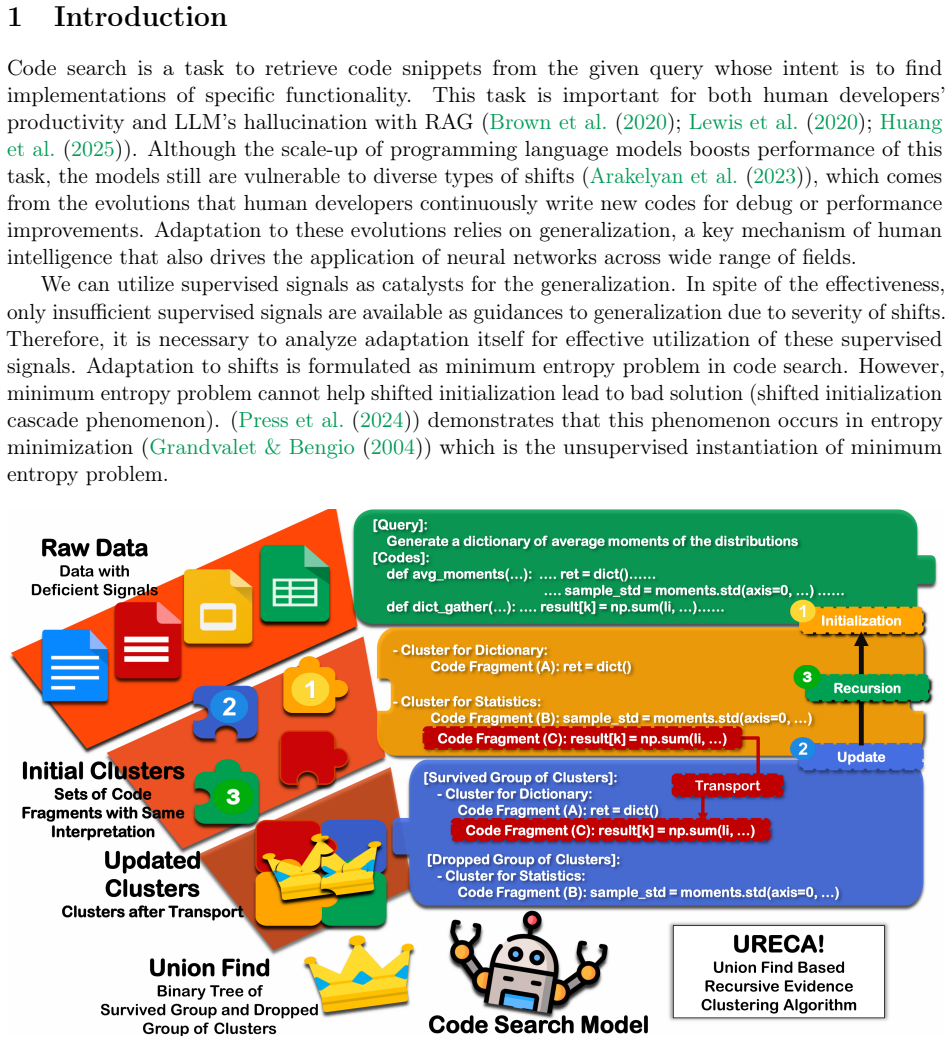
The central objects are two nested instances of the minimum set cover problem (choose the cheapest collection of sets whose union covers a given universe), and the load-bearing identity is the Lebesgue-integral rewriting $\ln \frac{1}{p(E_\alpha)} = \int p(E_\alpha)\,d\left(\frac{1}{p(E_\alpha)}\right)$, which the paper converts into a supremum over greedy choices that it identifies with the cost of those two set covers; the predecessor problem covers the universe of fragment events, and the successor problem covers the resulting collection of subsets, with weak duality binding the expected cover cost to entropy. The second mechanism is URECA's transport update, a simulation trick in which clusters are treated as measurable sets, so moving a fragment from source to target is simulated by subtracting its logit weight from one cluster and adding it to another, with the dynamics $p(C_{i,i}^{t+1} \mid C_{j,j}^t)$ estimated by attention scores between queries. The Thresholdly-Updatable Stationary Assumption—stationary dynamics until a threshold, then zeroing for clusters judged disjoint by divergence—is what turns the naive replacement of probabilities by logits into an unbiased transport in the limit.
What would settle it
Inspect the proof's base identity with a concrete finite distribution, say an event of probability $1/3$, and compute $\int p(E_\alpha)\,d(1/p(E_\alpha))$ in the standard Lebesgue sense used by the appendix; if the integral is undefined because $d(1/p)$ is not a measure, or if its value differs from $\ln 3$, Theorem 2.1 fails at its first equation.
Extended reading notes
Core claim
On the paper's own terms, the central discovery is Theorem 2.1: the minimum entropy problem is dual to a chain of two minimum set cover problems with a greedy algorithm, with the duality established through Lebesgue integration. The first, predecessor set cover builds the universe of the second, successor set cover out of disentangled representation fragments, and the second then constructs clusters; Theorem 2.2 states that minimum entropy clustering is exactly the process that clusters these fragments to minimize expected clustering cost. Because the greedy decisions are based only on summed probabilities of fragments, the mechanism ignores relationships between fragments, and the paper identifies this ignorance as the cause of shifted initialization cascade. URECA is the constructive claim: by tracking clusters as transportable sets of fragments, using attention scores as stationary dynamics and logits as evidence weights, it moves fragments from dying clusters to surviving ones under a Thresholdly-Updatable Stationary Assumption, which makes the transported logits an unbiased estimator of the transported probabilities. The paper's claim is that this restores the relationships entropy minimization drops and produces robust few-shot adaptation to shifts.
Load-bearing premise
The load-bearing premise is the first identity of Theorem 2.1, $\ln(1/p(E_\alpha)) = \int p(E_\alpha)\,d(1/p(E_\alpha))$; if the reciprocal probability $1/p$ is not a genuine measure, the Lebesgue-integral step collapses and with it the claimed chain of two minimum set cover problems, even if URECA still works in practice.
Editorial extensions
If this is right
- According to the paper, entropy minimization—and InfoNCE as its contrastive analogue—is a greedy clusterer that ignores fragment-level relationships, so any model fine-tuned with it inherits the shifted initialization cascade when distributions move.
- URECA's cluster transport can be added as an auxiliary loss on top of existing contrastive code-search losses, so the gains do not require retraining the underlying code model from scratch.
- In the reported experiments, URECA improves few-shot adaptation consistently across task shift, query shift, and code shift, with the largest margins in the harshest low-resource settings.
- The state-of-the-art CoSQA result under query shift indicates that relationship-aware clustering, not just sample-level contrastive learning, is what matters for realistic web-query code search.
- Because URECA estimates dynamics from attention scores, the paper's own comparison with CoCoSoDA suggests that the size of the gains is tied to how accurately the base model already estimates those dynamics.
Reading between the lines
- If the two-set-cover decomposition is taken seriously, it generalizes beyond code search: every entropy-minimization adaptation method, such as test-time adaptation or semi-supervised learning, could be audited for which fragment relationships it drops, and URECA-style transport is a candidate repair that the paper gestures at but does not test.
- A direct test of the paper's mechanism would be to compare URECA's cluster assignments against ground-truth functional modules of code; the cascade explanation predicts that URECA's advantage over InfoNCE should grow as the clusters align with true semantic modules.
- The theorem's mathematical core is not needed for the algorithm's empirical value: URECA's transport update could be evaluated as a standalone clustering regularizer, and if it works while the Lebesgue identity fails, the explanation would still need revising even though the method survives.
- The hard threshold in the Thresholdly-Updatable Stationary Assumption is a convenience rather than a fundamental requirement; learned or calibrated dynamics could replace it, and the paper's own framing suggests that would be the natural next step.
Editorial analysis
A structured set of objections, weighed in public.
Referee Report
Summary. The paper analyzes the minimum entropy formulation of adaptation to distribution shift in semantic code search. It claims that via a Lebesgue-integral decomposition, the minimum entropy problem is dual to a chain of two minimum set cover problems (Theorem 2.1) and that this chain reveals why entropy minimization ignores relationships among disentangled representations, leading to a 'shifted initialization cascade.' Based on this analysis, the paper proposes URECA, a union-find based recursive clustering algorithm that transports 'evidences' (logits) between clusters under a 'Thresholdly-Updatable Stationary Assumption,' and reports few-shot adaptation experiments on CodeSearchNet and CoSQA with CodeT5+, UniXCoder, and CoCoSoDA, claiming consistent gains and state-of-the-art performance on CoSQA.
Significance. If the theoretical results were valid, the paper would offer a novel bridge between information-theoretic entropy minimization and combinatorial set cover, with a practical clustering method for adapting code search models to distribution shifts. The experimental task is timely, and the empirical comparisons against InfoNCE on several backbones are a useful starting point. However, the paper does not release code (the provided repository is a placeholder), and the central theoretical claim rests on a flawed integral identity and a circular convergence theorem. The experimental tables also contain internal inconsistencies. Consequently, the claimed explanatory value of the 'chain of two minimum set cover problems' and the 'shifted initialization cascade' is not established, and the paper's significance is currently limited to a heuristic clustering rule whose motivation is unsupported.
major comments (4)
- [Section 2, Eq. (2.1); Appendix D.1] The foundational identity in Eq. (2.1), ln(1/p(Eα)) = ∫ p(Eα) d(1/p(Eα)), is not a valid integral identity. For p(Eα)=1/2, the left-hand side is ln 2 ≈ 0.693, while the right-hand side, as the proof in Appendix D.1 interprets it via Eq. (D.7), equals the supremum of Σ_{n=1}^{⌈1/p(Eα)⌉} p(Eα)·1, which evaluates to 1. The function 1/p cannot be used as an integration measure in this way, and the subsequent identification in Eqs. (2.2)-(2.3) of this supremum with the cost of a minimum set cover problem has no basis. Since Theorem 2.1 is the only bridge from entropy minimization to the chain of two minimum set cover problems, the shifted-initialization-cascade explanation and the theoretical motivation for URECA do not follow from the presented mathematics.
- [Appendix D.1] The extension from dyadic probabilities p(e)=2^{-k} to arbitrary real probabilities is not established. The text asserts that every real function can be approximated by simple functions with values a/2^n, but this does not imply that the supremum in Eq. (D.7) equals ln(1/p(Eα)), nor that the inequality c_Eα ≤ ln(1/p(Eα)) in Eq. (D.15) survives the limiting argument. The base-case identity is itself false, as noted above, so the approximate extension cannot rescue the claim.
- [Section 3.3, Theorem 3.1; Appendix D.4] Theorem 3.1 is circular. The assumption that p(C^t_j,j) converges to 1/|J| already implies, by continuity of the logarithm on the positive reals, that the logits ln(p(C^t_j,j)/p(y)) converge uniformly to each other; the additional Lipschitz condition with constant α·ln((1/|J|+ϵ)/(1/|J|-ϵ)) and α ∈ [0, (1/|J|-ϵ)/(1/|J|+ϵ)) does not constrain the actual function and is not satisfied by any nontrivial family of functions independent of α. Moreover, the proof of Lemma D.1 in Appendix D.4 claims that δ = ln((1/|J|+ϵ)/(1/|J|-ϵ)) can be an arbitrary positive real, but for fixed ϵ it is a specific value; the argument therefore does not establish the uniform Cauchy property. Consequently, the unbiasedness guarantee claimed in Section 3.2 for the logit-based transport (Eq. (3.11)) is not proven.
- [Section 4.1, Table 1] Table 1 contains an internal inconsistency in the UniXCoder row at 120 few-shot examples: URECA is reported as 45.1 with a gain of +2.3 over InfoNCE 51.8, but 45.1-51.8 = -6.7. This contradicts the claim in Section 4.1 of 'consistent performance gains' over InfoNCE. Additionally, the statement that URECA achieves state-of-the-art on CoSQA is not substantiated: Table 2 only compares URECA to InfoNCE on the same three backbones, with no comparison to any existing published SOTA systems on the CoSQA benchmark.
minor comments (6)
- [Section 4.1 and Appendix E.5] The text repeatedly refers to 'Appendix F.1∼F.4' and 'Appendix F.5', but the manuscript contains no Appendix F; the experimental details are in Appendix E. These dangling references should be corrected.
- [Section 4.2, Table 3] The caption 'InfoNCE/URECA(DIFF)' and the main-text sentence 'it is still significant even after 100 epochs for 59.1 % (InfoNCE) and 70.3% (URECA)' are inconsistent with the table entries (42/59.1 for CSN-Go at 120 few-shot examples); the reader cannot tell which number belongs to which method.
- [Appendix E.8] The code repository URL is a placeholder ('github_id/ureca'), so no implementation is available for reproducibility checks.
- [Throughout] The manuscript contains numerous typos and grammatical errors (e.g., 'Initializatoin', 'esitmates', 'Lebesuge', 'Jenson's Inequality', 'inf ty', 'mathbR'); these should be corrected before any revision.
- [Section 3 and Appendix D] The main text refers to Figures 1, 2, 5, 6, 7, and 8, but the figures are not all included in the provided manuscript; the descriptions in the text are insufficient to verify the claimed clustering construction.
- [Section 4] The tables report point estimates from three seeds without standard deviations, so no statistical significance can be assessed.
Circularity Check
The set-cover chain is constructed from a miscomputed 'Lebesgue' identity, Theorem 2.2 renames entropy as clustering, and Theorem 3.1 assumes the convergence it claims to establish.
-
self definitional
[Section 2, Eqs. (2.1)-(2.3); Appendix D.1, Eqs. (D.7)-(D.15)]
"We can rewrite the integral form of equation (2.1) to supremum form of equation (2.2) based on the definition of Lebesgue integral for non-negative measure (Appendix B). With properties of probability as Lebesgue measure, this supremum form hints that self information becomes the tight upper bound for the cost of solution to the chain of minimum set cover problems equation (2.3)."
Eq. (2.1) writes ln(1/p(Eα)) = ∫ p(Eα) d(1/p(Eα)), but 1/p is a function, not a measure; the claimed 'Lebesgue' supremum in Eq. (2.2) is Σ_{n=1}^{⌈1/p⌉} p(Eα)·1 = p(Eα)·⌈1/p(Eα)⌉ ≈ 1, not ln(1/p(Eα)). For p(Eα)=1/2 the sum is 1 while ln 2 ≈ 0.693. The proof then defines the universe Uα as the collection of ⌈1/p(Eα)⌉ set-cover minimizers u* = arg min ∫ s(e)dχ(e∈u), so the 'cost of the minimum set cover problem' is by construction the same sum as in Eq. (2.2), and the asserted bound c_Eα ≤ ln(1/p(Eα)) in (D.15) is not derived and fails numerically. The chain of two set-cover problems is manufactured to match the computed sum rather than derived from entropy minimization.
-
renaming known result
[Section 2, Theorem 2.2; Appendix D.2-D.3]
"Minimum entropy problem is equivalent to the problem which clusters the disentangled representations to minimize the expected cost of clustering given the probabilities for each event."
Entropy is already the expectation of self-information. The proof constructs 'clusters' by selecting one element from the successor set-cover solution for each event and then calls the resulting family 'clusters of disentangled representation by the definition of clustering (Definition D.1)'. The equivalence is therefore true by construction: the clustering cost is defined as the same p ln(1/p) sum that defines entropy, and the clusters are exactly the selected set-cover elements. This restates entropy as a clustering objective rather than providing an independent derivation that minimum entropy forces a particular clustering.
1 more flagged steps
-
self definitional
[Section 3.3, Theorem 3.1; Appendix D.4, Lemma D.1]
"If the UP-Limit of pt(Ctj,j) converges to 1/|J| and ln pt(Ctj,j)/p(y) is α · ln((1/|J|+ϵ)/(1/|J|-ϵ))-Lipschitz continuous ..., then ln pt(Ctj,j)/p(y) converges uniformly to each other as t → ∞."
The conclusion is a direct restatement of the assumption: if p_t(C^t_j,j) → 1/|J| for all j, then the logits ln(p_t(C^t_j,j)/p(y)) automatically converge uniformly to the common limit ln(1/(|J|·p(y))). Lemma D.1 only re-derives bounds on evid differences from the assumed p-bounds; no property of the URECA update rule is used. The paper then invokes this theorem to claim that transported logits are unbiased and that the estimation error disappears as update proceeds, but the required uniform convergence is assumed, not produced. The paper later states 'We naively assume that the no negative divergences come from the convergence of the joint probability distribution p(Ctj,j) to uniform distribution as 1/|K|', confirming that the load-bearing convergence is an input rather than an output.
full rationale
Most of the paper's theoretical contribution is not independently derived. Theorem 2.1 rests on Eq. (2.1), which treats the function 1/p as a Lebesgue measure; the resulting supremum in Eq. (2.2) evaluates to p·⌈1/p⌉ ≈ 1, not ln(1/p). The set-cover universe is then defined as the collection of ⌈1/p⌉ minimizers, so the 'cost of the chain of two minimum set cover problems' is identical to the sum in Eq. (2.2) by construction, and the bound c_Eα ≤ ln(1/p) in (D.15) is asserted without proof and fails numerically. Theorem 2.2 then renames the entropy expectation as 'expected cost of clustering' and calls the selected set-cover elements clusters by Definition D.1, so the claimed equivalence is a restatement rather than a derivation. Theorem 3.1 assumes p(C^t_j,j) → 1/|J| and concludes the logits converge uniformly; since logits are monotone functions of the p's, the conclusion follows immediately from the assumption, and the paper later admits the convergence of p to uniform is 'naively assumed.' Thus the chain-of-set-cover explanation, the clustering equivalence, and the uniform-convergence guarantee for URECA's transport each reduce to definitions or assumptions. The empirical comparisons to InfoNCE are genuine experiments and may support URECA as a heuristic, but they do not rescue the theoretical derivation from being circular-by-construction. No load-bearing self-citation chain was found; the circularity is internal to the paper's own equations and assumptions.
Assumptions & free parameters
free parameters (2)
- Threshold T in Thresholdly-Updatable Stationary Assumption =
not reported
- max_recursion_num =
not reported
assumptions (5)
- ad hoc to paper 1/p(Eα) is an integration measure so that ln(1/p) = ∫ p d(1/p).
- domain assumption Every real probability can be exactly represented by dyadic simple functions in a way that preserves the greedy set-cover cost bound.
- domain assumption Query q_i is the centroid of cluster C_i,j for all j, so cluster dynamics equal query attention p(q_i|q_j).
- domain assumption The conditional probability dynamics are stationary for all time steps and only become zero after a threshold.
- ad hoc to paper All elements in the solution of the successor set-cover have equal probability, so weighted self-information selects exactly one cluster per event.
invented entities (2)
-
disentangled representations / fragments (evidence)
-
shifted initialization cascade phenomenon
Cite this review
Pith. "Pith review of URECA: The Chain of Two Minimum Set Cover Problems exists behind Adaptation to Shifts in Semantic Code Search." pith.science (2026). https://pith.science/paper/WCFLNVJF
@misc{pith2026250207494,
  author       = {Pith},
  title        = {Pith review of: URECA: The Chain of Two Minimum Set Cover Problems exists behind Adaptation to Shifts in Semantic Code Search},
  year         = {2026},
  howpublished = {\url{https://pith.science/paper/WCFLNVJF}},
  note         = {Machine review of arXiv:2502.07494}
}
read the original abstract
Adaptation is to make model learn the patterns shifted from the training distribution. In general, this adaptation is formulated as the minimum entropy problem. However, the minimum entropy problem has inherent limitation -- shifted initialization cascade phenomenon. We extend the relationship between the minimum entropy problem and the minimum set cover problem via Lebesgue integral. This extension reveals that internal mechanism of the minimum entropy problem ignores the relationship between disentangled representations, which leads to shifted initialization cascade. From the analysis, we introduce a new clustering algorithm, Union-find based Recursive Clustering Algorithm~(URECA). URECA is an efficient clustering algorithm for the leverage of the relationships between disentangled representations. The update rule of URECA depends on Thresholdly-Updatable Stationary Assumption to dynamics as a released version of Stationary Assumption. This assumption helps URECA to transport disentangled representations with no errors based on the relationships between disentangled representations. URECA also utilize simulation trick to efficiently cluster disentangled representations. The wide range of evaluations show that URECA achieves consistent performance gains for the few-shot adaptation to diverse types of shifts along with advancement to State-of-The-Art performance in CoSQA in the scenario of query shift.
Figures


Figures from the paper (5 more)


Reference graph
Works this paper leans on
-
[1]
Arakelyan, S., Das, R. J., Mao, Y., and Ren, X. Exploring distributional shifts in large language models for code analysis. In Proceedings of the 2023 Conference on Empirical Methods in Natural Language Processing, EMNLP 2023, Singapore, December 6-10, 2023 , pp.\ 16298--16314, 2023
work page 2023
-
[2]
L ipschitz continuity in model-based reinforcement learning
Asadi, K., Misra, D., and Littman, M. L ipschitz continuity in model-based reinforcement learning. In Dy, J. and Krause, A. (eds.), Proceedings of the 35th International Conference on Machine Learning, volume 80 of Proceedings of Machine Learning Research, pp.\ 264--273. PMLR, 10--15 Jul 2018. URL https://proceedings.mlr.press/v80/asadi18a.html
work page 2018
-
[3]
D., Dhariwal, P., Neelakantan, A., Shyam, P., Sastry, G., Askell, A., et al
Brown, T., Mann, B., Ryder, N., Subbiah, M., Kaplan, J. D., Dhariwal, P., Neelakantan, A., Shyam, P., Sastry, G., Askell, A., et al. Language models are few-shot learners. Advances in neural information processing systems, 33: 0 1877--1901, 2020
1901
-
[4]
When deep learning met code search
Cambronero, J., Li, H., Kim, S., Sen, K., and Chandra, S. When deep learning met code search. In Proceedings of the ACM Joint Meeting on European Software Engineering Conference and Symposium on the Foundations of Software Engineering, ESEC/SIGSOFT FSE , pp.\ 964--974, 2019
work page 2019
-
[5]
Minimum entropy combinatorial optimization problems
Cardinal, J., Fiorini, S., and Joret, G. Minimum entropy combinatorial optimization problems. Theory of Computing Systems, 51: 0 4--21, 2012
work page 2012
-
[6]
In-context sharpness as alerts: An inner representation perspective for hallucination mitigation
Chen, S., Xiong, M., Liu, J., Wu, Z., Xiao, T., Gao, S., and He, J. In-context sharpness as alerts: An inner representation perspective for hallucination mitigation. In Salakhutdinov, R., Kolter, Z., Heller, K., Weller, A., Oliver, N., Scarlett, J., and Berkenkamp, F. (eds.), Proceedings of the 41st International Conference on Machine Learning, volume 235...
work page 2024
-
[7]
Infogan: Interpretable representation learning by information maximizing generative adversarial nets
Chen, X., Duan, Y., Houthooft, R., Schulman, J., Sutskever, I., and Abbeel, P. Infogan: Interpretable representation learning by information maximizing generative adversarial nets. Advances in neural information processing systems, 29, 2016
2016
-
[8]
Denton, E. L. Unsupervised learning of disentangled representations from video. Advances in neural information processing systems, 30, 2017
work page 2017
Show all 45 references
-
[9]
Codebert: A pre-trained model for programming and natural languages
Feng, Z., Guo, D., Tang, D., Duan, N., Feng, X., Gong, M., Shou, L., Qin, B., Liu, T., Jiang, D., and Zhou, M. Codebert: A pre-trained model for programming and natural languages. In Findings of the Association for Computational Linguistics: EMNLP , pp.\ 1536--1547, 2020
2020
-
[10]
and Bengio, Y
Grandvalet, Y. and Bengio, Y. Semi-supervised learning by entropy minimization. Advances in neural information processing systems, 17, 2004
2004
-
[11]
Greiff, W. R. The use of Exploratory Data Analysis in Information Retrieval Research, pp.\ 37--72. Springer US, Boston, MA, 2000. doi:10.1007/0-306-47019-5_2. URL https://doi.org/10.1007/0-306-47019-5_2
-
[12]
Deep code search
Gu, X., Zhang, H., and Kim, S. Deep code search. In Proceedings of the 40th International Conference on Software Engineering, ICSE , pp.\ 933--944, 2018
2018
-
[13]
K., Clement, C
Guo, D., Ren, S., Lu, S., Feng, Z., Tang, D., Liu, S., Zhou, L., Duan, N., Svyatkovskiy, A., Fu, S., Tufano, M., Deng, S. K., Clement, C. B., Drain, D., Sundaresan, N., Yin, J., Jiang, D., and Zhou, M. GraphCodeBERT : Pre-training code representations with data flow. In 9th In...
2021
-
[14]
UniXcoder : Unified cross-modal pre-training for code representation
Guo, D., Lu, S., Duan, N., Wang, Y., Zhou, M., and Yin, J. UniXcoder : Unified cross-modal pre-training for code representation. In Proceedings of the 60th Annual Meeting of the Association for Computational Linguistics, ACL , pp.\ 7212--7225, 2022
2022
-
[15]
and Gilbert, S
Halim, S. and Gilbert, S. Min-set-cover, August 2016
2016
-
[16]
and Karp, R
Halperin, E. and Karp, R. M. The minimum-entropy set cover problem. Theoretical Computer Science, 348: 0 240--250, 2005
2005
-
[17]
CoSQA : 20, 000+ web queries for code search and question answering
Huang, J., Tang, D., Shou, L., Gong, M., Xu, K., Jiang, D., Zhou, M., and Duan, N. CoSQA : 20, 000+ web queries for code search and question answering. In Proceedings of the 59th Annual Meeting of the Association for Computational Linguistics and the 11th International Joint C...
2021
-
[18]
A survey on hallucination in large language models: Principles, taxonomy, challenges, and open questions
Huang, L., Yu, W., Ma, W., Zhong, W., Feng, Z., Wang, H., Chen, Q., Peng, W., Feng, X., Qin, B., and Liu, T. A survey on hallucination in large language models: Principles, taxonomy, challenges, and open questions. ACM Trans. Inf. Syst., 43 0 (2), January 2025. ISSN 1046-8188....
2025 doi
-
[19]
CodeSearchNet Challenge : Evaluating the state of semantic code search
Husain, H., Wu, H., Gazit, T., Allamanis, M., and Brockschmidt, M. CodeSearchNet Challenge : Evaluating the state of semantic code search. ArXiV CoRR, 1909.09436, 2019
1909 arXiv
-
[20]
Ib-gan: Disentangled representation learning with information bottleneck generative adversarial networks
Jeon, I., Lee, W., Pyeon, M., and Kim, G. Ib-gan: Disentangled representation learning with information bottleneck generative adversarial networks. In Proceedings of the AAAI conference on artificial intelligence, volume 35, pp.\ 7926--7934, 2021
2021
-
[21]
and Yoon, H
Kwon, S. and Yoon, H. Lebesgue integral theory, 2012
2012
-
[22]
Entropy is not enough for test-time adaptation: From the perspective of disentangled factors
Lee, J., Jung, D., Lee, S., Park, J., Shin, J., Hwang, U., and Yoon, S. Entropy is not enough for test-time adaptation: From the perspective of disentangled factors. In The Twelfth International Conference on Learning Representations, ICLR , 2024
2024
-
[23]
u ttler, H., Lewis, M., Yih, W.-t., Rockt \
Lewis, P., Perez, E., Piktus, A., Petroni, F., Karpukhin, V., Goyal, N., K \"u ttler, H., Lewis, M., Yih, W.-t., Rockt \"a schel, T., et al. Retrieval-augmented generation for knowledge-intensive nlp tasks. Advances in Neural Information Processing Systems, 33: 0 9459--9474, 2020
2020
-
[24]
Rethinking negative pairs in code search
Li, H., Zhou, X., Luu, A., and Miao, C. Rethinking negative pairs in code search. In Bouamor, H., Pino, J., and Bali, K. (eds.), Proceedings of the 2023 Conference on Empirical Methods in Natural Language Processing, pp.\ 12760--12774, Singapore, December 2023. Association for...
2023 doi
-
[25]
Rewriting the code: A simple method for large language model augmented code search
Li, H., Zhou, X., and Shen, Z. Rewriting the code: A simple method for large language model augmented code search. In Ku, L.-W., Martins, A., and Srikumar, V. (eds.), Proceedings of the 62nd Annual Meeting of the Association for Computational Linguistics (Volume 1: Long Papers...
2024 doi
-
[26]
K., Fanti, G., and Oh, S
Lin, Z., Thekumparampil, K. K., Fanti, G., and Oh, S. Infogan-cr: Disentangling generative adversarial networks with contrastive regularizers. arXiv preprint arXiv:1906.06034, pp.\ 60, 2019
1906 arXiv
-
[27]
Activity image-to-video retrieval by disentangling appearance and motion
Liu, L., Li, J., Niu, L., Xu, R., and Zhang, L. Activity image-to-video retrieval by disentangling appearance and motion. In Proceedings of the AAAI Conference on Artificial Intelligence, volume 35, pp.\ 2145--2153, 2021
2021
-
[28]
Madhulatha, T. S. An overview on clustering methods. arXiv preprint arXiv:1205.1117, 2012
2012 arXiv
-
[29]
Cross-entropy loss functions: Theoretical analysis and applications
Mao, A., Mohri, M., and Zhong, Y. Cross-entropy loss functions: Theoretical analysis and applications. In International conference on Machine learning, pp.\ 23803--23828. PMLR, 2023
2023
-
[30]
RAGT ruth: A hallucination corpus for developing trustworthy retrieval-augmented language models
Niu, C., Wu, Y., Zhu, J., Xu, S., Shum, K., Zhong, R., Song, J., and Zhang, T. RAGT ruth: A hallucination corpus for developing trustworthy retrieval-augmented language models. In Ku, L.-W., Martins, A., and Srikumar, V. (eds.), Proceedings of the 62nd Annual Meeting of the As...
2024 doi
-
[31]
Oord, A. v. d., Li, Y., and Vinyals, O. Representation learning with contrastive predictive coding. arXiv preprint arXiv:1807.03748, 2018
2018 arXiv
-
[32]
The entropy enigma: Success and failure of entropy minimization
Press, O., Shwartz-Ziv, R., LeCun, Y., and Bethge, M. The entropy enigma: Success and failure of entropy minimization. In Salakhutdinov, R., Kolter, Z., Heller, K., Weller, A., Oliver, N., Scarlett, J., and Berkenkamp, F. (eds.), Proceedings of the 41st International Conferenc...
2024
-
[33]
Shannon, C. E. A mathematical theory of communication. Bell System Technical Journal, 27: 0 379--423, 1948
1948
-
[34]
Cocosoda: Effective contrastive learning for code search
Shi, E., Wang, Y., Gu, W., Du, L., Zhang, H., Han, S., Zhang, D., and Sun, H. Cocosoda: Effective contrastive learning for code search. In Proceedings of the 45th International Conference on Software Engineering, ICSE '23, pp.\ 2198–2210. IEEE Press, 2023. ISBN 9781665457019. ...
-
[35]
Disentangled representation learning gan for pose-invariant face recognition
Tran, L., Yin, X., and Liu, X. Disentangled representation learning gan for pose-invariant face recognition. In Proceedings of the IEEE conference on computer vision and pattern recognition, pp.\ 1415--1424, 2017
2017
-
[36]
Tent: Fully test-time adaptation by entropy minimization
Wang, D., Shelhamer, E., Liu, S., Olshausen, B., and Darrell, T. Tent: Fully test-time adaptation by entropy minimization. In International Conference on Learning Representations, 2021 a . URL https://openreview.net/forum?id=uXl3bZLkr3c
2021
-
[37]
Disentangled representation learning
Wang, X., Chen, H., Tang, S., Wu, Z., and Zhu, W. Disentangled representation learning. arXiv preprint arXiv:2211.11695, 2022
2022 arXiv
-
[38]
R., and Hoi, S
Wang, Y., Wang, W., Joty, S. R., and Hoi, S. C. H. CodeT5 : Identifier-aware unified pre-trained encoder-decoder models for code understanding and generation. In Proceedings of the 2021 Conference on Empirical Methods in Natural Language Processing, EMNLP , pp.\ 8696--8708, 2021 b
2021
-
[39]
Wang, Y., Le, H., Gotmare, A., Bui, N. D. Q., Li, J., and Hoi, S. C. H. CodeT5+ : Open code large language models for code understanding and generation. In Proceedings of the 2023 Conference on Empirical Methods in Natural Language Processing, EMNLP , pp.\ 1069--1088, 2023
2023
-
[40]
Wiles, O., Gowal, S., Stimberg, F., Rebuffi, S., Ktena, I., Dvijotham, K., and Cemgil, A. T. A fine-grained analysis on distribution shift. In The Tenth International Conference on Learning Representations, ICLR , 2022
2022
-
[41]
Dna-gan: Learning disentangled representations from multi-attribute images
Xiao, T., Hong, J., and Ma, J. Dna-gan: Learning disentangled representations from multi-attribute images. arXiv preprint arXiv:1711.05415, 2017
2017 arXiv
-
[42]
Learning to mine aligned code and natural language pairs from stack overflow
Yin, P., Deng, B., Chen, E., Vasilescu, B., and Neubig, G. Learning to mine aligned code and natural language pairs from stack overflow. In Proceedings of the 15th international conference on mining software repositories, pp.\ 476--486, 2018
2018
-
[43]
Disentangled code representation learning for multiple programming languages
Zhang, J., Hong, H., Zhang, Y., Wan, Y., Liu, Y., and Sui, Y. Disentangled code representation learning for multiple programming languages. Findings of the Association for Computational Linguistics: ACL-IJCNLP 2021, 2021
2021
-
[44]
F., Jiang, Z., and Neubig, G
Zhou, S., Alon, U., Xu, F. F., Jiang, Z., and Neubig, G. Docprompting: Generating code by retrieving the docs. In The Eleventh International Conference on Learning Representations, ICLR , 2023
2023
-
[45]
write newline
" write newline "" before.all 'output.state := FUNCTION n.dashify 't := "" t empty not t #1 #1 substring "-" = t #1 #2 substring "--" = not "--" * t #2 global.max substring 't := t #1 #1 substring "-" = "-" * t #2 global.max substring 't := while if t #1 #1 substring * t #2 gl...
Reviewed August 8, 2026 · model on record in the stance chip above.
Discussion (0). Continue with ORCID to comment.