REVIEW 3 major objections 3 minor 25 references
This paper shows that few-shot prompting with chain-of-thought reasoning brings GPT-4o-mini's music-analysis essay scores closest to teacher mean scores, while retrieval-augmented prompting systematically over-scores and self-consistency is
Reviewed by Pith at T0; open to challenge. T0 means a machine referee read the full paper against a public rubric. the ladder, T0–T4 →
GPT-4o-mini's scoring of music analysis essays agrees only moderately with teacher mean scores, with strategy-specific bias: Fs+CoT under-scores, RAG over-scores, and self-consistency is repeatable but weakly accurate per response.
T0 review reviewed 2026-08-04 challenge →
load-bearing objection Repeatability-vs-agreement split is the useful bit, but the unvalidated teacher criterion and missing CIs keep the main claim conditional. the 3 major comments →
Comparative Validation of GPT-4o-mini and Teacher Mean Scores for Automated Scoring of Music Analysis Responses: Single-Pass Deployment, Repeatability, and Strategy-Specific Bias
The pith
A machine-rendered reading of the paper's core claim, the machinery that carries it, and where it could break.
The reading
Core claim
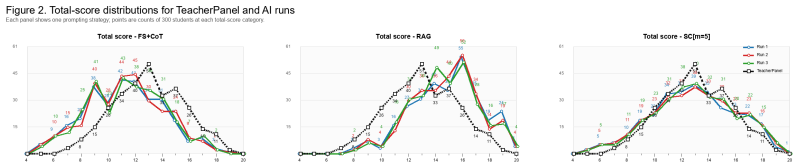
The paper's central claim is that the choice of prompting strategy changes both the accuracy and the bias of automated music-analysis scoring, and that the three studied strategies rank consistently. In a single pass, few-shot prompting with chain-of-thought reasoning (Fs+CoT) agreed with teacher mean scores most closely (ICC(2,1)=0.657, QWK=0.656, RMSE=2.461). Retrieval-augmented generation (RAG) correlated moderately (r=0.669) but over-scored systematically, with a mean bias of +1.787 total points and over-scoring on roughly 45% of responses in every dimension. Self-consistency (SC) had almost no directional bias (−0.083) and near-perfect run-to-run repeatability (intra-LLM ICC=0.990), yet
What carries the argument
The central object is the prompting strategy as an experimental condition. Fs+CoT feeds the model a few scored examples plus instructions to reason step-by-step before assigning a score; RAG supplies retrieved reference material on harmony and form; SC draws five internal score samples per response and combines them. These strategies are compared against the teacher mean score, the average of three independent teacher ratings, using absolute-agreement statistics (ICC 2,1, Krippendorff's alpha, QWK), error indices (RMSE, MAE, signed bias), and a three-run repetition scheme that separates stable strategy-specific scoring tendencies from run-to-run stochasticity.
Load-bearing premise
The study treats the mean of the three teachers' scores as the truth, but it never reports whether those three teachers agreed with each other; if they disagreed substantially, the benchmark itself is unstable.
What would settle it
Compute the inter-rater reliability (e.g., ICC) among the three teachers' raw dimension scores. If the ICC is below about 0.6, the teacher mean is too noisy to serve as a gold standard, and all agreement statistics reported for the model would be uninterpretable. Alternatively, run the same three prompts on a different corpus of music-analysis essays; if the ranking changes, the ordering found here is task-specific rather than a property of the strategies.
If this is right
- Choosing Fs+CoT as the default prompt for GPT-4o-mini would produce scores closer to teacher judgments than RAG or SC on similar music-analysis tasks.
- Because median aggregation over three runs barely changes scores, spending extra compute on repeated sampling is unlikely to fix a strategy's systematic bias; calibration is more effective.
- The consistent weak agreement on Terminology means automated scores should not be used to judge students' precise use of technical vocabulary without extra safeguards.
- Repeatability is not validity: SC's near-zero bias and high run-to-run ICC did not translate into per-response agreement with teachers.
- Operational deployment should treat the model as a pre-scorer in a human-in-the-loop system, flagging responses with large dimension discrepancies for teacher review.
Where Pith is reading between the lines
- If the teacher-mean benchmark itself were noisy (the paper does not report inter-rater reliability among the three teachers), the reported strategy ordering might partly reflect noise rather than true scoring quality; a direct check would be to compute the teachers' ICC.
- The bias pattern suggests a simple calibration — shifting Fs+CoT scores upward by about 1.7 points and RAG scores downward by about 1.8 points — might align their totals with teachers; a testable extension is whether such linear calibration preserves the ranking of strategies.
- Because the study uses only one model, one task, and one generation temperature, the ordering might not transfer to other music-analysis prompts or to larger models; a direct replication varying these factors would test generality.
Editorial analysis
A structured set of objections, weighed in public.
Referee Report
Summary. The paper reports a comparative validation of GPT-4o-mini for rubric-based scoring of 300 university music-analysis essays. Three prompting strategies (Fs+CoT, RAG, and SC) scored all responses three times at temperature 0.9. Single-pass Run1 scores and median-of-three aggregated scores were compared with the mean of three independent teachers' ratings on four dimensions and total score. Agreement was quantified with Pearson r, ICC(2,1), Krippendorff's alpha, QWK, RMSE/MAE, and bias. The main finding is that Fs+CoT shows the strongest agreement with teacher means (Run1 ICC=0.657, QWK=0.656), RAG systematically over-scores (bias=1.787), SC is most repeatable across runs but has weaker per-response agreement (ICC=0.537), and median aggregation preserves the strategy ordering. The paper concludes that prompting strategies produce distinct scoring profiles and that operational deployment requires strategy-specific calibration and human oversight.
Significance. If the teacher-mean criterion is reliable and the prompting treatments are fully specified, the study is a useful addition to LLM-as-judge and automated-essay-scoring research, especially for music education. The multi-run design, the explicit separation of repeatability from agreement, the use of bootstrapped bias intervals, and the dimension-level analyses are strengths. The benchmark is external (teacher means) and no fitted parameters are used, so the main comparison is not circular. However, the force of the central 'Fs+CoT agrees best' claim depends on two unverified conditions: teacher inter-rater reliability and the actual prompt/retrieval implementation. Neither is currently documented in the manuscript, and the promised paired strategy-difference intervals are absent. These gaps weaken the reported evidence relative to the conclusions, but they are addressable with existing data and appended materials.
major comments (3)
- [§3.2] Teacher inter-rater reliability is not reported. The manuscript states that three teachers independently rated all responses and that their mean was used as the reference score, but no ICC, Krippendorff's alpha, QWK, or pairwise agreement among teachers is given. Because every RQ1/RQ3 statistic is computed against this teacher mean, the criterion itself is unvalidated. If the three teachers disagree substantially, the observed AI-teacher agreement coefficients conflate AI misfit with teacher inconsistency, and the ordering of strategies may change. Please compute and report teacher-IRR (e.g., ICC(2,1) and QWK) and discuss its level before interpreting the AI agreement results.
- [§3.6 / §4.4] The methods promise paired bootstrap confidence intervals for differences between prompting strategies, but the results never report such intervals. Table 5 gives per-strategy bias CIs only; no CI is shown for the difference in ICC, QWK, or RMSE between Fs+CoT and RAG/SC. Thus the central claim that Fs+CoT is the 'strongest' strategy rests on point estimates without a formal comparison of uncertainty. Please report paired bootstrap CIs for the key metric differences (e.g., Fs+CoT minus RAG and Fs+CoT minus SC) or state that the estimated differences are not statistically distinguishable.
- [§3.3 / §3.1] The prompting strategies are not fully specified. The paper gives the strategy names but does not provide the actual prompts (including the few-shot examples for Fs+CoT), the RAG retrieval configuration (corpus, chunking, top-k, source documents), or the self-consistency scoring protocol beyond m=5. Since the independent variable is the prompting strategy, readers cannot assess whether the implementations are fair or representative, and the results cannot be reproduced. Please include a supplementary appendix with full prompt texts, few-shot examples, and retrieval details.
minor comments (3)
- [Table 5] Exact-agreement (%) and over/under-scoring percentages are computed between integer AI scores and fractional teacher means, but no rounding rule is stated. Please explain how 'exact agreement' is defined (e.g., rounded teacher mean to nearest integer, or AI within a band).
- [Table 1 title] The title 'Inter-Rater Reliability and Agreement Across Prompt Strategies' is misleading because the table reports AI-teacher agreement and does not contain teacher inter-rater reliability. Consider renaming e.g., 'Agreement between Prompt Strategies and Teacher Mean Scores.'
- [Abstract and §4.4] The abstract says RAG 'systematically over-scores (bias = 1.787)' and Fs+CoT 'under-scored' but does not report whether the bootstrap CIs for the bias difference exclude zero. After the paired difference CIs are added, the abstract could state the uncertainty around these bias comparisons.
Circularity Check
No circular derivation: results are empirical comparisons against an external teacher-mean benchmark, not fits to the outcome being predicted.
full rationale
The paper's central claim (Fs+CoT shows strongest agreement with teacher mean scores in Run1 and Median3R) is an empirical comparison of observed LLM scores to an external human reference. The teacher mean is not constructed from LLM outputs, and no parameter is fitted to the agreement statistics. Agreement coefficients (Pearson r, ICC(2,1), Krippendorff's α, QWK, RMSE) are standard external validation metrics applied after scoring. Median3R aggregation is transparently labeled a study-specific robustness procedure, not a fitted prediction. The only self-citation (Lin et al., 2025) appears in background paragraphs about music-analysis scoring challenges and is not load-bearing for the present results. The absence of reported teacher inter-rater reliability in Section 3.2 is a potential validity limitation for the criterion, but it does not make the derivation circular; similarly, Table 5's exact-agreement percentages against fractional teacher means would need a rounding rule, but that is a reporting/measurement issue, not circularity. The derivation chain is therefore self-contained with respect to the empirical claims made.
Axiom & Free-Parameter Ledger
free parameters (3)
- sampling temperature =
0.9
- self-consistency internal generations m =
5
- few-shot example set and RAG retrieval configuration =
not reported
axioms (4)
- domain assumption The mean of three teachers' ratings is an adequate gold standard for scoring quality.
- domain assumption The model, prompt, rubric, and response were truly held constant across runs, with temperature the only source of variation.
- domain assumption The three prompting strategies were implemented correctly and distinctly according to their named definitions.
- standard math Standard psychometric interpretations of ICC, QWK, and Krippendorff's alpha apply to these score distributions.
Cite this review
Pith. "Pith review of Comparative Validation of GPT-4o-mini and Teacher Mean Scores for Automated Scoring of Music Analysis Responses: Single-Pass Deployment, Repeatability, and Strategy-Specific Bias." pith.science (2026). https://pith.science/paper/WD4KRNJT
@misc{pith2026260801783,
  author       = {Pith},
  title        = {Pith review of: Comparative Validation of GPT-4o-mini and Teacher Mean Scores for Automated Scoring of Music Analysis Responses: Single-Pass Deployment, Repeatability, and Strategy-Specific Bias},
  year         = {2026},
  howpublished = {\url{https://pith.science/paper/WD4KRNJT}},
  note         = {Machine review of arXiv:2608.01783}
}
read the original abstract
Scoring open-ended music analysis responses is time-consuming and requires nuanced judgments of harmonic knowledge and formal understanding. This study evaluates the validity and repeatability of GPT-4o-mini for rubric-based scoring of music analysis essays, using teacher mean scores as the benchmark. A dataset of 300 university-level student responses was scored by teachers on four dimensions: Harmony, Form, Reasoning, and Terminology. GPT-4o-mini scored the same responses using three prompting strategies: few-shot prompting with chain-of-thought reasoning (Fs+CoT), retrieval-augmented generation (RAG), and self-consistency based on five internal generations per administration (SC). Each strategy was administered three times with the model, prompt, rubric, and response held constant. Single-pass scores represented an operational scoring condition, whereas median aggregation across three runs was used to examine robustness. Agreement with teacher mean scores was evaluated using correlation, intraclass correlation, Krippendorff's alpha, quadratic weighted kappa, and scoring error indices. Fs+CoT showed the strongest agreement with teacher mean scores in both single-pass scoring and median aggregation. RAG showed systematic over-scoring, whereas SC produced highly repeatable scores but weaker individual-level agreement. Dimension-level analyses showed that scoring performance varied across rubric components, with Terminology generally showing weaker agreement than Reasoning. These findings indicate that GPT-4o-mini can generate stable scores for complex music analysis responses, but prompting strategies produce distinct scoring profiles. Operational use therefore requires strategy-specific calibration, dimension-level validation, and continued human oversight.
Figures


Reference graph
Works this paper leans on
-
[1]
Bestgen, Y. (2022). Please, don't forget the difference and the confidence interval when seeking for the state-of-the-art status. In Proceedings of the Thirteenth Language Resources and Evaluation Conference (pp. 5956--5962)
work page 2022
-
[2]
B., Mann, B., Ryder, N., Subbiah, M., Kaplan, J., Dhariwal, P., et al
Brown, T. B., Mann, B., Ryder, N., Subbiah, M., Kaplan, J., Dhariwal, P., et al. (2020). Language models are few-shot learners. Advances in Neural Information Processing Systems, 33, 1877--1901
work page 2020
-
[3]
Cohen, J. (1968). Weighted kappa: Nominal scale agreement with provision for scaled disagreement or partial credit. Psychological Bulletin, 70(4), 213--220. https://doi.org/10.1037/h0026256
doi:10.1037/h0026256 1968
-
[4]
Cook, N. (1994). A guide to musical analysis. Oxford University Press
work page 1994
-
[5]
Dikli, S. (2006). An overview of automated scoring of essays. The Journal of Technology, Learning and Assessment, 5(1)
work page 2006
-
[6]
Ewell, P., & Cumming, T. (2017). History and conceptual basis of assessment in higher education. In T. Cumming & M. D. Miller (Eds.), Enhancing assessment in higher education: Putting psychometrics to work. Stylus
work page 2017
-
[7]
Gaggioli, A., Casaburi, G., Ercolani, L., Collov \`a , F., Torre, P., & Davide, F. (2025). Assessing the reliability and validity of large language models for automated assessment of student essays in higher education. arXiv preprint arXiv:2508.02442
Pith/arXiv arXiv 2025
-
[8]
Garc \'i a-Varela, F., Nussbaum, M., Mendoza, M., Mart \'i nez-Troncoso, C., & Bekerman, Z. (2025). ChatGPT as a stable and fair tool for automated essay scoring. Education Sciences, 15(8), 946
work page 2025
-
[9]
Hennessy, J., & Corr, S. (2021). Chasing every mark: High-stakes assessment and curriculum narrowing in disciplinary literacy in the Irish secondary music classroom. British Journal of Music Education, 38(3), 193--206
work page 2021
-
[10]
Jong, Y. J., Kim, Y. J., & Ri, O. C. (2023). Review of feedback in automated essay scoring. arXiv preprint arXiv:2307.05553
Pith/arXiv arXiv 2023
-
[11]
Koo, T. K., & Li, M. Y. (2016). A guideline of selecting and reporting intraclass correlation coefficients for reliability research. Journal of Chiropractic Medicine, 15(2), 155--163
work page 2016
-
[12]
Kostka, S. M., Payne, D., & Alm \'e n, B. (2018). Tonal harmony: With an introduction to post-tonal music. McGraw-Hill
work page 2018
-
[13]
Lewis, P., Perez, E., Piktus, A., Petroni, F., Karpukhin, V., Goyal, N., et al. (2020). Retrieval-augmented generation for knowledge-intensive NLP tasks. Advances in Neural Information Processing Systems, 33, 9459--9474
work page 2020
-
[14]
Lin, B., Jin, L., & Min, K. S. (2025, October). Can LLMs reliably score student-written musical form analyses? A study on few-shot learning and teacher ratings. In eLearn: World Conference on EdTech (pp. 50--55). Association for the Advancement of Computing in Education
work page 2025
-
[15]
Manakul, P., Liusie, A., & Gales, M. (2023). SelfCheckGPT: Zero-resource black-box hallucination detection for generative large language models. In Proceedings of the 2023 Conference on Empirical Methods in Natural Language Processing (pp. 9004--9017)
work page 2023
-
[16]
Ohyama, T. (2025). A comparison of confidence interval methods for the intraclass correlation coefficient based on the one-way random effects model. Japanese Journal of Statistics and Data Science, 1--16
work page 2025
-
[17]
J., Correnti, R., Wang, E., & Matsumura, L
Rahimi, Z., Litman, D. J., Correnti, R., Wang, E., & Matsumura, L. C. (2017). Assessing students' use of evidence and organization in response-to-text writing: Using natural language processing for rubric-based automated scoring. International Journal of Artificial Intelligence in Education, 27, 694--728
work page 2017
-
[18]
Ramineni, C., & Williamson, D. M. (2013). Automated essay scoring: Psychometric guidelines and practices. Assessing Writing, 18(1), 25--39
work page 2013
-
[19]
Renze, M. (2024). The effect of sampling temperature on problem solving in large language models. In Findings of the Association for Computational Linguistics: EMNLP 2024 (pp. 7346--7356)
work page 2024
-
[20]
Schroeder, K., & Wood-Doughty, Z. (2024). Can you trust LLM judgments? Reliability of LLM-as-a-judge. arXiv preprint arXiv:2412.12509
Pith/arXiv arXiv 2024
-
[21]
Van der Schaaf, M., Baartman, L., & Prins, F. (2012). Exploring the role of assessment criteria during teachers' collaborative judgement processes of students' portfolios. Assessment & Evaluation in Higher Education, 37(7), 847--860. https://doi.org/10.1111/j.1745-3992.2011.00223.x
arXiv 2012
-
[22]
Wang, X., Wei, J., Schuurmans, D., Le, Q., Chi, E., Narang, S., et al. (2022). Self-consistency improves chain-of-thought reasoning in language models. arXiv preprint arXiv:2203.11171
Pith/arXiv arXiv 2022
-
[23]
Wei, J., Wang, X., Schuurmans, D., Bosma, M., Xia, F., Chi, E., et al. (2022). Chain-of-thought prompting elicits reasoning in large language models. Advances in Neural Information Processing Systems, 35, 24824--24837
work page 2022
-
[24]
Williamson, D. M., Xi, X., & Breyer, F. J. (2012). A framework for evaluation and use of automated scoring. Educational Measurement: Issues and Practice, 31(1), 2--13
work page 2012
-
[25]
Yoo, H., Lee, Y., Kim, H., et al. (2025). Dataset for rubric-based essay scoring on EFL writing. In Proceedings of the 63rd Annual Meeting of the Association for Computational Linguistics
work page 2025
This paper was first reviewed by deepseek-v4-flash on August 4, 2026.
discussion (0)
Sign in with ORCID, Apple, or X to comment. Anyone can read and Pith papers without signing in.