REVIEW 4 major objections 5 minor 1 cited by
New millimeter CO observations of the gas-rich debris disks 49 Cet and HD 32297
T0 review · 4 major / 5 minor · reviewed 2026-08-14 · deepseek-v4-flash
Pith's one-line read Carbon shielding explains CO-rich debris disks around two young stars
desk verdict Solid new isotopologue detections that double the shielded-debris-disk sample, wrapped in a plausible but viscosity-sensitive model that the authors themselves hedge. read the letter →
The pith
A machine-rendered reading of the paper's core claim, the machinery that carries it, and where it could break.
The reading
What carries the argument
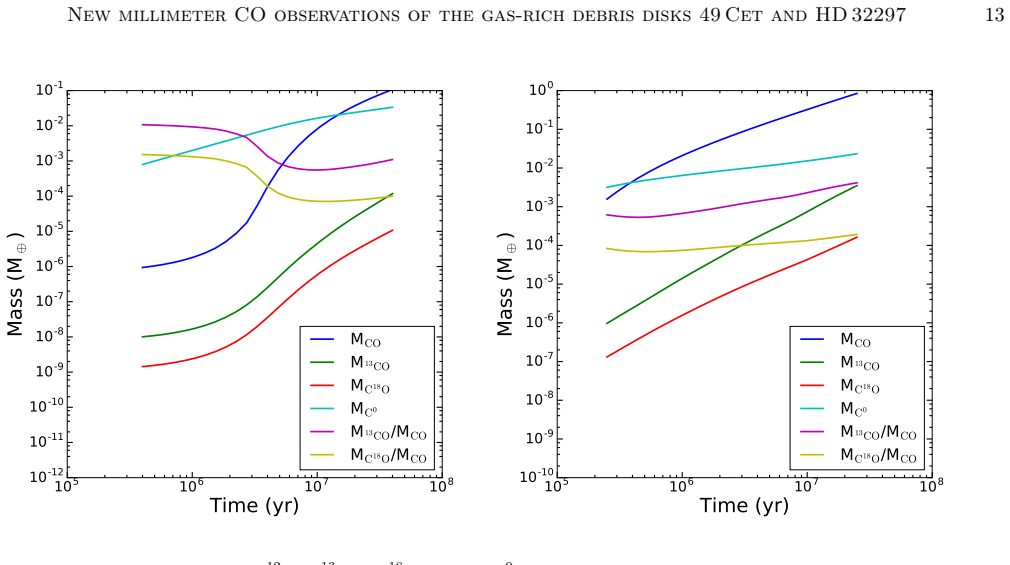
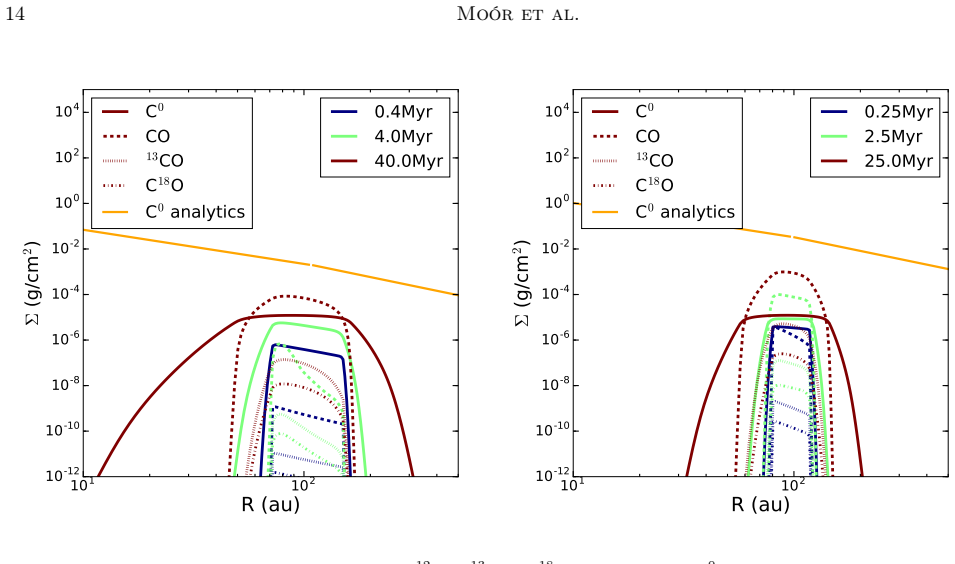
The central mechanism is the shielded secondary gas disk: CO and CO$_2$ released from colliding icy planetesimals are photodissociated into carbon and oxygen, and the neutral carbon atoms, if they accumulate faster than they spread, become optically thick to ultraviolet radiation and shield the remaining CO; CO molecules also self-shield against dissociation. The paper's specific new tool is a one-dimensional viscous evolution code that tracks $^{12}$CO, $^{13}$CO, C$^{18}$O, and C$^0$ together at all radii, treating isotope-selective photodissociation for the first time in a debris disk model, which allows the rare-isotope line fluxes to be fit directly.
What would settle it
Measure the non-thermal line width of the CO (2-1) emission in HD 32297 with sufficient spectral resolution to constrain $\alpha$: if the implied viscosity exceeds about $10^{-4}$, the carbon shield cannot build up and the observed CO mass would not be sustainable under the secondary-only scenario.
Extended reading notes
Core claim
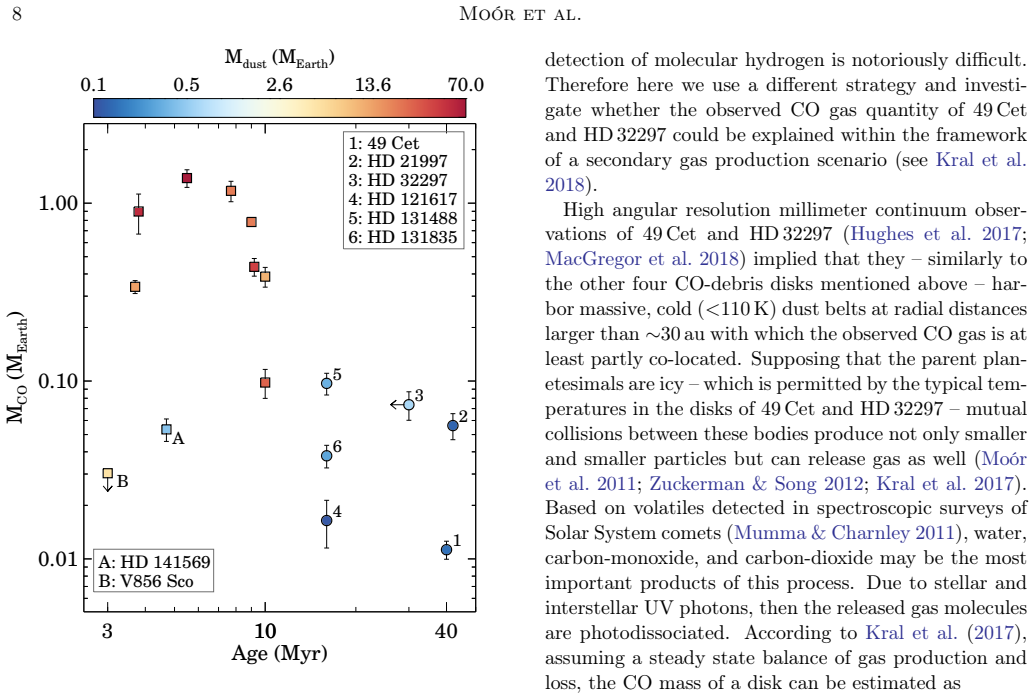
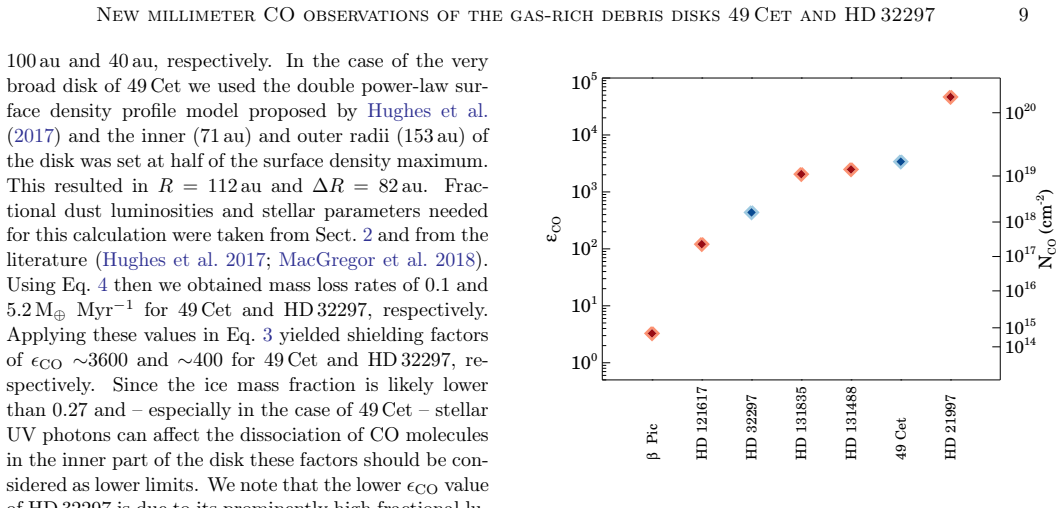
Using the ALMA 7-m array, the team detected $^{13}$CO toward 49 Cet and HD 32297 and C$^{18}$O toward HD 32297, showing that the $^{12}$CO emission is optically thick and implying total CO masses of about $0.011\,M_\oplus$ and $0.074\,M_\oplus$ respectively. They then adapted the shielded secondary gas disk model of Kral et al. (2018) into a one-dimensional viscous model that follows $^{12}$CO, $^{13}$CO, C$^{18}$O, and neutral carbon at every radius, including isotope-selective photodissociation. The paper's central claim is that this model reproduces the observed isotopologue masses with CO production rates of roughly $0.005$–$0.03\,M_\oplus$/Myr and a low viscosity parameter ($\alpha \lesssim 10^{-4}$), because neutral carbon and CO self-shielding extend the CO lifetime by factors of several hundred to a few thousand. In the case of 49 Cet, the predicted CI line flux also matches the observed value, adding a third independent constraint. The authors thus conclude that the high CO content of both disks can be understood without primordial hydrogen gas, though they do not rule it out.
Load-bearing premise
The model requires the gas to spread very slowly, with a viscosity parameter $\alpha$ between about $10^{-5}$ and $10^{-4}$, a value inferred from the low ionization in shielded gas but not directly measured; if the true viscosity were much higher, carbon would disperse and the shielding would fail.
Editorial extensions
If this is right
- The two disks join four previously known CO-rich debris disks as shielded debris disks, a class that can be powered entirely by second-generation gas from planetesimal collisions.
- The required CO production rates translate to CO+CO$_2$ ice mass fractions of about 5% for 49 Cet and 0.7% for HD 32297, comparable to the ice content of solar-system comets.
- In HD 32297 the derived gas surface density gives a Stokes number $St \lesssim 1$ for the smallest bound grains, meaning gas drag should shape the dust distribution; this can explain the warm small grains observed in that disk.
- The model predicts that neutral carbon spreads farther than CO, so resolved CI maps should show a more extended gas halo; this is a testable signature of the shielding mechanism.
Reading between the lines
- If the low viscosities ($\alpha \approx 10^{-5}$–$10^{-4}$) are real, similar carbon-shielding may operate in other moderately gas-rich debris disks, and the absence of CO in dust-rich disks like HR 4796 could reflect either lower production rates or higher viscosity rather than a lack of icy planetesimals.
- A direct measurement of turbulent line broadening in the CO lines of HD 32297 with ALMA at higher spectral resolution could test the assumed viscosity, since the model's $\alpha$ range corresponds to subsonic, but measurable, non-thermal velocity dispersions.
- The same mechanism might protect other volatile molecules (e.g., CO$_2$ or H$_2$O fragments) from photodissociation, implying that shielded debris disks could be identifiable by their full volatile inventory, not just CO.
Signed reviews
Editorial analysis
A structured set of objections, weighed in public.
Referee Report
Summary. The paper presents ALMA 7m-array Band 6 observations of 12CO, 13CO, and C18O toward the debris disks around the young A-type stars 49 Cet and HD 32297. The measured 13CO/12CO and C18O/13CO line ratios imply that the 12CO emission is optically thick in both disks, and the optically thin isotopologue fluxes lead to inferred total CO masses of about 0.011 M_earth (49 Cet) and 0.074 M_earth (HD 32297), i.e. above the 0.01 M_earth threshold that defines the previously identified CO-rich debris disk class. The authors argue that such high CO masses require strong shielding, and they adapt the Kral et al. (2018) secondary gas disk model, now including radial viscous evolution of 12CO, 13CO, C18O, and atomic carbon plus isotope-selective photodissociation, to see whether the observed isotopologue masses can be reproduced without primordial H2. A grid over CO production rate and viscosity parameter alpha yields an acceptable region for 49 Cet that also matches the observed CI line flux and inner CO radius, while for HD 32297 the C18O mass can be matched only with very low alpha and the agreement is admitted to be marginal. The paper then discusses gas-dust coupling, concluding that small grains in HD 32297 are plausibly coupled to the gas, and argues that the two systems are new representatives of shielded debris disks, while noting that a primordial origin cannot be excluded.
Significance. If the modeling claim holds, the paper significantly enlarges the sample of CO-rich debris disks with measured isotopologues from four to six and provides the first such measurements for 49 Cet and HD 32297. The observational analysis is careful: line flux ratios, optical depth arguments, and mass estimates from optically thin isotopologues are standard and the systematic uncertainties are discussed. The upgraded model is a genuine step forward in adding radial evolution and isotope-selective photodissociation to secondary gas disk modeling, and it makes testable predictions for CI emission and for the radial extent of CO versus C0. The independent constraints used for 49 Cet (CI line flux and inner CO radius) are valuable because they are not simply the mass being fitted. However, the central explanation is partly constructed by construction: the model's production rate and alpha are varied to match the very masses that are then said to be explained, and for HD 32297 the surviving parameter region depends on an unmeasured and extremely low viscosity.
major comments (4)
- [Sect. 5.3.2, Fig. 4] The central demonstration that the shielded secondary gas disk model explains the observed CO content is partly circular: the model grid is scored against the same 13CO (49 Cet) and C18O (HD 32297) masses that the free parameters Mdot_CO and alpha are varied to reproduce. The solid black contours therefore trace the fitted relation rather than a prediction. The independent constraints (CI line flux and inner CO radius for 49 Cet; inner radius alone for HD 32297) are what rescue the exercise, but for HD 32297 the acceptable region is essentially defined by the requirement alpha <~ 2e-5 and the authors themselves call the agreement marginal. Please separate the fitted constraints from the predictive checks and state explicitly how much parameter space survives if the isotopologue mass contours are omitted.
- [Sect. 5.3.1 and 5.3.2] The extremely low viscosity, alpha ~ 1e-5 to 9e-5, is an input assumption rather than a model output. Although the text states that the new code computes the ionization fraction at every radial location, alpha is treated as an independent grid parameter and is not derived from that ionization state. For HD 32297 the required alpha is below about 2e-5, and the supporting argument from ambipolar diffusion and low ionization is only qualitative. Please add a sensitivity analysis showing whether any Mdot_CO can reproduce the observed masses for, e.g., alpha = 1e-4 or 1e-3, or alternatively derive alpha from the computed ionization balance. Without such a test, the secondary-only interpretation rests on an untested assumption about the disk's transport properties.
- [Sect. 5.3.3 and Sect. 4.2] The model predicts that isotope-selective photodissociation lowers the 13CO/12CO and C18O/12CO ratios below the ISM values used in Section 4.2, and as a result the simulated 12CO masses are about an order of magnitude higher than the observationally inferred masses quoted in Table 1 and Figure 2. This is acknowledged in Section 5.3.3, but the abstract and Section 6 should not present the Section 4.2 masses as the definitive CO content without noting that the adopted model implies substantially larger 12CO masses. The discrepancy does not weaken the 'optically thick' conclusion, but it affects the quantitative comparison with protoplanetary disks and the shielding factors derived in Section 5.2.
- [Sect. 5.3.5 and Sect. 6] The abstract's and Section 6's framing that the secondary gas disk model can explain the observed CO levels is too strong given the paper's own admission in Section 5.3.5 that primordial H2 cannot be ruled out. The observations and model demonstrate consistency with a secondary origin, but they do not uniquely establish it, because the same CO masses and shielding factors can in principle be produced by leftover hydrogen. Please temper the language to 'consistent with' rather than 'can explain' in the abstract, or add an explicit statement that the two scenarios are currently degenerate and identify the specific observations that would break the degeneracy.
minor comments (5)
- [Throughout] There are several typographical issues, e.g. 'obser v ations' in the title and section headings and 'neccessarily' in Section 5.2; these should be corrected in the final version.
- [Fig. 4 caption] The caption contains run-together notation such as 'F12CO(2-1) = 1.05Jykms-1' and 'i=84º'; please add spaces and consistent units for readability.
- [Sect. 5.2] The phrase 'CO mass estimates are from Fig. 2a' appears to reference a panel that does not exist in Figure 2; please correct the cross-reference.
- [Sect. 5.3.1] The upgraded model is described as being presented in detail in a forthcoming paper, and no code or data products are made public. Since several central results depend on these numerical simulations, a public code release or a detailed appendix would substantially improve reproducibility.
- [Sect. 4.2] The sentence 'Since with the adopted temperatures the fractional population is close to its maximum in LTE, these deviations can typically lead to higher gas masses' is slightly ambiguous; it would be clearer to state explicitly that lower x2 values correspond to higher inferred masses.
Circularity Check
The observed CO mass is reproduced by fitting the model's free parameter Mdot_CO; independent constraints (CI flux, inner radius) provide partial grounding, but the central 'explanation' of the CO level is by construction.
-
fitted input called prediction
[Section 5.3.2, Figure 4, grid fit to observed 13CO/C18O masses]
"To find a best fit model to the 13CO and C18O masses derived from observations for 49Cet and HD32297, we run a large grid of 100 models to explore the parameter space in ˙MCO and α. The grid is logarithmic for both parameters and comprised of 10 elements going from 10−3 to 10−1M⊕/Myr for ˙MCO and from 10−5 to 10−2 for α. For each model, we compute the total13CO (for 49Cet) or C18O (for HD32297) masses and compare them to observed values."
The model's CO production rate Mdot_CO is a free parameter tuned so that the computed 13CO (or C18O) mass equals the observed value. Therefore the abstract's statement that 'we can explain the observed CO level' is, for the CO mass itself, a restatement of the fit rather than an independent prediction. The independent constraints (CI line flux, inner CO radius, 12CO flux) do narrow the acceptable parameter region and provide non-circular validation, but the central CO-mass agreement is by construction.
full rationale
The paper's central claim — that the shielded secondary gas disk model explains the observed CO content of 49 Cet and HD 32297 — is partly based on a grid search that fits Mdot_CO (and alpha) to the observed 13CO or C18O masses (Sect. 5.3.2, Fig. 4). This is a fitted-input-called-prediction pattern: the CO mass match is guaranteed by choosing Mdot_CO appropriately. However, the paper does include independent observables: for 49 Cet, the CI line flux and inner CO radius; for HD 32297, the inner CO radius and 12CO line flux. These overdetermine the two-parameter grid and give the model some genuine predictive content, so the circularity is partial rather than total. The low-alpha requirement (alpha ~ 1e-5) is a significant weakness and is argued from Kral & Latter 2016 rather than derived from the model's own ionization calculation, but it is an input assumption, not a circular reduction. The self-citation to Kral et al. 2018 is present and load-bearing as the model framework, but the new independent constraints mean the central claim does not reduce solely to that citation. The paper also honestly concedes in Sect. 5.3.5 that primordial H2 cannot be ruled out, further limiting the force of the secondary-only interpretation. Overall, the CO-mass agreement is partly constructed by the fit, yielding a circularity score of 6.
Assumptions & free parameters
free parameters (5)
- CO production rate Mdot_CO =
~4.6e-3 M_Earth/Myr (49 Cet), ~3.6e-2 M_Earth/Myr (HD 32297)
- Viscosity parameter alpha =
~4.6e-5 (49 Cet), ~1.5e-5 (HD 32297)
- Gas temperature =
20 K adopted
- Onset time of collisional gas production =
5 Myr after star birth
- Radial distribution of gas release =
constant with radius
assumptions (6)
- domain assumption LTE and optically thin emission for 13CO and C18O lines
- domain assumption Local interstellar isotope ratios [12C]/[13C]=77 and [16O]/[18O]=560
- domain assumption Planetesimals are icy with CO+CO2 ice mass fraction up to 0.27
- standard math Collisional mass loss rate follows Eq. 4 of Matrà et al. 2017b
- domain assumption Shielding efficiencies of CO and C0 follow Visser et al. 2009 and Kral et al. 2018
- domain assumption Gas disk viscously evolves with an alpha prescription and is pre-stirred from 5 Myr
Cite this review
Pith. "Pith review of New millimeter CO observations of the gas-rich debris disks 49 Cet and HD 32297." pith.science (2026). https://pith.science/paper/WD5Z6J42
@misc{pith2026190809685,
  author       = {Pith},
  title        = {Pith review of: New millimeter CO observations of the gas-rich debris disks 49 Cet and HD 32297},
  year         = {2026},
  howpublished = {\url{https://pith.science/paper/WD5Z6J42}},
  note         = {Machine review of arXiv:1908.09685}
}
abstract
Previous observations revealed the existence of CO gas at nearly protoplanetary level in several dust-rich debris disks around young A-type stars. Here we used the ALMA 7m-array to measure $^{13}$CO and C$^{18}$O emission toward two debris disks, 49 Cet and HD 32297, and detected similarly high CO content ($>$0.01M$_\oplus$). These high CO masses imply a highly efficient shielding of CO molecules against stellar and interstellar ultraviolet photons. Adapting a recent secondary gas disk model that considers both shielding by carbon atoms and self-shielding of CO, we can explain the observed CO level in both systems. Based on the derived gas densities we suggest that, in the HD 32297 disk, dust and gas are coupled and the dynamics of small grains is affected by the gaseous component. For 49 Cet, the question of coupling remains undecided. We found that the main stellar and disk propertiesof 49 Cet and HD 32297 are very similar to those of previously identified debris disks with high CO content. These objects constitute together the first known representatives of shielded debris disks.
Figures

Figures from the paper (3 more)

Forward citations
Cited by 1 Pith paper
-
A search for circumstellar gas in pre-main-sequence debris discs using absorption spectroscopy
Absorption spectroscopy of 130 young debris-disc hosts yields two new circumstellar-gas detections (TYC7879-1373-1 stable; HIP30414 variable/accreting), both pre-MS and <5 Myr, bringing the <10 Myr total to eight.
Reference graph
Works this paper leans on
-
[1]
M., Wilner, D
Andrews, S. M., Wilner, D. J., Hughes, A. M., et al. 2012, ApJ, 744, 162
2012
-
[2]
P., van der Marel, N., et al
Ansdell, M., Williams, J. P., van der Marel, N., et al. 2016, ApJ, 828, 46
2016
-
[3]
2016, A&A, 593, A73
Asensio-Torres, R., Janson, M., Hashimoto, J., et al. 2016, A&A, 593, A73
2016
-
[4]
E., & Paresce, F
Backman, D. E., & Paresce, F. 1993, Protostars and Planets III, 1253
1993
-
[5]
2018, AJ, 156, 58
Mantelet, G., & Andrae, R. 2018, AJ, 156, 58
2018
-
[6]
Beckwith, S. V. W., Sargent, A. I., Chini, R. S., & Guesten, R. 1990, AJ, 99, 924 18 Moór et al
1990
-
[7]
2007, ApJ, 655, 528
Besla, G., & Wu, Y. 2007, ApJ, 655, 528
2007
-
[8]
Spatially resolved spectroscopy of the debris disk HD 32297: Further evidence of small dust grains
Bhowmik, T., Boccaletti, A., Thébault, P., et al. 2019, arXiv e-prints, arXiv:1908.08511
work page Pith review arXiv 2019
Show all 91 references
-
[9]
2012, A&A, 544, A85
Boccaletti, A., Augereau, J.-C., Lagrange, A.-M., et al. 2012, A&A, 544, A85
2012
-
[10]
Booth, M., Matrà, L., Su, K. Y. L., et al. 2019, MNRAS, 482, 3443
2019
-
[11]
D., Walsh, C., & van Dishoeck, E
Bosman, A. D., Walsh, C., & van Dishoeck, E. F. 2018, A&A, 618, A182
2018
-
[12]
Brinch, C., & Hogerheijde, M. R. 2010, A&A, 523, A25
2010
-
[13]
A., Lamy, P
Burns, J. A., Lamy, P. L., & Soter, S. 1979, Icarus, 40, 1
1979
-
[14]
G., & Kurucz, R
Castelli, F., Gratton, R. G., & Kurucz, R. L. 1997, A&A, 318, 841
1997
-
[15]
2018, ApJ, 861, 72
Cataldi, G., Brandeker, A., Wu, Y., et al. 2018, ApJ, 861, 72
2018
-
[16]
2008, A&A, 488, 565 Choquet, É., Milli, J., Wahhaj, Z., et al
Chapillon, E., Guilloteau, S., Dutrey, A., & Piétu, V. 2008, A&A, 488, 565 Choquet, É., Milli, J., Wahhaj, Z., et al. 2017, ApJL, 834, L12
2008
-
[17]
J., Debes, J., et al
Currie, T., Rodigas, T. J., Debes, J., et al. 2012, ApJ, 757, 28
2012
-
[18]
H., Weinberger, A
Debes, J. H., Weinberger, A. J., & Kuchner, M. J. 2009, ApJ, 702, 318
2009
-
[19]
Dent, W. R. F., Wyatt, M. C., Roberge, A., et al. 2014, Science, 343, 1490
2014
-
[20]
K., Lebreton, J., Roberge, A., Augereau, J.-C., & Krivov, A
Donaldson, J. K., Lebreton, J., Roberge, A., Augereau, J.-C., & Krivov, A. V. 2013, ApJ, 772, 17
2013
-
[21]
M., Fitzgerald, M
Esposito, T. M., Fitzgerald, M. P., Graham, J. R., & Kalas, P. 2014, ApJ, 780, 25
2014
-
[22]
I., Bergin, E
Favre, C., Cleeves, L. I., Bergin, E. A., Qi, C., & Blake, G. A. 2013, ApJL, 776, L38
2013
-
[23]
R., et al
Fedele, D., Carney, M., Hogerheijde, M. R., et al. 2017, A&A, 600, A72
2017
-
[24]
2017, A&A, 601, A7 Fernández, R., Brandeker, A., & Wu, Y
Feldt, M., Olofsson, J., Boccaletti, A., et al. 2017, A&A, 601, A7 Fernández, R., Brandeker, A., & Wu, Y. 2006, ApJ, 643, 509
2017
-
[25]
P., Kalas, P
Fitzgerald, M. P., Kalas, P. G., & Graham, J. R. 2007, ApJ, 670, 557
2007
-
[26]
M., Hughes, A
Flaherty, K. M., Hughes, A. M., Andrews, S. M., et al. 2016, ApJ, 818, 97 Gaia Collaboration, Brown, A. G. A., Vallenari, A., et al. 2018, A&A, 616, A1
2016
-
[27]
S., Holland, W
Greaves, J. S., Holland, W. S., Matthews, B. C., et al. 2016, MNRAS, 461, 3910
2016
-
[28]
2007, A&A, 475, 755
Grigorieva, A., Thébault, P., Artymowicz, P., & Brandeker, A. 2007, A&A, 475, 755
2007
-
[29]
S., Pérez, S., Saito, M., et al
Hales, A. S., Pérez, S., Saito, M., et al. 2018, ApJ, 859, 111
2018
-
[30]
1994, A&A, 291, 546
Henning, T., Launhardt, R., Steinacker, J., & Thamm, E. 1994, A&A, 291, 546
1994
-
[31]
E., Sato, A., Tsukagoshi, T., et al
Higuchi, A. E., Sato, A., Tsukagoshi, T., et al. 2017, ApJL, 839, L14
2017
-
[32]
Hildebrand, R. H. 1983, QJRAS, 24, 267
1983
-
[33]
S., Matthews, B
Holland, W. S., Matthews, B. C., Kennedy, G. M., et al. 2017, MNRAS, 470, 3606
2017
-
[34]
M., Wilner, D
Hughes, A. M., Wilner, D. J., Kamp, I., & Hogerheijde, M. R. 2008, ApJ, 681, 626
2008
-
[35]
M., Lieman-Sifry, J., Flaherty, K
Hughes, A. M., Lieman-Sifry, J., Flaherty, K. M., et al. 2017, ApJ, 839, 86
2017
-
[36]
M., Duchêne, G., & Matthews, B
Hughes, A. M., Duchêne, G., & Matthews, B. C. 2018, ARA&A, 56, 541
2018
-
[37]
P., Chen, C
Hung, L.-W., Fitzgerald, M. P., Chen, C. H., et al. 2015, ApJ, 802, 138
2015
-
[38]
2007, A&A, 469, 213
Isella, A., Testi, L., Natta, A., et al. 2007, A&A, 469, 213
2007
-
[39]
2005, ApJL, 635, L169
Kalas, P. 2005, ApJL, 635, L169
2005
-
[40]
H., Qi, C., Dickson-Vandervelde, D
Kastner, J. H., Qi, C., Dickson-Vandervelde, D. A., et al. 2018, ApJ, 863, 106
2018
-
[41]
M., Marino, S., Matrà, L., et al
Kennedy, G. M., Marino, S., Matrà, L., et al. 2018, MNRAS, 475, 4924 Kóspál, Á., Moór, A., Juhász, A., et al. 2013, ApJ, 776, 77
2018
-
[42]
C., Kama, M., & Matra, L
Kral, Q., Marino, S., Wyatt, M. C., Kama, M., & Matra, L. 2018, arXiv:1811.08439
2018 arXiv
-
[43]
C., & Kennedy, G
Kral, Q., Matrà, L., Wyatt, M. C., & Kennedy, G. M. 2017, MNRAS, 469, 521
2017
-
[44]
F., et al
Kral, Q., Wyatt, M., Carswell, R. F., et al. 2016, MNRAS, 461, 845
2016
-
[45]
2016, MNRAS, 461, 1614
Kral, Q., & Latter, H. 2016, MNRAS, 461, 1614
2016
-
[46]
Krivov, A. V. 2010, Research in Astronomy and Astrophysics, 10, 383 Lecavelier des Etangs, A., Vidal-Madjar, A., Roberge, A., et al. 2001, Nature, 412, 706
2010
-
[47]
M., Carpenter, J
Lieman-Sifry, J., Hughes, A. M., Carpenter, J. M., et al. 2016, ApJ, 828, 25
2016
-
[48]
2018, A&A, 616, A2
Lindegren, L., Hernández, J., Bombrun, A., et al. 2018, A&A, 616, A2
2018
-
[49]
J., Pascucci, I., et al
Long, F., Herczeg, G. J., Pascucci, I., et al. 2017, ApJ, 844, 99
2017
-
[50]
Lynden-Bell, D., & Pringle, J. E. 1974, MNRAS, 168, 603
1974
-
[51]
A., Wilner, D
MacGregor, M. A., Wilner, D. J., Chandler, C., et al. 2016, ApJ, 823, 79
2016
-
[52]
A., Weinberger, A
MacGregor, M. A., Weinberger, A. J., Hughes, A. M., et al. 2018, ApJ, 869, 75
2018
-
[53]
2016, MNRAS, 460, 2933
Marino, S., Matrà, L., Stark, C., et al. 2016, MNRAS, 460, 2933
2016
-
[54]
C., Panić, O., et al
Marino, S., Wyatt, M. C., Panić, O., et al. 2017, MNRAS, 465, 2595 Martin-Zaïdi, C., Deleuil, M., Le Bourlot, J., et al. 2008, A&A, 484, 225 Matrà, L., MacGregor, M. A., Kalas, P., et al. 2017a, ApJ, 842, 9 New millimeter CO obser v ations of the gas-rich debris disks 49 Cet a...
2017
-
[55]
2007, in Astronomical Society of the Pacific Conference Series, Vol
Golap, K. 2007, in Astronomical Society of the Pacific Conference Series, Vol. 376, Astronomical Data Analysis Software and Systems XVI, ed. R. A. Shaw, F. Hill, & D. J. Bell, 127
2007
-
[56]
2012, A&A, 544, A78
Meeus, G., Montesinos, B., Mendigutía, I., et al. 2012, A&A, 544, A78
2012
-
[57]
Miotello, A., Bruderer, S., & van Dishoeck, E. F. 2014, A&A, 572, A96
2014
-
[58]
F., Williams, J
Miotello, A., van Dishoeck, E. F., Williams, J. P., et al. 2017, A&A, 599, A113
2017
-
[59]
1993, Icarus, 106, 20
Miyake, K., & Nakagawa, Y. 1993, Icarus, 106, 20
1993
-
[60]
Packham, C., & Radomski, J. T. 2007, ApJL, 666, L109 Moór, A., Ábrahám, P., Juhász, A., et al. 2011, ApJL, 740, L7 Moór, A., Henning, T., Juhász, A., et al. 2015a, ApJ, 814, 42 Moór, A., Kóspál, Á., Ábrahám, P., et al. 2015b, MNRAS, 447, 577 Moór, A., Curé, M., Kóspál, Á., et ...
2007
-
[61]
Y., Bryden, G., Werner, M
Morales, F. Y., Bryden, G., Werner, M. W., & Stapelfeldt, K. R. 2016, ApJ, 831, 97
2016
-
[62]
J., & Charnley, S
Mumma, M. J., & Charnley, S. B. 2011, ARA&A, 49, 471
2011
-
[63]
1994, A&A, 291, 943
Ossenkopf, V., & Henning, T. 1994, A&A, 291, 943
1994
-
[64]
V., Marshall, J
Pawellek, N., Krivov, A. V., Marshall, J. P., et al. 2014, ApJ, 792, 65 Péricaud, J., di Folco, E., Dutrey, A., et al. 2016, in IAU
2014
-
[65]
314, Young Stars & Planets Near the Sun, ed
Symposium, Vol. 314, Young Stars & Planets Near the Sun, ed. J. H. Kastner, B. Stelzer, & S. A. Metchev, 201–202 Péricaud, J. 2016, Ph.D. Thesis, L’UNIVERSITÉ DE
2016
-
[66]
2017, A&A, 600, A62
BORDEAUX, BORDEAUX Péricaud, J., Di Folco, E., Dutrey, A., Guilloteau, S., & Piétu, V. 2017, A&A, 600, A62
2017
-
[67]
2006, AJ, 131, 2290
Hogerheijde, M. 2006, AJ, 131, 2290
2006
-
[68]
2018, A&A, 614, A3 Redfield, S
Rebollido, I., Eiroa, C., Montesinos, B., et al. 2018, A&A, 614, A3 Redfield, S. 2007, ApJL, 656, L97
2018
-
[69]
Richert, A. J. W., Lyra, W., & Kuchner, M. J. 2018, ApJ, 856, 41
2018
-
[70]
2012, A&A, 546, L8
Riviere-Marichalar, P., Barrado, D., Augereau, J.-C., et al. 2012, A&A, 546, L8
2012
-
[71]
2014, A&A, 565, A68
Riviere-Marichalar, P., Barrado, D., Montesinos, B., et al. 2014, A&A, 565, A68
2014
-
[72]
Grady, C. A. 2014, ApJL, 796, L11
2014
-
[73]
2013, ApJ, 771, 69
Roberge, A., Kamp, I., Montesinos, B., et al. 2013, ApJ, 771, 69
2013
-
[74]
J., Debes, J
Rodigas, T. J., Debes, J. H., Hinz, P. M., et al. 2014, ApJ, 783, 21
2014
-
[75]
A., Andrews, S
Rosenfeld, K. A., Andrews, S. M., Hughes, A. M., Wilner, D. J., & Qi, C. 2013, ApJ, 774, 16
2013
-
[76]
1986, PASP, 98, 685
Sadakane, K., & Nishida, M. 1986, PASP, 98, 685
1986
-
[77]
D., & Hines, D
Schneider, G., Silverstone, M. D., & Hines, D. C. 2005, ApJL, 629, L117
2005
-
[78]
A., Hines, D
Schneider, G., Grady, C. A., Hines, D. C., et al. 2014, AJ, 148, 59
2014
-
[79]
Silverstone, M. D. 2000, PhD thesis, UNIVERSITY OF
2000
-
[80]
J., Skinner, C
Sylvester, R. J., Skinner, C. J., Barlow, M. J., & Mannings, V. 1996, MNRAS, 279, 915
1996
-
[81]
2001, ApJ, 557, 990 van der Plas, G., Ménard, F., Gonzalez, J.-F., et al
Takeuchi, T., & Artymowicz, P. 2001, ApJ, 557, 990 van der Plas, G., Ménard, F., Gonzalez, J.-F., et al. 2019, A&A, 624, A33
2001
-
[82]
F., & Black, J
Visser, R., van Dishoeck, E. F., & Black, J. H. 2009, A&A, 503, 323
2009
-
[83]
W., & Sargent, A
Wahhaj, Z., Koerner, D. W., & Sargent, A. I. 2007, ApJ, 661, 36
2007
-
[84]
A., Boley, A
White, J. A., Boley, A. C., MacGregor, M. A., Hughes, A. M., & Wilner, D. J. 2018, MNRAS, 474, 4500
2018
-
[85]
L., & Rood, R
Wilson, T. L., & Rood, R. 1994, ARA&A, 32, 191
1994
-
[86]
Wyatt, M. C. 2008, ARA&A, 46, 339
2008
-
[87]
C., Panić, O., Kennedy, G
Wyatt, M. C., Panić, O., Kennedy, G. M., & Matrà, L. 2015, Ap&SS, 357, 103
2015
-
[88]
Wyatt, M. C. 2018, Handbook of Exoplanets, 146
2018
-
[89]
Zuckerman, B., Forveille, T., & Kastner, J. H. 1995, Nature, 373, 494
1995
-
[90]
2012, ApJ, 758, 77
Zuckerman, B., & Song, I. 2012, ApJ, 758, 77
2012
-
[91]
2019, ApJ, 870, 27
Zuckerman, B. 2019, ApJ, 870, 27
2019
Reviewed August 14, 2026 · model on record in the stance chip above.
Discussion (0). Continue with ORCID to comment.