A Local Perspective on the Edge Removal Problem
Pith reviewed 2026-05-25 11:16 UTC · model grok-4.3
The pith
Sufficient conditions on the encoding function of one removed edge allow proving achievability of a related rate vector after removal.
A machine-rendered reading of the paper's core claim, the machinery that carries it, and where it could break.
Core claim
Our central results give sufficient conditions on the function carried by edge e* in the code used to achieve a particular rate vector under which we can demonstrate the achievability of a related rate vector once e* is removed.
What carries the argument
The sufficient local conditions on the encoding function carried by the single removed edge e*.
If this is right
- The known bound on rate loss after edge removal holds whenever the removed edge satisfies the local conditions.
- The edge-removal statement applies to strictly larger families of encoding functions than linear or Abelian-group codes.
- Rate achievability arguments can be completed locally on one edge without re-deriving global code properties.
- The result applies directly to any network in which an edge carrying a qualifying function is removed.
Where Pith is reading between the lines
- The local lens might simplify proofs for rate preservation in time-varying or adversarial networks where global linearity cannot be assumed.
- One could test whether the same conditions suffice for multicast or multi-source settings beyond the unicast cases implicitly covered.
- The approach suggests examining other network problems, such as edge addition or capacity scaling, through analogous local function constraints.
Load-bearing premise
The local conditions on the function of e* are sufficient to carry the rate-achievability argument through the rest of the network without additional global restrictions on other edges.
What would settle it
A concrete network, rate vector, and function on e* that meets the stated local conditions yet fails to achieve any related rate vector after e* is removed would falsify the central claim.
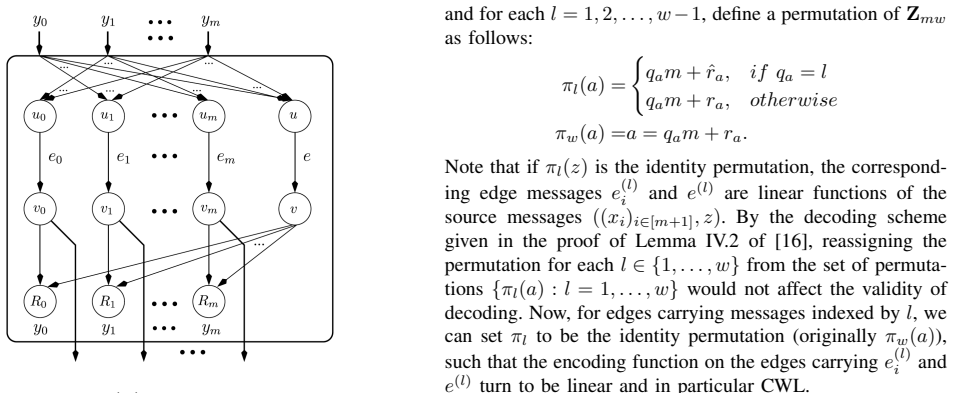
Figures
read the original abstract
The edge removal problem studies the loss in network coding rates that results when a network communication edge is removed from a given network. It is known, for example, that in networks restricted to linear coding schemes and networks restricted to Abelian group codes, removing an edge e* with capacity Re* reduces the achievable rate on each source by no more than Re*. In this work, we seek to uncover larger families of encoding functions for which the edge removal statement holds. We take a local perspective: instead of requiring that all network encoding functions satisfy certain restrictions (e.g., linearity), we limit only the function carried on the removed edge e*. Our central results give sufficient conditions on the function carried by edge e* in the code used to achieve a particular rate vector under which we can demonstrate the achievability of a related rate vector once e* is removed.
Editorial analysis
A structured set of objections, weighed in public.
Referee Report
Summary. The manuscript examines the edge removal problem in network coding. It seeks to identify larger families of encoding functions (beyond linear and Abelian group codes) for which removing an edge e* of capacity R_{e*} reduces each source rate by at most R_{e*}. The central contribution is a local perspective: the authors derive sufficient conditions on the encoding function carried specifically by the removed edge e* (in a code achieving a given rate vector) under which a related rate vector remains achievable after edge removal, without imposing global restrictions on other edges.
Significance. If the derived conditions are non-vacuous and the sufficiency arguments hold, the local approach meaningfully extends the known edge-removal guarantees to broader classes of functions while preserving the rate-loss bound. The constructive, function-specific nature of the conditions is a clear strength relative to global linearity or group-code restrictions.
minor comments (2)
- The abstract asserts the existence of sufficient conditions but does not preview the form of those conditions or the key technical steps; a one-sentence characterization in the abstract would improve accessibility.
- Notation for the related rate vector after edge removal is introduced without an explicit equation reference in the provided abstract; ensure the first appearance is tied to a numbered display equation.
Simulated Author's Rebuttal
We thank the referee for the positive summary, significance assessment, and recommendation of minor revision. No specific major comments were raised in the report.
Circularity Check
No significant circularity; derivation is self-contained
full rationale
The paper states a constructive result: it supplies sufficient local conditions on the encoding function of a single edge e* such that a related rate vector remains achievable after removal. This is a direct proof of sufficiency under the stated premises rather than a claim that reduces by construction to its own inputs, a fitted parameter, or a self-citation chain. The work explicitly builds on externally known results for linear codes and Abelian group codes; no load-bearing uniqueness theorem or ansatz is imported from the authors' prior work. The central claim is therefore independent of the result it proves.
Axiom & Free-Parameter Ledger
axioms (1)
- domain assumption Standard directed-graph network model with capacity-constrained edges and achievable rate vectors
Reference graph
Works this paper leans on
-
[1]
On equivalence between network topologies,
T. Ho, M. Effros, and S. Jalali, “On equivalence between network topologies,” in IEEE Allerton Conference on Communication, Control, and Computing, 2010, pp. 391–398
work page 2010
-
[2]
On the impact of a single edge on the network coding capacity,
S. Jalali, M. Effros, and T. Ho, “On the impact of a single edge on the network coding capacity,” in IEEE Information Theory and Applications Workshop, 2011, pp. 1–5
work page 2011
-
[3]
Network coding: Is zero error always possible?
M. Langberg and M. Effros, “Network coding: Is zero error always possible?” in IEEE Allerton Conference on Communication, Control, and Computing, 2011, pp. 1478–1485
work page 2011
-
[4]
On a capacity equivalence between network and index coding and the edge removal problem,
M. F. Wong, M. Langberg, and M. Effros, “On a capacity equivalence between network and index coding and the edge removal problem,” in IEEE International Symposium on Information Theory (ISIT) , 2013, pp. 972–976
work page 2013
-
[5]
Outer bounds and a functional study of the edge removal problem,
E. J. Lee, M. Langberg, and M. Effros, “Outer bounds and a functional study of the edge removal problem,” in IEEE Information Theory Workshop, 2013, pp. 1–5
work page 2013
-
[6]
On an equivalence of the reduction of k-unicast to 2-unicast capacity and the edge removal property,
M. F. Wong, M. Effros, and M. Langberg, “On an equivalence of the reduction of k-unicast to 2-unicast capacity and the edge removal property,” in IEEE International Symposium on Information Theory (ISIT), 2015, pp. 371–375
work page 2015
-
[7]
On tightness of an entropic region outer bound for network cod- ing and the edge removal property,
——, “On tightness of an entropic region outer bound for network cod- ing and the edge removal property,” in IEEE International Symposium on Information Theory (ISIT) , 2016, pp. 1769–1773
work page 2016
-
[8]
The effect of removing a network commu- nication edge: group network codes,
F. Wei and M. Langberg, “The effect of removing a network commu- nication edge: group network codes,” in IEEE Allerton Conference on Communication, Control, and Computing , 2017
work page 2017
-
[9]
On achievable rate regions for source coding over networks,
W. Gu, “On achievable rate regions for source coding over networks,” Ph.D. dissertation, California Institute of Technology, 2009
work page 2009
-
[10]
On the relationship between edge removal and strong converses,
O. Kosut and J. Kliewer, “On the relationship between edge removal and strong converses,” in IEEE International Symposium on Information Theory (ISIT), 2016, pp. 1779–1783
work page 2016
-
[11]
S. Kamath, N. David, and C.-C. Wang, “Two-unicast is hard,” in IEEE International Symposium on Information Theory (ISIT), 2014, pp. 2147– 2151
work page 2014
-
[12]
Network coding capacity regions via entropy functions,
T. H. Chan and A. Grant, “Network coding capacity regions via entropy functions,” IEEE Transactions on Information Theory , vol. 60, no. 9, pp. 5347–5374, 2014
work page 2014
-
[13]
A characterization of the capacity region for network coding with dependent sources,
W. Kim, M. Langberg, and M. Effros, “A characterization of the capacity region for network coding with dependent sources,” in IEEE International Symposium on Information Theory (ISIT), 2016, pp. 1764– 1768
work page 2016
-
[14]
Insufficiency of linear coding in network information flow,
R. Dougherty, C. Freiling, and K. Zeger, “Insufficiency of linear coding in network information flow,”IEEE Transactions on Information Theory, vol. 51, no. 8, pp. 2745–2759, 2005
work page 2005
-
[15]
Dualities between entropy functions and network codes,
T. Chan and A. Grant, “Dualities between entropy functions and network codes,” IEEE Transactions on Information Theory , vol. 54, no. 10, pp. 4470–4487, 2008
work page 2008
-
[16]
A class of non-linearly solvable networks,
J. Connelly and K. Zeger, “A class of non-linearly solvable networks,” IEEE Transactions on Information Theory , vol. 63, no. 1, pp. 201–229, 2017
work page 2017
-
[17]
Lexicographic products and the power of non-linear network coding,
A. Blasiak, R. Kleinberg, and E. Lubetzky, “Lexicographic products and the power of non-linear network coding,” in IEEE 52nd Annual Symposium on Foundations of Computer Science (FOCS) , 2011, pp. 609–618
work page 2011
-
[18]
R. W. Yeung, Information theory and network coding. Springer Science & Business Media, 2008
work page 2008
-
[19]
good” and elements in Gi\S(k′) i “bad
J. Gallian, Contemporary abstract algebra . Cengage Learning, 2016. APPENDIX I. P ROOF OF COROLLARY 2 We apply the model and definitions from [8]. Proof of Corollary 2. We show that for any edgee∗∈E there exists a random variable Y which satisfies all three conditions in Theorem 1, which implies that the edge removal statement holds onI. By Theorem 4 proven...
work page 2016
-
[20]
that we can modify the code of [16] and make the global encoding function φge CWL
-
[21]
Subnetwork: N1(m): In the coding scheme of [16] all edges in N1(m) have a linear global encoding function
-
[22]
From the expressions we notice that the edge message e(l) 0 is a linear function of source messages
Subnetwork: N2(m,w ): By Lemma IV .4 of [16], a solution for N2(m,w ) is given as a single blocklength code over the ring Zmw for each l = 1, 2,...,w by e(l) 0 = m+1∑ j=1 x(l) j , e(l) i =πl(z)+ m+1∑ j=1,j̸=i x(l) j (i = 1, 2,...,m + 1), e(l) =πl(z)+ m+1∑ j=1 x(l) j . From the expressions we notice that the edge message e(l) 0 is a linear function of sour...
-
[23]
Subnetwork: N3(m1,m 2): By Lemma V .4 of [16], a solution for N3(m1,m 2) (m1 =m and m2 =smα) is given as a single blocklength code over the ring Zmα+1 for each l = 1, 2 by e(l) 0 = ml∑ j=1 x(l) j , e(l) i =πl(z)+ ml∑ j=1,j̸=i x(l) j (i = 1, 2,...,m + 1), e(l) =πl(z)+ ml∑ j=1 x(l) j . By the encoding functions given above, we know for l = 1, 2 thate(l) 0 i...
discussion (0)
Sign in with ORCID, Apple, or X to comment. Anyone can read and Pith papers without signing in.