A Census of Variable and Transient Radio Sources Within High-Energy Neutrino Fields
Pith reviewed 2026-06-26 00:56 UTC · model grok-4.3
The pith
SKA-Mid observations of neutrino fields will detect faint variable radio sources down to four times lower flux levels than MeerKAT.
A machine-rendered reading of the paper's core claim, the machinery that carries it, and where it could break.
Core claim
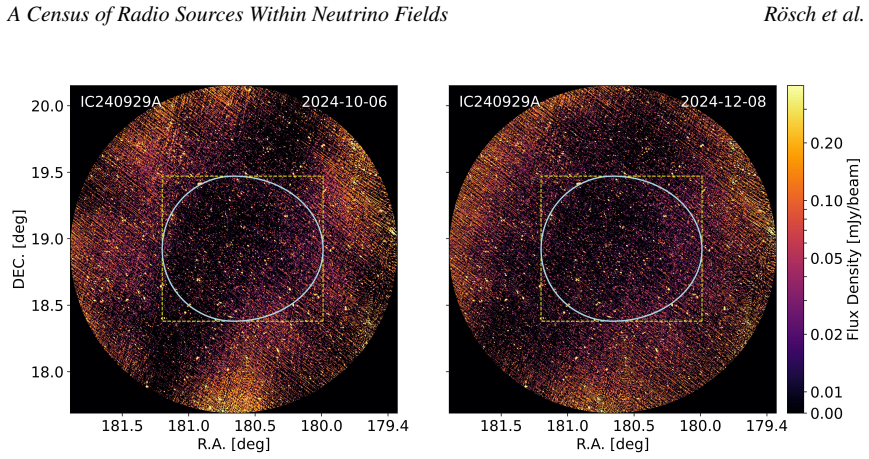
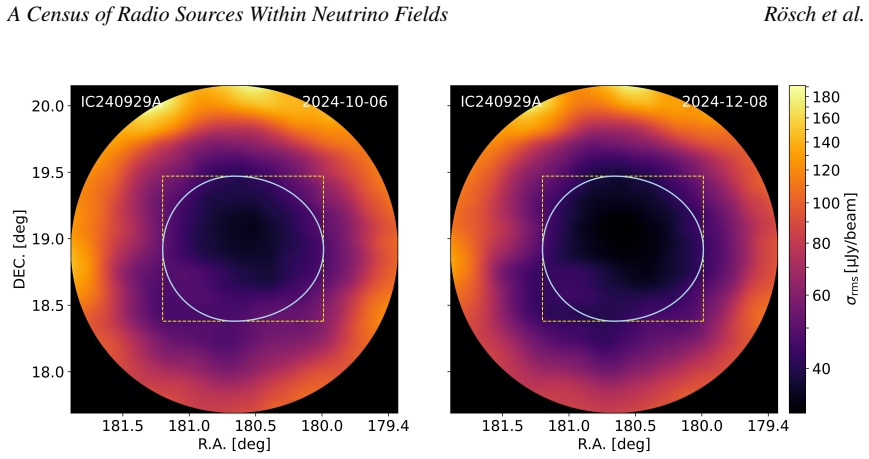
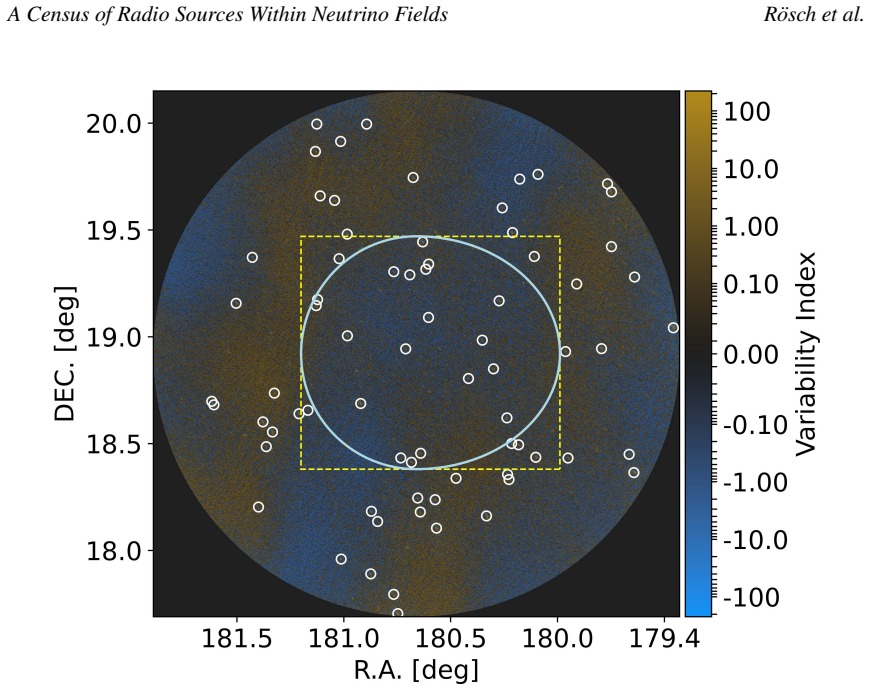
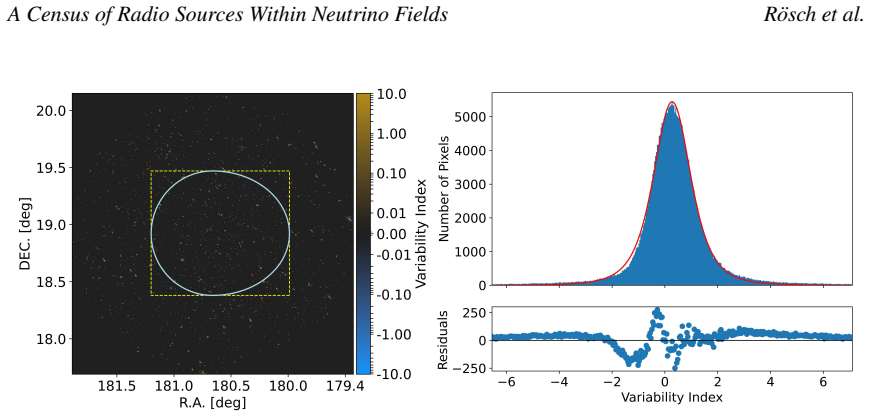
The bulk of the diffuse neutrino flux might be emitted from a rather faint and numerous source population. The sub-mJy low-frequency radio sky may harbor these neutrino emitters that have gone unnoticed in previous searches. SKA-Mid continuum observations of high-energy neutrino fields will yield the most complete census of coincident transient and variable radio sources that might be associated with the neutrino emission. In previous MeerKAT observations of the IceCube gold alert IC240929A at 815 MHz, about 550 faint radio sources were detected inside the 90% uncertainty region with flux densities between 169 μJy and 140 mJy. In its AA4 configuration, SKA-Mid will achieve about four times t
What carries the argument
Sensitivity gain of SKA-Mid AA4 over MeerKAT combined with wide-field VLBI to test for high-brightness-temperature compact emission in radio sources inside neutrino uncertainty regions.
If this is right
- Even fainter radio sources within neutrino fields become detectable.
- All candidate radio sources inside the fields can be tested for AGN-like compact emission.
- A larger sample of potential neutrino emitters becomes available for statistical association studies.
- Low-frequency radio surveys become a systematic tool for identifying multi-messenger counterparts.
Where Pith is reading between the lines
- The approach could shift neutrino source searches from rare bright flares to a systematic census of faint variables.
- Coordinated radio monitoring campaigns timed with neutrino alerts would be needed to catch short-lived transients.
- The same radio census strategy could be applied to other candidate neutrino source classes such as tidal disruption events.
Load-bearing premise
The bulk of the diffuse neutrino flux is emitted by a faint and numerous population of sources that produce variable or transient radio emission at sub-mJy levels.
What would settle it
Deep SKA-Mid maps of multiple IceCube neutrino fields that show no statistical excess of variable or compact radio sources compared with random control fields.
Figures
read the original abstract
The origin of high-energy cosmic neutrinos detected by the IceCube observatory is a hotly debated topic in astroparticle physics. Neutrinos can be produced via interactions of high-energy protons with photons. There are multiple candidate source classes which can accelerate cosmic particles to the energies required to emit high-energy cosmic neutrinos and which have in common that they lead to variable/transient radio emissions. However, so far only a few active galactic nuclei (AGNs) could be associated with high confidence with IceCube neutrinos. The bulk of the diffuse neutrino flux might be emitted from a rather faint and numerous source population. The sub-mJy low-frequency radio sky may harbor these neutrino emitters that have gone unnoticed in previous searches. SKA-Mid continuum observations of high-energy neutrino fields will yield the most complete census of coincident transient and variable radio sources that might be associated with the neutrino emission. In previous MeerKAT observations of the IceCube gold alert IC240929A at 815 MHz, we detect about 550 faint radio sources inside the 90% uncertainty region of this neutrino field with flux densities between $169\,\mathrm{\mu Jy}$ and $140\,\mathrm{mJy}$. In its AA4 configuration, SKA-Mid will achieve about four times the sensitivity of MeerKAT, allowing for the detection of even fainter radio sources within such neutrino fields. By adding wide-field VLBI analysis of the fields under consideration, all neutrino-candidate radio sources can be tested for high brightness-temperature compact emission (indicative of an AGN classification) and milliarcsecond-scale resolved structures.
Editorial analysis
A structured set of objections, weighed in public.
Referee Report
Summary. The manuscript proposes using SKA-Mid continuum observations of high-energy neutrino fields, building on a MeerKAT detection of ~550 sources in the IC240929A 90% uncertainty region at 815 MHz (fluxes 169 μJy to 140 mJy), to census variable/transient radio sources potentially linked to IceCube neutrinos. It claims SKA-Mid AA4 will achieve ~4x MeerKAT sensitivity for fainter sources and that wide-field VLBI will allow testing all candidates for high brightness-temperature compact emission indicative of AGN classification.
Significance. If the assumptions about the faint neutrino source population hold, the outlined strategy could provide a systematic radio-based approach to identifying neutrino emitters. The concrete MeerKAT source count in one field supplies a useful observational baseline. The work is primarily forward-looking and descriptive rather than presenting new fitted results or derivations.
major comments (2)
- [Abstract] Abstract: the assertion that 'wide-field VLBI analysis of the fields under consideration' will allow 'all neutrino-candidate radio sources' to be tested for high brightness-temperature compact emission is not supported by sensitivity considerations. Wide-field VLBI at ~800 MHz typically reaches rms noise of several hundred μJy, which would leave a non-negligible fraction of the sub-mJy population (already detected at 169 μJy by MeerKAT) below the VLBI threshold.
- [Abstract] Abstract: the reported detection of 'about 550 faint radio sources' supplies no information on detection thresholds, variability criteria, error analysis, or source classification methods. This absence of methodological detail is load-bearing for the claim that these sources form the basis of a reliable census.
minor comments (1)
- The text would benefit from explicit separation between the existing MeerKAT observational result and the projected SKA-Mid capabilities.
Simulated Author's Rebuttal
We thank the referee for their thoughtful review and constructive comments on our manuscript. We address each major comment point by point below, agreeing where revisions are warranted to improve clarity and accuracy.
read point-by-point responses
-
Referee: [Abstract] Abstract: the assertion that 'wide-field VLBI analysis of the fields under consideration' will allow 'all neutrino-candidate radio sources' to be tested for high brightness-temperature compact emission is not supported by sensitivity considerations. Wide-field VLBI at ~800 MHz typically reaches rms noise of several hundred μJy, which would leave a non-negligible fraction of the sub-mJy population (already detected at 169 μJy by MeerKAT) below the VLBI threshold.
Authors: We agree that the abstract wording overstates the reach of wide-field VLBI. The manuscript's intent was to highlight VLBI's role in classifying compact AGN-like emission where detectable, but we acknowledge that sensitivity limits mean not every sub-mJy source (down to 169 μJy) will be accessible. We will revise the abstract to state that VLBI will test sources above the VLBI detection threshold for high brightness-temperature emission, and we will add a brief discussion of the expected fraction of the population that can be probed. This change will be reflected in the revised manuscript. revision: yes
-
Referee: [Abstract] Abstract: the reported detection of 'about 550 faint radio sources' supplies no information on detection thresholds, variability criteria, error analysis, or source classification methods. This absence of methodological detail is load-bearing for the claim that these sources form the basis of a reliable census.
Authors: The abstract is constrained by length, but the full manuscript details the MeerKAT observations of IC240929A, including the 169 μJy threshold and source flux range. To address the referee's valid concern about the abstract standing alone, we will insert a concise clause noting the detection threshold and directing readers to the methods section for variability criteria, error analysis, and classification. This ensures the abstract better supports the census claim without expanding excessively. revision: yes
Circularity Check
No circularity; purely descriptive observational paper with no derivations or fits
full rationale
The paper contains no equations, parameter fits, derivations, or load-bearing self-citations that reduce claims to inputs by construction. It reports MeerKAT detections and projects SKA-Mid/VLBI capabilities based on stated instrument sensitivities and prior observations, without any self-definitional loops, fitted inputs renamed as predictions, or ansatzes smuggled via citation. The central claims are forward-looking statements about future observations and are self-contained against external benchmarks.
Axiom & Free-Parameter Ledger
axioms (1)
- domain assumption Candidate neutrino sources produce variable or transient radio emission
Reference graph
Works this paper leans on
-
[1]
PyBDSF: Python Blob Detection and Source Finder
-
[2]
reproject: Python-based astronomical image reprojection
-
[3]
Revolution in Astronomy with ALMA: The Third Year , year = 2015, editor =
Radio Astronomy Tools in Python: Spectral-cube, pvextractor, and more. Revolution in Astronomy with ALMA: The Third Year , year = 2015, editor =
2015
-
[4]
The NRAO VLA Sky Survey. , keywords =. doi:10.1086/300337 , adsurl =
-
[5]
The Caltech-NRAO Stripe 82 Survey (CNSS). I. The Pilot Radio Transient Survey In 50 deg ^ 2. , keywords =. doi:10.3847/0004-637X/818/2/105 , archivePrefix =. 1601.01693 , primaryClass =
work page internal anchor Pith review Pith/arXiv arXiv doi:10.3847/0004-637x/818/2/105
-
[6]
An insight into the extragalactic transient and variable microJy radio sky across multiple decades. , keywords =. doi:10.1093/mnras/stz2748 , archivePrefix =. 1909.12588 , primaryClass =
-
[7]
Data reduction and error analysis for the physical sciences
-
[8]
, year = 2025, month = feb, volume =
Observation of an ultra-high-energy cosmic neutrino with KM3NeT. , year = 2025, month = feb, volume =. doi:10.1038/s41586-024-08543-1 , adsurl =
-
[9]
, keywords =
Neutrinos from flat-spectrum radio quasars. , keywords =
-
[10]
Constraining High-energy Neutrino Emission from Supernovae with IceCube. , keywords =. doi:10.3847/2041-8213/acd2c9 , archivePrefix =. 2303.03316 , primaryClass =
-
[11]
Evidence for neutrino emission from the nearby active galaxy NGC 1068. Science , keywords =. doi:10.1126/science.abg3395 , archivePrefix =. 2211.09972 , primaryClass =
-
[12]
Beginning a Journey Across the Universe: The Discovery of Extragalactic Neutrino Factories. , keywords =. doi:10.3847/2041-8213/ac7d5b , archivePrefix =. 2207.06314 , primaryClass =
-
[13]
Growing evidence for high-energy neutrinos originating in radio blazars. , keywords =. doi:10.1093/mnras/stad1467 , archivePrefix =. 2211.09631 , primaryClass =
-
[14]
Directional Association of TeV to PeV Astrophysical Neutrinos with Radio Blazars. , keywords =. doi:10.3847/1538-4357/abceb8 , archivePrefix =. 2009.08914 , primaryClass =
-
[15]
Observational Evidence for the Origin of High-energy Neutrinos in Parsec-scale Nuclei of Radio-bright Active Galaxies. , keywords =. doi:10.3847/1538-4357/ab86bd , archivePrefix =. 2001.00930 , primaryClass =
-
[16]
Association of IceCube neutrinos with radio sources observed at Owens Valley and Mets \"a hovi Radio Observatories. , keywords =. doi:10.1051/0004-6361/202039481 , archivePrefix =. 2009.10523 , primaryClass =
-
[17]
The contribution of Fermi-2LAC blazars to the diffuse TeV-PeV neutrino flux
The Contribution of Fermi-2LAC Blazars to Diffuse TeV-PeV Neutrino Flux. , keywords =. doi:10.3847/1538-4357/835/1/45 , archivePrefix =. 1611.03874 , primaryClass =
work page internal anchor Pith review Pith/arXiv arXiv doi:10.3847/1538-4357/835/1/45
-
[18]
A Search for Millimeter-bright Blazars as Astrophysical Neutrino Sources. , keywords =. doi:10.3847/1538-4357/ae31e2 , archivePrefix =. 2507.03989 , primaryClass =
-
[19]
Association of the IceCube neutrinos with blazars in the CGRaBS sample. , keywords =. doi:10.1051/0004-6361/202347624 , archivePrefix =. 2407.07153 , primaryClass =
-
[20]
Search for Correlations of High-energy Neutrinos Detected in IceCube with Radio-bright AGN and Gamma-Ray Emission from Blazars. , keywords =. doi:10.3847/1538-4357/acdfcb , archivePrefix =. 2304.12675 , primaryClass =
-
[21]
Coincidence of a high-fluence blazar outburst with a PeV-energy neutrino event
Coincidence of a high-fluence blazar outburst with a PeV-energy neutrino event. Nature Physics , keywords =. doi:10.1038/nphys3715 , archivePrefix =. 1602.02012 , primaryClass =
work page internal anchor Pith review Pith/arXiv arXiv doi:10.1038/nphys3715
-
[22]
TELAMON: Effelsberg monitoring of AGN jets with very-high-energy astroparticle emission. I. Program description and sample characterization. , keywords =. doi:10.1051/0004-6361/202348262 , archivePrefix =. 2401.06296 , primaryClass =
-
[23]
ATCA monitoring of gamma-ray loud AGN
ATCA monitoring of gamma-ray loud AGN. arXiv e-prints , keywords =. doi:10.48550/arXiv.1205.2403 , archivePrefix =. 1205.2403 , primaryClass =
work page internal anchor Pith review Pith/arXiv arXiv doi:10.48550/arxiv.1205.2403
-
[24]
Annual Review of Nuclear and Particle Science , keywords =
High-Energy Extragalactic Neutrino Astrophysics. Annual Review of Nuclear and Particle Science , keywords =. doi:10.1146/annurev-nucl-011122-061547 , archivePrefix =. 2203.11936 , primaryClass =
-
[25]
Science with a Next Generation Very Large Array , year = 2018, editor =
Radio Emission from Short Gamma-ray Bursts in the Multi-messenger Era. Science with a Next Generation Very Large Array , year = 2018, editor =
2018
-
[26]
Radio Emission from Supernovae and Gamma-Ray Bursters. , keywords =. doi:10.1146/annurev.astro.40.060401.093744 , adsurl =
-
[27]
Diagnosing the Circumburst Environment with Multiband Gamma-Ray Burst Radio Afterglows. , keywords =. doi:10.3847/1538-4357/ac4695 , archivePrefix =. 2203.08646 , primaryClass =
-
[28]
The Radio to GeV Afterglow of GRB 221009A. , keywords =. doi:10.3847/2041-8213/acbfad , archivePrefix =. 2302.04388 , primaryClass =
-
[29]
The Cosmic Core-collapse Supernova Rate does not match the Massive-Star Formation Rate
The Cosmic Core-collapse Supernova Rate Does Not Match the Massive-star Formation Rate. , keywords =. doi:10.1088/0004-637X/738/2/154 , archivePrefix =. 1102.1977 , primaryClass =
work page internal anchor Pith review Pith/arXiv arXiv doi:10.1088/0004-637x/738/2/154 1977
-
[30]
Radio Properties of Tidal Disruption Events. , keywords =. doi:10.1007/s11214-020-00702-w , archivePrefix =. 2006.01159 , primaryClass =
-
[31]
A tidal disruption event coincident with a high-energy neutrino. Nature Astronomy , keywords =. doi:10.1038/s41550-020-01295-8 , archivePrefix =. 2005.05340 , primaryClass =
-
[32]
TANAMI: Tracking active galactic nuclei with austral milliarcsecond interferometry. III. First-epoch S band images. , keywords =. doi:10.1051/0004-6361/202347823 , archivePrefix =. 2310.10206 , primaryClass =
-
[33]
38th International Cosmic Ray Conference , year = 2024, month = sep, eid =
The Impact of Southern-Hemisphere Radio Blazar Observations on Neutrino Astronomy. 38th International Cosmic Ray Conference , year = 2024, month = sep, eid =
2024
-
[34]
Structured jets in BL Lac objects: efficient PeV neutrino factories?
Structured Jets in BL Lac Objects: Efficient PeV Neutrino Factories?. , keywords =. doi:10.1088/2041-8205/793/1/L18 , archivePrefix =. 1407.0907 , primaryClass =
work page internal anchor Pith review Pith/arXiv arXiv doi:10.1088/2041-8205/793/1/l18 2041
-
[35]
High-energy cosmic neutrinos from spine-sheath BL Lac jets
High-energy cosmic neutrinos from spine-sheath BL Lac jets. , keywords =. doi:10.1093/mnras/stv1023 , archivePrefix =. 1411.2783 , primaryClass =
work page internal anchor Pith review Pith/arXiv arXiv doi:10.1093/mnras/stv1023
-
[36]
The KM3NeT alert system for online multi-messenger astronomy
Cecchini, Vincent and Buson, Sara and Celli, Silvia and Deguire, Paul and Dornic, Damien and Ducoin, Jean-Grégoire and Le Guirriec, Emmanuel and Illuminati, Giulia and Lamoureux, Mathieu and Lincetto, Massimiliano and Magnani, Francesco and Marconi, Martina and Mastrodicasa, Massimo and Pfeiffer, Leonard and Vannoye, Godefroy and Veutro, Alessandro. The K...
-
[37]
TANAMI: tracking active galactic nuclei with austral milliarcsecond interferometry . I. First-epoch 8.4 GHz images. , keywords =. doi:10.1051/0004-6361/200912724 , archivePrefix =. 1005.4432 , primaryClass =
work page internal anchor Pith review Pith/arXiv arXiv doi:10.1051/0004-6361/200912724
-
[38]
37th International Cosmic Ray Conference , year = 2022, month = mar, eid =
TELAMON: Monitoring of AGN with the Effelsberg 100-m Telescope in the Context of Astroparticle Physics. 37th International Cosmic Ray Conference , year = 2022, month = mar, eid =. doi:10.22323/1.395.0974 , archivePrefix =. 2108.00383 , primaryClass =
-
[39]
The Multimessenger Chakra of Blazar Jets , year = 2023, editor =
VLBI Scrutiny of a New Neutrino-Blazar Multiwavelength-Flare Coincidence. The Multimessenger Chakra of Blazar Jets , year = 2023, editor =. doi:10.1017/S1743921323000893 , archivePrefix =. 2301.13859 , primaryClass =
-
[40]
A Decade of Short-duration Gamma-Ray Burst Broadband Afterglows: Energetics, Circumburst Densities, and Jet Opening Angles. , keywords =. doi:10.1088/0004-637X/815/2/102 , archivePrefix =. 1509.02922 , primaryClass =
work page internal anchor Pith review Pith/arXiv arXiv doi:10.1088/0004-637x/815/2/102
-
[41]
2026 , publisher =
Matthias Kadler and author2 and author3 and author4 and author5 , title =. 2026 , publisher =
2026
-
[42]
2026 , publisher =
Stefano Giarratana and author2 and author3 and author4 and author5 , title =. 2026 , publisher =
2026
-
[43]
2026 , publisher =
Xinwen Shu and author2 and author3 and author4 and author5 , title =. 2026 , publisher =
2026
-
[44]
GRB Coordinates Network , year = 2026, month = jan, volume =
GRB 251202A: further radio observations with the VLA. GRB Coordinates Network , year = 2026, month = jan, volume =
2026
-
[45]
GRB Coordinates Network , year = 2026, month = jan, volume =
GRB 251222A: radio detection with the VLA. GRB Coordinates Network , year = 2026, month = jan, volume =
2026
-
[46]
GRB Coordinates Network , year = 2025, month = dec, volume =
GRB 251202A: radio detection with the VLA. GRB Coordinates Network , year = 2025, month = dec, volume =
2025
-
[47]
GRB Coordinates Network , year = 2025, month = jul, volume =
GRB 250702F: radio detection with the VLA. GRB Coordinates Network , year = 2025, month = jul, volume =
2025
-
[48]
GRB Coordinates Network , year = 2025, month = feb, volume =
GRB 250205A / EP250205A: radio detection with the VLA. GRB Coordinates Network , year = 2025, month = feb, volume =
2025
-
[49]
GRB Coordinates Network , year = 2025, month = jan, volume =
GRB 241217A / EP241217B: radio detection with the VLA. GRB Coordinates Network , year = 2025, month = jan, volume =
2025
-
[50]
GRB Coordinates Network , year = 2024, month = nov, volume =
GRB 241026A: radio detection with the VLA. GRB Coordinates Network , year = 2024, month = nov, volume =
2024
-
[51]
GRB Coordinates Network , year = 2024, month = nov, volume =
GRB 241025A: radio detection with the VLA. GRB Coordinates Network , year = 2024, month = nov, volume =
2024
-
[52]
GRB Coordinates Network , year = 2024, month = oct, volume =
GRB 240912A: radio detection with the VLA. GRB Coordinates Network , year = 2024, month = oct, volume =
2024
-
[53]
GRB Coordinates Network , year = 2024, month = oct, volume =
GRB 240916A: radio detection with the VLA. GRB Coordinates Network , year = 2024, month = oct, volume =
2024
-
[54]
GRB Coordinates Network , year = 2024, month = sep, volume =
GRB 240414A: further radio observations with the VLA. GRB Coordinates Network , year = 2024, month = sep, volume =
2024
-
[55]
GRB Coordinates Network , year = 2024, month = sep, volume =
GRB 240910A: radio detection with the VLA. GRB Coordinates Network , year = 2024, month = sep, volume =
2024
-
[56]
GRB Coordinates Network , year = 2024, month = apr, volume =
GRB 240414A: radio detection with the VLA. GRB Coordinates Network , year = 2024, month = apr, volume =
2024
-
[57]
GRB Coordinates Network , year = 2024, month = mar, volume =
GRB 231215A: further radio observations with the VLA. GRB Coordinates Network , year = 2024, month = mar, volume =
2024
-
[58]
GRB Coordinates Network , year = 2024, month = jan, volume =
GRB 231215A: radio detection with the VLA. GRB Coordinates Network , year = 2024, month = jan, volume =
2024
-
[59]
GRB Coordinates Network , year = 2023, month = aug, volume =
GRB 230812B: radio detection with the VLA. GRB Coordinates Network , year = 2023, month = aug, volume =
2023
-
[60]
A Radio-Selected Sample of Gamma Ray Burst Afterglows
A Radio-selected Sample of Gamma-Ray Burst Afterglows. , keywords =. doi:10.1088/0004-637X/746/2/156 , archivePrefix =. 1110.4124 , primaryClass =
work page internal anchor Pith review Pith/arXiv arXiv doi:10.1088/0004-637x/746/2/156
-
[61]
Jet Emission in Young Radio Sources: a Fermi-LAT Gamma-ray View
Jet Emission in Young Radio Sources: A Fermi Large Area Telescope Gamma-Ray View. , keywords =. doi:10.1088/0004-637X/780/2/165 , archivePrefix =. 1311.7647 , primaryClass =
work page internal anchor Pith review Pith/arXiv arXiv doi:10.1088/0004-637x/780/2/165
-
[62]
The relativistic parsec-scale jets of the blazars TXS 0506+056 and PKS 0502+049 and their possible association with gamma-ray flares and neutrino production. , keywords =. doi:10.1093/mnras/stab3022 , archivePrefix =. 2112.08858 , primaryClass =
-
[63]
Rapid jet ejection from PKS 0215+015 coincident with a high-energy neutrino event
Rapid jet ejection from PKS 0215+015 coincident with a high-energy neutrino event. , keywords =. doi:10.1051/0004-6361/202558593 , archivePrefix =. 2603.02325 , primaryClass =
work page internal anchor Pith review Pith/arXiv arXiv doi:10.1051/0004-6361/202558593
discussion (0)
Sign in with ORCID, Apple, or X to comment. Anyone can read and Pith papers without signing in.