REVIEW 3 major objections 6 minor 106 references
Make Still Further Progress: Chain of Thoughts for Tabular Data Leaderboard
T0 review · 3 major / 6 minor · reviewed 2026-08-15 · deepseek-v4-flash
Pith's one-line read A chain of tabular thoughts lets an LLM act as an instance-wise ensemble expert, achieving the best average ranking across TinyBench2 classification and regression tasks.
desk verdict Novel LLM-as-ensemble-aggregator idea, but the main evaluation feeds in-sample neighbor predictions to the LLM, so the reported gains are probably inflated. read the letter →
The pith
A machine-rendered reading of the paper's core claim, the machinery that carries it, and where it could break.
The reading
What carries the argument
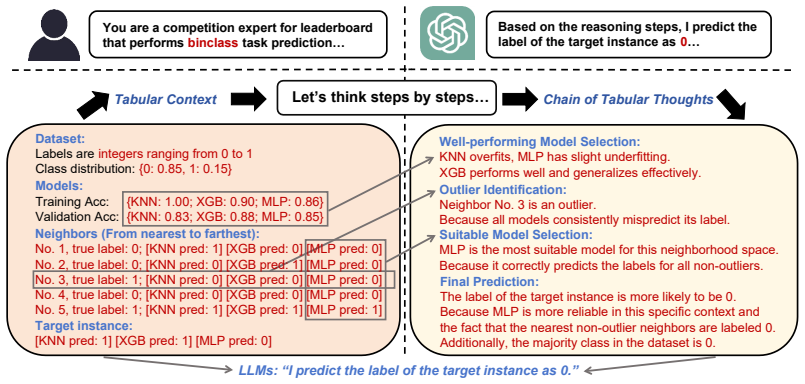
The load-bearing mechanism is the tabular context, a per-instance prompt assembled without raw features: the $K$ nearest neighbors (found by Manhattan distance re-weighted with mutual information), their true labels, each external model's predictions on neighbors and target, the external models' training and validation accuracies, and label frequencies (classification) or label range (regression). Carrying the reasoning is the Chain of Tabular Thoughts (CoT2), a four-step prompting strategy that asks the LLM to (a) identify well-performing models, (b) flag outlier neighbors, (c) select the models most suited to the clean local neighborhood, and (d) make the final prediction by combining local labels with the chosen models' outputs. A consensus threshold (agreement of at least $\tau = 3/4$ of external models) decides which instances skip LLM inference entirely.
What would settle it
Replace the in-sample neighbor predictions in the prompt with out-of-fold predictions (each neighbor excluded from the training of the models that predict it) and rerun the TinyBench2 comparison; if CoT2's best average ranking falls behind standard weighted voting, the gain came from in-sample optimism rather than genuine local model selection.
Extended reading notes
Core claim
The paper's central discovery claim is that a large language model, given no raw features and no semantic descriptions, can act as a competition-style ensemble expert by reading a structured 'tabular context'. The context encodes the local evidence around each test instance: the true labels and external-model predictions of its nearest neighbors, the external models' predictions on the target itself, the models' training and validation accuracies, and the label distribution. CoT2 then instructs the LLM to reason in four explicit steps, first filtering models and neighbor outliers, then selecting models that fit the local neighborhood, and finally combining local neighbor labels with the chosen models' votes. The authors report that this instance-wise, LLM-driven integration achieves the best average ranking on TinyBench2 classification and regression tasks, improving on the same LLM prompted without the chain of thought and on all static ensemble baselines.
Load-bearing premise
The load-bearing premise is that how well external models predict on the training-set neighbors of a target tells the LLM how well those models will predict on the target itself, even though those neighbor predictions are in-sample and therefore optimistically biased.
Editorial extensions
If this is right
- CoT2 achieves the best average ranking across 30 TinyBench2 classification datasets and the best average ranking across 15 regression datasets, surpassing all single models and all tested static ensemble rules.
- Adding the four-step chain of thought improves accuracy over the same LLM using the bare tabular context; for example, gpt-3.5-turbo mean accuracy rises from 84.79 to 86.85 on five reported datasets.
- The consensus gate skips LLM inference for the majority of easy test rows, so the method preserves most of its accuracy while substantially lowering inference cost.
- Anonymizing external model names improves performance on four of five datasets, suggesting the LLM can reason from model behavior rather than model identity.
- Increasing the external model pool size and including stronger models improves CoT2's accuracy, so the framework benefits from richer ensembles.
Reading between the lines
- A testable extension the paper does not run: feed the LLM out-of-fold neighbor predictions (each neighbor predicted by models trained without it); the result would separate genuine local model competence from agreement that an in-sample fit can produce.
- The tabular context could drive other LLM outputs besides a single label, such as a confidence score, an abstention decision, or a natural-language explanation of which models were trusted and why; the paper's framework already supplies the evidence for such outputs.
- The consensus gate is set at a fixed threshold $\tau = 3/4$; the paper's own ablation shows accuracy and inference cost both change with $\tau$, so per-dataset threshold tuning or learning the threshold from validation data is a plausible way to push the cost-accuracy frontier.
- Because the LLM never sees feature values, the same interface could be deployed as a model-votes-only API for privacy-sensitive tabular data, with external models running locally and only non-semantic predictions leaving the data owner's environment.
Signed reviews
Editorial analysis
A structured set of objections, weighed in public.
Referee Report
Summary. The paper proposes CoT^2 (Chain of Tabular Thoughts), a prompting strategy that uses a large language model (LLM) to perform instance-wise integration of predictions from an external pool of tabular models. For each test instance, the method builds a tabular context from the true labels and model predictions of its nearest neighbors in the training set, plus dataset-level statistics, and guides the LLM through four reasoning steps: well-performing model selection, outlier identification, suitable model selection, and final prediction. The method is evaluated on the TinyBench2 benchmark across 30 classification and 15 regression datasets, reporting the best average ranking among a broad set of baselines, including a non-LLM context-based baseline called MetaXGB.
Significance. If the reported results are trustworthy, the paper would introduce a meaningful new application of LLMs as interpretable ensemble meta-learners for tabular data, with a privacy-friendly context that avoids raw features and semantic descriptions. The idea of letting an LLM select and combine local model predictions through structured reasoning is novel and of broad interest. The manuscript also includes a useful non-LLM baseline and an ablation study. However, the strength of the empirical claim is weakened by a load-bearing methodological issue: the local model selection step uses in-sample neighbor predictions, which are optimistically biased, and the study design has a self-benchmarking overlap and hyperparameter tuning on the evaluation datasets. These issues preclude accepting the central claim without additional experiments.
major comments (3)
- [Section 3.3 / Eq. (5)] The 'Suitable Model Selection' step selects the most suitable external models for the target instance by evaluating their predictions on the K nearest neighbors retrieved from the training set D. Since all external models are trained on D, these neighbor predictions are in-sample and optimistically biased; for KNN they can be near-perfect regardless of out-of-sample performance. The prompt in Figure 2 even shows KNN with training accuracy 1.00 while its neighbor predictions disagree with several true labels, illustrating exactly this memorization-vs-generalization confusion. The paper does not establish that in-sample agreement on training neighbors is a valid proxy for model quality on the target, so the claimed gains over fixed ensembles may be largely an artifact of the LLM selecting models that memorized the retrieved points rather than models that generalize locally. I request the authors to either retrieve neighbors from a held-out validation set (where model predictions are out-of-sample) or use cross-validated predictions on the training set, and rerun the main comparisons; they should also report how often the models selected in step c actually outperform the globally best model on the corresponding validation neighborhoods.
- [Section 4.3 / Appendix B] The hyperparameters (number of neighbors k=10, hard-sample threshold tau=3/4, temperature 0.2, and the choice of distance metric) are ablated and effectively tuned on the same five datasets (BAS, DIS, SYL, CRE, FOR) that are also used in the main comparison in Table 1 and in Figures 4-8. This creates a risk of selection bias: the reported performance on those datasets may be optimistic because the method is tuned on the evaluation set. The authors should use a separate dataset-level validation split for hyperparameter selection or justify why the chosen values are dataset-independent a priori; at minimum, the paper should acknowledge this overlap and report results with a fixed default configuration on all datasets.
- [Section 4.2] The paper claims that CoT2 'significantly outperforms' MetaXGB, but the per-dataset results in Table 4 show that CoT2-Deepseek-v3 loses to MetaXGB on BAS (94.55 vs 95.52), WQW (63.59 vs 63.67), and JC2 (95.26 vs 98.57), and ties on VUL. The Wilcoxon-Holm critical-difference diagram is the only statistical evidence, but the exact p-values or the number of wins/losses across the 30 datasets are not reported in the text. I ask the authors to report the paired test statistics and to clarify whether the advantage over MetaXGB and over the simple Averaging baseline is significant at the 0.05 level after correction; this is important because the regression results in Table 5 show CoT2 with average rank 3.00 versus Simple Average rank 3.67, which is a much smaller margin than the classification diagram suggests.
minor comments (6)
- [Section 4.1] The evaluation protocol repeats each experiment with five random seeds and reports mean ± std, but the LLM inference temperature is 0.2; the reported variance likely reflects both model training randomness and LLM sampling stochasticity. The authors should clarify whether the LLM responses are fixed across seeds or resampled, and whether the same LLM output is used for all five runs per dataset.
- [Section 2.4] The claim that 'no prior work has explored using LLMs as intelligent ensemble experts' is too strong; there are existing works on LLM-based ensembling of model predictions (e.g., LLM-Blender) and on LLMs for model selection. The authors should soften this novelty claim and cite relevant prior art.
- [Appendix D] The regression prompt in Figure 10 contains a regex extraction error: the text in Section 3.3 says the regex is changed to '(-?d+.d+)' but the displayed code still uses 'I predict the label of the target instance as (\d+)'. Also, the backslashes in the regex are missing in the text. This should be corrected for reproducibility.
- [Section 3.3] The notation for the number of selected models is confusing: the paper writes 'M_s' for both the set of models and its cardinality. Please use a clearer notation, e.g., 'S' for the selected set and '|S|' for its size.
- [Section 3.2] Equation (2) includes '{y_j}_{j=1}^N' as an input to the context function, but the surrounding text inputs the entire dataset label set only as a label range/frequency summary. This is inconsistent; the authors should either remove that term or clarify that it denotes the label frequencies.
- [Section 4.1] The evaluation uses TinyBench2, which is introduced in reference [74] by the same research group that authors this paper, and the model implementations are built on TALENT ([49], also the authors' group). This does not invalidate the results, but the paper should explicitly acknowledge the potential conflict and provide a brief external sanity check, for example by reporting results on a few datasets from an independent benchmark.
Circularity Check
No derivation-level circularity; mild same-group benchmark and toolbox self-citations are not load-bearing.
full rationale
The paper's core pipeline is not circular. External models are trained on the training split, their validation accuracies come from a held-out validation split, and the LLM's final prediction in Eq. 7 is a free decision over independent inputs (neighbor labels, model predictions, and accuracies); no equation in Section 3 forces the output to equal any input by construction. The central empirical claim is evaluated against numerous external baselines (XGBoost, CatBoost, TabR, TabPFN, etc.), giving it independent grounding. The TinyBench2 benchmark [74] and TALENT toolbox [49] are authored by the same group, but they serve as dataset collection and tuning infrastructure rather than as evidence for the method's mechanism, so these self-citations are not load-bearing. The ablation on five datasets that also appear in the main comparison is a minor validation-design caveat, but it does not amount to a fitted parameter being renamed as a prediction or any derivation-level circularity.
Assumptions & free parameters
free parameters (3)
- Number of neighbors k =
10
- Hard-sample agreement threshold tau =
3/4
- LLM inference temperature =
0.2
assumptions (6)
- domain assumption Mutual information between each feature and the label is a valid measure of feature relevance for neighbor search in Equation 1.
- domain assumption The correctness of external models on training-set neighbors is informative about their suitability for the test target.
- domain assumption A large language model can perform reliable multi-step numerical reasoning over a purely symbolic tabular context and emit a parseable answer.
- ad hoc to paper The four hand-crafted reasoning steps constitute a good expert strategy for ensembling.
- domain assumption TinyBench2 is representative of tabular benchmarks and its rankings are stable.
- domain assumption The validation split is sufficient for early stopping and model selection without overfitting.
Cite this review
Pith. "Pith review of Make Still Further Progress: Chain of Thoughts for Tabular Data Leaderboard." pith.science (2026). https://pith.science/paper/WDI7B4PU
@misc{pith2026250513421,
  author       = {Pith},
  title        = {Pith review of: Make Still Further Progress: Chain of Thoughts for Tabular Data Leaderboard},
  year         = {2026},
  howpublished = {\url{https://pith.science/paper/WDI7B4PU}},
  note         = {Machine review of arXiv:2505.13421}
}
abstract
Tabular data, a fundamental data format in machine learning, is predominantly utilized in competitions and real-world applications. The performance of tabular models--such as gradient boosted decision trees and neural networks--can vary significantly across datasets due to differences in feature distributions and task characteristics. Achieving top performance on each dataset often requires specialized expert knowledge. To address this variability, practitioners often aggregate the predictions of multiple models. However, conventional aggregation strategies typically rely on static combination rules and lack instance-level adaptability. In this work, we propose an in-context ensemble framework for tabular prediction that leverages large language models (LLMs) to perform dynamic, instance-specific integration of external model predictions. Without access to raw tabular features or semantic information, our method constructs a context around each test instance using its nearest neighbors and the predictions from a pool of external models. Within this enriched context, we introduce Chain of Tabular Thoughts (CoT$^2$), a prompting strategy that guides LLMs through multi-step, interpretable reasoning, making still further progress toward expert-level decision-making. Experimental results show that our method outperforms well-tuned baselines and standard ensemble techniques across a wide range of tabular datasets.
Figures


Figures from the paper (11 more)


Reference graph
Works this paper leans on
-
[1]
Josh Achiam, Steven Adler, Sandhini Agarwal, Lama Ahmad, Ilge Akkaya, Florencia Leoni Aleman, Diogo Almeida, Janko Altenschmidt, Sam Altman, Shyamal Anadkat, et al. Gpt-4 technical report. CoRR, abs/2303.08774, 2023
arXiv 2023
-
[2]
Credit risk analysis using machine and deep learning models
Peter Martey Addo, Dominique Guegan, and Bertrand Hassani. Credit risk analysis using machine and deep learning models. Risks, 2018
2018
-
[3]
Arik and Tomas Pfister
Sercan Ö. Arik and Tomas Pfister. Tabnet: Attentive interpretable tabular learning. In AAAI, 2021
2021
-
[4]
Sarkhan Badirli, Xuanqing Liu, Zhengming Xing, Avradeep Bhowmik, and Sathiya S. Keerthi. Gradient boosting neural networks: Grownet. CoRR, abs/2002.07971, 2020
arXiv 2002
-
[5]
Exploring LLM agents for cleaning tabular machine learning datasets
Tommaso Bendinelli, Artur Dox, and Christian Holz. Exploring LLM agents for cleaning tabular machine learning datasets. CoRR, abs/2503.06664, 2025
arXiv 2025
-
[6]
Unveiling challenges for llms in enterprise data engineering
Jan-Micha Bodensohn, Ulf Brackmann, Liane V ogel, Anupam Sanghi, and Carsten Binnig. Unveiling challenges for llms in enterprise data engineering. CoRR, abs/2504.10950, 2025
arXiv 2025
-
[7]
Elephants never forget: Testing language models for memorization of tabular data
Sebastian Bordt, Harsha Nori, and Rich Caruana. Elephants never forget: Testing language models for memorization of tabular data. CoRR, abs/2403.06644, 2024
arXiv 2024
-
[8]
Deep neural networks and tabular data: A survey
Vadim Borisov, Tobias Leemann, Kathrin Seßler, Johannes Haug, Martin Pawelczyk, and Gjergji Kasneci. Deep neural networks and tabular data: A survey. IEEE Transactions on Neural Networks and Learning Systems , 2022
2022
Show all 106 references
-
[9]
Conditional likelihood maximisation: A unifying framework for information theoretic feature selection
Gavin Brown, Adam Craig Pocock, Ming-Jie Zhao, and Mikel Luján. Conditional likelihood maximisation: A unifying framework for information theoretic feature selection. Journal of Machine Learning Research, 2012
2012
-
[10]
Language models are few-shot learners
Tom Brown, Benjamin Mann, Nick Ryder, Melanie Subbiah, Jared D Kaplan, Prafulla Dhariwal, Arvind Neelakantan, Pranav Shyam, Girish Sastry, Amanda Askell, et al. Language models are few-shot learners. In NeurIPS, 2020
2020
-
[11]
Understanding the limits of deep tabular methods with temporal shift
Hao-Run Cai and Han-Jia Ye. Understanding the limits of deep tabular methods with temporal shift. CoRR, abs/2502.20260, 2025. 11
2025
-
[12]
MLE-bench: Evaluating machine learning agents on machine learning engineering
Jun Shern Chan, Neil Chowdhury, Oliver Jaffe, James Aung, Dane Sherburn, Evan Mays, Giulio Starace, Kevin Liu, Leon Maksin, Tejal Patwardhan, Aleksander Madry, and Lilian Weng. MLE-bench: Evaluating machine learning agents on machine learning engineering. In ICLR, 2025
2025
-
[13]
Tabcaps: A capsule neural network for tabular data classification with bow routing
Jintai Chen, KuanLun Liao, Yanwen Fang, Danny Chen, and Jian Wu. Tabcaps: A capsule neural network for tabular data classification with bow routing. In ICLR, 2023
2023
-
[14]
Chen, and Jian Wu
Jintai Chen, Kuanlun Liao, Yao Wan, Danny Z. Chen, and Jian Wu. Danets: Deep abstract networks for tabular data classification and regression. In AAAI, 2022
2022
-
[15]
Excelformer: A neural network surpassing gbdts on tabular data
Jintai Chen, Jiahuan Yan, Danny Ziyi Chen, and Jian Wu. Excelformer: A neural network surpassing gbdts on tabular data. CoRR, abs/2301.02819, 2023
2023 arXiv
-
[16]
Trompt: Towards a better deep neural network for tabular data
Kuan-Yu Chen, Ping-Han Chiang, Hsin-Rung Chou, Ting-Wei Chen, and Tien-Hao Chang. Trompt: Towards a better deep neural network for tabular data. In ICML, 2023
2023
-
[17]
Xgboost: A scalable tree boosting system
Tianqi Chen and Carlos Guestrin. Xgboost: A scalable tree boosting system. In KDD, 2016
2016
-
[18]
Zhang, Han Bao, Hanwei Xu, Haocheng Wang, Haowei Zhang, Honghui Ding, Huajian Xin, Huazuo Gao, Hui Li, Hui Qu, J
DeepSeek-AI, Aixin Liu, Bei Feng, Bing Xue, Bingxuan Wang, Bochao Wu, Chengda Lu, Chenggang Zhao, Chengqi Deng, Chenyu Zhang, Chong Ruan, Damai Dai, Daya Guo, Dejian Yang, Deli Chen, Dongjie Ji, Erhang Li, Fangyun Lin, Fucong Dai, Fuli Luo, Guangbo Hao, Guanting Chen, Guowei L...
2024 arXiv
-
[19]
Lift: Language-interfaced fine-tuning for non-language machine learning tasks
Tuan Dinh, Yuchen Zeng, Ruisu Zhang, Ziqian Lin, Michael Gira, Shashank Rajput, Jy-yong Sohn, Dimitris Papailiopoulos, and Kangwook Lee. Lift: Language-interfaced fine-tuning for non-language machine learning tasks. In NeurIPS, 2022
2022
-
[20]
A tutorial on bayesian optimization
Peter I Frazier. A tutorial on bayesian optimization. CoRR, abs/2305.02449, 2018
2018 arXiv
-
[21]
Retrieval-augmented generation for large language models: A survey
Yunfan Gao, Yun Xiong, Xinyu Gao, Kangxiang Jia, Jinliu Pan, Yuxi Bi, Yi Dai, Jiawei Sun, and Haofen Wang. Retrieval-augmented generation for large language models: A survey. CoRR, abs/2312.10997, 2023
2023 arXiv
-
[22]
Large scale transfer learning for tabular data via language modeling
Josh Gardner, Juan C Perdomo, and Ludwig Schmidt. Large scale transfer learning for tabular data via language modeling. In NeurIPS, 2024
2024
-
[23]
Tabm: Advancing tabular deep learning with parameter-efficient ensembling
Yury Gorishniy, Akim Kotelnikov, and Artem Babenko. Tabm: Advancing tabular deep learning with parameter-efficient ensembling. In ICLR, 2025
2025
-
[24]
On embeddings for numerical features in tabular deep learning
Yury Gorishniy, Ivan Rubachev, and Artem Babenko. On embeddings for numerical features in tabular deep learning. In NeurIPS, 2022
2022
-
[25]
Tabr: Tabular deep learning meets nearest neighbors in 2023
Yury Gorishniy, Ivan Rubachev, Nikolay Kartashev, Daniil Shlenskii, Akim Kotelnikov, and Artem Babenko. Tabr: Tabular deep learning meets nearest neighbors in 2023. In ICLR, 2024
2023
-
[26]
Revisiting deep learning models for tabular data
Yury Gorishniy, Ivan Rubachev, Valentin Khrulkov, and Artem Babenko. Revisiting deep learning models for tabular data. In NeurIPS, 2021
2021
-
[27]
Why do tree-based models still outperform deep learning on typical tabular data? In NeurIPS, 2022
Léo Grinsztajn, Edouard Oyallon, and Gaël Varoquaux. Why do tree-based models still outperform deep learning on typical tabular data? In NeurIPS, 2022. 12
2022
-
[28]
Large language models can automatically engineer features for few-shot tabular learning
Sungwon Han, Jinsung Yoon, Sercan O Arik, and Tomas Pfister. Large language models can automatically engineer features for few-shot tabular learning. In ICML, 2024
2024
-
[29]
Rafiul Hassan, Sadiq Al-Insaif, Muhammad Imtiaz Hossain, and Joarder Kamruzzaman
Md. Rafiul Hassan, Sadiq Al-Insaif, Muhammad Imtiaz Hossain, and Joarder Kamruzzaman. A machine learning approach for prediction of pregnancy outcome following IVF treatment. Neural Computing and Applications , 2020
2020
-
[30]
Tabllm: Few-shot classification of tabular data with large language models
Stefan Hegselmann, Alejandro Buendia, Hunter Lang, Monica Agrawal, Xiaoyi Jiang, and David Sontag. Tabllm: Few-shot classification of tabular data with large language models. In AISTATS, 2023
2023
-
[31]
Tabpfn: A transformer that solves small tabular classification problems in a second
Noah Hollmann, Samuel Müller, Katharina Eggensperger, and Frank Hutter. Tabpfn: A transformer that solves small tabular classification problems in a second. In ICLR, 2023
2023
-
[32]
Large language models for automated data science: Introducing caafe for context-aware automated feature engineering
Noah Hollmann, Samuel Müller, and Frank Hutter. Large language models for automated data science: Introducing caafe for context-aware automated feature engineering. In NeurIPS, 2023
2023
-
[33]
Accurate predictions on small data with a tabular foundation model
Noah Hollmann, Samuel Müller, Lennart Purucker, Arjun Krishnakumar, Max Körfer, Shi Bin Hoo, Robin Tibor Schirrmeister, and Frank Hutter. Accurate predictions on small data with a tabular foundation model. Nature, 2025
2025
-
[34]
Better by default: Strong pre-tuned mlps and boosted trees on tabular data
David Holzmüller, Léo Grinsztajn, and Ingo Steinwart. Better by default: Strong pre-tuned mlps and boosted trees on tabular data. In NeurIPS, 2024
2024
-
[35]
Infiagent-dabench: Evaluating agents on data analysis tasks
Xueyu Hu, Ziyu Zhao, Shuang Wei, Ziwei Chai, Qianli Ma, Guoyin Wang, Xuwu Wang, Jing Su, Jingjing Xu, Ming Zhu, Yao Cheng, Jianbo Yuan, Jiwei Li, Kun Kuang, Yang Yang, Hongxia Yang, and Fei Wu. Infiagent-dabench: Evaluating agents on data analysis tasks. In ICML, 2024
2024
-
[36]
Mlagentbench: Evaluating language agents on machine learning experimentation
Qian Huang, Jian V ora, Percy Liang, and Jure Leskovec. Mlagentbench: Evaluating language agents on machine learning experimentation. In ICML, 2024
2024
-
[37]
Tabtransformer: Tabular data modeling using contextual embeddings
Xin Huang, Ashish Khetan, Milan Cvitkovic, and Zohar Karnin. Tabtransformer: Tabular data modeling using contextual embeddings. CoRR, abs/2012.06678, 2020
2012 arXiv
-
[38]
Automated machine learning: methods, systems, challenges
Frank Hutter, Lars Kotthoff, and Joaquin Vanschoren. Automated machine learning: methods, systems, challenges. Springer Nature, 2019
2019
-
[39]
Tangos: Regularizing tabular neural networks through gradient orthogonalization and specialization
Alan Jeffares, Tennison Liu, Jonathan Crabbé, Fergus Imrie, and Mihaela van der Schaar. Tangos: Regularizing tabular neural networks through gradient orthogonalization and specialization. In ICLR, 2023
2023
-
[40]
Representation learning for tabular data: A comprehensive survey
Jun-Peng Jiang, Si-Yang Liu, Hao-Run Cai, Qile Zhou, and Han-Jia Ye. Representation learning for tabular data: A comprehensive survey. CoRR, abs/2504.16109, 2025
2025 arXiv
-
[41]
Tabular insights, visual impacts: Transferring expertise from tables to images
Jun-Peng Jiang, Han-Jia Ye, Leye Wang, Yang Yang, Yuan Jiang, and De-Chuan Zhan. Tabular insights, visual impacts: Transferring expertise from tables to images. In ICML, 2024
2024
-
[42]
AIDE: ai-driven exploration in the space of code
Zhengyao Jiang, Dominik Schmidt, Dhruv Srikanth, Dixing Xu, Ian Kaplan, Deniss Jacenko, and Yuxiang Wu. AIDE: ai-driven exploration in the space of code. CoRR, abs/2502.13138, 2025
2025 arXiv
-
[43]
Lightgbm: A highly efficient gradient boosting decision tree
Guolin Ke, Qi Meng, Thomas Finley, Taifeng Wang, Wei Chen, Weidong Ma, Qiwei Ye, and Tie-Yan Liu. Lightgbm: A highly efficient gradient boosting decision tree. In NIPS, 2017
2017
-
[44]
Self-normalizing neural networks
Günter Klambauer, Thomas Unterthiner, Andreas Mayr, and Sepp Hochreiter. Self-normalizing neural networks. In NIPS, 2017
2017
-
[45]
Towards localization via data embedding for tabPFN
Mykhailo Koshil, Thomas Nagler, Matthias Feurer, and Katharina Eggensperger. Towards localization via data embedding for tabPFN. In NeurIPS Workshop, 2024
2024
-
[46]
Large language models engineer too many simple features for tabular data
Jaris Küken, Lennart Purucker, and Frank Hutter. Large language models engineer too many simple features for tabular data. CoRR, abs/2410.17787, 2024. 13
2024 arXiv
-
[47]
Retrieval-augmented generation for knowledge-intensive nlp tasks
Patrick Lewis, Ethan Perez, Aleksandra Piktus, Fabio Petroni, Vladimir Karpukhin, Naman Goyal, Heinrich Küttler, Mike Lewis, Wen-tau Yih, Tim Rocktäschel, Sebastian Riedel, and Douwe Kiela. Retrieval-augmented generation for knowledge-intensive nlp tasks. In NeurIPS, 2020
2020
-
[48]
Autokaggle: A multi-agent framework for autonomous data science competitions
Ziming Li, Qianbo Zang, David Ma, Jiawei Guo, Tuney Zheng, Minghao Liu, Xinyao Niu, Yue Wang, Jian Yang, Jiaheng Liu, Wanjun Zhong, Wangchunshu Zhou, Wenhao Huang, and Ge Zhang. Autokaggle: A multi-agent framework for autonomous data science competitions. CoRR, abs/2410.20424, 2024
-
[49]
TALENT: A tabular analytics and learning toolbox
Si-Yang Liu, Hao-Run Cai, Qi-Le Zhou, and Han-Jia Ye. TALENT: A tabular analytics and learning toolbox. CoRR, abs/2407.04057, 2024
2024 arXiv
-
[50]
Tabpfn unleashed: A scalable and effective solution to tabular classification problems
Si-Yang Liu and Han-Jia Ye. Tabpfn unleashed: A scalable and effective solution to tabular classification problems. CoRR, abs/2502.02527, 2025
2025 arXiv
-
[51]
Roberta: A robustly optimized bert pretraining approach
Yinhan Liu, Myle Ott, Naman Goyal, Jingfei Du, Mandar Joshi, Danqi Chen, Omer Levy, Mike Lewis, Luke Zettlemoyer, and Veselin Stoyanov. Roberta: A robustly optimized bert pretraining approach. CoRR, abs/1907.11692, 2019
1907 arXiv
-
[52]
Cresswell, Keyvan Golestan, Guangwei Yu, Maksims V olkovs, and Anthony L
Junwei Ma, Valentin Thomas, Rasa Hosseinzadeh, Hamidreza Kamkari, Alex Labach, Jesse C. Cresswell, Keyvan Golestan, Guangwei Yu, Maksims V olkovs, and Anthony L. Caterini. Tabdpt: Scaling tabular foundation models. CoRR, abs/2410.18164, 2024
-
[53]
Zico Kolter
Hariharan Manikandan, Yiding Jiang, and J. Zico Kolter. Language models are weak learners. In NeurIPS, 2023
2023
-
[54]
McElfresh, Sujay Khandagale, Jonathan Valverde, Vishak Prasad C., Ganesh Ra- makrishnan, Micah Goldblum, and Colin White
Duncan C. McElfresh, Sujay Khandagale, Jonathan Valverde, Vishak Prasad C., Ganesh Ra- makrishnan, Micah Goldblum, and Colin White. When do neural nets outperform boosted trees on tabular data? In NeurIPS, 2023
2023
-
[55]
Statistical foundations of prior-data fitted networks
Thomas Nagler. Statistical foundations of prior-data fitted networks. In ICML, 2023
2023
-
[56]
Optimized feature generation for tabular data via llms with decision tree reasoning
Jaehyun Nam, Kyuyoung Kim, Seunghyuk Oh, Jihoon Tack, Jaehyung Kim, and Jinwoo Shin. Optimized feature generation for tabular data via llms with decision tree reasoning. In NeurIPS, 2024
2024
-
[57]
Efficient neural architecture search via parameters sharing
Hieu Pham, Melody Guan, Barret Zoph, Quoc Le, and Jeff Dean. Efficient neural architecture search via parameters sharing. In ICML, 2018
2018
-
[58]
Neural oblivious decision ensembles for deep learning on tabular data
Sergei Popov, Stanislav Morozov, and Artem Babenko. Neural oblivious decision ensembles for deep learning on tabular data. In ICLR, 2020
2020
-
[59]
Omniscience: A domain-specialized LLM for scientific reasoning and discovery
Vignesh Prabhakar, Md Amirul Islam, Adam Atanas, Yao-Ting Wang, Joah Han, Aastha Jhunjhunwala, Rucha Apte, Robert Clark, Kang Xu, Zihan Wang, and Kai Liu. Omniscience: A domain-specialized LLM for scientific reasoning and discovery. CoRR, abs/2503.17604, 2025
2025 arXiv
-
[60]
Hardml: A benchmark for evaluating data science and machine learning knowledge and reasoning in AI
Tidor-Vlad Pricope. Hardml: A benchmark for evaluating data science and machine learning knowledge and reasoning in AI. CoRR, abs/2501.15627, 2025
2025 arXiv
-
[61]
Catboost: unbiased boosting with categorical features
Liudmila Ostroumova Prokhorenkova, Gleb Gusev, Aleksandr V orobev, Anna Veronika Doro- gush, and Andrey Gulin. Catboost: unbiased boosting with categorical features. In NeurIPS, 2018
2018
-
[62]
Tabicl: A tabular foundation model for in-context learning on large data
Jingang Qu, David Holzmüller, Gaël Varoquaux, and Marine Le Morvan. Tabicl: A tabular foundation model for in-context learning on large data. In ICML, 2025
2025
-
[63]
Tabred: A benchmark of tabular machine learning in-the-wild
Ivan Rubachev, Nikolay Kartashev, Yury Gorishniy, and Artem Babenko. Tabred: A benchmark of tabular machine learning in-the-wild. CoRR, abs/2406.19380, 2024
2024 arXiv
-
[64]
Autoint: Automatic feature interaction learning via self-attentive neural networks
Weiping Song, Chence Shi, Zhiping Xiao, Zhijian Duan, Yewen Xu, Ming Zhang, and Jian Tang. Autoint: Automatic feature interaction learning via self-attentive neural networks. In CIKM, 2019. 14
2019
-
[65]
Caterini
Valentin Thomas, Junwei Ma, Rasa Hosseinzadeh, Keyvan Golestan, Guangwei Yu, Maksims V olkovs, and Anthony L. Caterini. Retrieval & fine-tuning for in-context tabular models. In NeurIPS, 2024
2024
-
[66]
Deep & cross network for ad click predictions
Ruoxi Wang, Bin Fu, Gang Fu, and Mingliang Wang. Deep & cross network for ad click predictions. In ADKDD, 2017
2017
-
[67]
Ruoxi Wang, Rakesh Shivanna, Derek Zhiyuan Cheng, Sagar Jain, Dong Lin, Lichan Hong, and Ed H. Chi. DCN V2: improved deep & cross network and practical lessons for web-scale learning to rank systems. In WWW, 2021
2021
-
[68]
Transtab: Learning transferable tabular transformers across tables
Zifeng Wang and Jimeng Sun. Transtab: Learning transferable tabular transformers across tables. In NeurIPS, 2022
2022
-
[69]
Chain-of-thought prompting elicits reasoning in large language models
Jason Wei, Xuezhi Wang, Dale Schuurmans, Maarten Bosma, Fei Xia, Ed Chi, Quoc V Le, Denny Zhou, et al. Chain-of-thought prompting elicits reasoning in large language models. In NeurIPS, 2022
2022
-
[70]
Scalable in-context learning on tabular data via retrieval-augmented large language models
Xumeng Wen, Shun Zheng, Zhen Xu, Yiming Sun, and Jiang Bian. Scalable in-context learning on tabular data via retrieval-augmented large language models. CoRR, abs/2502.03147, 2025
2025 arXiv
-
[71]
Batchensemble: an alternative approach to efficient ensemble and lifelong learning
Yeming Wen, Dustin Tran, and Jimmy Ba. Batchensemble: an alternative approach to efficient ensemble and lifelong learning. In ICLR, 2020
2020
-
[72]
Switchtab: Switched autoencoders are effective tabular learners
Jing Wu, Suiyao Chen, Qi Zhao, Renat Sergazinov, Chen Li, Shengjie Liu, Chongchao Zhao, Tianpei Xie, Hanqing Guo, Cheng Ji, Daniel Cociorva, and Hakan Brunzell. Switchtab: Switched autoencoders are effective tabular learners. In AAAI, 2024
2024
-
[73]
Making pre-trained language models great on tabular prediction
Jiahuan Yan, Bo Zheng, Hongxia Xu, Yiheng Zhu, Danny Chen, Jimeng Sun, Jian Wu, and Jintai Chen. Making pre-trained language models great on tabular prediction. In ICLR, 2024
2024
-
[74]
A closer look at deep learning on tabular data
Han-Jia Ye, Si-Yang Liu, Hao-Run Cai, Qi-Le Zhou, and De-Chuan Zhan. A closer look at deep learning on tabular data. CoRR, abs/2407.00956, 2024
2024
-
[75]
A closer look at tabpfn v2: Strength, limitation, and extension
Han-Jia Ye, Si-Yang Liu, and Wei-Lun Chao. A closer look at tabpfn v2: Strength, limitation, and extension. CoRR, abs/2502.17361, 2025
2025 arXiv
-
[76]
Revisiting nearest neighbor for tabular data: A deep tabular baseline two decades later
Han-Jia Ye, Huai-Hong Yin, De-Chuan Zhan, and Wei-Lun Chao. Revisiting nearest neighbor for tabular data: A deep tabular baseline two decades later. In ICLR, 2025
2025
-
[77]
Rethinking pre-training in tabular data: A neighborhood embedding perspective
Han-Jia Ye, Qi-Le Zhou, Huai-Hong Yin, De-Chuan Zhan, and Wei-Lun Chao. Rethinking pre-training in tabular data: A neighborhood embedding perspective. CoRR, abs/2311.00055, 2025
2025 arXiv
-
[78]
Ptarl: Prototype-based tabular representation learning via space calibration
Hangting Ye, Wei Fan, Xiaozhuang Song, Shun Zheng, He Zhao, Dan dan Guo, and Yi Chang. Ptarl: Prototype-based tabular representation learning via space calibration. In ICLR, 2023
2023
-
[79]
Natural language reasoning, a survey
Fei Yu, Hongbo Zhang, Prayag Tiwari, and Benyou Wang. Natural language reasoning, a survey. ACM Computing Surveys, 2023
2023
-
[80]
Mlcopilot: Unleashing the power of large language models in solving machine learning tasks
Lei Zhang, Yuge Zhang, Kan Ren, Dongsheng Li, and Yuqing Yang. Mlcopilot: Unleashing the power of large language models in solving machine learning tasks. In EACL (1). Association for Computational Linguistics, 2024
2024
-
[81]
Automl-gpt: Automatic machine learning with GPT
Shujian Zhang, Chengyue Gong, Lemeng Wu, Xingchao Liu, and Mingyuan Zhou. Automl-gpt: Automatic machine learning with GPT. CoRR, abs/2305.02499, 2023
2023 arXiv
-
[82]
TIFG: text-informed feature generation with large language models
Xinhao Zhang and Kunpeng Liu. TIFG: text-informed feature generation with large language models. In IEEE Big Data, 2024
2024
-
[83]
Opencodeinterpreter: Integrating code generation with execution and refinement
Tianyu Zheng, Ge Zhang, Tianhao Shen, Xueling Liu, Bill Yuchen Lin, Jie Fu, Wenhu Chen, and Xiang Yue. Opencodeinterpreter: Integrating code generation with execution and refinement. In ACL (Findings), 2024
2024
-
[84]
Unlocking the transferability of tokens in deep models for tabular data
Qi-Le Zhou, Han-Jia Ye, Leye Wang, and De-Chuan Zhan. Unlocking the transferability of tokens in deep models for tabular data. CoRR, abs/2310.15149, 2023
2023 arXiv
-
[85]
Deep forest
Zhi-Hua Zhou and Ji Feng. Deep forest. National science review, 2019. 15 The Appendix consists of four sections: • Appendix A: We provide detailed descriptions of the datasets used in our experiments, along with implementation details for reproducibility. • Appendix B: We pres...
2019
-
[89]
I predict the label of the target instance as [Your Answer]
Based on the true labels of the non-outlier neighbors, the label frequencies, and the target instance’s predicted labels from the most suitable models and well-performing models, list the labels of the non-outlier neighbors and the predictions of the most suitable models on th...
-
[90]
Then you select well-performing models from external models
Based on the training accuracies and validation accuracies of each model, You infer the overall performance of the external models on the dataset. Then you select well-performing models from external models. We aim for you to identify overfitting and underfitting models based ...
-
[91]
If the majority of well-performing models predict incorrectly for a particular neighbor, it suggests that this neighbor might be an outlier, negatively affecting the predictions
Based on the true labels of the neighbors, the neighbors’ predicted labels from well-performing models, and the label frequencies, you identify non-outliers among the neighbors. If the majority of well-performing models predict incorrectly for a particular neighbor, it suggest...
-
[92]
Models that perform well overall on the dataset may not be the most efficient at predicting the target instance
Based on the true labels of the non-outliers, the non-outliers’ predicted labels from all models, and the label frequencies, you select the most suitable models for the neighborhood space of the target instance. Models that perform well overall on the dataset may not be the mo...
-
[93]
I predict the label of the target instance as [Your Answer]
Based on the true labels of the non-outlier neighbors, the label frequencies, and the target instance’s predicted labels from the most suitable models and well-performing models, list the labels of the non-outlier neighbors and the predictions of the most suitable models on th...
-
[94]
Based on the training and validation accuracies of the external models, we can infer the overall performance on the dataset. The models with high training and validation accuracies such as lightgbm (0.8168 training, 0.7764 validation) and xgboost (0.8020 training, 0.7809 valid...
-
[95]
1, 2, 4, 6, 7, 9, 10 are non-outliers as they have a majority of correct predictions from well-performing models
Identifying non-outliers among the neighbors: - No. 1, 2, 4, 6, 7, 9, 10 are non-outliers as they have a majority of correct predictions from well-performing models. - No. 3, 5, 8 are outliers as most of the well-performing models predict incorrectly for them
-
[96]
Selecting the most suitable models for the target instance: Based on the non-outlier neighbors, the models that seem suitable for the target instance are knn, resnet, and ftt
-
[97]
I predict the label of the target instance as 0
Final analysis: - Non-outlier neighbors’ labels: 0, 0, 0, 0, 0, 0, 0, 0, 0, 0 - Predictions from the most suitable models on the target instance: [knn pred: 0] [resnet pred: 0] [ftt pred: 0] Considering the majority label from the non-outlier neighbors and the predictions from...
-
[98]
**Evaluate External Models:** - **Training vs. Validation Accuracy:** - **KNN:** Training: 0.6934, Validation: 0.6654 (Slight overfitting) - **XGBoost:** Training: 0.8020, Validation: 0.7809 (Good performance, slight overfitting) - **CatBoost:** Training: 0.7850, Validation: 0...
-
[99]
- Neighbors 3, 5, 8 have true label 1
**Identify Non-Outliers Among Neighbors:** - **Neighbor Analysis:** - Neighbors 1, 2, 4, 6, 7, 9, 10 have true label 0. - Neighbors 3, 5, 8 have true label 1. - **Outlier Detection:** - Neighbor 8 is an outlier as all models predict 1, but most neighbors are labeled 0. - Neigh...
-
[100]
- MLP, ResNet, AutoInt, FTT consistently predict 0 for non-outliers
**Select Suitable Models for Neighborhood:** - **Non-Outlier Neighbors:** 1, 2, 4, 6, 7, 9, 10 (all true label 0) - **Model Performance on Non-Outliers:** - XGBoost, CatBoost, LightGBM show some incorrect predictions on non-outliers. - MLP, ResNet, AutoInt, FTT consistently pr...
-
[101]
**Final Prediction Using KNN and Model Ensembling:** - **Non-Outlier Neighbors’ True Labels:** All are 0. - **Target Instance Predictions from Suitable Models:** - MLP: 0, ResNet: 0, AutoInt: 0, FTT: 0 - **Well-Performing Models’ Predictions on Target:** - XGBoost: 1, CatBoost...
-
[103]
Label 0 — All well-performing models predicted 0 → ✅ correct
-
[104]
Label 1 — xgboost: 0 ❌ , catboost: 1 ✅ , lightgbm: 1 ✅ , ftt: 0 ❌ → 2 correct, 2 incorrect → borderline
-
[105]
Label 0 — xgboost: 1 ❌ , catboost: 0 ✅ , lightgbm: 1 ❌ , ftt: 0 ✅ → 2 correct, 2 incorrect → borderline
-
[106]
Label 1 — xgboost: 0 ❌ , catboost: 0 ❌ , lightgbm: 1 ✅ , ftt: 0 ❌ → 1 correct, 3 incorrect → likely ❌ outlier
-
[107]
Label 0 — xgboost: 1 ❌ , catboost: 1 ❌ , lightgbm: 1 ❌ , ftt: 0 ✅ → 1 correct, 3 incorrect → ❌ outlier
-
[109]
Label 1 — All correct → ✅
-
[110]
Label 0 — All correct → ✅
-
[111]
27 Step 3: Select Most Suitable Models in the Neighborhood Now we evaluate how each model performs on the non-outlier neighbors (Neighbors 1,2,3,4,7,8,9,10)
Label 0 — All correct → ✅ Outliers: Neighbors 5 and 6 Borderline (keep for now): Neighbors 3 and 4 Non-outliers: Neighbors 1, 2, 3, 4, 7, 8, 9, 10 图片由MarkdownToImage生成 Figure 16: Step 2 of the response generated by the latest ChatGPT model for the example in Figure 9. 27 Step ...
Reviewed August 15, 2026 · model on record in the stance chip above.
Discussion (0). Continue with ORCID to comment.