REVIEW 2 major objections 4 minor 28 references
Reproducing the exact two-body scattering amplitude is not enough to construct the correct effective low-energy theory of quasi-1D fermions; explicit three-body terms are required in both weakly and strongly attractive limits.
Reviewed by Pith at T0; open to challenge. T0 means a machine referee read the full paper against a public rubric. the ladder, T0–T4 →
2026-08-04 16:45 UTC pith:WDNO5C3I
load-bearing objection Worth taking seriously: the weak-coupling negative result is clean and new, but the strong-coupling benchmark is mischaracterized internally and the proposed fix doesn't reproduce the claimed divergence. the 2 major comments →
Benchmarking the fermionic quasi-1D many-body problem
The pith
A machine-rendered reading of the paper's core claim, the machinery that carries it, and where it could break.
Core claim
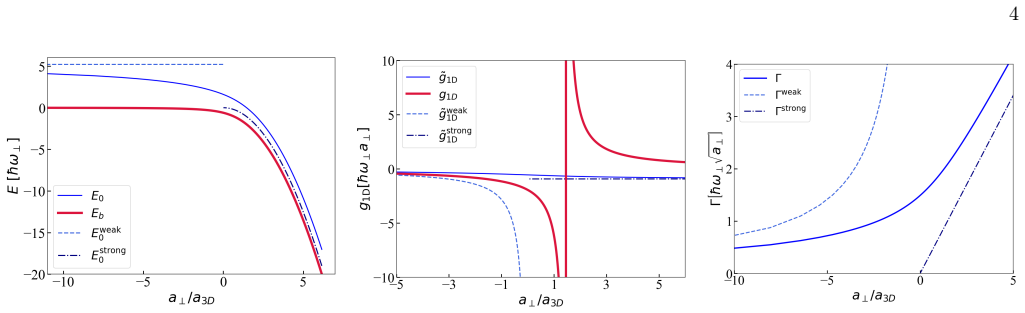
The central claim, on the paper's own terms, is that a coupled-channel model of quasi-1D spin-1/2 fermions—two fermion species plus a bosonic dimer field, with parameters E0, tilde g_1D and Gamma fixed by the exact two-body T-matrix of the quasi-1D problem—cannot reproduce the exact low-energy many-body theory. In the weakly attractive limit a_3D→0⁻, after eliminating the dimer field, the model reproduces the two-body contact interaction and its effective-range correction but misses the emergent three-body interaction that arises from virtual transverse excitations. In the strongly attractive limit a_3D→0⁺, the model's atom-dimer scattering length is 3a_perp/zeta(3/2), independent of a_3D, w
What carries the argument
The central object is the coupled-channel Hamiltonian H_cc = T + U + V, in which U is a contact interaction between unlike fermions with strength tilde g_1D and V converts a pair of fermions into a bosonic dimer (and back) with strength Gamma; the bare dimer energy E0 and the two couplings are fixed by matching the exact quasi-1D two-body scattering amplitude and its bound-state pole. The paper uses this construction as a controlled test bed: a Schrieffer-Wolff elimination of the dimer field probes the weakly attractive many-body sector, and a diagrammatic resummation of atom-dimer scattering probes the strongly attractive sector. Where the two-body-matched model fails, the paper identifies
Load-bearing premise
The load-bearing premise is that the exact atom-dimer result a_AD = -(r_perp)^2/(2×1.2 a_3D), reduced to 1D, is the correct benchmark—in particular that the quasi-1D atom-dimer scattering length diverges as a_3D→0; if the exact length were finite or constant, the claimed qualitative contradiction in the strongly attractive limit would evaporate (and the paper's own conclusion that this length 'should vanish' is not consistent with that formula).
What would settle it
Solve the three-body atom-dimer problem in a quasi-1D harmonic waveguide directly from the underlying three-dimensional zero-range model for a_3D→0⁺, extracting a_AD without constructing a 1D effective Hamiltonian. If a_AD stays finite as a_3D→0 rather than diverging as 1/a_3D, the claimed structurally incorrect scaling disappears.
If this is right
- Effective 1D models for quasi-1D fermions that use only two-body input are incomplete; explicit three-body terms must be added near confinement-induced resonances.
- In the weakly attractive limit, the missing three-body term enters at a specific order in a_3D, so it should appear as a measurable correction to the equation of state and density profile.
- In the strongly attractive limit, the coupled-channel prediction of a constant a_AD is qualitatively wrong; the correct 1/a_3D divergence changes atom-dimer scattering and dimer loss dynamics.
- Adding the three-fermion term W and the atom-dimer term W' recovers the exact two- and three-body sectors at leading order, and the cross-contributions between branches are subleading.
- The additional terms modify the equation of state and break integrability, adding decay channels and increasing relaxation rates in the quasi-1D gas.
Where Pith is reading between the lines
- An editorial reading of the text: the conclusion says the exact atom-dimer scattering length 'should vanish' in the strongly attractive limit, while Eq. (36) gives a 1/a_3D divergence. These statements conflict; depending on which benchmark is meant, the claimed failure is either a scaling error (constant vs divergent) or a sign/magnitude error. This should be settled before citing the strong-coup
- The same benchmarking logic suggests an analogous structural failure for bosonic quasi-1D gases, where three-body physics is generically more important; the need for explicit few-body terms may be a general feature of dimensional reduction near resonances, not a fermion-specific accident.
- If the exact divergence is confirmed, a practical consequence is that effective 1D models should be parameterized by three-body observables (such as the atom-dimer scattering length) rather than by two-body data alone, and the three-body scale becomes an independent input to the low-energy theory.
Editorial analysis
A structured set of objections, weighed in public.
Referee Report
Summary. The paper benchmarks a coupled-channel effective model for quasi-1D fermions against exact low-energy results in the weakly and strongly attractive limits. In the weakly attractive regime, a Schrieffer-Wolff reduction of the coupled-channel Hamiltonian reproduces the exact two-body interaction (including effective-range corrections) but fails to generate the emergent three-body term of the full quasi-1D effective theory. In the strongly attractive regime, the model yields a constant atom-dimer scattering length a_AD_1D = 3a_perp / ζ(3/2), whereas the exact benchmark of Ref. [26] gives a_AD_1D_exact = −(a_r^⊥)^2/(2×1.2 a_3D), which diverges as −1/a_3D. The authors argue that this discrepancy is structural and requires adding an explicit three-body interaction W and a direct atom-dimer term W′ to the effective Hamiltonian. The paper therefore claims that matching only the two-body scattering amplitude is insufficient for a correct low-energy description of quasi-1D fermionic systems.
Significance. If the main claim holds, this is a valuable result: it demonstrates, with explicit derivations, that low-energy effective one-dimensional models for confined fermions must go beyond two-body input, and it identifies concrete missing three-body terms. The paper is particularly strong in the weakly attractive sector, where the Schrieffer-Wolff calculation is transparent and the comparison with the exact effective Hamiltonian is direct and quantitative. The strong-coupling analysis relies on a single exact benchmark from Ref. [26], but the qualitative contrast—constant versus a_3D-dependent atom-dimer scattering length—is sharp and falsifiable. The paper also ships a resummation of the atom-dimer T-matrix in Appendix A, which is a useful technical contribution. The main caveat is that the proposed corrective term W′ is not fully derived and its stated dependence on a_3D is ambiguous; however, this ambiguity is local and fixable.
major comments (2)
- [Sec. V, Eq. (42)] The construction of W′ and its coupling ~g_AD is under-specified. As written, ~g_AD = (ℏ²/2ma_⊥)(ζ(3/2)+O(a_3D)) appears to be a constant plus a subleading term that vanishes as a_3D→0. A constant ~g_AD by itself would yield a constant a_AD_1D, not the −1/a_3D divergence of Eq. (36). The only way the stated form can work is if the constant ℏ²ζ(3/2)/(2ma_⊥) is intended to cancel the existing coupled-channel contact coupling Γ²/E0, leaving a residual O(a_3D) term that dominates the effective atom-dimer coupling after cancellation. This cancellation is not stated or derived. Please make the identification with a_AD_1D_exact explicit, show how the constant term cancels Γ²/E0, and give the coefficient of the residual O(a_3D) term (or at least its relation to the parameters of Eq. (36)). Without this step, Eq. (42) does not demonstrate the proposed fix.
- [Sec. VI and Eq. (36)] The concluding sentence says exact three-body calculations show that atom-dimer 'should vanish' in the strongly attractive regime. This is inconsistent with Eq. (36), which gives a_AD_1D_exact = −(a_r^⊥)²/(2×1.2 a_3D), i.e. a scattering length that diverges as −1/a_3D. A diverging scattering length corresponds to a vanishing 1D coupling (or vanishing low-energy scattering amplitude), not a vanishing scattering length. The paper should rephrase this as 'the atom-dimer scattering length diverges as −1/a_3D (equivalently, the effective atom-dimer coupling vanishes)' to avoid mischaracterizing the benchmark. This matters because the strong-coupling contradiction is framed in terms of this limit behavior.
minor comments (4)
- [Sec. V and Appendix A] Please define the sign convention for the atom-dimer scattering length and coupling constant consistently. In Sec. II, g_1D = −2ℏ²/(m a_1D), while in Appendix A the relation g_AD = 2ℏ²/(3m a_AD) is used with no minus sign. The sign of a_AD from Eq. (34) depends on this convention and should be stated explicitly.
- [Sec. IV, Eq. (20)] The momentum summation indices in the expression for H_3 are hard to follow. The notation k_1+k_3+p_3 = p_2+p_4+k_4 appears to have a typo in the labeling of momenta and the dummy variables; consider rewriting with a clearer set of independent momenta.
- [Sec. VI] The phrase 'breakdown ... is structural' is used several times. It would help to specify precisely what 'structural' means: e.g., no finite renormalization of the two-body coupling can generate the required three-body term at the same order, because the missing term has a different operator structure.
- [Sec. III, Fig. 1] The figure caption says the effective parameters in the two limits are shown as dashed-dot dark blue and dashed light blue curves, but the text does not explain what happens at intermediate values. It would be clearer to indicate the regions of validity of the asymptotic expressions, especially near the confinement-induced resonance.
Circularity Check
Weak-coupling benchmark is a same-group prior result, but the strong-coupling contradiction rests on an independent external benchmark and the model's own derivation is not circular.
specific steps
-
self citation load bearing
[Section IV (Weakly Attractive Limit), Eqs. (18)-(21); central comparison vs H_eff]
"In this case, it was recently shown that the true quasi-1D system could be described using an effective 1D Hamiltonian characterized by a two-body zero-range potential, plus some perturbative finite range corrections and an emerging three-body interaction [19]."
The weak-coupling benchmark H_eff (Eqs. 18-21), including the crucial three-body term H3 with g3b = -a3D^2/(4m) Li_{1/2}(1/4), is imported from reference [19], whose authors include the present coauthor F. Chevy. The paper's weak-coupling conclusion is that a two-body-tuned coupled-channel Hamiltonian, after Schrieffer-Wolff elimination, reproduces only the two-body part of H_eff and misses H3. The absence is computed here, but the target value and even the claimed existence of the 'emergent three-body interaction' are prior results of the same group. Thus the weak-coupling leg of the negative claim is a comparison against a self-cited benchmark; if [19] were not accepted, the result would be empty. This is self-citation that is partially load-bearing, although the coupled-channel side is
full rationale
Score 3. The paper's central negative result has two independent legs. The strong-coupling leg is benchmarked against Eq. (36), a_AD_1D_exact = -(r_perp)^2/(2*1.2 a_3D), taken from the independent external reference [26] (Mora et al.). The coupled-channel prediction a_AD_1D = 3a⊥/ζ(3/2) is derived in this paper from the model's two-body-fitted parameters, so the contradiction is a genuine model prediction versus an external benchmark, not a circular fit. The weak-coupling leg, however, uses as its 'exact low-energy theory' the effective Hamiltonian of [19] (Chevy & Orso), which shares author F. Chevy. The paper's claim that the coupled-channel model misses an emergent three-body interaction is a comparison to this self-cited H3. The current paper does compute the coupled-channel effective two-body and three-body sectors itself, so the absence of H3 is not itself circular, but the definition of the correct target is a same-group prior result. This warrants a 3 rather than 0/2. I also flag two non-circular correctness concerns: (i) the conclusion states exact calculations 'show that atom-dimer should vanish' while Eq. (36) diverges as -1/a_3D; the intended statement is presumably that the 1D coupling g_AD ∝ -1/a_AD vanishes, but the text as written is inconsistent. (ii) The proposed W' coupling is written as gAD = (ℏ^2/2ma⊥)(ζ(3/2)+O(a_3D)) 'with the second term becoming dominant as a3D → 0'; an O(a3D) term cannot dominate a non-zero constant, and this expression would yield a constant a_AD, not the 1/a_3D divergence of Eq. (36). This undermines the constructive fix but is not a circularity. Overall, no self-definitional or fitted-input-as-prediction circularity is present; the derivation is substantially self-contained against external benchmarks.
Axiom & Free-Parameter Ledger
free parameters (2)
- g_AD (atom-dimer contact coupling of W') =
hbar^2/(2m a_perp) (zeta(3/2) + O(a_3D))
- E0, g_tilde_1D, Gamma (coupled-channel parameters) =
Eqs. (9)-(11)
axioms (6)
- domain assumption H_eff of [19] (Eqs. 18-21), including the three-body term with g_3b = -(a_3D^2/4m) Li_{1/2}(1/4), is the exact low-energy theory of the quasi-1D system in the weakly attractive limit.
- domain assumption Eq. (36): the quasi-1D atom-dimer scattering length is a_AD_1D_exact = -(r_perp)^2/(2 x 1.2 a_3D), with 3D atom-dimer length 1.2 a_3D from [26].
- domain assumption The coupled-channel Hamiltonian (Eqs. 4-7), one bosonic dimer per pair plus contact couplings, is a representative member of the class of effective 1D models based only on two-body physics.
- domain assumption Matching the two-body T-matrix to third order in k (scattering length plus effective range, Eqs. 9-11) is sufficient to fix the effective model.
- domain assumption In the strongly attractive limit, the dimer propagator is dominated by bare molecular states, so the Gamma^2 and g_tilde_1D terms in Eq. (32) are negligible.
- standard math Schrieffer-Wolff transformation (Eqs. 22-28) with S proportional to Gamma is a valid perturbative elimination in the weak-coupling limit.
invented entities (1)
-
bosonic dimer field c_k in the coupled-channel Hamiltonian
independent evidence
Cite this review
Pith. "Pith review of Benchmarking the fermionic quasi-1D many-body problem." pith.science (2026). https://pith.science/paper/WDNO5C3I
@misc{pith2026260802007,
  author       = {Pith},
  title        = {Pith review of: Benchmarking the fermionic quasi-1D many-body problem},
  year         = {2026},
  howpublished = {\url{https://pith.science/paper/WDNO5C3I}},
  note         = {Machine review of arXiv:2608.02007}
}
read the original abstract
We investigate the validity of effective one-dimensional models for quasi-1D fermionic systems by benchmarking a coupled-channel approach against the exact low-energy theory derived from the underlying three-dimensional problem in the weakly and strongly attractive limits. We show that reproducing the exact two-body scattering amplitude is insufficient to construct the correct effective low-energy theory of quasi-1D fermions. In the weakly attractive regime, it does not capture the emergent three-body interaction induced by transverse excitations. In the strongly attractive regime, it yields an atom-dimer scattering length with an incorrect dependence on the three-dimensional scattering length. These results demonstrate the limitations of effective one-dimensional descriptions based solely on two-body physics and highlight the need to explicitly include few-body correlations in quasi-1D systems.
Figures


Reference graph
Works this paper leans on
-
[1]
Bloch, J
I. Bloch, J. Dalibard, and W. Zwerger, Rev. Mod. Phys. 80, 885 (2008)
2008
-
[2]
N. D. Mermin and H. Wagner, Physical Review Letters 17, 1133 (1966)
1966
-
[3]
Giamarchi,Quantum physics in one dimension, Vol
T. Giamarchi,Quantum physics in one dimension, Vol. 121 (Clarendon press, Oxford, 2003). 9
2003
-
[4]
Kinoshita, T
T. Kinoshita, T. Wenger, and D. S. Weiss, Nature440, 900 (2006)
2006
-
[5]
F. He, Y. Z. Jiang, H. Q. Lin, R. G. Hulet, H. Pu, and X. W. Guan, Physical Review Letters125, 190401 (2020)
2020
-
[6]
M. A. Cazalilla, R. Citro, T. Giamarchi, E. Orignac, and M. Rigol, Reviews of Modern Physics83, 1405 (2011)
2011
-
[7]
Hadzibabic and J
Z. Hadzibabic and J. Dalibard, La Rivista del Nuovo Cimento 2011 34:634, 389 (2011)
2011
-
[8]
Lahaye, C
T. Lahaye, C. Menotti, L. Santos, M. Lewenstein, and T. Pfau, Reports on Progress in Physics72, 126401 (2009)
2009
-
[9]
Trautmann, P
A. Trautmann, P. Ilzhöfer, G. Durastante, C. Politi, M. Sohmen, M. J. Mark, and F. Ferlaino, Physical Re- view Letters121, 213601 (2018)
2018
-
[10]
E. H. Lieb and W. Liniger, Physical Review130, 1605 (1963)
1963
-
[11]
C. N. Yang, Physical Review Letters19, 1312 (1967)
1967
-
[12]
Gaudin, Physics Letters A24, 55 (1967)
M. Gaudin, Physics Letters A24, 55 (1967)
1967
-
[13]
C. Chin, R. Grimm, P. Julienne, and E. Tiesinga, Re- views of Modern Physics82, 1225 (2010)
2010
-
[14]
S. Sala, P. I. Schneider, and A. Saenz, Physical Review Letters109, 073201 (2012)
2012
-
[15]
Sobirey, H
L. Sobirey, H. Biss, N. Luick, M. Bohlen, H. Moritz, and T. Lompe, Physical Review Letters129, 083601 (2022)
2022
-
[16]
Haller, M
E. Haller, M. J. Mark, R. Hart, J. G. Danzl, L. Reich- söllner, V. Melezhik, P. Schmelcher, and H.-C. Nägerl, Physical Review Letters104, 153203 (2010)
2010
-
[17]
J. P. Kestner and L.-M. Duan, Physical Review A74, 053606 (2006)
2006
-
[18]
J. P. Kestner and L. M. Duan, Physical Review A - Atomic, Molecular, and Optical Physics76, 063610 (2007)
2007
-
[19]
Chevy and G
F. Chevy and G. Orso, Physical Review A107, 043317 (2023)
2023
-
[20]
Pricoupenko, Phys
L. Pricoupenko, Phys. Rev. A99, 012711 (2019)
2019
-
[21]
H. W. Hammer, A. Nogga, and A. Schwenk, Reviews of Modern Physics85, 197 (2013)
2013
-
[22]
Olshanii, Physical Review Letters81, 938 (1998)
M. Olshanii, Physical Review Letters81, 938 (1998)
1998
-
[23]
Abramowitz and I
M. Abramowitz and I. A. Stegun,Handbook of mathe- matical functions with formulas, graphs, and mathemati- cal tables, Vol. 55 (US Government printing office, 1948)
1948
-
[24]
Bergeman, M
T. Bergeman, M. G. Moore, and M. Olshanii, Physical Review Letters91, 163201 (2003)
2003
-
[25]
J. R. Schrieffer and P. A. Wolff, Physical Review149, 491 (1966)
1966
-
[26]
C. Mora, R. Egger, A. O. Gogolin, and A. Komnik, Physical Review Letters93, 170403 (2004)
2004
-
[27]
I. E. Mazets, T. Schumm, and J. Schmiedmayer, Phys. Rev. Lett.100, 210403 (2008)
2008
-
[28]
Kristensen and L
T. Kristensen and L. Pricoupenko, Physical Review A 93, 023629 (2016)
2016
This paper was first reviewed by deepseek-v4-flash on August 4, 2026.
discussion (0)
Sign in with ORCID, Apple, or X to comment. Anyone can read and Pith papers without signing in.