REVIEW 4 major objections 4 minor 60 references
Adaptive criterion and modification of wave-particle decomposition in UGKWP method for high-speed flow simulation
T0 review · 4 major / 4 minor · reviewed 2026-08-07 · deepseek-v4-flash
Pith's one-line read The UGKWP method can run high-speed multiscale flows 1.5 to 4 times faster by adding a mesh-based local Knudsen criterion and a side-split flux correction, with no loss of accuracy against UGKS and DSMC.
desk verdict A useful, well-validated speedup for UGKWP, with one ad hoc blending term that needs a sensitivity study and a grid-convergence check before I'd trust it in the transitional cells. read the letter →
The pith
A machine-rendered reading of the paper's core claim, the machinery that carries it, and where it could break.
The reading
What carries the argument
The load-bearing object is the local wave-particle weight $\eta(Kn_L)$, computed from $Kn_L=\min(Kn_\mathrm{GLL},Kn_\lambda)$. Here $Kn_\mathrm{GLL}=\lambda/(\rho/|\nabla\rho|)$ measures the density-variation length scale and $Kn_\lambda=\lambda/L_{\lambda,\mathrm{ref}}$ uses the local mesh size $L_{\lambda,\mathrm{ref}}=C\sqrt{\Omega_i}$ in two dimensions or $C\sqrt[3]{\Omega_i}$ in three dimensions with $C=20$; the paper motivates this by the principle that the mesh is the observation scale of a numerical multiscale scheme. A hyperbolic tangent of $Kn_L/Kn_\mathrm{ref}$ with $Kn_\mathrm{ref}=0.01$ gives $\eta\approx 1$ in rarefied cells and $\eta\approx 0$ in continuum cells, and exponential moving averaging damps stochastic noise in $\eta$ and $\rho$. The second mechanism is the side-split flux of Eqs. (27)--(28), which evaluates the UGKS time-integration coefficients $\delta_a,\dots,\delta_e$ and $\eta$ with cell values on each side of an interface instead of interface-averaged values, adding the correction term $[1-\eta(Kn_\lambda)]\hat{\delta}_f$ with $\hat{\delta}_f=-\tau^2(1-e^{-\Delta t/\tau})$ to recover viscosity when $\eta$ is small. Together these mechanisms set how many particles are sampled, where they are sampled, and how their macroscopic flux is reconciled with the hydrodynamic-wave flux.
What would settle it
Run the AUGKWP method on a cold-wall hypersonic boundary layer or shock-separated flow where wall heat flux is highly sensitive, with the same $C=20$ and $Kn_\mathrm{ref}=0.01$, and compare cell-by-cell heat flux and shear stress with UGKS or DSMC in the strip of cells where $\eta$ crosses from 0 to 1; a systematic deviation there, or a spurious mass accumulation at the wave-particle interface, would show that the modified flux evolution does not generalize beyond the reported cases.
Extended reading notes
Core claim
The central claim is that the original UGKWP partition weight $e^{-\Delta t/\tau}$, based only on a global time step versus local relaxation time, misclassifies large near-equilibrium regions of hypersonic flows as rarefied, and that this misclassification can be repaired with a three-part local-scale criterion. The paper replaces the weight by $\eta(Kn_L)\,e^{-\Delta t/\tau}$ with $Kn_L=\min(Kn_\mathrm{GLL},Kn_\lambda)$, where $Kn_\mathrm{GLL}$ measures the density-gradient length scale and $Kn_\lambda$ compares the mean free path with the local mesh size, and $\eta$ is a hyperbolic-tangent switch centered at $Kn_\mathrm{ref}=0.01$. To align the deterministic wave evolution with the particle evolution in cells where $\eta$ and $\tau$ change strongly across an interface, the equilibrium flux and the free-transport wave flux are computed separately on each side of the interface (Eqs. 27--28), with a Chapman-Enskog correction $[1-\eta(Kn_\lambda)]\hat{\delta}_f$ added to restore viscous fluxes in continuum cells. The paper reports that this reduces particle numbers by a factor between roughly 1.5 and 4 in the tested cases while stagnation-line and wall distributions of pressure, shear stress, and heat flux agree with UGKS and DSMC references.
Load-bearing premise
The load-bearing premise is that the ad hoc Chapman-Enskog correction added in Eq. (28), with prefactor $[1-\eta(Kn_\lambda)]$ and $\hat{\delta}_f=-\tau^2(1-e^{-\Delta t/\tau})$, recovers the correct viscous stress and heat flux in cells where the scale changes rapidly; the term is chosen to match the continuum limit, not derived from the integral solution, so if it is wrong the accuracy in transition regions degrades even though the test cases match.
Editorial extensions
If this is right
- In the cylinder case at $Kn_\infty=0.001$, the $Kn_L$ criterion reduces particles from 1483k (original UGKWP) to 313k and per-step CPU time from 2.24 s to 0.83 s, a factor of about 2.7.
- At $Kn_\infty=0.1$, the adaptive criterion gives essentially no gain over the original method, showing that the savings are specific to near-continuum regions rather than rarefied flows.
- In the side-jet case, which is mostly continuum with a small locally rarefied region, the method uses about 97k particles versus 724k for the original UGKWP and keeps the DSMC flow features (penetration height and recirculation lengths within about 20%).
- Wherever $\eta=0$, the scheme reduces to the gas-kinetic scheme, so the adaptive method continuously spans particle, hybrid wave-particle, and fully deterministic wave limits.
- The mesh-based $Kn_\lambda$ makes the physical regime classification depend on discretization, meaning that mesh refinement in a boundary layer or stagnation region pushes those cells toward the continuum description.
Reading between the lines
- Because the Chapman-Enskog correction in Eq. (28) is an ad hoc adjustment rather than a term derived from the integral solution, its viscous and heat-flux behavior in transitional cells is only calibrated by the four reported test cases; cases with strong thermal non-equilibrium or different Prandtl numbers could expose errors that these comparisons do not.
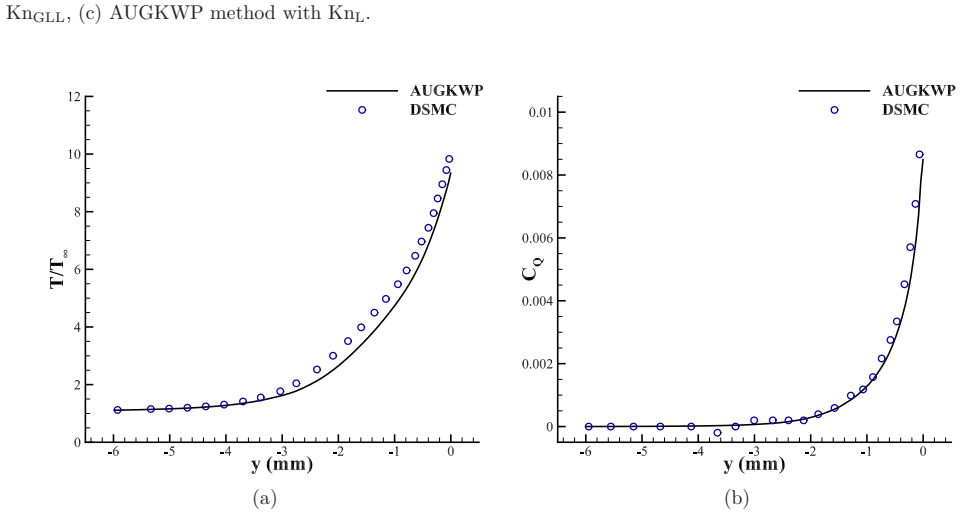
- A focused sensitivity study of the pre-shock temperature deviation the authors report at $Kn_\infty=0.01$ (Fig. 6d), attributed to an under-resolved discontinuity and to particles being abruptly released and reabsorbed, would show whether the EMA time scale or the smoothness of $\eta$ needs adjustment rather than the flux correction.
- The side-split flux repair suggests a general design rule for hybrid wave-particle schemes: whenever the wave-particle weight varies steeply across an interface, cell-based coefficients should be used on each side rather than an interface average; this rule may transfer to other kinetic particle-continuum hybrids beyond UGKWP.
- Since $Kn_\lambda$ depends on the local mesh, the adaptive classification will change if the mesh is adapted; using $\eta$ or $Kn_L$ as an error indicator for mesh refinement could let users place particles exactly where the flow is rarefied, a feedback loop the paper does not explore.
Editorial analysis
A structured set of objections, weighed in public.
Referee Report
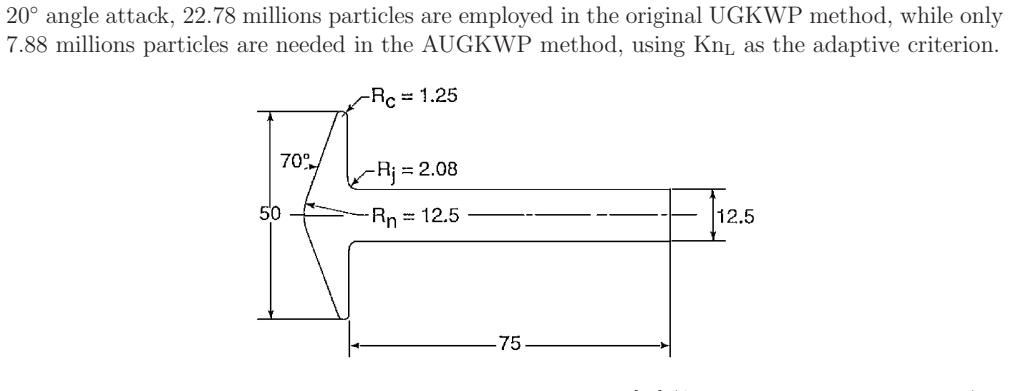
Summary. The manuscript extends the adaptive unified gas-kinetic wave-particle (AUGKWP) method for high-speed multiscale flows. It introduces a composite local Knudsen number KnL = min(KnGLL, Knλ), an exponential moving average for noise reduction, and a modified interface flux (Eqs. 27-28) that splits the hydrodynamic and free-transport fluxes by left/right cell states and adds a Chapman-Enskog correction weighted by [1−η(Knλ)]. The method is validated on four hypersonic configurations: flow around a cylinder at Kn∞ = 0.1, 0.01, and 0.001, a slender cavity, a side-jet impingement, and a 70-degree blunted cone with a sting. The central claim is that the adaptive criterion and the flux modification improve efficiency by a factor of about 1.5 to 4 while matching UGKS, DSMC, and experimental reference data.
Significance. If the accuracy and efficiency claims hold, the proposed method is practically valuable for hypersonic vehicle simulations, where continuum and rarefied regions coexist and deterministic velocity-space solvers are prohibitively expensive. The numerical evidence is extensive: multiple Knudsen numbers for the cylinder case, comparisons with DSMC for the cavity and side-jet cases, a three-dimensional test, wall heat-flux and force comparisons, and single-core CPU timings that make the speedup claim concrete rather than rhetorical. The validation is non-circular because accuracy is checked against external benchmarks. However, the central method depends on an ad hoc Chapman-Enskog correction term and on several free constants whose influence is not quantified; these issues need to be addressed before the efficiency-accuracy trade-off can be regarded as fully established.
major comments (4)
- [Sec. 4.2, Eq. (28)] The added term [1−η(Knλ)] δ̂f ∫ Ψ(∂g^h/∂x·u + ∂g^h/∂t) is introduced as a Chapman-Enskog correction, but it is not derived from the integral solution in Eq. (5), and the prefactor [1−η(Knλ)] is described only as an "adjusting parameter." The paper should provide a derivation or at least an asymptotic analysis showing that, in the combined left/right formulation, this term recovers the Navier-Stokes stress and heat flux with the intended viscosity in the continuum limit, and it should quantify the error introduced when η(Knλ) varies rapidly between neighboring cells. The present validation does not isolate this term, because every test case exercises the correction together with the new adaptive criterion.
- [Sec. 3.2, Eqs. (13) and (16)] Since W^hp = e^{−Δt/τ} ρ^h, the DVM free-transport flux subtracted in Eq. (16) should be proportional to e^{−Δt/τ}, but the equation displays e^{Δt/τ}. In addition, expanding f(−ut,0) = g^h(0,0) − t u·∂g^h/∂x gives a minus sign for the time-integrated gradient term, yet Eq. (16) shows a plus sign. This apparent inconsistency propagates into Eqs. (20) and (28). Please correct the notation or explain the convention; if the implementation follows the printed formulas, the claimed particle-wave flux balance is not the one derived from Eq. (13).
- [Sec. 5.1, Fig. 6(d)] The paper reports a visible deviation of the AUGKWP temperature from UGKS in the pre-shock region at Kn∞ = 0.01 and attributes it to mesh under-resolution and to particles being released and absorbed abruptly. This region is precisely the drastic scale-variation situation that the modified flux in Sec. 4.2 is designed to handle, so the attribution needs direct support. A grid-convergence study at this condition, with and without the Sec. 4.2 modification, is necessary to show that the deviation is a resolution artifact rather than a modeling error in Eq. (28).
- [Sec. 4.1 and Tables 1-2] The method depends on Kn_ref = 0.01, C = 20, NEMA = 100, and N_hp,ref = 100, but no sensitivity analysis is reported. These constants directly determine the location and sharpness of the wave-particle transition and therefore influence both accuracy and the reported speedup. The paper should include at least a sensitivity test for Kn_ref and C, and ideally for NEMA, to show that the efficiency gains are not an artifact of fine-tuned parameters and that accuracy is robust to plausible variations.
minor comments (4)
- [Sec. 4.2, Eq. (28)] The notation η(Knλ) is not previously defined; Sec. 4.1 defines η(KnL) with KnL = min(KnGLL, Knλ). Please define η(Knλ) explicitly and state why the blending uses only the Knλ component rather than KnL.
- [Sec. 5.4] The statement "the third case of the experiment" should specify which case in Refs. [55,56] is used and should give the corresponding free-stream conditions that were actually simulated, since the comparison in Fig. 20 depends on those conditions.
- [Sec. 5.1, Fig. 6(d)] In Fig. 6(d) the caption states that velocity is nondimensionalized by the inflow sound speed, but the normalization for temperature is not stated; please clarify both axes and their legends.
- [Sec. 4.1, Eq. (18)] The transition width in the tanh argument is set by Kn_ref itself (the denominator inside the tanh), which is an unusual choice; a sentence explaining this scaling and its sensitivity to the numerical value would help the reader.
Circularity Check
No significant circularity: the modified UGKWP flux is constructed explicitly from the integral solution and validated against external UGKS, DSMC, and experimental benchmarks.
full rationale
The derivation chain is self-contained. The UGKWP flux follows openly from the integral solution (Eq. 5) with coefficients (Eq. 9); the adaptive modification is an explicit replacement (Eqs. 19-20) and a split-side reformulation (Eqs. 27-28). Accuracy is measured against UGKS, DSMC, and experimental data in Sections 5.1-5.4, so the central claim that the method matches these benchmarks is not fixed by construction. The parameters Knref = 0.01, C = 20, and NEMA = 100 are adopted from prior work or stated as settings, but none is fitted to the quantities later called predictions (stagnation-line profiles, heat-flux coefficients, aerodynamic coefficients); those outputs are generated by the full scheme and compared with external references. The [1 − η(Knλ)] CE-blending in Eq. (28) is explicitly described as 'an adjusting parameter'; this is an acknowledged heuristic and a robustness concern, not a circular reduction. Self-citations [29,20] identify the base AUGKWP method but do not by themselves force the present validation results, which rest on independent benchmarks.
Assumptions & free parameters
free parameters (4)
- C =
20
- NEMA =
100
- Kn_ref =
0.01
- N_hp,ref =
100
assumptions (3)
- domain assumption The Shakhov kinetic model accurately represents the gas physics for the studied hypersonic flows.
- ad hoc to paper The tanh blending function η(KnL) with Kn_ref=0.01 provides a reasonable smooth transition between continuum and rarefied regimes.
- ad hoc to paper The added Chapman-Enskog correction term [1−η(Knλ)]δ̂f is necessary and sufficient to recover the Navier-Stokes viscosity in the continuum limit.
Cite this review
Pith. "Pith review of Adaptive criterion and modification of wave-particle decomposition in UGKWP method for high-speed flow simulation." pith.science (2026). https://pith.science/paper/WEIX3PER
@misc{pith2026250612722,
  author       = {Pith},
  title        = {Pith review of: Adaptive criterion and modification of wave-particle decomposition in UGKWP method for high-speed flow simulation},
  year         = {2026},
  howpublished = {\url{https://pith.science/paper/WEIX3PER}},
  note         = {Machine review of arXiv:2506.12722}
}
abstract
Benefitting from the direct modeling of physical laws in a discretized space and the automatic decomposition of hydrodynamic waves and particles, the unified gas-kinetic wave-particle (UGKWP) method offers notable advantages in various multiscale physics, such as hypersonic flow, plasma transport and radiation transport. Aiming at achieving a more suitable and efficient wave-particle decomposition in high-speed flow simulation and enhancing the performance in the drastic scale variation region, in this work, the scale adaptive criterion is studied and the flux evolution of UGKWP method is modified. Specifically, besides the perspective of time which is naturally considered in the time-dependent distribution function of UGKWP method, two more criteria from views of space and gradient are utilized to identify the local scale, and to reduce the computational consumption of particles on describing the near-equilibrium microscopic gas distribution function. Moreover, corresponding to the coefficients in the time integration flux of unified gas-kinetic scheme (UGKS), the evolution of hydrodynamic wave is modified to be more consistent with particles, which is essential when the scale changes intensely in different cells. A variety of test cases are conducted to validate the performance of the adaptive UGKWP method, including hypersonic flows around a cylinder at multiple inflow Knudsen numbers, hypersonic flow over a slender cavity, side-jet impingement on hypersonic flow and three-dimensional hypersonic flows over a $70^{\circ}$ blunted cone with a cylindrical sting.
Figures


Figures from the paper (18 more)






Reference graph
Works this paper leans on
-
[29]
Y. Wei, J. Cao, X. Ji, K. Xu, Adaptive wave-particle decompositio n in ugkwp method for high-speed flow simulations, Advances in Aerodynamics 5 (2023) 25. doi:https://doi.org/10.1186/s42774-023-00156-y
-
[1]
G. A. Bird, Molecular gas dynamics and the direct simulation of gas fl ows, Clarendon Press, 1994. 27
work page 1994
-
[2]
K. Xu, Direct modeling for computational fluid dynamics: Constru ction and application of unified gas-kinetic schemes, World Scientific, 2015
work page 2015
-
[3]
W. Long, Y. Wei, K. Xu, Nonequilibrium flow simulations using unified gas-kinetic wave-particle method, AIAA Journal 62 (4) (2024) 14 11–1433. doi:https://doi.org/10.2514/1.J063641
-
[4]
Z.-H. Li, A.-P. Peng, Q. Ma, L.-N. Dang, X.-W. Tang, X.-Z. Sun, Gas -kinetic unified algorithm for computable modeling of Boltzmann equation and application to aer othermodynamics for falling disintegration of uncontrolled Tiangong-No.1 spacecraft, Ad vances in Aerodynamics 1 (2019) 4. doi:https://doi.org/10.1186/s42774-019-0009-4
-
[5]
Y. Wang, S. Liu, C. Zhuo, C. Zhong, Investigation of nonlinear sq ueeze-film damping involv- ing rarefied gas effect in micro-electro-mechanical systems, Comp uters & Mathematics with Applications 114 (2022) 898–1221. doi:https://doi.org/10.1016/j.camwa.2022.03.045
- [6]
-
[7]
D. Jiang, M. Mao, J. Li, X. Deng, An implicit parallel UGKS solver for flows covering various regimes, Advances in Aerodynamics 1 (20 19) 8. doi:https://doi.org/10.1186/s42774-019-0008-5
Show all 60 references
-
[8]
L. Mieussens, Discrete-velocity models and numerical schemes f or the Boltzmann-BGK equa- tion in plane and axisymmetric geometries, Journal of Computationa l Physics 162 (2) (2000) 429–466. doi:https://doi.org/10.1006/jcph.2000.6548
2000
-
[9]
Pieraccini, G
S. Pieraccini, G. Puppo, Implicit-explicit schemes for BGK kinetic eq uations, Journal of Scientific Computing 32 (2007) 1–28. doi:https://doi.org/10.1007/s10915-006-9116-6
2007 doi
-
[10]
Li, H.-X
Z.-H. Li, H.-X. Zhang, Gas-kinetic numerical studies of three-d imensional complex flows on spacecraft re-entry, Journal of Computational Physics 228 (4) (2009) 1116–1138. doi:https://doi.org/10.1016/j.jcp.2008.10.013
2009 doi
-
[11]
Xu, J.-C
K. Xu, J.-C. Huang, A unified gas-kinetic scheme for continuum a nd rar- efied flows, Journal of Computational Physics 229 (20) (2010) 77 47–7764. doi:https://doi.org/10.1016/j.jcp.2010.06.032
2010 doi
-
[12]
Z. Guo, K. Xu, R. Wang, Discrete unified gas-kinetic scheme for all Knudsen num- ber flows: Low-speed isothermal case, Physical Review E 88 (3) (2 013) 033305. doi:https://doi.org/10.1103/PhysRevE.88.033305
-
[13]
W. Su, L. Zhu, P. Wang, Y. Zhang, L. Wu, Can we find steady-st ate solutions to multiscale rarefied gas flows within dozens of iterations?, Journal of Comput ational Physics 407 (2020) 109245. doi:https://doi.org/10.1016/j.jcp.2020.109245
2020
-
[14]
W. Ren, H. Liu, S. Jin, An asymptotic-preserving Monte Carlo me thod for the Boltzmann equation, Journal of Computational Physics 276 (2 014) 380–404. doi:https://doi.org/10.1016/j.jcp.2014.07.029. 28
2014 doi
-
[16]
Fei, A time-relaxed Monte Carlo method preserving the Navier - Stokes asymptotics, Journal of Computational Physics 486 (202 3) 112128
F. Fei, A time-relaxed Monte Carlo method preserving the Navier - Stokes asymptotics, Journal of Computational Physics 486 (202 3) 112128. doi:https://doi.org/10.1016/j.jcp.2023.112128
2023
-
[17]
C. Liu, Y. Zhu, K. Xu, Unified gas-kinetic wave-particle methods I: Contin- uum and rarefied gas flow, Journal of Computational Physics 401 ( 2020) 108977. doi:https://doi.org/10.1016/j.jcp.2019.108977
2020
-
[18]
X. Xu, Y. Zhu, C. Liu, K. Xu, UGKS-based implicit iterative method for multiscale nonequi- librium flow simulations, SIAM Journal of Scientific Computing 44 (4) (2 022) B996–B1017. doi:https://doi.org/10.1137/21M1421398
-
[19]
Y. Wei, W. Long, K. Xu, Adaptive unified gas-kinetic scheme for d iatomic gases with rota- tional and vibrational nonequilibrium, Computer Physics Communicat ions 305 (2024) 109324. doi:https://doi.org/10.1016/j.cpc.2024.109324
2024
-
[20]
W. Long, Y. Wei, K. Xu, An implicit adaptive unified gas-kinetic sche me for steady- state solutions of nonequilibrium flows, Physics of Fluids 36 (10) (202 4) 106114. doi:https://doi.org/10.1063/5.0232275
-
[21]
Zhang, S
R. Zhang, S. Liu, J. Chen, H. Jin, C. Zhuo, C. Zhong, Implicit unifi ed gas-kinetic scheme for steady state solution of hypersonic thermodynamic no n-equilibrium flows, Communications in Nonlinear Science and Numerical Simulation 140 (202 5) 108367. doi:https://doi.org/10.1016/j...
-
[22]
C. Liu, K. Xu, A unified gas-kinetic scheme for micro flow simulation based on linearized kinetic equation, Advances in Aerodynamics 2 (20 20) 1. doi:https://doi.org/10.1186/s42774-020-00045-8
-
[23]
C. Liu, K. Xu, A unified gas kinetic scheme for continuum and rare fied flows V: Multiscale and multi-component plasma transport, Communications in Computa tional Physics 22 (5) (2017) 1175–1223. doi:https://doi.org/10.4208/cicp.OA-2017-0102
2017 doi
-
[24]
M. Quan, X. Yang, Y. Wei, K. Xu, Radiative hydrodynamic equatio ns with nonequilibrium radiative transfer, Physical Review D 111 (2025) 103038. doi:https://doi.org/10.1103/PhysRevD.111.103038
2025 doi
-
[25]
Z. Guo, J. Li, K. Xu, Unified preserving properties of kinetic sch emes, Physical Review E 107 (2) (2023) 025301. doi:https://doi.org/10.1103/PhysRevE.107.025301
2023 doi
-
[26]
Y. Zhu, C. Liu, C. Zhong, K. Xu, Unified gas-kinetic wave-partic le methods. II. Multiscale simulation on unstructured mesh, Physics of Fluids 31 (201 9) 067105. doi:https://doi.org/10.1063/1.5097645. 29
-
[27]
K. Xu, A gas-kinetic BGK scheme for the Navier-Stokes equatio ns and its connection with artificial dissipation and Godunov method, Journal of Computation al Physics 171 (20) (2001) 289–335. doi:https://doi.org/10.1006/jcph.2001.6790
2001
-
[28]
Z. Guo, Y. Zhu, K. Xu, Kinetic representation of the unified gas -kinetic wave-particle method and beyond (2024). arXiv:2408.05691
2024 arXiv
-
[30]
S. Liu, C. Zhong, M. Fang, Simplified unified wave-particle method with quantified model- competition mechanism for numerical calculation of multiscale flows, P hysical Review E 102 (2020) 013304. doi:https://doi.org/10.1103/PhysRevE.102.013304
2020 doi
-
[31]
L. M. Yang, Z. H. Li, C. Shu, Y. Y. Liu, J. Wu, Discrete unified gas -kinetic wave- particle method for flows in all flow regimes, Physical Review E 108 (20 23) 015302. doi:https://doi.org/10.1103/PhysRevE.108.015302
-
[32]
Y. Wei, Y. Zhu, K. Xu, Unified gas-kinetic wave-particle methods VII: Diatomic gas with rota- tional and vibrational nonequilibrium, Journal of Computational Ph ysics 497 (2024) 112610. doi:https://doi.org/10.1016/j.jcp.2023.112610
2024
-
[33]
X. Yang, Y. Wei, S. Wei, K. Xu, Unified gas-kinetic wave-particle m ethod for three- dimensional simulation of gas-particle fluidized bed, Chemical Enginee ring Journal 497 (2024) 112610. doi:https://doi.org/10.1016/j.cej.2022.139541
2024
-
[34]
X. Yang, Y. Zhu, C. Liu, K. Xu, Unified gas-kinetic wave-particle method for frequency- dependent radiation transport equation, Journal of Computatio nal Physics 522 (2025) 113587. doi:https://doi.org/10.1016/j.jcp.2024.113587
2025
-
[35]
Z. Pu, K. Xu, Unified gas-kinetic wave-particle method for multis cale flow sim- ulation of partially ionized plasma, Journal of Computational Physics (2025) 113918doi:https://doi.org/10.1016/j.jcp.2025.113918
2025
-
[36]
X. Yang, K. Xu, Wave-particle based multiscale modeling and simula tion of non-equilibrium turbulent flows (2025). arXiv:2503.07207
2025 arXiv
-
[37]
X. Xu, Y. Chen, K. Xu, Modeling and computation for non-equilibr ium gas dynam- ics: Beyond single relaxation time kinetic models, Physics of Fluids 33 (2 021) 011703. doi:https://doi.org/10.1063/5.0036203
-
[38]
D. B. Hash, H. A. Hassan, Assessment of schemes for coupling Monte Carlo and Navier- Stokes solution methods, Journal of Thermophysics and Heat Tra nsfer 10 (1996) 242–249. doi:https://doi.org/10.2514/3.781
1996 doi
-
[39]
Q. Sun, I. D. Boyd, G. V. Candler, A hybrid continuum/particle a pproach for model- ing subsonic, rarefied gas flows, Journal of Computational Physic s 194 (2004) 256–277. doi:https://doi.org/10.1016/j.jcp.2003.09.00. 30
2004 doi
-
[40]
T. E. Schwartzentruber, L. C. Scalabrin, I. D. Boyd, A modula r particle-continuum numerical method for hypersonic non-equilibrium gas flows, Journal of Compu tational Physics 225 (2007) 1159–1174. doi:https://doi.org/10.1016/j.jcp.2007.01.022
2007 doi
-
[41]
E. M. Shakhov, Generalization of the Krook kinetic relaxation eq uation, Fluid Dynamics 3 (1968) 95–96. doi:https://doi.org/10.1007/BF01029546
1968 doi
-
[42]
P. L. Bhatnagar, E. P. Gross, M. Krook, A model for collision pr ocesses in gases. I. Small amplitude processes in charged and neutral one-component syst ems, Physical Review Journals Archive 94 (1954) 511–525. doi:https://doi.org/10.1103/PhysRev.94.511
1954 doi
-
[43]
X. Xu, Y. Chen, C. Liu, Z. Li, K. Xu, Unified gas-kinetic wave-par ticle meth- ods V: Diatomic molecular flow, Journal of Computational Physics 44 2 (2021) 110496. doi:https://doi.org/10.1016/j.jcp.2021.110496
2021
-
[44]
G. May, B. Srinivasan, A. Jameson, An improved gas-kinetic BGK finite-volume method for three-dimensional transonic flow, Journal of Computational Phy sics 220 (2) (2007) 856–878. doi:https://doi.org/10.1016/j.jcp.2006.05.027
2007 doi
-
[45]
C. Liu, G. Zhou, W. Shyy, K. Xu, Limitation principle for computat ional fluid dynamics, Shock Waves 29 (2019) 1083–1102. doi:https://doi.org/10.1007/s00193-018-0881-6
2019 doi
-
[46]
L. Luo, L. Wu, Multiscale simulation of rarefied gas dynamics via dir ect in- termittent GSIS-DSMC coupling, Advances in Aerodynamics 6 (2024 ) 22. doi:https://doi.org/10.1186/s42774-024-00188-y
2024 doi
-
[47]
van Leer, Towards the ultimate conservative difference sch eme
B. van Leer, Towards the ultimate conservative difference sch eme. V. A second-order se- quel to Godunov’s method, Journal of Computational Physics 32 ( 1) (1979) 101–136. doi:https://doi.org/10.1016/0021-9991(79)90145-1
1979 doi
-
[48]
J. A. White, H. Nishikawa, R. A. Baurle, Weighted least-squares cell-average gradient construction methods for the VULCAN-CFD second-order accur ate unstructured grid cell- centered finite-volume solver, 2019
2019
-
[49]
Venkatakrishnan, Convergence to steady state solutions of the Euler equations on un- structured grids with limiters, Journal of Computational Physics 1 18 (1) (1995) 120–130
V. Venkatakrishnan, Convergence to steady state solutions of the Euler equations on un- structured grids with limiters, Journal of Computational Physics 1 18 (1) (1995) 120–130. doi:https://doi.org/10.1006/jcph.1995.1084
1995
-
[50]
Blazek, Computational fluid dynamics: Principles and applicatio ns, Elsevier, 2005
J. Blazek, Computational fluid dynamics: Principles and applicatio ns, Elsevier, 2005
2005
-
[51]
R. C. Palharini, T. J. Scanlon, C. White, Chemically reacting hyper sonic flows over 3D cavities: Flowfield structure characterisation, Computers and Flu ids 165 (2018) 173–187. doi:https://doi.org/10.1016/j.compfluid.2018.01.029
2018 doi
-
[52]
G. E. Palmer, M. Pulsonetti, W. A. Wood, S. Alter, P. Gnoffo, C. T ang, Computational assessment of thermal protection system damage experienced d uring STS-118, Journal of Spacecraft and Rockets 46 (6) (2009) 1110–1116. doi:https://doi.org/10.2514/1.40478. 31
2009 doi
-
[53]
G. Guo, Q. Luo, J. Wu, Numerical investigation on flow and aerot hermal characteristics of rarefied hypersonic flows over slender cavities, Aerospace Scienc e and Technology 144 (2024) 108768. doi:https://doi.org/10.1016/j.ast.2023.108768
2024
-
[54]
I. T. Karpuzcu, D. A. Levin, Study of side-jet interactions ov er a hyper- sonic cone flow using kinetic methods, AIAA Journal 61 (11) (2023) 4741–4751. doi:https://doi.org/10.2514/1.J063020
2023 doi
-
[55]
All` egre, D
J. All` egre, D. Bisch, J. C. Lengrand, Experimental rarefied aerodynamic forces at hypersonic conditions over 70-degree blunted cone, Journal of Spacecraft and Rockets 34 (6) (1997) 719–
1997
-
[56]
All` egre, D
J. All` egre, D. Bisch, J. C. Lengrand, Experimental rarefied heat transfer at hypersonic condi- tions over 70-degree blunted cone, Journal of Spacecraft and R ockets 34 (6) (1997) 724–728. doi:https://doi.org/10.2514/2.3302
1997 doi
-
[57]
Schouler, Y
M. Schouler, Y. Pr´ evereaud, L. Mieussens, Survey of flight a nd numerical data of hypersonic rarefied flows encountered in earth orbit and atmospheric reentr y, Progress in Aerospace Sciences 118 (2020) 100638. doi:https://doi.org/10.1016/j.paerosci.2020.100638
2020
-
[58]
J. Cao, S. Liu, C. Zhong, C. Zhuo, K. Xu, Multiple solutions of non lin- ear coupled constitutive relation model and its rectification in non-e quilibrium flow computation, Computers & Mathematics with Applications 174 (2 024) 1–17. doi:https://doi.org/10.1016/j.camwa.2024.08.017
-
[59]
S. Zeng, Z. He, W. Zhao, W. Chen, A computational strategy f or nonlinear coupled constitu- tive relations of rarefied nonequilibrium flows on unstructured grids , Aerospace Science and Technology 141 (2023) 108477. doi:https://doi.org/10.1016/j.ast.2023.108477
2023
-
[60]
J. Moss, V. Dogra, J. Price, D. Hash, Comparison of DSMC and e x- perimental results for hypersonic external flows, 1995, pp. AIA A 95–2028. doi:https://doi.org/10.2514/6.1995-2028. 32
1995 doi
-
[723]
doi:https://doi.org/10.2514/2.3301
Reviewed August 7, 2026 · model on record in the stance chip above.
Discussion (0). Continue with ORCID to comment.