REVIEW 3 major objections 4 minor 59 references
Semantic Concept Spaces: Guided Topic Model Refinement using Word-Embedding Projections
T0 review · 3 major / 4 minor · reviewed 2026-08-14 · deepseek-v4-flash
Pith's one-line read Hand-editing word-embedding maps makes topic models more distinct.
desk verdict A well-engineered visual analytics system for injecting domain knowledge into topic models, but the empirical claim of quality improvement is not supported by the reported numbers. read the letter →
The pith
A machine-rendered reading of the paper's core claim, the machinery that carries it, and where it could break.
The reading
What carries the argument
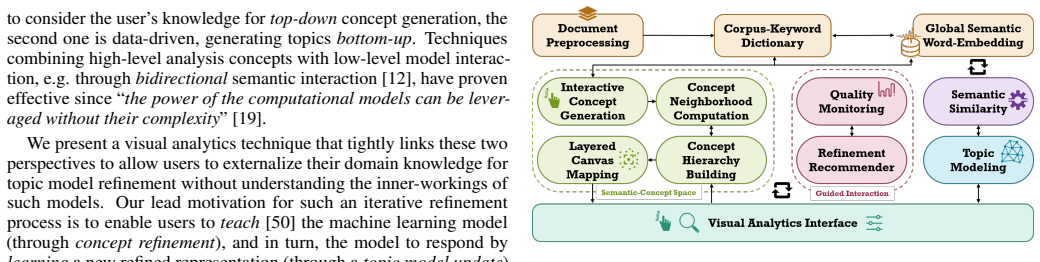
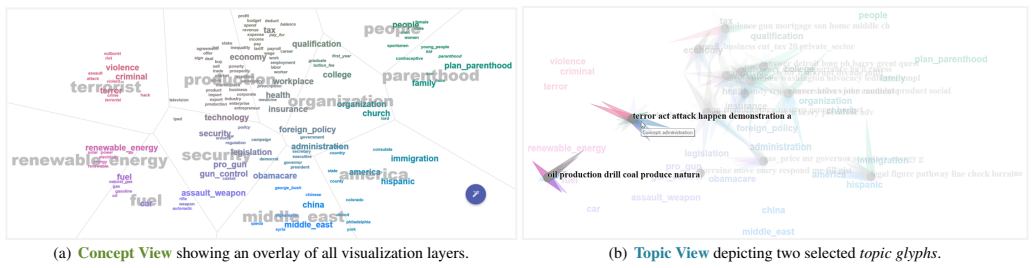
The machinery is a pair of parallel hierarchies over one shared word-embedding space: the user-driven concept hierarchy (base words, descriptors, concepts, super-concepts) and the data-driven topic hierarchy (keywords, documents, topics). The load-bearing link is a weighted word vector: every word carries scores for its relevance to concepts, topics, documents, and the corpus, and user edits alter those weights, which are then used to readjust keyword weighting in topic-model training. A concept-anchored t-SNE projection and topic glyphs with spikes to related concepts make the semantic relations visible and actionable.
What would settle it
Instrument a run of the system and log the word weights before and after a single concept edit; if the edit does not change the weights that feed topic-model retraining, the central mechanism is not operating. A second check: have independent users refine the same corpus from the same starting model and compare the eight quality metrics; if distinctiveness gains are not reproducible across users, the claim of robust improvement fails.
Extended reading notes
Core claim
On its own terms, the paper's central claim is that user knowledge can be externalized as a hierarchy of concepts over a word-embedding space, and that changing this hierarchy changes the scoring of words, which in turn reweights the keywords used by topic modeling. The refinement acts as must-link and cannot-link constraints, so promoting, demoting, merging, or reassigning words teaches the model the user's semantics. Two user studies and an annotation study are offered as evidence that the resulting topics are more distinct and that guided recommendations achieve gains with less feedback.
Load-bearing premise
The load-bearing premise is that a user's edits to the concept hierarchy are translated reliably into changed word weights and constraints for the topic model; the paper describes this mapping in words but gives no equations or algorithm for it.
Editorial extensions
If this is right
- Domain experts can refine topics without touching the underlying model, because the interaction happens in the concept space rather than in algorithm parameters.
- Concepts refined on one corpus can seed the analysis of a related corpus, avoiding a cold start.
- The guided recommendation queue targets high-impact words, so small numbers of accepted suggestions can produce visible quality gains.
- The evaluation's quantitative result—distinctiveness rising sharply while coherence and separation fall slightly—implies that refinement buys interpretable separation at some cost to statistical coherence.
- Must-link and cannot-link constraints can be expressed through spatial editing rather than through explicit rule specification.
Reading between the lines
- An unstated corollary is that the same interaction scheme could steer other embedding-based models, such as clustering or retrieval, by treating the edited concept hierarchy as a prior over the vector space.
- The transferability claim suggests a practical test the paper does not run: refine concepts on one debate corpus, apply them to a second debate, and compare topic quality against a cold-start model.
- Because the user's edits are meant to act as constraints, instrumenting the pipeline to log exact weight changes would let future work verify that the system's concept-to-model mapping matches user intent.
Editorial analysis
A structured set of objections, weighed in public.
Referee Report
Summary. The paper presents Semantic Concept Spaces, a visual analytics framework that lets users refine a topic model by manipulating a concept hierarchy in a word-embedding space. The system maintains two parallel hierarchies—a user-driven concept hierarchy and a data-driven topic hierarchy—over a shared vector space, and maps user interactions into word-weight adjustments that act as must-link/cannot-link constraints for topic model retraining. The interface supports direct manipulation, guided relevance feedback through recommended refinements, and topic glyphs that expose conceptual associations. The authors report qualitative feedback from six experts and quantitative quality-metric changes, plus a four-annotator ranking of five concept-space/topic-model outputs.
Significance. If the central claim were fully substantiated, this would be a useful contribution to human-in-the-loop topic modeling: the dual-hierarchy design, the transferability of refined concepts across corpora, and the explicit guidance component are novel and well-motivated. The qualitative study provides encouraging evidence that domain experts can externalize knowledge and see model responses. However, the quantitative evidence is currently too weak to support the abstract's 'confirm improvements' claim. The mixed metric changes, absence of significance testing, and the informal mapping between user actions and model updates mean the paper's main claim is not yet established. The strengths are the system's availability, the clear separation of concept and topic hierarchies, and the thoughtful discussion of interaction design.
major comments (3)
- [Section 5.2] The central mechanism linking user edits to topic model changes is not specified. The text states that 'we use the learned weights and scores from the concept refinement to readjust the keyword weighting for the topic model training. These act as "must-link" and "cannot-link" constraints' but gives no equations, pseudocode, or formal description of how a hierarchy-level change (promotion, demotion, reassignment, merge) translates into a concrete weight change or constraint. This is load-bearing because the framework's claim of being a model-agnostic refinement method depends on this mapping. Please provide the precise update rule, including how the hierarchy level and descriptor-concept assignments affect the keyword weights and how the IHTM (or any topic model) consumes these constraints.
- [Section 6.2] The quantitative results do not support the claim of topic-model quality improvements. Of the eight reported metrics, five move in the adverse direction (Coherence -5.49%, Separation -12.09%, Branching Factor -26.47%, Compactness -11.77%, Topic Size +1.45%), and only Distinctiveness shows a large positive change (+331.31%). The sentence 'topics became significantly more distinct' is unsupported because no significance test, confidence interval, or per-participant variance is reported. The average relative changes alone are insufficient to establish that the refinements improve topic quality; at best they indicate a trade-off. Please report the underlying per-participant values, the distribution of changes, and appropriate inferential statistics, or revise the central claim to describe a trade-off rather than an overall improvement.
- [Table 1] The annotation study uses only four annotators and compares outputs that were produced under different procedures: the manual refinement model came from one participant in the first study, while the guided refinement model was generated through a different process. There is no paired design, no control for annotator differences, and no statistical comparison. The conclusion that 'manual refinement of the concept space yields the most well-perceived concept view, while the guided topic refinement leads to the highest ranking topic modeling result' is not supported by the reported rank means and standard deviations. Please either provide inferential statistics appropriate for the small sample or clearly present these results as descriptive observations that cannot be used to validate the central improvement claim.
minor comments (4)
- [Section 3.2] The t-SNE parameters (perplexity=5, theta=0.5, 5000 learning iterations) are stated but no rationale or sensitivity analysis is given; since the projection underpins the entire visual workspace, a brief justification or reference would improve reproducibility.
- [Section 6.2] It is unclear whether the reported average relative changes are computed across all six expert participants and whether each participant had multiple refinement cycles; please clarify the exact unit of analysis and the number of models compared.
- [Section 6.1] The quote describing the interface as a 'neat combination of ecstatically pleasing components' appears to contain a typo; 'aesthetically pleasing' seems intended.
- [Abstract] The abstract's phrase 'We confirm the improvements achieved through our approach' overstates the evidence given the mixed quantitative results and lack of significance tests; consider softening the language to match the actual findings.
Circularity Check
Quantitative "topic model quality improvements" are measured with the same metrics that drive the guided refinement, so the improvement claim is partly self-referential.
-
fitted input called prediction
[Section 5.1 (Quality Monitoring / Refinement Recommendation) and Section 6.2 (Quantitative Results)]
""the quality monitoring component evaluates the internal quality of the topic modeling based on the criteria outlined in our previous work [16]" ... "Based on the results of the quality monitoring, the recommender keeps a constantly-updated queue of words and their suggested actions" ... "The average relative change, from the initial model to the refined model, based on the eight observed quality metrics [16] was as follows...""
The same metrics from [16] are used twice: first as the objective for the guided refinement recommender (Section 5.1), and second as the outcome measure for the claimed 'topic model quality improvements' (Section 6.2). A refinement queue that ranks words by these metrics and suggests actions to improve them will tend to move the same metrics in the reported direction even if the user's semantic knowledge contributes nothing. The abstract's confirmation claim therefore rests in part on an optimisation target being relabelled as an independent evaluation. The circularity is partial because participants could accept or reject suggestions and direct manipulation is not purely metric-driven, and because the annotation study offers separate qualitative evidence.
full rationale
The derivation chain is not formally specified: Section 5.2 says the learned weights 'act as must-link and cannot-link constraints' without equations, so no exact Eq X = Eq Y can be exhibited. The main circularity is the identity between the guidance objective and the evaluation metric: both come from the authors' prior work [16]. This makes the quantitative improvement claim partially self-referential. The negative average changes in five of eight metrics (coherence -5.49%, separation -12.09%, branching factor -26.47%, compactness -11.77%) also undercut the headline 'improvements'; the large distinctiveness gain is reported without significance testing. The annotation study (Table 1) provides some independent grounding, but it compares non-paired outputs with four annotators. Overall, the central claim has independent content in the visual interaction design and qualitative results, so score 4 rather than higher.
Assumptions & free parameters
free parameters (6)
- t-SNE perplexity =
5
- t-SNE theta =
0.5
- t-SNE learning iterations =
5000
- epsilon_similarity =
0.4
- epsilon_neighborhood =
6
- top n,m keywords =
15
assumptions (5)
- domain assumption User domain knowledge, externalized through concept edits, improves topic model semantic quality.
- domain assumption Word embeddings from ConceptNet capture meaningful semantic similarity for the corpus words.
- ad hoc to paper The mapping from hierarchy level changes to word weight changes and topic model constraints is well-defined.
- standard math t-SNE projection preserves semantic neighborhoods sufficiently for clustering and concept hierarchy building.
- domain assumption The eight quality metrics from [16] are appropriate measures of topic model quality.
Cite this review
Pith. "Pith review of Semantic Concept Spaces: Guided Topic Model Refinement using Word-Embedding Projections." pith.science (2026). https://pith.science/paper/WETWZNDR
@misc{pith2026190800475,
  author       = {Pith},
  title        = {Pith review of: Semantic Concept Spaces: Guided Topic Model Refinement using Word-Embedding Projections},
  year         = {2026},
  howpublished = {\url{https://pith.science/paper/WETWZNDR}},
  note         = {Machine review of arXiv:1908.00475}
}
read the original abstract
We present a framework that allows users to incorporate the semantics of their domain knowledge for topic model refinement while remaining model-agnostic. Our approach enables users to (1) understand the semantic space of the model, (2) identify regions of potential conflicts and problems, and (3) readjust the semantic relation of concepts based on their understanding, directly influencing the topic modeling. These tasks are supported by an interactive visual analytics workspace that uses word-embedding projections to define concept regions which can then be refined. The user-refined concepts are independent of a particular document collection and can be transferred to related corpora. All user interactions within the concept space directly affect the semantic relations of the underlying vector space model, which, in turn, change the topic modeling. In addition to direct manipulation, our system guides the users' decision-making process through recommended interactions that point out potential improvements. This targeted refinement aims at minimizing the feedback required for an efficient human-in-the-loop process. We confirm the improvements achieved through our approach in two user studies that show topic model quality improvements through our visual knowledge externalization and learning process.
Figures


Figures from the paper (2 more)

Reference graph
Works this paper leans on
-
[16]
M. El-Assady, F. Sperrle, O. Deussen, D. Keim, and C. Collins. Visual Analytics for Topic Model Optimization based on User-Steerable Specu- lative Execution. IEEE Trans. on Visualization and Computer Graphics, 25(1):374–384, 2019. doi: 10.1109/TVCG.2018.2864769
arXiv 2019
-
[1]
E. Alexander, C.-C. Chang, M. Shimabukuro, S. Franconeri, C. Collins, and M. Gleicher. Perceptual biases in font size as a data encoding. IEEE Trans. on Visualization and Computer Graphics, 24(8):2397–2410, 2017. doi: 10.1109/TVCG.2017.2723397
-
[2]
E. Alexander, J. Kohlmann, R. Valenza, M. Witmore, and M. Gleicher. Serendip: Topic model-driven visual exploration of text corpora. In Proc. IEEE Symp. on Visual Analytics Science and Technology (VAST), pp. 173– 182, 2014
work page 2014
-
[3]
D. Andrzejewski, X. Zhu, and M. Craven. Incorporating domain knowl- edge into topic modeling via dirichlet forest priors. In Proc. Int. Conf. on Machine Learning, pp. 25–32, 2009
work page 2009
-
[4]
D. M. Blei. Probabilistic topic models. Communications of the ACM , 55(4):77–84, 2012. doi: 10.1145/2133806.2133826
arXiv 2012
-
[5]
D. M. Blei, A. Y . Ng, and M. I. Jordan. Latent Dirichlet Allocation.J. of Machine Learning Research, 3:993–1022, 2003
work page 2003
-
[6]
M. Cavallo and C ¸. Demiralp. A visual interaction framework for dimen- sionality reduction based data exploration. Proc. SIGCHI Conf. on Human Factors in Computing Systems, 2018
work page 2018
-
[7]
Z. Chen, A. Mukherjee, B. Liu, M. Hsu, and M. Castellanos. Leveraging multi-domain prior knowledge in topic models. Proc. Int. Joint Conf. on Artificial Intelligence, pp. 2071–2077, 2013
work page 2013
Show all 59 references
-
[8]
J. Choo, C. Lee, C. K. Reddy, and H. Park. UTOPIAN: User-driven topic modeling based on interactive nonnegative matrix factorization. IEEE Trans. on Visualization and Computer Graphics, 19(12):1992–2001, Dec. 2013
1992
-
[9]
Collins, N
C. Collins, N. Andrienko, T. Schreck, J. Yang, J. Choo, U. Engelke, A. Jena, and T. Dwyer. Guidance in the human–machine analytics process. Visual Informatics, 2(3):166–180, 2018
2018
-
[10]
W. Dou, X. Wang, R. Chang, and W. Ribarsky. ParallelTopics: A proba- bilistic approach to exploring document collections. In Conf. on Visual An- alytics Science and Technology, pp. 231–240, 2011. doi: 10.1109/V AST. 2011.6102461
2011
-
[11]
W. Dou, L. Yu, X. Wang, Z. Ma, and W. Ribarsky. HierarchicalTopics: Visually exploring large text collections using topic hierarchies. IEEE Trans. on Visualization and Computer Graphics, 19(12):2002–2011, 2013
2002
-
[12]
Dowling, J
M. Dowling, J. Wenskovitch, P. Hauck, A. Binford, N. Polys, and C. North. A bidirectional pipeline for semantic interaction. In Proc. Workshop on Machine Learning from User Interaction for Visualization and Analytics (at IEEE VIS 2018), vol. 11, 2018
2018
-
[13]
El-Assady, A
M. El-Assady, A. Hautli-Janisz, V . Gold, M. Butt, K. Holzinger, and D. Keim. Interactive visual analysis of transcribed multi-party discourse. In Proc. of Association for Computational Linguistics, ACL System Demon- strations, pp. 49–54. ACL, 2017. doi: 10.18653/v1/P17-4009
2017 doi
-
[14]
El-Assady, W
M. El-Assady, W. Jentner, F. Sperrle, R. Sevastjanova, A. Hautli-Janisz, M. Butt, and D. Keim. lingvis.io - A Linguistic Visual Analytics Frame- work. In Proc. of Association for Computational Linguistics, ACL System Demonstrations. ACL, 2019
2019
-
[15]
El-Assady, R
M. El-Assady, R. Sevastjanova, F. Sperrle, D. Keim, and C. Collins. Pro- gressive learning of topic modeling parameters: A visual analytics frame- work. IEEE Trans. on Visualization and Computer Graphics, 24(1):382– 391, 2018. doi: 10.1109/TVCG.2017.2745080
2018
-
[17]
El-Assady, F
M. El-Assady, F. Sperrle, R. Sevastjanova, M. Sedlmair, and D. Keim. LTMA: Layered topic matching for the comparative exploration, evalua- tion, and refinement of topic modeling results. In Int. Symp. on Big Data Visual and Immersive Analytics, pp. 1–10, Oct 2018. doi: 10.1109/...
2018
-
[18]
Endert, L
A. Endert, L. Bradel, and C. North. Beyond control panels: Direct manip- ulation for visual analytics. IEEE Computer Graphics and Applications, 33(4):6–13, 2013
2013
-
[19]
Endert, R
A. Endert, R. Chang, C. North, and M. Zhou. Semantic interaction: Coupling cognition and computation through usable interactive analytics. IEEE Computer Graphics and Applications, 35(4):94–99, 2015
2015
-
[20]
Endert, P
A. Endert, P. Fiaux, and C. North. Semantic interaction for visual text analytics. In Proc. SIGCHI Conf. on Human factors in Computing Systems, pp. 473–482. ACM, 2012
2012
-
[21]
Endert, W
A. Endert, W. Ribarsky, C. Turkay, B. W. Wong, I. Nabney, I. D. Blanco, and F. Rossi. The state of the art in integrating machine learning into visual analytics. Computer Graphics Forum, 36(8):458–486, 2017. doi: 10.1111/cgf.13092
2017 doi
-
[22]
Federico, M
P. Federico, M. Wagner, A. Rind, A. Amor-Amor ´os, S. Miksch, and W. Aigner. The role of explicit knowledge: A conceptual model of knowledge-assisted visual analytics. In Proc. IEEE Conf. on Visual Ana- lytics Science and Technology (VAST), pp. 92–103. IEEE, 2017
2017
-
[23]
Felix, S
C. Felix, S. Franconeri, and E. Bertini. Taking word clouds apart: An empirical investigation of the design space for keyword summaries. IEEE Trans. on Visualization and Computer Graphics, 24(1):657–666, 2018. doi: 10.1109/TVCG.2017.2746018
2018
-
[24]
R. A. Finkel and J. L. Bentley. Quad trees a data structure for retrieval on composite keys. Acta Informatica, 4(1):1–9, Mar 1974. doi: 10.1007/ BF00288933
1974
-
[25]
S. Fortune. A sweepline algorithm for voronoi diagrams. Algorithmica, 2:153–174, 1987
1987
-
[26]
Gleicher
M. Gleicher. Considerations for Visualizing Comparison. IEEE Trans. on Visualization and Computer Graphics, 24(1):413–423, 1 2018. doi: 10. 1109/TVCG.2017.2744199
2018
-
[27]
Halkidi, Y
M. Halkidi, Y . Batistakis, and M. Vazirgiannis. Clustering validity check- ing methods: part ii. ACM Sigmod Record, 31(3):19–27, 2002
2002
-
[28]
G. E. Hinton and S. T. Roweis. Stochastic neighbor embedding. In Advances in Neural Information Processing Systems, pp. 857–864, 2003
2003
-
[29]
Hoque and G
E. Hoque and G. Carenini. ConVisIT: Interactive topic modeling for exploring asynchronous online conversations. In Proc. Int. Conf. on Intelligent User Interfaces, pp. 169–180. ACM, 2015
2015
-
[30]
Y . Hu, J. Boyd-Graber, B. Satinoff, and A. Smith. Interactive topic modeling. Machine learning, 95(3):423–469, 2014
2014
-
[31]
Isenberg, P
T. Isenberg, P. Isenberg, J. Chen, M. Sedlmair, and T. M¨oller. A system- atic review on the practice of evaluating visualization. IEEE Trans. on Visualization and Computer Graphics, 19(12):2818–2827, Dec. 2013. doi: 10.1109/TVCG.2013.126
2013 doi
-
[32]
Iv´ancsy, A
R. Iv´ancsy, A. Babos, and C. Leg´any. Analysis and extensions of popular clustering algorithms. In Int. Symposium of Hungarian Researchers on Computational Intelligence, 2005
2005
-
[33]
Jiang, S
L. Jiang, S. Liu, and C. Chen. Recent research advances on interactive machine learning. J. of Visualization, pp. 1–17, 2018
2018
-
[34]
L. T. Kaastra and B. Fisher. Field experiment methodology for pair ana- lytics. In Proc. Workshop on Beyond Time and Errors: Novel Evaluation Methods for Visualization (BELIV), pp. 152–159. ACM Press, 2014
2014
-
[35]
Levy and Y
O. Levy and Y . Goldberg. Dependency-based word embeddings. In Proceedings of the Annual Meeting of the Association for Computational Linguistics (Volume 2: Short Papers), vol. 2, pp. 302–308, 2014
2014
-
[36]
C. Li, Y . Duan, H. Wang, Z. Zhang, A. Sun, and Z. Ma. Enhancing topic modeling for short texts with auxiliary word embeddings. ACM Trans. Inf. Syst., 36(2):11, 2017. doi: 10.1145/3091108
2017 doi
-
[37]
S. Liu, X. Wang, M. Liu, and J. Zhu. Towards better analysis of ma- chine learning models: A visual analytics perspective. Visual Informatics, 1(1):48–56, 2017
2017
-
[38]
L. v. d. Maaten and G. Hinton. Visualizing data using t-SNE.J. of Machine Learning Research, 9(Nov):2579–2605, 2008
2008
-
[39]
C. D. Manning and H. Sch¨utze. Foundations of Statistical Natural Lan- guage Processing. MIT Press, Cambridge, MA, USA, 1999
1999
-
[40]
Mehta, A
H. Mehta, A. Chalbi, F. Chevalier, , and C. Collins. Datatours: A data narratives framework. In Proc. of IEEE Conf. on Information Visualization (InfoVis), Posters, 2017
2017
-
[41]
Mikolov, I
T. Mikolov, I. Sutskever, K. Chen, G. S. Corrado, and J. Dean. Distributed representations of words and phrases and their compositionality. In Proc. Advances in Neural Information Processing Systems , pp. 3111–3119, 2013
2013
-
[42]
C. E. Moody. Mixing Dirichlet topic models and word embeddings to make lda2vec. CoRR, abs/1605.02019, 2016
2016 arXiv
-
[43]
D. Q. Nguyen, R. Billingsley, L. Du, and M. Johnson. Improving topic models with latent feature word representations. Trans. of the Association for Computational Linguistics, 3:299–313, 2015
2015
-
[44]
D. Park, S. Kim, J. Lee, J. Choo, N. Diakopoulos, and N. Elmqvist. ConceptVector: Text visual analytics via interactive lexicon building using word embedding. IEEE Trans. on Visualization and Computer Graphics, 24(1):361–370, 2017
2017
-
[45]
Rayson and R
P. Rayson and R. Garside. Comparing corpora using frequency profiling. In Proc. Workshop on Comparing Corpora-Volume 9, pp. 1–6. Association for Computational Linguistics, 2000
2000
-
[46]
Y . Ren, R. Wang, and D. Ji. A topic-enhanced word embedding for Twitter sentiment classification. Inf. Sci., 369:188–198, 2016. doi: 10.1016/j.ins. 2016.06.040
2016 doi
-
[47]
Sadeghi, C
A. Sadeghi, C. Lange, M.-E. Vidal, and S. Auer. Integration of scholarly communication metadata using knowledge graphs. In Proc. Int. Con. on Theory and Practice of Digital Libraries, pp. 328–341. Springer, 2017
2017
-
[48]
A. I. Schein, A. Popescul, L. H. Ungar, and D. M. Pennock. Methods and metrics for cold-start recommendations. In Proc. of Int. Conf. on Research and Development in Information Retrieval, pp. 253–260. ACM, 2002
2002
-
[49]
Sevastjanova, F
R. Sevastjanova, F. Beck, B. Ell, C. Turkay, R. Henkin, M. Butt, D. A. Keim, and M. El-Assady. Going beyond visualization: Verbalization as complementary medium to explain machine learning models. In Proc. Workshop on Visualization for AI Explainability, 2018
2018
-
[50]
P. Y . Simard, S. Amershi, D. M. Chickering, A. E. Pelton, S. Ghorashi, C. Meek, G. Ramos, J. Suh, J. Verwey, M. Wang, et al. Machine teaching: A new paradigm for building machine learning systems. arXiv preprint arXiv:1707.06742, 2017
2017 arXiv
-
[51]
Sp¨arck Jones
K. Sp¨arck Jones. A statistical interpretation of term specificity and its application in retrieval. J. of Documentation, 28(1):11–21, 1972
1972
-
[52]
Speer, J
R. Speer, J. Chin, and C. Havasi. ConceptNet 5.5: An open multilingual graph of general knowledge. In Proc. AAAI Conf. on Artificial Intelligence, 2017
2017
-
[53]
Spinner, U
T. Spinner, U. Schlegel, H. Sch¨afer, and M. El-Assady. explAIner: A visual analytics framework for interactive and explainable machine learning. IEEE Trans. on Visualization and Computer Graphics, 2019
2019
-
[54]
Streeb, R
D. Streeb, R. Kehlbeck, D. J¨ackle, and M. El-Assady. Distances, neighbor- hoods, or dimensions? Projection literacy for the analysis of multivariate data. In Proc. Workshop on Visualization for AI Explainability, 2018
2018
-
[55]
X. Wang, S. Liu, J. Liu, J. Chen, J. Zhu, and B. Guo. TopicPanorama: A full picture of relevant topics. IEEE Trans. on Visualization and Computer Graphics, 2016. doi: 10.1109/TVCG.2016.2515592
2016
-
[56]
Z. Wang, J. Zhang, J. Feng, and Z. Chen. Knowledge graph and text jointly embedding. In Proc. of Conf. on Empirical Methods in Natural Language Processing, pp. 1591–1601, 2014
2014
-
[57]
Wyszecki and W
G. Wyszecki and W. Stiles. Color Science: Concepts and Methods, Quan- titative Data and Formulas. Wiley, 1968
1968
-
[58]
H. Zhao, L. Du, and W. Buntine. A word embeddings informed focused topic model. In Proc. of The 9th Asian Conf. on Machine Learning (ACML), pp. 423–438, 2017
2017
-
[59]
Y . Zhao, G. Karypis, and U. Fayyad. Hierarchical clustering algorithms for document datasets. Data Mining and Knowledge Discovery, 10(2):141– 168, 2005
2005
Reviewed August 14, 2026 · model on record in the stance chip above.
Discussion (0). Continue with ORCID to comment.