REVIEW 3 major objections 4 minor 34 references
Accuracy and scalability of asynchronous compressible flow solver for transitional flows
T0 review · 3 major / 4 minor · reviewed 2026-08-07 · deepseek-v4-flash
Pith's one-line read High-order flow simulations can run on stale boundary data and still capture transition, gaining up to 4x speed at 18,432 cores.
desk verdict Solid integration of asynchrony-tolerant schemes into a production DNS solver with real speedups, but accuracy and speedups are demonstrated at different asynchrony settings — one more airfoil run at L=5 would close the gap. read the letter →
The pith
A machine-rendered reading of the paper's core claim, the machinery that carries it, and where it could break.
The reading
What carries the argument
The asynchrony-tolerant (AT) finite-difference scheme, a boundary stencil that approximates spatial derivatives at PE boundaries from several delayed time levels at buffer points, with coefficients fixed by a Taylor-series constraint system that eliminates lower-order terms so that $q$th-order spatial accuracy survives a delay of up to $L$ time steps. Around this core sit two auxiliary constructions: buffer extrapolation at the zeroth Runge-Kutta stage, and buffer updates in intermediate stages that replace spatial derivatives with temporal derivatives built from the same coefficient-constraint logic, so multistage time integration can skip communication entirely. Two algorithms carry the parallel implementation: the communication-avoiding algorithm (CAA), which communicates periodically and produces uniform delays, and the synchronization-avoiding algorithm (SAA), which initiates non-blocking communication every step without enforcing synchronization and produces stochastic delays.
What would settle it
Run the NACA0012 transition case with CAA-AT at the $L=5$ delay used in the scaling benchmarks and compare the time- and span-averaged surface pressure coefficient and streamwise maximum turbulent kinetic energy against the synchronous baseline; a measurable shift in the separation or transition location near $x/c \approx 0.3$, or the appearance of high-frequency oscillations at PE boundaries, would break the combined accuracy-plus-speedup claim. The paper's error-scaling relation already predicts how boundary error grows with delay, so the test is quantitative.
Extended reading notes
Core claim
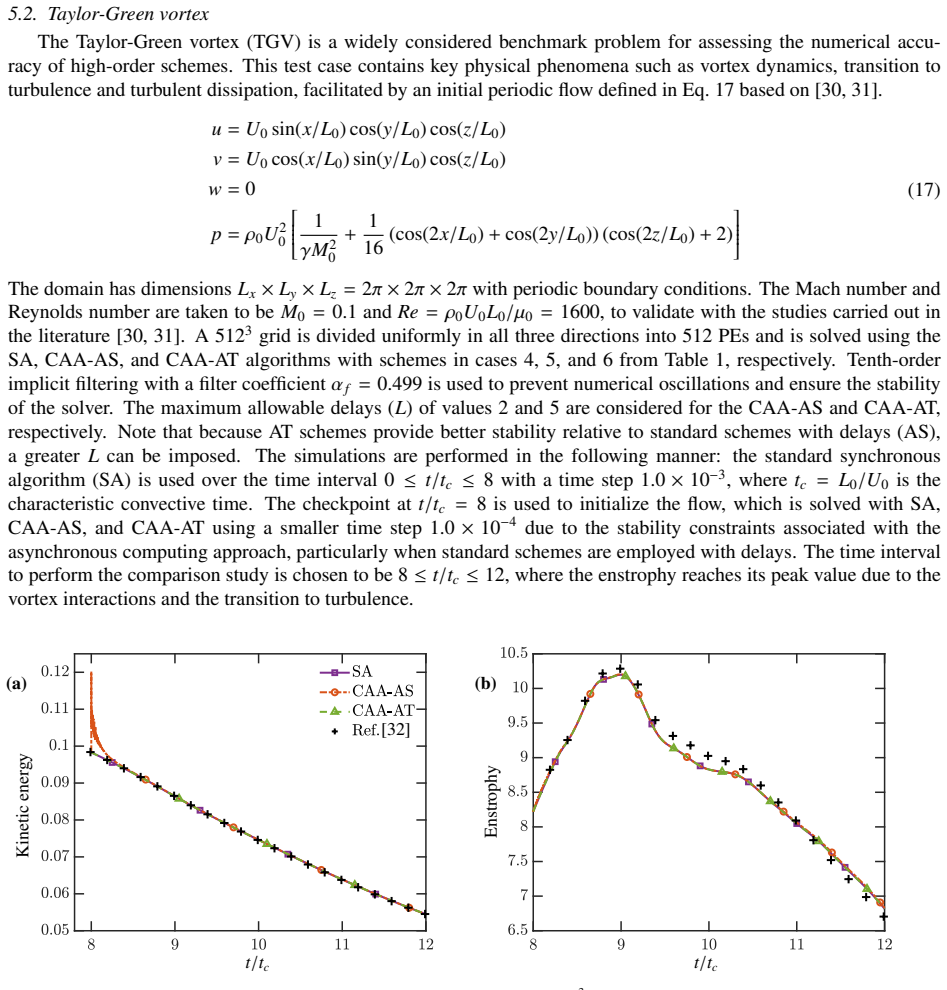
Delayed data at processing-element boundaries does not have to cost accuracy, provided the boundary stencils are rebuilt as asynchrony-tolerant schemes. Naive asynchronous use of standard finite differences collapses to first-order accuracy and emits spurious pressure waves and distorted vortical structures, but the AT-based communication-avoiding and synchronization-avoiding algorithms retain the full design accuracy — second order for LSERK2-CD2-AT2 and fourth order for LSERK4-CD4-AT4, verified up to a maximum allowable delay $L=8$. The same correction keeps sensitive transition physics intact: on the NACA0012 airfoil the asynchronous run matches the synchronous transition location and pressure and turbulent kinetic energy distributions, and in the Taylor-Green vortex it matches the kinetic-energy and enstrophy evolution at a delay where naive asynchronous runs contaminate the whole pressure field.
Load-bearing premise
The flagship claim couples two different settings: the airfoil transition accuracy is checked only with a maximum allowable delay of one time step, while the airfoil speedups are measured with a delay limit of five, so the accuracy of the transitional flow at the delay that produces the reported speedups is assumed rather than demonstrated.
Editorial extensions
If this is right
- The asynchronous solver shows clean second- and fourth-order convergence in the isentropic vortex case at maximum allowable delay $L=8$, so a user can relax communication without re-validating the order of accuracy of the boundary treatment.
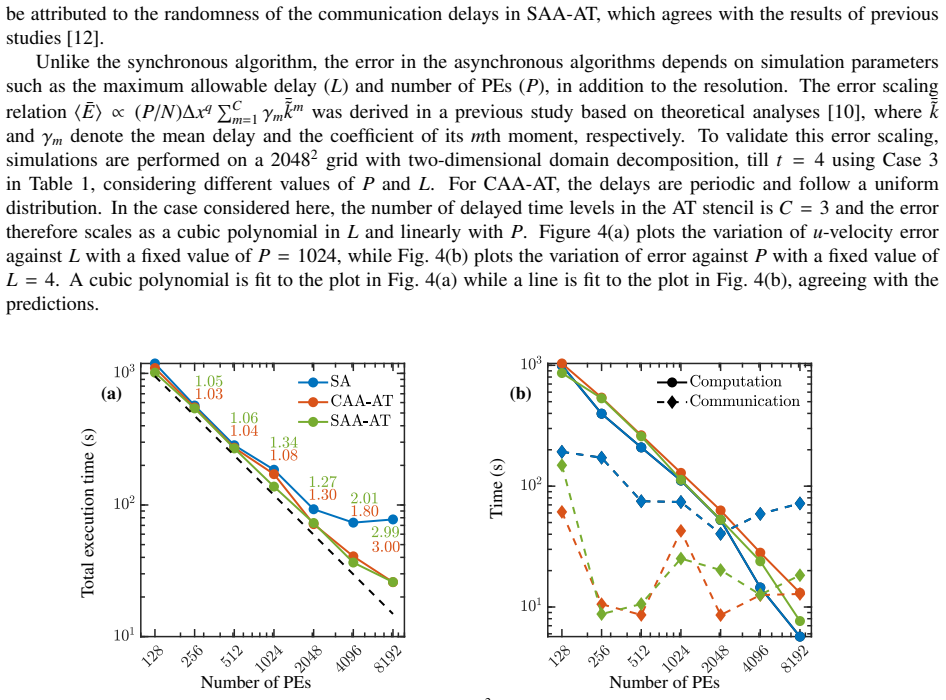
- The error introduced by asynchrony is predictable: for the AT2 scheme it grows as a cubic polynomial in the maximum delay $L$ and linearly in the number of PEs, matching the theoretical relation $\langle\bar{E}\rangle \propto (P/N)\Delta x^q \sum_m \gamma_m \bar{k}^m$, so the delay $L$ becomes a quantity a user can budget against accuracy.
- Strong-scaling plateaus move to much larger core counts: the synchronous solver's execution time plateaus between 2048 and 8192 cores while CAA-AT and SAA-AT stay near ideal scaling, with communication time, not compute, dominating the synchronous cost; speedups reach 4.26x at 8192 cores on the Taylor-Green case, about 3x on the vortex case, and about 2.7x on the airfoil case.
- For sensitive flows the AT correction is decisive: CAA-AS, which uses standard schemes with delayed data, distorts vortical structures and radiates spurious pressure waves in the Taylor-Green vortex, whereas CAA-AT matches the synchronous solution and captures the key vortical structure across the PE boundary.
- The synchronization-avoiding variant has architecture-dependent, stochastic delays, and the paper shows its delay distribution — mostly one or two time steps, with larger delays becoming more probable at higher PE counts — correlates directly with deviations from ideal scaling on the two test supercomputers.
Reading between the lines
- The accuracy-and-speedup promise for the most sensitive case couples two settings the paper never combines: airfoil transition accuracy is demonstrated at maximum delay $L=1$, while the airfoil speedup benchmarks run at $L=5$. The natural next experiment is the airfoil physics at $L=5$, and the paper's own error-scaling relation makes the expected accuracy penalty quantitative rather than speculat
- Because AT corrections are localized at boundaries and arithmetically dense, their relative cost should shrink as subdomains shrink; the measured speedups are therefore likely to grow, not shrink, as core counts pass 18,432, provided the delay distribution stays thin-tailed.
- The same machinery is a generic pattern for stencil-based exascale PDE solvers — the authors cite discontinuous-Galerkin and reacting-flow extensions of the approach — so 'rebuild boundary stencils in time and skip synchronization' may transfer well beyond structured finite-difference solvers.
- The validated error-scaling law turns the maximum delay $L$ into a tunable parameter: an application can set the delay from an accuracy budget up front, which is what would make asynchronous execution a rigorous option for transition-sensitive engineering simulations rather than an uncontrolled approximation.
Editorial analysis
A structured set of objections, weighed in public.
Referee Report
Summary. The paper integrates asynchrony-tolerant (AT) schemes into the COMP-SQUARE compressible Navier-Stokes solver via two parallel algorithms: a communication-avoiding algorithm (CAA) and a synchronization-avoiding algorithm (SAA). It reports order-of-accuracy verification for isentropic vortex advection, accuracy comparisons for the Taylor-Green vortex (TGV) and for transitional flow over a NACA0012 airfoil, and strong/weak scaling experiments on up to 18,432 cores with speedups up to about 4x relative to the synchronous baseline. The abstract and conclusions claim that the AT-based asynchronous solver preserves high-order accuracy for sensitive transitional flows while substantially improving scalability.
Significance. If the results hold, the paper demonstrates a practically important step: prior AT scheme theory, developed on canonical PDEs, can be embedded in an established multi-block structured CFD solver and produce accurate transitional-flow predictions while reducing communication overhead. The authors deserve credit for verifying the nominal convergence orders of CAA-AT and SAA-AT, for matching the TGV evolution to a pseudo-spectral reference at L=5, and for quantifying SAA delay statistics and correlating them with performance. The main weakness is that accuracy and scalability are demonstrated at different asynchrony settings, so the paper's combined claim "accurate for transitional flows at the settings that produce the speedups" is not yet directly supported. The AT scheme derivations are imported from prior work rather than derived here, but this is not a circularity problem because the numerical behavior is validated against independent references.
major comments (3)
- [Sec. 5.3, Figs. 9 and 11] The airfoil accuracy comparison is performed with CAA-AT at L=1 (Fig. 9 caption), while the reported speedups of 2.47x and 2.73x are measured at L=5 (Fig. 11 and surrounding text). Under the intended CAA semantics, L=1 bounds the time-step delay to at most one step, so the multi-step delayed-data regime that produces the communication savings is not exercised in the accuracy test. Since the paper's own error law (Sec. 5.1, Fig. 4a) shows boundary error growing as a polynomial in the delay, with degree related to the number of AT time levels (C=5 for AT4), the effect of L=5 on the separation-induced transition cannot be inferred from the L=1 result. Please add a quantitative accuracy comparison at L=5 (e.g., transition location, cp error, and TKEmax error norms) or explicitly restrict the accuracy claim to L=1.
- [Sec. 5.2, Figs. 6 and 8] The TGV accuracy comparison is shown at L=5 for CAA-AT (Fig. 6 caption), while the strong- and weak-scaling speedups, including the headline 4.26x at 8192 cores, are reported at L=10 (Fig. 8 and text). The kinetic-energy and enstrophy agreement in Fig. 6 therefore does not cover the asynchrony level used in the scaling benchmarks. Please provide an accuracy-versus-L study or a TGV accuracy comparison at L=10, or report the scaling results at the same L used in the accuracy tests.
- [Sec. 4.2, Algorithm 2] The CAA pseudocode is internally inconsistent with the reported L values. As printed, the conditions "0 <= n%L <= C-1" and "n%L == C-1" mean that for L=1 and C=5 the communication/reset branch is never taken (since n%1=0 and 0 != 4), so the delay would never reset; for L=10 and C=5 the reset would occur at n%L=4, giving a maximum delay of about 5 rather than 10. This contradicts the stated definition of L as the maximum allowable delay and the reported L=1 and L=10 experiments. Please correct the pseudocode (e.g., replace C-1 with L-1 or clarify the modulo convention) and describe how the L=1 case is actually implemented and verified.
minor comments (4)
- [Sec. 5.1, Fig. 4] The dashed curve in Fig. 4(a) is described as a best-fit cubic polynomial, but the fitted polynomial is not reported; giving the fit coefficients would allow readers to check whether the L-dependence is indeed a degree-(C-1) polynomial rather than just a visual fit.
- [Sec. 5.1, Fig. 3] In Fig. 3(b), the legend lists both CAA-AT and SAA-AT, but the two curves may overlap; please use distinguishable markers or explicitly state where they coincide.
- [Sec. 5.3, Fig. 10] The caption describes panels (c) and (d) as comparisons against Ref. [33], but the text does not state the quantitative difference in transition location between SA and CAA-AT; a numerical value would strengthen the claim of consistent transition prediction.
- [Eq. 16] The pressure relation is written as "p_inf - p = ...", which is unconventional; writing "p = p_inf - ..." would make the sign convention clearer.
Circularity Check
No circularity: accuracy claims are validated against external references, and the L=1 vs L=5 speedup mismatch is a coverage gap, not a circular reduction.
full rationale
The paper's claimed derivation chain is not circular. The asynchrony-tolerant (AT) schemes are imported from prior published work [10,13] as explicit coefficient constraints (Eqs. 6 and 13) with stated assumptions (CFL exponent r, target order q), and they are not defined in terms of the flow solutions they are used to predict. The core accuracy claims are independently validated: order-of-accuracy via convergence against the exact isentropic vortex solution (Fig. 3a), Taylor-Green vortex accuracy against the external pseudo-spectral reference [32] (Fig. 6), and airfoil transition against the high-fidelity LES of Visbal and Garmann [33] (Fig. 10c). The error-scaling relation from Ref. [10] is invoked to predict a cubic-in-L and linear-in-P dependence, which the paper then fits and compares; because the functional form is derived rather than fitted and is not used to define the solver's error, this is validation, not a fitted-input-as-prediction. The L=1 accuracy vs L=5 speedup mismatch in Sec. 5.3 (and the analogous L=5 vs L=10 gap in the TGV scaling study) is a coverage or verification gap, not a circularity: it means the combined accuracy-plus-speedup claim is not demonstrated at the exact speedup settings, but no equation in the paper makes a predicted quantity equal to an input by construction. Self-citations are present but not load-bearing: [10,13] supply parameter-free coefficient constraints with stated assumptions that do not include the target results, and the paper's own numerical tests provide independent evidence for the central claims.
Assumptions & free parameters
free parameters (3)
- Maximum allowable delay L =
1 (airfoil accuracy), 5 (airfoil scaling and TGV accuracy), 8 (vortex accuracy), 10 (TGV scaling)
- Time step size =
2e-3 and 1e-3 for vortex SA and asynchronous runs; 1e-3 and 1e-4 for TGV SA and asynchronous runs; airfoil not stated
- Filter coefficient alpha_f =
0.499
assumptions (4)
- domain assumption AT Taylor-coefficient constraints (Eq. 6 in Sec. 3.1) carry over from scalar PDEs to the nonlinear compressible Navier-Stokes equations on curvilinear grids.
- domain assumption Delayed PE-boundary data can be modeled by fixed integer delays k in Taylor expansions, with random delays distributed around a bounded mean.
- domain assumption High-order Pade filtering suppresses asynchrony-induced high-frequency oscillations without altering physical flow structures.
- domain assumption COMP-SQUARE's standard high-order finite difference and compact schemes are stable and accurate on the tested curvilinear multi-block grids.
Cite this review
Pith. "Pith review of Accuracy and scalability of asynchronous compressible flow solver for transitional flows." pith.science (2026). https://pith.science/paper/WFPJJBRW
@misc{pith2026250603027,
  author       = {Pith},
  title        = {Pith review of: Accuracy and scalability of asynchronous compressible flow solver for transitional flows},
  year         = {2026},
  howpublished = {\url{https://pith.science/paper/WFPJJBRW}},
  note         = {Machine review of arXiv:2506.03027}
}
abstract
To overcome the communication bottlenecks observed in state-of-the-art parallel time-dependent flow solvers at extreme scales, an asynchronous computing approach that relaxes communication and synchronization at a mathematical level was previously developed. This approach preserves high-order accuracy of computations near processing element boundaries using asynchrony-tolerant (AT) schemes while significantly improving the scalability. The numerical properties of the AT schemes were studied based on simple linear and nonlinear partial differential equations (PDEs) in previous works. Allowing asynchrony in numerical schemes can minimize communication overheads in a parallel setting in two ways: one that avoids communication over a few predetermined time steps, and the other that initiates communications without enforcing synchronization. In this study, the asynchronous algorithms are incorporated into the high-order compressible flow solver COMP-SQUARE, which solves practically relevant flow problems in complex geometries in a multi-block framework. The numerical efficacy and scalability of the two asynchronous algorithms are demonstrated for three test cases: isentropic advection of a vortex, the Taylor-Green vortex, and a much more sensitive case of the flow transitioning on a NACA0012 airfoil. Speed-ups of up to $4\times$ with respect to the baseline synchronous algorithm are observed in the scaling experiments performed on up to 18,432 cores. The results of this study demonstrate the applicability of AT schemes on established CFD solvers to improve scalability at extreme scales as the scientific computing environment moves to the exascale era.
Figures


Figures from the paper (9 more)



Reference graph
Works this paper leans on
-
[1]
J. H. Chen, A. Choudhary, B. D. Supinski, M. Devries, E. R. Hawkes, S. Klasky, W. K. Liao, K. L. Ma, J. Mellor-Crummey, N. Podhorszki, R. Sankaran, S. Shende, C. S. Yoo, Terascale direct numerical simulations of turbulent combustion using S3D, Computational Science and Discovery 2 (2009)
work page 2009
-
[2]
K. W. Jenkins, R. S. Cant, Direct numerical simulation of turbulent flame kernels, in: D. Knight, L. Sakell (Eds.), Recent Advances in DNS and LES, Springer Netherlands, Dordrecht, 1999, pp. 191–202
work page 1999
-
[3]
O. Desjardins, G. Blanquart, G. Balarac, H. Pitsch, High order conservative finite difference scheme for variable density low Mach number turbulent flows, Journal of Computational Physics 227 (2008) 7125–7159
work page 2008
-
[4]
T. C. Germann, Co-design in the exascale computing project, The International Journal of High Performance Computing Applications 35 (2021) 503–507
work page 2021
-
[5]
D. Amitai, S. Itzikowitz, Parallel adaptive and time-stabilizing schemes for constant-coefficient parabolic PDE’s, 1992. 20 Derivative Expression (∂ϕ/∂t) (0) i 1 12∆t 2˜k3 +15 ˜k2 +35 ˜k+25 ϕn−˜k i − 1 6∆t 4˜k3 +27 ˜k2 +52 ˜k+24 ϕn−˜k−1 i + 1 2∆t 2˜k3 +12 ˜k2 +19 ˜k+6 ϕn−˜k−2 i − 1 6∆t 4˜k3 +21 ˜k2 +28 ˜k+8 ϕn−˜k−3 i + 1 12∆t 2˜k3 +9 ˜k2 +11 ˜k+3 ϕn−˜k−4 ...
work page 1992
- [6]
-
[7]
A. Konduri, D. A. Donzis, Poster: Asynchronous Computing for Partial Differential Equations at Extreme Scales, in: 2012 SC Companion: High Performance Computing, Networking Storage and Analysis, 2012, pp. 1444–1444
work page 2012
-
[8]
D. A. Donzis, K. Aditya, Asynchronous finite-difference schemes for partial differential equations, Journal of Computational Physics 274 (2014) 370–392
work page 2014
Show all 34 references
-
[9]
Mittal, S
A. Mittal, S. Girimaji, Proxy-equation paradigm: A strategy for massively parallel asynchronous computations, Physical Review E 96 (2017)
2017
-
[10]
Aditya, D
K. Aditya, D. A. Donzis, High-order asynchrony-tolerant finite difference schemes for partial differential equations, Journal of Computational 21 Physics 350 (2017) 550–572
2017
-
[11]
Aditya, T
K. Aditya, T. Gysi, G. Kwasniewski, T. Hoefler, D. A. Donzis, J. H. Chen, A scalable weakly-synchronous algorithm for solving partial differential equations, 2019
2019
-
[12]
Kumari, D
K. Kumari, D. A. Donzis, Direct numerical simulations of turbulent flows using high-order asynchrony-tolerant schemes: Accuracy and performance, Journal of Computational Physics 419 (2020)
2020
-
[13]
S. K. Goswami, V . J. Matthew, K. Aditya, Implementation of low-storage Runge-Kutta time integration schemes in scalable asynchronous partial differential equation solvers, Journal of Computational Physics 477 (2023)
2023
-
[14]
Kumari, E
K. Kumari, E. Cleary, S. Desai, D. A. Donzis, J. H. Chen, K. Aditya, Evaluation of finite difference based asynchronous partial differential equations solver for reacting flows, Journal of Computational Physics 477 (2023)
2023
-
[15]
S. K. Goswami, K. Aditya, An asynchronous discontinuous-Galerkin method for solving PDEs at extreme scales, 2022
2022
-
[16]
S. K. Goswami, K. Aditya, An asynchronous discontinuous Galerkin method for massively parallel PDE solvers, Computer Methods in Applied Mechanics and Engineering 430 (2024)
2024
-
[17]
A. K. Arumugam, K. Aditya, An asynchronous discontinuous Galerkin method for combustion simulations, 2025
2025
-
[18]
N. R. Vadlamani, P. G. Tucker, P. Durbin, Distributed Roughness Effects on Transitional and Turbulent Boundary Layers, Flow, Turbulence and Combustion 100 (2018) 627–649
2018
-
[19]
A. S. Malathi, M. Nardini, A. Vaid, N. R. Vadlamani, R. D. Sandberg, Profile Loss Reduction of High-Lift Turbine Blades with Rough and Ribbed Surfaces, Journal of Turbomachinery 145 (2023)
2023
-
[20]
N. R. Vadlamani, P. G. Tucker, Eddy resolving simulations of intake under crosswinds, in: M. V . Salvetti, V . Armenio, J. Fr ¨ohlich, B. J. Geurts, H. Kuerten (Eds.), Direct and Large-Eddy Simulation XI, Springer International Publishing, Cham, 2019, pp. 523–529
2019
-
[21]
Tyacke, N
J. Tyacke, N. R. Vadlamani, W. Trojak, R. Watson, Y . Ma, P. G. Tucker, Turbomachinery simulation challenges and the future, 2019
2019
-
[22]
A. I. Arasu, S. S. Sarvankar, N. R. Vadlamani, Distortion Control in Intakes Subject to Strong Crosswinds Using Steady V ortex Generator Jets, AIAA Journal (2024) 1–16
2024
-
[23]
Y . Lin, R. Vadlamani, M. Savill, P. Tucker, Wall-resolved large eddy simulation for aeroengine aeroacoustic investigation, in: Aeronautical Journal, volume 121, Cambridge University Press, 2017, pp. 1032–1050
2017
-
[24]
Nampelly, A
G. Nampelly, A. S. Malathi, A. Vaid, N. R. Vadlamani, S. Rengarajan, K. Kontis, Surface Roughness Effects on Cavity Flows, Flow, Turbulence and Combustion 109 (2022) 1215–1239
2022
-
[25]
S. K. Lele, Compact Finite Difference Schemes with Spectral-like Resolution, Journal of Computational Physics 103 (1992) 42
1992
-
[26]
M. R. Visbal, D. V . Gaitonde, On the use of higher-order finite-difference schemes on curvilinear and deforming meshes, Journal of Computational Physics 181 (2002) 155–185
2002
-
[27]
J. H. Williamson, Low-storage Runge-Kutta schemes, Journal of Computational Physics (1980) 3548–56
1980
-
[28]
C. A. Kennedy, M. H. Carpenter, R. M. Lewis, Low-storage, explicit Runge-Kutta schemes for the compressible Navier-Stokes equations, Applied Numerical Mathematics 35 (2000) 177–219
2000
-
[29]
M. H. Carpenter, C. A. Kennedy, Fourth-order 2N-storage Runge-Kutta schemes, Technical Report, NASA Technical Memorandum 109112, 1994
1994
-
[30]
L. T. Diosady, S. M. Murman, Case 3.3: Taylor-Green V ortex Evolution, Technical Report, NASA Ames Research Center, 2015
2015
-
[31]
DeBonis, Solutions of the Taylor-Green V ortex Problem Using High-Resolution Explicit Finite Difference Methods, 2013
J. DeBonis, Solutions of the Taylor-Green V ortex Problem Using High-Resolution Explicit Finite Difference Methods, 2013
2013
-
[32]
W. M. van Rees, A. Leonard, D. I. Pullin, P. Koumoutsakos, A comparison of vortex and pseudo-spectral methods for the simulation of periodic vortical flows at high Reynolds numbers, Journal of Computational Physics 230 (2011) 2794–2805
2011
-
[33]
M. R. Visbal, D. J. Garmann, Analysis of dynamic stall on a pitching airfoil using high-fidelity large-eddy simulations, in: AIAA Journal, volume 56, American Institute of Aeronautics and Astronautics Inc., 2018, pp. 46–63
2018
-
[34]
D. V . Gaitonde, M. R. Visbal, High-Order Schemes for Navier-Stokes Equations: Algorithm and Implementation Into FDL3DI, 1998. 22
1998
Reviewed August 7, 2026 · model on record in the stance chip above.
Discussion (0). Continue with ORCID to comment.