REVIEW 4 major objections 5 minor 40 references
Quantum Circuit Optimization Based on Dynamic Grouping and ZX-Calculus for Reducing 2-Qubit Gate Count
T0 review · 4 major / 5 minor · reviewed 2026-08-06 · deepseek-v4-flash
Pith's one-line read By randomly grouping circuit layers into subcircuits and running a k-step lookahead rewrite search in ZX diagrams, this paper reports an average 18% reduction in two-qubit gates across benchmark circuits.
desk verdict The 18% reduction is plausible but not reproducible from the paper as written; a sign error in the annealing rule and missing parameters should be fixed before the numbers are cited. read the letter →
The pith
A machine-rendered reading of the paper's core claim, the machinery that carries it, and where it could break.
The reading
What carries the argument
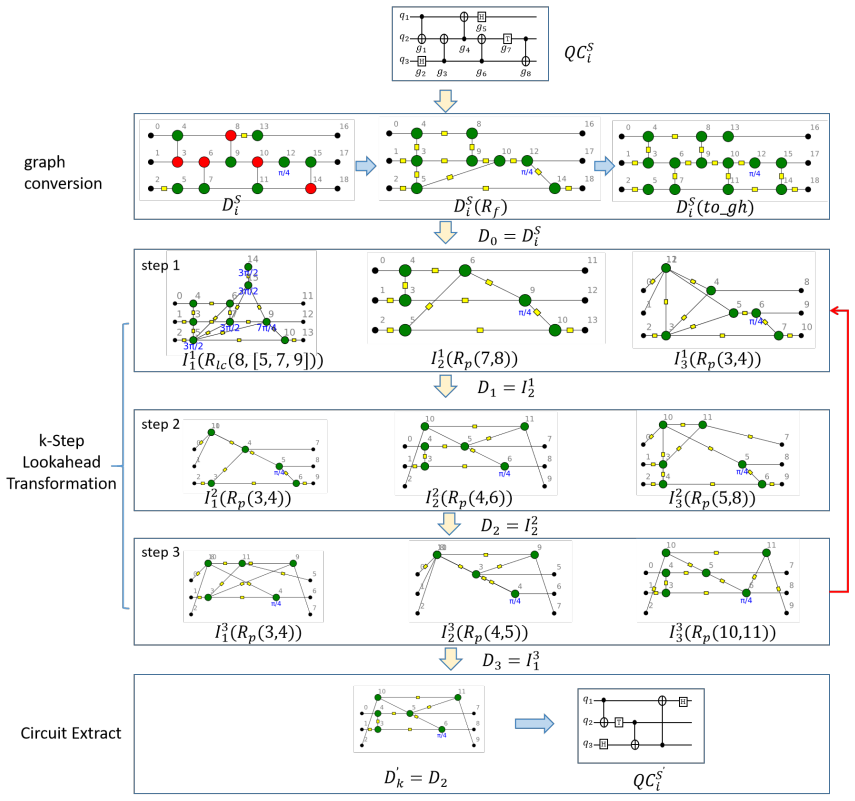
The load-bearing object is the k-step lookahead search over ZX-diagram rewrites, guided by a two-stage cost model. ZX-calculus represents a quantum circuit as a graph of Z and X spiders connected by wires, and equivalence-preserving rewrite rules (node fusion, color change, local complementation, pivoting) allow structural simplification; circuits are recovered from simplified diagrams by a gflow-based extraction algorithm. The search generates a random set of candidate rules, applies them to produce candidate diagrams, scores intermediate diagrams by their number of Hadamard edges, and after k steps scores the fully extracted candidate by its two-qubit gate count. Around this core sit the randomized grouping by consecutive gate layers, the delayed gate placement that cancels redundant Hadamard gates introduced during extraction, and the simulated annealing loop that iterates over grouping configurations.
What would settle it
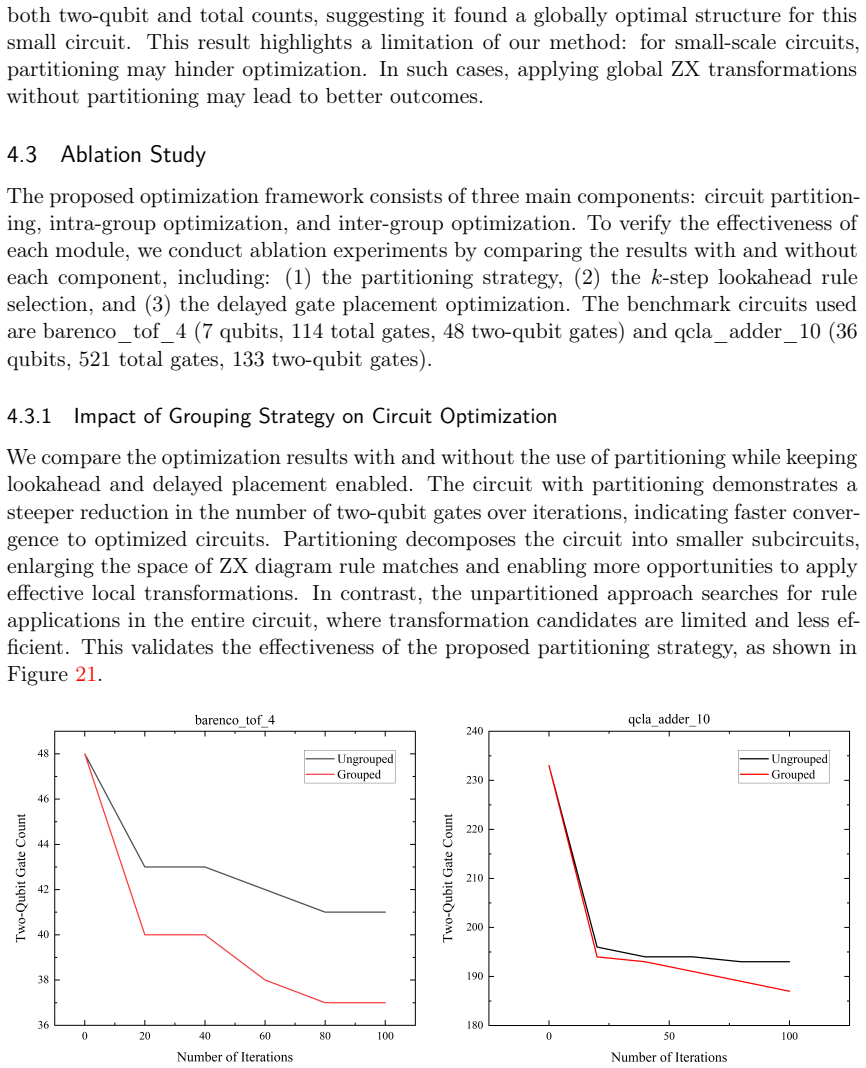
On a fixed benchmark circuit, enumerate all k-step ZX rewrite sequences up to depth k, extract each final diagram, and count two-qubit gates; if the exhaustive sequence often produces fewer two-qubit gates than the Hadamard-edge-pruned lookahead, the pruning proxy is falsified. Reproducing the ablation of Section 4.3.2, where removing lookahead makes two-qubit gate counts rise, would support the mechanism; observing the opposite would refute it.
Extended reading notes
Core claim
The paper's central claim is that the locality bottleneck of ZX-calculus circuit optimization can be broken by randomized partitioning and anticipatory rule screening. Instead of applying single rewrite rules greedily to one large diagram, the optimizer partitions the circuit into subcircuits, explores several rule-application steps ahead, and uses the two-qubit gate count of the extracted circuit as the final selection criterion. The intermediate search is pruned by Hadamard-edge counts, and the merged result is cleaned with a delay-based gate-cancellation pass; a simulated annealing loop varies the partition to approach a global optimum. The paper reports that this pipeline reduces two-qubit gates by an average of 18% on the benchmark set, outperforms existing heuristic ZX methods by about 4% on average, and can improve upon a strong rule-based optimizer by up to 15% on specific circuits such as adder_8.
Load-bearing premise
The search assumes that minimizing the number of Hadamard edges at each intermediate lookahead step predicts which rewrite path will yield the fewest two-qubit gates after extraction, even though the paper concedes that ZX simplification can sometimes increase the extracted two-qubit count.
Editorial extensions
If this is right
- If an 18% average reduction in two-qubit gates holds across benchmarks, NISQ circuits of the tested scale can be run with proportionally less two-qubit noise and lower hardware cost.
- The lookahead mechanism prevents a known failure mode in which ZX simplification shrinks the diagram but increases the extracted two-qubit count; the ablations show that without lookahead the two-qubit gate count can rise.
- Combining the method with rule-based preprocessing yields even larger two-qubit reductions (about 22% on average), indicating that partitioned ZX search finds structures that local rewrite rules miss.
- The cost function is modular: reweighting it could target total gate count, depth, or other metrics, although the paper notes that depth and fidelity are harder to assess directly from ZX diagrams.
- The paper acknowledges that rule matching scales poorly with circuit size, so applying the scheme to larger circuits will require more scalable rewrite-rule enumeration.
Reading between the lines
- The Hadamard-edge pruning premise is testable: an unpruned exhaustive-enumeration version of the same search would show whether this proxy discards genuinely better rewrite paths; the paper's own Section 4.2.1 admission that ZX simplification can increase extracted two-qubit counts makes this the natural stress point.
- Because grouping lengths and candidate rules are drawn randomly and annealing accepts worse solutions probabilistically, runs may differ; adding fixed random seeds or deterministic diversity measures would let practitioners measure the variance of the reported 18% and 4% figures.
- The reported edge on gf circuits and arithmetic circuits suggests the method exploits repeated modular structure at layer boundaries; testing on other structured circuit families (e.g., reversible adders and multipliers) would sharpen the boundary of where partitioning helps.
- The k-step lookahead is effectively a hand-designed policy over ZX rewrites; replacing the random rule sampling with a learned policy could reduce the number of diagrams that must be extracted, since extraction cost dominates the search.
Editorial analysis
A structured set of objections, weighed in public.
Referee Report
Summary. The manuscript proposes a quantum circuit optimization framework that combines randomized dynamic grouping of circuits, ZX-calculus rewriting with a k-step lookahead search, a delayed gate placement post-processing step, and a simulated annealing outer loop. The reported experimental claims are a mean 18% reduction in two-qubit gates relative to the original circuits, a 4% mean improvement over the heuristic ZX-based method R2Q, and favorable comparisons with Nam, VOQC, Qiskit, and Quartz on a 25-circuit benchmark set. The central contribution is a practical engineering recipe for integrating partitioning with lookahead rule selection in ZX-based optimization, rather than a new mathematical result about the ZX-calculus. The appendix-level details indicate that the method is built on PyZX and R2Q, and the main numerical tables are plausibly consistent with the claimed average improvements.
Significance. If the claims are reproducible, the paper would provide a practically useful increment over existing ZX-calculus-based two-qubit gate optimizers: the idea of partitioning circuits to enlarge the rewrite-rule search space and using a k-step lookahead to filter rewrites by the extracted two-qubit count is sensible, and the reported 18% average reduction is comparable to the Nam optimizer while beating R2Q by about 4 percentage points. The paper also honestly acknowledges known failure modes of ZX extraction, such as increased two-qubit counts on small circuits and inflated single-qubit gate counts. However, the significance is currently limited by reproducibility gaps in the stochastic pipeline, inconsistencies among the headline numbers in the abstract, body, and conclusion, and the absence of any variance or sensitivity analysis for a randomized algorithm. These issues must be resolved before the empirical claims can be independently checked.
major comments (4)
- [§3.5, step (4)] The simulated annealing acceptance rule is internally inconsistent. The text defines Δ = F2q(QC) − F2q(QC′), so a circuit with fewer two-qubit gates gives Δ > 0, yet the manuscript states that Δ ≤ 0 is an improvement and is accepted while Δ > 0 is worse and accepted only probabilistically. With the stated sign, every improving move would be treated as a worse move, and the monotone decreases shown in the §4.3 ablation curves could not be produced by a literal implementation. This is a load-bearing error because the final two-qubit counts depend on the SA acceptance rule; it must be corrected and the acceptance probability must be written explicitly with the correct sign.
- [§3.2.2, Eq. (7); §3.3.2, Eq. (10)] The stochastic pipeline used to generate the headline numbers is not fully specified. Eq. (7) uses the undefined symbols a and n(r), and §3.3.2 never defines j, the number of randomly sampled rules per lookahead step, even though Eq. (10) and the surrounding text depend on j. No random seed, cooling schedule, initial temperature law, or maximum iteration count is given, and §4.1 states only that parameters were set by trial-and-error. Because the average 18% reduction and 4% improvement over R2Q are empirical statements about this specific procedure, the absence of these definitions makes the central results unreproducible from the paper description alone.
- [Abstract; §5; Tables 1 and 2] The headline numbers are not mutually consistent. The abstract claims an average 18% reduction, 'up to 25% reduction, especially on gf circuits', and a 4% average improvement over heuristic ZX methods, while the conclusion states average reductions of 8% compared with delay-placement-only optimization and 3% compared with ZX-based heuristic methods. Section 4.2.1 reports up to 41% reduction for vbe_adder_3, not the 25% quoted in the abstract, and the 25% figure appears to refer to total gate count rather than two-qubit gates. The authors should reconcile these statements and state one unambiguous set of primary claims with the exact benchmark subsets to which they apply.
- [§4.1 and §4.3] The experiments provide no statistical characterization of a stochastic optimization algorithm. The partitioning, rule sampling, and simulated annealing are all randomized, yet each benchmark is reported as a single number with no repeated runs, standard deviations, or seed information. Since the values of b, k, and T were chosen by trial-and-error on the evaluation benchmarks, the reported improvements could reflect favorable parameter selection rather than a robust algorithmic advantage. The authors should report means and spreads over multiple seeds and, ideally, a small sensitivity analysis over the main hyperparameters.
minor comments (5)
- [Eq. (15)] Equation (15) contains a typo: the second concatenated list begins with g^{c1}_2, but it should be g^{c2}_1 or an analogous enumeration of the gates of c2.
- [Eq. (11)] The definition of FE(I^1_j) is garbled; the notation 'e + 1 ∈ E' inside the formula is not a well-formed counting condition. The intended meaning appears to be a count of Hadamard edges, and the equation should be rewritten with an indicator function.
- [§4.2.1] The sentence 'As shown in Table 1,' after the discussion of small circuits appears to be a dangling fragment; a complete observation or cross-reference should follow it.
- [§5] The conclusion mentions experiments on 'randomly generated instances', but Section 4 describes only the 25 Nam-derived benchmark circuits; this discrepancy should be removed or the missing experiments should be added.
- [§4.1] The statement that parameters were set via 'trial-and-error and experience' should be accompanied by the actual ranges explored and, ideally, a table of the final values for b, k, T, j, p, and the cooling schedule.
Circularity Check
No significant circularity: the reported gate-count reductions are empirical benchmark measurements of an optimization procedure, not derivations that reduce to their inputs.
full rationale
The paper's central claims are experimental: it runs a stochastic partitioning plus ZX-lookahead optimizer on 25 benchmark circuits and reports measured two-qubit gate counts after extraction. There is no step in which a quantity defined in terms of the target result is presented as a prediction. The k-step lookahead selects intermediate diagrams by Hadamard-edge count, but the final selection is explicitly re-evaluated by the extracted two-qubit gate count (Eq. 13 and Section 3.3.2), so the reported reduction is not forced by the proxy. The method is implemented on PyZX and R2Q, but R2Q is an external baseline (Staudacher et al.), not prior work by these authors, and the 4% improvement over R2Q is a measured comparison rather than a self-citation. Parameters such as b, k, and T are stated to have been set by trial-and-error (Section 4.1), which is a benchmark-tuning reproducibility concern, not circular reasoning. The sign convention issue in the simulated-annealing acceptance rule (Section 3.5) and the undefined random quantities in Eqs. (6)-(7) also affect reproducibility, but they are not instances of the paper's outputs being equivalent to its inputs by construction. No load-bearing self-citation, imported uniqueness theorem, or ansatz-smuggling citation appears in the derivation chain.
Assumptions & free parameters
free parameters (6)
- b (minimum group size) =
5
- k (lookahead steps) =
4
- T (simulated annealing temperature) =
300
- j (number of random rules sampled per lookahead step) =
not specified
- a and n(r) (group length range parameters) =
undefined
- p (no-improvement tolerance) =
5
assumptions (4)
- standard math ZX-calculus rewrite rules preserve circuit equivalence, including completeness for Clifford+T.
- domain assumption PyZX's To_Graph and Extract functions faithfully convert circuits to ZX diagrams and back.
- standard math Independently optimizing consecutive subcircuits and concatenating them preserves global circuit equivalence.
- domain assumption The benchmark set and the two-qubit gate count objective are representative of NISQ circuit optimization value.
Cite this review
Pith. "Pith review of Quantum Circuit Optimization Based on Dynamic Grouping and ZX-Calculus for Reducing 2-Qubit Gate Count." pith.science (2026). https://pith.science/paper/WFTHJYLW
@misc{pith2026250714434,
  author       = {Pith},
  title        = {Pith review of: Quantum Circuit Optimization Based on Dynamic Grouping and ZX-Calculus for Reducing 2-Qubit Gate Count},
  year         = {2026},
  howpublished = {\url{https://pith.science/paper/WFTHJYLW}},
  note         = {Machine review of arXiv:2507.14434}
}
read the original abstract
In the noisy intermediate-scale quantum (NISQ) era, two-qubit gates in quantum circuits are more susceptible to noise than single-qubit gates. Therefore, reducing the number of two-qubit gates is crucial for improving circuit efficiency and reliability. As quantum circuits scale up, the optimization search space becomes increasingly complex, leading to challenges such as low efficiency and suboptimal solutions. To address these issues, this paper proposes a quantum circuit optimization approach based on dynamic grouping and ZX-calculus. First, a random strategy-based dynamic grouping method partitions the circuit into multiple subcircuits. Second, a ZX-calculus guided k-step lookahead search performs equivalent subcircuit filtering to minimize two-qubit gate counts. Third, a delay-aware placement method optimizes the recombined circuit to reduce the overall gate count. Finally, simulated annealing iteratively updates the grouping strategy to achieve an optimized two-qubit gate count. Experimental results on benchmark datasets demonstrate the effectiveness and superiority of the proposed method in reducing two-qubit gates. Compared to the original circuits, the approach achieves an average reduction of 18% in two-qubit gates. It outperforms classical methods with up to 25% reduction, especially on gf circuits, and shows a 4% average improvement over heuristic ZX-calculus-based methods, validating its efficiency.
Figures


Figures from the paper (21 more)






Reference graph
Works this paper leans on
-
[1]
Algorithms for quantum computation: Discrete logarithms and factoring
P.W. Shor. “Algorithms for quantum computation: Discrete logarithms and factoring”. In Proceedings 35th Annual Symposium on Foundations of Computer Science. Pages 124–134. Santa Fe, NM, USA (1994). IEEE Comput. Soc. Press
work page 1994
-
[2]
A fast quantum mechanical algorithm for database search
Lov K. Grover. “A fast quantum mechanical algorithm for database search”. In Proceedings of the twenty-eighth annual ACM symposium on Theory of computing - STOC ’96. Pages 212–219. Philadelphia, Pennsylvania, United States (1996). ACM Press
work page 1996
-
[3]
Tian-Ming Li, Jia-Chi Zhang, Bing-Jie Chen, Kaixuan Huang, Hao-Tian Liu, Yong-Xi Xiao, Cheng-Lin Deng, Gui-Han Liang, Chi-Tong Chen, Yu Liu, and others. “High- precision pulse calibration of tunable couplers for high-fidelity two-qubit gates in su- perconducting quantum processors”. Physical Review Applied23, 024059 (2025)
work page 2025
-
[4]
Protecting quan- tum gates from arbitrary single-and two-qubit errors
Gangcheng Wang, Chunfeng Wu, Chunfang Sun, and Xun-Li Feng. “Protecting quan- tum gates from arbitrary single-and two-qubit errors”. Advanced Quantum Technolo- giesPage 2500041 (2025). 27
work page 2025
-
[5]
A comprehensive review of quantum circuit optimization: Current trends and future directions
KrishnageethaKaruppasamy, VarunPuram, StevensJohnson, andJohnsonPThomas. “A comprehensive review of quantum circuit optimization: Current trends and future directions”. Quantum Reports 7, 2 (2025)
work page 2025
-
[6]
Quantum theory, the Church–Turing principle and the universal quantum computer
David Deutsch. “Quantum theory, the Church–Turing principle and the universal quantum computer”. Proceedings of the Royal Society of London. A. Mathematical and Physical Sciences400, 97–117 (1985)
work page 1985
-
[7]
Polynomial-time T-depth op- timization of Clifford+ T circuits via matroid partitioning
Matthew Amy, Dmitri Maslov, and Michele Mosca. “Polynomial-time T-depth op- timization of Clifford+ T circuits via matroid partitioning”. IEEE Transactions on Computer-Aided Design of Integrated Circuits and Systems33, 1476–1489 (2014)
work page 2014
-
[8]
Quan- tum circuit simplification and level compaction
Dmitri Maslov, Gerhard W Dueck, D Michael Miller, and CamilleNegrevergne. “Quan- tum circuit simplification and level compaction”. IEEE Transactions on Computer- Aided Design of Integrated Circuits and Systems27, 436–444 (2008)
work page 2008
Show all 40 references
-
[9]
Interacting quantum observables
Bob Coecke and Ross Duncan. “Interacting quantum observables”. In International col- loquium on automata, languages, and programming. Pages 298–310. Springer (2008)
2008
-
[10]
A template-based technique for efficient Clifford+ T-based quantum circuit implementation
Laxmidhar Biswal, Rakesh Das, Chandan Bandyopadhyay, Anupam Chattopadhyay, and Hafizur Rahaman. “A template-based technique for efficient Clifford+ T-based quantum circuit implementation”. Microelectronics Journal81, 58–68 (2018)
2018
-
[11]
Relaxed peephole optimization: A novel compiler optimization for quantum circuits
Ji Liu, Luciano Bello, and Huiyang Zhou. “Relaxed peephole optimization: A novel compiler optimization for quantum circuits”. In 2021 IEEE/ACM international sym- posium on code generation and optimization (CGO). Pages 301–314. IEEE (2021)
2021
-
[12]
Monte Carlo graph search for quantum circuit optimization
Bodo Rosenhahn and Tobias J Osborne. “Monte Carlo graph search for quantum circuit optimization”. Physical Review A108, 062615 (2023)
2023
-
[13]
Quantum circuit optimization with alphatensor
Francisco JR Ruiz, Tuomas Laakkonen, Johannes Bausch, Matej Balog, Moham- madamin Barekatain, Francisco JH Heras, Alexander Novikov, Nathan Fitzpatrick, Bernardino Romera-Paredes, John van de Wetering, and others. “Quantum circuit optimization with alphatensor”. Nature Machine...
2025
-
[14]
Exact and Practical Pattern Matching for Quantum Circuit Optimization
Raban Iten, Romain Moyard, Tony Metger, David Sutter, and Stefan Woerner. “Exact and Practical Pattern Matching for Quantum Circuit Optimization”. ACM Transac- tions on Quantum Computing3, 1–41 (2022)
2022
-
[15]
Au- tomated optimization of large quantum circuits with continuous parameters
Yunseong Nam, Neil J. Ross, Yuan Su, Andrew M. Childs, and Dmitri Maslov. “Au- tomated optimization of large quantum circuits with continuous parameters”. npj Quantum Information 4, 23 (2018)
2018
-
[16]
6-qubit Optimal Clifford Circuits
Sergey Bravyi, Joseph A. Latone, and Dmitri Maslov. “6-qubit Optimal Clifford Circuits”. npj Quantum Information8, 79 (2022)
2022
-
[17]
Quartz: Su- peroptimization of Quantum circuits
Mingkuan Xu, Zikun Li, Oded Padon, Sina Lin, Jessica Pointing, Auguste Hirth, Henry Ma, Jens Palsberg, Alex Aiken, Umut A. Acar, and Zhihao Jia. “Quartz: Su- peroptimization of Quantum circuits”. In Proceedings of the 43rd ACM SIGPLAN In- ternational Conference on Programming ...
2022
-
[18]
Quantum Circuit Tem- plate Matching Optimization Method for Constrained Connectivity
Xiaofeng Gao, Zhijin Guan, Shiguang Feng, and Yibo Jiang. “Quantum Circuit Tem- plate Matching Optimization Method for Constrained Connectivity”. Axioms 12, 687 (2023)
2023
-
[19]
Quantum computing with Qiskit
AliJavadi-Abhari, MatthewTreinish, KevinKrsulich, ChristopherJ.Wood, JakeLish- man, Julien Gacon, Simon Martiel, Paul D. Nation, Lev S. Bishop, Andrew W. Cross, Blake R. Johnson, and Jay M. Gambetta. “Quantum computing with Qiskit” (2024)
2024
-
[20]
Clifford Circuit Optimization with Templates and Symbolic Pauli Gates
Sergey Bravyi, Ruslan Shaydulin, Shaohan Hu, and Dmitri Maslov. “Clifford Circuit Optimization with Templates and Symbolic Pauli Gates”. Quantum5, 580 (2021)
2021
-
[21]
t|ket〉: a retargetable compiler for NISQ devices
Seyon Sivarajah, Silas Dilkes, Alexander Cowtan, Will Simmons, Alec Edgington, and 28 Ross Duncan. “t|ket〉: a retargetable compiler for NISQ devices”. Quantum Science and Technology6, 014003 (2021)
2021
-
[22]
A verified optimizer for Quantum circuits
Kesha Hietala, Robert Rand, Shih-Han Hung, Xiaodi Wu, and Michael Hicks. “A verified optimizer for Quantum circuits”. Proceedings of the ACM on Programming Languages 5, 1–29 (2021)
2021
-
[23]
Pat- tern Tree: Enhancing Efficiency in Quantum Circuit Optimization Based on Pattern- matching
Mingyu Chen, Yu Zhang, Zhaoyu Zheng, Yongshang Li, and Haoning Deng. “Pat- tern Tree: Enhancing Efficiency in Quantum Circuit Optimization Based on Pattern- matching” (2024). arXiv:2412.07803
2024 arXiv
-
[24]
Syn- thesizing Quantum-Circuit Optimizers
Amanda Xu, Abtin Molavi, Lauren Pick, Swamit Tannu, and Aws Albarghouthi. “Syn- thesizing Quantum-Circuit Optimizers”. Proceedings of the ACM on Programming Languages 7, 835–859 (2023)
2023
-
[25]
AltGraph: Redesign- ing Quantum Circuits Using Generative Graph Models for Efficient Optimization
Collin Beaudoin, Koustubh Phalak, and Swaroop Ghosh. “AltGraph: Redesign- ing Quantum Circuits Using Generative Graph Models for Efficient Optimization”. CoRRabs/2403.12979 (2024)
2024 arXiv
-
[26]
Interacting Quantum Observables: Categorical Alge- bra and Diagrammatics
Bob Coecke and Ross Duncan. “Interacting Quantum Observables: Categorical Alge- bra and Diagrammatics”. New Journal of Physics13, 043016 (2011)
2011
-
[27]
The ZX-calculus is complete for stabilizer quantum mechanics
Miriam Backens. “The ZX-calculus is complete for stabilizer quantum mechanics”. New Journal of Physics16, 093021 (2014)
2014
-
[28]
A complete axiomatisation of the ZX-calculus for Clifford+ T quantum mechanics
Emmanuel Jeandel, Simon Perdrix, and Renaud Vilmart. “A complete axiomatisation of the ZX-calculus for Clifford+ T quantum mechanics”. In Proceedings of the 33rd annual ACM/IEEE symposium on logic in computer science. Pages 559–568. (2018)
2018
-
[29]
ZX-calculus for the working quantum computer scien- tist
John van de Wetering. “ZX-calculus for the working quantum computer scien- tist” (2020). arXiv: 2012.13966
2020 arXiv
-
[30]
PyZX: Large Scale Automated Dia- grammatic Reasoning
Aleks Kissinger and John Van De Wetering. “PyZX: Large Scale Automated Dia- grammatic Reasoning”. Electronic Proceedings in Theoretical Computer Science318, 229–241 (2020)
2020
-
[31]
Reducing T-count with the ZX-calculus
Aleks Kissinger and John van de Wetering. “Reducing T-count with the ZX-calculus”. Physical Review A102, 022406 (2020)
2020
-
[32]
Reducing 2-QuBit Gate Count for ZX-Calculus based Quantum Circuit Optimization
Korbinian Staudacher, Tobias Guggemos, Sophia Grundner-Culemann, and Wolfgang Gehrke. “Reducing 2-QuBit Gate Count for ZX-Calculus based Quantum Circuit Optimization”. Electronic Proceedings in Theoretical Computer Science 394, 29– 45 (2023)
2023
-
[33]
Optimizing ZX-diagrams with deep rein- forcement learning
Maximilian Nägele and Florian Marquardt. “Optimizing ZX-diagrams with deep rein- forcement learning”. Machine Learning: Science and Technology5, 035077 (2024)
2024
-
[34]
Reinforcement Learning Based Quantum Circuit Optimization via ZX-Calculus
Jordi Riu, Jan Nogué, Gerard Vilaplana, Artur Garcia-Saez, and Marta P. Estarel- las. “Reinforcement Learning Based Quantum Circuit Optimization via ZX-Calculus”. Quantum 9, 1758 (2025)
2025
-
[35]
Robust and Resource-Efficient Quantum Circuit Approximation
Tirthak Patel, Ed Younis, Costin Iancu, Wibe de Jong, and Devesh Tiwari. “Robust and Resource-Efficient Quantum Circuit Approximation” (2021). arXiv:2108.12714
2021 arXiv
-
[36]
QGo: Scalable Quantum Circuit Optimization Using Automated Synthesis
Xin-Chuan Wu, Marc Grau Davis, Frederic T. Chong, and Costin Iancu. “QGo: Scalable Quantum Circuit Optimization Using Automated Synthesis” (2022). arXiv:2012.09835
2022 arXiv
-
[37]
Towards optimal topology aware quantum circuit synthesis
Marc G Davis, Ethan Smith, Ana Tudor, Koushik Sen, Irfan Siddiqi, and Costin Iancu. “Towards optimal topology aware quantum circuit synthesis”. In 2020 IEEE international conference on quantum computing and engineering (QCE). Pages 223–
2020
-
[38]
Wide Quantum Circuit Optimization with Topology Aware Synthesis
Mathias Weiden, Justin Kalloor, John Kubiatowicz, Ed Younis, and Costin Iancu. “Wide Quantum Circuit Optimization with Topology Aware Synthesis”. CoRRabs/2206.13645 (2022). 29
2022 arXiv
-
[39]
Smarter k-Partitioning of ZX-Diagrams for Improved Quantum Circuit Simulation
Matthew Sutcliffe. “Smarter k-Partitioning of ZX-Diagrams for Improved Quantum Circuit Simulation” (2024)
2024
-
[40]
There and back again: A circuit extraction tale
Miriam Backens, Hector Miller-Bakewell, Giovanni de Felice, Leo Lobski, and John van de Wetering. “There and back again: A circuit extraction tale”. Quantum 5, 421 (2021). 30
2021
Reviewed August 6, 2026 · model on record in the stance chip above.
Discussion (0). Continue with ORCID to comment.