A new open-shell CCSDTQ implementation and its application to the basis set convergence of post-CCSDT(Q) corrections in computational thermochemistry
Pith reviewed 2026-05-20 01:55 UTC · model grok-4.3
The pith
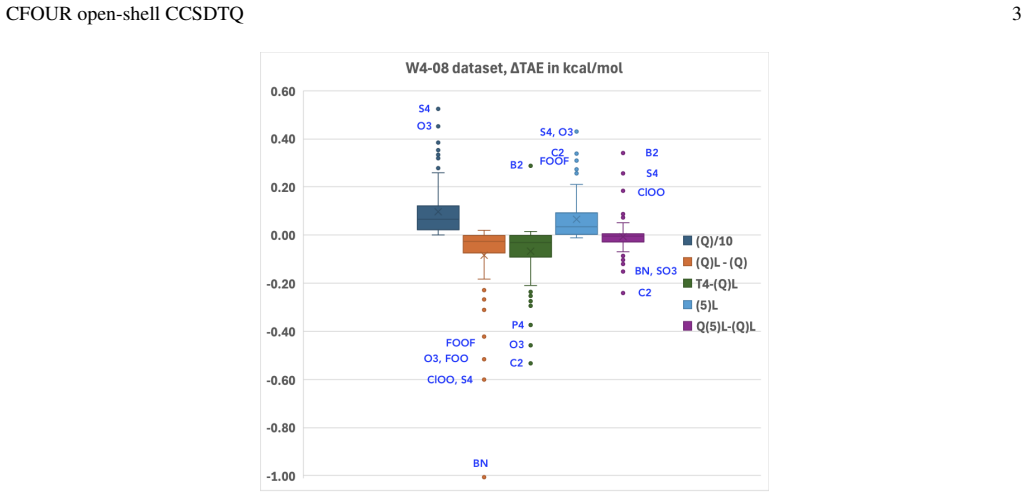
A single-shot CCSDTQ(5)Λ-CCSDT(Q)Λ correction efficiently handles post-CCSDT(Q) terms by exploiting opposing basis-set trends in difficult molecules.
A machine-rendered reading of the paper's core claim, the machinery that carries it, and where it could break.
Core claim
Extending CCSDTQ to UHF and ROHF references enables systematic study of post-CCSDT(Q) corrections; for challenging cases the CCSDTQ–CCSDT(Q)Λ and (5)Λ contributions oppose each other in their basis-set dependence, so a single combined CCSDTQ(5)Λ–CCSDT(Q)Λ correction converges efficiently, and the less spin-contaminated UHF solution yields better-behaved energies.
What carries the argument
Open-shell CCSDTQ implementation applied to basis-set extrapolation of higher-order correlation corrections beyond CCSDT(Q).
If this is right
- Convergence of the (Q)Λ to (Q) difference is relatively rapid with basis-set size.
- For difficult species the CCSDTQ–CCSDT(Q)Λ correction may converge more slowly than (5)Λ.
- The opposing trends allow a single-shot CCSDTQ(5)Λ–CCSDT(Q)Λ term to be the most cost-effective choice.
- Energetics from the less spin-contaminated UHF solution are markedly better behaved for radicals with bifurcating references.
Where Pith is reading between the lines
- The method could be tested on larger open-shell systems relevant to combustion or atmospheric modeling to check transferability.
- Similar opposition of higher-order terms might appear in other properties such as reaction barriers or ionization energies.
- The implementation opens the door to routine inclusion of these corrections in automated thermochemical protocols without prohibitive cost.
Load-bearing premise
The opposing basis-set trends and efficiency gains seen for B2 and O3 generalize to other molecules and reference functions.
What would settle it
Repeating the basis-set scan for a different open-shell system such as NO or CN and finding that the CCSDTQ–CCSDT(Q)Λ and (5)Λ corrections no longer oppose each other.
Figures
read the original abstract
We extend the CCSDTQ implementation in CFOUR to UHF and ROHF references and demonstrate its efficiency. We apply it to basis set convergence of post-CCSDT(Q) corrections for the W4-08 thermochemical dataset. Convergence of (Q)$_\Lambda$--(Q) is relatively rapid. For difficult species (e.g., B2, O3), CCSDTQ--CCSDT(Q)$_\Lambda$ may converge more slowly than (5)$_\Lambda$, but the effects and and basis-set trends oppose each other. Consequently, a single-shot CCCSDTQ(5)$_\Lambda$-CCSDT(Q)$_\Lambda$ correction appears most efficient. For radicals with bifurcating UHF solutions, energetics of the `less spin-contaminated' solution are clearly more well-behaved. Our best computed adiabatic electron affinity of ozone is in excellent agreement with experiment.
Editorial analysis
A structured set of objections, weighed in public.
Referee Report
Summary. The manuscript extends the CCSDTQ implementation in CFOUR to UHF and ROHF open-shell references and applies the new code to study basis-set convergence of post-CCSDT(Q) corrections (including CCSDTQ, CCSDT(Q)Λ, and (5)Λ) for the W4-08 thermochemical dataset. It reports relatively rapid convergence of (Q)Λ to (Q), opposing signs and basis-set trends between CCSDTQ–CCSDT(Q)Λ and (5)Λ contributions for difficult cases such as B2 and O3 (suggesting a combined CCSDTQ(5)Λ–CCSDT(Q)Λ correction is most efficient), better-behaved energetics from less spin-contaminated UHF solutions in radicals with bifurcating references, and excellent agreement between the best computed adiabatic electron affinity of ozone and experiment.
Significance. If the reported opposing trends and cancellation patterns hold beyond the highlighted examples, the work offers a practical route to reduce computational cost for high-accuracy thermochemistry on challenging open-shell systems while retaining post-CCSDT(Q) accuracy. The open-shell CCSDTQ implementation itself is a useful addition to the CFOUR ecosystem for the community.
major comments (2)
- Results section on W4-08 application (discussion of B2 and O3): The central recommendation that a single-shot CCSDTQ(5)Λ–CCSDT(Q)Λ correction is most efficient rests on the observation that CCSDTQ–CCSDT(Q)Λ and (5)Λ contributions oppose each other with opposing basis-set trends. This pattern is shown only for B2 and O3; the manuscript does not demonstrate that the same cancellation occurs for other open-shell or multireference species in the W4-08 set, so the general efficiency claim for the full dataset is not yet substantiated.
- Ozone EA results (final computed value): While excellent agreement with experiment is stated, the manuscript provides no explicit basis-set details, error estimates, or direct comparison to other high-level methods (e.g., full CCSDTQ or CCSDT(Q) in the same basis) for the final adiabatic electron affinity, making it difficult to evaluate how much the opposing corrections contribute to the agreement.
minor comments (2)
- Abstract: Typographical errors include 'CCCSDTQ(5)Λ' (should be 'CCSDTQ(5)Λ') and the duplicated 'and and' in 'the effects and and basis-set trends'.
- Notation: The manuscript uses both (5)Λ and CCSDT(5)Λ; consistent subscript/superscript formatting across the text and tables would improve readability.
Simulated Author's Rebuttal
We thank the referee for the positive evaluation of our work and the detailed, constructive comments. We respond to each major comment below, indicating planned revisions where appropriate.
read point-by-point responses
-
Referee: Results section on W4-08 application (discussion of B2 and O3): The central recommendation that a single-shot CCSDTQ(5)Λ–CCSDT(Q)Λ correction is most efficient rests on the observation that CCSDTQ–CCSDT(Q)Λ and (5)Λ contributions oppose each other with opposing basis-set trends. This pattern is shown only for B2 and O3; the manuscript does not demonstrate that the same cancellation occurs for other open-shell or multireference species in the W4-08 set, so the general efficiency claim for the full dataset is not yet substantiated.
Authors: We agree that the detailed illustrations of opposing trends and basis-set behavior are presented for B2 and O3 as representative challenging cases. The manuscript applies the full suite of methods across the W4-08 set, but the magnitude of post-CCSDT(Q) corrections is small for the majority of species, rendering the combined correction efficient in practice. To strengthen the presentation, we will revise the relevant section to clarify that the efficiency advantage is most pronounced for difficult open-shell and multireference systems, and we will add a concise summary (or supplementary table) of correction sizes for additional W4-08 open-shell species to better contextualize the general applicability. revision: partial
-
Referee: Ozone EA results (final computed value): While excellent agreement with experiment is stated, the manuscript provides no explicit basis-set details, error estimates, or direct comparison to other high-level methods (e.g., full CCSDTQ or CCSDT(Q) in the same basis) for the final adiabatic electron affinity, making it difficult to evaluate how much the opposing corrections contribute to the agreement.
Authors: We concur that additional technical details on the ozone electron affinity would improve transparency. In the revised manuscript we will include the specific basis sets used for the final adiabatic EA value, quantitative error estimates, and direct numerical comparisons with CCSDT(Q) and CCSDTQ results obtained in the same or comparable bases. This will allow readers to assess the contribution of the opposing corrections to the final agreement with experiment. revision: yes
Circularity Check
No circularity; results from direct implementation and computation
full rationale
The paper extends the existing CCSDTQ code in CFOUR to UHF/ROHF references and then reports explicit numerical results on basis-set convergence of post-CCSDT(Q) corrections for the W4-08 dataset. The efficiency claim for a single-shot CCSDTQ(5)Λ–CCSDT(Q)Λ correction follows from observed opposing trends in B2 and O3, which are independent computational outcomes rather than any self-definitional reduction, fitted parameter renamed as prediction, or load-bearing self-citation chain. The final validation against the experimental adiabatic electron affinity of ozone is an external benchmark, rendering the entire chain self-contained.
Axiom & Free-Parameter Ledger
axioms (1)
- domain assumption Coupled-cluster theory with up to quadruple excitations provides a systematically improvable description of electron correlation for the studied systems.
Lean theorems connected to this paper
-
IndisputableMonolith/Cost/FunctionalEquationwashburn_uniqueness_aczel unclear?
unclearRelation between the paper passage and the cited Recognition theorem.
We extend the CCSDTQ implementation in CFOUR to UHF and ROHF references and demonstrate its efficiency. We apply it to basis set convergence of post-CCSDT(Q) corrections for the W4-08 thermochemical dataset.
-
IndisputableMonolith/Foundation/RealityFromDistinctionreality_from_one_distinction unclear?
unclearRelation between the paper passage and the cited Recognition theorem.
For difficult species (e.g., B2, O3), CCSDTQ–CCSDT(Q)Λ may converge more slowly than (5)Λ, but the effects and basis-set trends oppose each other.
What do these tags mean?
- matches
- The paper's claim is directly supported by a theorem in the formal canon.
- supports
- The theorem supports part of the paper's argument, but the paper may add assumptions or extra steps.
- extends
- The paper goes beyond the formal theorem; the theorem is a base layer rather than the whole result.
- uses
- The paper appears to rely on the theorem as machinery.
- contradicts
- The paper's claim conflicts with a theorem or certificate in the canon.
- unclear
- Pith found a possible connection, but the passage is too broad, indirect, or ambiguous to say the theorem truly supports the claim.
Reference graph
Works this paper leans on
-
[1]
Journal of Computational Chemistry , year =
Waigum, Alexander and Suchaneck, Sarah and Köhn, Andreas , title =. Journal of Computational Chemistry , year =
-
[2]
Vu, Khanh and Pandian, Joshua and Zhang, Boyi and Annas, Christina and Parker, Anna J. and Mancini, John S. and Wang, Evan B. and Saldana-Greco, Diomedes and Nelson, Emily S. and Springsted, Greg and Lischka, Hans and Plasser, Felix and Parish, Carol A. , title =. The Journal of Physical Chemistry A , year =
-
[3]
Amir Karton and Ilya Kaminker and Jan M L Martin , doi =. Economical Post-CCSD(T) Computational Thermochemistry Protocol and Applications to Some Aromatic Compounds † , volume =. The Journal of Physical Chemistry A , month =. 2009 , note =
work page 2009
-
[4]
Toward an affordable density-based measure for the quality of a coupled cluster calculation
Toward an affordable density-based measure for the quality of a coupled cluster calculation jp-2026-00684e , author=. 2026 , journal =. 2509.04429 , archivePrefix=
work page internal anchor Pith review Pith/arXiv arXiv 2026
-
[5]
Amir Karton and Jan M. L. Martin , doi =. W4 thermochemistry of. Molecular Physics , keywords =
-
[6]
Persson, B. Joakim and Taylor, Peter R. and Lee, Timothy J. , title =. 1997 , volume =
work page 1997
- [7]
- [8]
-
[9]
and Zerzucha, Piotr and Kuś, Tomasz and Bartlett, Rodney J
Musiał, Monika and Kucharski, Stanisław A. and Zerzucha, Piotr and Kuś, Tomasz and Bartlett, Rodney J. , title =. 2009 , volume =
work page 2009
-
[11]
On the theoretical determination of the electron affinity of ozone , journal = tca, year =
Gonz. On the theoretical determination of the electron affinity of ozone , journal = tca, year =
-
[12]
and Xu, Cangshan and Kim, Eun H
Arnold, Don W. and Xu, Cangshan and Kim, Eun H. and Neumark, Daniel M. , title =. 1994 , volume =
work page 1994
-
[13]
Novick, Stewart E. and Engelking, Paul C. and Jones, Patrick L. and Futrell, Jean H. and Lineberger, W. Carl , title =. 1979 , volume =
work page 1979
-
[14]
Second-Order Perturbation Theory with a
Andersson, Kerstin and Malmqvist, Per-. Second-Order Perturbation Theory with a. 1990 , volume =
work page 1990
-
[15]
Andersson, Kerstin and Malmqvist, Per-. Second-Order Perturbation Theory with a Complete Active Space Self-Consistent Field Reference Function , journal = jcp, year =
-
[18]
The coupled-cluster single, double, triple, and quadruple excitation method , author =. 1992 , publisher =
work page 1992
-
[19]
Kucharski, Stanislaw A. and Bartlett, Rodney J. , title =. 1992 , doi =
work page 1992
-
[20]
Kucharski, Stanislaw A. and Bartlett, Rodney J. , title =. Cluster Expansion Methods in Molecular Electronic Structure , editor =. 1993 , doi =
work page 1993
- [21]
-
[22]
Stanton, John F. and Bartlett, Rodney J. , title =. 1993 , doi =
work page 1993
-
[23]
Matthews, Devin A. and Gauss, J. Revisitation of Nonorthogonal Spin Adaptation in Coupled Cluster Theory , journal = jcc, year =
- [25]
-
[26]
Maciej Spiegel and Emmanouil Semidalas and Jan M. L. Martin and Megan R. Bentley and John F. Stanton , doi =. Post-
-
[27]
Karton, Amir , doi =
-
[28]
Thorpe and David Feller and David H
James H. Thorpe and David Feller and David H. Bross and Branko Ruscic and John F. Stanton , journal = pccp, year =. Sub 20 cm ^
-
[29]
James H. Thorpe and Josie L. Kilburn and David Feller and P. Bryan Changala and David H. Bross and Branko Ruscic and John F. Stanton , journal = jcp, year =. Elaborated thermochemical treatment of
-
[30]
Aditya Barman and Gregory H. Jones and Kaila E. Weflen and Margarita Shepelenko and Jan M. L. Martin , year=. Coupling between thermochemical contributions of subvalence correlation and of higher-order post-
-
[31]
Goodson, David Z. , title = ". 2002 , month =. doi:10.1063/1.1462620 , url =
-
[32]
Sinnokrot, Mutasem Omar and Sherrill, C. David , title =. 2004 , doi =
work page 2004
-
[33]
Lesiuk, Michał , title =
-
[34]
Vladimir Fishman and Emmanouil Semidalas and Margarita Shepelenko and Jan M. L. Martin , title=. 2025 , pages=
work page 2025
-
[35]
Factorized Quadruples and a Predictor of Higher-Level Correlation in Thermochemistry , author=. 2024 , eprint=
work page 2024
-
[36]
Averting the Infrared Catastrophe in the Gold Standard of Quantum Chemistry , author =. Phys. Rev. Lett. , volume =. 2023 , month =
work page 2023
- [37]
- [38]
-
[39]
Ten-no, Seiichiro and Noga, Jozef , doi =. Wiley Interdiscip. Rev. Comput. Mol. Sci. , month =
-
[43]
Dunning Jr., Thom H. and Peterson, Kirk A. and Woon, David E. , city =. doi:10.1002/0470845015.cca053 , title =
-
[44]
Kendall, Rick A. and Dunning Jr., Thom H. and Harrison, Robert J. , year =. Electron affinities of the first-row atoms revisited. Systematic basis sets and wave functions , volume =. doi:10.1063/1.462569 , number =
-
[45]
Woon, David E. and Dunning Jr., Thom H. , doi =. Gaussian-Basis Sets for Use in Correlated Molecular Calculations .3
-
[46]
Yuan He and Zhi He and Dieter Cremer , doi =. Comparison of. Theor. Chem. Acc. , keywords =
-
[47]
Bartlett and Miroslav Urban , doi =
Jozef Noga and Rodney J. Bartlett and Miroslav Urban , doi =. Towards a full
-
[48]
Miroslav Urban and Jozef Noga and Samuel J. Cole and Rodney J. Bartlett , doi =. Towards a full CCSDT model for electron correlation , volume =
-
[49]
The coupled‐cluster single, double, and triple excitation model for open‐shell single reference functions , author=. 1990 , doi =
work page 1990
-
[50]
Air Force Office of Scientific Research
Fifth-Order Many-Body Perturbation Theory and Its Relationship to Various Coupled-Cluster Approaches**This research has been supported by the U.S. Air Force Office of Scientific Research. , editor =. Adv. Quantum Chem. , publisher =. 1986 , issn =. doi:10.1016/S0065-3276(08)60051-9 , author =
-
[51]
S66: A well-balanced database of benchmark interaction energies relevant to biomolecular structures , author=. 2011 , publisher=
work page 2011
-
[53]
Stanton, John F , journal=ppl, volume=. Why. 1997 , publisher=
work page 1997
- [54]
-
[57]
Noga, Jozef and Bartlett, Rodney J. , doi =
-
[59]
Brauer, Brina and Kesharwani, Manoj Kumar and Kozuch, Sebastian and Martin, Jan M. L. , doi =
-
[61]
Francis and Bernardi, Fernando , doi =
Boys, S. Francis and Bernardi, Fernando , doi =. Mol. Phys. , month =
-
[62]
Vladimir Fishman and Emmanouil Semidalas and Jan M. L. Martin , journal = jpca, keywords =. doi:10.1021/acs.jpca.4c03012 , title =
-
[63]
Attila Tajti and Péter G. Szalay and Attila G. Császár and Mihály Kállay and Jürgen Gauss and Edward F. Valeev and Bradley A. Flowers and Juana Vázquez and John F. Stanton , doi =. HEAT: High accuracy extrapolated ab initio thermochemistry. , volume =
-
[64]
High-accuracy extrapolated ab initio thermochemistry
Yannick J Bomble and Juana Vázquez and Mihály Kállay and Christine Michauk and Péter G Szalay and Attila G Császár and Jürgen Gauss and John F Stanton , doi =. High-accuracy extrapolated ab initio thermochemistry
-
[65]
Harding and Juana Vázquez and Branko Ruscic and Angela K
Michael E. Harding and Juana Vázquez and Branko Ruscic and Angela K. Wilson and Jürgen Gauss and John F. Stanton , doi =. High-accuracy extrapolated ab initio thermochemistry
-
[66]
James H. Thorpe and Chris A. Lopez and T. Lam Nguyen and Joshua H. Baraban and David H. Bross and Branko Ruscic and John F. Stanton , doi =. High-accuracy extrapolated ab initio thermochemistry
- [67]
-
[70]
Describing Noncovalent Interactions beyond the Common Approximations: How Accurate Is the `Gold Standard',. 2013 , month = apr, pages =. doi:10.1021/ct400057w , number =
-
[72]
DeYonker, Nathan J. and Cundari, Thomas R. and Wilson, Angela K. , year =. The correlation consistent composite approach (ccCA): An alternative to the Gaussian-n methods , volume =. doi:10.1063/1.2173988 , number =
-
[73]
Peterson, Charles and Penchoff, Deborah A. and Wilson, Angela K. , editor =. 2016 , pages =. doi:10.1016/bs.arcc.2016.04.001 , publisher =
-
[74]
A coupled cluster approach with triple excitations
Lee, Yoon S and Kucharski, Stanislaw A and Bartlett, Rodney J. A coupled cluster approach with triple excitations
-
[75]
Nagy and Mihály Kállay , title =
Péter R. Nagy and Mihály Kállay , title =. 2019 , volume =
work page 2019
-
[76]
Nagy and Gyula Samu and Mih \'a ly K \'a llay
P \'e ter R. Nagy and Gyula Samu and Mih \'a ly K \'a llay. Optimization of the linear-scaling local natural orbital CCSD(T) method: Improved algorithm and benchmark applications
-
[77]
P \'e ter R. Nagy. State-of-the-art local correlation methods enable accurate and affordable gold standard quantum chemistry up to a few hundred atoms. Chem. Sci
-
[78]
Dubecký, Matúš and Mitas, Lubos and Jurečka, Petr , title =. 2016 , doi =
work page 2016
-
[79]
Lao, Ka Un , year =. Canonical coupled cluster binding benchmark for nanoscale noncovalent complexes at the hundred-atom scale , volume =. doi:10.1063/5.0242359 , number =
-
[80]
Interactions between large molecules pose a puzzle for reference quantum mechanical methods , author =. Nat. Commun. 2021 , doi =
work page 2021
- [81]
-
[82]
Understanding Discrepancies of Wavefunction Theories for Large Molecules , author=. 2024 , eprint=
work page 2024
-
[83]
Petersson and David Feller and Kirk A
Ericka C Barnes and George A. Petersson and David Feller and Kirk A. Peterson , doi =. The CCSD(T) complete basis set limit for Ne revisited. , volume =
-
[84]
J. Phys. Chem. , month =. doi:10.1021/j100103a020 , issn =
-
[85]
and Lao, Ka Un and Herbert, John M
Richard, Ryan M. and Lao, Ka Un and Herbert, John M. , year =. Achieving the CCSD(T) Basis-Set Limit in Sizable Molecular Clusters: Counterpoise Corrections for the Many-Body Expansion , volume =. J. Phys. Chem. Lett. , publisher =. doi:10.1021/jz401368u , number =
-
[86]
doi:10.1021/acs.chemrev.5b00526 , file =
Řez. doi:10.1021/acs.chemrev.5b00526 , file =
-
[87]
Papajak, Ewa and Zheng, Jingjing and Xu, Xuefei and Leverentz, Hannah R. and Truhlar, Donald G. , doi =
-
[88]
Jan M. L. Martin and Peter R. Taylor , doi =. Benchmark quality total atomization energies of small polyatomic molecules , volume =
-
[89]
António J. C. Varandas , doi =. Canonical versus explicitly correlated coupled cluster: Post‐complete‐basis‐set extrapolation and the quest of the complete‐basis‐set limit , volume =
-
[90]
Dunning Jr, Thom H. , journal=jcp, volume=. Gaussian basis sets for use in correlated molecular calculations. 1989 , publisher=
work page 1989
-
[91]
Hill, Robert Nyden , doi =
-
[92]
Schwartz, Charles , doi =. Phys. Rev. , month =
-
[93]
Kutzelnigg, Werner and Morgan, John D , doi =
-
[94]
Schwenke, David W. , doi =. Mol. Phys. , keywords =
-
[95]
Carroll, Dennis P. and Silverstone, Harris J. and Metzger, Robert Melville , doi =
discussion (0)
Sign in with ORCID, Apple, or X to comment. Anyone can read and Pith papers without signing in.