REVIEW 2 major objections 3 minor 92 references
Phase transitions in coupled Ising chains and SO($N$)-symmetric spin chains
T0 review · 2 major / 3 minor · reviewed 2026-08-02 · deepseek-v4-flash
Pith's one-line read This paper establishes that the competing-mass/N-spin transition in N coupled Ising CFTs is continuous only for N=2 (Ising) and N=3 (four-state Potts) and first-order for all N≥4, locating the threshold between 3 and 4.
desk verdict A serious, mostly convincing paper claiming first-order transitions for all N≥4 in a generic family of 1D field theories; the N=4 evidence has one soft spot that a thorough referee should push on. read the letter →
The pith
A machine-rendered reading of the paper's core claim, the machinery that carries it, and where it could break.
The reading
What carries the argument
The central object is the N-copy Ising CFT Hamiltonian with three perturbations: mass m (dimension 1), N-spin coupling λ1 (dimension N/8), and marginal four-fermion coupling λ2. Its one-loop RG equations have only complex fixed points in the epsilon expansion, so no real scale-invariant fixed point exists perturbatively for N<16; λ2 flows negative and slows, producing a 'walking' regime that can mimic criticality. On the lattice, the coupled Ising chains Hamiltonian realizes the field theory; the strong-coupling limit reduces to the Ising chain for N=2 and the four-state Potts Ashkin-Teller point for N=3, but to a multi-spin model with no known solution for N≥4. MPS simulations distinguish f
What would settle it
A non-perturbative RG computation (e.g., truncated conformal space) of the field theory at N=4 that finds a real fixed point would refute the first-order claim; alternatively, an MPS calculation of the N=4 coupled Ising chains at (K,g)=(0.3,0.5) with bond dimension well beyond χ=800 that shows S_vN saturating as ξ→∞ supports first-order, while continued logarithmic growth with the same slope refutes it.
Extended reading notes
Core claim
The field theory is H = -iv/(4π)∫dx Σ (ξR∂ξR - ξL∂ξL) - im∫dx Σ ξRξL + λ1 ∫dx ∏σ_a, with a marginal λ2 four-fermion term. Combining a one-loop RG analysis near N=16 with large-scale MPS calculations on coupled Ising chains and SO(N) ladders for N=2..6, the authors show the transition driven by m and λ1 is continuous for N=2 and N=3, with central charges c≈0.5 and c≈1 and exponents matching Ising and four-state Potts, and first-order for N≥4. In the N=4 coupled Ising chains, entanglement entropy shows saturating or jumping behavior with bond dimension; the SO(5) and SO(6) models show order-parameter jumps and finite extrapolated correlation lengths. The RG analysis finds no real fixed points
Load-bearing premise
The claim that N≥4 transitions are first-order rests on interpreting apparent criticality in some N=4 datasets as 'walking' caused by a marginally relevant coupling slowly flowing through zero; if that interpretation is wrong, the N=4 data would support a continuous transition.
Editorial extensions
If this is right
- For N=2 and N=3, the transition belongs to the Ising and four-state Potts universality classes, respectively; the four-state Potts identification is supported by string-correlation exponents close to 1/2.
- For N≥4, the transition is first-order, so no emergent CFT describes it; this refines the SPT-transition conjecture by showing its premise (existence of a continuous transition) fails for SO(N) with odd N≥5.
- The threshold Nc lies between 3 and 4, making N=4 the marginal case where weakly-first-order behavior with very large correlation lengths is expected.
- Transitions between SO(N) SPT and trivial phases in spin ladders (e.g., SO(3)xSO(3) and SO(6) models) are first-order rather than critical.
Reading between the lines
- If the walking interpretation holds, the apparent logarithmic growth of entanglement entropy in the N=4 (K=0.3, g=0.5) dataset should saturate at still larger bond dimensions; this is a concrete prediction that can be checked.
- The absence of real fixed points suggests complex CFTs may underlie the walking; adding a non-Hermitian perturbation to the lattice models could expose them, as the authors hint for future work.
- The same mechanism may operate in coupled q-state Potts CFTs for q>2, where a similar threshold in N could separate continuous from first-order transitions.
- For even N, the first-order SPT-to-trivial transition may be entangled with an additional Z2-breaking order, so multi-critical behavior could appear at length scales beyond those probed.
Editorial analysis
A structured set of objections, weighed in public.
Referee Report
Summary. The paper studies a 1+1D field theory of N copies of the Ising CFT coupled by a mass term and an N-spin interaction [Eqs. (1)-(2)], which describes coupled Ising chains and SO(N)-symmetric spin ladders. Combining a one-loop RG analysis around N=16 with infinite MPS simulations, the authors argue that the transition is continuous for N=2 (Ising universality) and N=3 (four-state Potts universality), but first-order for all N≥4, so the threshold lies in 3<Nc<4. They further apply this to SO(N) SPT-to-trivial transitions, concluding that for odd N≥5 such transitions are generically first-order, refining the Verresen-Moessner-Pollmann conjecture.
Significance. If the central claim is correct, it resolves an open problem in 1D quantum criticality: competing relevant perturbations in multi-component Ising CFTs do not produce conformal fixed points for N≥4, with direct consequences for SPT transitions in SO(N) spin chains. The paper combines analytic RG with high-quality numerical data (bond dimensions up to 12800), checks N=2 and N=3 against independent known results, and includes a useful Ashkin-Teller control calculation. These strengths make the work potentially important. The main uncertainty lies in the N=4 classification, where one coupled-Ising dataset appears to show critical behavior and is attributed to an unverified walking mechanism; this needs to be resolved before the headline conclusion is fully established.
major comments (2)
- [Appendix B 2, Fig. 14] The N=4 dataset (K,g)=(0.3,0.5) at h=1.3028 shows S_vN growing logarithmically with ξ, fitted with c≈1.388 over the accessible range. The text dismisses this as a transient walking effect of the marginal coupling λ2 passing through zero, but this is not derived from the RG equations (3) nor independently verified. This dataset is the only direct lattice-model counterexample to the N≥4 first-order claim, so invoking walking without quantitative support (e.g., a predicted crossover scale or demonstration of eventual saturation at larger χ) makes the classification of this discriminating case circular. Please provide such evidence or weaken the claim accordingly.
- [Secs. IV B, IV D and Conclusion] The SO(N) lattice models are claimed to realize Eq. (2), but the mapping is only justified perturbatively around the decoupled critical point. The numerical parameters used, e.g., J4=-1 for SO(4) and θ=0.175π for SO(6), are far from that regime, and the conclusion explicitly admits the correspondence 'is not well justified beyond a perturbative regime.' Thus the SO(N) simulations do not currently provide independent quantitative tests of the field-theory prediction. Please either restrict the field-theory claims to the coupled-Ising realizations or add a concrete check of the mapping (e.g., operator-content or amplitude-ratio tests) at the simulated parameters.
minor comments (3)
- [Sec. III C 3] The text states the N=4 transition is near h∼1.235, while Fig. 5(d) uses h=1.2346, 1.2344, 1.2348; please reconcile the notation.
- [Sec. II A, Eq. (5)] The two fixed points differ by the sign of G1; it would help to comment on whether this sign corresponds to spontaneous symmetry breaking direction or is merely the two minima of the effective potential.
- [Appendix B 2, Fig. 14] For (K,g)=(0,2) and (0.3,2), the entropy fits give c=0.973 and c=1.064, close to c=1 but with c<1 in one case; a sentence on the fitting range and expected corrections would aid interpretation.
Circularity Check
No significant circularity: RG derivation and N=2/N=3 benchmarks provide independent content; self-citations are not load-bearing.
full rationale
RG equations (3) are computed in Appendix A 1 from the standard Ising OPEs (A6), not fitted to the target classification. The N=2 and N=3 continuous transitions are benchmarked against independent exact/known results: c≈0.5 and exponents (0.124–0.130, ~1) for Ising; c≈1, string exponent ≈0.475–0.486 and comparison with the exactly solvable Ashkin-Teller model at the four-state Potts point for N=3. The N≥4 first-order claim rests on the absence of real fixed points in the ϵ=16−N RG analysis and on MPS observables (saturating S_vN, finite extrapolated ξ, order-parameter jumps) across several lattice models. The one dataset that appears log-growing at (K,g)=(0.3,0.5) is interpreted as walking using the one-loop RG equation (3c), dG2/dl<0, which makes λ2 pass through zero; this is a qualitative consequence of Eq. (3c), not an ad hoc curve fitted to the conclusion. Self-citations (e.g., Refs. [14,66,68]) supply background and effective-field-theory mappings, but these are corroborated by independent work (Refs. [67,68]) and are not the sole support for the central claim; the paper itself flags the lattice-to-field-theory correspondence as not well justified beyond the perturbative regime, which is a limitation/correctness risk, not a circular reduction. No prediction is equal by construction to an input parameter.
Assumptions & free parameters
assumptions (6)
- standard math The Ising CFT OPEs used to derive the one-loop RG equations (Eq. A6) are correct and complete.
- domain assumption The coupled-Ising lattice model (7) has the field theory (2) as its continuum limit, with m∝h−J, λ1∝−g, λ2∝K.
- domain assumption The lattice Hamiltonian (7) possesses an SO(N) symmetry under open boundary conditions, supporting the SO(N)_1 WZW description.
- domain assumption Kramers-Wannier duality maps σ↔μ and m→−m, allowing the SO(N) SPT lattice models to be mapped onto Eq. (2).
- domain assumption The lattice-to-field-theory correspondence for the SO(5) (Eq. 40) and SO(6) (Eq. 42) models remains valid beyond the perturbative regime around the SO(N)_1 critical point.
- ad hoc to paper The 'walking' flow of the marginal coupling λ2 (slow passage through λ2=0) explains the logarithmic entropy growth seen for (K,g)=(0.3,0.5) at N=4, rather than signaling a continuous transition.
Cite this review
Pith. "Pith review of Phase transitions in coupled Ising chains and SO($N$)-symmetric spin chains." pith.science (2026). https://pith.science/paper/WGRL7WRI
@misc{pith2026260217029,
  author       = {Pith},
  title        = {Pith review of: Phase transitions in coupled Ising chains and SO($N$)-symmetric spin chains},
  year         = {2026},
  howpublished = {\url{https://pith.science/paper/WGRL7WRI}},
  note         = {Machine review of arXiv:2602.17029}
}
abstract
We investigate the nature of quantum phase transitions in a (1+1)-dimensional field theory composed of $N$ copies of the Ising conformal field theory interacting via competing relevant perturbations. The field theory governs the competition between a mass term and an interaction involving the product of $N$ order-parameter fields, which is realized, e.g. in coupled Ising chains, two-leg spin ladders, and SO($N$)-symmetric spin chains. By combining a perturbative renormalization group analysis and large-scale matrix-product state simulations, we systematically determine the nature of the phase transition as a function of $N$. For $N=2$ and $N=3$, we confirm that the transition is continuous, belonging to the Ising and four-state Potts universality classes, respectively. In contrast, for $N \ge 4$, our results provide compelling evidence that the transition becomes first order. We further apply these findings to specific lattice models with SO($N$) symmetry, including spin-$1/2$ and spin-$1$ two-leg ladders, that realize a direct transition between an SO($N$) symmetry-protected topological phase and a trivial phase. Our results refine a recent conjecture regarding the criticality of transitions between SPT phases.
Figures


Figures from the paper (12 more)




Reference graph
Works this paper leans on
-
[1]
charge-conjugation
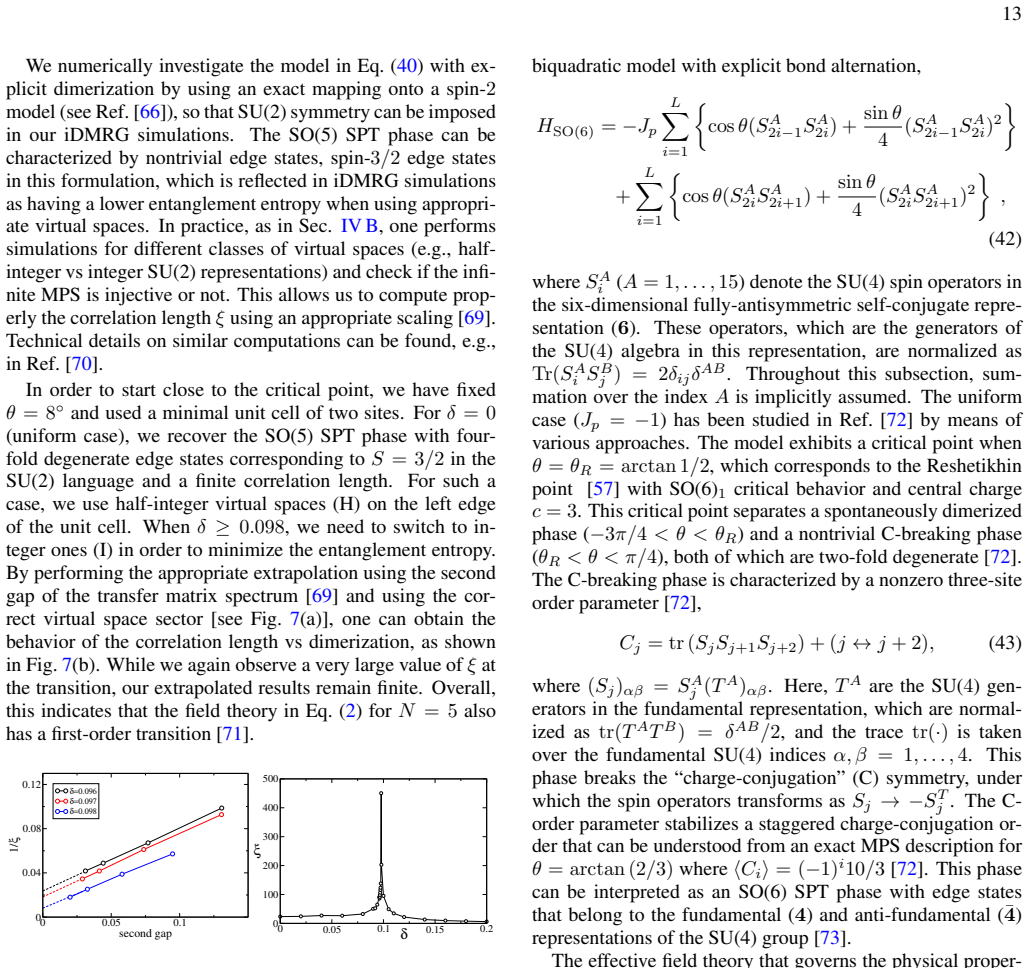
In fact, the model in Eq. (41) can be directly mapped onto Eq. (2) withN= 5by performing a Kramers-Wannier duality transformation. 13 We numerically investigate the model in Eq. (40) with ex- plicit dimerization by using an exact mapping onto a spin-2 model (see Ref. [66]), so that SU(2) symmetry can be imposed in our iDMRG simulations. The SO(5) SPT phas...
2025
-
[2]
Derivation of RG equations We here consider the Euclidean action corresponding to the Hamiltonian in Eq. (2), S= Z dτ dx 4π NX a=1 [ξa R(∂τ −iv∂ x)ξa R +ξ a L(∂τ +iv∂ x)ξa L] + v 2π X j=0,1,2 Gj Z dτ dx α2−∆j Oj(x),(A1) whereαis a short-distance cutoff at the lattice scale and∆ j is the scaling dimension for the operatorO j(x). The dimen- sionless couplin...
-
[3]
(3), we find six nontrivial fixed points(G ∗ 0, G∗ 1, G∗ 2)
Nontrivial fixed points of RG equations SubstitutingN= 16−ϵinto the RG equations in Eq. (3), we find six nontrivial fixed points(G ∗ 0, G∗ 1, G∗ 2). In the lead- ing order ofϵ, they are given by FP± 1 : ±i √ 14 15 +O(ϵ),0, 1 15 +O(ϵ) ! ,(A8a) FP± 2 : O(ϵ2),±i √ 7ϵ 60 +O(ϵ 2), ϵ 240 +O(ϵ 2) ! ,(A8b) FP± 3 : − 225 1798 +O(ϵ),±i √ 898 899 +O(ϵ), 30 899 +O(ϵ)...
-
[4]
III C, we claimed that the coupled Ising Hamiltonian in Eq
Ashkin-Teller model In Sec. III C, we claimed that the coupled Ising Hamiltonian in Eq. (7) forN= 3has a continuous phase transition described by the four-state Potts CFT. Although the scaling analysis for the entanglement entropy confirms the expected central charge c= 1, those for the correlation functions of local operators strongly deviate from the as...
-
[5]
III C, we presented numerical results for the coupled Ising Hamiltonian in Eq
Coupled Ising chains In Sec. III C, we presented numerical results for the coupled Ising Hamiltonian in Eq. (7) forK= 0andg= 0.5. We here provide additional results for the other choices of the parameters:(K, g) = (0,2),(±0.3,0.5), and(±0.3,2). In Fig. 11, we show the correlation lengthξ, von Neuman entanglement entropyS vN, and connected correlation func...
-
[6]
SO(N)-symmetric spin chains We here provide additional numerical results for the SO(4)-symmetric ladder in Eq. (30). In the main text, the representation of the virtual spaces, either (H,H)-to-(I,I) or (H,I)-to-(I,H), is determined by minimizing the ground-state energy density computed from variational MPS with bond dimensionsχ= 12800. ForJ 1 = 1,J 4 =−1,...
1938
-
[7]
Giamarchi,Quantum Physics in One Dimension(Oxford University Press, 2003)
T. Giamarchi,Quantum Physics in One Dimension(Oxford University Press, 2003)
2003
-
[8]
A. O. Gogolin, A. A. Nersesyan, and A. M. Tsvelik,Bosoniza- tion and Strongly Correlated Systems(Cambridge University Press, 2004)
2004
Show all 92 references
-
[9]
Di Francesco, P
P. Di Francesco, P. Mathieu, and D. S´en´echal,Conformal Field Theory, Graduate Texts in Contemporary Physics (Springer- Verlag New York, 1997)
1997
-
[10]
A. B. Zamolodchikov, Renormalization group and perturbation theory about fixed points in two-dimensional field theory, Sov. J. Nucl. Phys.46, 1090 (1987)
1987
-
[11]
Cardy,Scaling and Renormalization in Statistical Physics, Cambridge Lecture Notes in Physics (Cambridge University Press, 1996)
J. Cardy,Scaling and Renormalization in Statistical Physics, Cambridge Lecture Notes in Physics (Cambridge University Press, 1996)
1996
-
[12]
Mussardo,Statistical Field Theory: An introduction to Ex- actly Solved Models in Statistical Physics(Oxford University Press, 2020)
G. Mussardo,Statistical Field Theory: An introduction to Ex- actly Solved Models in Statistical Physics(Oxford University Press, 2020)
2020
-
[13]
K. G. Wilson and M. E. Fisher, Critical exponents in 3.99 di- mensions, Phys. Rev. Lett.28, 240 (1972)
1972
-
[14]
K. G. Wilson and J. Kogut, The renormalization group and the ϵexpansion, Phys. Rep.12, 75 (1974)
1974
-
[15]
D. R. Nelson, J. M. Kosterlitz, and M. E. Fisher, Renormalization-group analysis of bicritical and tetracritical points, Phys. Rev. Lett.33, 813 (1974)
1974
-
[16]
J. M. Kosterlitz, D. R. Nelson, and M. E. Fisher, Bicritical and tetracritical points in anisotropic antiferromagnetic sys- tems, Phys. Rev. B13, 412 (1976)
1976
-
[17]
Delfino and G
G. Delfino and G. Mussardo, Non-integrable aspects of the multi-frequency sine-Gordon model, Nucl. Phys. B516, 675 (1998)
1998
-
[18]
Fabrizio, A
M. Fabrizio, A. Gogolin, and A. Nersesyan, Critical properties of the double-frequency sine-Gordon model with applications, Nucl. Phys. B580, 647 (2000)
2000
-
[19]
Bajnok, L
Z. Bajnok, L. Palla, G. Tak´acs, and F. W´agner, Nonperturbative study of the two-frequency sine-Gordon model, Nucl. Phys. B 601, 503 (2001)
2001
-
[20]
Lecheminant, A
P. Lecheminant, A. O. Gogolin, and A. A. Nersesyan, Critical- ity in self-dual sine-Gordon models, Nucl. Phys. B639, 502 (2002)
2002
-
[21]
Delfino, Field theory of scaling lattice models: The Potts an- tiferromagnet, inStatistical Field Theories, edited by A
G. Delfino, Field theory of scaling lattice models: The Potts an- tiferromagnet, inStatistical Field Theories, edited by A. Cap- pelli and G. Mussardo (Springer Netherlands, Dordrecht, 2002) pp. 3–12
2002
-
[22]
Lecheminant and K
P. Lecheminant and K. Totsuka, TheSU(N)self-dual sine– Gordon model and competing orders, J. Stat. Mech.2006, L12001 (2006)
2006
-
[23]
Lecheminant, Nature of the deconfining phase transition in the (2+1)-dimensionalSU(N)Georgi–Glashow model, Phys
P. Lecheminant, Nature of the deconfining phase transition in the (2+1)-dimensionalSU(N)Georgi–Glashow model, Phys. Lett. B648, 323 (2007)
2007
-
[24]
Fuji and P
Y . Fuji and P. Lecheminant, Non-AbelianSU(N−1)-singlet fractional quantum Hall states from coupled wires, Phys. Rev. B95, 125130 (2017)
2017
-
[25]
A. B. Zamolodchikov, ”Irreversibility” of the flux of the renor- malization group in a 2D field theory, JETP Lett.43, 730 (1986)
1986
-
[26]
Fabrizio, A
M. Fabrizio, A. O. Gogolin, and A. A. Nersesyan, From band insulator to Mott insulator in one dimension, Phys. Rev. Lett. 83, 2014 (1999)
2014
-
[27]
Wang and A
Y .-J. Wang and A. Nersesyan, Ising model description of the SU(2) 1 quantum critical point in a dimerized two-leg spin-1/2 ladder, Nucl. Phys. B583, 671 (2000)
2000
-
[28]
Duivenvoorden and T
K. Duivenvoorden and T. Quella, Topological phases of spin chains, Phys. Rev. B87, 125145 (2013)
2013
-
[29]
Tu, G.-M
H.-H. Tu, G.-M. Zhang, and T. Xiang, Class of exactly solv- ableSO(n)symmetric spin chains with matrix product ground states, Phys. Rev. B78, 094404 (2008)
2008
-
[30]
Verresen, R
R. Verresen, R. Moessner, and F. Pollmann, One-dimensional symmetry protected topological phases and their transitions, Phys. Rev. B96, 165124 (2017)
2017
-
[31]
Wang, Phase diagrams of the generalized spin- 1 2 ladder under staggered field and dimerization: A renormalization- group study, Phys
Y .-J. Wang, Phase diagrams of the generalized spin- 1 2 ladder under staggered field and dimerization: A renormalization- group study, Phys. Rev. B68, 214428 (2003)
2003
-
[32]
G. S. Grest and M. Widom,N-color Ashkin-Teller model, Phys. Rev. B24, 6508 (1981)
1981
-
[33]
Fradkin,N-color Ashkin-Teller model in two dimensions: Solution in the large-Nlimit, Phys
E. Fradkin,N-color Ashkin-Teller model in two dimensions: Solution in the large-Nlimit, Phys. Rev. Lett.53, 1967 (1984)
1967
-
[34]
Shankar, Ashkin-Teller and Gross-Neveu models: New rela- tions and results, Phys
R. Shankar, Ashkin-Teller and Gross-Neveu models: New rela- tions and results, Phys. Rev. Lett.55, 453 (1985)
1985
-
[35]
H. A. Ceccatto, QuantumN-colour Ashkin-Teller model: exact solution in the large-Nlimit, J. Phys. A24, 2829 (1991)
1991
-
[36]
Ashkin and E
J. Ashkin and E. Teller, Statistics of two-dimensional lattices with four components, Phys. Rev.64, 178 (1943)
1943
-
[37]
Kohmoto, M
M. Kohmoto, M. den Nijs, and L. P. Kadanoff, Hamiltonian studies of thed= 2Ashkin-Teller model, Phys. Rev. B24, 5229 (1981)
1981
-
[38]
Franchi, A
A. Franchi, A. Pelissetto, and E. Vicari, Quantum critical be- haviors and decoherence of weakly coupled quantum Ising models within an isolated global system, Phys. Rev. E107, 014113 (2023)
2023
-
[39]
Rossini and E
D. Rossini and E. Vicari, Stacked quantum Ising systems and quantum Ashkin-Teller model (2026), arXiv:2601.18922 [cond-mat.stat-mech]
2026 arXiv
-
[40]
Kohmoto and H
M. Kohmoto and H. Tasaki, HiddenZ 2×Z2 symmetry breaking and the Haldane phase in the S=1/2 quantum spin chain with bond alternation, Phys. Rev. B46, 3486 (1992)
1992
-
[41]
I. P. McCulloch, Infinite size density matrix renormalization group, revisited (2008), arXiv:0804.2509 [cond-mat.str-el]
2008 arXiv
-
[42]
Zauner-Stauber, L
V . Zauner-Stauber, L. Vanderstraeten, M. T. Fishman, F. Ver- straete, and J. Haegeman, Variational optimization algorithms for uniform matrix product states, Phys. Rev. B97, 045145 (2018)
2018
-
[43]
Vanderstraeten, J
L. Vanderstraeten, J. Haegeman, and F. Verstraete, Tangent- space methods for uniform matrix product states, SciPost Phys. Lect. Notes , 7 (2019)
2019
-
[44]
Yang, Modular invariant partition function of the Ashkin- Teller model on the critical line and N = 2 superconformal in- variance, Nucl
S.-K. Yang, Modular invariant partition function of the Ashkin- Teller model on the critical line and N = 2 superconformal in- variance, Nucl. Phys. B285, 183 (1987)
1987
-
[45]
F. C. Alcaraz, M. N. Barber, and M. T. Batchelor, Conformal invariance and the spectrum of the XXZ chain, Phys. Rev. Lett. 58, 771 (1987)
1987
-
[46]
J. L. Cardy, Logarithmic corrections to finite-size scaling in strips, J. Phys. A19, L1093 (1986)
1986
-
[47]
D. G. Shelton, A. A. Nersesyan, and A. M. Tsvelik, Antiferro- magnetic spin ladders: Crossover between spin s=1/2 and s=1 chains, Phys. Rev. B53, 8521 (1996)
1996
-
[48]
A. A. Nersesyan and A. M. Tsvelik, One-dimensional spin- liquid without magnon excitations, Phys. Rev. Lett.78, 3939 (1997)
1997
-
[49]
Allen and D
D. Allen and D. S´en´echal, Non-abelian bosonization of the frus- trated antiferromagnetic spin-1/2 chain, Phys. Rev. B55, 299 (1997). 22
1997
-
[50]
Mart ´ın-Delgado, J
M. Mart ´ın-Delgado, J. Dukelsky, and G. Sierra, Phase diagram of the 2-leg Heisenberg ladder with alternating dimerization, Phys. Lett. A250, 430 (1998)
1998
-
[51]
V . N. Kotov, J. Oitmaa, and Z. Weihong, Excitation spectrum and ground-state properties of theS= 1 2 Heisenberg ladder with staggered dimerization, Phys. Rev. B59, 11377 (1999)
1999
-
[52]
D. C. Cabra and M. D. Grynberg, Massive and massless behav- ior in dimerized spin ladders, Phys. Rev. Lett.82, 1768 (1999)
1999
-
[53]
Nakamura, T
M. Nakamura, T. Yamamoto, and K. Ide, Phase diagram of the spin- 1 2 bond-alternating two-leg ladder, J. Phys. Soc. Jpn.72, 1022 (2003)
2003
-
[54]
Lecheminant and E
P. Lecheminant and E. Orignac, Magnetization and dimeriza- tion profiles of the cut two-leg spin ladder, Phys. Rev. B65, 174406 (2002)
2002
-
[55]
Affleck and F
I. Affleck and F. D. M. Haldane, Critical theory of quantum spin chains, Phys. Rev. B36, 5291 (1987)
1987
-
[56]
Totsuka and M
K. Totsuka and M. Suzuki, The spin-1/2 Heisenberg spin ladder with bond alternation, J. Phys. Condens. Matter7, 6079 (1995)
1995
-
[57]
Kato and A
Y . Kato and A. Tanaka, Numerical study of the S=1 antiferro- magnetic spin chain with bond alternation, J. Phys. Soc. Jpn. 63, 1277 (1994)
1994
-
[58]
Yamamoto, Elementary excitations of S=1 antiferromag- netic Heisenberg chains with bond alternation, Phys
S. Yamamoto, Elementary excitations of S=1 antiferromag- netic Heisenberg chains with bond alternation, Phys. Rev. B51, 16128 (1995)
1995
-
[59]
Yamamoto, Critical exponentηin S=1 antiferromagnetic Heisenberg chains with alternating interaction, Phys
S. Yamamoto, Critical exponentηin S=1 antiferromagnetic Heisenberg chains with alternating interaction, Phys. Rev. B52, 10170 (1995)
1995
-
[60]
Totsuka, Y
K. Totsuka, Y . Nishiyama, N. Hatano, and M. Suzuki, Isotropic spin-1 chains with bond alternation: analytic and numerical studies, J. Phys. Condens. Matter7, 4895 (1995)
1995
-
[61]
Affleck, The quantum Hall effects,σ-models atθ=πand quantum spin chains, Nucl
I. Affleck, The quantum Hall effects,σ-models atθ=πand quantum spin chains, Nucl. Phys. B257, 397 (1985)
1985
-
[62]
N. Y . Reshetikhin, A method of functional equations in the the- ory of exactly solvable quantum systems, Lett. Math. Phys.7, 205 (1983)
1983
-
[63]
N. Y . Reshetikhin, Integrable models of quantum one- dimensional magnets with O(n) and Sp(2k) symmetry, Theor. Math. Phys.63, 555 (1985)
1985
-
[64]
A. K. Kolezhuk and H.-J. Mikeska, Non-Haldane spin-liquid models with exact ground states, Phys. Rev. Lett.80, 2709 (1998)
1998
-
[65]
Hijii and T
K. Hijii and T. Sakai, Ground state phase diagram of anS= 1 2 two-leg Heisenberg spin ladder system with negative four-spin interaction, Phys. Rev. B88, 104403 (2013)
2013
-
[66]
N. J. Robinson, A. Altland, R. Egger, N. M. Gergs, W. Li, D. Schuricht, A. M. Tsvelik, A. Weichselbaum, and R. M. Konik, Nontopological Majorana zero modes in inhomoge- neous spin ladders, Phys. Rev. Lett.122, 027201 (2019)
2019
-
[67]
S. K. Pati, R. R. P. Singh, and D. I. Khomskii, Alternating spin and orbital dimerization and spin-gap formation in coupled spin-orbital systems, Phys. Rev. Lett.81, 5406 (1998)
1998
-
[68]
Azaria, A
P. Azaria, A. O. Gogolin, P. Lecheminant, and A. A. Nersesyan, One-dimensional SU(4) spin-orbital model: A low-energy ef- fective theory, Phys. Rev. Lett. , 624
-
[69]
C. Itoi, S. Qin, and I. Affleck, Phase diagram of a one- dimensional spin-orbital model, Phys. Rev. B61, 6747 (2000)
2000
-
[70]
Yamashita, N
Y . Yamashita, N. Shibata, and K. Ueda, Numerical study of the one-dimensional spin-orbit coupled system with SU(2)⊗SU(2) symmetry, J. Phys. Soc. Jpn.69, 242 (2000)
2000
-
[71]
Cai, H.-K
P.-Y . Cai, H.-K. Jin, and Y . Zhou, Symmetry-protected topo- logical order identified via Gutzwiller-guided density matrix renormalization group:SO(n)spin chains, Phys. Rev. B112, 045125 (2025)
2025
-
[72]
F. Alet, S. Capponi, H. Nonne, P. Lecheminant, and I. P. Mc- Culloch, Quantum criticality in the SO(5) bilinear-biquadratic Heisenberg chain, Phys. Rev. B83, 060407 (2011)
2011
-
[73]
Wu, J.-P
C. Wu, J.-P. Hu, and S.-C. Zhang, Exact SO(5) symmetry in the spin-3/2fermionic system, Phys. Rev. Lett.91, 186402 (2003)
2003
-
[74]
Tu and R
H.-H. Tu and R. Or ´us, Effective field theory for theSO(n) bilinear-biquadratic spin chain, Phys. Rev. Lett.107, 077204 (2011)
2011
-
[75]
M. M. Rams, P. Czarnik, and L. Cincio, Precise extrapolation of the correlation function asymptotics in uniform tensor network states with application to the Bose-Hubbard and XXZ models, Phys. Rev. X8, 041033 (2018)
2018
-
[76]
Capponi, L
S. Capponi, L. Devos, P. Lecheminant, K. Totsuka, and L. Van- derstraeten, Non-Landau quantum phase transition in mod- ulated SU(N) Heisenberg spin chains, Phys. Rev. B111, L020404 (2025)
2025
-
[77]
[86] by performing a similar nu- merical analysis (data not shown)
We have additionally checked that the extrapolated correlation length remains finite at first-order transitions for a tricritical Ising chain proposed in Ref. [86] by performing a similar nu- merical analysis (data not shown)
-
[78]
Affleck, D
I. Affleck, D. Arovas, J. B. Marston, and D. Rabson, SU(2n) quantum antiferromagnets with exactC-breaking ground states, Nucl. Phys. B366, 467 (1991)
1991
-
[79]
Capponi, P
S. Capponi, P. Lecheminant, and K. Totsuka, Phase diagram of the SO(6) bilinear-biquadratic Hida spin chain, in preparation
-
[80]
V . P. Yurov and A. B. Zamolodchikov, Truncated conformal space approach to scaling Lee-Yang model, Int. J. Mod. Phys. A05, 3221 (1990)
1990
-
[81]
A. J. A. James, R. M. Konik, P. Lecheminant, N. J. Robinson, and A. M. Tsvelik, Non-perturbative methodologies for low- dimensional strongly-correlated systems: From non-Abelian bosonization to truncated spectrum methods, Rep. Prog. Phys. 81, 046002 (2018)
2018
-
[82]
Gorbenko, S
V . Gorbenko, S. Rychkov, and B. Zan, Walking, weak first- order transitions, and complex CFTs, J. High Energy Phys. 2018(10), 108
2018
-
[83]
Gorbenko, S
V . Gorbenko, S. Rychkov, and B. Zan, Walking, weak first- order transitions, and complex CFTs II. Two-dimensional Potts model atQ >4, SciPost Phys.5, 050 (2018)
2018
-
[84]
Dotsenko, J
V . Dotsenko, J. L. Jacobsen, M.-A. Lewis, and M. Picco, Cou- pled Potts models: Self-duality and fixed point structure, Nucl. Phys. B546, 505 (1999)
1999
-
[85]
S. R. Kousvos, A. Piazza, and A. Vichi, Exploring replica-Potts CFTs in two dimensions (2024), arXiv:2405.19416 [hep-th]
2024 arXiv
-
[86]
Antunes and C
A. Antunes and C. Behan, Coupled minimal conformal field theory models revisited, Phys. Rev. Lett.130, 071602 (2023)
2023
-
[87]
Antunes and C
A. Antunes and C. Behan, Coupled minimal models revisited II: Constraints from permutation symmetry, SciPost Phys.18, 132 (2025)
2025
-
[88]
Antunes and J
A. Antunes and J. Rong, Irrational CFTs from coupled anyon chains with non-invertible symmetries? (2025), arXiv:2507.14280 [hep-th]
2025 arXiv
- [89]
-
[90]
Van Damme, L
M. Van Damme, L. Devos, and J. Haegeman, MPSKit (2025)
2025
-
[91]
Y . Fuji, S. Capponi, L. Devos, and P. Lecheminant, Data for ”Phase transitions in coupled Ising chains and SO(N)- symmetric spin chains”, 10.5281/zenodo.18883563 (2026)
2026 doi
-
[92]
O’Brien and P
E. O’Brien and P. Fendley, Lattice supersymmetry and order- disorder coexistence in the tricritical Ising model, Phys. Rev. Lett.120, 206403 (2018)
2018
Reviewed August 2, 2026 · model on record in the stance chip above.
Discussion (0). Sign in to comment.