REVIEW 2 major objections 5 minor 138 references
Quintessence dark energy model in non-linear $f(Q)$ theory with bulk-viscosity
T0 review · 2 major / 5 minor · reviewed 2026-08-07 · deepseek-v4-flash
Pith's one-line read A quadratic $f(Q)$-gravity model with bulk viscosity, fitted to CC, BAO, and Pantheon data, yields an ever-accelerating quintessence universe with $H_0 \approx 68$ km/s/Mpc, $q_0 \approx -0.32$, and an age near 13.8 Gyr.
desk verdict The MCMC constraints in this paper do not apply to the model's field equations: the key reduction drops nonzero terms and the fitted H(z) contradicts the solved H(t). read the letter →
The pith
A machine-rendered reading of the paper's core claim, the machinery that carries it, and where it could break.
The reading
What carries the argument
The load-bearing object is the hyperbolic solution $H(t) = k_0 \coth(k_1 t + c_0)$, obtained from Eq. (35), $\dot{H} + \frac{36\alpha(2m+1)}{36\alpha(2m+1)+\xi_1(m+2)^2} H^2 - \frac{\xi_0(m+2)^2}{36\alpha(2m+1)+\xi_1(m+2)^2} = 0$. That equation comes from substituting the anisotropy ansatz $A = B^m$ (equivalently $A = a^{3m/(m+2)}$, $B = a^{3/(m+2)}$), the quadratic $f(Q) = -\alpha Q^2$, the non-metricity scalar $Q = -\frac{18(2m+1)}{(m+2)^2} H^2$, and the viscosity law $\xi = \xi_1\dot{H} - \xi_0$ into the difference of the pressure field equations. This one equation fixes the Hubble law, and through it every derived quantity: the deceleration parameter, effective equation of state, cosmographic coefficients, age integral, Om function, and statefinder pair.
What would settle it
Plug the claimed solution $H(t) = k_0\coth(k_1t + c_0)$ back into the original field equations (17)-(19) with $f(Q) = -\alpha Q^2$, and evaluate the difference equation (31) numerically at the best-fit parameters. If the residual is not identically zero (or numerically far below the fitted $H^2$ terms), the central claim fails at the level of the field equations; a symbolic computer-algebra check of the step from Eq. (31) to Eq. (35) gives the same verdict.
Extended reading notes
Core claim
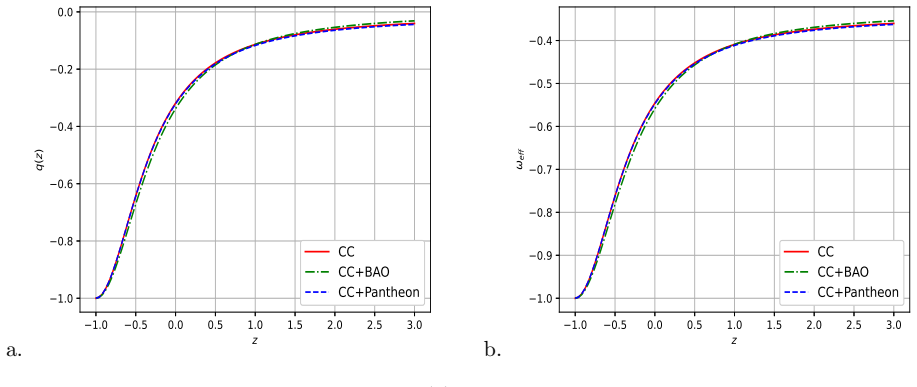
On the paper's own terms, the central discovery is a closed-form viscous solution in non-linear $f(Q)$ theory. Choosing $f(Q) = -\alpha Q^2$ and $\xi = \xi_1\dot{H} - \xi_0$ in an LRS Bianchi type-I metric with the anisotropy relation $A = B^m$ reduces the difference of the pressure field equations to a first-order equation for the average Hubble parameter, whose solution is $H(t) = k_0 \coth(k_1 t + c_0)$ and whose scale factor is $a(t) = c_1[\sinh(k_1 t + c_0)]^n$. With the constrained parameters, the deceleration parameter stays between $-1$ and $0$ at all redshifts, the effective equation of state stays inside the quintessence window, the Om diagnostic has a negative slope, and the statefinder and cosmographic curves move toward the $\Lambda$CDM point at late times. The paper reads these as evidence of a quintessence, ever-accelerating, mildly anisotropic dark-energy model produced by non-linear non-metricity gravity plus bulk viscosity.
Load-bearing premise
Everything hinges on the algebraic reduction from Eq. (31) to Eq. (35): after substituting $A = a^{3m/(m+2)}$, $B = a^{3/(m+2)}$, $f(Q) = -\alpha Q^2$, and $\xi = \xi_1\dot H - \xi_0$, the leftover terms proportional to $(m-1)H^2\dot H$ and $(m-1)H^4$ must cancel; if they do not, the $\coth$ Hubble law and every number derived from it do not describe the proposed model.
Editorial extensions
If this is right
- The three fits (CC, CC+BAO, CC+Pantheon) return $H_0 = 68.2 \pm 1.3$, $68.11 \pm 0.52$, and $68.4 \pm 1.6$ km/s/Mpc, so if the model is right, the expansion rate today sits near the lower side of the measured range.
- $q(z)$ is negative over the whole fitted range with $q_0 \approx -0.32$, and the effective equation of state obeys $-1 \le \omega_{\rm eff} < -1/3$, so the model universe is ever-accelerating rather than a transient-transition model.
- The negative Om slope and the late-time approach of the statefinder pair toward $(r, s) = (1, 0)$ classify the dark energy as quintessence converging to $\Lambda$CDM.
- The age integral gives $t_0$ between 13.81 and 13.89 Gyr across the three datasets, close to the conventional age of the universe.
- The anisotropy parameter is small ($\Delta \approx 0.00002$ to $0.0007$), so the anisotropic background remains observationally close to a flat, isotropic universe.
Reading between the lines
- Editorial inference: the whole parameter set inherits the algebraic step from Eq. (31) to Eq. (35); a user of these numbers should first verify that the substitution leaves no uncancelled $H^2\dot{H}$ or $H^4$ terms, since that check is more direct than re-running the fits.
- Editorial inference: because the fitted $H_0$ lands near 68 km/s/Mpc rather than the higher local-distance-ladder value, this class of viscous $f(Q)$ models is a natural ingredient in Hubble-tension discussions, although the paper itself does not quantify that comparison.
- Editorial inference: fitting the same model to independent high-redshift expansion data would test whether the $\coth$ Hubble law remains viable beyond the redshifts covered by the current $H(z)$ and Pantheon samples.
Editorial analysis
A structured set of objections, weighed in public.
Referee Report
Summary. The paper constructs an LRS Bianchi type-I cosmological model in quadratic f(Q) gravity with a bulk-viscous fluid whose viscosity coefficient is taken as ξ(t)=ξ1 Ḣ−ξ0. The author claims to derive a hyperbolic Hubble solution H(t)=k0 coth(k1t+c0) from the difference of the modified field equations, then uses MCMC on CC, BAO, and Pantheon datasets to constrain the parameters H0, ξ1, m, α. From the fitted function the paper reports an ever-accelerating quintessence behavior (q0≈−0.32, ωeff≈−0.55, ωv≈−0.46), a present age ≈13.8 Gyr, and negative-slope Om diagnostic, along with statefinder and cosmographic analyses.
Significance. If the derivations were correct, the paper would offer a new anisotropic viscous dark-energy model in non-linear f(Q) gravity and demonstrate its consistency with late-time cosmological observations. The manuscript includes the standard ingredients of such an analysis: exact field equations, explicit ansätze, MCMC implementation, and comparison with CC, BAO, and Pantheon data. However, the central step from Eq. (31) to Eq. (35) is algebraically wrong, and the subsequent H(z) formula (38) is inconsistent with the solved scale factor. These are load-bearing errors, not presentation issues: they invalidate the fitted model and all derived cosmological diagnostics. Because the core claim—that this model fits the data and behaves as quintessence—rests entirely on these steps, the paper cannot be accepted in its current form. The negative slope of the Om diagnostic and the quintessence classification are direct artifacts of the erroneous H(z).
major comments (2)
- [Section 3, Eqs. (31)–(35)] The reduction leading to Eq. (35) is algebraically incorrect. Substituting A=a^{3m/(m+2)}, B=a^{3/(m+2)}, f(Q)=−αQ^2, Q=−18(2m+1)/(m+2)^2 H^2, and ξ=ξ1 Ḣ−ξ0 into Eq. (31) gives, after dividing by the non-zero factor 3(m−1)/(m+2)H, the equation 108α(2m+1)/(m+2)^2 H Ḣ + 108α(2m+1)(m^2+m−1)/((m−1)(m+2)^3) H^3 + 3ξ1 Ḣ − 3ξ0 = 0. This contains terms proportional to H Ḣ and H^3 that do not appear in Eq. (35), and these terms do not vanish for the best-fit values (e.g., m≈1.05, α≈1.09 in the CC case). Consequently the hyperbolic solution (36) solves Eq. (35) but does not solve Eq. (31), so the solution (36)–(37) is not a solution of the modified field equations actually defined by the paper.
- [Section 3, Eq. (38)] The Hubble function H(z) in Eq. (38) is not the redshift-space form of the scale factor (37). From a(t)=c1 sinh^n(k1t+c0) one obtains H(t)=k0 coth(k1t+c0), which behaves as H ∝ a^{−1/n} ∝ (1+z)^{1/n} at high redshift (early times). In contrast, Eq. (38) gives H(z) ∝ (1+z)^{−1/n}, decaying to zero as z→∞. Thus Eq. (38) represents a different model, and the MCMC fits in Section 4, which use Eq. (38) in the χ² definitions (43)–(44) and (50)–(51), constrain parameters of that spurious function rather than the model derived in Section 3. All parameter constraints in Table 2 and the subsequent cosmological conclusions are therefore invalid.
minor comments (5)
- [Section 5.5, Eqs. (65)–(67)] The reported values σ/θ ≈ −0.010582 and σ/H ≈ −0.031748 for the CC+BAO dataset are negative, whereas σ, θ, and H are non-negative quantities; the expression should use the absolute value |m−1|/(m+2).
- [Section 5.2, Eq. (60)] The conversion factor '978' in Eq. (60) is not defined or justified; moreover this age formula inherits the incorrect H(z) from Eq. (38), so the quoted age t0≈13.8 Gyr is not a property of the solved model.
- [Section 4, Table 2 and Figs. 1–2] The parameter c1 is fixed to 1.5 rather than marginalized or fitted, although c1 appears explicitly in H(z) in Eq. (38) and controls the redshift dependence of the model; its arbitrary choice influences the fitted values of H0, ξ1, m, and α.
- [Throughout] Several typos and grammatical issues remain, e.g., 'Binachi' for 'Bianchi' and 'Tise condition' for 'This condition' in Section 3; these should be corrected in any revision.
- [Section 5.4, Om diagnostic] The negative slope of Om(z) is a direct mathematical consequence of the incorrect H(z) in Eq. (38), which decreases with z; this diagnostic should not be reported as a prediction of the model until the H(z) error is fixed.
Circularity Check
No significant circularity: the reported diagnostics are functions of the fitted model, not inputs to the fit, and the self-citations are not load-bearing.
full rationale
The derivation chain is: field equations in f(Q) gravity, the ansatz f(Q) = -alpha Q^2, the anisotropy relation A = B^m, the bulk-viscosity assumption xi = xi1 Hdot - xi0, the resulting first-order ODE for H(t), the hyperbolic solution, the H(z) expression, and then MCMC fits to CC, BAO, and Pantheon data. The quantities highlighted as 'results' (q0, omega_eff, Omega_m slope, age, statefinder pairs) are all evaluated from the best-fit H(z) after the parameters H0, xi1, m, alpha and M have been fitted. That is a standard model-interpretation step, not a circular one: those diagnostics are not used to define the model or to determine the fitted parameters, and no fitted parameter is renamed as an independent prediction. The model does impose a fixed functional form before fitting, so the diagnostics are constrained by that form, but that is a limitation of the model-building approach rather than circular reasoning. The self-citations to the author's previous f(Q) and bulk-viscosity papers are background references and are not used as load-bearing uniqueness theorems or as justification for the core equations; the core assumptions (quadratic f(Q) and linear-in-Hdot bulk viscosity) are stated explicitly in the paper itself. Note that the algebraic step from Eq. (31) to Eq. (35) appears not to close: substituting the anisotropic relations and the quadratic f(Q) into Eq. (31) yields terms proportional to H Hdot and H^3 that are absent from Eq. (35). This is a correctness or consistency flaw, not a circularity, and therefore does not raise the circularity score. The paper is self-contained against its external H(z) and Pantheon data in the sense that its claimed numerical outputs are not assumed in advance of the fit.
Assumptions & free parameters
free parameters (7)
- H0 =
68.2 +/- 1.3 (CC), 68.11 +/- 0.52 (CC+BAO), 68.4 +/- 1.6 (CC+Pantheon)
- xi1 =
0.166, 0.0047, 0.183
- m =
1.05, 0.946, 1.01
- alpha =
1.09, 1.26, 0.96
- c1 =
1.5 (fixed by hand)
- xi0 =
not directly reported
- M =
23.8477 +/- 0.0051
assumptions (5)
- domain assumption Shear is proportional to expansion scalar, giving A=B^m with m != 1.
- ad hoc to paper Bulk viscosity takes the form xi=xi1 Hdot-xi0.
- ad hoc to paper f(Q) is exactly quadratic, f(Q)=-alpha Q^2.
- domain assumption LRS Bianchi type-I metric Eq. (13) describes the spacetime.
- standard math The connection is torsion-free and matter has no hypermomentum.
Cite this review
Pith. "Pith review of Quintessence dark energy model in non-linear $f(Q)$ theory with bulk-viscosity." pith.science (2026). https://pith.science/paper/WHTZZQYG
@misc{pith2026250602543,
  author       = {Pith},
  title        = {Pith review of: Quintessence dark energy model in non-linear $f(Q)$ theory with bulk-viscosity},
  year         = {2026},
  howpublished = {\url{https://pith.science/paper/WHTZZQYG}},
  note         = {Machine review of arXiv:2506.02543}
}
abstract
In this study, we investigate a locally rotationally symmetric (LRS) Bianchi type-I cosmological model in non-linear form of $f(Q)$ gravity with observational constraints. We solved the modified Einstein's field equations with a viscous fluid source and got a hyperbolic solution. First, we apply MCMC analysis to the cosmic chronometer (CC), Baryon Acoustic Oscillation (BAO) and Pantheon datasets to place observational constraints on the model parameters. Using constrained values of model parameters, we study the behavior of cosmological parameters, such as the Hubble parameter $H$, the deceleration parameter $q$, and the equation of state (EoS) parameter $\omega_{v}$ with the skewness parameter $\delta_{v}$ for the viscous fluid. In addition, we perform the Om diagnostics and statefinder analysis to categorize dark energy models. Also, we studied cosmographic series coefficients to explore the whole evolution of the derived universe model. We estimated the current age of the universe as $t_{0}\approx13.8$ Gyrs. We obtained a quintessential and ever-accelerating model with bulk viscosity fluid.
Figures


Figures from the paper (7 more)


Reference graph
Works this paper leans on
-
[1]
Perlmutter et al
S. Perlmutter et al. , Measurements of the cosmological parameters Omega and Lam bda from the first 7 supernovae at z ≥ 0.35, Astrophys. J. , 483 (1997) 565-581
1997
-
[2]
Perlmutter et al
S. Perlmutter et al. , Discovery of a supernova explosion at half the age of the uni verse and its cosmological implications, Nature, 391 (1998) 51-54
1998
-
[3]
D. N. Spergel, et al., First Year Wilkinson Microwave Anisotropy Probe (WMAP) Observations: Determination of Cosmological Parameters, Astrophys. J. Suppl. , 148 (2003) 175-194
2003
-
[4]
Verde et
L. Verde et. al. , The 2dF Galaxy Redshift Survey: the bias of galaxies and the density of the Universe, Mon. Not. R. Astron. Soc. , 335 (2002) 432-440
2002
-
[5]
Hinshaw et al
G. Hinshaw et al. , Five-Year Wilkinson Microwave Anisotropy Probe Observat ions: Data Processing, Sky Maps, And Basic Results, Astrophys. J. Suppl. , 180 (2009) 225-245
2009
-
[6]
Zlatev, L
I. Zlatev, L. Wang, P. Steinhardt, Quintessence, cosmic coincidence, and the cosmological constant, Phys. Rev. Lett. 82 (1999) 896-899
1999
-
[7]
Steinhardt, L
P. Steinhardt, L. Wang, I. Zlatev., Cosmological tracki ng solutions, Phys. Rev. D 59(1999) 123504
1999
-
[8]
Caldwell, M
R. Caldwell, M. Kamionkowski, N. Weinberg., Phantom Ene rgy: Dark Energy with ω < −1 Causes a Cosmic Doomsday, Phys. Rev. Lett. 91(2003) 071301
2003
Show all 138 references
-
[9]
Hinshaw et al
G. Hinshaw et al. , Nine-year Wilkinson Microwave Anisotropy Probe (WMAP) ob servations: cosmological parameter results, Astrophys. J. Suppl. Ser. 208 (2013) 19
2013
-
[10]
Ade et al
P.A.R. Ade et al. , Planck 2015 results XIII. Cosmological parameters, Astron. Astrophys. 594 (2016) A13
2016
-
[11]
C. M. Will, The confrontation between general relativi ty and experiment, Living Rev. Relativ. 17 1-117 (2014)
2014
-
[12]
E. N. Saridakis et al. Modified gravity and cosmology: An update by the cantata netw ork, (2021) arXiv:2105.12582
2021 arXiv
-
[13]
H. A. Buchdahl, Non-Linear Lagrangians and Cosmologic al Theory, Mon. Not. R. Astron. Soc. 150 (1970) 1-8
1970
-
[14]
J. D. Barrow, A. C. Ottewill, The stability of general re lativistic cosmological theory, J. Phys. A, Math. Gen. 16 (1983) 2757. 19
1983
-
[15]
Nojiri, S
S. Nojiri, S. D. Odintsov, Modified f (R) gravity consistent with realistic cosmology: From a matte r dominated epoch to a dark energy universe, Phys. Rev. D 74 (2006) 086005
2006
-
[16]
Elizalde, D
E. Elizalde, D. Saez-Gomez, f (R) cosmology in the presence of a phantom fluid and its scalar-t ensor coun- terpart: Towards a unified precision model of the evolution o f the Universe, Phys. Rev. D 80 (2009) 044030
2009
-
[17]
Schrodinger, E
E. Schrodinger, E. Schrodinger, and E. Dinger, Space-T ime Structure, Cambridge Science Classics (Cam- bridge University Press, 1985)
1985
-
[18]
G. J. Olmo, Palatini approach to modified gravity: f (R) theories and beyond, Int. J. Mod. Phys. D 20 (2011) 413-462, arXiv:1101.3864 [gr-qc]
2011 arXiv
-
[19]
Heisenberg, A systematic approach to generalisatio ns of General Relativity and their cosmological impli- cations, Phys
L. Heisenberg, A systematic approach to generalisatio ns of General Relativity and their cosmological impli- cations, Phys. Rept. 796 (2019) 1-113, arXiv:1807.01725 [gr-qc]
2019 arXiv
-
[20]
Beltran Jimenez, L
J. Beltran Jimenez, L. Heisenberg, and T. S. Koivisto, T he geometrical trinity of gravity, Universe 5 (2019) 173, arXiv:1903.06830 [hep-th]
2019 arXiv
-
[21]
Aldrovandi and J
R. Aldrovandi and J. G. Pereira, Teleparallel Gravity, Vol. 173 (Springer, Dordrecht, 2013)
2013
-
[22]
Beltran Jimenez, L
J. Beltran Jimenez, L. Heisenberg, and T. Koivisto, Coi ncident general relativity, Phys. Rev. D 98 (2018) 044048, arXiv:1710.03116 [grqc]
2018 arXiv
-
[23]
J. M. Nester and H. J. Yo, Symmetric teleparallel genera l relativity, Chin. J. Phys. 37 (1999) 113-117, arXiv:gr-qc/9809049 [gr-qc]
1999 arXiv
-
[24]
Ferraro and F
R. Ferraro and F. Fiorini, Modified teleparallel gravit y: inflation without an inflaton, Phys. Rev. D 75 (2007) 084031, arXiv:gr-qc/0610067 [gr-qc]
2007 arXiv
-
[25]
Ferraro and F
R. Ferraro and F. Fiorini, Non-trivial frames for f (T ) theories of gravity and beyond, Phys. Lett. B 702 (2011) 75-80, arXiv:1103.0824 [gr-qc]
2011 arXiv
-
[26]
Hohmann, L
M. Hohmann, L. Jarv, M. Krssak, and C. Pfeifer, Modified t eleparallel theories of gravity in symmetric spacetimes, Phys. Rev. D 100 (2019) 084002, arXiv:1901.05472 [gr-qc]
2019 arXiv
-
[27]
A. A. Starobinsky, Disappearing cosmological constan t in f (R) gravity, JETP Lett. 86 (2007) 157-163, arXiv:0706.2041 [astro-ph]
2007 arXiv
-
[28]
Amendola, K
L. Amendola, K. Enqvist, and T. Koivisto, Unifying Eins tein and Palatini gravities, Phys. Rev. D 83 (2011) 044016, arXiv:1010.4776 [gr-qc]
2011 arXiv
-
[29]
Capozziello and M
S. Capozziello and M. De Laurentis, Extended theories o f gravity, Phys. Rept. 509 (2011) 167-321, arXiv:1108.6266 [gr-qc]
2011 arXiv
-
[30]
Beltran Jimenez, L
J. Beltran Jimenez, L. Heisenberg, T. S. Koivisto and S. Pekar, Cosmology in f (Q) geometry, Phys. Rev. D 101 (2020) 103507
2020
-
[31]
Harko et al
T. Harko et al. , Coupling matter in modified f (Q) gravity, Phys. Rev. D 98 (2018) 084043. arXiv:1806.10437 [gr-qc]
2018 arXiv
-
[32]
Heisenberg, Review on f (Q) gravity, Physics Reports 1066 (2024) 1-78
L. Heisenberg, Review on f (Q) gravity, Physics Reports 1066 (2024) 1-78
2024
-
[33]
Capozziello and R
S. Capozziello and R. D’Agostino, Model-independent r econstruction of f (Q) non-metric gravity, Phys. Lett. B 832 (2022) 137229
2022
-
[34]
D. C. Maurya, A. Dixit and A. Pradhan, Transit String Dar k Energy Models in f (Q) Gravity, Inter. J. Geom. Meth. Mod. Phys. Accepted (2023); 20
2023
-
[35]
Maurya, Phantom dark energy nature of string-fluid cosmological models in f (Q)-gravity, Gravit
D.C. Maurya, Phantom dark energy nature of string-fluid cosmological models in f (Q)-gravity, Gravit. Cos- mol. 29 (2023) 345-361
2023
-
[36]
Maurya, J
D.C. Maurya, J. Singh, Modified f (Q)-gravity string cosmological models with observational c onstraints, Astronomy and Computing 46 (2024) 100789. https://doi.org/10.1016/j.ascom.2024.1 00789
2024 doi
-
[37]
F. K. Anagnostopoulos, S. Basilakos, E. N. Saridakis, F irst evidence that non-metricity f (Q) gravity could challenge ΛCDM, Phys. Lett. B 822 136634 (2021)
2021
-
[38]
De, T.-H
A. De, T.-H. Loo, E.N. Saridakis, Non-metricity with bo undary terms:f (Q, C) gravity and cosmology, JCAP 2024(03) 050 (2024)
2024
-
[39]
Anagnostopoulos, V
F.K. Anagnostopoulos, V. Gakis,E.N. Saridakis, et al. , New models and big bang nucleosynthesis constraints in f (Q) gravity, Eur. Phys. J. C 83 58 (2023)
2023
-
[40]
Shabani, A
H. Shabani, A. De,T.H. Loo, et al , Cosmology of f (Q) gravity in non-flat Universe, Eur. Phys. J. C 84 285 (2024)
2024
-
[41]
Singha, A
R. Singha, A. Singh, Observationally Compatible Cosmo logical Scenarios in Gravity with Lagrangian Recon- struction, Gravit. Cosmol. 31 260-269 (2025)
2025
-
[42]
Brevik and S
I. Brevik and S. D. Odintsov, Cardy-Verlinde entropy fo rmula in viscous cosmology, Phys. Rev. D 65 (2002) 067302
2002
-
[43]
D. J. Liu and X. Z. Li, Dynamics of quintessence with ther mal interactions, Phys. Lett. B 611 (2005) 8
2005
-
[44]
Eckart, The thermodynamics of irreversible process es
C. Eckart, The thermodynamics of irreversible process es. III. Relativistic theory of the simple fluid, Phys. Rev. 58 (1940) 919
1940
-
[45]
L. D. Landau and E. M. Lifshitz, Fluid Mechanics (Butter worth Heinemann, Oxford, 1987)
1987
-
[46]
Israel, Non-stationary irreversible thermodynami cs: a causal relativistic theory, Ann
W. Israel, Non-stationary irreversible thermodynami cs: a causal relativistic theory, Ann. Phys. 100 (1976) 310
1976
-
[47]
Israel and J
W. Israel and J. M. Stewart, Thermodynamics of nonstati onary and transient effects in a relativistic gas, Phys. Lett. A 58 (1976) 213
1976
-
[48]
C. J. Feng and X. Z. Li., Viscous Ricci dark energy, Phys. Lett. B , 680 (2009) 355
2009
-
[49]
Maartens, Dissipative cosmology, Class
R. Maartens, Dissipative cosmology, Class. Quantum Grav. 12 (1995) 1455
1995
-
[50]
Harko and M
T. Harko and M. K. Mak, Viscous Bianchi type I universes i n brane cosmology, Class. Quantum Grav. 20 (2003) 407
2003
-
[51]
Gorbunova, Olesya, and Lorenzo Sebastiani, Viscous flu ids and Gauss-Bonnet modified gravity, Gen. Relativ. Gravit. 42 (2010) 2873
2010
-
[52]
Weinberg, Gravitation and Cosmology: Principles an d Applications of the General Theory of Relativity (Wiley, New York, 1972)
S. Weinberg, Gravitation and Cosmology: Principles an d Applications of the General Theory of Relativity (Wiley, New York, 1972)
1972
-
[53]
Zimdahl and D
W. Zimdahl and D. Pavon, Expanding universe with positi ve bulk viscous pressures?, Phys. Rev. 61 (2000) 108301
2000
-
[54]
J. C. Fabris, S. V. B. Goncalves, and R. de S´ a Ribeiro, Bu lk viscosity driving the acceleration of the Universe, Gen. Relativ. Gravit. 38 (2006) 495
2006
-
[55]
Li and J
B. Li and J. D. Barrow, Does bulk viscosity create a viabl e unified dark matter model?, Phys. Rev. D 79 (2009) 103521. 21
2009
-
[56]
W. S. Hip´ olito-Ricaldi, H. E. S. Velten and W. Zimdahl, Viscous dark fluid universe, Phys. Rev. D 82 (2010) 063507
2010
-
[57]
Avelino and U
A. Avelino and U. Nucamendi, Exploring a matter-domina ted model with bulk viscosity to drive the accel- erated expansion of the Universe, JCAP 08 (2010) 009
2010
-
[58]
Paul, Origin of bulk viscosity in cosmology and its th ermodynamic implications, Phys
T. Paul, Origin of bulk viscosity in cosmology and its th ermodynamic implications, Phys. Rev. D 111(8) 083540 (2025)
2025
-
[59]
Zindahl, et al
W. Zindahl, et al. , Cosmic antifriction and accelerated expansion, Phys. Rev. D 64 (2001) 063501
2001
-
[60]
J. R. Wilson, G. J. Mathews and G. M. Fuller, Bulk viscosi ty, decaying dark matter, and the cosmic accel- eration, Phys. Rev. D 75 (2007) 043521
2007
-
[61]
Okumura and F
H. Okumura and F. Yonezawa, New expression of the bulk vi scosity, Phys. A 321 (2003) 207
2003
-
[62]
Ilg and H
P. Ilg and H. C. Ottinger, Non-equilibrium relativisti c thermodynamics in bulk viscous cosmology, Phys. Rev. D 61 (2000) 023510
2000
-
[63]
Brevik, Ø
I. Brevik, Ø. Grøn, J. de Haro, S.D. Odintsov, E.N. Sarid akis, Viscous cosmology for early- and late-time universe, Int. J. Mod. Phys. D 26(14) 1730024 (2017)
2017
-
[64]
Pasqua, Power-law and logarithmic entropy-correct ed Ricci viscous dark energy and dynamics of scalar fields, Astrophys
A. Pasqua, Power-law and logarithmic entropy-correct ed Ricci viscous dark energy and dynamics of scalar fields, Astrophys. Space Sci. 346 531-543 (2013)
2013
-
[65]
Chakraborty, S
G. Chakraborty, S. Chattopadhyay E. G¨ udekli, Viscous holographic f (Q) cosmology with some versions of holographic dark energy with generalized cut-offs, Res. Astron. Astrophys. 21(12) 317 (2021)
2021
-
[66]
Pradhan, D
A. Pradhan, D. C. Maurya and A. Dixit, Dark energy nature of viscus universe in f (Q)-gravity with obser- vational constraints, Int. J. Geom. Meth. Mod. Phys. 18 (08), 2150124
-
[67]
Dixit, D
A. Dixit, D. C. Maurya and A. Pradhan, Phantom dark energ y nature of bulk-viscosity universe in modified f (Q)-gravity, Inter. J. Geom. Meth. Mod. Phys. 19 (2022) 2250198-581
2022
-
[68]
Pradhan, A
A. Pradhan, A. Dixit and D. C. Maurya, Quintessence Beha vior of an Anisotropic Bulk Viscous Cosmological Model in Modified f (Q)-Gravity, Symmetry 14 (2022) 2630
2022
-
[69]
Koussour, S
M. Koussour, S. H. Shekh, M. Bennai, Anisotropic f (Q) gravity model with bulk viscosity, Mod. Phys. Lett. A 39 2450023 (2024)
2024
-
[70]
R. Zia, D. C. Maurya and A. K. Shukla, Transit cosmologic al models in modified f (Q, T ) gravity, Int. J. Geom. Meth. Mod. Phys. , 18 (2021) 2150051
2021
-
[71]
Capozziello et al
S. Capozziello et al. , Extended Gravity Cosmography, Int. J. Mod. Phys. D 28 (2019) 1930016
2019
-
[72]
Visser, Cosmography: Cosmology without the Einstei n equations, Gen
M. Visser, Cosmography: Cosmology without the Einstei n equations, Gen. Rel. Grav. 37 (2005) 1541
2005
-
[73]
Visser, Conformally Friedmann-Lemaitre-Robertso n-Walker cosmologies, Class
M. Visser, Conformally Friedmann-Lemaitre-Robertso n-Walker cosmologies, Class. Quant. Grav. 32 (2015) 135007
2015
-
[74]
P. K. S. Dunsby, O. Luongo, On the theory and application s of modern cosmography, Int. J. Geom. Meth. Mod. Phys. 13 (2016) 1630002
2016
-
[75]
Capozziello, O
S. Capozziello, O. Farooq, O. Luongo, B. Ratra, Cosmogr aphic bounds on the cosmological deceleration- acceleration transition redshift in f (R) gravity, Phys. Rev D 90 (2014) 044016
2014
-
[76]
Luongo, G
O. Luongo, G. B. Pisani, A. Troisi, Cosmological degene racy versus cosmography: A cosmographic dark energy model, Int. J. Mod. Phys. D 26 (2017) 1750015. 22
2017
-
[77]
Piazza, T
F. Piazza, T. Schucker, Minimal cosmography, Gen. Rel. Grav. 48 (2016) 41
2016
-
[78]
Bamba, S
K. Bamba, S. Capozziello, S. Nojiri, S. D. Odintsov, Dar k energy cosmology: the equivalent description via different theoretical models and cosmography tests, Astrop. Sp. Sci. 342 (2012) 155
2012
-
[79]
J. C. Carvalho, J. S. Alcaniz, Cosmography and cosmic ac celeration, Mon. Not. Roy. Astron. Soc. 418 (2011) 1873
2011
-
[80]
Beltran Jimenez, L
J. Beltran Jimenez, L. Heisenberg, and T. S. Koivisto, T eleparallel Palatini theories, JCAP 1808 039 (2018), arXiv:1803.10185 [gr-qc]
2018 arXiv
-
[81]
C. B. Collins and W. H. Stephen, Why is the universe isotr opic?, ApJ 180 (1973) 317-334
1973
-
[82]
C. B. Collins, E. N. Glass, D. A. Wilkinson, Exact Spatia lly Homogeneous Cosmologies, Gen. Relativ. Gravit. 12 (1980) 805-823
1980
-
[83]
F. E. Bunn et al. , How anisotropic is our universe?, Phys. Rev. Lett. 77 (1996) 2883
1996
-
[84]
Harko and M
T. Harko and M. K. Mak., Viscous Bianchi type I universes in brane cosmology, Class. Quantum Grav. 20 (2003) 407
2003
-
[85]
Harko and M
T. Harko and M. K. Mak., Anisotropy in Bianchi-type bran e cosmologies, Class. Quantum Grav. 21 (2004) 1489
2004
-
[86]
M. E. Rodrigues, et al., Locally rotationally symmetri c Bianchi type-I cosmological model in f (T ) gravity: from early to dark energy dominated universe, International Journal of Modern Physics D 23 (2014) 1450004
2014
-
[87]
C. W. Misner, K. S. Thorne and J. A. Wheeler, Gravitation (W.H. Freemann and Company, San Francisco, 1973)
1973
-
[88]
X. H. Meng and X. Dou, Singularities and Entropy in Bulk V iscosity Dark Energy Model, Commun. Theor. Phys. 52 (2009) 377
2009
-
[89]
X. H. Meng, Jie Ren and H. M. Gaung, Friedmann cosmology w ith a generalized equation of state and bulk viscosity, Commun. Theor. Phys. 47 (2007) 379
2007
-
[90]
Avelino and U
A. Avelino and U. Nucamendi, Exploring a matter-domina ted model with bulk viscosity to drive the accel- erated expansion of the Universe, J. Cosmol. Astropart. Phys. 9 (2010) 1008
2010
-
[91]
B. D. Normann and I. Brevik, Characteristic properties of two different viscous cosmology models for the future universe, Mod. Phys. Lett. A 32 (2017) 1750026
2017
-
[92]
E. J. Copeland, M. Sami and S. Tsujikawa, Dynamics of dar k energy, Int. J. Mod. Phys. D 15, 1753 (2006), [arXiv:hep-th/0603057]
2006 arXiv
-
[93]
Gaztanaga, A
E. Gaztanaga, A. Cabre and L. Hui, Mon. Not. Roy. Astron. Soc. 399, 1663–1680 (2009)
2009
-
[94]
Jimenez and A
R. Jimenez and A. Loeb, Constraining Cosmological Para meters Based on Relative Galaxy Ages, ApJ 573 (2002) 37
2002
-
[95]
Hogg and D.F
D.W. Hogg and D.F. Mackey, Data analysis recipes: Using Markov Chain Monte Carlo, The Astrophysical Journal Supplement Series 236 (2018) 18. [arXiv:1710.06068 [astro-ph.IM]]
2018 arXiv
-
[96]
Zhang, H
C. Zhang, H. Zhang, S. Yuan et al. , Four new observational H(z) data from luminous red galaxies in the Sloan Digital Sky Survey data release seven, Res. Astron. Astrophys. 14, 1221 (2014)
2014
-
[97]
Jimenez, L
R. Jimenez, L. Verde, T. Treu et al. , Constraints on the equation of state of dark energy and the H ubble constant from stellar ages and the cosmic microwave backgro und, Astrophys. J. 593, 622 (2003). 23
2003
-
[98]
Simon, L
J. Simon, L. Verde and R. Jimenez, Constraints on the red shift dependence of the dark energy potential, Phys. Rev. D 71, 123001 (2005)
2005
-
[99]
Moresco, A
M. Moresco, A. Cimatti, R. Jimenez et al. , Improved constraints on the expansion rate of the Universe up to z ∼ 1.1 from the spectroscopic evolution of cosmic chronometers, JCAP 1208, 006 (2012)
2012
-
[100]
Moresco, L
M. Moresco, L. Pozzetti, A. Cimatti et al. , A 6% measurement of the Hubble parameter at z ∼ 0.45: direct evidence of the epoch of cosmic re-acceleration, JCAP 1605, 014 (2016)
2016
-
[101]
A. L. Ratsimbazafy, S. I. Loubser, S. M. Crawford et al. , Age-dating luminous red galaxies observed with the Southern African Large Telescope, Mon. Not. Roy. Astron. Soc. 467, 3239–3254 (2017)
2017
-
[102]
Stern, R
D. Stern, R. Jimenez, L. Verde et al. , Cosmic chronometers: constraining the equation of state o f dark energy. I: H(z) measurements, JCAP 2, 8 (2010)
2010
-
[103]
Borghi, M
N. Borghi, M. Moresco and A. Cimatti, Toward a better un derstanding of cosmic chronometers: a new measurement of H(z) at z ∼ 0.7, Astrophys. J. Lett. 928, L4 (2022)
2022
-
[104]
Moresco, Raising the bar: new constraints on the Hub ble parameter with cosmic chronometers at z ∼ 2, Mon
M. Moresco, Raising the bar: new constraints on the Hub ble parameter with cosmic chronometers at z ∼ 2, Mon. Not. Roy. Astron. Soc. 450, L16 (2015)
2015
-
[105]
A. Oka, S. Saito, T. Nishimichi, Simultaneous constra ints on the growth of structure and cosmic expansion from the multipole power spectra of the SDSS DR7 LRG sample, Mon. Not. Roy. Astron. Soc. 439, 2515–2530 (2014)
2014
-
[106]
Wang et al
Y. Wang et al. , The clustering of galaxies in the completed SDSS-III Baryo n Oscillation Spectroscopic Survey: tomographic BAO analysis of DR12 combined sample in configuration space, Mon. Not. Roy. Astron. Soc. 469, 3762–3774 (2017)
2017
-
[107]
Chuang and Y
C.-H. Chuang and Y. Wang, Modelling the anisotropic tw o-point galaxy correlation function on small scales and single-probe measurements of H(z), DA(z) and f (z)σ8(z) from the Sloan Digital Sky Survey DR7 luminous red galaxies, Mon. Not. Roy. Astron. Soc. 435, 255–262 (2013)
2013
-
[108]
Alam et al., The clustering of galaxies in the completed SDSS-III Baryo n Oscillation Spectroscopic Survey: cosmological analysis of the DR12 galaxy sample, Mon
S. Alam et al., The clustering of galaxies in the completed SDSS-III Baryo n Oscillation Spectroscopic Survey: cosmological analysis of the DR12 galaxy sample, Mon. Not. Roy. Astron. Soc. 470, 2617–2652 (2017)
2017
-
[109]
Blake, S
C. Blake, S. Brough, M. Colless et al. , The WiggleZ Dark Energy Survey: joint measurements of the expansion and growth history at z < 1, Mon. Not. Roy. Astron. Soc. 425, 405–414 (2012)
2012
-
[110]
Chuang, F
C.-H. Chuang, F. Prada, A. J. Cuesta et al. , The clustering of galaxies in the SDSS-III Baryon Oscillat ion Spectroscopic Survey: single-probe measurements and the s trong power of f (z)σ8(z) on constraining dark energy, Mon. Not. Roy. Astron. Soc. 433, 3559–3571 (2013)
2013
-
[111]
Anderson et al
L. Anderson et al. , The clustering of galaxies in the SDSS-III Baryon Oscillat ion Spectroscopic Survey: baryon acoustic oscillations in the Data Releases 10 and 11 G alaxy samples, Mon. Not. Roy. Astron. Soc. 441, 24–62 (2014)
2014
-
[112]
G. B. Zhao et al. , The clustering of the SDSS-IV extended Baryon Oscillation Spectroscopic Survey DR14 quasar sample: a tomographic measurement of cosmic structu re growth and expansion rate based on optimal redshift weights, Mon. Not. Roy. Astron. Soc. 482, 3497–3513 (2019)
2019
-
[113]
Neveux et al
R. Neveux et al. , The completed SDSS-IV extended Baryon Oscillation Spectr oscopic Survey: BAO and RSD measurements from the anisotropic power spectrum of the quasar sample between redshift 0.8 and 2.2, Mon. Not. Roy. Astron. Soc. 499, 210–229 (2020). 24
2020
-
[114]
N. G. Busca, T. Delubac, J. Rich et al. , Baryon acoustic oscillations in the Ly α forest of BOSS quasars, Astron. Astrophys. 552, A96 (2013)
2013
-
[115]
Font-Ribera et al
A. Font-Ribera et al. , DESI and other Dark Energy experiments in the era of neutrin o mass measurements, J. Cosm. Astropart. Phys. 2014, 027 (2014)
2014
-
[116]
H. D. Mas Des Bourboux, J.-M. Le Goff, M. Blomqvist et al. , Baryon acoustic oscillations from the complete SDSS-III Ly α-quasar cross-correlation function at z = 2.4, Astron. Astrophys. 608, A130 (2017)
2017
-
[117]
R. El Ouardi, et al., Model-Independent Reconstructi on of f (T ) Gravity Using Genetic Algorithms, Chi- nese Physics C , (2025), http://iopscience.iop.org/article/10.1088/1 674-1137/ade6d6. [arXiv:2506.03235 [astro- ph.CO]]
2025 arXiv
-
[118]
Y. Yang, X. Ren, Q. Wang et al. , Quintom cosmology and modified gravity after DESI 2024, Sci. Bull. 69, 2698 (2024)
2024
-
[119]
Gil-Mar ´ ınet al
H. Gil-Mar ´ ınet al. , The Completed SDSS-IV extended Baryon Oscillation Spectr oscopic Survey: measure- ment of the BAO and growth rate of structure of the luminous re d galaxy sample from the anisotropic power spectrum between redshifts 0.6 and 1.0, Mon. Not. Roy. Astron. S...
2020
-
[120]
J. E. Bautista et al. , The completed SDSS-IV extended Baryon Oscillation Spectr oscopic Survey: mea- surement of the BAO and growth rate of structure of the lumino us red galaxy sample from the anisotropic correlation function between redshifts 0.6 and 1, Mon. Not. Roy. Astro...
2021
-
[121]
Avila et al
S. Avila et al. , The Completed SDSS-IV extended Baryon Oscillation Spectr oscopic Survey: exploring the halo occupation distribution model for emission line galax ies, Mon. Not. Roy. Astron. Soc. 499, 5486–5507 (2020)
2020
-
[122]
Hou et al
J. Hou et al. , The completed SDSS-IV extended Baryon Oscillation Spectr oscopic Survey: BAO and RSD measurements from anisotropic clustering analysis of the q uasar sample in configuration space between redshift 0.8 and 2.2, Mon. Not. Roy. Astron. Soc. 500, 1201–1221 (2021)
2021
-
[123]
Du Mas Des Bourboux et al
H. Du Mas Des Bourboux et al. , The completed SDSS-IV extended baryon oscillation spectr oscopic survey: baryon acoustic oscillations with Ly α forests, Astrophys. J. 901, 153 (2020)
2020
-
[124]
Moresco, R
M. Moresco, R. Jimenez, L. Verde et al. , Setting the stage for cosmic chronometers. II. Impact of st ellar population synthesis models systematics and full covarian ce matrix, Astrophys. J. 898, 82 (2020)
2020
-
[125]
Asvesta, L
K. Asvesta, L. Kazantzidis, L. Perivolaropoulos, C.G . Tsagas, Observational constraints on the deceleration parameter in a tilted universe, Mon. Not. R. Astron. Soc. 513, 2394-2406 (2022)
2022
-
[126]
Ellis, R
G. Ellis, R. Maartens, M. MacCallum, Relativistic Cos mology (Cambridge University Press, Cambridge, 2012). https://doi.org/10.1017/CBO9781139014403
2012 doi
-
[127]
D. C. Maurya, Late-time accelerating cosmological mo dels in f (R, Lm, T )-gravity with observational con- straints, Phys. Dark Universe 46 (2024) 101722
2024
-
[128]
D. C. Maurya, K. Yesmakhanova, R. Myrzakulov, G. Nugma nova, FLR W Cosmology in Metric-Affine F (R, Q) Gravity, Chinese Phys. C 48(12) 125101 (2024)
2024
-
[129]
D. C. Maurya, Transit dark energy models in Hoyle-Narl ikar gravity with observational constraints, Phys. Dark Univ. 47 101782 (2025)
2025
-
[130]
D. C. Maurya, Constrained transit cosmological model s in f (R, Lm, T )-gravity, Int. J. Geom. Meth. Mod. Phys., (2025), https://doi.org/10.1142/S0219887825500 288. 25
2025 doi
-
[131]
D. C. Maurya, Accelerating cosmological models in Hoy le-Narlikar gravity with observational constraints, Int. J. Geom. Meth. Mod. Phys., (2025). https://doi.org/10 .1142/S0219887825500896
2025
-
[132]
Lalke, G.P
A.R. Lalke, G.P. Singh, A. Singh, Cosmic dynamics with late-time constraints on the parametric deceleration parameter model. Eur. Phys. J. Plus 139 288 (2024)
2024
-
[133]
Mandal, A
S. Mandal, A. Singh, R. Chaubey, Late-time constraint s on barotropic fluid cosmology, Phys. Lett. A 519 129714 (2024)
2024
-
[134]
Singh, S
A. Singh, S. Krishnannair, Affine EoS cosmologies: Obse rvational and dynamical system constraints, As- tronomy and Computing 47 100827 (2024)
2024
-
[135]
Sahni, et al
V. Sahni, et al. , Statefinder-A new geometrical diagnostic of dark energy, JETP Lett. 77, 201 (2003)
2003
-
[136]
Alam, et al
U. Alam, et al. , Exploring the expanding universe and dark energy using the Statefinder diagnostic, Mon. Not. R. Astron. Soc. 344, 1057 (2003)
2003
-
[137]
Sami, et al
M. Sami, et al. , Cosmological dynamics of a nonminimally coupled scalar fie ld system and its late time cosmic relevance, Phys. Rev. D 86, 103532 (2012)
2012
-
[138]
Sahni, A
V. Sahni, A. Shafieloo, A. A. Starobinsky, Two new diagn ostics of dark energy, Phys. Rev. D 78 (2008) 103502. 26
2008
Reviewed August 7, 2026 · model on record in the stance chip above.
Discussion (0). Sign in to comment.