REVIEW 4 major objections 6 minor 32 references
Biases in LLM-Generated Musical Taste Profiles for Recommendation
T0 review · 4 major / 6 minor · reviewed 2026-08-06 · deepseek-v4-flash
Pith's one-line read LLM-written taste profiles are scrutable but biased: rap-heavy profiles score lower with users, metal-heavy profiles higher, even after controlling for actual taste.
desk verdict A first user-study pass at whether LLM taste profiles represent users fairly; the rap/metal bias claim is plausible but not yet statistically solid because the bootstrap clustering is unstated. read the letter →
The pith
A machine-rendered reading of the paper's core claim, the machinery that carries it, and where it could break.
The reading
What carries the argument
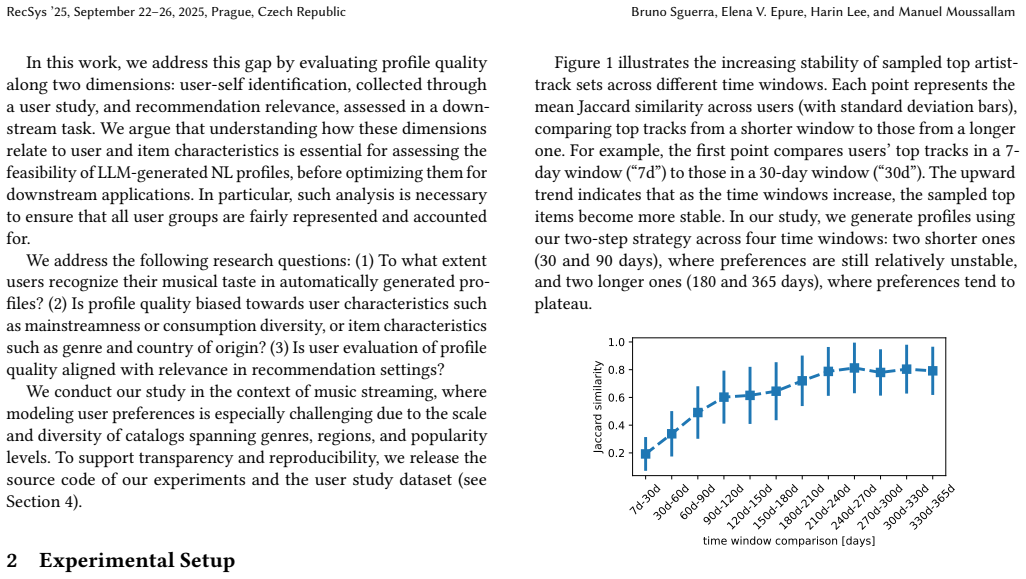
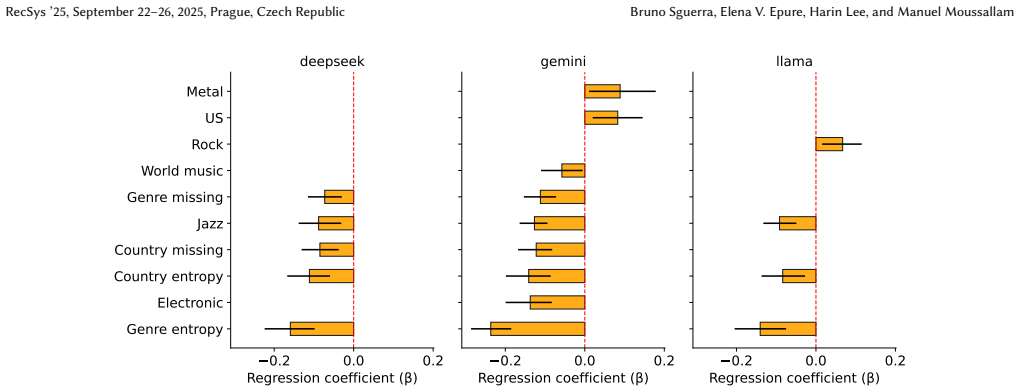
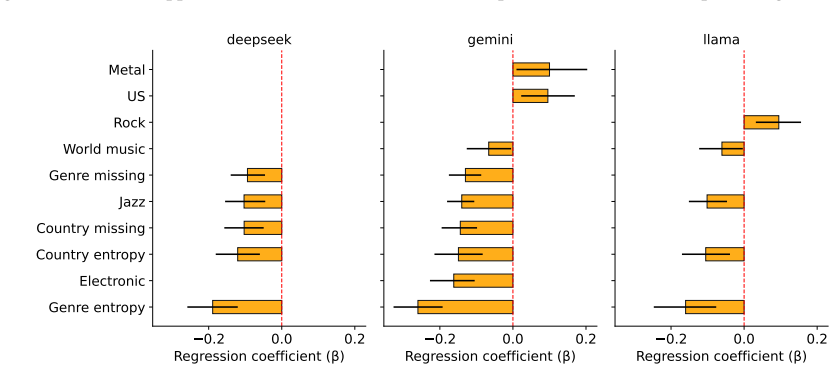
The machinery has two parts. First, the 'delta rating' $\delta r_{u,i}$, defined as a user's rating of a profile generated from their own data minus the median of their ratings of stranger profiles, isolates self-recognition from personal response style; this is the outcome used throughout. Second, a doubly robust estimator of the average treatment effect of genre content on $\delta r_{u,i}$ combines outcome regression with propensity-score weighting, so that the effect of, say, a high share of rap tracks is estimated after adjusting for confounders such as the user's actual long-term genre mix and their specialist/generalist score. Profiles are produced by a two-step artist-then-track sampling of listening history across four time windows, prompting three different LLMs with metadata, which determines the item composition the bias analysis operates on.
What would settle it
Re-run the bootstrap at the user level, resampling the 12 profiles of each participant together rather than individual ratings, and recompute the doubly robust ATE intervals for rap and metal; if the 95% intervals cross zero, the central genre-bias claim collapses. Because the participants are volunteers from a single company, a replication with a broader, independent sample of listeners would test whether the effects generalize.
Extended reading notes
Core claim
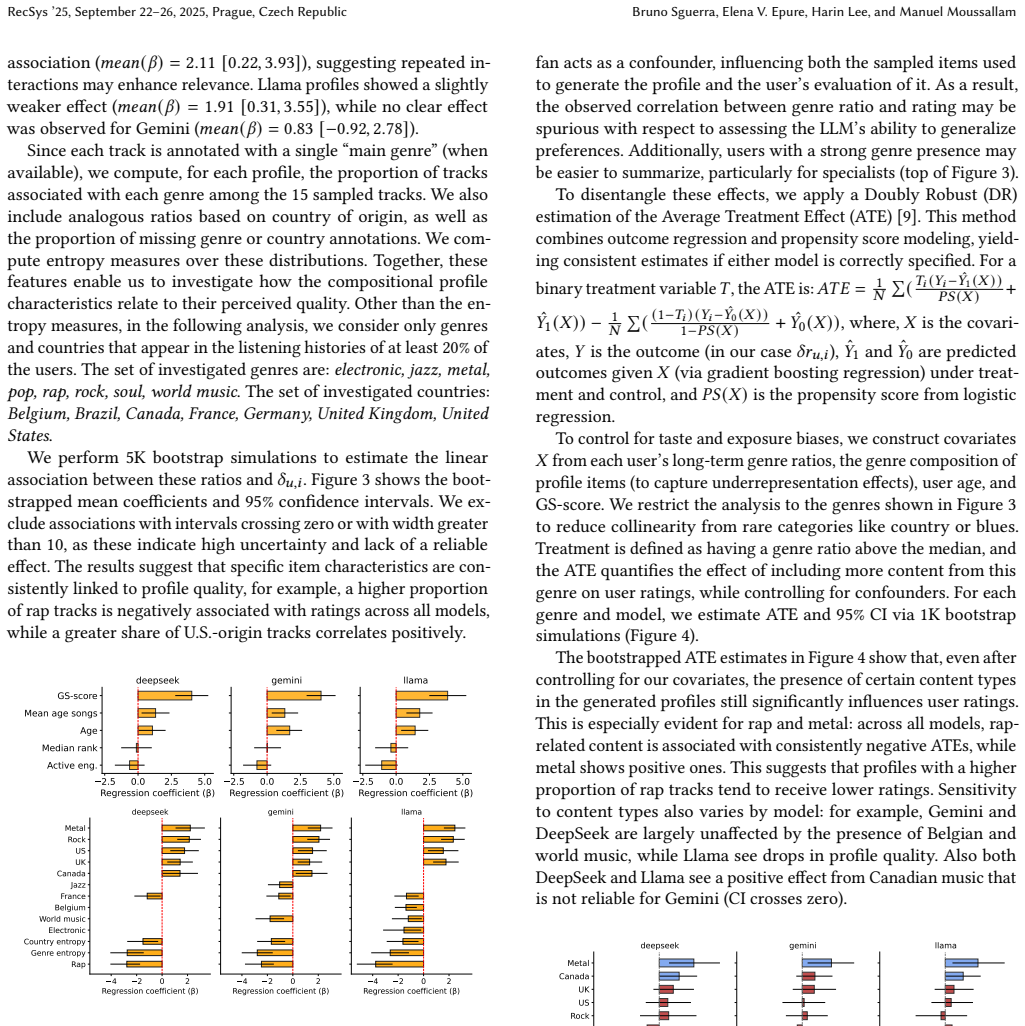
The paper's central claim is that natural-language taste profiles generated by LLMs from a user's own listening history are recognized by the user as genuinely theirs—profiles beat random strangers' profiles on a 7-point self-recognition scale—but the degree of recognition is systematically biased. A doubly robust causal analysis, controlling for each user's long-term genre preferences, specialist/generalist tendency, and profile composition, finds that across all three models studied, a higher share of rap content lowers profile ratings while a higher share of metal content raises them. The paper interprets this as evidence of content-type-specific biases in how models verbalize tastes, not merely a reflection of what users like. It further finds that these user-perceived quality judgments correlate only weakly with how useful the profiles are in a downstream recommendation task, so a profile that scores well on self-recognition is not necessarily the one that yields better recommendations.
Load-bearing premise
The load-bearing assumption is that the 12 ratings each of the 64 participants gives can be treated as independent observations in the bootstrap resampling that produces the confidence intervals; if instead the resampling unit is the user, the reported intervals are too narrow and the rap-negative, metal-positive effects may not survive.
Editorial extensions
If this is right
- If the bias claim holds, LLM-written taste profiles are not neutral mirrors of listening data: the same listening behavior can be verbalized in ways that users find more or less accurate depending on genre mix and model.
- Users whose listening is dominated by rap could systematically receive less representative profiles than metal listeners, which is a fairness problem for any recommendation system that surfaces these profiles to users.
- Since the choice of LLM changes ratings more than the length of the listening window, deploying such profiles requires model selection or post-hoc style correction, not just longer or better consumption samples.
- The weak correlation between self-recognition ratings and downstream recommendation performance implies that optimizing profiles for user-perceived accuracy and optimizing them for recommendation utility are separate goals that may need separate profile versions.
Reading between the lines
- Editorial extension: the rap-negative and metal-positive asymmetry is consistent with over- or under-representation of communities and language registers in LLM training corpora; a direct test would correlate profile ratings with corpus frequency estimates for the genres, controlling for metadata quality.
- Editorial extension: the fact that one model's profiles were systematically preferred suggests surface style (mentioning artist names, abstraction level, length) rather than content accuracy drives self-recognition; an ablation that strips profiles of proper nouns would separate style from substance.
- Editorial extension: because only 64 participants and three models were used, the specific effect sizes and model rankings are likely unstable; the paper's design can be extended to a larger sample and more models with the same released code and dataset.
Editorial analysis
A structured set of objections, weighed in public.
Referee Report
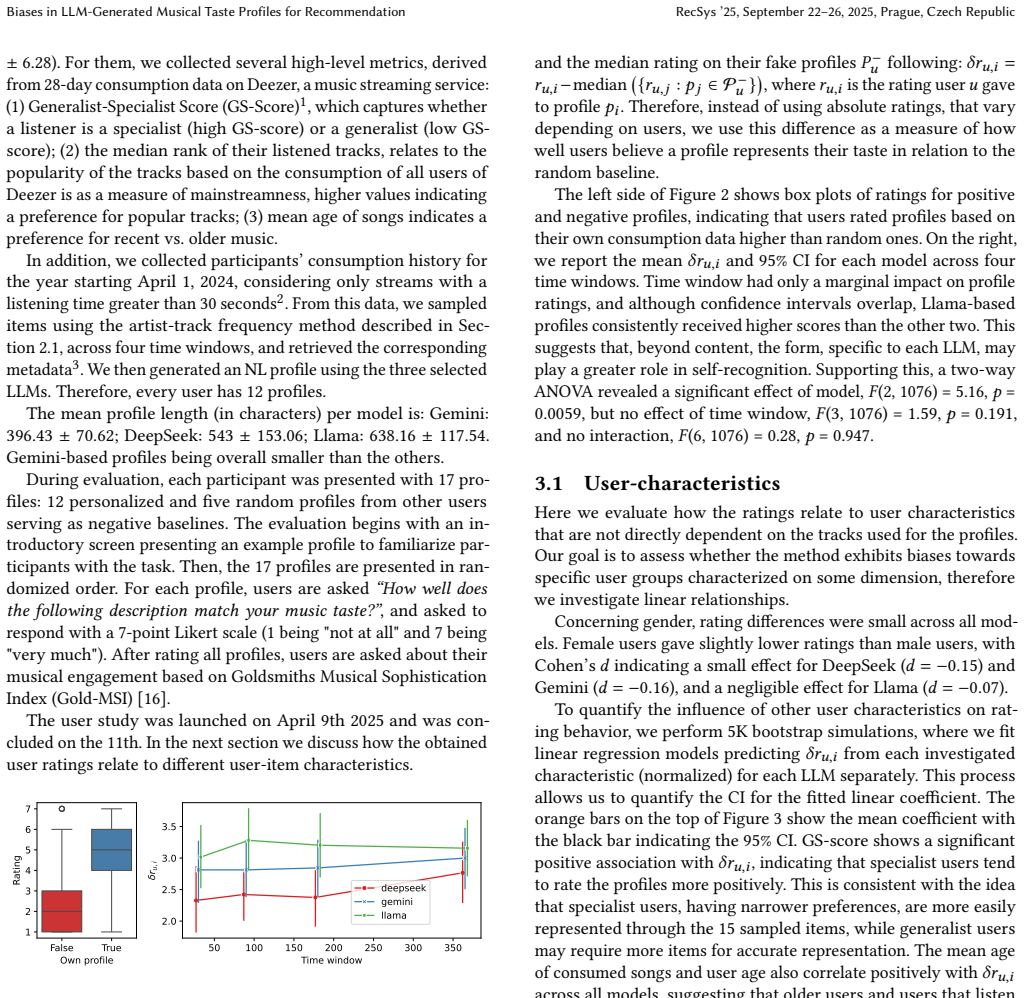
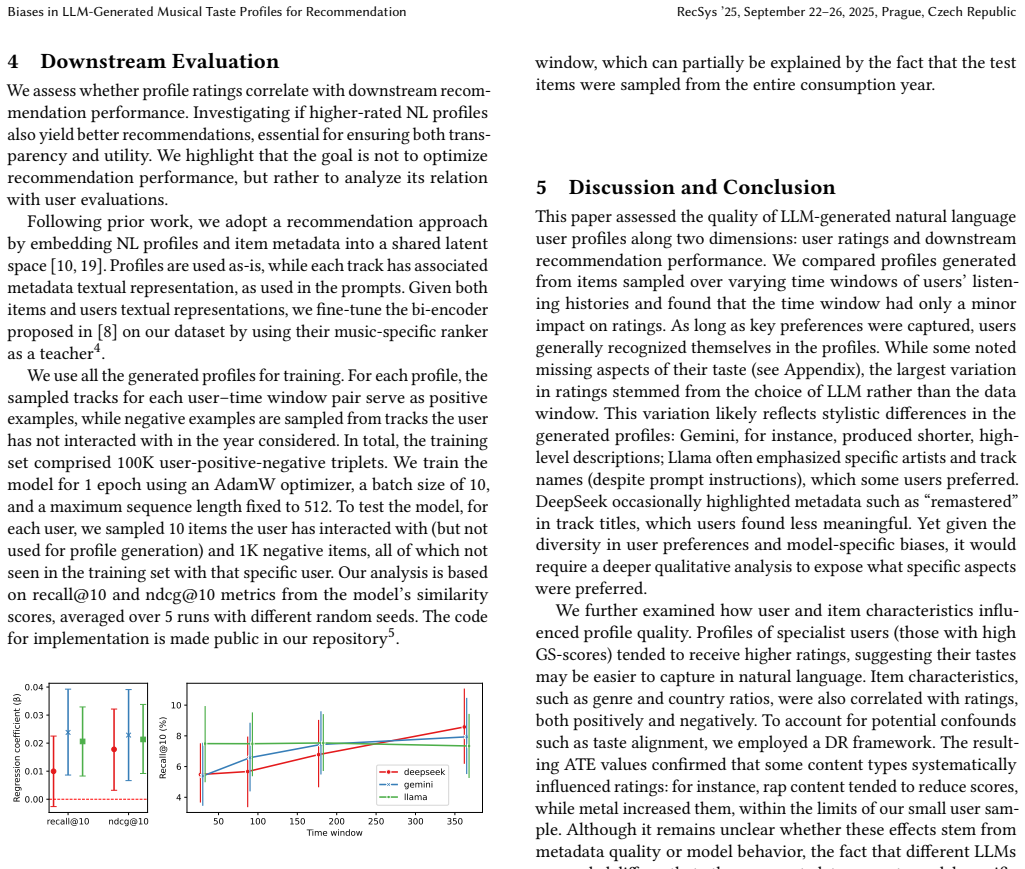
Summary. This paper studies biases in LLM-generated natural-language music taste profiles. Sixty-four Deezer employees rated 12 profiles generated from their own listening histories (3 LLMs \u00d7 4 time windows) plus 5 random other-user profiles as negative baselines; the analysis uses the per-user normalized rating \u03b4r_u,i (rating minus the median of that user's false-profile ratings). The authors test linear associations between \u03b4r and user attributes (GS-score, mainstreamness, age, engagement) and item-composition features (genre/country ratios, entropy), then apply a doubly robust (DR) ATE estimator to separate genre-ratio effects from taste confounding. They report that rap content lowers ratings while metal raises them across all three models, that specialist users rate their profiles higher, and that user ratings correlate only weakly with downstream recall@10/ndcg@10 of a fine-tuned bi-encoder. The central empirical claim is the rap/metal ATE result presented in Section 3.3 and reiterated in Section 5.
Significance. The question is timely and the experimental design has real strengths: random negative baselines; within-user \u03b4r normalization; doubly robust estimation to control for taste confounding; a downstream evaluation on held-out items not used in profile generation (so the recommendation metrics are genuinely out-of-sample, with no circularity); and release of the code and user-study dataset. Section 5's limitation statements (small N=64, three LLMs, in-house recruiting) are to the authors' credit and properly constrain external generalization, but they do not by themselves resolve the internal-validity concerns about the bootstrap inference. If the rap/metal ATE findings survive those concerns, the paper makes a concrete contribution to fairness evaluation of LLM-based profiling; if they do not, the headline claim loses its statistical support. The contribution is therefore conditional on the points in the major comments.
major comments (4)
- [§3.1–§3.3 and §4 (Figures 2–5)] The paper never specifies the resampling unit for any bootstrap procedure (5K in §3.1–§3.2, 1K in §3.3, and the recommendation regressions in §4). Each of the 64 users contributes four ratings per model (one per time window) and twelve across models, and the outcome \u03b4r_u,i shares a per-user baseline median across all of those ratings; profile-level resampling would therefore treat 256 correlated rows (per-model analyses) or 768 rows (cross-model analyses) as independent when the effective number of units is 64. The central claims that rap ATEs are consistently negative and metal ATEs consistently positive across models, the GS-score effect in §3.1, and the model differences in Figure 2 all rest on CI coverage. Please re-run all bootstrap analyses with the user as the resampling unit (keeping all profiles per sampled user), report both profile-level and user-level CIs, and state the resampling unit explicitly in the main text.
- [§3.2, Appendix (Figures 10–11)] The sentence 'We exclude associations with intervals crossing zero or with width greater than 10' applies a post-hoc filter to the very outcomes the section then interprets: on a \u03b4r scale that spans roughly \u22126 to +6, a 95% CI wider than 10 covers essentially the entire plausible response range, so the threshold is not interpretable as a precision safeguard. Because the filtering is applied after seeing the same bootstrap results, the 'consistently linked' associations in §3.2 (rap negative, US positive) are partly selected findings rather than confirmatory evidence. The same issue extends to §3.3, where the genre set for the DR analysis is restricted to the genres previously shown in Figure 3, making the rap/metal ATE tests non-independent of the screening step. Please either report the full set of associations without the width-based filter, or pre-specify a principled exclusion rule (e.g., based on a measure of minimum detectable effect) and apply it uniformly to §3.2, §3.3, and the Appendix.
- [§3.3 (ATE equation, Figure 4)] The DR estimator is the statistical basis for the headline causal claims, but the specification has a potential overlap between treatment and covariates, and no diagnostics are reported. Treatment is defined as a genre ratio above the median, while the covariate vector X is stated to include 'the genre composition of profile items'; if X contains the same profile genre ratio that defines T, then T is nearly a deterministic function of X, the estimated propensity scores collapse toward 0/1, and the DR weights 1/PS(X) and 1/(1\u2212PS(X)) become unstable. Please state precisely which profile-composition variables enter X for a given genre's treatment, confirm that the treated genre's own ratio is excluded from the propensity model, and report the distribution of estimated propensity scores across the 1K bootstrap runs. In addition, the analyses report no covariate-balance or overlap diagnostics, and it is not stated whether the propensity and outcome models are refit inside each bootstrap iteration.
- [§3.1–§3.3] Across §3.1–§3.3 the paper conducts bootstrap regressions for six user characteristics, eight genres, seven countries, two entropy measures, and two missingness proportions, for three separate LLMs (on the order of 50+ coefficient tests), and the ATE analysis adds 24 tests (8 genres \u00d7 3 models). No multiple-comparison control is reported, so some CIs will exclude zero by chance. For the rap and metal results to be presented as 'consistent' across all models, please report the total number of tests performed and provide a sensitivity check (e.g., a permutation-based false-discovery control, or a pre-specified small confirmatory set of genres) demonstrating that the rap/metal findings survive adjustment.
minor comments (6)
- [§3 (two-way ANOVA)] The reported F-statistics use (2,1076), (3,1076), and (6,1076) degrees of freedom, which implies N=1088 ratings; please clarify whether all 17 evaluations per user (including the five random baselines) entered the ANOVA and how the baseline profiles were assigned to model/window levels, since the text only describes factors over the 12 true profiles.
- [§3.1] The gender analysis reports Cohen's d values between \u22120.07 and \u22120.16 without confidence intervals or a significance test; please add CIs or soften the quantitative claim.
- [§3.1] User age and mean age of consumed songs are analyzed in separate regressions even though they are correlated (Pearson = 0.22, p = 0.048), so the two positive associations may reflect a single underlying effect; a joint model containing both predictors would clarify the incremental contribution.
- [§4] The downstream fine-tuning description is under-specified: it states that the bi-encoder from [8] is fine-tuned 'using their music-specific ranker as a teacher' but does not specify the distillation loss, whether the teacher produces soft targets, or how the 100K triplets are balanced across users and profiles, all of which are needed to reproduce the recommendation results.
- [Figure 4 caption] The caption says 'Blue bars show a consistent effect, while red bars correspond to estimates whose 95% CI bar crosses zero,' but the main text never defines 'consistent' beyond the CI not crossing zero, and the term is used per-model even though the narrative treats effects as consistent across models; please define the term explicitly.
- [Throughout] The model name is written inconsistently as both 'Deepseek' and 'DeepSeek'; please standardize. Also, the phrases '5K bootstrap simulations' and '1K bootstrap simulations' should state the resampling unit (users vs. profile rows) at first use.
Circularity Check
The DR 'ATE' in §3.3 collapses by construction to the raw genre-ratio/rating association, so the rap/metal causal claim is a renamed correlation rather than a confounder-controlled effect.
-
renaming known result
[Section 3.3 'Biases in NL profiles', ATE definition and Figure 4; echoed in Section 5 Discussion]
"To control for taste and exposure biases, we construct covariates X from each user's long-term genre ratios, the genre composition of profile items (to capture underrepresentation effects), user age, and GS-score. ... Treatment is defined as having a genre ratio above the median ... The bootstrapped ATE estimates in Figure 4 show that, even after controlling for our covariates, the presence of certain content types in the generated profiles still significantly influences user ratings."
The treatment indicator for each genre is T = 1{profile genre ratio > median}, which is a deterministic function of the covariate 'genre composition of profile items' explicitly included in X. Therefore the true propensity score is 0 for controls and 1 for treated units by construction. In the doubly robust formula, for treated units (Y - Yhat1)/PS + Yhat1 reduces to Y when PS=1, and for controls (Y - Yhat0)/(1-PS) + Yhat0 reduces to Y when PS=0, so the ATE collapses algebraically to the unadjusted mean difference E[Y|T=1] - E[Y|T=0]. This is exactly the same raw genre-ratio/rating association already reported in Section 3.2.
full rationale
The paper is fundamentally an empirical user study, and most of its analyses are self-contained rather than derived by construction. However, one load-bearing step is circular. In Section 3.3, the average treatment effect is defined by a median split of the profile genre ratio while the covariate set includes that same profile genre composition. Consequently, the propensity score is degenerate (0/1), and the doubly robust estimator reduces to the unadjusted mean difference between high- and low-ratio profiles. The conclusion in Section 5 that 'rap content tended to reduce scores, while metal increased them' therefore rests on an ATE that is mathematically identical to the raw association already displayed in Section 3.2. This is a renaming of a known result as a controlled causal estimate, not an independent confirmation. The other potential concerns are not circularity: the bootstrap confidence intervals treat profile ratings as independent even though users contribute multiple profiles, but that is a statistical validity issue, not a derivation reducing to its inputs; the self-cited teacher model [8] is used only as a tool in the downstream recommendation section and is not load-bearing for the bias claims; and the GS-score is an externally defined metric rather than a fitted version of the outcome. Because the central causal phrasing depends on the vacuous ATE adjustment, the circularity is partial but real, warranting a score of 6.
Assumptions & free parameters
free parameters (3)
- Genre/country inclusion threshold =
0.20 (proportion of users)
- CI width exclusion threshold =
10
- Median split for treatment in DR analysis =
per-genre median
assumptions (4)
- domain assumption Ratings on a 7-point Likert scale reflect perceived representativeness of taste.
- domain assumption The 30-second listening threshold defines a positive interaction.
- standard math Doubly robust estimation yields consistent ATE if either the outcome regression or the propensity model is correctly specified.
- standard math Bootstrap resampling yields valid confidence intervals for the regression coefficients.
Cite this review
Pith. "Pith review of Biases in LLM-Generated Musical Taste Profiles for Recommendation." pith.science (2026). https://pith.science/paper/WI46W2NS
@misc{pith2026250716708,
  author       = {Pith},
  title        = {Pith review of: Biases in LLM-Generated Musical Taste Profiles for Recommendation},
  year         = {2026},
  howpublished = {\url{https://pith.science/paper/WI46W2NS}},
  note         = {Machine review of arXiv:2507.16708}
}
read the original abstract
One particularly promising use case of Large Language Models (LLMs) for recommendation is the automatic generation of Natural Language (NL) user taste profiles from consumption data. These profiles offer interpretable and editable alternatives to opaque collaborative filtering representations, enabling greater transparency and user control. However, it remains unclear whether users consider these profiles to be an accurate representation of their taste, which is crucial for trust and usability. Moreover, because LLMs inherit societal and data-driven biases, profile quality may systematically vary across user and item characteristics. In this paper, we study this issue in the context of music streaming, where personalization is challenged by a large and culturally diverse catalog. We conduct a user study in which participants rate NL profiles generated from their own listening histories. We analyze whether identification with the profiles is biased by user attributes (e.g., mainstreamness, taste diversity) and item features (e.g., genre, country of origin). We also compare these patterns to those observed when using the profiles in a downstream recommendation task. Our findings highlight both the potential and limitations of scrutable, LLM-based profiling in personalized systems.
Figures
Figures from the paper (7 more)
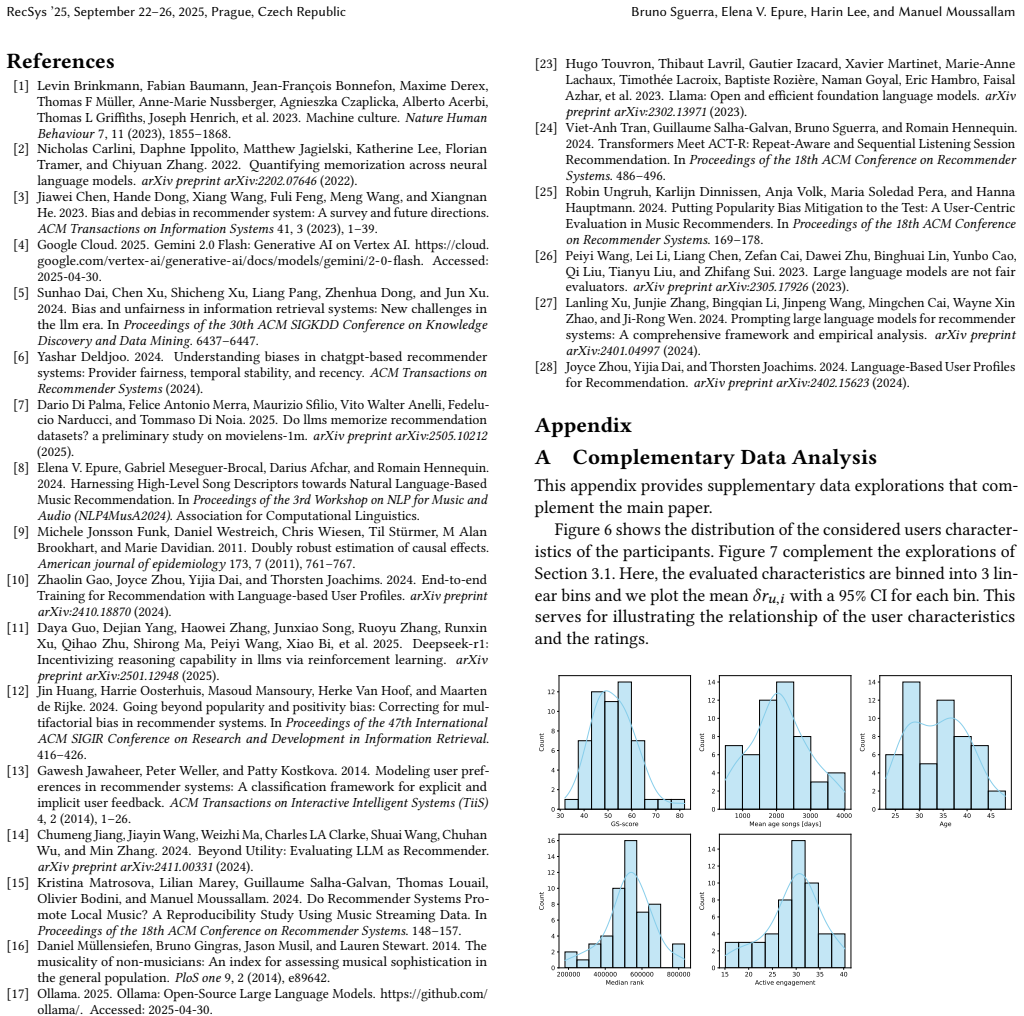
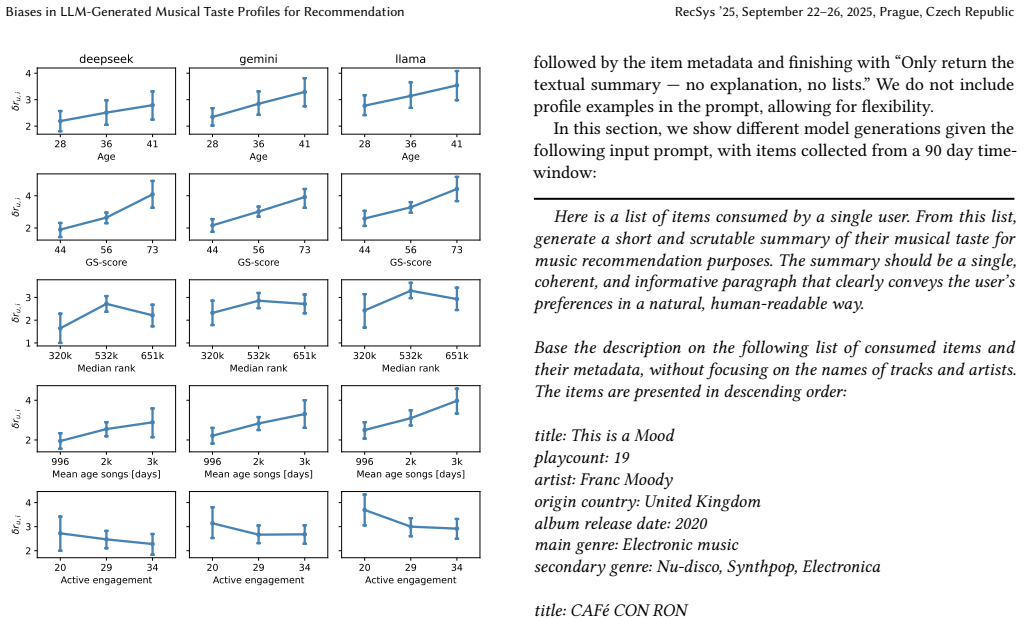
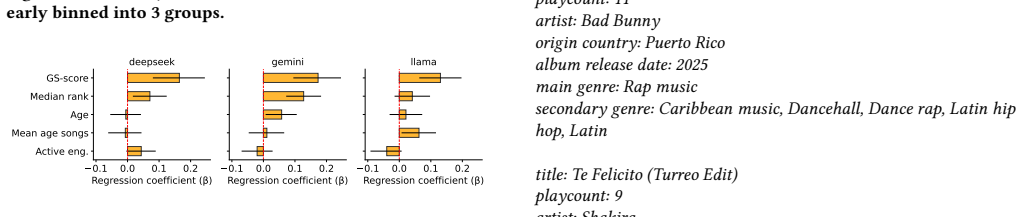
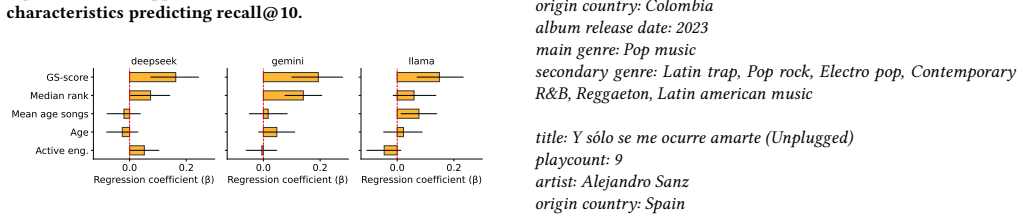
Reference graph
Works this paper leans on
-
[1]
Levin Brinkmann, Fabian Baumann, Jean-François Bonnefon, Maxime Derex, Thomas F Müller, Anne-Marie Nussberger, Agnieszka Czaplicka, Alberto Acerbi, Thomas L Griffiths, Joseph Henrich, et al. 2023. Machine culture. Nature Human Behaviour 7, 11 (2023), 1855–1868
work page 2023
-
[2]
Nicholas Carlini, Daphne Ippolito, Matthew Jagielski, Katherine Lee, Florian Tramer, and Chiyuan Zhang. 2022. Quantifying memorization across neural language models. arXiv preprint arXiv:2202.07646 (2022)
arXiv 2022
-
[3]
Jiawei Chen, Hande Dong, Xiang Wang, Fuli Feng, Meng Wang, and Xiangnan He. 2023. Bias and debias in recommender system: A survey and future directions. ACM Transactions on Information Systems 41, 3 (2023), 1–39
2023
-
[4]
Google Cloud. 2025. Gemini 2.0 Flash: Generative AI on Vertex AI. https://cloud. google.com/vertex-ai/generative-ai/docs/models/gemini/2-0-flash. Accessed: 2025-04-30
work page 2025
-
[5]
Sunhao Dai, Chen Xu, Shicheng Xu, Liang Pang, Zhenhua Dong, and Jun Xu
-
[6]
Yashar Deldjoo. 2024. Understanding biases in chatgpt-based recommender systems: Provider fairness, temporal stability, and recency. ACM Transactions on Recommender Systems (2024)
work page 2024
-
[7]
Dario Di Palma, Felice Antonio Merra, Maurizio Sfilio, Vito Walter Anelli, Fedelu- cio Narducci, and Tommaso Di Noia. 2025. Do llms memorize recommendation datasets? a preliminary study on movielens-1m. arXiv preprint arXiv:2505.10212 (2025)
work page Pith review arXiv 2025
-
[8]
Epure, Gabriel Meseguer-Brocal, Darius Afchar, and Romain Hennequin
Elena V. Epure, Gabriel Meseguer-Brocal, Darius Afchar, and Romain Hennequin
Show all 32 references
-
[9]
Michele Jonsson Funk, Daniel Westreich, Chris Wiesen, Til Stürmer, M Alan Brookhart, and Marie Davidian. 2011. Doubly robust estimation of causal effects. American journal of epidemiology 173, 7 (2011), 761–767
2011
-
[10]
In Proceedings of the 3rd Workshop on NLP for Music and Audio (NLP4MusA2024)
Harnessing High-Level Song Descriptors towards Natural Language-Based Music Recommendation. In Proceedings of the 3rd Workshop on NLP for Music and Audio (NLP4MusA2024). Association for Computational Linguistics
-
[11]
Daya Guo, Dejian Yang, Haowei Zhang, Junxiao Song, Ruoyu Zhang, Runxin Xu, Qihao Zhu, Shirong Ma, Peiyi Wang, Xiao Bi, et al . 2025. Deepseek-r1: Incentivizing reasoning capability in llms via reinforcement learning. arXiv preprint arXiv:2501.12948 (2025)
2025 arXiv
-
[12]
Zhaolin Gao, Joyce Zhou, Yijia Dai, and Thorsten Joachims. 2024. End-to-end Training for Recommendation with Language-based User Profiles. arXiv preprint arXiv:2410.18870 (2024)
2024 arXiv
-
[13]
Gawesh Jawaheer, Peter Weller, and Patty Kostkova. 2014. Modeling user pref- erences in recommender systems: A classification framework for explicit and implicit user feedback. ACM Transactions on Interactive Intelligent Systems (TiiS) 4, 2 (2014), 1–26
2014
-
[14]
Jin Huang, Harrie Oosterhuis, Masoud Mansoury, Herke Van Hoof, and Maarten de Rijke. 2024. Going beyond popularity and positivity bias: Correcting for mul- tifactorial bias in recommender systems. In Proceedings of the 47th International ACM SIGIR Conference on Research and De...
2024
-
[15]
Kristina Matrosova, Lilian Marey, Guillaume Salha-Galvan, Thomas Louail, Olivier Bodini, and Manuel Moussallam. 2024. Do Recommender Systems Pro- mote Local Music? A Reproducibility Study Using Music Streaming Data. In Proceedings of the 18th ACM Conference on Recommender Syst...
2024
-
[16]
Chumeng Jiang, Jiayin Wang, Weizhi Ma, Charles LA Clarke, Shuai Wang, Chuhan Wu, and Min Zhang. 2024. Beyond Utility: Evaluating LLM as Recommender. arXiv preprint arXiv:2411.00331 (2024)
2024 arXiv
-
[17]
Ollama. 2025. Ollama: Open-Source Large Language Models. https://github.com/ ollama/. Accessed: 2025-04-30
2025
-
[18]
Daniel Müllensiefen, Bruno Gingras, Jason Musil, and Lauren Stewart. 2014. The musicality of non-musicians: An index for assessing musical sophistication in the general population. PloS one 9, 2 (2014), e89642
2014
-
[19]
Filip Radlinski, Krisztian Balog, Fernando Diaz, Lucas Dixon, and Ben Wedin. 2022. On natural language user profiles for transparent and scrutable recommendation. In Proceedings of the 45th International ACM SIGIR Conference on Research and Development in Information Retrieval...
2022
-
[20]
Pantelis Pipergias Analytis and Philipp Hager. 2023. Collaborative filtering algorithms are prone to mainstream-taste bias. In Proceedings of the 17th ACM Conference on Recommender Systems . 750–756
2023
-
[21]
Markus Schedl. 2019. Deep learning in music recommendation systems. Frontiers in Applied Mathematics and Statistics 5 (2019), 457883
2019
-
[22]
Jerome Ramos, Hossein A Rahmani, Xi Wang, Xiao Fu, and Aldo Lipani. 2024. Transparent and Scrutable Recommendations Using Natural Language User Profiles. In Proceedings of the 62nd Annual Meeting of the Association for Compu- tational Linguistics (Volume 1: Long Papers) . 13971–13984
2024
-
[23]
Hugo Touvron, Thibaut Lavril, Gautier Izacard, Xavier Martinet, Marie-Anne Lachaux, Timothée Lacroix, Baptiste Rozière, Naman Goyal, Eric Hambro, Faisal Azhar, et al. 2023. Llama: Open and efficient foundation language models. arXiv preprint arXiv:2302.13971 (2023)
2023 arXiv
-
[24]
Bruno Sguerra, Viet-Anh Tran, Romain Hennequin, and Manuel Moussallam
-
[25]
Robin Ungruh, Karlijn Dinnissen, Anja Volk, Maria Soledad Pera, and Hanna Hauptmann. 2024. Putting Popularity Bias Mitigation to the Test: A User-Centric Evaluation in Music Recommenders. In Proceedings of the 18th ACM Conference on Recommender Systems. 169–178
2024
-
[26]
Peiyi Wang, Lei Li, Liang Chen, Zefan Cai, Dawei Zhu, Binghuai Lin, Yunbo Cao, Qi Liu, Tianyu Liu, and Zhifang Sui. 2023. Large language models are not fair evaluators. arXiv preprint arXiv:2305.17926 (2023)
2023 arXiv
-
[27]
Viet-Anh Tran, Guillaume Salha-Galvan, Bruno Sguerra, and Romain Hennequin
-
[28]
In Proceedings of the 18th ACM Conference on Recommender Systems
Transformers Meet ACT-R: Repeat-Aware and Sequential Listening Session Recommendation. In Proceedings of the 18th ACM Conference on Recommender Systems. 486–496
-
[31]
Lanling Xu, Junjie Zhang, Bingqian Li, Jinpeng Wang, Mingchen Cai, Wayne Xin Zhao, and Ji-Rong Wen. 2024. Prompting large language models for recommender systems: A comprehensive framework and empirical analysis. arXiv preprint arXiv:2401.04997 (2024)
2024 arXiv
-
[32]
Only return the textual summary — no explanation, no lists
Joyce Zhou, Yijia Dai, and Thorsten Joachims. 2024. Language-Based User Profiles for Recommendation. arXiv preprint arXiv:2402.15623 (2024). Appendix A Complementary Data Analysis This appendix provides supplementary data explorations that com- plement the main paper. Figure 6...
2024 arXiv
-
[2024]
In Proceedings of the 30th ACM SIGKDD Conference on Knowledge Discovery and Data Mining
Bias and unfairness in information retrieval systems: New challenges in the llm era. In Proceedings of the 30th ACM SIGKDD Conference on Knowledge Discovery and Data Mining . 6437–6447
-
[2025]
In Proceedings of the 33rd ACM Conference on User Modeling, Adaptation and Personalization
Uncertainty in Repeated Implicit Feedback as a Measure of Reliability. In Proceedings of the 33rd ACM Conference on User Modeling, Adaptation and Personalization
Reviewed August 6, 2026 · model on record in the stance chip above.
Discussion (0). Sign in to comment.