A Numerical Experiment on Oscillatory Magnetic Reconnection in a Laboratory Plasma System Driven by Alternating Currents
Pith reviewed 2026-06-27 14:27 UTC · model grok-4.3
The pith
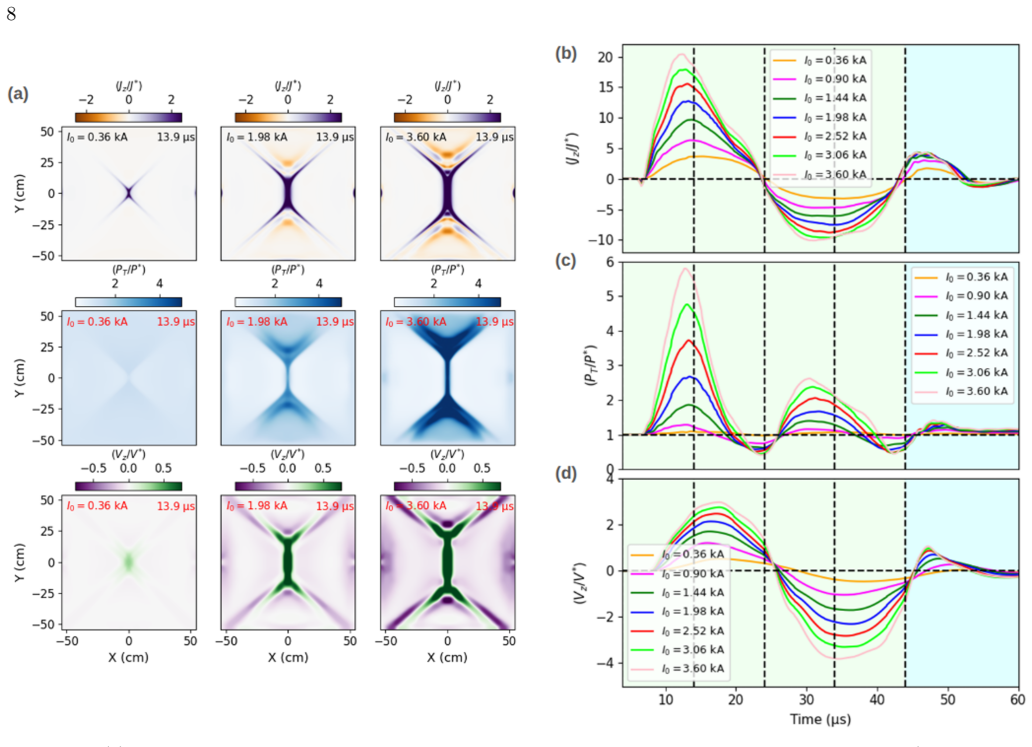
Alternating currents cause a magnetic null to collapse into y-directed then x-directed current sheets with lagging Hall flows.
A machine-rendered reading of the paper's core claim, the machinery that carries it, and where it could break.
Core claim
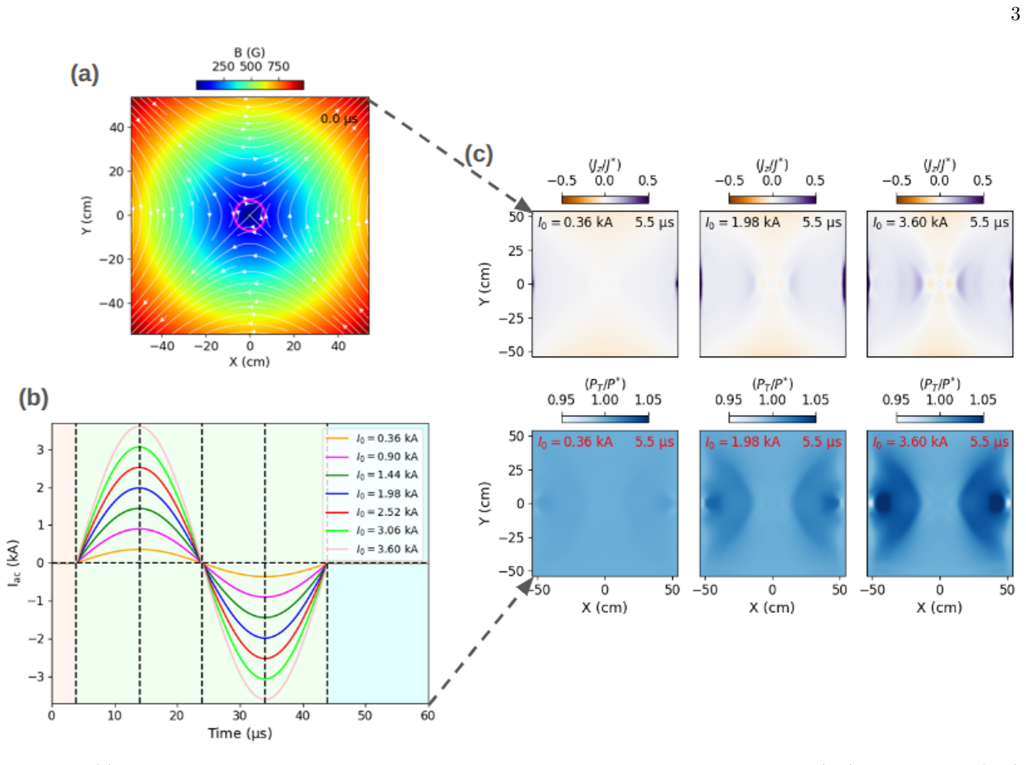
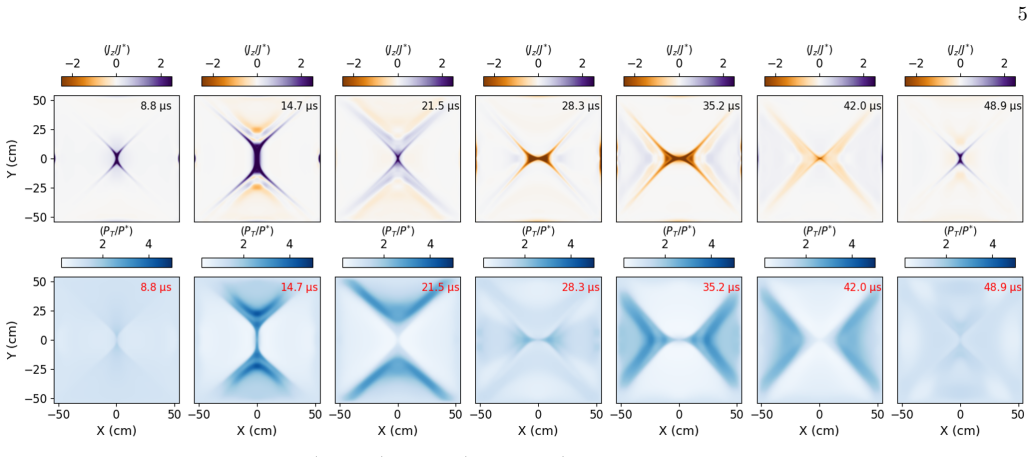
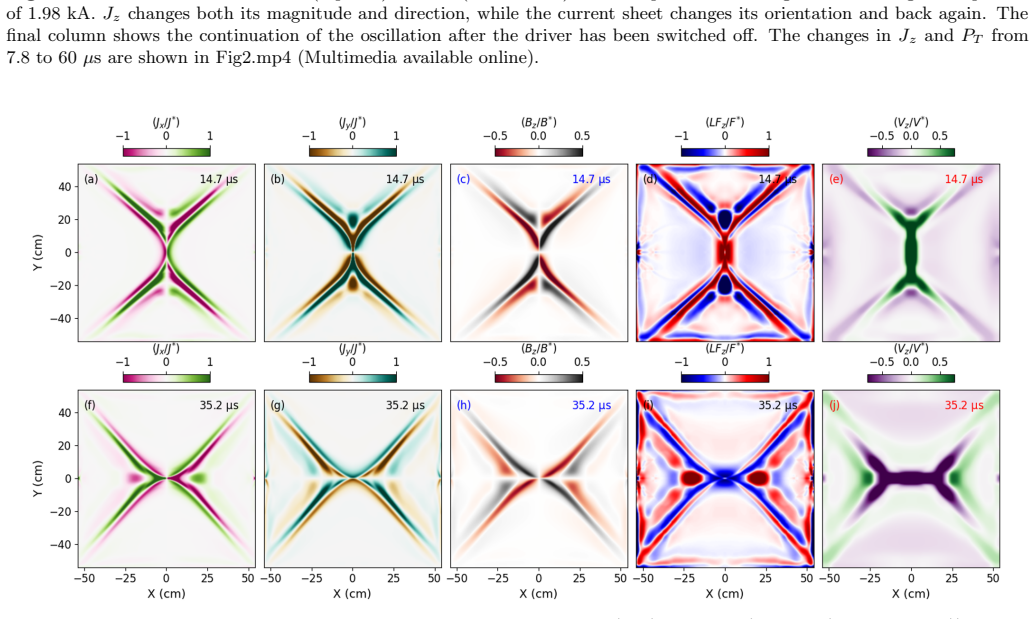
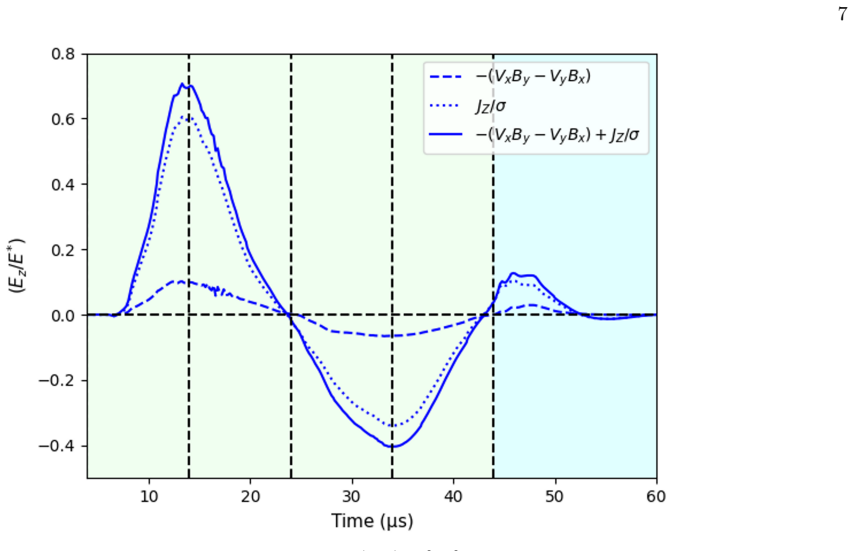
The magnetic null region collapses to first form a y-directed current sheet that later changes its orientation to the x-direction. The x-directed current sheet has smaller enhanced thermal pressure and out-of-plane current than the y-directed current sheet. The Hall effect produces an out-of-plane plasma flow that evolves with a time lag with respect to the enhanced thermal pressure and out-of-plane current density. Increasing the amplitude of the alternating current produces higher thermal pressure, out-of-plane current density, and out-of-plane plasma flow, while the first peaks of thermal pressure and out-of-plane current density occur earlier.
What carries the argument
collapse and reorientation of the current sheet at the magnetic null under alternating-current boundary driving, with the Hall term generating lagged out-of-plane flow
If this is right
- Higher alternating current amplitude increases thermal pressure, out-of-plane current density, and out-of-plane plasma flow.
- The first peaks in thermal pressure and out-of-plane current density occur at earlier times when amplitude is raised.
- The y-directed current sheet develops stronger pressure and current enhancements than the later x-directed sheet.
- Out-of-plane plasma flow from the Hall effect appears with a measurable delay after the pressure and current peaks.
Where Pith is reading between the lines
- The described time lag implies a specific temporal ordering in how magnetic energy converts to thermal and kinetic forms during each cycle.
- Similar driving in other null configurations could produce observable flow lags even when full reorientation does not occur.
- If the lag persists across different resistivities, it may serve as a diagnostic for Hall-mediated reconnection in varying plasma regimes.
Load-bearing premise
The numerical setup including the alternating-current boundary driving and Hall term treatment faithfully reproduces the laboratory plasma without dominant artifacts.
What would settle it
Direct measurement in a physical experiment of whether the current sheet switches from y to x orientation and whether out-of-plane flow peaks lag the thermal pressure and current peaks would test the result.
Figures
read the original abstract
Using the open source MPI-AMRVAC framework, we study oscillatory reconnection in a laboratory plasma, which occurs when a magnetic null is perturbed by incoming fast magnetoacoustic waves driven by an alternating current. The magnetic null region collapses to first form a $y$-directed current sheet that later changes its orientation to the $x$-direction. The $x$-directed current sheet has smaller enhanced thermal pressure and out-of-plane current than the $y$-directed current sheet. The Hall effect produces an out-of-plane plasma flow that evolves with a time lag with respect to the enhanced thermal pressure and out-of-plane current density. Increasing the amplitude of the alternating current produces higher thermal pressure, out-of-plane current density, and out-of-plane plasma flow, while the first peaks of thermal pressure and out-of-plane current density occur earlier.
Editorial analysis
A structured set of objections, weighed in public.
Referee Report
Summary. The manuscript presents a numerical experiment using the open-source MPI-AMRVAC code to simulate oscillatory magnetic reconnection in a laboratory plasma driven by alternating currents at a magnetic null. It reports that the null collapses first into a y-directed current sheet that later reorients to an x-directed sheet possessing smaller enhanced thermal pressure and out-of-plane current; the Hall term generates an out-of-plane plasma flow that lags the pressure and current enhancements; and increasing the driving amplitude raises the peak values while advancing the first peaks of pressure and current.
Significance. If the reported sequence, property differences, and time lag prove robust, the work would supply concrete dynamical insight into how Hall physics and wave driving control current-sheet orientation and flow timing in driven reconnection. The open-source framework and parameter study on driving amplitude are strengths that could aid reproducibility and extension to other lab configurations.
major comments (1)
- [Abstract and Results] The abstract and results sections state specific outcomes (y-to-x reorientation, reduced pressure/current in the x-sheet, Hall-induced time lag, and amplitude scalings) without any reported grid resolution, AMR refinement criteria, convergence tests, resistivity model details, or Hall-term-off controls. Because these quantities are the central claims, the absence of such validation leaves open the possibility that the timing, orientation change, and lag are sensitive to numerical diffusion, boundary artifacts, or grid bias, as flagged in the weakest assumption.
Simulated Author's Rebuttal
We thank the referee for the detailed review and constructive feedback on our numerical experiment. We address the single major comment below and will incorporate the requested validation details into a revised manuscript.
read point-by-point responses
-
Referee: [Abstract and Results] The abstract and results sections state specific outcomes (y-to-x reorientation, reduced pressure/current in the x-sheet, Hall-induced time lag, and amplitude scalings) without any reported grid resolution, AMR refinement criteria, convergence tests, resistivity model details, or Hall-term-off controls. Because these quantities are the central claims, the absence of such validation leaves open the possibility that the timing, orientation change, and lag are sensitive to numerical diffusion, boundary artifacts, or grid bias, as flagged in the weakest assumption.
Authors: We agree that explicit reporting of numerical parameters and validation tests is necessary to support the central claims. The original manuscript describes the MPI-AMRVAC setup at a high level but does not include the requested quantitative details or control runs. In the revised version we will add a new subsection (Numerical Methods and Validation) that reports: (i) base grid resolution and AMR refinement criteria (including the refinement threshold on current density and magnetic field divergence), (ii) the explicit resistivity model (including value and spatial dependence), (iii) results of convergence tests at three resolutions, and (iv) direct comparisons with otherwise identical runs performed with the Hall term switched off. These additions will be referenced from both the abstract and results sections so that readers can immediately assess numerical robustness. revision: yes
Circularity Check
No circularity: results are direct outputs of a forward numerical simulation
full rationale
The paper describes a numerical experiment in MPI-AMRVAC that evolves an alternating-current-driven magnetic null and reports the resulting current-sheet reorientation, pressure/current differences, and Hall-induced flow lag as simulation outputs. No parameter fitting to target data, no self-definitional relations, and no load-bearing self-citations that reduce the central claims to prior author work are present in the provided text. The derivation chain consists of initial conditions plus discretized MHD/Hall equations whose outputs are the reported quantities; these outputs are not forced by construction to match any fitted input.
Axiom & Free-Parameter Ledger
free parameters (1)
- amplitude of alternating current
axioms (1)
- domain assumption Hall-MHD equations govern the evolution of the plasma and magnetic field.
Reference graph
Works this paper leans on
-
[1]
Birn, J., Drake, J. F., Shay, M. A., et al. 2001, J. Geophys. Res., 106, 3715, doi: 10.1029/1999JA900449
-
[2]
2024, Fundamental Plasma Physics, 10, 100049, doi: 10.1016/j.fpp.2024.100049
Stewart, J. 2024, Fundamental Plasma Physics, 10, 100049, doi: 10.1016/j.fpp.2024.100049
-
[3]
Craig, I., & McClymont, A. 1991, Astrophys. J., 371, L41, doi: 10.1086/185997
-
[4]
Drake, J. F., Shay, M. A., & Swisdak, M. 2008, Physics of Plasmas, 15, 042306, doi: 10.1063/1.2901194
-
[5]
Drake, J. F., Antiochos, S. K., Bale, S. D., et al. 2025, SSRv, 221, 27, doi: 10.1007/s11214-025-01153-x
-
[6]
2021, Exploring 3D Collisionless Magnetic Reconnection in the Laboratory, NASA Proposal ID
Egedal, J. 2021, Exploring 3D Collisionless Magnetic Reconnection in the Laboratory, NASA Proposal ID. 21-HTIDS21-0003
2021
-
[7]
2014, PhRvL, 113, 105003, doi: 10.1103/PhysRevLett.113.105003
Fiksel, G., Fox, W., Bhattacharjee, A., et al. 2014, PhRvL, 113, 105003, doi: 10.1103/PhysRevLett.113.105003
-
[8]
2011, in 2010 NASA Laboratory Astrophysics Workshop, C45
Fox, W., Bhattacharjee, A., & Germaschewski, K. 2011, in 2010 NASA Laboratory Astrophysics Workshop, C45
2011
-
[9]
2022, in APS Meeting Abstracts, Vol
Fox, W., Schaeffer, D., Fiksel, G., et al. 2022, in APS Meeting Abstracts, Vol. 2022, APS Division of Plasma Physics Meeting Abstracts, CM09.005
2022
-
[10]
Frank, A. G., & Savinov, S. A. 2024, Symmetry, 16, 103, doi: 10.3390/sym16010103
-
[11]
Gershman, D. J., Fuselier, S. A., Cohen, I. J., et al. 2024, SSRv, 220, 7, doi: 10.1007/s11214-023-01017-2
-
[12]
Goedbloed, J. P. H., & Poedts, S. 2004, Principles of Magnetohydrodynamics
2004
-
[13]
Hare, J. D., Suttle, L., Lebedev, S. V., et al. 2017, PhRvL, 118, 085001, doi: 10.1103/PhysRevLett.118.085001
-
[14]
High resolution schemes for hyperbolic conservation laws , journal =
Harten, A. 1983, Journal of Computational Physics, 49, 357, doi: 10.1016/0021-9991(83)90136-5
-
[15]
Hesse, M., & Cassak, P. A. 2020, Journal of Geophysical Research (Space Physics), 125, e25935, doi: 10.1029/2018JA025935 11
-
[16]
Huba, J. D. 1995, Physics of Plasmas, 2, 2504, doi: 10.1063/1.871212
-
[17]
Huba, J. D. 2003, in Space Simulations, ed. M. Scholer, C. Dum, & J. B¨ uchner (New York: Springer), 170–197
2003
-
[18]
D., & Rudakov, L
Huba, J. D., & Rudakov, L. I. 2002, Phys. Plasmas, 9, 4435
2002
-
[19]
Huba, J. D., & Rudakov, L. I. 2003, Physics of Plasmas, 10, 3139, doi: 10.1063/1.1582474
-
[20]
Karampelas, K., McLaughlin, J. A., Botha, G. J. J., & R´ egnier, S. 2022, ApJ, 925, 195, doi: 10.3847/1538-4357/ac3b53 —. 2023, ApJ, 943, 131, doi: 10.3847/1538-4357/acac90
-
[21]
2023, A&A, 673, A66, doi: 10.1051/0004-6361/202245359
Keppens, R., Popescu Braileanu, B., Zhou, Y., et al. 2023, A&A, 673, A66, doi: 10.1051/0004-6361/202245359
-
[22]
Knoll, D. A., & Chac´ on, L. 2006, PhRvL, 96, 135001, doi: 10.1103/PhysRevLett.96.135001
-
[23]
Leroy, M. H. J., & Keppens, R. 2017, Physics of Plasmas, 24, 012906, doi: 10.1063/1.4974758
-
[24]
Malakit, K., Cassak, P. A., Shay, M. A., & Drake, J. F. 2009, Geophys. Res. Lett., 36, L07107, doi: 10.1029/2009GL037538
-
[25]
Mandt, M. E., Denton, R. E., & Drake, J. F. 1994, Geophys. Res. Lett., 21, 73, doi: 10.1029/93GL03382
-
[26]
McLaughlin, J. A., De Moortel, I., Hood, A. W., & Brady, C. S. 2009, A&A, 493, 227, doi: 10.1051/0004-6361:200810465
-
[27]
McLaughlin, J. A., Thurgood, J. O., & MacTaggart, D. 2012, A&A, 548, A98, doi: 10.1051/0004-6361/201220234
-
[28]
Mondal, S., Srivastava, A. K., Pontin, D. I., et al. 2024, ApJ, 977, 235, doi: 10.3847/1538-4357/ad9022
-
[29]
Moreno-Insertis, F., Hansteen, V. H., & N´ obrega-Siverio, D. 2025, arXiv e-prints, arXiv:2510.19993, doi: 10.48550/arXiv.2510.19993
-
[30]
Nakamura, R., Burch, J. L., Birn, J., et al. 2025, SSRv, 221, 17, doi: 10.1007/s11214-025-01143-z
-
[31]
2016, PhRvL, 116, 255001, doi: 10.1103/PhysRevLett.116.255001
Olson, J., Egedal, J., Greess, S., et al. 2016, PhRvL, 116, 255001, doi: 10.1103/PhysRevLett.116.255001
-
[32]
Pontin, D. I., & Priest, E. R. 2022, Living Reviews in Solar Physics, 19, 1, doi: 10.1007/s41116-022-00032-9
-
[33]
Pontin, D. I., Wyper, P. F., & Priest, E. R. 2024, in Magnetohydrodynamic Processes in Solar Plasmas, ed. A. K. Srivastava, M. Goossens, & I. Arregui, 345–414, doi: 10.1016/B978-0-32-395664-2.00014-1
-
[34]
2014, Magnetohydrodynamics of the Sun, doi: 10.1017/CBO9781139020732
Priest, E. 2014, Magnetohydrodynamics of the Sun, doi: 10.1017/CBO9781139020732
-
[35]
Richter, M. M., Mu˜ noz, P. A., & Spanier, F. 2025, Physics of Plasmas, 32, 093904, doi: 10.1063/5.0268535
-
[36]
Rogers, B. N., Denton, R. E., Drake, J. F., & Shay, M. A. 2001, PhRvL, 87, 195004, doi: 10.1103/PhysRevLett.87.195004
-
[37]
1984, SoPh, 91, 103, doi: 10.1007/BF00213617
Sakai, J., Tajima, T., & Brunel, F. 1984, SoPh, 91, 103, doi: 10.1007/BF00213617
-
[38]
2025, SSRv, 221, 81, doi: 10.1007/s11214-025-01210-5
Shay, M., Adhikari, S., Beesho, N., et al. 2025, SSRv, 221, 81, doi: 10.1007/s11214-025-01210-5
-
[39]
Shay, M. A., Drake, J. F., Rogers, B. N., & Denton, R. E. 2001, J. Geophys. Res., 106, 3759, doi: 10.1029/1999JA001007
-
[40]
The Astrophysical Journal , keywords =
Srivastava, A. K., Mishra, S. K., Jel´ ınek, P., et al. 2019, ApJ, 887, 137, doi: 10.3847/1538-4357/ab4a0c
-
[41]
The Astrophysical Journal , keywords =
Srivastava, A. K., Mondal, S., Priest, E. R., et al. 2025, ApJ, 984, 36, doi: 10.3847/1538-4357/adc379
-
[42]
Stanier, A., Daughton, W., Simakov, A. N., et al. 2017, Physics of Plasmas, 24, 022124, doi: 10.1063/1.4976712
-
[43]
Thurgood, J. O., Pontin, D. I., & McLaughlin, J. A. 2017, ApJ, 844, 2, doi: 10.3847/1538-4357/aa79fa
-
[44]
Uzdensky, D. A., & Kulsrud, R. M. 2006, Physics of Plasmas, 13, 062305, doi: 10.1063/1.2209627 van Leer, B. 1979, Journal of Computational Physics, 32, 101, doi: 10.1016/0021-9991(79)90145-1
-
[45]
2017, Journal of Plasma Physics, 83, 205830501, doi: 10.1017/S0022377817000782
Vekstein, G. 2017, Journal of Plasma Physics, 83, 205830501, doi: 10.1017/S0022377817000782
-
[46]
2005, in American Institute of Physics Conference Series, Vol
Yamada, M., Ji, H., Kulsrud, R., et al. 2005, in American Institute of Physics Conference Series, Vol. 784, Magnetic Fields in the Universe: From Laboratory and Stars to Primordial Structures., ed. E. M. de Gouveia dal Pino, G. Lugones, & A. Lazarian (AIP), 27–41, doi: 10.1063/1.2077169
-
[47]
2010, Reviews of Modern Physics, 82, 603, doi: 10.1103/RevModPhys.82.603
Yamada, M., Kulsrud, R., & Ji, H. 2010, Reviews of Modern Physics, 82, 603, doi: 10.1103/RevModPhys.82.603
-
[48]
2014, Nature Communications, 5, 4774, doi: 10.1038/ncomms5774
Yamada, M., Yoo, J., Jara-Almonte, J., et al. 2014, Nature Communications, 5, 4774, doi: 10.1038/ncomms5774
-
[49]
Yamada, M., Yoo, J., & Myers, C. E. 2016, Physics of Plasmas, 23, 055402, doi: 10.1063/1.4948721
-
[50]
1997, Physics of Plasmas, 4, 1936, doi: 10.1063/1.872336
Yamada, M., Ji, H., Hsu, S., et al. 1997, Physics of Plasmas, 4, 1936, doi: 10.1063/1.872336
discussion (0)
Sign in with ORCID, Apple, or X to comment. Anyone can read and Pith papers without signing in.