REVIEW 3 major objections 4 minor 15 references
Soft Robotics-Inspired Flexible Antenna Arrays
T0 review · 3 major / 4 minor · reviewed 2026-08-06 · deepseek-v4-flash
Pith's one-line read The paper claims that an antenna array whose geometry is bent like soft tentacles, with only two control parameters per tentacle, can outperform fixed and per-element reconfigurable arrays in multi-user MISO downlinks.
desk verdict New soft-robot antenna model with real potential, but the SCA gradient omits the precoder dependence and the headline gains don't reconcile; worth a serious referee, but needs a major fix. read the letter →
The pith
A machine-rendered reading of the paper's core claim, the machinery that carries it, and where it could break.
The reading
What carries the argument
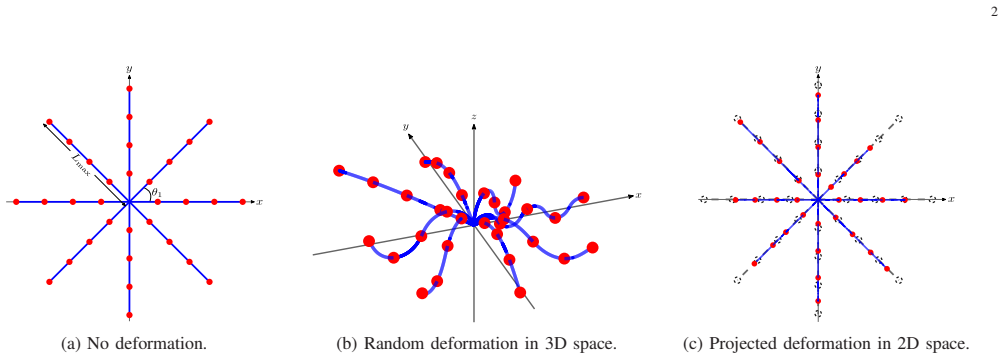
The central object is the tentacle deformation map. Each of the $M$ tentacles carries $N$ elements and is modeled as a space curve of fixed total length $L_{\max}$, with vertical deformation $z_m(\ell)=A_m\sin(v_m\ell)$. To keep the arc length fixed, the in-plane projection is $u_m(\ell)=\int_0^\ell\sqrt{1-[A_m v_m \cos(v_m \bar{\ell})]^2}\,d\bar{\ell}$, so the $2M$ parameters $(A_m,v_m)$ for $m=1,\ldots,M$ determine all $MN$ element positions in three dimensions. The optimization then alternates between computing the sum rate and its gradient at the current deformation and solving a convex subproblem built from a first-order Taylor expansion of the objective and constraints.
What would settle it
At the same channel realizations used in the paper, compute the exact sum rate at the deformation returned by the SCA loop using the full channel-dependent ZF precoder, and compare it with the output of a fine grid search over $(A_m,v_m)$; if the SCA solution is no better than random deformations or the gain over the fixed array disappears, the reported 73% and 26% gains rest on the omitted precoder-derivative term.
Extended reading notes
Core claim
The paper's central claim is that bending the whole antenna structure—rather than moving each antenna element—is a genuine new source of spatial degrees of freedom. The tentacle model preserves the total arc length $L_{\max}$ while deforming, so the $\lambda/2$ spacing between elements is maintained and mutual coupling is not worsened. With the ZF precoder fixed, the paper derives a first-order surrogate of the sum rate and uses successive convex approximation to search over the $2M$ deformation parameters. The numerical result that carries the claim is the reported up-to-73% and up-to-26% sum-rate gains over the fixed and per-element baselines.
Load-bearing premise
The optimization treats the zero-forcing precoder as fixed when computing the gradient, although the precoder depends on the channel and hence on the deformation, so the first-order model may not match the true objective.
Editorial extensions
If this is right
- If the reported gains are real, future base stations could be made reconfigurable with $2M$ control parameters instead of one per element, reducing actuation hardware and power.
- The benefit is larger in interference-limited settings: at $K=4$ the SRA adds about 12 bps/Hz over the fixed array, roughly twice the gain at $K=2$.
- Because arc length is preserved during deformation, the element spacing stays at $\lambda/2$, so structure bending does not at first order worsen mutual coupling.
- The 3D per-element benchmark still achieves higher rates than the SRA, so the paper's contribution is a favorable tradeoff between control complexity and performance, not a claim of absolute capacity gain.
Reading between the lines
- A natural extension the paper leaves implicit: allowing more than one sinusoidal harmonic per tentacle (or non-sinusoidal shapes) would stay within the structure-level actuation paradigm while adding parameters; it could close some of the gap to the 3D per-element upper bound.
- The channel model assumes perfect channel state information; under imperfect CSI the relative advantage of deformation over fixed arrays may shrink, and this can be tested by feeding the same algorithm noisy channel estimates.
- The model assumes any $(A_m,v_m)$ satisfying $|A_m v_m|\le 1$ is physically reachable; an actuator model with bandwidth or stiffness limits could restrict this set, and a hardware test of the commanded shapes would show whether the assumed configuration space is realistic.
Editorial analysis
A structured set of objections, weighed in public.
Referee Report
Summary. The manuscript proposes a soft-robot-inspired antenna array (SRA) in which each of M tentacles carries N antenna elements and deforms as a sinusoidal vertical displacement with amplitude A_m and spatial frequency v_m, while preserving total arc length. The authors model a multi-user MISO downlink with a geometric Saleh-Valenzuela channel and ZF precoding, formulate the sum-rate maximization over the 2M deformation parameters as a nonconvex problem, and propose an SCA algorithm based on a first-order Taylor expansion with the gradient computed in Appendix A. Simulation results claim substantial gains: up to 72.6% over a fixed concentric circular array and up to 26.2% over a 2D reconfigurable array, with a 3D per-element array as an upper bound. The paper concludes that structure-level flexibility is a promising new degree of freedom for antenna arrays.
Significance. The idea is timely and practically motivated: soft continuum robots with tip-extending or pneumatically actuated structures have been demonstrated in the antenna literature, so a mathematical model of structure-level reconfigurability is a useful addition. The arc-length-preserving deformation model and the reduction of the search space from MN element coordinates to 2M deformation parameters are clean and are the paper's main conceptual strengths. The authors also provide a transparent complexity analysis and compare against three baselines. I rate the significance conditional: if the optimization is corrected and the gains survive, the paper would establish a new array topology worth further study; if the gains are an artifact of the flawed gradient, the contribution reduces to a model description with an unverified optimization algorithm.
major comments (3)
- [Appendix A, Eq. (23)] The gradient used in the SCA surrogate (Eq. (18)) differentiates the SINR terms S_ki with respect to z_{m,n} while treating the ZF precoder w_i as a constant. However, in Eqs. (12)-(13) w_i is a column of W(z) = alpha(z) H(z)^H (H(z)H(z)^H)^{-1}, and H(z) depends on every deformation parameter through Eqs. (5)-(7); hence d w_i / d z_{m,n} is generally nonzero and the omitted terms can be significant. Since Eq. (18) is the first-order model on which (P2) is built, the SCA updates are not guaranteed to ascend the true sum rate, and the convergence statement in Algorithm 1 is unsupported. The numerical gains in Fig. 2 (e.g., 61.9%, 18.1%, 72.6%, 26.2%) are therefore not established as properties of the SRA geometry until the experiments are rerun with an exact gradient, or with the implemented gradient verified against finite differences.
- [Section II-B, Eq. (13)] The printed ZF precoder F = H(H^H H)^{-1} has the wrong dimensions for the stated H in C^{K x MN}; it would map to C^{K x MN}, and the Gram matrix H^H H is singular when K < MN (e.g., MN = 32 and K <= 4 in the simulations). The standard ZF precoder is F = H^H (H H^H)^{-1} in C^{MN x K}, and the text should also correct the statement 'F in C^{M x K}' to 'F in C^{MN x K}'. Please confirm that the simulations implement the corrected form; otherwise the SINR in Eq. (15) is not computed from a valid ZF precoder and the numerical results cannot be interpreted.
- [Section IV (Benchmarks)] The optimization procedure for the reconfigurable CCAA baselines (2D and 3D) is not described. The reported gains over the 2D reconfigurable array (up to 26%) are meaningful only if the baseline positions are optimized to a comparable local optimum with a comparable algorithm; if the baselines use random or heuristic placements, the comparison favors the SRA by construction. Please specify the baseline optimization (objective, algorithm, initialization, number of runs) or use published benchmark results.
minor comments (4)
- [Section II-A / Appendix A, Eq. (24)] The vertical displacement is written as A_m sin(omega t + v_m ell_n) in Eq. (1) and Eq. (24), but Eq. (5) uses A_m sin(v_m ell_n) after the text says the time dependence is dropped. Please fix the phase convention and state whether t is set to a specific value per coherence block.
- [Section III (Algorithm 1)] The text says the algorithm 'converges to the optimal solution'; with a first-order SCA surrogate it should say 'converges to a stationary point' under standard SCA assumptions, and even that requires a correct gradient. The current wording overclaims.
- [Section V (Conclusion)] The conclusion states that the SRA outperforms fixed and per-element RA geometries 'by 26% and 73%, respectively', but Fig. 2(a) reports gains over the fixed CCAA of 61.9-72.6% and over the 2D RA of 18.1-26.2%; the order appears reversed and the values do not match.
- [Section IV (Reproducibility)] The paper reports no code or data availability. Providing the simulation code or a detailed reproducibility note would strengthen the paper, especially because the main quantitative claims depend on the optimization implementation.
Circularity Check
No significant circularity: the SRA sum-rate results follow from the model and simulations without recycling fitted constants or load-bearing self-citations.
full rationale
The derivation chain is self-contained: the tentacle geometry defines element positions through Eqs. (1)-(5), the Saleh-Valenzuela channel in Eq. (6) builds H(z), the ZF precoder in Eqs. (12)-(13) defines the SINR and sum-rate in Eqs. (15)-(17), and the SCA procedure in Eqs. (18)-(19) optimizes the deformation parameters. No fitted constant or calibration target is recycled into the reported gains. The fixed and per-element RA baselines are evaluated in the same simulation framework with the same geometry and channel model, so the comparison is not statistically forced. The only self-citation, Ref. [9] (Efrem and Krikidis), is used as background on fluid-antenna joint position optimization and is not load-bearing for the SRA claim; other robotics citations, Refs. [13] and [14], are external and provide physical motivation rather than the mathematical result. The sinusoidal deformation is openly declared as an assumption, not smuggled in by citation. The observation that SRA can always match the fixed array because Am=0 is feasible in P1 is a monotonicity property, not a circular reduction; the quantitative gains and the gains over per-element RA are data-dependent simulation outcomes. The Appendix A gradient keeps w_i fixed while differentiating, which may be an accuracy or convergence concern, but it does not make the reported performance equal to the paper's inputs by construction. Overall, the central claim has independent content and no circular step is exhibited.
Assumptions & free parameters
assumptions (5)
- domain assumption Saleh-Valenzuela channel model with Nc clusters and Np paths per cluster
- ad hoc to paper The deformation of each tentacle is a single sinusoid with amplitude A_m and spatial frequency v_m
- domain assumption The total arc length remains constant under deformation, enforced by Eqs. (2)-(4) with |A_m v_m| ≤ 1
- domain assumption Zero-forcing precoding with equal power normalization
- standard math Directional cosine antenna pattern with directivity factor κ
Cite this review
Pith. "Pith review of Soft Robotics-Inspired Flexible Antenna Arrays." pith.science (2026). https://pith.science/paper/WIZHCTAL
@misc{pith2026250706589,
  author       = {Pith},
  title        = {Pith review of: Soft Robotics-Inspired Flexible Antenna Arrays},
  year         = {2026},
  howpublished = {\url{https://pith.science/paper/WIZHCTAL}},
  note         = {Machine review of arXiv:2507.06589}
}
read the original abstract
In this work, a novel soft continuum robot-inspired antenna array is proposed, featuring tentacle-like structures with multiple antenna elements. The proposed array achieves reconfigurability through continuous deformation of its geometry, in contrast to reconfigurable antennas which incur a per-element control. More specifically, the deformation is modeled by amplitude and spatial frequency parameters. We consider a multi-user multiple-input single-output downlink system, whereby the optimal deformation parameters are found to maximize the sum rate in the network. A successive convex approximation method is adopted to solve the problem. Numerical results show that the proposed deformable array significantly outperforms fixed geometry and per-element reconfigurable arrays in sum rate, demonstrating the benefits of structure-level flexibility for next-generation antenna arrays.
Figures

Reference graph
Works this paper leans on
-
[1]
6G wireless systems: Vision, requirements, challenges, insights, and opportunities,
H. Tataria, M. Shafi, A. F. Molisch, M. Dohler, H. Sj¨ oland , and F. Tufvesson, “6G wireless systems: Vision, requirements, challenges, insights, and opportunities,” Proc. IEEE, vol. 109, no. 7, pp. 1166–1199, Jul. 2021
work page 2021
-
[2]
Robust beamfor ming design for RIS-assisted cognitive radio systems with hardw are impair- ments,
H. Hui, Y . Zou, Y . Li, L. Zhai, and B. Ning, “Robust beamfor ming design for RIS-assisted cognitive radio systems with hardw are impair- ments,” IEEE Trans. V eh. Technol. , vol. 73, no. 12, pp. 19080-19095, Dec. 2024
work page 2024
-
[3]
Fl uid antenna systems,
K.-K. Wong, A. Shojaeifard, K.-F. Tong, and Y . Zhang, “Fl uid antenna systems,” IEEE Trans. Wireless Commun., vol. 20, no. 3, pp. 1950–1962, Mar. 2021
1950
-
[4]
Modeling and performance ana lysis for movable antenna enabled wireless communications,
L. Zhu, W. Ma, and R. Zhang, “Modeling and performance ana lysis for movable antenna enabled wireless communications,” IEEE Trans. Wireless Commun., vol. 23, no. 6, pp. 6234–6250, Jun. 2024
2024
-
[5]
Flexible antenna arrays for wireless communication s: Modeling and performance evaluation,
S. Y ang, J. An, Y . Xiu, W. Lyu, B. Ning, Z. Zhang, M. Debbah, and C. Y uen, “Flexible antenna arrays for wireless communication s: Modeling and performance evaluation,” IEEE Trans. Wireless Commun. , vol. 24, no. 6, pp. 4937-4951, Jun. 2025
work page 2025
-
[6]
Flexible intelligent metasurfaces for downlink mu ltiuser MISO communications,
J. An, C. Y uen, M. D. Renzo, M. Debbah, H. Vincent Poor, and L. Hanzo, “Flexible intelligent metasurfaces for downlink mu ltiuser MISO communications,” IEEE Trans. Wireless Commun. , vol. 24, no. 4, pp. 2940-2955, Apr. 2025
work page 2025
-
[7]
W. K. New et al., “A tutorial on fluid antenna system for 6G n etworks: Encompassing communication theory, optimization methods and hard- ware designs,” IEEE Commun. Surv. Tuts. , early access, Nov. 15, 2024
work page 2024
-
[8]
Movable antennas for wireless commu- nication: Opportunities and challenges
L. Zhu, W. Ma and R. Zhang, “Movable antennas for wireless commu- nication: Opportunities and challenges”, IEEE Commun. Mag. , vol. 62, no. 6, pp. 114-120, Jun. 2024
work page 2024
Show all 15 references
-
[9]
Transmit and receive antenn a port selection for channel capacity maximization in fluid-MIMO systems
C. N. Efrem and I. Krikidis, “Transmit and receive antenn a port selection for channel capacity maximization in fluid-MIMO systems”, IEEE Wireless Commun. Lett. , vol. 13, no. 11, pp. 3202–3206, Nov. 2024
2024
-
[10]
G lobally optimal movable antenna-enhanced multi-user communicati on: Discrete antenna positioning, motion power consumption, and imperf ect CSI,
Y . Wu, D. Xu, D. W. K. Ng, W. Gerstacker, and R. Schober, “G lobally optimal movable antenna-enhanced multi-user communicati on: Discrete antenna positioning, motion power consumption, and imperf ect CSI,” arXiv preprint arXiv:2408.15435 , Aug. 2024
2024 arXiv
-
[11]
Flexibl e intelligent metasurface for enhancing multi-target wireless sensing
Z. Teng, J. An, L. Gan, N. Al-Dhahir, and Z. Han, “Flexibl e intelligent metasurface for enhancing multi-target wireless sensing” , IEEE Trans. V eh. Technol., early access, Jul. 2025
2025
-
[12]
Design, fabrication and contro l of soft robots,
D. Rus and M. T. Tolley, “Design, fabrication and contro l of soft robots,” Nature, vol. 521, no. 7553, pp. 467–475, May 2015
2015
-
[13]
A tip-extending soft robot enables reconfigurab le and deployable antennas,
L. H. Blumenschein, L. T. Gan, J. A. Fan, A. M. Okamura, an d E. W. Hawkes, “A tip-extending soft robot enables reconfigurab le and deployable antennas,” IEEE Robot. Automat. Lett. , vol. 3, no. 2, pp. 949–956, Apr. 2018
2018
-
[14]
Rotenna: Harnessing seaml ess integra- tion of continuum robot for dynamic electromagnetic reconfi guration
F. Deng, S. Y ao and K. M. Luk, “Rotenna: Harnessing seaml ess integra- tion of continuum robot for dynamic electromagnetic reconfi guration”, IEEE Robot. Automat. Lett. , vol. 8, no. 12, pp. 8557-8564, Dec. 2023
2023
-
[15]
C. A. Balanis, Antenna theory: Analysis and design , 2nd ed. John Wiley & Sons, Inc., 1997
1997
Reviewed August 6, 2026 · model on record in the stance chip above.
Discussion (0). Continue with ORCID to comment.