REVIEW 3 major objections 6 minor 102 references
DWM: Separating World Effects from Actions in Latent World Models
T0 review · 3 major / 6 minor · reviewed 2026-08-01 · deepseek-v4-flash
Pith's one-line read A training-time auxiliary world head can separate what the environment does on its own from what the agent's action changes in latent world models, and that separation is what makes planning succeed under persistent gravity, drift, and iner
desk verdict Worth reviewing: clever supervision-level decomposition with consistent planning gains, but the zero-action identification is untested. read the letter →
The pith
A machine-rendered reading of the paper's core claim, the machinery that carries it, and where it could break.
The reading
What carries the argument
The central object is the additive identity zhat = zhat_w + zhat_a, where zhat_w is the output of the training-only world head attached to the shared predictor state and zhat_a is defined as the residual zhat - zhat_w. The identity is operationalized from the counterfactual definition of the world effect—the expected next latent under a zero action—and is enforced by two auxiliary losses: a world-contrastive InfoNCE objective that makes zhat_w invariant to action perturbations while keeping it state-discriminative, and an orthogonality constraint that forces zhat_w and zhat_a to encode complementary information. Because the extra branch is discarded at inference, the entire mechanism lives i
What would settle it
Compare the world head's output to the actual zero-action next latent on held-out PushT-W frames with the action held to zero; if the cosine similarity or MSE of the world head against this counterfactual target is no better than an action-invariant constant, the contrastive objective has not identified the world effect and the planning gains must come from a different mechanism.
Extended reading notes
Core claim
On the paper's own terms, the discovery is that the next-latent target of a latent world model should be decomposed during training into an action-invariant world component and an action-driven residual, and that this can be done without touching the inference architecture. DWM keeps the original prediction head (the only head used at planning time) and adds a parallel world head that reads the same predictor state. A normalized InfoNCE objective makes the world head's output invariant to random perturbations of the current action yet discriminative across states, and an orthogonality penalty separates the world readout from the residual action component. The paper shows that this supervisio
Load-bearing premise
The load-bearing premise is that the world-contrastive InfoNCE objective (Eq. 7) forces the world head to encode the true counterfactual world effect of Eq. 4—the expected next latent under a zero action—rather than any other action-invariant, state-dependent function; if that identification fails, the orthogonality constraint can distort the prediction head and the decomposition may not be what improves planning.
Editorial extensions
If this is right
- If the decomposition is what drives the gains, then any action-conditioned latent world model can be made more plan-accurate in environments with persistent world effects by changing only its training objective, not its architecture or inference pipeline.
- The improved prediction quality should transfer to downstream uses of the dynamics model—policy learning, imagination-based search, and long-horizon reasoning—not just CEM planning, because the paper observes the same gains in one-step and horizon-20 rollout error.
- The stability of the action-driven component across out-of-distribution gravity (cosine similarity 0.9991) implies the learned decomposition generalizes to world-effect settings the model was not trained on.
- Because adding zero-action training data to a single-target model does not restore planning success, the paper's conclusion is that the bottleneck is the training objective, not data coverage.
- The fact that flat benchmarks show no degradation means the extra supervision is inert when no action-invariant world effect exists, so the method is safe to apply to standard control tasks as well.
Reading between the lines
- I would expect the same training-time decomposition to transfer to other latent-dynamics objectives (for example, TD-style or diffusion-based predictors), but the paper only demonstrates it on one backbone and one task family; that is a testable extension rather than a claim.
- A direct identifiability check—comparing the world head's output to the true zero-action next latent, which the paper's own Section 3.3 experiment has the data for—would settle whether the contrastive loss recovers the intended counterfactual or merely some action-invariant nuisance.
- If the decomposition is identifiable, a useful by-product would be that dynamics models could be reused across environments that share action effects but differ in world effects, since the action-driven component is learned to be world-invariant.
- The 6-point gain on Ball-in-Cup, where the world effect is state-dependent oscillation rather than a constant drift, suggests the benefit may shrink as the world effect becomes harder to fit with an action-invariance assumption; this is my inference, not the paper's.
Editorial analysis
A structured set of objections, weighed in public.
Referee Report
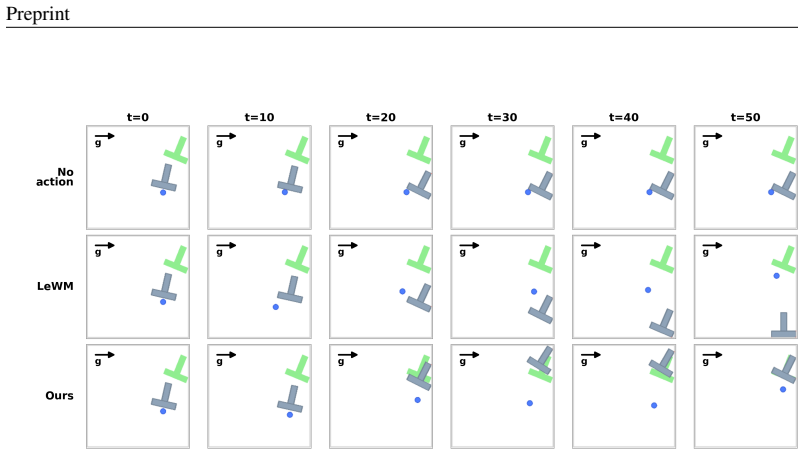
Summary. The paper proposes DWM, a training-time modification of action-conditioned latent world models. DWM adds an auxiliary world head h_w to the shared predictor state, trains it with a world-contrastive InfoNCE objective (Eq. 7) to be invariant to action perturbations while discriminative across contexts, and defines the action-driven component as the residual z_a = z - z_w, with an orthogonality regularizer. The central claim is that this induces a decomposition z = z_w + z_a, where z_w approximates the zero-action counterfactual world effect defined in Eq. 4, and that this supervision-level separation improves CEM planning in environments with persistent action-invariant dynamics. The paper evaluates DWM on new W-variants of PushT, Reacher, and TwoRoom, plus Ball-in-Cup, reporting large planning gains on the W-variants (e.g., +12.0 pp on PushT-W), roughly parity on flat counterparts, and improved one-step and rollout prediction losses.
Significance. The paper's contribution is potentially useful: it is model-agnostic, leaves the inference-time architecture unchanged, and the proposed W-variant benchmark suite is a constructive step toward evaluating world models under persistent action-invariant dynamics. The zero-action data experiment in Section 3.3 is a good falsifiable probe, and the OOD gravity test is a welcome robustness check. However, the central mechanistic claim — that h_w learns the counterfactual world effect of Eq. 4 — is not yet established. The objective in Eq. 7 enforces action-invariance, which is a necessary but not sufficient condition for identifying Eq. 4; without direct comparison to zero-action targets, the decomposition remains partly definitional. The empirical evidence also needs stronger statistical backing. If the identification gap is closed and the statistics are tightened, the paper would make a solid contribution to model-based control.
major comments (3)
- [Sections 3.2, 4.2 (Eqs. 4, 7)] Eq. 7 does not identify the counterfactual target in Eq. 4. The positive term of L_wc only requires h_w(g(context, a_t)) to be invariant to the current action for a fixed history; any function of the history/context — including z_t itself, a constant, or an action-invariant nuisance feature — satisfies it. The negative term prevents collapse to a constant but does not single out E[z_{t+1} | history, a_t=0] - z_t. The paper never compares h_w's output to the actual zero-action next latent, despite having zero-action transitions available from the Section 3.3 protocol and from the W-variant simulators. Table 1 demonstrates only action-invariance, not correctness. Because z_a is defined as the residual z - z_w, Eq. 5 is true by construction and cannot validate the decomposition. Consequently, the planning gains in Fig. 3 may arise from L_wc acting as a generic contrastive regularizer on the
- [Section 5.2, Tables 2 and 3] The statistical support for the main empirical claim is thin. All headline planning results (Fig. 3) average over only 3 CEM planner seeds with n=50 start–goal pairs per seed, yet the text does not report the numeric error bars or confidence intervals shown in the figure; no paired significance test is given for the main improvements. Table 2 reports large prediction-loss reductions (e.g., -89.8% one-step on PushT-W) with no variance, sample size, or test. Table 3 appears to report a single evaluation per ablation configuration, with no repeated seeds. Given the differences are 10.7–16.7 percentage points, the authors should report per-seed results, confidence intervals, and paired tests (or equivalent) for the main comparisons and ablations, and state explicitly how many training and evaluation seeds each table uses.
- [Section 5.3, Table 1] The disentanglement diagnostic overclaims what it shows. Low world-head variance under action perturbation is necessary for h_w to be action-invariant, but it is also satisfied by a constant function or any action-invariant state-dependent feature; it says nothing about whether h_w matches the zero-action world effect of Eq. 4. The sentence 'the action-invariant world effect that our objective was designed to isolate' is therefore an unsupported identification assertion. The authors should either provide direct evidence that h_w's output aligns with the zero-action counterfactual target, or soften the mechanistic interpretation to 'action-invariant component' without claiming it equals the true world effect.
minor comments (6)
- [Section 3.3] The claim that 32.0% vs 30.0% is 'statistically indistinguishable' needs a test or at least a variance estimate; with n=50 pairs and 3 seeds, the statement is under-supported.
- [Section 5.4] The OOD cosine similarity (0.9991) and effect MSE (0.0015) are reported without baseline or normalization. If the action-driven component has small norm, these values are inflated. Report the norm of z_a and compare against a random-feature baseline.
- [Notation] The encoder is denoted both φ (Section 3.1) and ϕ (Section 4.1, Figure 2); please standardize.
- [Section 3.1 / Appendix A] For Reacher-W, please clarify what 'null action' means in the DMC action space (zero joint torques) and whether the reported zero-action world effect includes the arm's passive dynamics under gravity.
- [Section 5.2 / Figure 3] The error bars in Fig. 3 should be either reported numerically in the text or in a table; the current narrative only gives point estimates.
- [Table 2] The metric names 'Offline pred loss' and 'Rollout@20 pred loss' are used for both latent MSE and qpos error; please clarify in the table caption that different tasks use different error spaces.
Circularity Check
No circularity: the additive split is explicitly a modelling identity, and the planning gains are external empirical results.
full rationale
The claimed derivation chain is not circular. The only place where the world/action decomposition is 'by construction' is Eq. 5 (Δz_action := Δz − Δz_world) and its model analogue ẑ_a := ẑ − ẑ_w in Section 4.1; the paper explicitly labels Eq. 5 a 'modelling identity rather than a claim that the two effects combine additively at the physical level,' so the additive split is an inductive bias, not a predicted empirical fact. The world head h_w is trained with the world-contrastive InfoNCE loss (Eq. 7), which enforces action-invariance and state-discriminability; Table 1's confirmation that h_w is action-invariant therefore checks the training objective rather than independently verifying identification with the zero-action counterfactual of Eq. 4. That is an identification/validation gap—the paper never compares h_w to the actual zero-action next-latent targets, despite having such data in the Section 3.3 experiment—but it is not a circular reduction: Eq. 7 does not contain Eq. 4's target, and no fitted parameter is renamed as a prediction. The central empirical claims—CEM planning success on the three W-variants, rollout errors, Ball-in-Cup, and OOD gravity—are external evaluations against baselines under matched training and CEM protocols, and the reported gains do not follow by construction from the definition of ẑ_a. There are no load-bearing self-citations; references to LeWM, Dino-WM, and related work are to other groups' work. The paper's main limitation is an unverified identification assumption, not circularity, so it scores 0 on the circularity scale.
Assumptions & free parameters
free parameters (4)
- λ_wc =
0.3
- λ_orth =
0.5
- τ (InfoNCE temperature) =
0.07
- λ_sig (latent regularizer weight) =
not reported
assumptions (5)
- domain assumption The action-invariant world effect is the expected next latent when the current action is replaced by zero (Eq. 4), and is independent of the actual action.
- ad hoc to paper InfoNCE invariance to random action perturbations suffices to identify the zero-action world effect (Eq. 7 approximates Eq. 4).
- ad hoc to paper The true action-driven residual is approximately orthogonal to the world component in latent space (L_orth).
- domain assumption LeWM with single-target supervision is a strong and representative baseline; CEM planning in latent space is a fair evaluation protocol.
- domain assumption The 30% zero-action mixture test in Section 3.3 rules out data coverage as an explanation.
invented entities (1)
-
Action-invariant world-effect component Δz_world (and its learned readout h_w)
Cite this review
Pith. "Pith review of DWM: Separating World Effects from Actions in Latent World Models." pith.science (2026). https://pith.science/paper/WJLE4J57
@misc{pith2026260718715,
  author       = {Pith},
  title        = {Pith review of: DWM: Separating World Effects from Actions in Latent World Models},
  year         = {2026},
  howpublished = {\url{https://pith.science/paper/WJLE4J57}},
  note         = {Machine review of arXiv:2607.18715}
}
read the original abstract
Latent world models underpin much of modern model-based control, yet current action-conditioned formulations supervise the next-latent transition with a single, undifferentiated target, forcing a monolithic learning signal to absorb every source of state change. In real world, however, transitions arise from two heterogeneous sources: an action-driven component induced by the agent, and an action-invariant world effect -- the change that would still occur under a null action, dictated by the environment's intrinsic dynamics (e.g., gravity-driven sliding, inertia, contact rebound, and persistent drift). Fusing them into a single target entangles the two inside the latent transition, prevents the model from attributing observed changes to their underlying causes, and undermines the transferability of the learned dynamics. We introduce DWM (Decomposed World Model), a supervision-level framework that operationalizes this decomposition. DWM augments the predictor of a latent world model with an auxiliary world head, regularized by a normalized world-contrastive objective to be action-invariant, while the original pred head is coupled to it via an orthogonality constraint; together, the two signals induce an explicit additive decomposition of the predicted transition into an action-invariant and a complementary action-driven component, without altering the underlying architecture or inference pipeline. To evaluate DWM under persistent world effects, we construct W-variants of three standard control benchmarks -- PushT-W, Reacher-W, and TwoRoom-W -- each instantiating a distinct action-invariant dynamic. DWM matches strong baselines on the flat counterparts and delivers a mean absolute improvement of 13.1% in CEM planning success across the W-variants.
Figures


Figures from the paper (1 more)

Reference graph
Works this paper leans on
-
[1]
Scaling Learning Algorithms Towards
Bengio, Yoshua and LeCun, Yann , booktitle =. Scaling Learning Algorithms Towards
-
[2]
and Osindero, Simon and Teh, Yee Whye , journal =
Hinton, Geoffrey E. and Osindero, Simon and Teh, Yee Whye , journal =. A Fast Learning Algorithm for Deep Belief Nets , volume =
-
[3]
2016 , publisher =
Deep learning , author =. 2016 , publisher =
2016
-
[4]
ICML , year =
Learning latent dynamics for planning from pixels , author =. ICML , year =
-
[5]
ICLR , year =
Dream to control: Learning behaviors by latent imagination , author =. ICLR , year =
-
[6]
ICLR , year =
Mastering Atari with discrete world models , author =. ICLR , year =
-
[7]
arXiv preprint arXiv:2301.04104 , year =
Mastering diverse domains through world models , author =. arXiv preprint arXiv:2301.04104 , year =
-
[8]
ICML , year =
Temporal difference learning for model predictive control , author =. ICML , year =
Show all 102 references
-
[9]
ICLR , year =
TD-MPC2: Scalable, robust world models for continuous control , author =. ICLR , year =
-
[10]
arXiv preprint arXiv:2301.08243 , year =
Self-supervised learning from images with a joint-embedding predictive architecture , author =. arXiv preprint arXiv:2301.08243 , year =
-
[11]
arXiv preprint arXiv:2603.19312 , year =
LeWorldModel: Stable End-to-End Joint-Embedding Predictive Architecture from Pixels , author =. arXiv preprint arXiv:2603.19312 , year =
-
[12]
ICLR , year =
Data-efficient reinforcement learning with self-predictive representations , author =. ICLR , year =
-
[13]
arXiv preprint arXiv:2605.21800 , year =
Stable-worldmodel: Reproducible infrastructure for world-model research , author =. arXiv preprint arXiv:2605.21800 , year =
-
[14]
ICLR , year =
Contingency-aware exploration in reinforcement learning , author =. ICLR , year =
-
[15]
ICML , year =
Denoised MDPs: Learning world models better than the world itself , author =. ICML , year =
-
[16]
ICLR , year =
AdaRL: What, where, and how to adapt in transfer reinforcement learning , author =. ICLR , year =
-
[17]
ICML , year =
Genie: Generative interactive environments , author =. ICML , year =
-
[18]
arXiv preprint arXiv:2312.10812 , year =
Learning to act without actions: Latent action policies from observation , author =. arXiv preprint arXiv:2312.10812 , year =
-
[19]
ICLR , year =
Contrastive learning of structured world models , author =. ICLR , year =
-
[20]
Frontiers in Neurorobotics , volume=
FOCUS: object-centric world models for robotic manipulation , author=. Frontiers in Neurorobotics , volume=
-
[21]
NeurIPS , year =
Learning world models with identifiable factorization , author =. NeurIPS , year =
-
[22]
arXiv preprint arXiv:2105.04906 , year =
VICReg: Variance-invariance-covariance regularization for self-supervised learning , author =. arXiv preprint arXiv:2105.04906 , year =
-
[23]
arXiv preprint arXiv:2406.00000 , year =
SIGReg: Isotropic Gaussian regularization for latent representations , author =. arXiv preprint arXiv:2406.00000 , year =
-
[24]
European Journal of Operational Research , volume =
Optimization of computer simulation models with rare events , author =. European Journal of Operational Research , volume =
-
[25]
NeurIPS , year =
Deep reinforcement learning in a handful of trials using probabilistic dynamics models , author =. NeurIPS , year =
-
[26]
NeurIPS Workshop , year =
Disentangling the independently controllable factors of variation by interacting with the world , author =. NeurIPS Workshop , year =
-
[27]
ICCV , year =
Rethinking ImageNet pre-training , author =. ICCV , year =
-
[28]
arXiv preprint arXiv:1807.03748 , year =
Representation learning with contrastive predictive coding , author =. arXiv preprint arXiv:1807.03748 , year =
-
[29]
ICML , year =
A simple framework for contrastive learning of visual representations , author =. ICML , year =
-
[30]
CVPR , year =
Momentum contrast for unsupervised visual representation learning , author =. CVPR , year =
-
[31]
CVPR , year =
Unsupervised feature learning via non-parametric instance discrimination , author =. CVPR , year =
-
[32]
ICML , year =
Understanding contrastive representation learning through alignment and uniformity on the hypersphere , author =. ICML , year =
-
[33]
NeurIPS , year =
Gradient surgery for multi-task learning , author =. NeurIPS , year =
-
[34]
ICML , year =
Which tasks should be learned together in multi-task learning? , author =. ICML , year =
-
[35]
NeurIPS , year =
What is being transferred in transfer learning? , author =. NeurIPS , year =
-
[36]
ICLR , year =
Critical learning periods in deep networks , author =. ICLR , year =
-
[37]
ICLR , year =
The early phase of neural network training , author =. ICLR , year =
-
[38]
RSS , year =
Diffusion policy: Visuomotor policy learning via action diffusion , author =. RSS , year =
-
[39]
arXiv preprint arXiv:1801.00690 , year =
DeepMind control suite , author =. arXiv preprint arXiv:1801.00690 , year =
-
[40]
arXiv preprint arXiv:1606.01540 , year =
OpenAI Gym , author =. arXiv preprint arXiv:1606.01540 , year =
-
[41]
ICLR , year =
Benchmarks for deep off-policy evaluation , author =. ICLR , year =
-
[42]
ICML , year =
On calibration of modern neural networks , author =. ICML , year =
-
[43]
ICML , year =
Challenging common assumptions in the unsupervised learning of disentangled representations , author =. ICML , year =
-
[44]
NeurIPS , year =
Recurrent world models facilitate policy evolution , author =. NeurIPS , year =
-
[45]
Nature , volume =
Mastering Atari, Go, chess and shogi by planning with a learned model , author =. Nature , volume =
-
[46]
ICLR , year =
Model based reinforcement learning for Atari , author =. ICLR , year =
-
[47]
ICLR , year =
Transformers are sample-efficient world models , author =. ICLR , year =
-
[48]
ICLR , year =
Transformer-based world models are happy with 100k interactions , author =. ICLR , year =
-
[49]
arXiv preprint arXiv:2309.17080 , year =
GAIA-1: A generative world model for autonomous driving , author =. arXiv preprint arXiv:2309.17080 , year =
-
[50]
arXiv preprint arXiv:2412.03572 , year =
Navigation world models , author =. arXiv preprint arXiv:2412.03572 , year =
-
[51]
Open Review , year =
A path towards autonomous machine intelligence , author =. Open Review , year =
-
[52]
Transactions on Machine Learning Research , year =
Revisiting feature prediction for learning visual representations from video , author =. Transactions on Machine Learning Research , year =
-
[53]
arXiv preprint arXiv:2312.00000 , year =
A survey on joint-embedding predictive architectures , author =. arXiv preprint arXiv:2312.00000 , year =
-
[54]
ICLR , year =
beta-VAE: Learning basic visual concepts with a constrained variational framework , author =. ICLR , year =
-
[55]
NeurIPS , year =
Isolating sources of disentanglement in variational autoencoders , author =. NeurIPS , year =
-
[56]
ICLR , year =
A meta-transfer objective for learning to disentangle causal mechanisms , author =. ICLR , year =
-
[57]
ICLR , year =
Learning invariant representations for reinforcement learning without reconstruction , author =. ICLR , year =
-
[58]
CLeaR , year =
Disentanglement via mechanism sparsity regularization: A new principle for nonlinear ICA , author =. CLeaR , year =
-
[59]
ICML , year =
Causal curiosity: RL agents discovering self-supervised experiments for causal representation learning , author =. ICML , year =
-
[60]
ICML , year =
Imitating latent policies from observation , author =. ICML , year =
-
[61]
ICLR , year =
Learning what you can do before doing anything , author =. ICLR , year =
-
[62]
CoRL , year =
Learning latent plans from play , author =. CoRL , year =
-
[63]
arXiv preprint arXiv:2310.06114 , year =
Learning interactive real-world simulators , author =. arXiv preprint arXiv:2310.06114 , year =
-
[64]
NeurIPS , year =
Object-centric learning with slot attention , author =. NeurIPS , year =
-
[65]
ICLR , year =
SPACE: Unsupervised object-oriented scene representation via spatial attention and decomposition , author =. ICLR , year =
-
[66]
ICML , year =
Learning to simulate complex physics with graph networks , author =. ICML , year =
-
[67]
NeurIPS , year =
Interaction networks for learning about objects, relations and physics , author =. NeurIPS , year =
-
[68]
ICLR , year =
Bridging the gap to real-world object-centric learning , author =. ICLR , year =
-
[69]
NeurIPS , year =
Bootstrap your own latent: A new approach to self-supervised learning , author =. NeurIPS , year =
-
[70]
CVPR , year =
Exploring simple Siamese representation learning , author =. CVPR , year =
-
[71]
ICML , year =
Barlow Twins: Self-supervised learning via redundancy reduction , author =. ICML , year =
-
[72]
ICCV , year =
Emerging properties in self-supervised vision transformers , author =. ICCV , year =
-
[73]
NeurIPS , year =
Can we gain more from orthogonality regularizations in training deep networks? , author =. NeurIPS , year =
-
[74]
AAAI , year =
Orthogonal weight normalization , author =. AAAI , year =
-
[75]
Journal of Guidance, Control, and Dynamics , volume =
Model predictive path integral control: From theory to parallel computation , author =. Journal of Guidance, Control, and Dynamics , volume =
-
[76]
ICRA , year =
Neural network dynamics for model-based deep reinforcement learning with model-free fine-tuning , author =. ICRA , year =
-
[77]
NeurIPS , year =
When to trust your model: Model-based policy optimization , author =. NeurIPS , year =
-
[78]
NeurIPS , year =
Online and offline reinforcement learning by planning with a learned model , author =. NeurIPS , year =
-
[79]
Transactions on Machine Learning Research , year =
Learning representations for pixel-based control: What matters and why? , author =. Transactions on Machine Learning Research , year =
-
[80]
ICLR , year =
Mastering visual continuous control: Improved data-augmented reinforcement learning , author =. ICLR , year =
-
[81]
ICML , year =
Learning task informed abstractions , author =. ICML , year =
-
[82]
ICLR , year =
Provable RL with exogenous distractors via multistep inverse dynamics , author =. ICLR , year =
-
[83]
NeurIPS , year =
Isolating and leveraging controllable and noncontrollable visual dynamics in world models , author =. NeurIPS , year =
-
[84]
ICLR , year =
Deep Lagrangian networks: Using physics as model prior for deep learning , author =. ICLR , year =
-
[85]
NeurIPS , year =
Hamiltonian neural networks , author =. NeurIPS , year =
-
[86]
Software Impacts , volume =
dm\_control: Software and tasks for continuous control , author =. Software Impacts , volume =
-
[87]
CoRL , year =
Implicit behavioral cloning , author =. CoRL , year =
-
[88]
ICLR , year =
Reinforcement learning with unsupervised auxiliary tasks , author =. ICLR , year =
-
[89]
ICML , year =
GradNorm: Gradient normalization for adaptive loss balancing in deep multitask networks , author =. ICML , year =
-
[90]
CVPR , year =
Multi-task learning using uncertainty to weigh losses for scene geometry and semantics , author =. CVPR , year =
-
[91]
ICLR , year =
In search of lost domain generalization , author =. ICLR , year =
-
[92]
ICML , year =
WILDS: A benchmark of in-the-wild distribution shifts , author =. ICML , year =
-
[93]
arXiv preprint arXiv:1907.02893 , year =
Invariant risk minimization , author =. arXiv preprint arXiv:1907.02893 , year =
1907 arXiv
-
[94]
ICLR , year =
An image is worth 16x16 words: Transformers for image recognition at scale , author =. ICLR , year =
-
[95]
ICML , year =
Batch normalization: Accelerating deep network training by reducing internal covariate shift , author =. ICML , year =
-
[96]
ICLR , year =
Decoupled weight decay regularization , author =. ICLR , year =
-
[97]
ICLR , year =
SGDR: Stochastic gradient descent with warm restarts , author =. ICLR , year =
-
[98]
AAAI , year =
FiLM: Visual reasoning with a general conditioning layer , author =. AAAI , year =
-
[99]
NeurIPS , year=
Simplifying latent dynamics with softly state-invariant world models , author=. NeurIPS , year=
-
[100]
ICCV , year =
Scalable diffusion models with transformers , author =. ICCV , year =
-
[101]
arXiv preprint arXiv:2604.03208 , year=
Hierarchical planning with latent world models , author=. arXiv preprint arXiv:2604.03208 , year=
-
[102]
arXiv preprint arXiv:2411.04983 , year=
Dino-wm: World models on pre-trained visual features enable zero-shot planning , author=. arXiv preprint arXiv:2411.04983 , year=
Reviewed August 1, 2026 · model on record in the stance chip above.
Discussion (0). Sign in to comment.