REVIEW 3 major objections 5 minor 14 references
LiteTopK: Exploiting the Curse of Dimensionality for a Fused Indexer-TopK Kernel in Long-Context Sparse Attention
T0 review · 3 major / 5 minor · reviewed 2026-08-02 · deepseek-v4-flash
Pith's one-line read LiteTopK shows that sparse-attention scores concentrate, allowing a fused indexer-top-k kernel to keep exact results while cutting memory traffic and speeding prefill.
desk verdict A clever kernel design that targets a real bottleneck, but the exact per-query top-k guarantee is unproven and the manuscript is unfinished. read the letter →
The pith
A machine-rendered reading of the paper's core claim, the machinery that carries it, and where it could break.
The reading
What carries the argument
The load-bearing object is the 'threshold bin': an equal-width quantization of an estimated score range, maintained online via a histogram, whose lower edge serves as a conservative gate. Its role is to convert score concentration into a cheap integer comparison that runs on CUDA cores while Tensor Cores compute scores, so candidates are filtered before any HBM write. A second mechanism, the affine bin-space score (an invertible rescaling of the raw score), lets the kernel compute bin IDs with the existing FFMA chain at effectively zero extra cost and recover exact scores at output.
What would settle it
Run LiteTopK on a synthetic query set drawn from two score regimes (one cluster with high similarity scores, one with low), and compare each query's output against brute-force exact top-k; any discrepancy in the low-score cluster would falsify the exactness claim.
Extended reading notes
Core claim
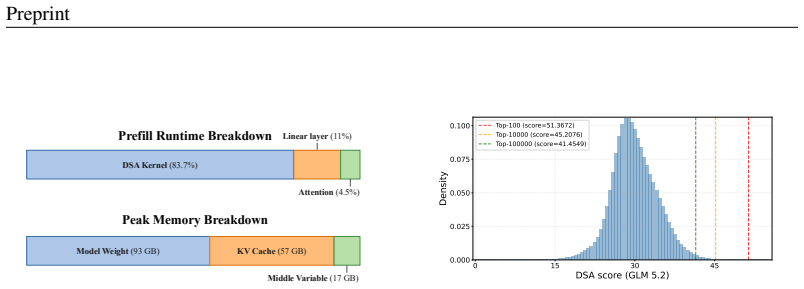
The central discovery is that sparse-attention scores concentrate so strongly that a single online threshold can gate almost all candidates. LiteTopK samples a small set of candidates (for DSA, the most frequent top-k tokens from the previous chunk), builds a binned histogram, and maintains a threshold bin; candidates below the bin's lower edge are dropped before write-back, and only the threshold bin needs a tail top-k selection. The paper claims this preserves exact Top-k because the sample's k-th largest score bounds the global threshold (the global threshold is no lower than the local one), and the affine bin-space score is losslessly invertible, so no score information is lost. LITEDSA
Load-bearing premise
A single global score threshold, estimated from the previous chunk's most frequent top-k tokens, is tight enough for every query in the current chunk, so filtering below it never discards any query's true top-k candidates.
Editorial extensions
If this is right
- Avoids materializing the full score matrix, reducing peak auxiliary memory from tens of gigabytes to roughly 1.5 GB at 1M-token prefill.
- Enables larger prefill chunks (8,192 tokens) without sub-chunking, so end-to-end latency drops beyond the raw kernel speedup.
- Exact top-k output is retained: the final output matches the original sparse-attention result exactly.
- Speedups generalize across GPU architectures (B200 and H100) and to large-k retrieval workloads, suggesting the method is not attention-specific.
- LITEDSA further accelerates the attention kernel itself by roughly 1.7-1.8x through shared KV loads across neighboring queries.
Reading between the lines
- The score-concentration principle could be applied to any score-then-select operator with long-tailed distributions, including recommendation candidate retrieval; the sample need not be temporal—random sampling may suffice.
- If the single-threshold assumption fails for queries with heterogeneous score scales, a per-query or per-group threshold would be needed; the paper's exactness claim does not explicitly cover that case.
- One testable extension is dynamically choosing bin counts and widths from the observed sample to maximize the fraction of candidates gated, rather than using fixed equal-width bins.
- The neighbor-packing idea suggests a broader family of lossless I/O-deduplication kernels for memory-bound attention, which could combine with cross-layer index reuse.
Editorial analysis
A structured set of objections, weighed in public.
Referee Report
Summary. The paper proposes LiteTopK, a fused indexer-top-k kernel for sparse attention. It observes that DSA-style attention scores concentrate in a narrow range, and leverages this by sampling a subset of candidates, building an equal-width histogram, and using a single threshold bin to filter out supposedly unpromising candidates before per-query top-k selection. A companion method, LiteDSA, packs neighboring queries' selected candidates and masks extra scores. The paper claims exact per-query top-k preservation, reduced memory traffic, and reports 1.2–1.4x end-to-end prefill speedups on GLM-5.2/LongCat at 768K–1M context on 8 B200 GPUs.
Significance. If the claims were correct, the contribution would be practically valuable: reducing HBM traffic for indexer-top-k is a real bottleneck in long-context prefill. The paper is well-motivated, evaluates in a realistic deployment, and contains a clever implementation detail in the affine bin-score computation (Eq. 3). The public code availability is also a plus. However, the central correctness guarantee is not established. The paper's proof of exactness applies a single-list subset argument to a per-query operation, and no empirical output-equality check is reported. Because the claimed speedups are meaningful only if the kernel actually preserves the exact per-query top-k sets, this gap is load-bearing.
major comments (3)
- [§3.1–3.2, Eq. (2)] The paper defines TopK(q) per query, but the correctness argument uses a single global threshold bin. The statement 'since the sample is a subset of X, its k-th largest score cannot exceed the k-th largest score over all of X' is valid only for one fixed score list. With multiple queries, a low-scoring query's true top-k threshold can be below the global threshold bin; gating out all candidates below that bin can drop tokens that belong to that query's top-k. The manuscript does not prove that the sampled threshold is a lower bound for every query's per-query k-th largest score, nor does it define 'global top-k threshold' in a way that bridges to Eq. (2). This is exactly the stress-test concern, and it lands: the claimed exact per-query correctness is unsupported.
- [§4 (Experiments)] The experiments report only latency and memory consumption. Since the central claim is exact equivalence to the original top-k output, the paper should verify, for every benchmark configuration, that LiteTopK produces exactly the same per-query top-k sets (or at least bitwise-identical attention outputs) as the baseline. Without such a check, the assertion of 'no performance loss' cannot be credited, even if the proof gap were patched.
- [§3.2, §4.2] The candidate buffer has a fixed capacity ('12k'), but the number of candidates passing the gate is data-dependent. If the score concentration assumption is violated or the threshold is loosened by a stale refresh, survivors can exceed the buffer capacity. The paper does not describe an overflow path, and overflow would silently break exactness. Additionally, the text says 'capacity of 12k, corresponding to 24,576 candidates for k=2,048', which is internally inconsistent (12 × 2048 = 24,576, not 12,000). This needs clarification and a robustness argument.
minor comments (5)
- [Abstract / §1 / §4.2] Speedup and latency numbers are inconsistent across sections: abstract says 1.35x, introduction says 1.22x/1.39x, §4.2 says 1.26x/1.34x, and 153.3/128.4 is 1.19x, not 1.26x. Reconcile.
- [Title and text] Typos: 'THECURSE OFDIMENSIONALITY', 'Specifcally', inconsistent 'LiteTopk'/'LiteTopK', 'an more', and a placeholder 'XX ×' in the contributions list.
- [§1 and §2.2] The claims of being 'first to observe' score concentration and 'first Indexer-TopK fused kernel' are weakened by the discussion of Yin et al. 2026 and Flashlib. Clarify the novelty framing.
- [§3.2] The first prefill chunk has no 'previous chunk' from which to sample. The initialization for the first chunk is not described; specify how the sample and threshold are bootstrapped.
- [§3.1] The terms 'global top-k threshold' and 'local top-k threshold' are used without precise definitions. Define them with respect to Eq. (2) and explain how they relate to per-query thresholds.
Circularity Check
No significant circularity. The correctness argument is a standard subset bound, speedups are measured against external implementations, and the only author-overlapping citation (Yin et al. 2026) is motivational context. The global-threshold vs per-query top-k gap is a correctness risk, not a circular reduction.
full rationale
The paper's load-bearing claim is that the sample-initialized gate preserves exact Top-k: 'This initialization is conservative: since the sample is a subset of X, its k-th largest score cannot exceed the k-th largest score over all of X, so the true top-k threshold lies in or above the threshold bin and every true top-k candidate passes the gate' (Section 3.2), and 'the global top-k threshold is guaranteed to be no lower than the local top-k threshold' (Section 3.1). These are standard order-statistic bounds: the k-th largest of a subset cannot exceed the k-th largest of the universe, so the conclusion is not assumed in the premise and holds for any sample; correctness therefore does not reduce to the fitted smin/smax bins or to the previous-chunk sample. Efficiency gains are benchmarked against external implementations (official DSA, vLLM/Blackwell, Flashlib, Torch) on B200 and H100, so no fitted parameter is renamed as a predicted result. The only author-overlapping citation, Yin et al. 2026 (BBC), supports the score-concentration observation, and the paper re-demonstrates that observation in Figure 2; it affects filter effectiveness, not the correctness proof, so it is not load-bearing. Non-circular caveats, weighted under correctness risk rather than circularity: (i) Eq. (2) defines TopK(q) per query, while the kernel keeps one global histogram/threshold bin per CTA, and the paper never proves a single global threshold preserves every query's top-k set when per-query score scales differ; (ii) 'A stale threshold merely loosens the gate, admitting a few extra candidates, but are rare under score concentration' is an empirical assertion, not a correctness argument; (iii) 'no performance loss' is asserted without any reported output-equivalence experiment ('our evaluation focuses on efficiency'), and one contribution retains an 'up to XX ×' placeholder. These are omitted-proof/evidence gaps, not a derivation that is equivalent to its inputs by construction.
Assumptions & free parameters
free parameters (6)
- sample_size_factor_k_prime =
3k (for DSA)
- num_bins_m =
not specified
- threshold_refresh_period =
not specified
- candidate_buffer_capacity =
12k (24,576 for k=2048)
- flush_batch_size =
32 or 64
- component_context_cutoffs =
LiteTopK from 128K, LiteDSA from 4K
assumptions (6)
- domain assumption DSA scores concentrate in a narrow range with a long tail (score concentration).
- domain assumption Adjacent tokens share largely overlapping top-k candidate sets.
- ad hoc to paper The previous chunk's most frequent top-k tokens form a representative sample for the current chunk.
- ad hoc to paper A single scalar threshold bin preserves per-query top-k correctness.
- standard math An affine transform from score to bin ID is invertible and lossless.
- standard math The k-th largest of a subset lower-bounds the k-th largest of the full set.
Cite this review
Pith. "Pith review of LiteTopK: Exploiting the Curse of Dimensionality for a Fused Indexer-TopK Kernel in Long-Context Sparse Attention." pith.science (2026). https://pith.science/paper/WJLR6S43
@misc{pith2026260711976,
  author       = {Pith},
  title        = {Pith review of: LiteTopK: Exploiting the Curse of Dimensionality for a Fused Indexer-TopK Kernel in Long-Context Sparse Attention},
  year         = {2026},
  howpublished = {\url{https://pith.science/paper/WJLR6S43}},
  note         = {Machine review of arXiv:2607.11976}
}
read the original abstract
Indexer-TopK, the operation to compute the scores and select the top-k candidates, is widely used by sparse attention algorithms in large language models and vector retrieval in recommendation systems and vector databases. However, existing GPU-based Indexer-TopK kernels like DeepSeek Sparse Attention (DSA) remain inefficient due to excessive global memory traffic, costly synchronization, and prohibitive memory overhead. In this study, inspired by the curse of dimensionality phenomenon, we first observe that sparse attention scores exhibit a score concentration phenomenon, where scores tend to fall within a narrow range. Based on this observation, we propose LITETOPK, an efficient fused Indexer-TopK kernel. LITETOPK first samples a small subset of data to estimate query-data score ranges, then partitions candidates into bins accordingly. This organization allows the LITETOPK kernel to maintain a tight approximate threshold online, write back only promising candidates, reduce unnecessary I/O and memory overhead while preserving exact Top-k correctness. Building on LITETOPK, we further propose LITEDSA, which exploits the similarity of top-k candidate sets among neighboring tokens. LITEDSA packs neighboring tokens' candidates for joint computation and masks out extra scores for each query, thereby reducing memory traffic while preserving correctness. Experimental results in a real-world deployment environ ment with eight B200 GPUs show that LITETOPK+LITEDSA accelerates the prefill stage of GLM 5.2 by 1.35x, with no performance loss and lower memory overhead.
Figures


Figures from the paper (4 more)


Reference graph
Works this paper leans on
-
[6]
Aixin Liu, Aoxue Mei, Bangcai Lin, Bing Xue, Bingxuan Wang, Bingzheng Xu, Bochao Wu, Bowei Zhang, Chaofan Lin, Chen Dong, et al. Deepseek-v3. 2: Pushing the frontier of open large language models.arXiv preprint arXiv:2512.02556,
-
[8]
The sparse frontier: Sparse attention trade-offs in transformer llms
Piotr Nawrot, Jianing Li, Renjie Huang, Sebastian Ruder, Kelly Marchisio, and Edoardo Maria Ponti. The sparse frontier: Sparse attention trade-offs in transformer llms. InFindings of the Association for Computational Linguistics: ACL 2026, pp. 38667–38701,
2026
-
[9]
Sparq attention: Bandwidth-efficient LLM inference
Luka Ribar, Ivan Chelombiev, Luke Hudlass-Galley, Charlie Blake, Carlo Luschi, and Douglas Orr. Sparq attention: Bandwidth-efficient LLM inference. InForty-first International Conference on Machine Learning, ICML 2024, Vienna, Austria, July 21-27, 2024, volume 235 ofProceedings of Machine Learning Research, pp. 42558–42583,
2024
-
[10]
Ryan Synk, Monte Hoover, John Kirchenbauer, Neel Jain, Alex Stein, Manli Shu, Josue Melendez Sanchez, Ramani Duraiswami, and Tom Goldstein. Exploiting sparsity for long context inference: Million token contexts on commodity gpus.arXiv preprint arXiv:2502.06766,
-
[12]
A quantitative analysis and performance study for similarity-search methods in high-dimensional spaces
Roger Weber, Hans-J¨org Schek, and Stephen Blott. A quantitative analysis and performance study for similarity-search methods in high-dimensional spaces. InVLDB’98, Proceedings of 24rd International Conference on Very Large Data Bases, August 24-27, 1998, New York City, New York, USA, pp. 194–205,
1998
-
[13]
Tidaldecode: Fast and accurate LLM decoding with position persistent sparse attention
Lijie Yang, Zhihao Zhang, Zhuofu Chen, Zikun Li, and Zhihao Jia. Tidaldecode: Fast and accurate LLM decoding with position persistent sparse attention. InThe Thirteenth International Conference on Learning Representations, ICLR 2025, Singapore, April 24-28, 2025, 2025a. Lijie Yang, Zhihao Zhang, Arti Jain, Shijie Cao, Baihong Yuan, Yiwei Chen, Zhihao Jia,...
arXiv 2025
-
[14]
Ziqi Yin, Gao Cong, Kai Zeng, Jinwei Zhu, and Bin Cui. Bbc: Improving large-k approximate nearest neighbor search with a bucket-based result collector.arXiv preprint arXiv:2604.01960,
-
[1998]
Interactrank: Personalized web-scale search pre-ranking with cross interaction features
Sujay Khandagale, Bhawna Juneja, Prabhat Agarwal, Aditya Subramanian, Jaewon Yang, and Yuting Wang. Interactrank: Personalized web-scale search pre-ranking with cross interaction features. InCompanion Proceedings of the ACM on Web Conference 2025, WWW 2025, Sydney, NSW, Australia, 28 April 2025 - 2 May 2025, pp. 287–295,
2025
Show all 14 references
-
[2012]
Index- cache: Accelerating sparse attention via cross-layer index reuse.arXiv preprint arXiv:2603.12201,
Yushi Bai, Qian Dong, Ting Jiang, Xin Lv, Zhengxiao Du, Aohan Zeng, Jie Tang, and Juanzi Li. Index- cache: Accelerating sparse attention via cross-layer index reuse.arXiv preprint arXiv:2603.12201,
-
[2016]
Embedding and clustering your data can improve contrastive pretraining.arXiv preprint arXiv:2407.18887,
Luke Merrick. Embedding and clustering your data can improve contrastive pretraining.arXiv preprint arXiv:2407.18887,
-
[2023]
Minimax sparse attention.arXiv preprint arXiv:2606.13392,
Xunhao Lai, Weiqi Xu, Yufeng Yang, Qiaorui Chen, Yang Xu, Lunbin Zeng, Xiaolong Li, Haohai Sun, Haichao Zhu, Vito Zhang, et al. Minimax sparse attention.arXiv preprint arXiv:2606.13392,
-
[2024]
Approximate nearest neighbors: Towards removing the curse of dimensionality
Piotr Indyk and Rajeev Motwani. Approximate nearest neighbors: Towards removing the curse of dimensionality. InProceedings of the Thirtieth Annual ACM Symposium on the Theory of Computing, Dallas, Texas, USA, May 23-26, 1998, pp. 604–613,
1998
-
[2025]
Quest: Query-aware sparsity for efficient long-context llm inference.arXiv preprint arXiv:2406.10774,
Jiaming Tang, Yilong Zhao, Kan Zhu, Guangxuan Xiao, Baris Kasikci, and Song Han. Quest: Query-aware sparsity for efficient long-context llm inference.arXiv preprint arXiv:2406.10774,
-
[2026]
Ankit Gupta, Guy Dar, Shaya Goodman, David Ciprut, and Jonathan Berant
URL https://arxiv.org/abs/2602.15763. Ankit Gupta, Guy Dar, Shaya Goodman, David Ciprut, and Jonathan Berant. Memory-efficient transformers via top-k attention. InProceedings of the Second Workshop on Simple and Efficient Natural Language Processing, pp. 39–52,
Reviewed August 2, 2026 · model on record in the stance chip above.
Discussion (0). Sign in to comment.