REVIEW 3 major objections 5 minor 48 references
Multicontinuum Homogenization for Poroelasticity Model
T0 review · 3 major / 5 minor · reviewed 2026-08-06 · deepseek-v4-flash
Pith's one-line read This paper derives a multicontinuum poroelasticity model for an arbitrary number of continua, with all effective coefficients computed from local cell problems rather than fitted from experiments.
desk verdict A credible extension of multicontinuum homogenization to poroelasticity with good numerics, but the 'rigorous derivation' claim outruns the specification of the cell problems. read the letter →
The pith
A machine-rendered reading of the paper's core claim, the machinery that carries it, and where it could break.
The reading
What carries the argument
The central machinery is the multicontinuum expansion with constraint cell problems posed in oversampled representative volume elements. For each continuum, a characteristic function defines the average macroscopic variables; basis functions solve coupled cell problems with constraints on the averages and first gradients per continuum, enforced through Lagrange multipliers. Substituting the expansion into the variational formulation and pulling the smooth macroscopic variables out of the integrals yields effective coefficients as normalized bilinear forms evaluated on the cell solutions, and oversampling reduces boundary effects in those computations.
What would settle it
Simulate a two-continuum medium whose forcing wavelength is comparable to the coarse-block size, so continuum averages change rapidly between neighboring blocks, solve the full multicontinuum model and the fine-scale reference, and compare averaged pressure and displacement; pressure relative L2 error growing well above the reported ~1e-3 would show the smoothness assumption is the limiting step.
Extended reading notes
Core claim
The central claim is that a poroelasticity system with multiscale coefficients can be upscaled into a multicontinuum poroelasticity model for any prescribed number of continua by solving coupled constraint cell problems on oversampled representative volume elements. The fine-scale displacement and pressure are expanded as sums of averaged continuum states and their gradients, with expansion functions obtained from those cell problems; substituting the expansion into the variational formulation and invoking smoothness gives a closed system of displacement and pressure equations with all effective coefficients defined as normalized bilinear forms evaluated on the cell solutions. The paper positions the standard multiple-network poroelasticity (MPET) model as a special case of its second simplified model, with the difference that here the coefficients, including cross-porosity storage, come from the cell problems instead of experimental fits.
Load-bearing premise
The derivation assumes the averaged pressure and displacement fields are smooth over each coarse block; if they vary sharply at the coarse-block scale, the effective equations and their simplified versions lose accuracy.
Editorial extensions
If this is right
- The standard MPET model becomes a special case of the derived framework, so its coefficients, including cross-porosity storage, can be computed from cell problems instead of assumed or fitted.
- Because the derivation allows an arbitrary number of continua, media with several distinct fluid networks can be upscaled within the same formulation rather than by re-deriving each case.
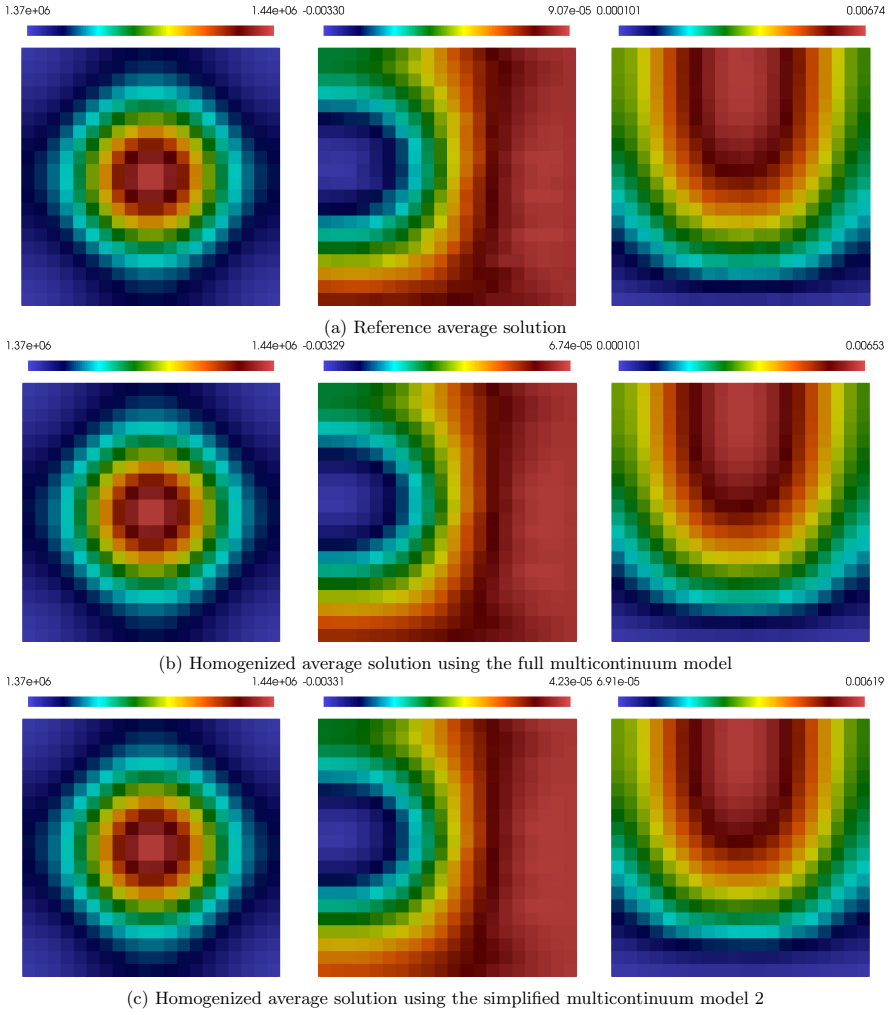
- Simplified Model 1 reproduces the full model's errors in the reported tests, giving an inexpensive form that retains the coupling terms; Simplified Model 2 is cheaper but has substantially larger displacement errors in non-periodic media.
- The effective coefficients are computed once from local problems and can be reused for many right-hand sides and time steps, which is what makes the coarse-grid simulations cheap.
Reading between the lines
- If this derivation extends to three dimensions and to micro-models posed in perforated domains, the same cell-problem pipeline could replace experimental calibration of MPET parameters in patient-specific brain models.
- A practical adaptive strategy suggested by the smoothness assumption is to monitor variation of continuum averages across neighboring coarse blocks and refine the coarse grid or add higher-order cell problems where gradients are steep.
- The systematic displacement errors of Simplified Model 2 point to a specific missing mechanism: its dropped coupling terms carry information about pressure-gradient-driven deformation, so retaining only a few of them might recover accuracy at low cost.
- The error tables suggest pressure is easier to upscale than displacement; if that pattern holds in three dimensions, separate accuracy criteria for pressure and displacement fields would be warranted.
Editorial analysis
A structured set of objections, weighed in public.
Referee Report
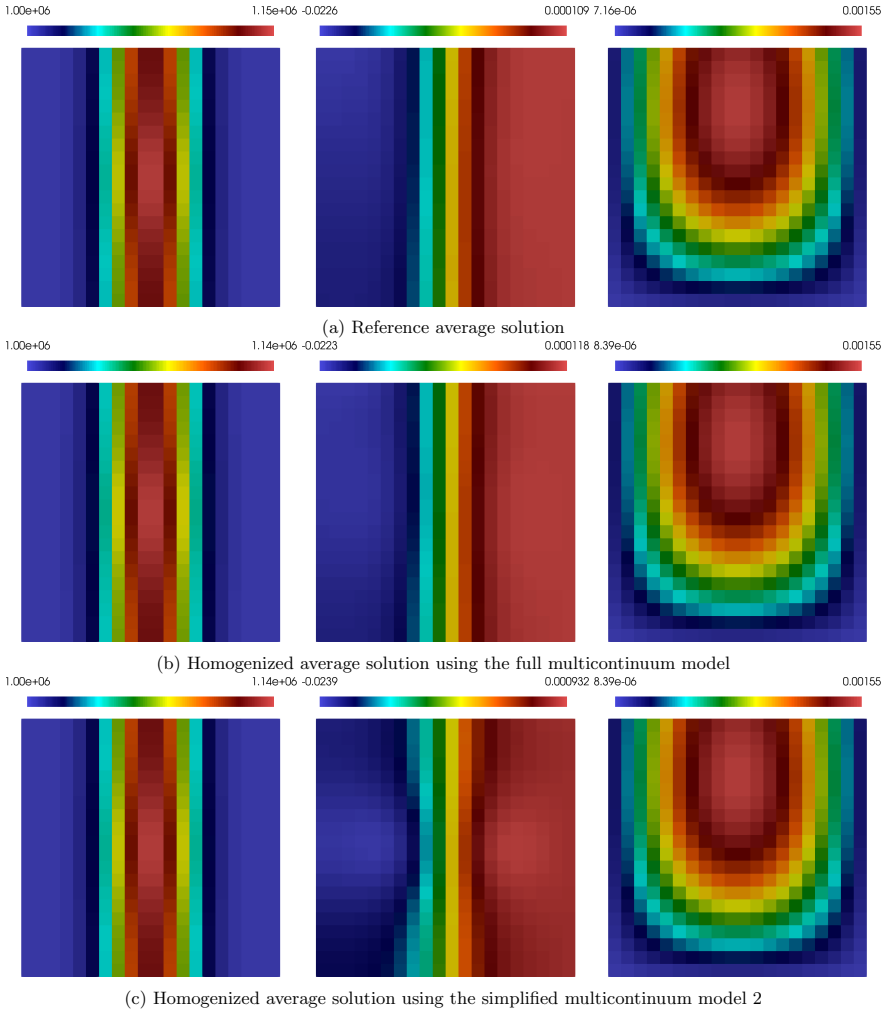
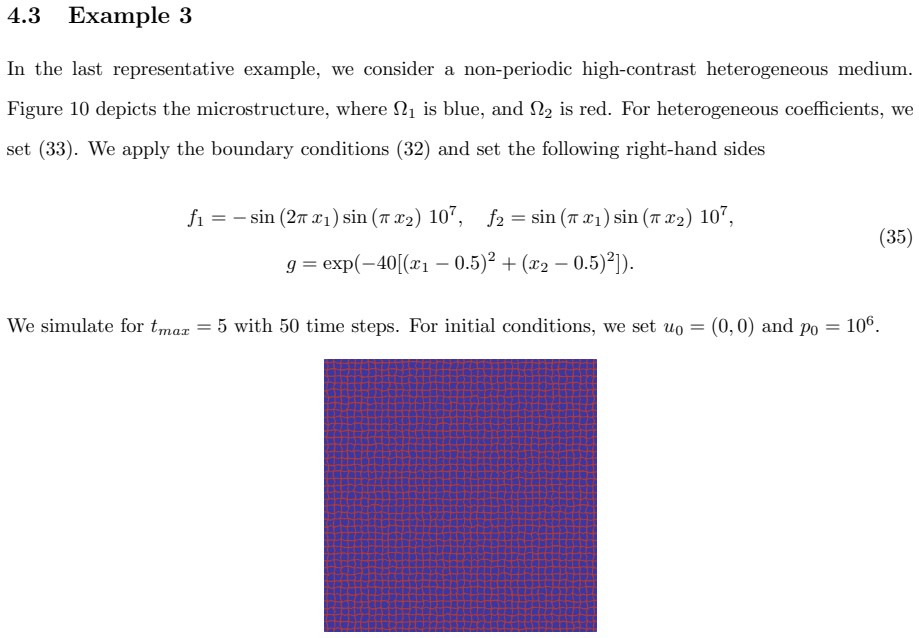
Summary. The paper applies the multicontinuum homogenization method of Efendiev and Leung to Biot poroelasticity with high-contrast coefficients. It formulates coupled constraint cell problems on oversampled representative volume elements, obtains multicontinuum expansions for the fine-scale displacement and pressure fields, and derives a general coupled system of macroscopic equations for an arbitrary number of continua, together with two simplified models. Numerical experiments on three two-dimensional microstructures compare the homogenized continuum averages with fine-scale reference solutions and report relative L2 errors of order 1e-3 for pressure and 1e-2 for displacement for the full and first simplified models. The abstract and conclusion describe the derivation as rigorous.
Significance. If the derivation is made fully rigorous and the cell problems are shown to be well-posed, the paper would provide a practical, microstructure-based route to computing MPET-type poroelastic coefficients (including cross-porosity storage and transfer terms) without experimental fitting. The numerical results support the potential utility of the method, and the extension of multicontinuum homogenization to a coupled flow-mechanics saddle-point system is nontrivial. The paper builds openly on the authors' prior multicontinuum homogenization framework and applies it to a new, physically relevant setting with numerical validation on several high-contrast microstructures.
major comments (3)
- [Section 3.2, Eqs. (10)-(13)] The cell problems are not well-posed as stated. No admissible function space or boundary condition on the oversampled domain R+_omega is specified, and no existence or uniqueness statement is given for the constrained saddle-point system. This is load-bearing because the bilinear form a_{R+_omega} has a nontrivial kernel: the elasticity part contains rigid-body motions and the pressure-diffusion part contains constants. The average constraints in (10)-(13) do not obviously remove all null modes; for example, if the continua are symmetric and share a common centroid, a rigid rotation about that centroid has zero mean over every sub-RVE R^l_omega and hence belongs to the kernel of the constrained problem. If the discrete saddle-point system is singular, the cell functions are not defined and the effective coefficients in (16)-(21) do not exist, so equations (24)-(25) are not derived. The authors should specify the boundary conditions used (including in the numerical implementation), add constraints fixing the remaining rigid-body modes (e.g., first-moment constraints), and prove or at least verify the nonsingularity of the cell problems for the geometries treated.
- [Section 3.3, Eqs. (8), (14)-(15); Conclusion, Section 5] The claim of a 'rigorous derivation' is not supported by the argument. The multicontinuum expansion (8) is an ansatz with no explicit remainder term; the derivation truncates the expansion after first gradients and uses the smoothness of U_is and P_i to pull these fields out of integrals over R_omega. No convergence result, error estimate, or identification of the asymptotic regime (e.g., epsilon tending to zero) is provided. The replacement of the integral over Omega by a sum of RVE integrals in (14) also assumes a scale separation that is not quantified. The numerical examples test only problems with slowly varying macroscopic fields and do not validate the truncation in regimes where the macroscopic variables vary on the coarse-block scale. I recommend either supplying a rigorous error analysis for a suitable class of coefficients or replacing 'rigorous' by 'formal' throughout and explicitly stating the approximation assumptions.
- [Section 4, numerical implementation] The numerical solution of the cell problems is not described. The paper states the oversampling parameters (l=5 and l=6) but does not say what boundary conditions are imposed on the oversampled RVE when discretizing (10)-(13), nor how the Lagrange multiplier constraints are enforced. Because the theoretical formulation leaves the boundary conditions unspecified, the reader cannot reproduce the effective coefficients or verify that the reported accuracies are not an artifact of a particular boundary treatment. The authors should describe the finite-element discretization of the cell problems, including the test/trial spaces and boundary conditions, and ideally provide the code or pseudocode.
minor comments (5)
- [Section 3.4, Tables 1-3] The errors for the full model and simplified model 1 are identical to four significant digits in all reported cases, yet the paper does not quantify the magnitudes of the omitted coefficients (e.g., A^pu, C^pu, D^uu, D^pp). The authors should either report the relative norms of the dropped terms or explain structural reasons (symmetry, constraint choices) for their vanishing; otherwise the simplification appears to be justified only by the particular test cases.
- [Section 4] The sensitivity of the results to the oversampling parameter l is not studied. Since l is a free parameter of the method, the paper should report the dependence of the effective coefficients and the L2 errors on l (e.g., l=1,2,3,4,5) for at least one example to demonstrate that the chosen values are adequate.
- [Section 2.2, Eq. (6)] The claim that the MPET model (6) is a particular case of simplified model 2 is not demonstrated term by term. The homogenized coefficients in (28)-(29) should be explicitly matched with the MPET parameters S_i, S_ij, kappa_i, alpha_i, and the transfer coefficients omega_ji.
- [Section 3.2] The notation for the sub-RVEs R^l_omega is ambiguous: it is not clear whether the R^l_omega are nested layers forming R+_omega or a partition into disjoint subregions. A precise definition of R^l_omega and of the characteristic functions psi^l_j would improve reproducibility.
- [General] There are several typographical and formatting issues, including inconsistent spacing in 'R VE', the broken citation marker in reference [27], and the use of 'Lam´ e' in the text; a careful proofreading pass is needed.
Circularity Check
Minor self-citation of the multicontinuum homogenization framework; the poroelasticity derivation itself is self-contained and not circular.
-
other
[Section 1, paragraph beginning 'Recently, the multicontinuum homogenization method...'; Section 3 opening; Section 5 conclusion]
"Recently, the multicontinuum homogenization method was presented in [31, 32, 33]. This method provides a rigorous and, at the same time, flexible methodology for deriving multicontinuum models."
The paper's 'rigorous derivation' claim rests in part on citing the authors' own prior works [31]-[33] (Efendiev and close collaborator Leung) for the multicontinuum homogenization framework. If those citations were the sole justification for the expansion ansatz (8)-(9) and the general validity of the method, the rigor claim would reduce to a self-citation chain. However, the paper explicitly constructs the poroelasticity-specific cell problems (10)-(13), the multicontinuum expansions, and the effective equations (16)-(29), so the self-citation is contextual rather than the unique load-bearing support. This is a minor self-citation issue, not a fully circular derivation.
full rationale
The central derivation is self-contained against external benchmarks. The effective coefficients in (16)-(21) are computed from cell problems (10)-(13) that depend only on geometry and material parameters, not on the fine-scale reference solution. The macroscopic equations (24)-(25) are obtained by substituting the multicontinuum expansions (8)-(9) into the variational formulation and using the smoothness assumption on the macroscopic variables, not by fitting any parameter to the target averages. The numerical section compares the resulting models against independent fine-scale finite-element solutions, and the errors are nonzero, so the reported accuracy is not forced by construction. The only mild circular-adjacent element is the self-citation of the multicontinuum homogenization framework as 'rigorous'; this is not load-bearing because the poroelasticity-specific derivation is performed in the paper. The simplified models are admittedly selected based on the numerical experiments, which makes their validation in-sample, but the full model's derivation and accuracy assessment remain independent. Accordingly, the circularity score is low.
Assumptions & free parameters
free parameters (1)
- Oversampling layers l =
5 (10x10 grid), 6 (20x20 grid)
assumptions (4)
- domain assumption The multicontinuum expansion (8) represents the fine-scale solution u and p in each RVE as a linear combination of the zeroth and first gradient cell functions.
- domain assumption The macroscopic variables U_is and P_i are smooth functions over each coarse block.
- domain assumption The constraint cell problems (10)-(13) are well-posed, with suitable (unspecified) boundary conditions on the oversampled region.
- domain assumption Each coarse block is faithfully represented by the RVE, and oversampling reduces boundary effects so that the local homogenized equations can be summed over the domain.
Cite this review
Pith. "Pith review of Multicontinuum Homogenization for Poroelasticity Model." pith.science (2026). https://pith.science/paper/WJWEQICZ
@misc{pith2026250620890,
  author       = {Pith},
  title        = {Pith review of: Multicontinuum Homogenization for Poroelasticity Model},
  year         = {2026},
  howpublished = {\url{https://pith.science/paper/WJWEQICZ}},
  note         = {Machine review of arXiv:2506.20890}
}
read the original abstract
In this paper, we derive multicontinuum poroelasticity models using the multicontinuum homogenization method. Poroelasticity models are widely used in many areas of science and engineering to describe coupled flow and mechanics processes in porous media. However, in many applications, the properties of poroelastic media possess high contrast, presenting serious computational challenges. It is well known that standard homogenization approaches often fail to give an accurate solution due to the lack of macroscopic parameters. Multicontinuum approaches allow us to consider such cases by defining several average states known as continua. In the field of poroelasticity, multiple-network models arising from the multiple porous media theory are representatives of these approaches. In this work, we extend previous findings by deriving the generalized multicontinuum poroelasticity model. We apply the recently developed multicontinuum homogenization method and provide a rigorous derivation of multicontinuum equations. For this purpose, we formulate coupled constraint cell problems in oversampled regions to consider different homogenized effects. Then, we obtain a multicontinuum expansion of the fine-scale fields and derive the multicontinuum model supposing the smoothness of macroscopic variables. We present the most general version of equations and the simplified ones based on our numerical experiments. Numerical results are presented for different heterogeneous media cases and demonstrate the high accuracy of our proposed multicontinuum models.
Figures


Figures from the paper (10 more)





Reference graph
Works this paper leans on
-
[1]
Massimiliano Ferronato, Giuseppe Gambolati, Pietro Teatini, and Domenico Ba` u. Stochastic poromechanical modeling of anthropogenic land subsidence.International journal of solids and structures, 43(11-12):3324–3336, 2006
work page 2006
-
[2]
Liqin Ding, Zhiqiao Wang, Baolin Liu, Jianguo Lv, and Yu Wang. Borehole stability analysis: A new model considering the effects of anisotropic permeability in bedding formation based on poroelastic theory.Journal of Natural Gas Science and Engineering, 69:102932, 2019
work page 2019
-
[3]
Lei Jin. A hydromechanical-stochastic approach to modeling fluid-induced seismicity in arbitrarily fractured poroelastic media: Effects of fractures and coupling.Tectonophysics, 826:229249, 2022. 29
work page 2022
-
[4]
Dominique Chapelle, J-F Gerbeau, J Sainte-Marie, and IE Vignon-Clementel. A poroelastic model valid in large strains with applications to perfusion in cardiac modeling.Computational Mechanics, 46:91–101, 2010
work page 2010
-
[5]
Amin Mehrabian and Younane Abousleiman. General solutions to poroviscoelastic model of hydro- cephalic human brain tissue.Journal of Theoretical Biology, 291:105–118, 2011
work page 2011
-
[6]
General theory of three-dimensional consolidation.Journal of applied physics, 12(2):155–164, 1941
Maurice A Biot. General theory of three-dimensional consolidation.Journal of applied physics, 12(2):155–164, 1941
1941
-
[7]
Maurice A Biot. Theory of elasticity and consolidation for a porous anisotropic solid.Journal of applied physics, 26(2):182–185, 1955
work page 1955
-
[8]
Maurice A Biot. Theory of deformation of a porous viscoelastic anisotropic solid.Journal of Applied physics, 27(5):459–467, 1956
work page 1956
Show all 48 references
-
[9]
Mechanics of porous elastic materials containing multiphase fluid.International journal of engineering science, 23(11):1203–1214, 1985
Lewis Thigpen and James G Berryman. Mechanics of porous elastic materials containing multiphase fluid.International journal of engineering science, 23(11):1203–1214, 1985
1985
-
[10]
OC Zienkiewicz and T Shiomi. Dynamic behaviour of saturated porous media; the generalized biot formulation and its numerical solution.International journal for numerical and analytical methods in geomechanics, 8(1):71–96, 1984
1984
-
[11]
Diego G Frias, M´ arcio A Murad, and Felipe Pereira. Stochastic computational modelling of highly heterogeneous poroelastic media with long-range correlations.International Journal for Numerical and Analytical Methods in Geomechanics, 28(1):1–32, 2004
2004
-
[12]
Cerebral water transport using multiple-network poroelastic theory: application to normal pressure hydrocephalus.Journal of Fluid Mechanics, 667:188–215, 2011
B Tully and Yiannis Ventikos. Cerebral water transport using multiple-network poroelastic theory: application to normal pressure hydrocephalus.Journal of Fluid Mechanics, 667:188–215, 2011
2011
-
[13]
Elsevier, 1978
George Papanicolau, Alain Bensoussan, and J-L Lions.Asymptotic analysis for periodic structures. Elsevier, 1978
1978
-
[14]
Springer Science & Business Media, 2012
Vasili Vasilievitch Jikov, Sergei M Kozlov, and Olga Arsenievna Oleinik.Homogenization of differ- ential operators and integral functionals. Springer Science & Business Media, 2012
2012
-
[15]
Homogenization and field concentrations in heterogeneous media.SIAM journal on mathematical analysis, 38(4):1048–1059, 2006
Robert Lipton. Homogenization and field concentrations in heterogeneous media.SIAM journal on mathematical analysis, 38(4):1048–1059, 2006. 30
2006
-
[16]
Analysis of upscaling absolute permeability
Xiao-Hui Wu, Yalchin Efendiev, and Thomas Y Hou. Analysis of upscaling absolute permeability. Discrete and Continuous Dynamical Systems Series B, 2(2):185–204, 2002
2002
-
[17]
Numerical calculation of equivalent grid block permeability tensors for heteroge- neous porous media.Water resources research, 27(5):699–708, 1991
Louis J Durlofsky. Numerical calculation of equivalent grid block permeability tensors for heteroge- neous porous media.Water resources research, 27(5):699–708, 1991
1991
-
[18]
Asymptotic homogenisation in linear elasticity
J Pinho-da Cruz, JA Oliveira, and F Teixeira-Dias. Asymptotic homogenisation in linear elasticity. part i: Mathematical formulation and finite element modelling.Computational Materials Science, 45(4):1073–1080, 2009
2009
-
[19]
Machine learning for accelerating macroscopic parameters prediction for poroelasticity problem in stochastic media.Computers & Mathematics with Applica- tions, 84:185–202, 2021
Maria Vasilyeva and Aleksey Tyrylgin. Machine learning for accelerating macroscopic parameters prediction for poroelasticity problem in stochastic media.Computers & Mathematics with Applica- tions, 84:185–202, 2021
2021
-
[20]
On a question about the propagation of heat in heterogeneous media.(russian) izvestiya akad.Nauk SSSR
LI Rubinˇ steın. On a question about the propagation of heat in heterogeneous media.(russian) izvestiya akad.Nauk SSSR. Ser. Geograf. Geofiz, 12:27–45, 1948
1948
-
[21]
Basic concepts in the theory of seepage of homogeneous liquids in fissured rocks [strata].Journal of applied mathematics and mechanics, 24(5):1286–1303, 1960
Grigory I Barenblatt, Iu P Zheltov, and IN Kochina. Basic concepts in the theory of seepage of homogeneous liquids in fissured rocks [strata].Journal of applied mathematics and mechanics, 24(5):1286–1303, 1960
1960
-
[22]
A theory of mixtures with different constituent temperatures.Journal of thermal stresses, 20(2):147–167, 1997
D Ie¸ san. A theory of mixtures with different constituent temperatures.Journal of thermal stresses, 20(2):147–167, 1997
1997
-
[23]
Upscaling of a diffusion problem with interfacial flux jump leading to a modified barenblatt model, 2019
Renata Bunoiu and Claudia Timofte. Upscaling of a diffusion problem with interfacial flux jump leading to a modified barenblatt model, 2019
2019
-
[24]
Derivation of the double porosity model of single phase flow via homogenization theory.SIAM Journal on Mathematical Analysis, 21(4):823– 836, 1990
Todd Arbogast, Jim Douglas, Jr, and Ulrich Hornung. Derivation of the double porosity model of single phase flow via homogenization theory.SIAM Journal on Mathematical Analysis, 21(4):823– 836, 1990
1990
-
[25]
Z Chai, B Yan, JE Killough, and Y Wang. An efficient method for fractured shale reservoir history matching: The embedded discrete fracture multi-continuum approach.Journal of Petroleum Science and Engineering, 160:170–181, 2018
2018
-
[26]
A multi-continuum theory for composite elastic materials.Acta Mechanica, 14(2):85–102, 1972
A Bedford and M Stern. A multi-continuum theory for composite elastic materials.Acta Mechanica, 14(2):85–102, 1972. 31
1972
-
[27]
On the problem of diffusion in solids.Acta Mechanica, 37(3):265–296, 1980
EC5860620447 Aifantis. On the problem of diffusion in solids.Acta Mechanica, 37(3):265–296, 1980
1980
-
[28]
On the theory of consolidation with double porosity.International Journal of Engineering Science, 20(9):1009–1035, 1982
RK Wilson and Elias C Aifantis. On the theory of consolidation with double porosity.International Journal of Engineering Science, 20(9):1009–1035, 1982
1982
-
[29]
Multiporosity/multipermeability approach to the simulation of naturally fractured reservoirs.Water resources research, 29(6):1621–1633, 1993
Mao Bai, Derek Elsworth, and Jean-Claude Roegiers. Multiporosity/multipermeability approach to the simulation of naturally fractured reservoirs.Water resources research, 29(6):1621–1633, 1993
1993
-
[30]
A multiple-network poroelastic model for biological systems and application to subject-specific modelling of cerebral fluid transport
Liwei Guo, John C Vardakis, Dean Chou, and Yiannis Ventikos. A multiple-network poroelastic model for biological systems and application to subject-specific modelling of cerebral fluid transport. International Journal of Engineering Science, 147:103204, 2020
2020
-
[31]
Multicontinuum homogenization and its relation to nonlocal multicontinuum theories.Journal of Computational Physics, 474:111761, 2023
Yalchin Efendiev and Wing Tat Leung. Multicontinuum homogenization and its relation to nonlocal multicontinuum theories.Journal of Computational Physics, 474:111761, 2023
2023
-
[32]
Multicontinuum homogenization
E Chung, Yalchin Efendiev, Juan Galvis, and Wing Tat Leung. Multicontinuum homogenization. general theory and applications.Journal of Computational Physics, 510:112980, 2024
2024
-
[33]
Some convergence analysis for multicontinuum homogenization.arXiv preprint arXiv:2401.12799, 2024
Wing Tat Leung. Some convergence analysis for multicontinuum homogenization.arXiv preprint arXiv:2401.12799, 2024
2024 arXiv
-
[34]
Multicontinuum homogenization in perforated domains.Journal of Computational Physics, 530:113845, 2025
Wei Xie, Yalchin Efendiev, Yunqing Huang, Wing Tat Leung, and Yin Yang. Multicontinuum homogenization in perforated domains.Journal of Computational Physics, 530:113845, 2025
2025
-
[35]
Multicontinuum homogeniza- tion for coupled flow and transport equations.Journal of Computational and Applied Mathematics, page 116736, 2025
Dmitry Ammosov, Jian Huang, Wing Tat Leung, and Buzheng Shan. Multicontinuum homogeniza- tion for coupled flow and transport equations.Journal of Computational and Applied Mathematics, page 116736, 2025
2025
-
[36]
Multicontinuum splitting scheme for multiscale flow problems.arXiv preprint arXiv:2410.05253, 2024
Yalchin Efendiev, Wing Tat Leung, Buzheng Shan, and Min Wang. Multicontinuum splitting scheme for multiscale flow problems.arXiv preprint arXiv:2410.05253, 2024
2024 arXiv
-
[37]
Dmitry Ammosov, Sergei Stepanov, Denis Spiridonov, and Wenyuan Li. Multicontinuum homog- enization for richards’ equation: The derivation and numerical experiments.Russian Journal of Numerical Analysis and Mathematical Modelling, 38(4):207–218, 2023
2023
-
[38]
Multi-scale finite-volume method for elliptic problems in subsurface flow simulation.Journal of computational physics, 187(1):47–67, 2003
Patrick Jenny, SH Lee, and Hamdi A Tchelepi. Multi-scale finite-volume method for elliptic problems in subsurface flow simulation.Journal of computational physics, 187(1):47–67, 2003. 32
2003
-
[39]
Springer Science & Business Media, 2009
Yalchin Efendiev and Thomas Y Hou.Multiscale finite element methods: theory and applications, volume 4. Springer Science & Business Media, 2009
2009
-
[40]
Generalized multiscale finite element methods (gmsfem).Journal of computational physics, 251:116–135, 2013
Yalchin Efendiev, Juan Galvis, and Thomas Y Hou. Generalized multiscale finite element methods (gmsfem).Journal of computational physics, 251:116–135, 2013
2013
-
[41]
Constraint energy minimizing general- ized multiscale finite element method.Computer Methods in Applied Mechanics and Engineering, 339:298–319, 2018
Eric T Chung, Yalchin Efendiev, and Wing Tat Leung. Constraint energy minimizing general- ized multiscale finite element method.Computer Methods in Applied Mechanics and Engineering, 339:298–319, 2018
2018
-
[42]
Algorithmic monotone multiscale finite volume methods for porous media flow.Journal of Computational Physics, 499:112739, 2024
Omar Chaabi and Mohammed Al Kobaisi. Algorithmic monotone multiscale finite volume methods for porous media flow.Journal of Computational Physics, 499:112739, 2024
2024
-
[43]
A generalized multiscale finite element method for poroelastic- ity problems i: Linear problems.Journal of Computational and Applied Mathematics, 294:372–388, 2016
Donald L Brown and Maria Vasilyeva. A generalized multiscale finite element method for poroelastic- ity problems i: Linear problems.Journal of Computational and Applied Mathematics, 294:372–388, 2016
2016
-
[44]
Generalized multiscale finite element method for the poroelasticity problem in multicontinuum media.Journal of Computational and Applied Mathematics, 374:112783, 2020
Aleksei Tyrylgin, Maria Vasilyeva, Denis Spiridonov, and Eric T Chung. Generalized multiscale finite element method for the poroelasticity problem in multicontinuum media.Journal of Computational and Applied Mathematics, 374:112783, 2020
2020
-
[45]
Constraint energy minimizing generalized multiscale fi- nite element method for nonlinear poroelasticity and elasticity.Journal of Computational Physics, 417:109569, 2020
Shubin Fu, Eric Chung, and Tina Mai. Constraint energy minimizing generalized multiscale fi- nite element method for nonlinear poroelasticity and elasticity.Journal of Computational Physics, 417:109569, 2020
2020
-
[46]
Springer Science & Business Media, 2012
Anders Logg, Kent-Andre Mardal, and Garth Wells.Automated solution of differential equations by the finite element method: The FEniCS book, volume 84. Springer Science & Business Media, 2012
2012
-
[47]
Gmsh: A 3-d finite element mesh generator with built-in pre-and post-processing facilities.International journal for numerical methods in engineer- ing, 79(11):1309–1331, 2009
Christophe Geuzaine and Jean-Fran¸ cois Remacle. Gmsh: A 3-d finite element mesh generator with built-in pre-and post-processing facilities.International journal for numerical methods in engineer- ing, 79(11):1309–1331, 2009
2009
-
[48]
Kitware, Inc., 2015
Utkarsh Ayachit.The paraview guide: a parallel visualization application. Kitware, Inc., 2015. 33
2015
Reviewed August 6, 2026 · model on record in the stance chip above.
Discussion (0). Continue with ORCID to comment.