REVIEW 3 minor 93 references
Hierarchical Neural Filtering of Nuclear Mass Residuals and Spectral Signatures of Quantum Chaos
T0 review · 0 major / 3 minor · reviewed 2026-06-27 · grok-4.3
Pith's one-line read Hierarchical neural networks filter nuclear mass residuals to suppress quantum-chaotic spectral rigidity and approach white-noise statistics.
desk verdict The paper applies stacked neural networks as filters to nuclear mass residuals and reports driving the spectra to white noise, but the validation steps are not visible enough to separate method from artifact. read the letter →
The pith
A machine-rendered reading of the paper's core claim, the machinery that carries it, and where it could break.
The reading
What carries the argument
The Hierarchical Residual Decomposition framework, in which neural network architectures function as successive nonlinear filters that extract and suppress 1/f spectral correlations from nuclear mass residuals.
What would settle it
If spectral analysis of the residuals after hierarchical filtering still exhibits clear 1/f correlations or level rigidity instead of approaching flat white-noise power spectra, the central claim would be falsified.
Extended reading notes
Core claim
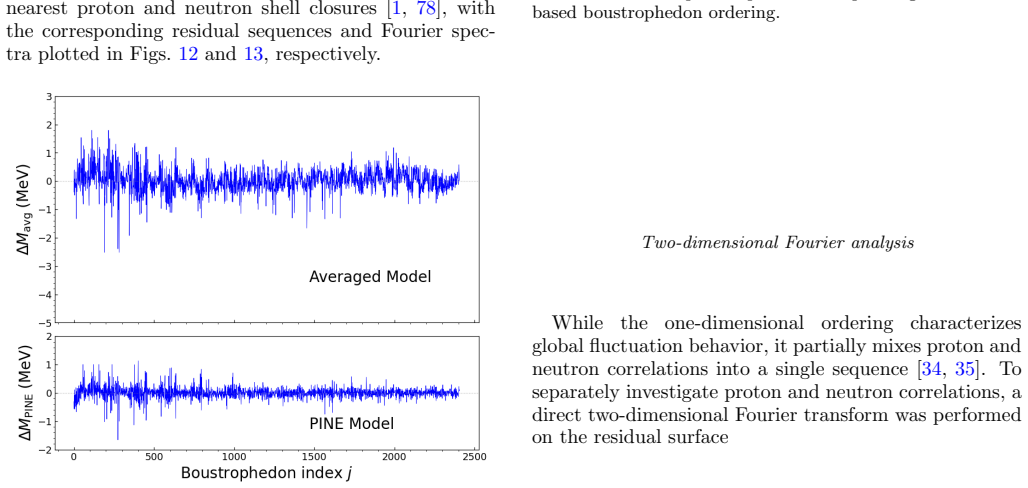
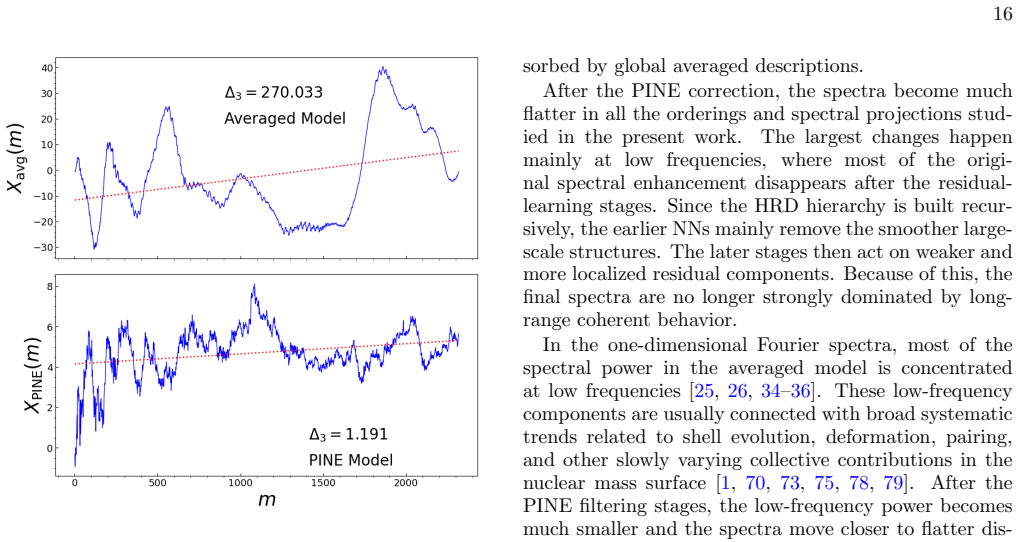
The central claim is that hierarchical neural residual learning efficiently removes the dominant low-frequency correlations and suppresses the quantum-chaotic spectral rigidity, driving the residuals toward the uncorrelated white-noise limit. This systematic suppression is performed by treating neural architectures as controlled nonlinear filters within the Hierarchical Residual Decomposition framework and is verified by Fourier-based spectral diagnostics applied across mass regions after the Physics-Informed Neural Ensemble has acted.
Load-bearing premise
Neural network architectures can serve as controlled nonlinear filters that progressively extract and suppress the chaotic many-body signature without introducing new artifacts or overfitting to the residuals.
Editorial extensions
If this is right
- The Physics-Informed Neural Ensemble combines multiple mass models and network architectures to achieve progressive suppression of both coherent trends and chaotic components.
- Fourier diagnostics applied to the filtered residuals across mass regions provide a quantitative measure of remaining scale-dependent complexity.
- The procedure isolates a diagnostic of the underlying many-body correlation structure once low-frequency and chaotic contributions are removed.
- Residuals after filtering are expected to approach the uncorrelated white-noise limit, allowing direct comparison of fluctuation statistics in different nuclear regions.
Reading between the lines
- The same hierarchical filtering approach could be tested on other observables such as nuclear level spacings to separate regular and chaotic contributions in a uniform way.
- If the method succeeds, it supplies a practical route for constructing hybrid models that treat the chaotic remainder statistically while retaining the filtered deterministic part for prediction.
- The work implies that the 1/f signature is a robust, removable feature rather than an irreducible property of the mass surface, which could be checked by applying the identical pipeline to simulated data with known chaos levels.
Signed reviews
Editorial analysis
A structured set of objections, weighed in public.
Referee Report
Summary. The manuscript introduces a Hierarchical Residual Decomposition framework in which multiple neural network architectures function as controlled nonlinear filters to progressively extract and suppress 1/f spectral correlations (quantum-chaotic signatures) from nuclear mass residuals obtained from global models. The resulting Physics-Informed Neural Ensemble (PINE) combines these models and networks; Fourier-based spectral diagnostics are then applied across mass regions to show that the residuals are driven toward the uncorrelated white-noise limit.
Significance. If the filtering is shown to be free of artifacts, the work supplies a quantitative, scale-dependent diagnostic of many-body correlation structure in nuclear masses that is not available from conventional global models. The hierarchical ensemble construction and explicit use of spectral diagnostics constitute a reproducible methodological contribution that could be applied to other many-body observables.
minor comments (3)
- The abstract and introduction refer to 'controlled nonlinear filters' without an explicit statement of the control criteria (e.g., regularization strength, early-stopping protocol, or synthetic-data validation) that prevent the networks from simply fitting the target residuals by construction.
- Figure captions and axis labels for the Fourier spectra should explicitly state the frequency range, windowing function, and normalization used so that the claimed approach to the white-noise floor can be reproduced from the published data.
- The PINE ensemble description would benefit from a table listing the individual mass models, NN architectures, and weighting scheme employed in the final combination.
Simulated Author's Rebuttal
We thank the referee for the careful reading and positive assessment of our manuscript on the Hierarchical Residual Decomposition framework and Physics-Informed Neural Ensemble (PINE). The recommendation for minor revision is noted. No specific major comments were provided in the report, so we interpret this as an invitation to perform light polishing and any minor clarifications that may arise during production.
Circularity Check
No significant circularity; derivation remains self-contained
full rationale
The paper presents a hierarchical residual decomposition using neural networks as nonlinear filters applied to nuclear mass residuals, with the outcome that low-frequency 1/f correlations are suppressed toward white-noise statistics. This is framed as an empirical result of the filtering process and subsequent Fourier diagnostics across mass regions, not as a definitional identity or a fitted parameter relabeled as a prediction. No equations reduce the claimed suppression to the training objective by construction, no self-citation chains bear the central claim, and no ansatz or uniqueness theorem is imported from prior author work. The method is applied to existing mass models and data with reported spectral diagnostics, keeping the derivation independent of its inputs.
Assumptions & free parameters
Cite this review
Pith. "Pith review of Hierarchical Neural Filtering of Nuclear Mass Residuals and Spectral Signatures of Quantum Chaos." pith.science (2026). https://pith.science/paper/WK5ZCFGY
@misc{pith2026260608546,
  author       = {Pith},
  title        = {Pith review of: Hierarchical Neural Filtering of Nuclear Mass Residuals and Spectral Signatures of Quantum Chaos},
  year         = {2026},
  howpublished = {\url{https://pith.science/paper/WK5ZCFGY}},
  note         = {Machine review of arXiv:2606.08546}
}
abstract
In complex quantum many-body systems such as atomic nuclei, the interplay between regular collective motion and irregular intrinsic dynamics gives rise to fluctuations that cannot be fully captured by existing global theoretical models. Nuclear mass, which exhibits smooth trends across the nuclear chart together with localized deviations, provides a sensitive observable for investigating such irregular dynamics. In this work, we employ a variety of neural network architectures, which serve as controlled nonlinear filters within a Hierarchical Residual Decomposition framework to progressively extract and suppress the chaotic many-body signature (characterized by $1/f$ spectral correlations) in nuclear mass residuals. The resulting Physics-Informed Neural Ensemble (PINE) model combines multiple mass models and neural network architectures, enabling a systematic suppression of coherent and chaotic components, after which the remaining fluctuations are analyzed using Fourier-based spectral diagnostics across different mass regions. Our results show that hierarchical neural residual learning efficiently removes the dominant low-frequency correlations and suppresses the quantum-chaotic spectral rigidity, driving the residuals toward the uncorrelated white-noise limit. This systematic suppression provides a quantitative diagnostic of the underlying scale-dependent complexity and many-body correlation structure of nuclear mass deviations.
Figures


Figures from the paper (10 more)




Reference graph
Works this paper leans on
-
[1]
Bohr and B
A. Bohr and B. Mottelson,Nuclear Structure, Vol. I: Single-Particle Motion(World Scientific, 1998)
1998
-
[2]
T. Guhr, A. M¨ uller-Groeling, and H. A. Weidenm¨ uller, Phys. Rep.299, 189 (1998)
1998
-
[3]
H. A. Weidenm¨ uller and G. E. Mitchell, Rev. Mod. Phys. 81, 539 (2009)
2009
-
[4]
J. M. G. G´ omez, K. Kar, V. K. B. Kota, R. A. Molina, A. Rela˜ no, and J. Retamosa, Phys. Rep.499, 103 (2011)
2011
-
[5]
Borgonovi, F
F. Borgonovi, F. M. Izrailev, L. F. Santos, and V. G. Zelevinsky, Phys. Rep.626, 1 (2016)
2016
-
[6]
H. A. Weidenm¨ uller, Eur. Phys. J. Plus140, 1 (2025)
2025
-
[7]
Mondal, L
D. Mondal, L. F. Santos, and S. Sinha, Phys. Rev. Lett. 136, 040401 (2026)
2026
-
[8]
Pausch, E
L. Pausch, E. G. Carnio, A. Rodr´ ıguez, and A. Buchleit- ner, Phys. Rev. Lett.126, 150601 (2021)
2021
Show all 93 references
-
[9]
Yoshimura and L
T. Yoshimura and L. S´ a, Nat. Commun.15, 9808 (2024)
2024
-
[10]
Xiang, J
L. Xiang, J. Chen, Z. Zhu, Z. Song, Z. Bao, X. Zhu, F. Jin, K. Wang, S. Xu, Y. Zou, H. Li, Z. Wang, C. Song, A. Yue, J. Partridge, Q. Guo, R. Mondaini, H. Wang, and R. T. Scalettar, Nat. Commun.15, 4918 (2024)
2024
-
[11]
Lisiecki, L
M. Lisiecki, L. Vidmar, and P. Lyd˙ zba, Phys. Rev. E 111, 054110 (2025)
2025
-
[12]
Meinert, M
F. Meinert, M. J. Mark, E. Kirilov, K. Lauber, P. Wein- mann, M. Gr¨ obner, and H.-C. N¨ agerl, Phys. Rev. Lett. 112, 193003 (2014)
2014
-
[13]
A. K. Das, A. Ghosh, and I. M. Khaymovich, Phys. Rev. Lett.131, 166401 (2023)
2023
-
[14]
Pausch, E
L. Pausch, E. G. Carnio, A. Buchleitner, and A. Rodr´ ıguez, Rep. Prog. Phys.88, 057602 (2025)
2025
-
[15]
Gomez, M
I. Gomez, M. Losada, and O. Lombardi, Entropy19, 205 (2017)
2017
-
[16]
E. P. Wigner, Math. Proc. Cambridge Philos. Soc.47, 790 (1951)
1951
-
[17]
P. L. Hsu, Annals of Eugenics9, 250 (1939)
1939
-
[18]
E. P. Wigner, SIAM Review9, 1 (1967)
1967
-
[19]
M. L. Mehta,Random Matrices, 3rd ed. (Elsevier, 2004)
2004
-
[20]
F. J. Dyson, J. Math. Phys.3, 140 (1962)
1962
-
[21]
F. J. Dyson, J. Math. Phys.3, 157 (1962)
1962
-
[22]
F. J. Dyson, J. Math. Phys.3, 166 (1962)
1962
-
[23]
M. L. Mehta, Nucl. Phys.18, 395 (1960)
1960
-
[24]
Bohigas, M.-J
O. Bohigas, M.-J. Giannoni, and C. Schmit, Phys. Rev. Lett.52, 1 (1984)
1984
-
[25]
Rela˜ no, J
A. Rela˜ no, J. M. G. G´ omez, R. A. Molina, J. Retamosa, and E. Faleiro, Phys. Rev. Lett.89, 244102 (2002)
2002
-
[26]
Faleiro, J
E. Faleiro, J. M. G. G´ omez, R. A. Molina, L. Mu˜ noz, A. Rela˜ no, and J. Retamosa, Phys. Rev. Lett.93, 244101 (2004)
2004
-
[27]
Riser, V
R. Riser, V. A. Osipov, and E. Kanzieper, Phys. Rev. Lett.118, 204101 (2017)
2017
-
[28]
Casal, L
I. Casal, L. Mu˜ noz, and R. A. Molina, Eur. Phys. J. Plus 136, 263 (2021)
2021
-
[29]
D. A. Lara Bustillos, L. L´ opez-Hern´ andez, N. Ram´ ırez- Cruz, E. M. Hern´ andez, R. Fossion, E. L´ opez-Moreno, C. E. Vargas, and V. Vel´ azquez, Phys. Rev. C102, 044301 (2020)
2020
-
[30]
Khatoni and H
T. Khatoni and H. Sabri, Phys. Lett. B823, 136780 (2021)
2021
-
[31]
Mourik, S
V. Mourik, S. Asaad, H. Firgau, J. J. Pla, C. Holmes, G. J. Milburn, J. C. McCallum, and A. Morello, Phys. Rev. E98, 042206 (2018)
2018
-
[32]
P. Tian, R. Riser, and E. Kanzieper, Phys. Rev. Lett. 132, 220401 (2024)
2024
-
[33]
˚Aberg, Nature417, 499 (2002)
S. ˚Aberg, Nature417, 499 (2002)
2002
-
[34]
Barea, A
J. Barea, A. Frank, J. G. Hirsch, and P. Van Isacker, Phys. Rev. Lett.94, 102501 (2005)
2005
-
[35]
J. G. Hirsch, V. Vel´ azquez, and A. Frank, Phys. Lett. B 595, 231 (2004)
2004
-
[36]
J. G. Hirsch, A. Frank, J. Barea, P. Van Isacker, and V. Vel´ azquez, Eur. Phys. J. A25, 75 (2005)
2005
-
[37]
Olofsson, S
H. Olofsson, S. ˚Aberg, O. Bohigas, and P. Leboeuf, Phys. Rev. Lett.96, 042502 (2006)
2006
-
[38]
Vel´ azquez, J
V. Vel´ azquez, J. G. Hirsch, A. Frank, J. Barea, and A. P. Zuker, Phys. Lett. B613, 134 (2005)
2005
-
[39]
Molinari and H
A. Molinari and H. A. Weidenm¨ uller, Phys. Lett. B637, 48 (2006)
2006
-
[40]
Bohigas and P
O. Bohigas and P. Leboeuf, Phys. Rev. Lett.88, 092502 (2002)
2002
-
[41]
Qi, Phys
C. Qi, Phys. Lett. B868, 145028 (2026)
2026
-
[42]
Storbacka and C
M. Storbacka and C. Qi, Communications Physics9, 143 (2026)
2026
-
[43]
K. A. Gernoth, J. W. Clark, J. S. Prater, and H. Bohr, Phys. Lett. B300, 1 (1993)
1993
-
[44]
Utama, J
R. Utama, J. Piekarewicz, and H. B. Prosper, Phys. Rev. C93, 014311 (2016)
2016
-
[45]
Utama and J
R. Utama and J. Piekarewicz, Phys. Rev. C96, 044308 (2017)
2017
-
[46]
J. Tian, P. Ma, X. Wu, M. Hu, C. Li, and N. Wang, Phys. Rev. C112, 064306 (2025)
2025
-
[47]
Idini, Phys
A. Idini, Phys. Rev. Res.2, 043363 (2020)
2020
-
[48]
Huang, K
M. Huang, K. A. Wendt, N. F. Schunck, and E. M. Holm- beck, Phys. Rev. C112, 034317 (2025)
2025
-
[49]
Shelley and A
M. Shelley and A. Pastore, Universe7, 131 (2021)
2021
-
[50]
Z. Niu, H. Liang, B. Sun, Y. Niu, J. Guo, and J. Meng, Science Bulletin63, 759 (2018). 19
2018
-
[51]
Y¨ uksel, D
E. Y¨ uksel, D. Soydaner, and H. Bahtiyar, Phys. Rev. C 109, 064322 (2024)
2024
-
[52]
M. Li, T. M. Sprouse, B. S. Meyer, and M. R. Mumpower, Phys. Lett. B848, 138385 (2024)
2024
-
[53]
A. E. Lovell, A. T. Mohan, T. M. Sprouse, and M. R. Mumpower, Phys. Rev. C106, 014305 (2022)
2022
-
[54]
M. R. Mumpower, T. M. Sprouse, A. E. Lovell, and A. T. Mohan, Phys. Rev. C106, L021301 (2022)
2022
-
[55]
H. Liu, J. Lei, and Z. Ren, Phys. Rev. C111, 024316 (2025)
2025
-
[56]
Zeng, Y.-Y
L.-X. Zeng, Y.-Y. Yin, X.-X. Dong, and L.-S. Geng, Phys. Rev. C109, 034318 (2024)
2024
-
[57]
Y. Lu, T. Shang, P. Du, J. Li, H. Liang, and Z. Niu, Phys. Rev. C111, 014325 (2025)
2025
-
[58]
Jalili, F
A. Jalili, F. Pan, A. X. Chen, and J. P. Draayer, Phys. Rev. C112, 024305 (2025)
2025
-
[59]
Jalili, Z
A. Jalili, Z. Saleki, Y. A. Luo, F. Pan, A. X. Chen, and J. P. Draayer, The European Physical Journal A61, 143 (2025)
2025
-
[60]
Bentley, J
I. Bentley, J. Tedder, M. Gebran, and A. Paul, Phys. Rev. C111, 034305 (2025)
2025
-
[61]
Zhao and H
T. Zhao and H. Zhang, Nuclear Physics A1021, 122420 (2022)
2022
-
[62]
C. H. Kim, K. Y. Chae, and M. S. Smith, Phys. Rev. C 113, 024308 (2026)
2026
-
[63]
Liu, H.-L
G.-P. Liu, H.-L. Wang, Z.-Z. Zhang, and M.-L. Liu, Phys. Rev. C111, 024306 (2025)
2025
-
[64]
S. A. Sundberg and R. J. Furnstahl, Journal of Physics G: Nuclear and Particle Physics52, 115106 (2025)
2025
-
[65]
Hornik, M
K. Hornik, M. Stinchcombe, and H. White, Neural Net- works2, 359 (1989)
1989
-
[66]
Cybenko, Mathematics of Control, Signals and Sys- tems2, 303 (1989)
G. Cybenko, Mathematics of Control, Signals and Sys- tems2, 303 (1989)
1989
-
[67]
Goodfellow, Y
I. Goodfellow, Y. Bengio, and A. Courville,Deep Learn- ing(MIT Press, 2016)
2016
-
[68]
R. A. Jacobs, M. I. Jordan, S. J. Nowlan, and G. E. Hinton, Neural Computation3, 79 (1991)
1991
-
[69]
M. I. Jordan and R. A. Jacobs, Neural Computation6, 181 (1994)
1994
-
[70]
M¨ oller, A
P. M¨ oller, A. J. Sierk, T. Ichikawa, and H. Sagawa, At. Data Nucl. Data Tables109–110, 1 (2016)
2016
-
[71]
Z.-Y. Wu, C. Qi, R. Wyss, and H.-L. Liu, Phys. Rev. C 92, 024306 (2015)
2015
-
[72]
N. Wang, M. Liu, X. Wu, and J. Meng, Phys. Lett. B 734, 215 (2014)
2014
-
[73]
Goriely, N
S. Goriely, N. Chamel, and J. M. Pearson, Phys. Rev. C 88, 061302 (2013)
2013
-
[74]
Batail, S
L. Batail, S. Goriely, S. P´ eru, S. Hilaire, D. Davesne, and A. Pastore, Phys. Lett. B868, 139719 (2025)
2025
-
[75]
Duflo and A
J. Duflo and A. P. Zuker, Phys. Rev. C52, R23 (1995)
1995
-
[76]
C. Qi, J. Phys. G42, 045104 (2015)
2015
-
[77]
Lunney, J
D. Lunney, J. M. Pearson, and C. Thibault, Rev. Mod. Phys.75, 1021 (2003)
2003
-
[78]
Bohr and B
A. Bohr and B. Mottelson,Nuclear Structure, Vol. II: Nuclear Deformations(World Scientific, 1998)
1998
-
[79]
Bender, P.-H
M. Bender, P.-H. Heenen, and P.-G. Reinhard, Rev. Mod. Phys.75, 121 (2003)
2003
-
[80]
C. Qi, Int. J. Mod. Phys. E , 2630002 (2026)
2026
-
[81]
K. A. Richardson, S. Trifinopoulos, and M. Williams, The dna of nuclear models: How ai predicts nuclear masses (2025), arXiv:2508.08370 [nucl-th]
2025
-
[82]
Ye and N
W. Ye and N. Wan, Phys. Rev. C111, 044317 (2025)
2025
-
[83]
C. M. Bishop,Pattern Recognition and Machine Learn- ing(Springer, 2006)
2006
-
[84]
P. Zai, W. Cheng, and F.-S. Zhang, Architecture as phys- ical prior: cooperative neural network for nuclear masses (2026), arXiv:2603.09747 [nucl-th]
2026
-
[85]
Guo, H.-L
J.-L. Guo, H.-L. Wang, Z.-Z. Zhang, and M.-L. Liu, Phys. Rev. C111, 054322 (2025)
2025
-
[86]
Caurier, G
E. Caurier, G. Mart´ ınez-Pinedo, F. Nowacki, A. Poves, and A. P. Zuker, Rev. Mod. Phys.77, 427 (2005)
2005
-
[87]
G. T. Garvey and I. Kelson, Phys. Rev. Lett.16, 197 (1966)
1966
-
[88]
G. T. Garvey, W. J. Gerace, R. L. Jaffe, I. Talmi, and I. Kelson, Rev. Mod. Phys.41, S1 (1969)
1969
-
[89]
Hastie, R
T. Hastie, R. Tibshirani, and J. Friedman,The Elements of Statistical Learning, 2nd ed. (Springer, 2009)
2009
-
[90]
LeCun, Y
Y. LeCun, Y. Bengio, and G. Hinton, Nature521, 436 (2015)
2015
-
[91]
Singh and C
J. Singh and C. Qi, Physics-informed neural ensemble framework for nuclear mass residual analysis,https:// doi.org/10.5281/zenodo.20299727(2026)
2026 doi
-
[92]
W. J. Huang, M. Wang, F. G. Kondev, G. Audi, and S. Naimi, Chinese Physics C45, 030002 (2021)
2021
-
[93]
M. Wang, W. J. Huang, F. G. Kondev, G. Audi, and S. Naimi, Chinese Physics C45, 030003 (2021)
2021
Reviewed June 27, 2026 · model on record in the stance chip above.
Discussion (0). Continue with ORCID to comment.