REVIEW 3 major objections 4 minor 91 references
UKRmol+: a suite for modelling of electronic processes in molecules interacting with electrons, positrons and photons using the R-matrix method
T0 review · 3 major / 4 minor · reviewed 2026-08-14 · deepseek-v4-flash
Pith's one-line read UKRmol+ reengineers the molecular R-matrix codes to model electron and positron scattering, photoionization, and time-dependent laser inputs with mixed Gaussian/B-spline continua.
desk verdict A substantial open-source release that delivers real new capability; referees should focus on documenting the integral library that the headline B-spline results depend on. read the letter →
The pith
A machine-rendered reading of the paper's core claim, the machinery that carries it, and where it could break.
The reading
What carries the argument
The central mechanism is the R-matrix division of space combined with the mixed Gaussian/B-spline continuum implemented in GBTOlib. BTOs, defined as radial B-splines multiplied by real spherical harmonics, represent the continuum at higher kinetic energies and support much larger R-matrix radii, while GTOs describe target and low-energy continuum regions. The load-bearing step is the construction and diagonalization of the energy-independent inner-region Hamiltonian: one diagonalization supplies all scattering energies, and subsequent outer-region propagation and matching produce the observables.
What would settle it
Compare GBTOlib's mixed Gaussian/B-spline integrals with high-order numerical quadrature on a small molecule at the suite's stated R-matrix parameters, and run its free-scattering eigenphase test across a wide energy range; eigenphase sums consistently above the paper's $10^{-2}$ rad rule of thumb would falsify the continuum representation.
Extended reading notes
Core claim
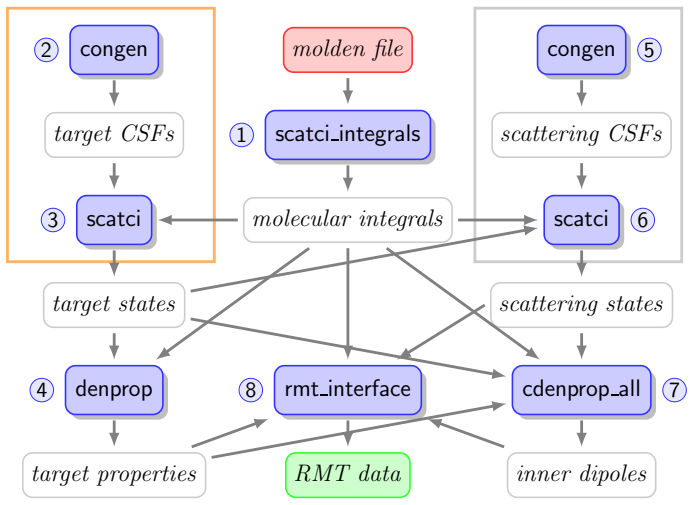
On its own terms, the central assertion is that UKRmol+ is a completely reengineered and extended version of the previous UKRmol codes, not an incremental patch. It takes target molecular orbitals from external quantum chemistry packages, builds the inner-region Hamiltonian with the GBTOlib integral library, diagonalizes it serially or in parallel, and feeds the eigenpairs to outer-region modules that yield K-matrices, cross sections, eigenphase sums, resonance parameters, photoionization dipoles, or RMT input. The demonstration cases are electron-impact excitation of thiophene, electron scattering from BeH at an R-matrix radius of $35\,a_0$ using a mixed GTO/BTO continuum, positron-H2 scattering with pseudostates, and photoionization of benzene. The paper argues that the suite reproduces earlier UKRmol results and that the BTO capability extends the reliable energy range beyond what double-precision GTO-only calculations allow.
Load-bearing premise
If the unpublished integral library used for the mixed Gaussian/B-spline basis has numerical errors, the B-spline continuum results collapse, since no independent published reference for those integrals yet exists.
Editorial extensions
If this is right
- Diffuse targets with R-matrix radii of tens of bohr become practical, as demonstrated by the BeH calculation at $35\,a_0$ with 50 target states.
- Photoionization calculations reach higher photoelectron energies: the mixed GTO/BTO basis removes unphysical oscillations that break down the double-precision GTO-only benzene results near 50 eV.
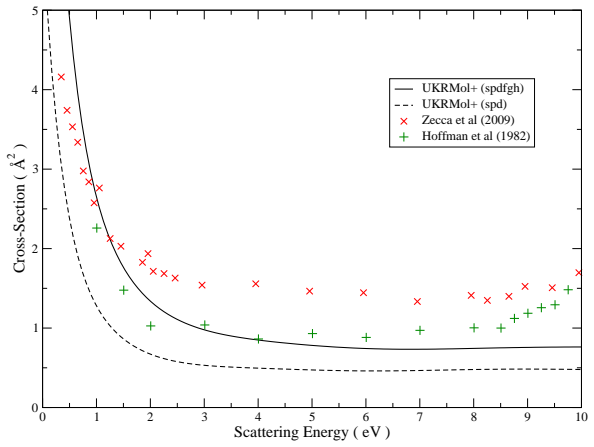
- Positron scattering with pseudostates improves the treatment of polarization and can be extended to larger targets through the parallel MPI-SCATCI diagonalizer.
- The same inner-region data feed the RMT code, so intense-laser time-dependent studies share an identical molecular description with the scattering and photoionization calculations.
- The distributed test suite covers all supported Abelian point groups, serial and parallel runs, and benchmark outputs for Hamiltonian eigenvalues, cross sections, and eigenphase sums.
Reading between the lines
- Beyond the paper's examples, the BTO continuum could become a systematic convergence tool: varying the R-matrix radius and the B-spline grid start gives a direct route to checking continuum completeness rather than merely extending the energy range.
- The benzene comparison suggests a cheap diagnostic: because the Legendre truncation parameters $L_{\mathrm{Leg}}=12$ and $24$ visibly change results above 25 eV, one could monitor convergence of the free-scattering eigenphase sum while raising these parameters in any new calculation.
- The phase-matching tools for geometry-dependent photoionization amplitudes imply a natural test: apply the suite to a molecule with a known conical intersection and verify that the matched dipoles vary smoothly along a closed loop around the intersection.
Signed reviews
Editorial analysis
A structured set of objections, weighed in public.
Referee Report
Summary. The manuscript describes UKRmol+, a Fortran 95/2003 suite for molecular R-matrix calculations of electron and positron scattering, molecular photoionization, and generation of input for the RMT time-dependent suite. The presentation covers the standard inner-/outer-region R-matrix formalism in Section 2, the individual programs and their namelists in Section 3, and the workflows for scattering, photoionization, and RMT input in Sections 4-6. A test suite is described in Section 7, and Section 8 presents illustrative applications: electron-impact excitation of thiophene compared with EELS data, electron scattering from BeH with a mixed GTO/BTO continuum at R = 35 a0, positron-H2 scattering with pseudostates, and photoionization of benzene comparing GTO-only and mixed GTO/BTO continuum bases.
Significance. If the central claims hold, UKRmol+ is a substantial community resource: it is open-source, distributed with a build system and test suite, supports MPI parallelization through MPI-SCATCI and MPI-RSOLVE, accepts target orbitals from external quantum chemistry packages, and extends the continuum representation to mixed Gaussian/B-spline bases. The Section 2.1 derivation is standard and correct, and the comparisons against independent experimental EELS and positron-beam data, together with reproduction of previously published BeH results, provide meaningful grounding. The authors are also candid about the limitations of the benzene demonstration. The main risk is that the new mixed GTO/BTO integral capability rests on GBTOlib, which is cited only as "In preparation", and the in-paper validation of that component is incomplete.
major comments (3)
- [Section 3.1.2 and Section 3.1.6] The free-scattering test (Section 3.1.2) checks overlap, kinetic-energy, and Bloch integrals in a one-electron problem with H = -nabla^2/2, but it cannot detect errors in the mixed two-electron integral classes <CC||TT> and <CC||CT>, which are precisely the numerically delicate classes needed for the BTO continuum capability. Since GBTOlib is described only as "In preparation" (Ref. [10]) and no independent analytical or numerical validation of these integral classes is reported, the headline BTO results rest on an unverified foundation. I recommend adding explicit convergence tests of these integral classes against known values, or against an independent implementation, and reporting the sensitivity to delta_r and the Legendre truncation parameters.
- [Section 8.4, Figure 12] The benzene photoionization example is the only in-paper molecular demonstration that exercises the mixed two-electron integrals, but the authors state that the calculation "is not to present accurate observables" and acknowledge that the results are not converged with respect to continuum angular momentum above about 50 eV. The visible differences between LLeg = 12 and LLeg = 24 in the 2E2g panel additionally show incomplete convergence in the Legendre truncation. As published evidence for the correctness of the mixed integral library this is weak; I ask for one converged benchmark, or a quantitative statement of the expected errors in the displayed curves.
- [Section 1 and Section 7] The claim that UKRmol+ "should be able to reproduce virtually all the old results" and that this "has indeed been tested for a number of targets" is not quantified, and the Section 7 test-suite benchmark outputs are generated by the same code, so they demonstrate reproducibility rather than correctness. A table comparing UKRmol and UKRmol+ results for at least one representative target, with stated tolerances, would make the backward-compatibility claim concrete and would strengthen the paper's central assertion.
minor comments (4)
- [Abstract] The abstract contains the typo "photionisation" in place of "photoionisation".
- [Section 2.2] The text reads "The next section shows shows how this leads"; the duplicated word should be removed.
- [Sections 3.1.5, 3.2, 3.4, 8.1, 8.2] There are several grammatical and typographical errors that should be corrected: "all the orbitals used for m a single orthonormal set" in Section 3.1.5, "differnet" in Section 3.2, "quadropole" in Section 3.4, "This calculations was" in Section 8.1, and "Hamilonians" in Section 8.2.
- [Figure 9] The caption ends with an incomplete phrase "[72] and." which should be completed or removed.
Circularity Check
No significant circularity: the paper's derivation chain is standard R-matrix algebra and its illustrative results are either compared with unnormalized experiment or labelled non-benchmark; the main self-reference is an in-preparation GBTOlib citation, a support gap rather than a circular reduction.
full rationale
The paper is a software-description/code-release article. Its Section 2 derivation follows the standard R-matrix embedding algebra (Eqs. 8-18): the Bloch operator converts the boundary-value problem into an eigenvalue problem, and the R-matrix is defined by projecting the spectral decomposition of the inner-region Green's function. Nothing in this chain is fitted, and no physical observable is defined in terms of the result it is supposed to predict. The illustrative calculations in Section 8 provide external anchoring where they claim it: the thiophene excitation function is compared to EELS data that the paper explicitly states were not normalized to theory, and the positron-H2 cross sections are compared to measurements by Zecca et al. and Hoffman et al. The BeH and benzene panels are explicitly capability demonstrations, not validated predictions (Section 8.4 says its purpose 'is not to present accurate observables'). The only load-bearing self-reference is GBTOlib (Ref. [10], 'In preparation'), which supplies the mixed GTO/BTO integrals used by the BTO continuum examples; the in-suite free-scattering test exercises only a one-electron zero-potential Hamiltonian and therefore cannot independently validate the mixed two-electron classes. That is a missing-support/correctness risk, not a circular reduction: the paper does not derive any result from GBTOlib, define a target quantity in terms of GBTOlib output, or invoke a uniqueness theorem. The test-suite 'benchmark outputs' are regression references produced by the same code and are presented as compilation tests, i.e. reproducibility checks rather than first-principles predictions. Hence no derivation in the paper reduces to its own inputs by construction; the appropriate finding is no significant circularity, with the GBTOlib dependency noted as the weak point.
Assumptions & free parameters
assumptions (5)
- domain assumption Fixed-nuclei non-relativistic Hamiltonian (Eq. 5) is used for the inner region.
- domain assumption Target electronic wavefunctions are assumed to have negligible amplitude on the R-matrix sphere boundary.
- domain assumption Outer-region projectile-target interaction is represented by a single-centre multipole expansion.
- domain assumption For photoionization, the initial bound state is fully contained within the R-matrix sphere.
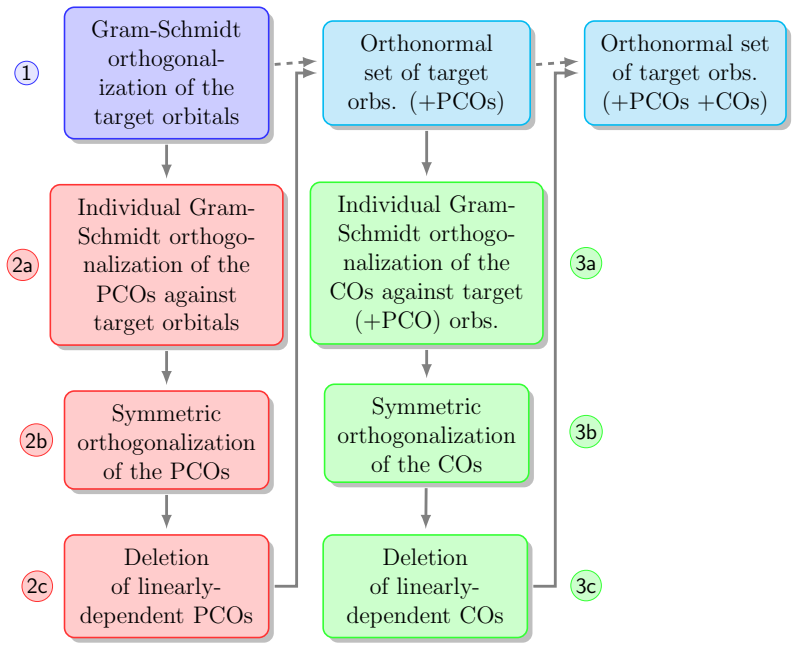
- domain assumption Symmetric orthogonalization of continuum orbitals with user-selected deletion thresholds preserves the physical description.
Cite this review
Pith. "Pith review of UKRmol+: a suite for modelling of electronic processes in molecules interacting with electrons, positrons and photons using the R-matrix method." pith.science (2026). https://pith.science/paper/WKJY6KFG
@misc{pith2026190803018,
  author       = {Pith},
  title        = {Pith review of: UKRmol+: a suite for modelling of electronic processes in molecules interacting with electrons, positrons and photons using the R-matrix method},
  year         = {2026},
  howpublished = {\url{https://pith.science/paper/WKJY6KFG}},
  note         = {Machine review of arXiv:1908.03018}
}
read the original abstract
UKRmol+ is a new implementation of the UK R-matrix electron-molecule scattering code. Key features of the implementation are the use of quantum chemistry codes such as Molpro to provide target molecular orbitals; the optional use of mixed Gaussian -- B-spline basis functions to represent the continuum and improved configuration and Hamiltonian generation. The code is described, and examples covering electron collisions from a range of targets, positron collisions and photionisation are presented. The codes are freely available as a tarball from Zenodo.
Figures


Figures from the paper (10 more)





Reference graph
Works this paper leans on
-
[10]
Z. Maˇ s ´ ın, et al, GBTOlib: library for evaluation of molecular integrals in the basis of multicentric gaussian and single-centre B-spline orbita ls., Computer Physics CommunicationIn preparation
-
[1]
P. G. Burke, K. A. Berrington (Eds.), Atomic and Molecular Proce sses, an R-matrix Approach, Institute of Physics Publishing, Bristol, 199 3. 67 Table B.22: Multiplication table for combinations of irreducible represe ntations of the Abelian groups supported with UKRmol+. Numbers are the M -values introduced in Table B.21. 0 1 2 3 4 5 6 7 0 0 1 2 3 4 5 6 ...
-
[3]
P. Descouvemont, D. Baye, The R-matrix theory, Rep. Prog. P hys. 73 (2010) 036301. doi:{10.1088/0034-4885/73/3/036301}
-
[4]
J. Tennyson, L. K. McKemmish, T. Rivlin, Low temperature chem- istry using the R-matrix method, Faraday Discuss. 195 (2016) 31– 48. doi:10.1039/c6fd00110f
-
[5]
Zhang, K
R. Zhang, K. L. Baluja, J. Franz, J. Tennyson, Positron collision s with molecular hydrogen: cross sections and annihilation parameters ca lcu- lated using the R-matrix with pseudo-states method, J. Phys. B: At. Mol. Opt. Phys. 44 (2011) 035203
2011
-
[6]
C. J. Gillan, J. Tennyson, P. G. Burke, The UK molecular R-matrix scattering package: a computational perspective, in: W. Huo, F. A. Gi- anturco (Eds.), Computational methods for Electron-molecule co llisions, Plenum, New York, 1995, pp. 239–254
1995
-
[7]
L. A. Morgan, C. J. Gillan, J. Tennyson, X. Chen, R-matrix calcula tions for polyatomic molecules: electron scattering by N 2O, J. Phys. B: At. Mol. Opt. Phys. 30 (1997) 4087–4096
1997
-
[8]
J. M. Carr, P. G. Galiatsatos, J. D. Gorfinkiel, A. G. Harvey, M. A . Lysaght, D. Madden, Z. Maˇ s ´ ın, M. Plummer, J. Tennyson, H. N. Varambhia, UKRmol: a low-energy electron- and positron-molecule scattering suite, The European Physical Journal D 66 (3) (2012) 58. doi:10.1140/epjd/e2011-20653-6
Show all 91 references
-
[9]
Werner, P
H.-J. Werner, P. J. Knowles, G. Knizia, F. R. Manby, M. Sch¨ utz, Mol- pro: a general-purpose quantum chemistry program package, WI REs Comput. Mol. Sci. 2 (2012) 242–253. doi:10.1002/wcms.82
2012 doi
-
[11]
A. G. Harvey, D. S. Brambila, F. Morales, O. Smirnova, An R-mat rix approach to electron-photon-molecule collisions: photoelectron a ngular 69 distributions from aligned molecules, J. Phys. B: At. Mol. Opt. Phys. 47 (2014) 215005. doi:{10.1088/0953-4075/47/21/215005}
2014 doi
-
[12]
D. S. Brambila, A. G. Harvey, Zdenˇ ek, J. D. Gorfinkiel, O. Smirn ova, The role of multichannel effects in the photoionization of the no 2 molecule: an ab initio r -matrix study, J. Phys. B: At. Mol. Opt. Phys. 48 (2015) 245101
2015
-
[13]
Brown, et al., RMT: R-matrix with time-dependence
A. Brown, et al., RMT: R-matrix with time-dependence. Solving the semi-relativistic, time-dependent Schr¨ odinger equation for g eneral, multi-electron atoms and molecules in intense, ultrashort, arbitrar ily polarized laser pulses., Comput. Phys. Commun.In preparation
-
[14]
Burke, C
P. Burke, C. Noble, V. Burke, R-matrix theory of atomic, molec - ular and optical processes, in: P. Berman, C. Lin, E. Ari- mondo (Eds.), Advances In Atomic, Molecular, and Opti- cal Physics, Vol. 54, Academic Press, 2007, pp. 237 – 318. doi:https://doi.org/10.1016/S1049-250X(...
2007 doi
-
[15]
P. G. Burke, R-Matrix Theory of Atomic Collisions: Application to Atomic, Molecular and Optical Processes, Springer, 2011
2011
-
[16]
Gailitis, New forms of asymptotic expansions for wavefunctio ns of charged-particle scattering, J
M. Gailitis, New forms of asymptotic expansions for wavefunctio ns of charged-particle scattering, J. Phys. B: At. Mol. Opt. Phys. 9 (1 976) 843
-
[17]
K. L. Baluja, P. G. Burke, L. A. Morgan, R-matrix propagation program for solving coupled second-order differential-equations, Compute r Phys. Comm. 27 (1982) 299–307
1982
-
[18]
L. A. Morgan, A generalized r-matrix propagation program for solv- ing coupled 2nd-order differential-equations, Computer Phys. Com m. 31 (1984) 419–422
1984
-
[19]
P. G. Burke, C. J. Noble, A. G. Sunderland, V. M. Burke, Electr on Collisions with Iron Peak Elements: A Computational Grand Challenge, Physica Scripta T100 (2002) 55–63
2002
-
[20]
C. J. Noble, R. K. Nesbet, Cfasym, a program for the calculatio n of the asymptotic solutions of the coupled equations of electron collisio n- theory, Computer Phys. Comm. 33 (1984) 399. 70
1984
-
[21]
Szmytkowski, J
R. Szmytkowski, J. Hinze, Convergence of the non-relativistic and rela- tivistic R -matrix expansions at the reaction volume boundary, Jour nal of Physics B: Atomic, Molecular and Optical Physics 29 (4) (1996) 76 1. doi:10.1088/0953-4075/29/4/018
1996 doi
-
[22]
Bachau, E
H. Bachau, E. Cormier, P. Decleva, J. E. Hansen, F. Martin, Ap plica- tions of b-splines in atomic and molecular physics, Rep. Prog. Phys. 6 4 (2001) 1815–1943
2001
-
[23]
Faure, J
A. Faure, J. D. Gorfinkiel, L. A. Morgan, J. Tennyson, GTOBAS : fitting continuum functions with Gaussian-type orbitals, Comp. Phys. Com - mun. 144 (2002) 224–241
2002
-
[24]
Tennyson, Electron - molecule collision calculations using the R- matrix method, Phys
J. Tennyson, Electron - molecule collision calculations using the R- matrix method, Phys. Rep. 491 (2010) 29–76
2010
-
[25]
M. M. Fujimoto, W. J. Brigg, J. Tennyson, R-matrix calculations of differential and integral cross sections for low-energy electron c ollisions with ethanol, The European Physical Journal D 66 (2012) 204
2012
-
[26]
W. J. Brigg, J. Tennyson, M. Plummer, R-matrix calculations of lo w- energy electron collisions with methane, J. Phys. B: At. Mol. Opt. Ph ys. 47 (2014) 185203
2014
-
[27]
Tennyson, R-matrix calculation of Rydberg states of CO, J
J. Tennyson, R-matrix calculation of Rydberg states of CO, J. Phys. B: At. Mol. Opt. Phys. 29 (1996) 6185–6201
1996
-
[28]
A. Dora, J. Tennyson, L. Bryjko, T. van Mourik, R-matrix calc ulation of low-energy electron collisions with uracil, J. Chem. Phys. 130 (16) (2009) 164307–8. doi:10.1063/1.3119667
2009 doi
-
[29]
Bartschat, E
K. Bartschat, E. T. Hudson, M. P. Scott, P. G. Burke, V. M. B urke, Electron-atom scattering at low and intermediate energies using a pseudo-state R-matrix basis, J. Phys. B: At. Mol. Opt. Phys. 29 ( 1996) 115–123
1996
-
[30]
J. D. Gorfinkiel, J. Tennyson, Electron-H + 3 collisions at intermediate energies, J. Phys. B: At. Mol. Opt. Phys. 37 (2004) L343–L350
2004
-
[31]
J. D. Gorfinkiel, J. Tennyson, Electron impact ionisation of small molecules at intermediate energies: the R-matrix with pseudostate s method, J. Phys. B: At. Mol. Opt. Phys. 38 (2005) 1607–1622. 71
2005
-
[32]
Halmov´ a, J
G. Halmov´ a, J. D. Gorfinkiel, J. Tennyson, Low and intermediate energy electron collisions with the C − 2 molecular anion, J. Phys. B: At. Mol. Opt. Phys. 41 (2008) 155201
2008
-
[33]
Jones, J
M. Jones, J. Tennyson, On the use of pseudostates to calcula te molecular polarizabilities, J. Phys. B: At. Mol. Opt. Phys. 43 (2010) 045101
2010
-
[34]
Zhang, P
R. Zhang, P. G. Galiatsatos, J. Tennyson, Positron collisions wit h acetylene calculated using the R-matrix with pseudo-states metho d, J. Phys. B: At. Mol. Opt. Phys. 44 (2011) 195203
2011
-
[35]
Schaftenaar, J
G. Schaftenaar, J. H. Noordik, Molden: a pre- and post- processing program for molecular and electronic structures, Jou r- nal of Computer-Aided Molecular Design 14 (2) (2000) 123–134. doi:10.1023/A:1008193805436
2000 doi
-
[36]
R. M. Parrish, L. A. Burns, D. G. A. Smith, A. C. Simmonett, A. E . DePrince, E. G. Hohenstein, U. Bozkaya, A. Y. Sokolov, R. Di Remig io, R. M. Richard, J. F. Gonthier, A. M. James, H. R. McAlexander, A. K u- mar, M. Saitow, X. Wang, B. P. Pritchard, P. Verma, H. F. Schaefe r...
2017
-
[37]
H. H. H. Homeier, E. O. Steinborn, Some properties of the coup ling co- efficients of real spherical harmonics and their relation to Gaunt co effi- cients, Journal of Molecular Structure: THEOCHEM 368 (1996) 31 –37. doi:16/S0166-1280(96)90531-X
1996
-
[38]
Darby-Lewis, Z
D. Darby-Lewis, Z. Maˇ s ´ ın, J. Tennyson, R-matrix calculation s of electron impact electronic excitation of {BeH}, Journal of Physics B: Atomic, Molecular and Optical Physics 50 (17) (2017) 175201. doi:10.1088/1361-6455/aa8161
2017 doi
-
[39]
Szab´ o, N
A. Szab´ o, N. S. Ostlund, Modern quantum chemistry: introdu ction to advanced electronic structure theory, Courier Dover Publication s, 1996. 72
1996
-
[42]
Sieradzka, J
A. Sieradzka, J. D. Gorfinkiel, Theoretical study of resonanc e formation in microhydrated molecules. i. pyridine-(h 2o)n, n = 1,2,3,5, The Journal of Chemical Physics 147 (3) (2017) 034302. doi:10.1063/1.4993941
2017 doi
-
[43]
Sieradzka, J
A. Sieradzka, J. D. Gorfinkiel, Theoretical study of resonanc e formation in microhydrated molecules. ii. thymine-(h 2o)n, n = 1,2,3,5, The Journal of Chemical Physics 147 (3) (2017) 034303. doi:10.1063/1.4993946
2017 doi
-
[45]
Tennyson, A new algorithm for Hamiltonian matrix constructio n in electron-molecule collision calculations, J
J. Tennyson, A new algorithm for Hamiltonian matrix constructio n in electron-molecule collision calculations, J. Phys. B: At. Mol. Opt. Phy s. 29 (1996) 1817–1828
1996
-
[46]
Yoshimine, CONSTRUCTION OF HAMILTONIAN MATRIX IN LARGE CONFIGURATION INTERACTION CALCULATIONS, J
M. Yoshimine, CONSTRUCTION OF HAMILTONIAN MATRIX IN LARGE CONFIGURATION INTERACTION CALCULATIONS, J. Comput. Phys. 11 (1973) 449–454
1973
-
[47]
A. D. McLean, in: W. A. Lester Jr (Ed.), Potential Energy Surf aces in Chemistry, San Jose: IBM Research Laboratory, 1971, p. 87
1971
-
[48]
A. F. Al-Refaie, J. Tennyson, A parallel algorithm for Hamilto- nian matrix construction in electronmolecule collision calculations: MPI-SCATCI, Computer Physics Communications 221 (2017) 53–62 . doi:10.1016/j.cpc.2017.07.023
2017 doi
-
[49]
Stathpoulos, F
A. Stathpoulos, F. C. F, A DA VIDSON PROGRAM FOR FINDING A FEW SELECTED EXTREME EIGENPAIRS OF A LARGE, SPARSE, 73 REAL, SYMMETRICAL MATRIX, Computer Phys. Comm. 79 (1994) 268–290. doi:10.1016/0010-4655(94)90073-6
1994 doi
-
[50]
Lehoucq, D
R. Lehoucq, D. Sorensen, C. Yang, ARPACK Users’ Guide: Solu tion of Large-scale Eigenvalue Problems with Implicitly Restarted Arnoldi Methods, Software, Environments, Tools, Society for Industria l and Ap- plied Mathematics, 1998
1998
-
[51]
J. Choi, J. Demmel, I. Dhillon, J. Dongarra, S. Ostrouchov, A. P etitet, K. Stanley, D. W. Walker, R. C. Whaley, ScaLAPACK: A Portable Lin- ear Algebra Library for Distributed Memory Computers - Design Iss ues and Performance, in: Proceedings of the Second International W orks...
1996
-
[52]
Hernandez, J
V. Hernandez, J. E. Roman, V. Vidal, SLEPc: A scalable and flexi- ble toolkit for the solution of eigenvalue problems, ACM Trans. Math. Software 31 (3) (2005) 351–362
2005
-
[53]
Tennyson, Phase factors in electron-molecule collision calcula tions, Computer Phys
J. Tennyson, Phase factors in electron-molecule collision calcula tions, Computer Phys. Comm. 100 (1997) 26–30
1997
-
[54]
C. J. Gillan, J. Tennyson, B. M. McLaughlin, P. G. Burke, Low ene rgy electron impact excitation of the nitrogen molecule: optically forbidd en transitions, J. Phys. B: At. Mol. Opt. Phys. 29 (1996) 1531–1547
1996
-
[55]
Tashiro, K
M. Tashiro, K. Morokuma, J. Tennyson, r-matrix calculation of electron collisions with electronically excited o 2 molecules, Phys. Rev. A 73 (2006) 052707. doi:10.1103/PhysRevA.73.052707. URL https://link.aps.org/doi/10.1103/PhysRevA.73.052707
2006 doi
-
[56]
Tennyson, Partitioned R-matrix theory for molecules, J
J. Tennyson, Partitioned R-matrix theory for molecules, J. Ph ys. B: At. Mol. Opt. Phys. 37 (2004) 1061–1071
2004
-
[57]
A. G. Harvey, D. S. Brambila, F. Morales, O. Smirnova, CDENPRO P: Transition matrix elements involving continuum states, arXiv e-print s (2013) arXiv:1401.0229 arXiv:1401.0229. 74
2013 arXiv
-
[58]
Loupas, J
A. Loupas, J. D. Gorfinkiel, Shape and core-excited resonanc es in elec- tron scattering from alanine, The Journal of Chemical Physics 150 (6) (2019) 064307. doi:10.1063/1.5081813
2019 doi
-
[59]
Tarana, J
M. Tarana, J. Tennyson, Polarization effects in electron collision s with Li2: application of the molecular R-matrix method with pseudostates, J. Phys. B: At., Mol. Opt. Phys. 41 (2008) 205204
2008
-
[60]
Sukuba, J
I. Sukuba, J. D. Gorfinkiel, Phys. Rev. A
-
[61]
Maˇ s ´ ın, J
Z. Maˇ s ´ ın, J. D. Gorfinkiel, Shape and core excited resonances in electron collisions with diazines, The Journal of Chemical Physics 137 (20) (20 12) 204312. doi:10.1063/1.4767345
-
[62]
P. G. Burke, H. M. Schey, Elastic scattering of low-energy electrons by atomic hydrogen, Phys. Rev. 126 (1962) 147–162. doi:10.1103/PhysRev.126.147
1962 doi
-
[63]
Tennyson, C
J. Tennyson, C. J. Noble, Reson–a program for the detection and fitting of breit-wigner resonances, Comput. Phys. Commun. 33 (1984) 4 21–424
1984
-
[64]
D. T. Stibbe, J. Tennyson, TIMEDEL: a program for the detection and parameterization of resonances using the time- delay matrix, Computer Phys. Comm. 114 (1-3) (1998) 236–242. doi:{10.1016/S0010-4655(98)00070-8}
1998 doi
-
[65]
D. A. Little, J. Tennyson, M. Plummer, C. J. Noble, A. G. Sunderland, TIMEDELn: A programme for the detection and parametrization of overlapping resonances using the time-delay method, Computer Physics Communications 215 (2017) 137 – 148. doi:https://doi.org/10.1016/j.cpc.2017.01.005
2017 doi
-
[66]
Tennyson, Continuum and bound states of the e − – CH + system using the R–Matrix method, J
J. Tennyson, Continuum and bound states of the e − – CH + system using the R–Matrix method, J. Phys. B: At. Mol. Opt. Phys. 21 (198 8) 805–816
-
[67]
Sanna, F
N. Sanna, F. A. Gianturco, Differential cross sections for elec - tron/positron scattering for polyatomic molecules, Computer Phy s. Comm. 114 (1998) 142–167. 75
1998
-
[68]
F. A. Gianturco, A. Jain, The theory of electron scattering fr om polyatomic molecules, Physics Reports 143 (6) (1986) 347–425. doi:10.1016/0370-1573(86)90125-0
1986 doi
-
[69]
Regeta, M
K. Regeta, M. Allan, C. Winstead, V. McKoy, Z. Maˇ s ´ ın, J. D. Gorfinkiel, Resonance effects in elastic cross sections for electron scatterin g on pyrimidine: Experiment and theory, The Journal of Chemical Physic s 144 (2). doi:http://dx.doi.org/10.1063/1.4937790
-
[70]
Zhang, A
R. Zhang, A. Faure, J. Tennyson, Electron and positron collisio ns with polar molecules: studies with the benchmark water molecule, Phys. Scripta 80 (2009) 015301
2009
-
[71]
Regeta, M
K. Regeta, M. Allan, Z. Maˇ s ´ ın, J. D. Gorfinkiel, Abso- lute cross sections for electronic excitation of pyrimidine by electron impact, The Journal of Chemical Physics 144 (2). doi:http://dx.doi.org/10.1063/1.4939077
-
[72]
Loupas, K
A. Loupas, K. Regeta, M. Allan, J. D. Gorfinkiel, Shape and core -excited resonances in thiophene, The Journal of Physical Chemistry A 122 (4) (2018) 1146–1155. doi:10.1021/acs.jpca.7b11865
2018 doi
-
[73]
D. A. Little, J. Tennyson, Singlet and triplet ab initio Rydberg states of N 2, J. Phys. B: At. Mol. Opt. Phys. 46 (2013) 145102
2013
-
[74]
B. K. Sarpal, S. E. Branchett, J. Tennyson, L. A. Morgan, Bo und states using the R-matrix method: Rydberg states of HeH, J. Phys. B: At . Mol. Opt. Phys. 24 (1991) 3685–3699
1991
-
[75]
M. J. Seaton, USE OF THE R-MATRIX METHOD FOR BOUND-STATE CALCULATIONS .1. GENERAL-THEORY, J. Phys. B: At. Mol. Opt. Phys. 18 (1985) 2111–2131. doi:{10.1088/0022-3700/18/11/008}
1985 doi
-
[76]
Rabad´ an, J
I. Rabad´ an, J. Tennyson, R-Matrix calculation of the bound a nd con- tinuum states of the e − – NO + system, J. Phys. B: At. Mol. Opt. Phys. 29 (1996) 3747–3761
1996
-
[77]
R. W. Brankin, I. Gladwell, J. R. Dormand, P. J. Prince, W. L. Seward, A RUNGE-KUTTA-NYSTROM CODE, ACM TRANS- ACTIONS ON MATHEMATICAL SOFTW ARE 15 (1989) 31–40. doi:{10.1145/62038.69650}. 76
1989
-
[78]
W. J. Brigg, A. G. Harvey, A. Dzarasova, S. Mohr, D. S. Bramb ila, F. Morales, O. Smirnova, J. Tennyson, Calculated photoionization c ross sections using Quantemol-N, Jap. J. Appl. Phys. 54 (2015) 06GA02
2015
-
[79]
Khamesian, N
M. Khamesian, N. Douguet, S. F. dos Santos, O. Dulieu, M. Raou lt, W. J. Brigg, V. Kokoouline, Formation of CN-, C3N-, and C5N- Molecules by Radiative Electron Attachment and their Destruc- tion by Photodetachment, Phys. Rev. Lett. 117 (2016) 123001. doi:{10.1103/PhysRevLett.1...
2016 doi
-
[80]
D. S. Brambila, A. G. Harvey, Z. Maˇ s ´ ın, J. D. Gorfinkiel, O. Smirnova, The role of multichannel effects in the photoionization of the NO 2 molecule: An ab initio R -matrix study, J. Phys. B: At. Mol. Opt. Phys. 48 (24) (2015) 245101. doi:10.1088/0953-4075/48/24/245101
2015 doi
-
[81]
D. S. Brambila, A. G. Harvey, K. Houfek, Z. Maˇ s ´ ın, O. Smirnova, Role of electronic correlations in photoionization of NO2 in the vicinity of the 2A1/2B2 conical intersection, Phys Chem Chem Phys 19 (30) (2017 ) 19673–19682. doi:10.1039/c7cp01643c
2017 doi
-
[83]
Rouz´ ee, A
A. Rouz´ ee, A. G. Harvey, F. Kelkensberg, D. Brambila, W. K. S iu, G. Gademann, O. Smirnova, M. J. J. Vrakking, Imaging the elec- tronic structure of valence orbitals in the XUV ionization of aligned molecules, J. Phys. B: At. Mol. Opt. Phys. 47 (12) (2014) 124017. doi:10.108...
2014 doi
-
[84]
B. D. Bruner, Z. Maˇ s ´ ın, M. Negro, F. Morales, D. Brambila, M.Devetta, D. Faccial` a, A. G. Harvey, M. Ivanov, Y. Mairesse, S. Patchkovs kii, V. Serbinenko, H. Soifer, S. Stagira, C. Vozzi, N. Dudovich, O. Smir nova, Multidimensional high harmonic spectroscopy of polyatomi...
2016 doi
-
[85]
Maˇ s ´ ın, A
Z. Maˇ s ´ ın, A. G. Harvey, M. Spanner, S. Patchkovskii, M. Iva nov, O. Smirnova, Electron correlations and pre-collision in the re-collision picture of high harmonic generation, J. Phys. B: At. Mol. Opt. Phys . 51 (13) (2018) 134006. doi:10.1088/1361-6455/aac598
2018 doi
-
[86]
D. R. Austin, F. McGrath, L. Miseikis, D. Wood, P. Hawkins, A. S. Johnson, M. Vacher, Z. Maˇ s ´ ın, A. Harvey, M. Ivanov, O. Smirno va, J. P. Marangos, Role of tunnel ionization in high harmonic generation from substituted benzenes, Faraday Discuss. 194 (0) (2016) 34 9–368. d...
2016 doi
-
[87]
D. M. Brink, G. R. Satchler, Angular Momentum, Clarendon Pres s ; Oxford University Press, Oxford; New York, 1993
1993
-
[88]
Ritchie, Theory of the angular distribution of photoelectron s ejected from optically active molecules and molecular negative ions, Phys
B. Ritchie, Theory of the angular distribution of photoelectron s ejected from optically active molecules and molecular negative ions, Phys. Rev . A 13 (4) (1976) 1411–1415. doi:10.1103/PhysRevA.13.1411
1976 doi
-
[89]
Richter, J
M. Richter, J. Gonzalez-Vazquez, Z. Maˇ s ´ ın, D. S. Brambila, A . Har- vey, F. Morales, F. Martn, Ultrafast imaging of laser-controlled no n- adiabatic dynamics in NO 2 from time-resolved photoelectron emission, Physical Chemistry Chemical Physics doi:10.1039/C9CP00649D
-
[90]
Mayer, Simple Theorems, Proofs, and Derivations in Quantum Chem- istry, US, Springer Science + Business Media New York, 2003
I. Mayer, Simple Theorems, Proofs, and Derivations in Quantum Chem- istry, US, Springer Science + Business Media New York, 2003
2003
-
[91]
K. L. Baluja, R. Zhang, J. Franz, J. Tennyson, Low-energy p ositron collisions with water: elastic and rotationally inelastic scattering, J. Phys. B: At. Mol. Opt. Phys. 40 (2007) 3515–3524
2007
-
[92]
A. G. Sanz, M. C. Fuss, F. Blanco, Z. Maˇ s ´ ın, J. D. Gorfinkiel, R. P. McEachran, M. J. Brunger, G. Garc ´ ıa, Cross-section cal- culations for positron scattering from pyrimidine over an energy range from 0.1 to 10000 ev, Phys. Rev. A 88 (2013) 062704. doi:10.1103/PhysRevA....
2013 doi
-
[93]
K. R. Hoffman, M. S. Dababneh, Y.-F. Hsieh, W. E. Kauppila, V. Po l, J. H. Smart, T. S. Stein, Total-cross-section measurements for positrons and electrons colliding with h 2, n 2, and co 2, Phys. Rev. A 25 (1982) 1393–1403. doi:10.1103/PhysRevA.25.1393. 78
1982 doi
-
[94]
Zecca, L
A. Zecca, L. Chiari, A. Sarkar, K. L. Nixon, M. J. Brunger, Tot al cross sections for positron scattering from h 2 at low energies, Phys. Rev. A 80 (2009) 032702. doi:10.1103/PhysRevA.80.032702
2009 doi
-
[95]
Tennyson, D
J. Tennyson, D. B. Brown, J. J. Munro, I. Rozum, H. N. Varam b- hia, N. Vinci, Quantemol-N: an expert system for performing electr on molecule collision calculations using the R-matrix method, J. Phys. Conf. Ser. 86 (2007) 012001
2007
-
[96]
Cooper, M
B. Cooper, M. Tudorovskaya, S. Mohr, A. O’Hare, M. Hanicinec , A. Dzarasova, J. Gorfinkiel, J. Benda, Z. Maˇ s ´ ın, A. Al-Refaie, P. J. Knowles, J. Tennyson, Quantemol Electron Collision: an expert sys - tem for performing UKRmol+ electron molecule collision calculations, Atoms. 79
Reviewed August 14, 2026 · model on record in the stance chip above.
Discussion (0). Continue with ORCID to comment.