Front propagation in non-homogeneous φ⁴ model
Pith reviewed 2026-05-19 17:46 UTC · model grok-4.3
The pith
A modified effective model accurately reproduces half-kink propagation in the inhomogeneous φ⁴ model.
A machine-rendered reading of the paper's core claim, the machinery that carries it, and where it could break.
Core claim
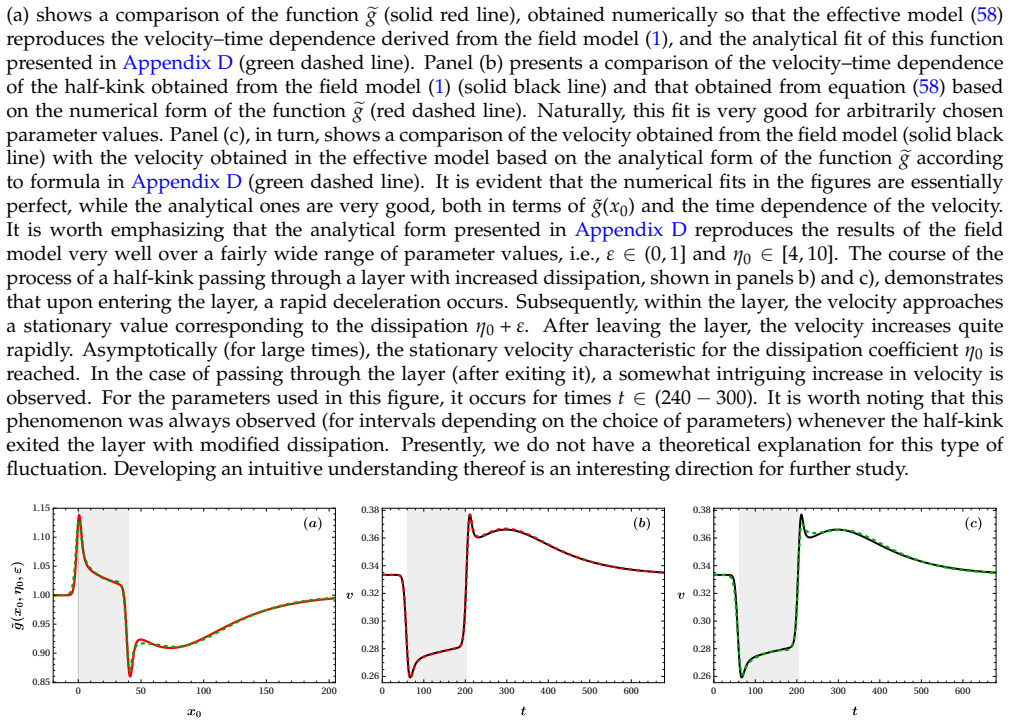
In the non-homogeneous φ⁴ model, front propagation is studied using kink solutions in unbounded domains and half-kinks in finite systems. The effective description derived from the kink ansatz accurately predicts the dynamics when the inhomogeneity is an interface between regions of different dissipation. However, for half-kinks modeling the decay of φ=0 to the true vacuum, the standard reduction leads to deviations. A consistent modification to the effective model is proposed, which successfully reproduces the field-theory results for half-kink propagation over a relatively broad range of parameters.
What carries the argument
Modified effective model incorporating position-dependent dissipation for consistent half-kink dynamics.
If this is right
- The standard effective kink approach accurately describes propagation across dissipation interfaces.
- Direct application of the same reduction to half-kinks produces large deviations from the full field evolution.
- The modified effective model matches field-theory speeds and shapes for both interface and layer inhomogeneities.
- Agreement holds over a relatively broad range of dissipation contrasts and layer widths.
Where Pith is reading between the lines
- Similar modifications could improve effective models for other dissipative field theories with spatial inhomogeneities.
- The approach may apply to front propagation in reaction-diffusion systems with heterogeneous media.
- Numerical tests with time-varying inhomogeneities could extend the model's applicability.
Load-bearing premise
The inhomogeneity affects the system only by making the dissipation coefficient position-dependent, without changing the form of the potential or introducing additional terms in the effective dynamics.
What would settle it
Numerical simulation of the full φ⁴ PDE for a half-kink with a given dissipation profile, comparing the resulting front velocity to the modified effective model's prediction; significant mismatch would disprove the reproduction.
Figures




read the original abstract
We investigate the propagation of fronts in an inhomogeneous medium within the framework of the $\phi^4$ model. The inhomogeneity is modeled either as an interface separating regions with different dissipation or as a finite layer with modified dissipation. The propagating front is described in two ways: as a kink solution in an effectively unbounded domain, and as a half-kink in a finite system. The half-kink represents the decay of the unstable state $\phi=0$ toward the true vacuum. We show that while the effective description based on the kink provides accurate results, applying a similar approach to the half-kink leads to significant deviations from the predictions of the field model. We then demonstrate that a consistent description does exist and propose a modified effective model which reproduces the field-theory results over a relatively broad range of parameters.
Editorial analysis
A structured set of objections, weighed in public.
Referee Report
Summary. The manuscript investigates front propagation in the inhomogeneous φ⁴ model, with inhomogeneity introduced either as an interface or a finite layer with modified dissipation. It compares the standard collective-coordinate (effective) description for a kink in an unbounded domain, which matches field-theory results, against the half-kink description in a finite system, which exhibits significant deviations. The central contribution is the construction of a modified effective model that incorporates the inhomogeneity solely through a position-dependent dissipation coefficient while leaving the potential unchanged, and that reproduces the full field-theory results for half-kink propagation over a relatively broad parameter range.
Significance. If the reproduction holds under detailed verification, the work supplies a practical reduced-order model for front dynamics where standard collective-coordinate methods break down. This addresses a concrete limitation in the effective description of half-kinks and could be useful for analyzing soliton-like propagation in spatially varying media. The explicit contrast between the two effective approaches and the full PDE simulations is a positive feature of the study.
major comments (2)
- [Abstract and §5 (modified model)] The claim that the modified effective model reproduces field-theory results “over a relatively broad range of parameters” (Abstract) is central to the paper’s contribution, yet the text provides neither explicit parameter intervals nor quantitative measures of agreement (e.g., relative L² errors or pointwise deviations). Without these, the robustness of the reproduction cannot be fully evaluated from the available material.
- [§2 (model setup) and §5] The modeling premise that inhomogeneity enters exclusively via a position-dependent dissipation term, with the potential and all other terms left unaltered (Abstract and the construction in §5), is load-bearing for the consistency of the reduced dynamics. A short derivation or scaling argument justifying why the potential remains unmodified would remove any ambiguity about whether the modification is derived or chosen to match the numerics.
minor comments (3)
- [Figures] Figure captions should list the specific parameter values (e.g., layer width, dissipation contrast) used in each panel so that readers can reproduce the comparison between the effective model and the field simulation.
- [§3 and §5] The notation for the position-dependent dissipation coefficient should be introduced once and used consistently; occasional switches between symbols or subscripts make the reduced equations harder to follow.
- [§4 (numerical methods)] A brief statement of the numerical scheme and spatial/temporal discretization used for the field-theory simulations would help assess the reliability of the reference data against which the effective models are tested.
Simulated Author's Rebuttal
We thank the referee for the positive assessment of our work and for the constructive comments, which help clarify the scope and justification of the modified effective model. We address each major comment below.
read point-by-point responses
-
Referee: [Abstract and §5 (modified model)] The claim that the modified effective model reproduces field-theory results “over a relatively broad range of parameters” (Abstract) is central to the paper’s contribution, yet the text provides neither explicit parameter intervals nor quantitative measures of agreement (e.g., relative L² errors or pointwise deviations). Without these, the robustness of the reproduction cannot be fully evaluated from the available material.
Authors: We agree that the absence of explicit parameter intervals and quantitative error metrics limits the ability to assess the breadth and accuracy of the reproduction. In the revised manuscript we will add, in §5, a table or paragraph specifying the ranges of dissipation contrast and layer width over which comparisons were performed, together with quantitative measures such as relative deviations in propagation speed and L² profile errors between the effective model and direct field simulations. revision: yes
-
Referee: [§2 (model setup) and §5] The modeling premise that inhomogeneity enters exclusively via a position-dependent dissipation term, with the potential and all other terms left unaltered (Abstract and the construction in §5), is load-bearing for the consistency of the reduced dynamics. A short derivation or scaling argument justifying why the potential remains unmodified would remove any ambiguity about whether the modification is derived or chosen to match the numerics.
Authors: The model construction in §2 introduces the inhomogeneity exclusively through the dissipation coefficient. The potential is left unchanged because it continues to set the equilibrium values and the shape of the front profile away from the inhomogeneous region. We will insert a short scaling argument in the revised §5 showing that, to leading order in the collective-coordinate projection, the contribution of the potential term to the effective force remains identical to the homogeneous case while the dissipative term acquires the position dependence; this follows directly from integrating the field equation against the translational mode. revision: yes
Circularity Check
No significant circularity; derivation remains self-contained
full rationale
The paper explicitly identifies failure of the standard collective-coordinate approach for the half-kink case and then introduces a modified effective model under the stated modeling assumption that inhomogeneity enters solely via a position-dependent dissipation coefficient (with potential and other terms unchanged). This is presented as an independent, consistent reduction whose agreement with field-theory numerics over a parameter range serves as validation rather than a fitted tautology. No load-bearing step reduces by construction to its own inputs, no self-citation chain is invoked to force uniqueness, and the central claim retains independent content from the underlying field model. The derivation is therefore self-contained against external benchmarks.
Axiom & Free-Parameter Ledger
axioms (1)
- domain assumption Inhomogeneity enters the model exclusively via a spatially varying dissipation coefficient while the φ⁴ potential remains unchanged.
Lean theorems connected to this paper
-
IndisputableMonolith/Cost/FunctionalEquation.leanwashburn_uniqueness_aczel unclear?
unclearRelation between the paper passage and the cited Recognition theorem.
We then demonstrate that a consistent description does exist and propose a modified effective model which reproduces the field-theory results over a relatively broad range of parameters.
-
IndisputableMonolith/Foundation/BranchSelection.leanbranch_selection unclear?
unclearRelation between the paper passage and the cited Recognition theorem.
The inhomogeneity is modeled either as an interface separating regions with different dissipation or as a finite layer with modified dissipation.
What do these tags mean?
- matches
- The paper's claim is directly supported by a theorem in the formal canon.
- supports
- The theorem supports part of the paper's argument, but the paper may add assumptions or extra steps.
- extends
- The paper goes beyond the formal theorem; the theorem is a base layer rather than the whole result.
- uses
- The paper appears to rely on the theorem as machinery.
- contradicts
- The paper's claim conflicts with a theorem or certificate in the canon.
- unclear
- Pith found a possible connection, but the passage is too broad, indirect, or ambiguous to say the theorem truly supports the claim.
Reference graph
Works this paper leans on
-
[1]
Double sine-Gordon class of universal coarsening dynamics in a spin-1 Bose gas , author =. Phys. Rev. A , volume =. 2025 , month =. doi:10.1103/df5w-3yfd , url =
-
[2]
Propagating Ferrodark Solitons in a Superfluid: Exact Solutions and Anomalous Dynamics , author =. Phys. Rev. Lett. , volume =. 2022 , month =. doi:10.1103/PhysRevLett.128.125301 , url =
-
[3]
Panayotis G. Kevrekidis and Jes. A Dynamical Perspective on the. 2019 , doi =
work page 2019
-
[4]
Dark-soliton-like magnetic domain walls in a two-dimensional ferromagnetic superfluid , author =. Phys. Rev. Res. , volume =. 2021 , month =. doi:10.1103/PhysRevResearch.3.023043 , url =
-
[5]
doi:10.1103/PhysRevD.105.065012 , url =
Relativistic Moduli Space for Kink Collisions , author =. doi:10.1103/PhysRevD.105.065012 , url =
-
[6]
doi:10.1016/0001-6160(79)90196-2 , url =
A Microscopic Theory for Antiphase Boundary Motion and Its Application to Antiphase Domain Coarsening , author =. doi:10.1016/0001-6160(79)90196-2 , url =
-
[7]
doi:10.1016/0167-2789(83)90289-0 , url =
Resonance Structure in Kink-Antikink Interactions in ^4 Theory , author =. doi:10.1016/0167-2789(83)90289-0 , url =
-
[8]
Caputo, Jean-Guy and Dobrowolski, Tomasz and Gatlik, Jacek and Kevrekidis, Panayotis G. , date =. Radial Kinks in a. doi:10.1103/PhysRevD.110.125025 , url =
-
[9]
doi:10.1103/PhysRevD.99.016010 , url =
Long-Range Interactions of Kinks , author =. doi:10.1103/PhysRevD.99.016010 , url =
-
[10]
Coleman, Fate of the false vacuum: Semiclassical theory, Phys
Coleman, Sidney , date =. Fate of the False Vacuum:. doi:10.1103/PhysRevD.15.2929 , url =
-
[11]
Reviews of Modern Physics , volume =
Pattern Formation Outside of Equilibrium , author =. doi:10.1103/RevModPhys.65.851 , url =
-
[12]
doi:10.1103/PhysRevE.111.024203 , url =
Kink Movement on a Periodic Background , author =. doi:10.1103/PhysRevE.111.024203 , url =
-
[13]
Dobrowolski, Tomasz and Gatlik, Jacek and Bryłowska, Zofia and Kevrekidis, Panayotis G. , date =. Kink Dynamics in a Non-Autonomous Sine-. doi:10.1063/5.0284611 , url =
-
[14]
Dobrowolski, Tomasz and Gatlik, Jacek and Bryłowska, Zofia and Kevrekidis, Panayotis G. , date =. Parametric Resonance in the Non-Autonomous Sine-. doi:10.1063/5.0296470 , url =
-
[15]
Ebert, Ute and Van Saarloos, Wim , date =. Front Propagation into Unstable States: Universal Algebraic Convergence towards Uniformly Translating Pulled Fronts , shorttitle =. doi:10.1016/S0167-2789(00)00068-3 , url =
-
[16]
doi:10.1103/PhysRevA.46.5214 , url =
Resonant Kink-Impurity Interactions in the ^4 Model , author =. doi:10.1103/PhysRevA.46.5214 , url =
-
[17]
Galley, Chad R. , date =. Classical. doi:10.1103/PhysRevLett.110.174301 , url =
-
[18]
Gatlik, Jacek and Dobrowolski, Tomasz and Kevrekidis, Panayotis G. , date =. Kink-Inhomogeneity Interaction in the Sine-. doi:10.1103/PhysRevE.108.034203 , url =
-
[19]
and Cuenda, Sara and Sánchez, Angel , date =
González, Jorge A. and Cuenda, Sara and Sánchez, Angel , date =. Kink Dynamics in Spatially Inhomogeneous Media:. doi:10.1103/PhysRevE.75.036611 , url =
-
[20]
and Haberman, Richard , date =
Goodman, Roy H. and Haberman, Richard , date =. Kink-. doi:10.1137/050632981 , url =
-
[21]
doi:10.1103/RevModPhys.60.781 , url =
Solitons in Conducting Polymers , author =. doi:10.1103/RevModPhys.60.781 , url =
-
[22]
doi:10.1088/0034-4885/58/5/001 , url =
Cosmic Strings , author =. doi:10.1088/0034-4885/58/5/001 , url =
-
[23]
doi:10.1103/PhysRevA.16.777 , url =
Solitons under Perturbations , author =. doi:10.1103/PhysRevA.16.777 , url =
-
[24]
Kevrekidis, P. G. and Khare, Avinash and Saxena, A. , date =. Solitary Wave Interactions in Dispersive Equations Using. doi:10.1103/PhysRevE.70.057603 , url =
-
[25]
Kevrekidis, P. G. , date =. Variational Method for Nonconservative Field Theories:. doi:10.1103/PhysRevA.89.010102 , url =
-
[26]
Kibble, Topology of cosmic domains and strings, J
Topology of Cosmic Domains and Strings , author =. doi:10.1088/0305-4470/9/8/029 , url =
-
[27]
doi:10.1103/RevModPhys.61.763 , url =
Dynamics of Solitons in Nearly Integrable Systems , author =. doi:10.1103/RevModPhys.61.763 , url =
-
[28]
Manton, N. S. and Oleś, K. and Romańczukiewicz, T. and Wereszczyński, A. , date =. Collective. doi:10.1103/PhysRevLett.127.071601 , url =
-
[29]
doi:10.1103/PhysRevA.18.1652 , url =
Perturbation Analysis of Fluxon Dynamics , author =. doi:10.1103/PhysRevA.18.1652 , url =
-
[30]
doi:10.1103/PhysRevB.28.3587 , url =
Physical Dynamics of Solitons , author =. doi:10.1103/PhysRevB.28.3587 , url =
-
[31]
doi:10.1016/j.cnsns.2015.05.012 , url =
Kink Scattering from a Parity-Time-Symmetric Defect in the ^4 Model , author =. doi:10.1016/j.cnsns.2015.05.012 , url =
-
[32]
Su, W. P. and Schrieffer, J. R. and Heeger, A. J. , date =. Solitons in. doi:10.1103/PhysRevLett.42.1698 , url =
-
[33]
Torrejon, J. and Martinez, E. and Hayashi, M. , title =. Nature Communications , volume =. 2016 , doi =
work page 2016
-
[34]
Sugiyama, T. , date =. Kink-. doi:10.1143/PTP.61.1550 , url =
-
[36]
doi:10.1016/0370-1573(85)90033-X , url =
Cosmic Strings and Domain Walls , author =. doi:10.1016/0370-1573(85)90033-X , url =
-
[37]
doi:10.1016/j.chaos.2024.114789 , url =
Topologically Protected Metastable States in Classical Dynamics , author =. doi:10.1016/j.chaos.2024.114789 , url =
-
[38]
doi:10.1103/PhysRevResearch.7.013096 , url =
Universal Critical Holography and Domain Wall Formation , author =. doi:10.1103/PhysRevResearch.7.013096 , url =
-
[39]
Demirkaya, A. and Kapitula, T. and Kevrekidis, P.G. and Stanislavova, M. and Stefanov, A. , title =. Studies in Applied Mathematics , volume =. doi:https://doi.org/10.1111/sapm.12053 , url =. https://onlinelibrary.wiley.com/doi/pdf/10.1111/sapm.12053 , abstract =
-
[40]
Chiral Damping of Magnetic Domain Walls , author =. doi:10.1038/nmat4518 , url =
-
[41]
Safeer, C. K. and Nsibi, Mohamed-Ali and Nath, Jayshankar and Gabor, Mihai Sebastian and Yang, Haozhe and Joumard, Isabelle and Auffret, Stephane and Gaudin, Gilles and Miron, Ioan-Mihai , date =. Effect of. doi:10.1038/s41467-022-28815-6 , url =
-
[42]
doi:10.1103/PhysRevB.93.214429 , url =
Phenomenology of Chiral Damping in Noncentrosymmetric Magnets , author =. doi:10.1103/PhysRevB.93.214429 , url =
-
[43]
Saadatmand, Danial and Borisov, Denis I. and Kevrekidis, Panayotis G. and Zhou, Kun and Dmitriev, Sergey V. , date =. Resonant Interaction of ^4 Kink with. doi:10.1016/j.cnsns.2017.07.019 , url =
-
[44]
Symmetry Breaking with a Slant: Topological Defects after an Inhomogeneous Quench , author =. Phys. Rev. Lett. , volume =. 1999 , month =. doi:10.1103/PhysRevLett.82.4749 , url =
-
[45]
Zurek, W. H. and Bettencourt, L. M. A. and Dziarmaga, J. and Antunes, N. D. Shards of Broken Symmetry. Topological Defects and the Non-Equilibrium Dynamics of Symmetry Breaking Phase Transitions. 2000. doi:10.1007/978-94-011-4106-2_5
-
[46]
Effective description of the impact of inhomogeneities on the movement of the kink front in 2+1 dimensions , author =. Phys. Rev. E , volume =. 2024 , month =. doi:10.1103/PhysRevE.109.024205 , url =
-
[47]
Barashenkov, I. V. and Oxtoby, O. F. , journal =. Wobbling kinks in. 2009 , month =. doi:10.1103/PhysRevE.80.026608 , url =
-
[48]
A.J. Bray , title =. Advances in Physics , volume =. 1994 , publisher =. doi:10.1080/00018739400101505 , URL =
-
[49]
Universal Scaling in the Motion of Random Interfaces , author =. Phys. Rev. Lett. , volume =. 1982 , month =. doi:10.1103/PhysRevLett.49.1223 , url =
-
[50]
Front propagation into unstable states , journal =
Wim. Front propagation into unstable states , journal =. 2003 , issn =. doi:https://doi.org/10.1016/j.physrep.2003.08.001 , url =
discussion (0)
Sign in with ORCID, Apple, or X to comment. Anyone can read and Pith papers without signing in.