REVIEW 5 major objections 6 minor 1 cited by
Privacy-Preserved Task Offloading in Mobile Blockchain with Deep Reinforcement Learning
T0 review · 5 major / 6 minor · reviewed 2026-08-14 · deepseek-v4-flash
Pith's one-line read The paper argues that a deep Q-network offloading policy can simultaneously raise user privacy and cut energy and latency for mobile blockchain miners, beating local-only, edge-only, and prior RL and CMDP baselines.
desk verdict A workmanlike DRL offloading paper whose latency/energy results are plausible but whose privacy claim rests on a borrowed, unvalidated proxy that is also the training objective. read the letter →
The pith
A machine-rendered reading of the paper's core claim, the machinery that carries it, and where it could break.
The reading
What carries the argument
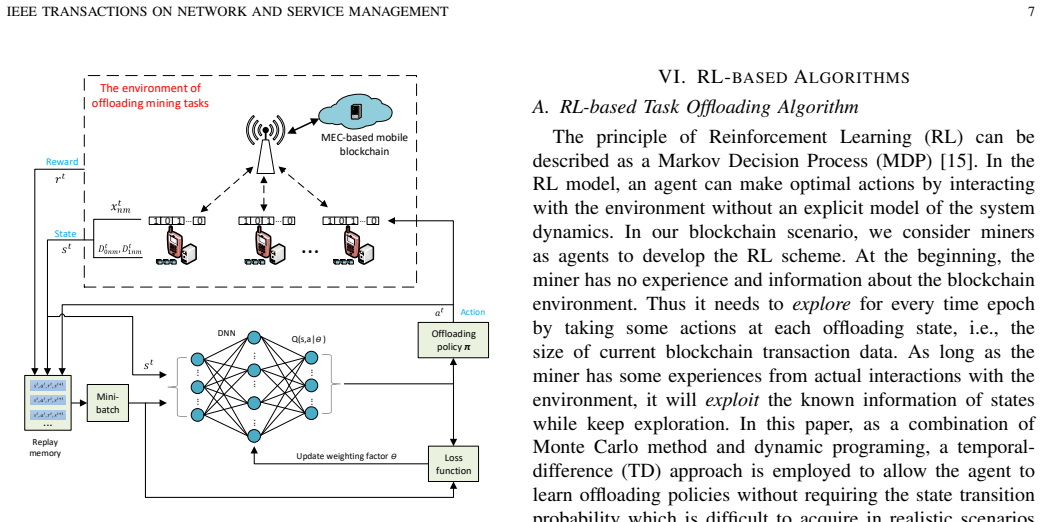
The load-bearing mechanism is the binary offloading decision $x^t_{nm}\in\{0,1\}$ combined with a reward that couples privacy and cost: the usage-pattern privacy term $P^{u,t}_{nm}=|D^t_{0nm}-x^t_{nm}(D^t_{0nm}+D^t_{1nm})|\,\mathbb{I}(g^t_n\ge\zeta)$ and the location privacy term $P^{l,t}_{nm}=\mathbb{I}[x^t_{nm}(D^t_{0nm}+D^t_{1nm})]\,\mathbb{I}(g^t_n<\zeta)$ reward the miner for deviating from the obvious channel-based offloading pattern, while the cost term $C_t$ penalizes latency and energy. The learning machinery is Q-learning with $\epsilon$-greedy exploration and Bellman optimality, and the deep version replaces the Q-table with a two-hidden-layer feedforward network trained by experience replay with loss $L_t(\theta_t)=\mathbb{E}[(r_t+\gamma\max Q(s_{t+1},a'|\theta')-Q(s_t,a_t|\theta_t))^2]$. This machinery carries the argument because every reported privacy and cost improvement is the same objective the agent is trained to optimize.
What would settle it
An adversary that infers a miner's location or usage pattern from the offloading history would settle the claim: if the DRLO policy does not reduce the adversary's inference accuracy compared with the baselines, or if the privacy score from Eq. (10) rises while a leakage measure such as mutual information between the offloading pattern and the true location stays flat or rises, then the central privacy enhancement claim fails.
Extended reading notes
Core claim
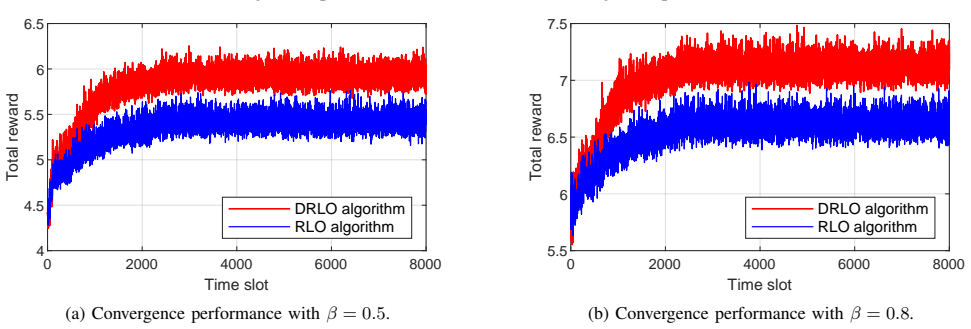
The paper's central claim is that the joint problem of task offloading, privacy preservation, and mining profit in a MEC-based mobile blockchain can be cast as a Markov decision process and solved by a deep Q-network, yielding a policy $\pi^*$ that at each slot selects the offloading action $x^t_{nm}\in\{0,1\}$ maximizing $r_t(s,a)=P_t(s,a)+R^{\text{mining}}_n-C_t(s,a)$. Here $P_t$ is the sum of usage-pattern privacy and location privacy from Eqs. (8)-(10), $R^{\text{mining}}_n$ is the expected mining reward after orphaning risk, and $C_t$ is the weighted latency and energy cost. The authors report that DRLO, the DQN version, converges in about 2500 slots to a higher long-term reward than the Q-learning version RLO, achieves the lowest average latency, power, and offloading cost among DRLO, RLO, edge-only, and local-only schemes for single and multi-user scenarios, and improves the privacy metric by roughly 5-13% over the RL and CMDP baselines.
Load-bearing premise
The load-bearing premise is that the privacy level computed by Eqs. (8)-(10) faithfully measures how much location and usage-pattern information a real attacker could learn from the offloading history, since the paper's privacy improvements are measured with that same formula the RL agent is trained to maximize.
Editorial extensions
If this is right
- If DRLO is deployed, mobile blockchain miners can offload both IoT data tasks and mining puzzles to a nearby MEC server while maintaining a learned balance between privacy, latency, and energy, without knowing the system dynamics in advance.
- DRLO's convergence after about 2,500 time slots means the offloading policy can be trained online in a dynamic channel and transaction environment, and it consistently outperforms the tabular Q-learning version RLO in long-term reward.
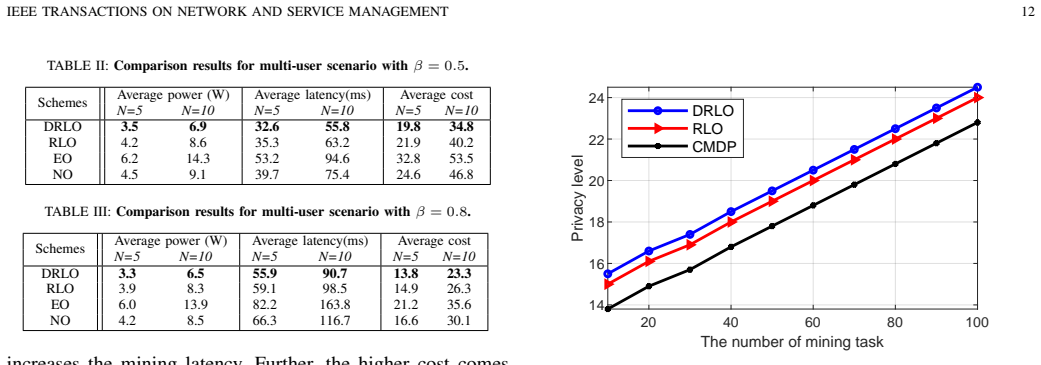
- In a single-user scenario with 12 tasks and $\beta=0.8$, DRLO cuts average offloading cost by about 18.7% relative to RLO and by 57% and 65% relative to edge-only and local-only offloading.
- In multi-user scenarios with 10 miners, DRLO reduces average cost by about 12.7%, 52.5%, and 30.4% compared with RLO, edge-only, and local-only schemes, respectively.
- The privacy level achieved by DRLO is about 5.2% and 12.7% higher than the RL-based and CMDP baselines at 10 kB transaction sizes, and about 5.5% and 13.4% higher at 100 kB.
Reading between the lines
- A direct stress test is to replace the privacy formula in Eqs. (8)-(10) with an information-theoretic leakage measure and retrain the same DRLO policy; if the advantage over baselines survives, the privacy claim does not hinge on the formula the agent was trained to maximize.
- Because the paper assumes the MEC server has sufficient capacity, the same DQN architecture could be extended to a state that includes edge queue lengths and resource prices, turning the binary offloading decision into a congestion-aware policy.
- The mining-reward term currently depends only on purchased hash power and orphaning probability; swapping in rewards from proof-of-stake or other consensus protocols would generalize the framework to non-PoW blockchains.
Signed reviews
Editorial analysis
A structured set of objections, weighed in public.
Referee Report
Summary. The manuscript proposes a mobile edge computing (MEC) based blockchain architecture in which mobile users act as miners and offload both IoT data-processing tasks and mining tasks to a MEC server. The offloading decision is formulated as a Markov decision process whose objective combines user privacy, mining reward, and offloading latency/energy cost, and two learning algorithms are proposed: a tabular Q-learning scheme (RLO) and a deep Q-network scheme (DRLO). The paper reports experiments comparing local and edge computation, and simulations comparing DRLO/RLO with non-offloading, edge-offloading, and CMDP-based baselines in terms of latency, power, cost, and a privacy metric. The main claimed contributions are that DRLO significantly enhances user privacy and reduces energy consumption and computation latency at minimum offloading cost.
Significance. If the central claims were fully supported, the paper would address a genuinely underexplored problem: privacy-aware computation offloading in MEC-based mobile blockchain networks, where earlier work has focused mainly on offloading efficiency and mining economics. The proposed DQN formulation and the inclusion of both IoT data tasks and mining tasks are reasonable extensions of existing RL-based offloading work, and the paper provides a fairly complete set of comparisons against common baselines. However, the two most distinctive claims—privacy enhancement and the joint optimization of privacy, mining reward, and cost—currently rest on an unvalidated and circular privacy metric and on a reward function that is not dimensionally consistent. The latency and energy comparisons are internally plausible, but the main intellectual contributions need substantial additional support before the conclusions can be accepted.
major comments (5)
- [V-B, Eq. (17), and VII-C] The immediate reward in Eq. (17) is the sum of the privacy level P_t (a data size, in bits, from Eqs. (8)-(10)), the mining reward R_mining_n (in tokens, Eq. (13)), and the negative cost C_t (a weighted sum of energy in joules and latency in seconds from Eq. (15)). These quantities have different units and orders of magnitude, so the scalar objective being maximized by RLO and DRLO is not well defined; the tradeoff factors α1, α2, and λ do not have a common scale. Eq. (21), which is presented as a rewrite of Eq. (17), omits R_mining and still subtracts an energy-latency cost from a privacy term, so it does not resolve the inconsistency. The authors should normalize or rescale the components and demonstrate that the reported gains are not artifacts of the chosen units and scales.
- [IV-B, Eqs. (8)-(10), and VII-C4, Fig. 10] The privacy metric used for evaluation is the same function that appears in the RL reward, and it is not validated against any attacker model. With x_t=1, Eq. (8) reduces to D1 under a good channel; with x_t=0 it reduces to D0; and Eq. (9) is 1 exactly when the user offloads under a bad channel. Thus the metric largely encodes the offloading decision itself, rather than the inference error of the curious MEC server or an eavesdropper described in Section IV-B. The privacy comparison in Fig. 10 therefore largely shows how well each algorithm optimizes this particular formula, not whether user location or usage patterns are actually protected. An independent validation—for example, measuring an adversary's estimation error of D0/D1 or of user location under the learned policies—is needed to support the abstract's claim of "significantly enhance user privacy."
- [III-A, IV-A, and VII-C3, Table II] The model assumes in Sections III.A and IV.A that the MEC server has sufficient computation resources to serve all miners, and the optimization problem P1 contains no capacity constraint, only the binary and deadline constraints (16a)-(16b). Yet the discussion of Table II states that "the computation capacity of the MEC server is only sufficient to provide resources for a certain number of miners" and attributes part of the EO scheme's poor performance to capacity limits. This contradiction affects the multi-user claims: if capacity is unlimited, the EO cost should not grow because of resource scarcity; if it is limited, the problem formulation and algorithms are missing a resource-allocation component. The authors should either remove the capacity discussion or add the corresponding constraint and incorporate capacity into the optimization.
- [V-B, Eqs. (13) and (17); VI-B] The mining reward term in the optimization objective cannot influence the learned offloading policy as formulated. R_mining_n in Eq. (13) depends only on p_n, H, s_n, and Y_n, while the action space in Section V-B is restricted to the offloading decision vector x_t; hash power and payment are treated as predetermined. Adding a constant with respect to the action to the reward does not change the argmax policy, so the joint optimization of mining profit and offloading is not actually implemented. The authors should either include mining-related actions in the MDP or explicitly state that the mining reward is a fixed offset and remove it from the objective that the RL agent optimizes.
- [VII-B and Abstract] The experimental evaluation in Section VII.B compares only local execution with edge execution in terms of processing time and battery consumption; it does not run the RLO or DRLO algorithms or compare them with the baselines. The abstract, however, states that experiments and simulations show the proposed schemes enhance privacy and reduce energy and latency. The experiments should either be integrated with the algorithm evaluation or the claims should be limited to the simulations; otherwise, the experimental evidence does not support the paper's stated contribution.
minor comments (6)
- [Algorithms 1 and 2] Algorithm 1, line 12, and Algorithm 2, line 10, contain a typographical error: "D1_0" should be "D_t_0nm" in the local-execution expression.
- [Eq. (15)] There is a typo in the text before Eq. (15): "taks" should be "tasks."
- [Section VII.D] In the final paragraph of Section VII.D, "adative" should be "adaptive."
- [VI-B, Algorithm 2, and VII-C1] Algorithm 2 does not implement a target network or a periodic target-network update, but Section VII.C.1 attributes the stability of DRLO to "the iterative target network." Either implement the target network as described or remove that explanation.
- [VII-C1, Fig. 5] The DQN architecture is selected by inspecting the same system-reward metric that the algorithm is trained to maximize, which risks overfitting the reported curve; a separate validation set or a description of the tuning protocol would strengthen the claim.
- [General reproducibility] No code or data availability statement is provided; releasing the simulation code and hyperparameter configurations would allow the community to reproduce the reported numbers, which would be particularly valuable given the number of tunable parameters in the reward and DQN.
Circularity Check
Privacy metric is also the training reward, so the privacy-enhancement claim is partly definitional; latency and energy comparisons remain independent.
-
self definitional
[Section V-B3, Eq. (17); Section VII-C4, Fig. 10]
"The objective of the RL agent is to find an optimal offloading decision action a at each state s with the aim of achieving ... the highest privacy level P(s,a) ... Accordingly, we can formulate the immediate system reward rt(s,a) as rt(s,a) = Pt(s,a) + Rmining_n - Ct(s,a). (17) ... Finally, we analyse the performance of the proposed offloading design in terms of the privacy metric ... However, the proposed DRLO method can achieve the best privacy performance, compared to the other benchmarks."
The privacy level reported in Fig. 10 is exactly Pt defined in Eqs. (8)-(10), and Eq. (17)/(21) makes Pt the reward component that the RLO and DRLO agents are trained to maximize. Thus the agents are optimizing the same quantity later used to substantiate the 'significantly enhance user privacy' claim; the privacy comparison largely shows how well each policy maximizes its own objective. Since Eqs. (8)-(10) are not validated against an independent attacker model or leakage measure, the privacy conclusion is a restatement of the training objective rather than an externally verified privacy result. The latency, power, and cost comparisons use independent physical formulas, so the circularity is confined to the privacy component.
full rationale
The paper's central privacy claim is partially circular: the privacy metric Pt of Eq. (10) appears both as the evaluated outcome in Fig. 10 and as a positive term in the RL reward of Eq. (17)/(21). Training a policy to maximize that reward and then reporting that it achieves the highest Pt is a by-construction consequence, unless Pt is independently validated as a faithful proxy for actual adversary inference, which the paper does not provide. However, the energy, latency, and offloading-cost results are built from separate physical formulas (Eqs. (1)-(7), (14)-(15)) and are compared against fixed non-learning baselines, so those claims have independent content. The benchmarks [28] and [29] are external works, and the paper's self-citations are used only for experimental hardware details, not as load-bearing theoretical support. I therefore assign a moderate score reflecting partial circularity in the privacy claim rather than the whole derivation.
Assumptions & free parameters
free parameters (4)
- beta tradeoff factor =
0.5 and 0.8
- lambda location privacy weight =
not specified
- zeta good channel threshold =
not specified
- DQN architecture and hyperparameters =
2 hidden layers, 500 units; learning rate 0.01; discount 0.85; replay memory 1e5; batch 128
assumptions (7)
- domain assumption The wireless channel power gain g_t follows a two-state Markov chain with symmetric transition probability 0.95 between good and bad states.
- domain assumption The MEC server has sufficient computation resources to serve all offloading tasks.
- domain assumption The privacy level formulas in Eqs. (8)-(10), borrowed from reference [29], correctly quantify user location and usage pattern privacy.
- domain assumption Time is slotted, each miner generates one data processing task per slot, and each block contains only one transaction.
- standard math The orphaning probability approximation P_orphan = 1 - exp(-eta*phi(s_n)) with eta = 1/600 is valid for the mining reward model.
- ad hoc to paper The total RL reward in Eq. (17) can be written as the sum of privacy level, mining reward, and negative cost without any unit normalization.
- standard math Tabular Q-learning converges to the optimal Q-function and deep Q-network training with experience replay will find a good policy for this problem.
Cite this review
Pith. "Pith review of Privacy-Preserved Task Offloading in Mobile Blockchain with Deep Reinforcement Learning." pith.science (2026). https://pith.science/paper/WL6BU463
@misc{pith2026190807467,
  author       = {Pith},
  title        = {Pith review of: Privacy-Preserved Task Offloading in Mobile Blockchain with Deep Reinforcement Learning},
  year         = {2026},
  howpublished = {\url{https://pith.science/paper/WL6BU463}},
  note         = {Machine review of arXiv:1908.07467}
}
read the original abstract
Blockchain technology with its secure, transparent and decentralized nature has been recently employed in many mobile applications. However, the mining process in mobile blockchain requires high computational and storage capability of mobile devices, which would hinder blockchain applications in mobile systems. To meet this challenge, we propose a mobile edge computing (MEC) based blockchain network where multi-mobile users (MUs) act as miners to offload their mining tasks to a nearby MEC server via wireless channels. Specially, we formulate task offloading and user privacy preservation as a joint optimization problem which is modelled as a Markov decision process, where our objective is to minimize the long-term system offloading costs and maximize the privacy levels for all blockchain users. We first propose a reinforcement learning (RL)-based offloading scheme which enables MUs to make optimal offloading decisions based on blockchain transaction states and wireless channel qualities between MUs and MEC server. To further improve the offloading performances for larger-scale blockchain scenarios, we then develop a deep RL algorithm by using deep Q-network which can efficiently solve large state space without any prior knowledge of the system dynamics. Simulation results show that the proposed RL-based offloading schemes significantly enhance user privacy, and reduce the energy consumption as well as computation latency with minimum offloading costs in comparison with the benchmark offloading schemes.
Figures


Figures from the paper (6 more)




Forward citations
Cited by 1 Pith paper
-
Integration of Blockchain and Cloud of Things: Architecture, Applications and Challenges
A comprehensive survey of blockchain-Cloud of Things integration that categorizes architectures, applications, platforms, and open challenges.
Reference graph
Works this paper leans on
-
[29]
Learning-Based Privacy-Aware Offloading for Healthcare IoT With Energy Harvesting,
M. Min, X. Wan, L. Xiao, Y . Chen, M. Xia, D. Wu, and H. Dai, “Learning-Based Privacy-Aware Offloading for Healthcare IoT With Energy Harvesting,” IEEE Internet of Things Journal , vol. 6, no. 3, pp. 4307–4316, Jun. 2019
work page 2019
-
[37]
X. Qiu, L. Liu, W. Chen, Z. Hong, and Z. Zheng, “Online Deep Reinforcement Learning for Computation Offloading in Blockchain- Empowered Mobile Edge Computing,” IEEE Transactions on Vehicular Technology, vol. 68, no. 8, pp. 8050–8062, Aug. 2019
work page 2019
-
[1]
A Review on the Use of Blockchain for the Internet of Things,
T. M. Fernandez-Carames and P. Fraga-Lamas, “A Review on the Use of Blockchain for the Internet of Things,” IEEE Access , vol. 6, pp. 32 979–33 001, 2018
work page 2018
-
[2]
Integration of Blockchain and Cloud of Things: Architecture, Applications and Challenges
D. C. Nguyen, P. N. Pathirana, M. Ding, and A. Seneviratne, “Integration of Blockchain and Cloud of Things: Architecture, Applications and Challenges,” arXiv:1908.09058, Aug. 2019
work page Pith review arXiv 1908
-
[3]
Performance Analysis and Application of Mobile Blockchain,
K. Suankaewmanee, D. T. Hoang, D. Niyato, S. Sawadsitang, P. Wang, and Z. Han, “Performance Analysis and Application of Mobile Blockchain,” in International Conference on Computing, Networking and Communications (ICNC) , Maui, HI, Mar. 2018, pp. 642–646
work page 2018
-
[4]
Blockchain for Secure EHRs Sharing of Mobile Cloud Based E-Health Systems,
D. C. Nguyen, P. N. Pathirana, M. Ding, and A. Seneviratne, “Blockchain for Secure EHRs Sharing of Mobile Cloud Based E-Health Systems,” IEEE Access, vol. 7, pp. 66 792–66 806, 2019
work page 2019
-
[5]
FruitChains: A Fair Blockchain,
R. Pass and E. Shi, “FruitChains: A Fair Blockchain,” in Proceedings of the ACM Symposium on Principles of Distributed Computing , ser. PODC ’17, Washington, DC, USA, Jul. 2017, pp. 315–324
work page 2017
-
[6]
Edge Computing: Vision and Challenges,
W. Shi, J. Cao, Q. Zhang, Y . Li, and L. Xu, “Edge Computing: Vision and Challenges,” IEEE Internet of Things Journal , vol. 3, no. 5, pp. 637–646, Oct. 2016
work page 2016
Show all 40 references
-
[7]
Mobile Edge Computing: A Survey on Archi- tecture and Computation Offloading,
P. Mach and Z. Becvar, “Mobile Edge Computing: A Survey on Archi- tecture and Computation Offloading,” IEEE Communications Surveys & Tutorials, vol. 19, no. 3, pp. 1628–1656, 2017
2017
-
[8]
A Survey on Mobile Edge Computing: The Communication Perspective,
Y . Mao, C. You, J. Zhang, K. Huang, and K. B. Letaief, “A Survey on Mobile Edge Computing: The Communication Perspective,” IEEE Communications Surveys & Tutorials , vol. 19, no. 4, pp. 2322–2358, 2017
2017
-
[9]
Mobile-Edge Computa- tion Offloading for Ultradense IoT Networks,
H. Guo, J. Liu, J. Zhang, W. Sun, and N. Kato, “Mobile-Edge Computa- tion Offloading for Ultradense IoT Networks,” IEEE Internet of Things Journal, vol. 5, no. 6, pp. 4977–4988, Dec. 2018
2018
-
[10]
Task Offloading for Mobile Edge Computing in Software Defined Ultra-Dense Network,
M. Chen and Y . Hao, “Task Offloading for Mobile Edge Computing in Software Defined Ultra-Dense Network,” IEEE Journal on Selected Areas in Communications , vol. 36, no. 3, pp. 587–597, Mar. 2018
2018
-
[11]
Computation offloading for mobile edge computing: A deep learning approach,
S. Yu, X. Wang, and R. Langar, “Computation offloading for mobile edge computing: A deep learning approach,” in 28th Annual Interna- tional Symposium on Personal, Indoor, and Mobile Radio Communica- tions (PIMRC), Montreal, QC, Oct. 2017, pp. 1–6
2017
-
[12]
Energy-Efficient Mobile- Edge Computation Offloading for Applications with Shared Data,
X. He, H. Xing, Y . Chen, and A. Nallanathan, “Energy-Efficient Mobile- Edge Computation Offloading for Applications with Shared Data,” in IEEE Global Communications Conference (GLOBECOM) , Abu Dhabi, United Arab Emirates, Dec. 2018, pp. 1–6
2018
-
[13]
Joint Admission Control and Resource Allocation in Edge Computing for Internet of Things,
S. Li, N. Zhang, S. Lin, L. Kong, A. Katangur, M. K. Khan, M. Ni, and G. Zhu, “Joint Admission Control and Resource Allocation in Edge Computing for Internet of Things,” IEEE Network , vol. 32, no. 1, pp. 72–79, Jan. 2018
2018
-
[14]
Towards 5G: A Reinforcement Learning-Based Scheduling Solution for Data Traffic Management,
I.-S. Comsa, S. Zhang, M. E. Aydin, P. Kuonen, Y . Lu, R. Trestian, and G. Ghinea, “Towards 5G: A Reinforcement Learning-Based Scheduling Solution for Data Traffic Management,” IEEE Transactions on Network and Service Management , vol. 15, no. 4, pp. 1661–1675, Dec. 2018
2018
-
[15]
R. S. Sutton and A. G. Barto, Reinforcement learning: an introduction , second edition ed., ser. Adaptive computation and machine learning series. Cambridge, Massachusetts: The MIT Press, 2018
2018
-
[16]
Deep Reinforcement Learning: A Brief Survey,
K. Arulkumaran, M. P. Deisenroth, M. Brundage, and A. A. Bharath, “Deep Reinforcement Learning: A Brief Survey,” IEEE Signal Process- ing Magazine, vol. 34, no. 6, pp. 26–38, Nov. 2017
2017
-
[17]
Human-level control through deep reinforcement learning,
V . Mnih, K. Kavukcuoglu, D. Silver, A. A. Rusu, J. Veness, M. G. Bellemare, A. Graves, M. Riedmiller, A. K. Fidjeland, G. Ostrovski, S. Petersen, C. Beattie, A. Sadik, I. Antonoglou, H. King, D. Kumaran, D. Wierstra, S. Legg, and D. Hassabis, “Human-level control through deep...
2015
-
[18]
Opti- mized Computation Offloading Performance in Virtual Edge Computing Systems Via Deep Reinforcement Learning,
X. Chen, H. Zhang, C. Wu, S. Mao, Y . Ji, and M. Bennis, “Opti- mized Computation Offloading Performance in Virtual Edge Computing Systems Via Deep Reinforcement Learning,” IEEE Internet of Things Journal, vol. 6, no. 3, pp. 4005–4018, Jun. 2019
2019
-
[19]
Deep reinforcement learning based computation offloading and resource allocation for MEC,
J. Li, H. Gao, T. Lv, and Y . Lu, “Deep reinforcement learning based computation offloading and resource allocation for MEC,” in IEEE Wire- less Communications and Networking Conference (WCNC) , Barcelona, Apr. 2018, pp. 1–6
2018
-
[20]
Learning- Based Computation Offloading for IoT Devices With Energy Harvest- ing,
M. Min, L. Xiao, Y . Chen, P. Cheng, D. Wu, and W. Zhuang, “Learning- Based Computation Offloading for IoT Devices With Energy Harvest- ing,” IEEE Transactions on Vehicular Technology , vol. 68, no. 2, pp. 1930–1941, Feb. 2019
1930
-
[21]
When Mobile Blockchain Meets Edge Computing,
Z. Xiong, Y . Zhang, D. Niyato, P. Wang, and Z. Han, “When Mobile Blockchain Meets Edge Computing,” IEEE Communications Magazine, vol. 56, no. 8, pp. 33–39, Aug. 2018
2018
-
[22]
Computation Offloading and Content Caching in Wireless Blockchain Networks With Mobile Edge Computing,
M. Liu, F. R. Yu, Y . Teng, V . C. M. Leung, and M. Song, “Computation Offloading and Content Caching in Wireless Blockchain Networks With Mobile Edge Computing,” IEEE Transactions on Vehicular Technology, vol. 67, no. 11, pp. 11 008–11 021, Nov. 2018
2018
-
[23]
Optimal Computational Power Allocation in Multi-Access Mobile Edge Computing for Blockchain,
Y . Wu, X. Chen, J. Shi, K. Ni, L. Qian, L. Huang, and K. Zhang, “Optimal Computational Power Allocation in Multi-Access Mobile Edge Computing for Blockchain,” Sensors, vol. 18, no. 10, p. 3472, Oct. 2018. IEEE TRANSACTIONS ON NETWORK AND SERVICE MANAGEMENT 14
2018
-
[24]
Distributed Resource Allocation in Blockchain-Based Video Streaming Systems With Mobile Edge Computing,
M. Liu, F. R. Yu, Y . Teng, V . C. M. Leung, and M. Song, “Distributed Resource Allocation in Blockchain-Based Video Streaming Systems With Mobile Edge Computing,” IEEE Transactions on Wireless Com- munications, vol. 18, no. 1, pp. 695–708, Jan. 2019
2019
-
[25]
Data Security and Privacy-Preserving in Edge Computing Paradigm: Survey and Open Issues,
J. Zhang, B. Chen, Y . Zhao, X. Cheng, and F. Hu, “Data Security and Privacy-Preserving in Edge Computing Paradigm: Survey and Open Issues,” IEEE Access, vol. 6, pp. 18 209–18 237, 2018
2018
-
[26]
Security Services Using Blockchains: A State of the Art Survey,
T. Salman, M. Zolanvari, A. Erbad, R. Jain, and M. Samaka, “Security Services Using Blockchains: A State of the Art Survey,” IEEE Commu- nications Surveys & Tutorials , vol. 21, no. 1, pp. 858–880, 2019
2019
-
[28]
Privacy-Aware Offloading in Mobile-Edge Computing,
X. He, J. Liu, R. Jin, and H. Dai, “Privacy-Aware Offloading in Mobile-Edge Computing,” inIEEE Global Communications Conference, Singapore, Dec. 2017, pp. 1–6
2017
-
[30]
Security Implications of Blockchain Cloud with Analysis of Block Withholding Attack,
D. K. Tosh, S. Shetty, X. Liang, C. A. Kamhoua, K. A. Kwiat, and L. Njilla, “Security Implications of Blockchain Cloud with Analysis of Block Withholding Attack,” in 17th IEEE/ACM International Sympo- sium on Cluster, Cloud and Grid Computing (CCGRID) , Madrid, Spain, May 2017...
2017
-
[31]
Hardening Stratum, the Bitcoin Pool Mining Protocol,
R. Recabarren and B. Carbunar, “Hardening Stratum, the Bitcoin Pool Mining Protocol,” arXiv:1703.06545, Mar. 2017
2017 arXiv
-
[32]
Location Privacy in Mobile Edge Clouds: A Chaff-Based Approach,
T. He, E. N. Ciftcioglu, S. Wang, and K. S. Chan, “Location Privacy in Mobile Edge Clouds: A Chaff-Based Approach,” IEEE Journal on Selected Areas in Communications, vol. 35, no. 11, pp. 2625–2636, Nov. 2017
2017
-
[33]
Estimation of Miner Hash Rates and Consensus on Blockchains (draft),
A. P. Ozisik, G. Bissias, and B. Levine, “Estimation of Miner Hash Rates and Consensus on Blockchains (draft),” arXiv:1707.00082, Jun. 2017
2017 arXiv
-
[34]
Blockchain for 5G and beyond networks: A state of the art survey,
D. C. Nguyen, P. N. Pathirana, M. Ding, and A. Seneviratne, “Blockchain for 5G and beyond networks: A state of the art survey,” Journal of Network and Computer Applications , vol. 166, p. 102693, Sep. 2020
2020
-
[35]
Credit-Based Payments for Fast Computing Resource Trading in Edge-Assisted Internet of Things,
Z. Li, Z. Yang, S. Xie, W. Chen, and K. Liu, “Credit-Based Payments for Fast Computing Resource Trading in Edge-Assisted Internet of Things,” IEEE Internet of Things Journal , vol. 6, no. 4, pp. 6606–6617, Aug. 2019
2019
-
[36]
The Bitcoin Mining Game,
N. Houy, “The Bitcoin Mining Game,” Ledger, vol. 1, pp. 53–68, Dec. 2016
2016
-
[38]
Secure Computation Offloading in Blockchain based IoT Networks with Deep Reinforcement Learning,
D. C. Nguyen, P. N. Pathirana, M. Ding, and A. Seneviratne, “Secure Computation Offloading in Blockchain based IoT Networks with Deep Reinforcement Learning,” arXiv:1908.07466, Aug. 2019
1908 arXiv
-
[39]
A Scalable Blockchain Framework for Secure Transactions in IoT,
S. Biswas, K. Sharif, F. Li, B. Nour, and Y . Wang, “A Scalable Blockchain Framework for Secure Transactions in IoT,” IEEE Internet of Things Journal , vol. 6, no. 3, pp. 4650–4659, Jun. 2019
2019
-
[40]
Collaborative Data Scheduling for Vehicular Edge Computing via Deep Reinforcement Learning,
Q. Luo, C. Li, T. H. Luan, and W. Shi, “Collaborative Data Scheduling for Vehicular Edge Computing via Deep Reinforcement Learning,”IEEE Internet of Things Journal , pp. 1–1, 2020. Dinh C. Nguyen (Graduate Student Member, IEEE) is currently pursuing the Ph.D. degree at the Sch...
2020
-
[2009]
Ming Ding (Senior Member, IEEE) received the B.S
Currently, he is a full Professor and the Director of Networked Sensing and Control group at the School of Engineering, Deakin University, Geelong, Australia and his current research interests include Bio-Medical assistive device design, human motion capture, mobile/wireless n...
2004
Reviewed August 14, 2026 · model on record in the stance chip above.
Discussion (0). Continue with ORCID to comment.