REVIEW 3 major objections 4 minor 21 references
Higher-order and mixed QCD-QED corrections for Drell-Yan
T0 review · 3 major / 4 minor · reviewed 2026-08-14 · deepseek-v4-flash
Pith's one-line read Transverse-momentum resummation can handle soft gluons and photons together, making mixed QCD-QED corrections to Z production computable at percent level.
desk verdict A competent proceedings summary of the author's own prior work on mixed QCD-QED qT resummation; no new results, but a serviceable introduction. read the letter →
The pith
A machine-rendered reading of the paper's core claim, the machinery that carries it, and where it could break.
The reading
What carries the argument
The carrying object is the extended $q_T$-resummation formula in impact-parameter space: the cross section is written as a Fourier integral over $b$ of $W_{ab}$, whose $N$-moment factorizes into a process-dependent hard-collinear factor $H'_N$ and a universal Sudakov form factor $\exp\{G'_N\}$. The novelty is that $G'_N$ and $H'_N$ are double series in $\alpha_S$ and $\alpha$, and the two running couplings evolve with mixed $\beta$-function coefficients $\beta_{n,m}$ and $\beta'_{n,m}$. This object carries the argument because it converts simultaneous soft-gluon and soft-photon emissions, which individually produce large logarithms in $q_T$, into an exponent that can be expanded order by order.
What would settle it
Compute the mixed QCD-QED cross section at fixed order in the region $q_T \sim M_Z$, where the resummation logarithms are small, and verify that it matches the expansion of the resummed formula; a discrepancy beyond the expected power-suppressed terms would signal a failure of the impact-parameter factorization.
Extended reading notes
Core claim
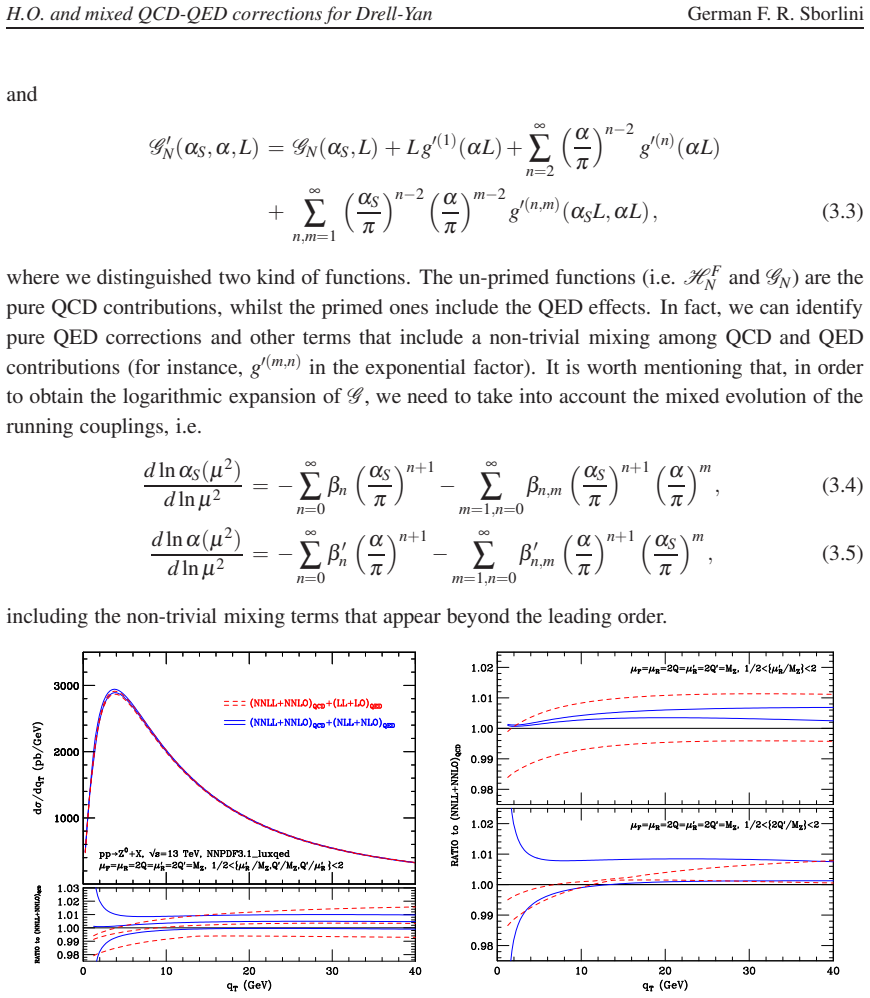
The paper claims that the $q_T$-resummation formalism, originally built for QCD, extends consistently to the simultaneous resummation of soft gluon and soft photon radiation. In impact-parameter space, the Fourier-conjugate space to the transverse momentum, the $N$-moment of the resummed cross section factorizes as $(W'_{ab})_N = \hat{\sigma}^{(0)}_{a+b\to F} H'_N(\alpha_S,\alpha) \exp\{G'_N(\alpha_S,\alpha,L)\}$, with $H'_N$ and $G'_N$ double series in the strong and electromagnetic couplings; the exponent contains mixed $\beta$-function terms that couple the running of $\alpha_S$ and $\alpha$. For Z production at the LHC, the author reports NLL+NLO QED accuracy including the non-trivial mixing terms, and the resulting $q_T$-spectrum corrections are small but non-negligible, at the percent level close to the resummation peak. The formalism is judged consistent because it gives physical predictions, and the added corrections reduce the scale uncertainty of the QCD-only result.
Load-bearing premise
The load-bearing premise is that soft gluon and soft photon emissions factorize cleanly into one shared exponential correction in transverse-momentum space, with no leftover mixed interference terms.
Editorial extensions
If this is right
- If the extended factorization is correct, the same double-expanded Sudakov exponent can be applied to other color-singlet processes, so the machinery is not tied to Z production alone.
- The QED scale variation shown in Fig. 1 provides a way to assign a combined QCD-QED theory uncertainty, which is narrower than the QCD-only band.
- Adding NLL+NLO QED corrections to NNLL+NNLO QCD gives a prediction suitable for percent-level comparisons with the measured $q_T$ spectrum at 13 TeV.
- The separation of $G'_N$ into QCD, QED, and mixed pieces allows each logarithmic order to be cross-checked against fixed-order mixed calculations.
Reading between the lines
- If the mixed exponent is universal, the same construction should appear in Higgs and diphoton $q_T$ spectra; testing it there would reveal which parts of $G'_N$ are process-independent.
- The mixed beta-function coefficients in Eqs. (3.4) and (3.5) imply that QED corrections feed back into the evolution of parton densities; this could become visible in precision Drell-Yan measurements used for PDF fits.
- A direct experimental check would be to extract the ratio of mixed-corrected to QCD-only predictions at several vector-boson masses: the formalism predicts how the logarithmic terms scale with $M$, so deviations would localize where the factorization breaks down.
Signed reviews
Editorial analysis
A structured set of objections, weighed in public.
Referee Report
Summary. This paper is a proceedings contribution for LHCP 2019. It reviews the qT-resummation formalism for Drell-Yan production, surveys the state of the art in higher-order QCD corrections, and summarizes an extension of the formalism that simultaneously resums soft-gluon and soft-photon radiation. The central new content is in Sec. 3.1: Eqs. (3.1)-(3.5) propose a resummed expression with a combined QCD-QED Sudakov exponent, including non-trivial mixing terms, and Fig. 1 shows NLL+NLO QED corrections to the Z-boson qT spectrum at 13 TeV. The paper concludes in Sec. 4 that these corrections are small but non-negligible, percent-level near the resummation peak, and that they reduce scale uncertainties. The technical derivation is not given in this manuscript; Ref. [20] is cited for details.
Significance. The paper addresses a relevant problem for precision LHC physics: mixed QCD-QED corrections to Drell-Yan production are expected to become numerically important as NNLO QCD and NLO electroweak effects compete. The proposed extension of the qT-resummation formalism is parameter-free and builds on an established factorization structure. If the underlying derivation in Ref. [20] is correct, the framework provides a tool for simultaneous resummation of gluon and photon radiation, and the phenomenological conclusion that the corrections are percent-level and stabilize scale uncertainties is valuable. The manuscript is not self-contained, and one printed equation is internally inconsistent as written; nevertheless, the claims are plausible and consistent with the cited literature.
major comments (3)
- [§3.1, Eq. (3.3)] The mixed term in the exponent is printed as a double sum over n,m starting at 1 with powers (α_S/π)^(n-2) (α/π)^(m-2). For n=m=1 this gives negative powers of both couplings, so the expansion as written is not perturbatively well-defined and does not reduce to a sensible O(α_S α) correction at the first non-trivial order. This appears to be a typo, likely the exponents should be shifted to n-1 and m-1 or equivalent, but as written it prevents the reader from verifying the claimed resummed expression. The equation should be corrected and the intended counting explained.
- [§3.1, Eqs. (3.1) and (3.3)] The central factorization ansatz, namely that simultaneous soft-gluon and soft-photon emissions can be described by the same impact-parameter structure with the hard-collinear factor H'_N and the exponent G'_N, is introduced by analogy with Eq. (2.5) and is not derived in this paper. The text refers to Ref. [20] for details, but the conclusions in Sec. 4 depend on the absence of non-factorizable O(α_S α) remainder terms beyond the additive/mixed exponent structure. As a standalone manuscript, the central claim is therefore conditional on the correctness of the derivation in Ref. [20]. The authors should either outline the key factorization argument, at least at the level of the soft-collinear mode separation, or state explicitly that this contribution is a summary of Ref. [20] and not a self-contained new derivation.
- [§3.1, Fig. 1 and Sec. 4] The phenomenological claims that the QCD-QED corrections are 'percent-level close to the resummation peak' and that they 'reduce the scale uncertainties' are supported only by the figure caption and a qualitative sentence. No numerical values, central scale choices, definitions of the uncertainty bands, or input PDF/EW scheme parameters are given in the text. This makes it impossible for the reader to quantitatively assess the size of the effect or the claimed stabilization from the manuscript alone. Please include the relevant numbers or a precise pointer to the corresponding section of Ref. [20] where the inputs and definitions are fully reported.
minor comments (4)
- [§2, Eq. (2.2)] The notation c12L2 and similar terms is not defined; standard notation such as c_{1,2} L^2 or an explicit statement that the coefficients are order-dependent would improve clarity.
- [§3.1, Eqs. (3.4)-(3.5)] The mixed beta functions β_{n,m} and β'_{n,m} are introduced but no explicit expressions or order-by-order values are given; at minimum, the text should state which orders enter the NLL+NLO QED result used in Fig. 1.
- [Fig. 1] The caption describes left and right panels with specific features, but no figure image is visible in the text; the published proceedings version should contain the actual plot and a clear statement of its axes and units.
- [General] There are several typographical artifacts in the text (e.g., 'V alència', 'Y an', and line-break issues in the abstract and references); a careful proofreading pass is needed before publication.
Circularity Check
No circularity found: the QCD-QED resummation extension is cited from prior work [20] and is not a fitted or self-referential input; the paper is a review, not a derivation-by-definition.
full rationale
This is a proceedings/review article. The standard qT-resummation formulas (2.3)-(2.6) are quoted from the literature (Ref. [2]), and the QCD-QED extension (3.1)-(3.5) is taken from the author's prior publication Ref. [20]. No parameter is fitted to the Z-boson qT spectrum that is then presented as a prediction; the plotted 'NLL+NLO QED' curve is the output of the framework in [20], not an input used to define it. Nothing in the manuscript defines G'_N in terms of the final 'small but non-negligible' correction, nor fits the mixed beta functions (3.4)-(3.5) to the result. The additive exponent structure (3.3) is an ansatz imported by citation rather than re-derived here, but importing a parameter-free published result is not circular: the cited work is external to this paper and its predictions can be tested against LHC data. The absence of an explicit proof of the simultaneous QCD-QED factorization is a completeness or correctness concern, not a self-referential derivation. Therefore no circular step meeting the evidentiary bar can be identified.
Assumptions & free parameters
assumptions (3)
- domain assumption QCD factorization theorem for Drell-Yan cross-section (Eq. 2.1)
- domain assumption Universality and exponentiation of soft-collinear radiation in qT-resummation (Eqs. 2.3-2.4)
- domain assumption Mixed QCD-QED beta functions (Eqs. 3.4-3.5) describe the coupled running of alpha_S and alpha
Cite this review
Pith. "Pith review of Higher-order and mixed QCD-QED corrections for Drell-Yan." pith.science (2026). https://pith.science/paper/WLIG2Q4C
@misc{pith2026190802209,
  author       = {Pith},
  title        = {Pith review of: Higher-order and mixed QCD-QED corrections for Drell-Yan},
  year         = {2026},
  howpublished = {\url{https://pith.science/paper/WLIG2Q4C}},
  note         = {Machine review of arXiv:1908.02209}
}
abstract
In this article, we discuss about the Drell-Yan process focusing on the computation of radiative corrections for vector boson production. First, we describe the $q_T$-resummation formalism and its application to obtain higher-order QCD corrections. We briefly summarize the state-of-the-art in these calculations, and motivate the need of more refined theoretical predictions. After that, we center into the inclusion of mixed QCD-QED higher-order contributions, both for fixed order and resummed calculations. In particular, we present a framework based on the $q_T$-resummation formalism to simultaneously handle soft gluon and photon radiation. Finally, we discuss future extensions of this approach and its phenomenological relevance.
Figures
Reference graph
Works this paper leans on
-
[20]
Combining QED and QCD transverse-momentum resummation for Z boson production at hadron colliders
L. Cieri, G. Ferrera and G. F. R. Sborlini, JHEP 1808 (2018) 165 [arXiv:1805.11948 [hep-ph]]
work page Pith review arXiv 2018
-
[1]
S. D. Drell and T. M. Y an, Phys. Rev. Lett. 25 (1970) 316. Erratum: Phys. Rev. Lett. 25 (1970) 902
work page 1970
- [2]
-
[3]
G. Altarelli, R. K. Ellis and G. Martinelli, Nucl. Phys. B 143 (1978) 521 Erratum: [Nucl. Phys. B 146 (1978) 544]
work page 1978
-
[4]
R. Hamberg, W . L. van Neerven and T. Matsuura, Nucl. Phys. B 359 (1991) 343 Erratum: [Nucl. Phys. B 644 (2002) 403]
work page 1991
-
[5]
C. Anastasiou, L. J. Dixon, K. Melnikov and F. Petriello, Phys. Rev. Lett. 91 (2003) 182002 [hep-ph/0306192]. 5 H.O. and mixed QCD-QED corrections for Drell-Y an German F. R. Sborlini
arXiv 2003
-
[6]
K. Melnikov and F. Petriello, Phys. Rev. D 74 (2006) 114017 [hep-ph/0609070]
arXiv 2006
-
[7]
Transverse-momentum resummation: a perturbative study of Z production at the Tevatron
G. Bozzi, S. Catani, G. Ferrera, D. de Florian and M. Grazz ini, Nucl. Phys. B 815 (2009) 174 [arXiv:0812.2862 [hep-ph]]
work page Pith review arXiv 2009
Show all 21 references
-
[8]
Bozzi, S
G. Bozzi, S. Catani, G. Ferrera, D. de Florian and M. Grazz ini, Phys. Lett. B 696 (2011) 207 [arXiv:1007.2351 [hep-ph]]
2011 arXiv
-
[9]
Boughezal, C
R. Boughezal, C. Focke, X. Liu and F. Petriello, Phys. Rev . Lett. 115 (2015) no.6, 062002 [arXiv:1504.02131 [hep-ph]]
2015 arXiv
-
[10]
Boughezal, J
R. Boughezal, J. M. Campbell, R. K. Ellis, C. Focke, W . T. Giele, X. Liu and F. Petriello, Phys. Rev. Lett. 116 (2016) no.15, 152001 [arXiv:1512.01291 [hep-ph]]
2016 arXiv
-
[11]
Catani, D
S. Catani, D. de Florian, G. Ferrera and M. Grazzini, JHE P 1512 (2015) 047 [arXiv:1507.06937 [hep-ph]]
2015 arXiv
-
[12]
Catani, L
S. Catani, L. Cieri, D. de Florian, G. Ferrera and M. Graz zini, Nucl. Phys. B 888 (2014) 75 [arXiv:1405.4827 [hep-ph]]
2014 arXiv
-
[13]
Bizon et al., JHEP 1812 (2018) 132 [arXiv:1805.05916 [hep-ph]]
W . Bizon et al., JHEP 1812 (2018) 132 [arXiv:1805.05916 [hep-ph]]
2018 arXiv
-
[14]
de Florian, G
D. de Florian, G. F. R. Sborlini and G. Rodrigo, Eur. Phys . J. C 76 (2016) no.5, 282 [arXiv:1512.00612 [hep-ph]]
2016 arXiv
-
[15]
de Florian, G
D. de Florian, G. F. R. Sborlini and G. Rodrigo, JHEP 1610 (2016) 056 [arXiv:1606.02887 [hep-ph]]
2016 arXiv
-
[16]
Chiesa, N
M. Chiesa, N. Greiner, M. Schonherr and F. Tramontano, J HEP 1710 (2017) 181 [arXiv:1706.09022 [hep-ph]]
2017 arXiv
-
[17]
G. F. R. Sborlini, PoS EPS-HEP2017 (2017) 398 [arXiv:1709.09596 [hep-ph]]
2017 arXiv
-
[18]
Wackeroth and W
D. Wackeroth and W . Hollik, Phys. Rev. D 55 (1997) 6788 [hep-ph/9606398]
1997 arXiv
-
[19]
de Florian, M
D. de Florian, M. Der and I. Fabre, Phys. Rev. D 98 (2018) no.9, 094008 [arXiv:1805.12214 [hep-ph]]
2018 arXiv
-
[21]
G. F. R. Sborlini, arXiv:1805.06192 [hep-ph]. 6
Reviewed August 14, 2026 · model on record in the stance chip above.
Discussion (0). Continue with ORCID to comment.