REVIEW 3 major objections 6 minor 58 references
First i-TED demonstrator: a Compton imager with Dynamic Electronic Collimation
T0 review · 3 major / 6 minor · reviewed 2026-08-14 · deepseek-v4-flash
Pith's one-line read The paper claims that the i-TED demonstrator, a Compton imager with a motorized scatter-absorber separation, achieves 8–14 degree angular resolution for 662 keV gamma rays with about 50 times the efficiency of comparable…
desk verdict First i-TED demonstrator paper: solid experimental characterization of a tunable Compton imager; the efficiency claims need a clearer event selection to be fully trustworthy. read the letter →
The pith
A machine-rendered reading of the paper's core claim, the machinery that carries it, and where it could break.
The reading
What carries the argument
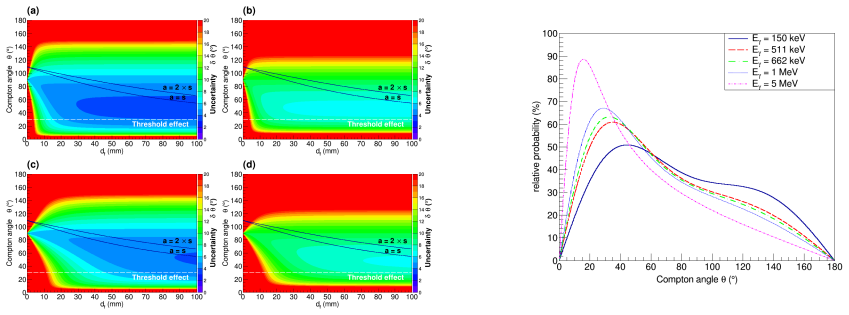
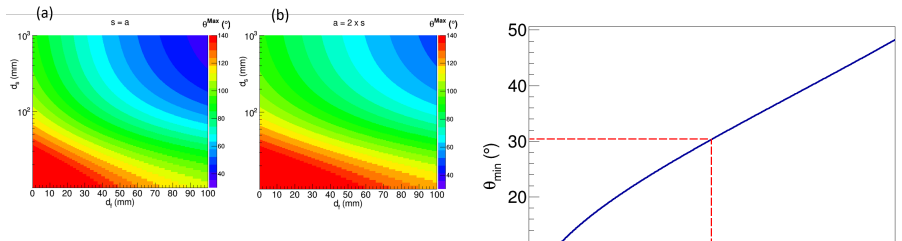
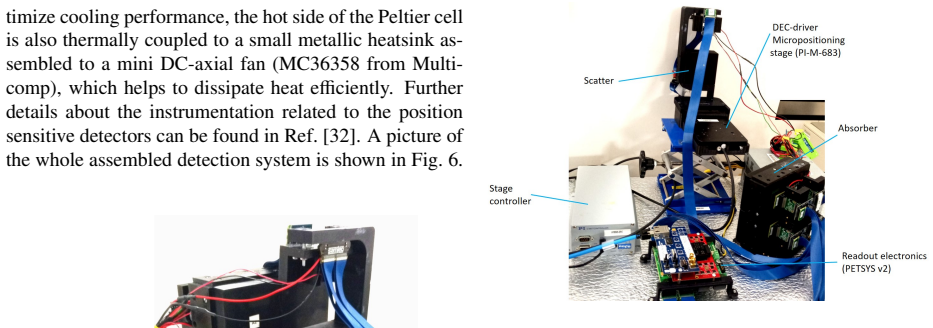
The load-bearing mechanism is Dynamic Electronic Collimation: a motorized stage changes the distance $d_f$ between the $50\times50\times10$ mm$^3$ scatter crystal and the four $50\times50\times25$ mm$^3$ absorber crystals, tuning the camera between high efficiency at small $d_f$ and better angular resolution at large $d_f$. The argument is carried by three analytic constraints: the Compton-angle uncertainty formula $\delta\theta$, which grows with energy and position uncertainty and with $1/\sin\theta$; the geometrical maximum-angle formula $\theta_{\mathrm{Max}}$ set by detector sizes and source distance; and the threshold-induced minimum angle, about $30^\circ$ for a $100$ keV threshold at $662$ keV. Position reconstruction relies on a fitted analytic light-response model for the monolithic crystals, giving about $1$ mm fwhm position accuracy, and the images are formed with a list-mode backprojection that intersects each Compton cone with the source plane.
What would settle it
One decisive check is to rerun the $^{137}$Cs measurements with a gate on the $662$ keV full-energy peak in the add-back spectrum and with exactly one reconstructed interaction per layer, then recompute efficiency and ARM; if the efficiency no longer exceeds the cited cameras by a factor of about $50$, or if the ARM moves outside $8^\circ$ to $14^\circ$, the reported imaging performance is not representative of clean single-Compton events.
Extended reading notes
Core claim
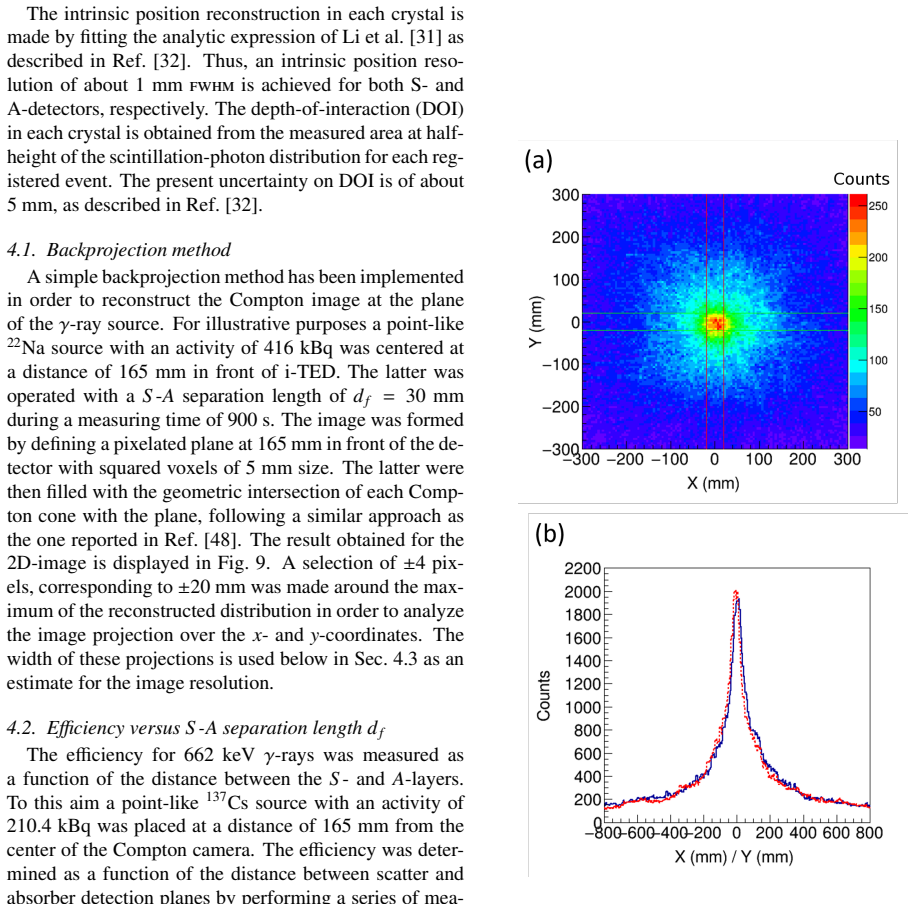
On the paper's own terms, the discovery is that a Compton imager built from five large LaCl$_3$(Ce) monolithic crystals and 320 readout channels works both as a total-energy detector and as a gamma-ray imager. For $662$ keV photons, the measured efficiency falls smoothly as the scatter-absorber separation $d_f$ grows, while the angular resolution improves roughly linearly from about $14^\circ$ at $d_f = 20$ mm to about $9^\circ$ at $d_f = 50$ mm and then flattens at $8.5(3)^\circ$. The sum-signal energy resolution is about $9\%$ fwhm at $662$ keV, the intrinsic position resolution is about $1$ mm fwhm, and the depth-of-interaction uncertainty is about $5$ mm; these values feed the analytic angular-uncertainty relation and motivate the design choices. Backprojected images of point-like $^{22}$Na and $^{137}$Cs sources reconstruct the source location over roughly two-thirds of $2\pi$. The paper's intended consequence is that the same detector can provide event-by-event gamma-ray direction information in neutron time-of-flight experiments, enabling spatial background discrimination.
Load-bearing premise
The reported efficiency and angular resolution rest on an event selection that is only partially specified, since the paper does not state whether events must deposit the full 662 keV energy and contain exactly one interaction in each layer.
Editorial extensions
If this is right
- For neutron-capture time-of-flight measurements, the imaging capability can suppress background from neutron-capture gamma rays in the surroundings, because true events point back to the sample while background events point elsewhere.
- An operator can tune $d_f$ for each neutron-energy window, using short separations where statistics are scarce and long separations where background rejection matters more.
- At the measured $8^\circ$ to $14^\circ$ angular resolution, a field of view of about $2/3$ of $2\pi$ is sufficient to monitor the main background directions around the sample.
- Improving the crystal energy resolution and lowering the $100$ keV threshold would extend the usable Compton-angle range and improve angular resolution beyond the present values.
- The factor-of-50 efficiency gain relative to other scintillator cameras keeps total measuring time feasible for low-mass or radioactive samples.
Reading between the lines
- If the measurements are repeated with a strict gate on the full-energy peak and exactly one interaction per layer, the factor-of-50 efficiency advantage will probably shrink; as written, the efficiency includes whatever event mixture the unstated selection admits.
- The same adjustable-separation hardware generalizes outside neutron capture, for example to security or decommissioning surveys where a short $d_f$ gives a fast coarse image and a longer $d_f$ refines it.
- Because the dominant angular-error term is the energy resolution, a modest spectroscopic improvement toward the $3.5\%$ assumed in the design curves could bring the angular resolution below $8^\circ$ without changing the crystals or electronics.
- A maximum-likelihood reconstruction would likely recover the compressed peripheral field-of-view positions seen in the simple backprojection images, so the $2/3$ of $2\pi$ estimate is a conservative floor for the hardware.
Signed reviews
Editorial analysis
A structured set of objections, weighed in public.
Referee Report
Summary. The paper reports the assembly and first laboratory characterization of the i-TED demonstrator, a Compton camera built from one 50x50x10 mm^3 LaCl3(Ce) monolithic scatter crystal and four 50x50x25 mm^3 absorber crystals read out by 320 SiPM channels. The distinctive feature is Dynamic Electronic Collimation (DEC), implemented with a motorized stage that changes the scatter-absorber distance d_f over a 50 mm range. The authors present measurements of the 662 keV detection efficiency versus d_f, the angular resolution measure (ARM) versus d_f, backprojected images of a 22Na point source, and a field-of-view study. They report an efficiency about a factor of 50 higher than other scintillator-based Compton cameras at similar energies, angular resolutions between about 8 and 14 degrees, and an angular field of view of about 2/3 of 2 pi. The intended application is background discrimination in neutron time-of-flight capture measurements.
Significance. If the reported performance is taken at face value, the paper demonstrates a working high-efficiency Compton imager based on large monolithic scintillators, with a remotely adjustable geometry that enables an efficiency-resolution trade-off. This is a useful step for the i-TED program and for scintillator-based Compton imaging more generally. The main strengths are that the efficiency and ARM values come from direct laboratory measurements with quoted statistical uncertainties, and the authors are honest about hardware limitations such as missing readout channels and the 100 keV threshold. However, the central quantitative claim, the factor-of-50 efficiency comparison with other cameras, currently rests on an incompletely specified event selection and on an extrapolation of the source distance that is not described. These issues are fixable but are load-bearing for the paper's main conclusion.
major comments (3)
- [Sec. 4.2, Fig. 10] The efficiency measurement is not sufficiently specified. The text states only a 10 ns coincidence window and a ~100 keV threshold, but does not state whether events were required to deposit the full 662 keV energy in the add-back spectrum, whether exactly one interaction per layer was required, or how multi-interaction and partial-energy events were treated. If the denominator is any S-A coincidence above threshold, the quoted efficiency is an inclusive coincidence efficiency that is not directly comparable to photopeak or imaging efficiencies in the literature. Please define the efficiency precisely, including the energy window, interaction multiplicity selection, and background subtraction.
- [Sec. 4.2 and Sec. 5] The factor-of-50 comparison with Refs. [44,52] relies on an extrapolation of the efficiency from a source distance of 165 mm to 30 mm, shown on the right-hand axis of Fig. 10, but the extrapolation procedure is not described and no justification is given for the assumed distance scaling. Moreover, no comparison table is provided listing source distance, energy window, and analysis cuts for i-TED and for the cited cameras. Please either provide a like-for-like comparison with all relevant conditions stated, or substantially soften the factor-of-50 claim.
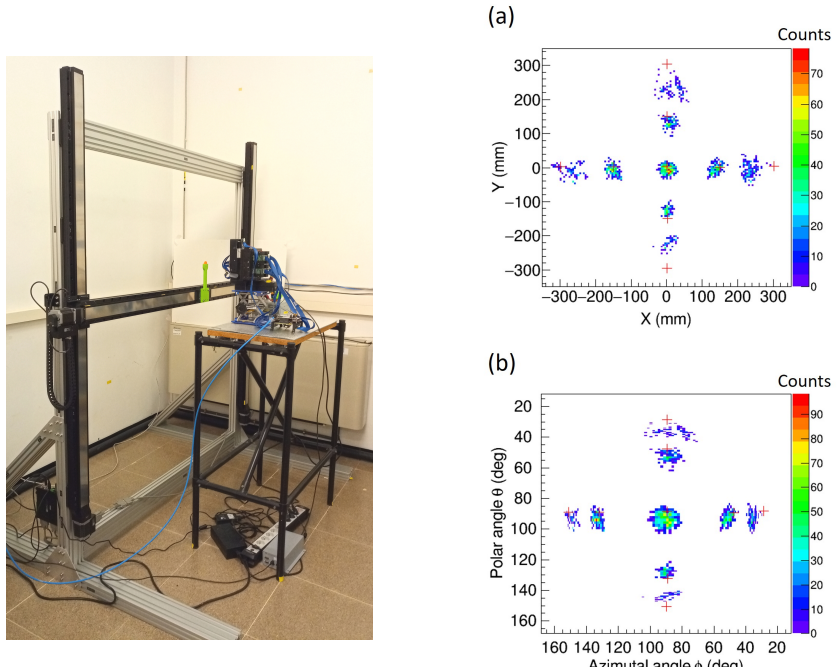
- [Sec. 4.3, Fig. 11] The angular resolution measurement is internally consistent but the event selection is again unspecified. The ARM is defined only as 'to the level of one standard deviation' without stating whether the distribution is of the angular distance between the true source direction and the backprojected Compton cone for all accepted events, and without stating whether partial-energy or multi-interaction events were included. This matters because including mis-reconstructed partial-energy events could degrade the ARM and make the quoted 8-14 degrees not representative of imaging quality for a point source. Please define the ARM distribution and the event selection used for it.
minor comments (6)
- [Sec. 2, Fig. 1] The design curves in Fig. 1 use spatial resolutions of 1-3 mm, while Sec. 3 reports a depth-of-interaction uncertainty of about 5 mm. Please clarify whether the quoted DOI uncertainty is included in the δr values used in Eq. (1) and Fig. 1, or whether the figure represents an idealized limit.
- [Sec. 4.1] The image resolution is estimated from projections over a ±20 mm selection around the maximum; please state explicitly how the projection width is converted to an angular or spatial resolution value and whether the result is a FWHM or another measure.
- [Sec. 4.2] The source activity is given as 210.4 kBq without an uncertainty; including the activity uncertainty and its contribution to the absolute efficiency uncertainty would improve the reproducibility of the efficiency numbers.
- [Sec. 4.4, Fig. 13] The field-of-view estimate of 'about 2/3 of 2π' is not accompanied by a quantitative criterion, such as the region within which reconstructed positions agree with true positions within a given tolerance. Please specify how the number was obtained.
- [Sec. 5] The acronym PHWT is used without definition in the discussion of future work; please spell it out at first use.
- [Throughout] The text contains several typographical errors, including 'repeteability', 'uncerainty', 'lineraity', and 'taken appart'; a careful proofreading pass would remove these.
Circularity Check
No significant circularity: the demonstrated performance numbers are new measurements fitted to data, and the self-citations provide context or reconstruction tools rather than forcing the results.
full rationale
The paper's central claims are experimental characterizations: efficiency versus S-A separation, ARM versus S-A separation, and field-of-view. The efficiency curve in Sec. 4.2 is a quadratic fit to measured 662 keV data, and the ARM curve in Sec. 4.3 is a linear fit to measured ARM values; neither fit is presented as a prediction derived from the paper's own assumptions. The angular-resolution formula of Eq. (1) is cited to an external reference (Ref. [30]) and is used only for design insight, not for generating the measured ARM numbers. The position-reconstruction method from Ref. [32] is a tool used to analyze events, and the measured resolutions are benchmarked against external literature values rather than forced by that method. The DEC concept is described via the authors' patent [39] and prior work [24], but the demonstrator's performance is measured independently; the self-citation is motivational and contextual, not load-bearing for the efficiency or angular-resolution results. The factor-of-50 efficiency comparison relies on the measured efficiency and external references [44,52]; even if the event-selection criteria are under-specified in the paper, that is a reproducibility and interpretation concern rather than a circular reduction. No step defines a quantity in terms of the very quantity it is claimed to predict, and no fitted parameter is renamed as a prediction. Thus no circularity is found.
Assumptions & free parameters
free parameters (2)
- Efficiency vs d_f quadratic fit coefficients =
a0 = 1.358e-2 %, a1 = -2.52e-4 %/mm, a2 = 1.41e-6 %/mm^2
- ARM vs d_f linear fit coefficients =
slope = -0.14(2) deg/mm, intercept = 15.8(9) deg
assumptions (4)
- standard math Compton scattering law and the analytic angular-resolution formula of Ref. [30] (Eq. 1) correctly describe the uncertainty in the Compton angle.
- domain assumption The position reconstruction method described in Ref. [32] provides approximately 1 mm fwhm spatial resolution and 5 mm DOI uncertainty in the assembled i-TED demonstrator.
- domain assumption The gamma-ray source is point-like and at a known distance for the backprojection images.
- domain assumption Doppler broadening from electron momentum is negligible compared to the intrinsic detector energy resolution.
Cite this review
Pith. "Pith review of First i-TED demonstrator: a Compton imager with Dynamic Electronic Collimation." pith.science (2026). https://pith.science/paper/WLMLDQBV
@misc{pith2026190808533,
  author       = {Pith},
  title        = {Pith review of: First i-TED demonstrator: a Compton imager with Dynamic Electronic Collimation},
  year         = {2026},
  howpublished = {\url{https://pith.science/paper/WLMLDQBV}},
  note         = {Machine review of arXiv:1908.08533}
}
abstract
i-TED consists of both a total energy detector and a Compton camera primarily intended for the measurement of neutron capture cross sections by means of the simultaneous combination of neutron time-of-flight (TOF) and $\gamma$-ray imaging techniques. TOF allows one to obtain a neutron-energy differential capture yield, whereas the imaging capability is intended for the discrimination of radiative background sources, that have a spatial origin different from that of the capture sample under investigation. A distinctive feature of i-TED is the embedded Dynamic Electronic Collimation (DEC) concept, which allows for a trade-off between efficiency and image resolution. Here we report on some general design considerations and first performance characterization measurements made with an i-TED demonstrator in order to explore its $\gamma$-ray detection and imaging capabilities.
Figures


Figures from the paper (8 more)




Reference graph
Works this paper leans on
- [24]
-
[1]
Introduction Neutron capture cross sections are a key nuclear- physics ingredient for the study of the formation of ele- ments heavier than iron in the stars [1, 2, 3]. Direct ( n,γ ) measurements are particularly relevant for the so-called slow nucleosynthesis ( s-) process, where most of the in- volved nuclei can be accessed in laboratory experiments. P...
-
[2]
Dynamic Electronic Collimation Detection e fficiency and image resolution are two of the most relevant performance aspects of any Compton imager. These two elements are discussed in the follow- ing, with the aim of introducing the concept of Dynamic Electronic Collimation (DEC). In Compton cameras based on two detection planes the intrinsic γ-ray detection ...
-
[3]
Materials i-TED is based on the Compton camera design with the aforementioned a = 2× s configuration. The position- sensitive scatter detector (S) consists of a 50×50×10 mm3 LaCl3(Ce) monolithic crystal optically coupled with sili- con grease (Saint Gobain BC-630) to a silicon photomul- tiplier SiPM (SensL ArrayJ-60035-64P-PCB), which fea- tures a segmenta...
-
[4]
Measurements and results An energy calibration of each detector is performed in the full energy range from 122 keV up to 1410 keV us- ing a radioactive source of 152Eu. The energy resolution at 662 keV ranges between 6 % and 10 % at fwhm for all the crystals and the average value of the detection thresh- old is 100 keV . A time coincidence window of 10 ns...
-
[5]
Discussion and outlook i-TED is a high-efficiency Compton imager, which im- plements the new concept of Dynamic Electronic Colli- mation for enhanced fieldability and optimization of the measuring time. In this work an i-TED demonstrator based on five large LaCl3(Ce) monolithic crystals and 320 readout channels has been assembled and characterized in terms of...
work page 2021
-
[6]
E. Margaret Burbidge, G. R. Burbidge, William A. Fowler, and F. Hoyle. Synthesis of the elements in stars. Rev. Mod. Phys., 29:547–650, Oct 1957
work page 1957
-
[7]
A. G. W. Cameron. On the origin of the heavy ele- ments. Astronomical Journal, 62:9–10, Feb 1957
work page 1957
Show all 58 references
-
[8]
K ¨appeler, R
F. K ¨appeler, R. Gallino, S. Bisterzo, and Wako Aoki. The s process: Nuclear physics, stellar mod- els, and observations. Reviews of Modern Physics , 83(1):157–194, Jan 2011
2011
-
[9]
Nishimura, R
N. Nishimura, R. Hirschi, T. Rauscher, A. St. J. Murphy, and G. Cescutti. Uncertainties in s- process nucleosynthesis in massive stars determined by Monte Carlo variations. Monthly Notices of the Royal Astronomical Society, 469(2):1752–1767, Aug 2017
2017
-
[10]
Cescutti, R
G. Cescutti, R. Hirschi, N. Nishimura, J. W. den Hartogh, T. Rauscher, A. St J. Murphy, and S. Cristallo. Uncertainties in s-process nucleosyn- thesis in low-mass stars determined from Monte Carlo variations. Monthly Notices of the Royal As- tronomical Society, 478(3):4101–412...
2018
-
[11]
Wisshak, F
K. Wisshak, F. Kappeler, F. V oss, and K. Guber. The Karlsruhe 4 pi BaF /sub 2 / detector. IEEE Trans- actions on Nuclear Science , 36:101–105, February 1989
1989
-
[12]
Reifarth, E.-I
R. Reifarth, E.-I. Esch, A. Alpizar-Vicente, E. M. Bond, T. A. Bredeweg, S. E. Glover, U. Greife, R. Hatarik, R. C. Haight, A. Kronenberg, J. M. O’Donnell, R. S. Rundberg, J. M. Schwantes, J. L. Ullmann, D. J. Vieira, J. B. Wilhelmy, and J. M. Wouters. (n, γ) measurements on r...
2005
-
[13]
Guerrero, D
C. Guerrero, D. Cano-Ott, E. Mendoza, J. L. Ta´ın, A. Algora, E. Berthoumieux, N. Colonna, C. Domingo-Pardo, E. Gonz ´alez-Romero, M. Heil, D. Jord´an, F. K¨appeler, C. Lampoudis, T. Mart´ınez, C. Massimi, R. Plag, and n TOF Collaboration. Monte Carlo simulation of the n TOF T...
2012
-
[14]
R. L. Macklin and J. H. Gibbons. Capture-Cross- Section Studies for 30-220-keV Neutrons Using a New Technique. Physical Review, 159:1007–1012, July 1967
1967
-
[15]
Abbondanno, G
U. Abbondanno, G. Aerts, H. Alvarez, S. An- driamonje, A. Angelopoulos, P. Assimakopoulos, C. O. Bacri, G. Badurek, P. Baumann, F. Be ˇcv´aˇr, H. Beer, J. Benlliure, B. Berthier, E. Berthomieux, S. Bo ffi, C. Borcea, E. Boscolo-Marchi, N. Bus- treo, P. Calvi ˜no, D. Cano-Ott, R....
2004
-
[16]
Borella, G
A. Borella, G. Aerts, F. Gunsing, M. Moxon, P. Schillebeeckx, and R. Wynants. The use of C6D 6 detectors for neutron induced capture cross-section measurements in the resonance region. Nuclear Instruments and Methods in Physics Research A , 577:626–640, July 2007
2007
-
[17]
R. R. Winters and R. L. Macklin. Maxwellian- averaged Neutron Capture Cross Sections for 99Tc and 95-98Mo. The Astroph. Jour. , 313:808, Feb 1987
1987
-
[18]
Abbondanno, G
U. Abbondanno, G. Aerts, F. Alvarez-Velarde, H. ´Alvarez-Pol, S. Andriamonje, J. Andrzejew- ski, G. Badurek, P. Baumann, F. Be ˇcv´aˇr, J. Ben- lliure, E. Berthoumieux, F. Calvi ˜no, D. Cano- Ott, R. Capote, P. Cennini, V . Chepel, E. Chi- averi, N. Colonna, G. Cortes, D. Cort...
2004
-
[19]
Lederer, C
C. Lederer, C. Massimi, S. Altstadt, J. Andrze- jewski, L. Audouin, M. Barbagallo, V . B ´ecares, F. Beˇcv´aˇr, F. Belloni, E. Berthoumieux, J. Billowes, V . Boccone, D. Bosnar, M. Brugger, M. Calviani, F. Calvi ˜no, D. Cano-Ott, C. Carrapic ¸o, F. Cerutti, E. Chiaveri, M. Chi...
2013
-
[20]
R. Plag, M. Heil, F. K ¨appeler, P. Pavlopoulos, R. Reifarth, K. Wisshak, and n TOF Collabora- tion. An optimized C 6D 6 detector for studies of resonance-dominated (n,γ) cross-sections. Nuclear Instruments and Methods in Physics Research A , 496:425–436, January 2003. 12
2003
-
[21]
ˇZugec, N
P. ˇZugec, N. Colonna, D. Bosnar, S. Altstadt, J. An- drzejewski, L. Audouin, M. Barbagallo, V . B´ecares, F. Beˇcv´aˇr, F. Belloni, E. Berthoumieux, J. Billowes, V . Boccone, M. Brugger, M. Calviani, F. Calvi ˜no, D. Cano-Ott, C. Carrapic ¸o, F. Cerutti, E. Chiaveri, M. Chin,...
2014
-
[22]
Tagliente, P
G. Tagliente, P. M. Milazzo, K. Fujii, U. Abbon- danno, G. Aerts, H. ´Alvarez, F. Alvarez-Velarde, S. Andriamonje, J. Andrzejewski, L. Audouin, G. Badurek, P. Baumann, F. Be ˇcv´aˇr, F. Bel- loni, E. Berthoumieux, F. Calvi ˜no, M. Calviani, D. Cano-Ott, R. Capote, C. Carrapic ...
2013
-
[23]
Neyskens, S
P. Neyskens, S. van Eck, A. Jorissen, S. Goriely, L. Siess, and B. Plez. The temperature and chronol- ogy of heavy-element synthesis in low-mass stars. Nature, 517(7533):174–176, Jan 2015
2015
-
[25]
D. L. P ´erez Mag ´an, L. Caballero, C. Domingo- Pardo, J. Agramunt-Ros, F. Albiol, A. Casanovas, A. Gonz´alez, C. Guerrero, J. Lerendegui-Marco, and A. Tarife˜no-Saldivia. First tests of the applicability of γ-ray imaging for background discrimination in time-of-flight neutron...
2016
-
[26]
Sch¨onfelder, A
V . Sch¨onfelder, A. Hirner, and K. Schneider. A tele- scope for soft gamma ray astronomy. Nuclear In- struments and Methods, 107:385–394, 1973
1973
-
[27]
Everett, J.S.Fleming, R.W
D.B. Everett, J.S.Fleming, R.W. Todd and J.M. Nightingale. Gamma-radiation imaging system based on the compton e ffect. Proc. IEEE, Vol. 124, pp.995-1000, 1977
1977
-
[28]
681740, PI: C
High-sensitivitY Measurements of key stellar Nucleo-Synthesis reactions (HYMNS), ERC- 13 Consolidator Grant Agreement No. 681740, PI: C. Domingo Pardo
-
[29]
Domingo-Pardo
C. Domingo-Pardo. i-TED: A novel concept for high-sensitivity (n,γ) cross-section measurements. Nuclear Instruments and Methods in Physics Re- search A, 825:78–86, July 2016
2016
-
[30]
Lessons learnt from comptel for future telescopes
V olker Schnfelder. Lessons learnt from comptel for future telescopes. New Astronomy Reviews , 48(1):193 – 198, 2004. Astronomy with Radioac- tivities IV and Filling the Sensitivity Gap in MeV Astronomy
2004
-
[31]
narrow-FOV Si /CdTe semiconductor Compton camera
Yuto Ichinohe, Yuusuke Uchida, Shin Watan- abe, Ikumi Edahiro, Katsuhiro Hayashi, Taka- fumi Kawano, Masanori Ohno, Masayuki Ohta, Shin‘ichiro Takeda, Yasushi Fukazawa, Miho Kat- suragawa, Kazuhiro Nakazawa, Hirokazu Odaka, Hiroyasu Tajima, Hiromitsu Takahashi, Tadayuki Takaha...
2016
-
[32]
Hiroyasu Tajima, Shin Watanabe, Yasushi Fukazawa, Roger Bland ford, Teruaki Enoto, Andrea Goldwurm, Kouichi Hagino, Kat- suhiro Hayashi, Yuto Ichinohe, Jun Kataoka, Jun’ichiro Katsuta, Takao Kitaguchi, Motohide Kokubun, Philippe Laurent, Franc ¸ois Lebrun, Olivier Limousin, Gr...
2018
-
[33]
Aldawood, P
S. Aldawood, P. G. Thirolf, A. Miani, M. B ¨ohmer, G. Dedes, R. Gernh ¨auser, C. Lang, S. Liprandi, L. Maier, T. Marin ˇsek, M. Mayerhofer, D. R. Schaart, I. V . Lozano, and K. Parodi. Develop- ment of a Compton camera for prompt-gamma med- ical imaging. Radiation Physics and ...
2017
-
[34]
Tashenov and J
S. Tashenov and J. Gerl. Imaging algorithm for background suppression in the planned gamma tracking array of DESPEC. Nuclear Instruments and Methods in Physics Research A , 586(2):224– 228, Feb 2008
2008
-
[35]
Mihailescu, K.M
L. Mihailescu, K.M. Vetter, M.T. Burks, E.L. Hull, and W.W. Craig. Speir: A ge compton camera. Nu- clear Instruments and Methods in Physics Research Section A: Accelerators, Spectrometers, Detectors and Associated Equipment, 570(1):89 – 100, 2007
2007
-
[36]
Z. Li, M. Wedrowski, P. Bruyndonckx, and G. Van- dersteen. Nonlinear least-squares modeling of 3D interaction position in a monolithic scintillator block. Physics in Medicine and Biology , 55:6515– 6532, November 2010
2010
-
[37]
Babiano, L
V . Babiano, L. Caballero, D. Calvo, I. Ladarescu, P. Olleros, and C. Domingo-Pardo. γ-Ray position reconstruction in large monolithic LaCl 3(Ce) crys- tals with SiPM readout. Nuclear Instruments and Methods in Physics Research A, 931:1–22, Jul 2019
2019
-
[38]
Gostoji ´c, V
A. Gostoji ´c, V . Tatischeff, J. Kiener, C. Hamadache, J. Peyr ´e, N. Karkour, D. Linget, L. Gibelin, X. Lafay, X. Grave, N. Dosme, E. Legay, S. Blin, and P. Barrillon. Characterization of LaBr 3:Ce and CeBr 3 calorimeter modules for 3D imaging in gamma-ray astronomy. Nuclear ...
2016
-
[39]
Liprandi, M
S. Liprandi, M. Mayerhofer, S. Aldawood, T. Binder, G. Dedes, A. Miani, D. Schaart, I. Va- lencia Lozano, K. Parodi, and P. Thirolf. Sub-3mm spatial resolution from a large monolithic LaBr3 (Ce) scintillator. Current Directions in Biomedical Engineering, 3:655–659, February 2017. 14
2017
-
[40]
Ulyanov, O
A. Ulyanov, O. Morris, O. J. Roberts, I. Tobin, L. Hanlon, S. McBreen, D. Murphy, N. Nelms, and B. Shortt. Localisation of gamma-ray interac- tion points in thick monolithic CeBr3 and LaBr3:Ce scintillators. Nuclear Instruments and Methods in Physics Research A, 844:81–89, Feb...
2017
-
[41]
Olleros, L
P. Olleros, L. Caballero, C. Domingo-Pardo, V . Babiano, I. Ladarescu, D. Calvo, P. Gramage, E. Nacher, J. L. Tain, and A. Tolosa. On the perfor- mance of large monolithic LaCl 3(Ce) crystals cou- pled to pixelated silicon photosensors. Journal of Instrumentation, 13:P03014, M...
2018
-
[42]
Relationship of the relativistic compton cross section to the momentum distribu- tion of bound electron states.Phys
Roland Ribberfors. Relationship of the relativistic compton cross section to the momentum distribu- tion of bound electron states.Phys. Rev. B, 12:2067– 2074, Sep 1975
1975
-
[43]
Klein and Y
O. Klein and Y . Nishina. ¨Uber die streuung von strahlung durch freie elektronen nach der neuen rel- ativistischen quantendynamik von dirac. Zeitschrift f¨ ur Physik, 52(11):853–868, Nov 1929
1929
-
[44]
Domingo Pardo, L
C. Domingo Pardo, L. Caballero Ontanaya, F.J. Albiol Colomer, and J. Agramunt Ros. Fo- cusable Compton Camera equipped with variable separation detectors. Patentscope, Dec 2015. PCT/ES2016/070916
2015
-
[45]
H. C. Boston, J. Gillam, A. J. Boston, R. J. Cooper, J. Cresswell, A. N. Grint, A. R. Mather, P. J. Nolan, D. P. Scraggs, G. Turk, C. J. Hall, I. Lazarus, A. Berry, T. Beveridge, and R. Lewis. Orthogonal strip HPGe planar SmartPET detectors in Compton configuration. Nuclear Ins...
2007
-
[46]
Kataoka, A
J. Kataoka, A. Kishimoto, T. Nishiyama, T. Fujita, K. Takeuchi, T. Kato, T. Nakamori, S. Ohsuka, S. Nakamura, M. Hirayanagi, S. Adachi, T. Uchiyama, and K. Yamamoto. Handy Compton camera using 3D position-sensitive scintillators coupled with large-area monolithic MPPC arrays. ...
2013
-
[47]
Stereo Compton cameras
K. Takeuchi, J. Kataoka, T. Nishiyama, T. Fujita, A. Kishimoto, S. Ohsuka, S. Nakamura, S. Adachi, M. Hirayanagi, T. Uchiyama, Y . Ishikawa, and T. Kato. “Stereo Compton cameras” for the 3-D lo- calization of radioisotopes. Nuclear Instruments and Methods in Physics Research A...
2014
-
[48]
Multiple scattering Compton camera with neutron activation for mate- rial inspection
Taewoong Lee and Wonho Lee. Multiple scattering Compton camera with neutron activation for mate- rial inspection. Nuclear Instruments and Methods in Physics Research A, 784:423–429, Jun 2015
2015
-
[49]
Kishimoto, J
A. Kishimoto, J. Kataoka, A. Koide, K. Sueoka, Y . Iwamoto, T. Taya, and S. Ohsuka. Develop- ment of a compact scintillator-based high-resolution Compton camera for molecular imaging. Nuclear Instruments and Methods in Physics Research A , 845:656–659, Feb 2017
2017
-
[50]
Performance evalu- ation of MACACO: a multilayer compton camera
Enrique Mu ˜noz, John Barrio, Ane Etxebeste, Pablo G Ortega, Carlos Lacasta, Josep F Oliver, Car- les Solaz, and Gabriela Llos ´a. Performance evalu- ation of MACACO: a multilayer compton camera. Physics in Medicine & Biology, 62(18):7321–7341, aug 2017
2017
-
[51]
First demon- stration of multi-color 3-D in vivo imaging using ultra-compact Compton camera
Aya Kishimoto, Jun Kataoka, Takanori Taya, Leo Tagawa, Saku Mochizuki, Shinji Ohsuka, Yuto Na- gao, Keisuke Kurita, Mitsutaka Yamaguchi, Naoki Kawachi, Keiko Matsunaga, Hayato Ikeda, Eku Shimosegawa, and Jun Hatazawa. First demon- stration of multi-color 3-D in vivo imaging us...
2017
-
[52]
Di Francesco, R
A. Di Francesco, R. Bugalho, L. Oliveira, A. Riv- etti, M. Rolo, J. C. Silva, and J. Varela. TOFPET 2: A high-performance circuit for PET time-of-flight. Nuclear Instruments and Methods in Physics Re- search A, 824:194–195, July 2016
2016
-
[53]
S. J. Wilderman, W. L. Rogers, G. F. Knoll, and J. C. Engdahl. Fast algorithm for list mode back- projection of Compton scatter camera data. IEEE Transactions on Nuclear Science, 45:957–962, June 1998
1998
-
[54]
Sarmouk, A
A. Sarmouk, A. D. Zych, T. O’Neill, R. S. White, and O. T. Tumer. Imaging gamma-ray sources with 15 a Compton double scatter telescope using the expec- tation maximization maximum likelihood (EMML) technique. IEEE Transactions on Nuclear Science , 41(4):1349–1353, Aug 1994
1994
-
[55]
Parra and H
L. Parra and H. H. Barrett. List-mode likelihood: Em algorithm and image quality estimation demon- strated on 2-d pet. IEEE Transactions on Medical Imaging, 17(2):228–235, April 1998
1998
-
[56]
Xu and Z
D. Xu and Z. He. Gamma-ray energy-imaging inte- grated spectral deconvolution. Nuclear Instruments and Methods in Physics Research A , 574:98–109, April 2007
2007
-
[57]
Development of a cost- effective Compton camera using a positron emis- sion tomography data acquisition system
Yuto Nagao, Mitsutaka Yamaguchi, Naoki Kawachi, and Hiroshi Watabe. Development of a cost- effective Compton camera using a positron emis- sion tomography data acquisition system. Nuclear Instruments and Methods in Physics Research A , 912:20–23, Dec 2018
2018
-
[58]
Macas, B
M. Macas, B. Fernndez, and J. Praena. The first neutron time-of-flight line in spain: Commission- ing and new data for the definition of a neutron standard field. Radiation Physics and Chemistry , 168:108538, 2020. 16
2020
Reviewed August 14, 2026 · model on record in the stance chip above.
Discussion (0). Continue with ORCID to comment.