Exploratory Responsiveness and Adaptive Rigidity under AI-Assisted Optimization
Pith reviewed 2026-06-27 16:16 UTC · model grok-4.3
The pith
AI predictive assistance can substitute for exploratory engagement, reducing adaptive responsiveness and trapping systems in local efficiency.
A machine-rendered reading of the paper's core claim, the machinery that carries it, and where it could break.
Core claim
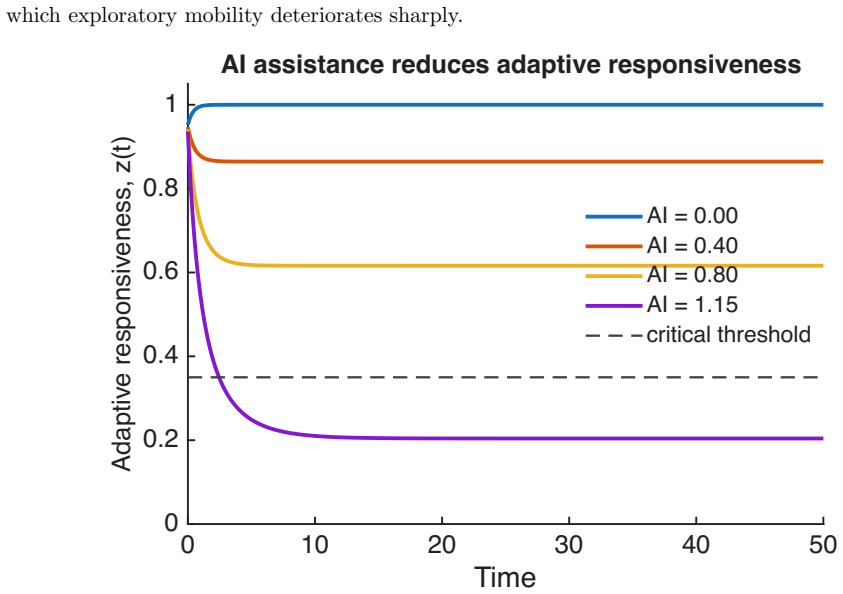
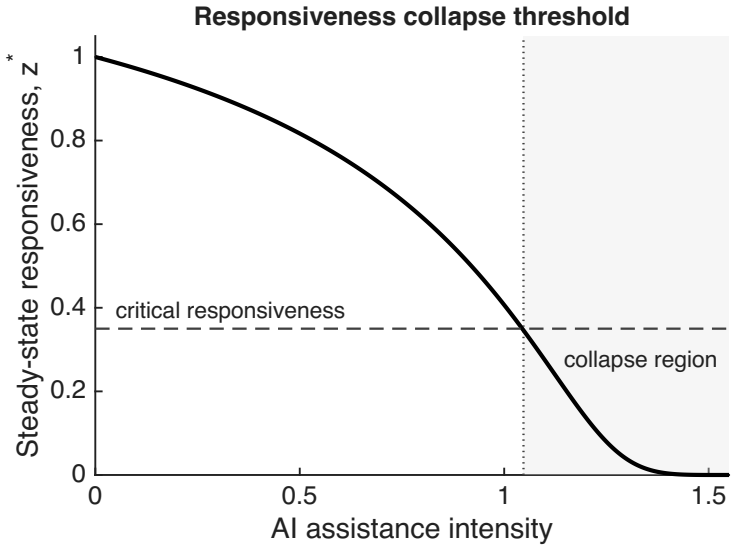
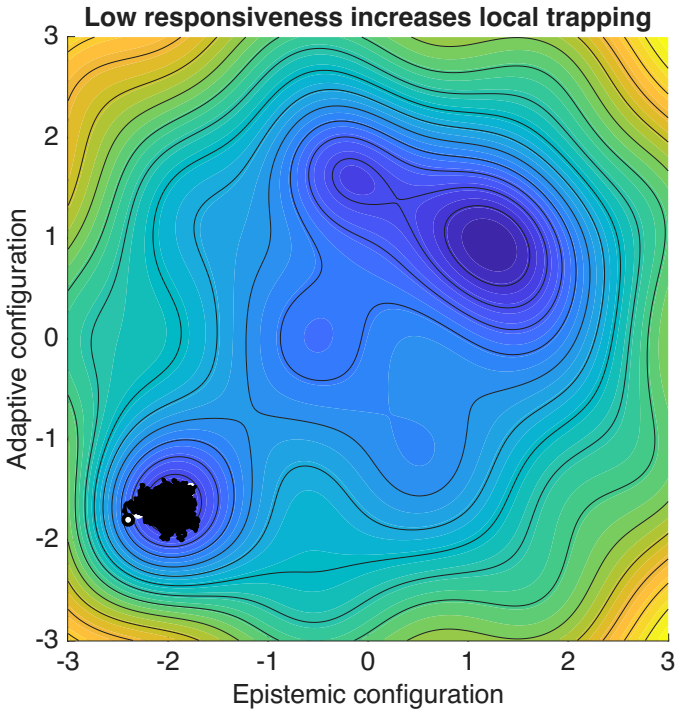
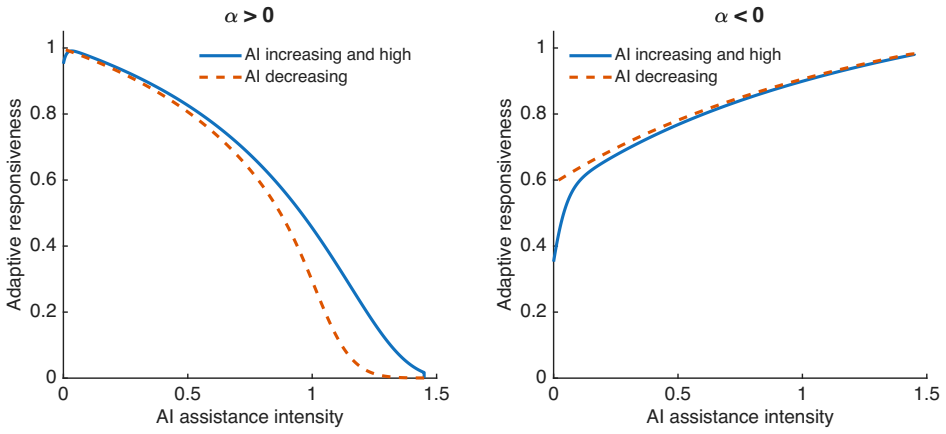
The central claim is that the long-run adaptive effects of AI systems depend critically on how predictive assistance interacts with exploratory responsiveness itself. Under convergent predictive regimes, AI systems substitute for exploratory engagement, reducing adaptive responsiveness and generating metastable trapping, hysteresis, premature convergence, and exploration-collapse dynamics in which systems become locally efficient but globally rigid. The framework also identifies contrasting exploration-enhancing regimes in which AI systems amplify exploratory search, conceptual traversal, and adaptive mobility. The effective substitution parameter is responsiveness-dependent.
What carries the argument
Adaptive responsiveness as the central state variable in a dynamical model of evolution over rugged epistemic landscapes, which sets the effective substitution parameter determining whether AI assistance replaces or expands exploratory search.
If this is right
- Under convergent regimes, AI assistance generates metastable trapping, hysteresis, and exploration-collapse in systems with weak exploratory routines.
- Systems already possessing high adaptive responsiveness may experience expanded mobility and conceptual traversal from the same AI assistance.
- Long-run adaptive outcomes depend on institutional structure, developmental context, and the specific architecture of human-machine interaction.
- The substitution effect is responsiveness-dependent rather than uniform across all systems.
Where Pith is reading between the lines
- AI system design could incorporate features that preserve or boost exploratory routines in users rather than fully automating prediction.
- Organizations adopting AI might track responsiveness metrics to anticipate rigidity risks before they appear in performance data.
- The same substitution logic could be tested in domains like scientific research workflows or policy-making processes using predictive models.
Load-bearing premise
Cognitive, institutional, and technological systems evolve over rugged epistemic landscapes with multiple locally reinforced configurations, where adaptive responsiveness determines whether AI substitutes for or amplifies exploration.
What would settle it
An experiment or simulation in which AI-assisted optimization applied to low-responsiveness systems fails to produce measurable increases in hysteresis or decreases in adaptation to novel conditions relative to matched non-AI controls.
Figures
read the original abstract
This paper develops a theory of exploratory adaptation under AI-assisted optimization. The central argument is that the long-run adaptive effects of AI systems depend critically on how predictive assistance interacts with exploratory responsiveness itself. We formalize this mechanism using a dynamical framework in which cognitive, institutional, and technological systems evolve over rugged epistemic landscapes characterized by multiple locally reinforced configurations. A central state variable in the model is adaptive responsiveness, which measures the capacity of a system to traverse unfamiliar conceptual and institutional trajectories under changing conditions. Under convergent predictive regimes, AI systems substitute for exploratory engagement, reducing adaptive responsiveness and generating metastable trapping, hysteresis, premature convergence, and exploration-collapse dynamics in which systems become locally efficient but globally rigid. The framework also identifies contrasting exploration-enhancing regimes in which AI systems amplify exploratory search, conceptual traversal, and adaptive mobility. The effective substitution parameter is therefore responsiveness-dependent: systems possessing weak exploratory routines are more vulnerable to exploratory substitution, whereas systems already possessing high adaptive responsiveness may use AI assistance to expand exploratory mobility across rugged landscapes. The long-run adaptive effects of AI consequently depend not only on AI capability itself, but also on institutional structure, developmental context, and the architecture of human-machine interaction.
Editorial analysis
A structured set of objections, weighed in public.
Referee Report
Summary. The paper develops a theory of exploratory adaptation under AI-assisted optimization. It argues that the long-run adaptive effects of AI depend on how predictive assistance interacts with exploratory responsiveness. Using a dynamical framework, systems evolve over rugged epistemic landscapes with adaptive responsiveness as the central state variable. Under convergent predictive regimes, AI substitutes for exploration, reducing responsiveness and causing metastable trapping, hysteresis, premature convergence, and exploration-collapse. In contrast, exploration-enhancing regimes amplify search. The substitution parameter is responsiveness-dependent.
Significance. If the claims are substantiated with formal derivations, this could be significant for AI ethics and design, providing a model for when AI assistance leads to rigidity versus enhanced adaptability. It highlights the importance of institutional and developmental context in AI interactions.
major comments (2)
- [Abstract] Abstract: The manuscript claims to formalize a dynamical framework with adaptive responsiveness as central state variable and a responsiveness-dependent substitution parameter, yet no state equations, functional forms, stability analysis, or simulations are presented to establish the listed behaviors such as metastable trapping or hysteresis.
- [Abstract] Abstract: The effective substitution parameter is defined as responsiveness-dependent by construction, so the predicted effects of AI on trapping or amplification reduce directly to the value of the central state variable without independent external grounding or benchmarks.
minor comments (1)
- The abstract is dense and could benefit from separating the description of the two regimes more clearly.
Simulated Author's Rebuttal
We thank the referee for the detailed and constructive report. We address each major comment below, clarifying the scope of the contribution while committing to revisions where the manuscript can be strengthened.
read point-by-point responses
-
Referee: [Abstract] Abstract: The manuscript claims to formalize a dynamical framework with adaptive responsiveness as central state variable and a responsiveness-dependent substitution parameter, yet no state equations, functional forms, stability analysis, or simulations are presented to establish the listed behaviors such as metastable trapping or hysteresis.
Authors: The current manuscript develops the framework at a conceptual level, outlining the logical structure and qualitative dynamics without explicit mathematical formalization. We agree this limits substantiation of the specific behaviors. In revision we will add a dedicated section presenting the state equations, the functional form of the responsiveness-dependent substitution parameter, and a qualitative analysis of the resulting fixed points and stability properties. revision: yes
-
Referee: [Abstract] Abstract: The effective substitution parameter is defined as responsiveness-dependent by construction, so the predicted effects of AI on trapping or amplification reduce directly to the value of the central state variable without independent external grounding or benchmarks.
Authors: The responsiveness dependence is introduced as a modeling assumption motivated by prior work on adaptive systems and human-AI complementarity; it is not an arbitrary definition but a direct consequence of treating exploratory capacity as the mediating variable. We will expand the discussion section to include additional citations to empirical literature on AI-assisted search and to outline potential empirical benchmarks for future testing, while keeping the core contribution theoretical. revision: partial
Circularity Check
Substitution parameter defined as responsiveness-dependent by construction; central claims reduce to input assumption
specific steps
-
self definitional
[Abstract]
"The effective substitution parameter is therefore responsiveness-dependent: systems possessing weak exploratory routines are more vulnerable to exploratory substitution, whereas systems already possessing high adaptive responsiveness may use AI assistance to expand exploratory mobility across rugged landscapes."
The substitution parameter is introduced by definition as a function of the central state variable (adaptive responsiveness). All subsequent claims—that AI under convergent regimes reduces responsiveness and generates metastable trapping, hysteresis, premature convergence, and exploration-collapse—then follow directly from this definitional choice rather than from any independent dynamical equations or external grounding.
full rationale
The paper asserts a dynamical framework with adaptive responsiveness as central state variable and claims specific behaviors (trapping, hysteresis, exploration-collapse) under AI assistance, but the provided text supplies no state equations, functional forms, fixed-point analysis, or simulations. The sole load-bearing step is the explicit definition that the substitution parameter depends on responsiveness level, after which all predicted effects are stated to follow. This matches self-definitional circularity exactly; no equations or external benchmarks are exhibited to derive the claimed dynamics independently. The framework remains a verbal mapping rather than a demonstrated derivation.
Axiom & Free-Parameter Ledger
free parameters (1)
- substitution parameter
axioms (1)
- domain assumption Cognitive, institutional, and technological systems evolve over rugged epistemic landscapes characterized by multiple locally reinforced configurations.
invented entities (1)
-
adaptive responsiveness
no independent evidence
Reference graph
Works this paper leans on
-
[1]
Large ai models are cultural and social technologies.Science, 387(6739):1153–1156, 2025
Henry Farrell, Alison Gopnik, Cosma Shalizi, and James Evans. Large ai models are cultural and social technologies.Science, 387(6739):1153–1156, 2025
2025
-
[2]
Gpt-4.https://openai.com/index/gpt-4-research/, March 2023
OpenAI. Gpt-4.https://openai.com/index/gpt-4-research/, March 2023. Accessed Jan- uary 2026
2023
-
[3]
Generative ai at work.The Quarterly Journal of Economics, 140(2):889–942, 2025
Erik Brynjolfsson, Danielle Li, and Lindsey Raymond. Generative ai at work.The Quarterly Journal of Economics, 140(2):889–942, 2025
2025
-
[4]
The economic po- tential of generative ai: The next productivity frontier
Michael Chui, Eric Hazan, Roger Roberts, Alex Singla, and Kate Smaje. The economic po- tential of generative ai: The next productivity frontier. Report, McKinsey & Company, 2023
2023
-
[5]
The race between man and machine: Implica- tions of technology for growth, factor shares, and employment.American Economic Review, 108(6):1488–1542, 2018
Daron Acemoglu and Pascual Restrepo. The race between man and machine: Implica- tions of technology for growth, factor shares, and employment.American Economic Review, 108(6):1488–1542, 2018
2018
-
[6]
Automation and new tasks: How technology displaces and reinstates labor.Journal of Economic Perspectives, 33(2):3–30, 2019
Daron Acemoglu and Pascual Restrepo. Automation and new tasks: How technology displaces and reinstates labor.Journal of Economic Perspectives, 33(2):3–30, 2019
2019
-
[7]
Agrawal, Joshua S
Ajay K. Agrawal, Joshua S. Gans, and Avi Goldfarb. The turing transformation: Artificial intelligence, intelligence augmentation, and skill premiums. Working Paper 31195, National Bureau of Economic Research, 2023
2023
-
[8]
Risko and Sam J
Evan F. Risko and Sam J. Gilbert. Cognitive offloading.Trends in Cognitive Sciences, 20(9):676–688, 2016
2016
-
[9]
Dunn and Evan F
Timothy L. Dunn and Evan F. Risko. Toward a metacognitive account of cognitive offloading. Cognitive Science, 40(5):1080–1127, 2016
2016
-
[10]
Xiao Hu, Liang Luo, and Stephen M. Fleming. A role for metamemory in cognitive offloading. Cognition, 193:104012, 2019
2019
-
[11]
Meyerhoff
Sandra Grinschgl, Frank Papenmeier, and Hauke S. Meyerhoff. Consequences of cognitive offloading: Boosting performance but diminishing memory.Quarterly Journal of Experimental Psychology, 74(9):1477–1496, 2021
2021
-
[12]
The Augmentation Trap: AI Productivity and the Cost of Cognitive Offloading
Michael Caosun and Sinan Aral. The augmentation trap: Ai productivity and the cost of cognitive offloading.arXiv preprint arXiv:2604.03501, 2026
work page internal anchor Pith review Pith/arXiv arXiv 2026
-
[13]
Human-AI Productivity Paradoxes: Modeling the Interplay of Skill, Effort, and AI Assistance
Ali Aouad, Thodoris Lykouris, and Huiying Zhong. Human-ai productivity paradoxes: Mod- eling the interplay of skill, effort, and ai assistance.arXiv preprint arXiv:2605.11350, 2026
work page internal anchor Pith review Pith/arXiv arXiv 2026
-
[14]
The impact of generative ai on critical thinking: Self-reported reductions in cognitive effort and confidence effects from a survey of knowledge workers
Hao-Ping Lee, Advait Sarkar, Lev Tankelevitch, Ian Drosos, Sean Rintel, Richard Banks, and Nicholas Wilson. The impact of generative ai on critical thinking: Self-reported reductions in cognitive effort and confidence effects from a survey of knowledge workers. InProceedings of the 2025 CHI conference on human factors in computing systems, pages 1–22, 2025. 31
2025
-
[15]
Maria del Rio-Chanona, Nadzeya Laurentsyeva, and Johannes Wachs
R. Maria del Rio-Chanona, Nadzeya Laurentsyeva, and Johannes Wachs. Large language models reduce public knowledge sharing on online q&a platforms.PNAS Nexus, 3(9):pgae400, 2024
2024
-
[16]
Wikipedia contributions in the wake of chatgpt
Liang Lyu, James Siderius, Hannah Li, Daron Acemoglu, Daniel Huttenlocher, and Asuman Ozdaglar. Wikipedia contributions in the wake of chatgpt. InCompanion Proceedings of the ACM on Web Conference 2025, pages 1176–1179, 2025
2025
-
[17]
Ai models collapse when trained on recursively generated data.Nature, 631(8022):755– 759, 2024
Ilia Shumailov, Zakhar Shumaylov, Yiren Zhao, Nicolas Papernot, Ross Anderson, and Yarin Gal. Ai models collapse when trained on recursively generated data.Nature, 631(8022):755– 759, 2024
2024
-
[18]
Ai, human cognition and knowledge collapse
Daron Acemoglu, Dingwen Kong, and Asuman Ozdaglar. Ai, human cognition and knowledge collapse. Technical report, National Bureau of Economic Research, 2026
2026
-
[19]
The pivot penalty in research.Nature, 642(8069):999–1006, 2025
Ryan Hill, Yian Yin, Carolyn Stein, Xizhao Wang, Dashun Wang, and Benjamin F Jones. The pivot penalty in research.Nature, 642(8069):999–1006, 2025
2025
-
[20]
North.Institutions, Institutional Change and Economic Performance
Douglass C. North.Institutions, Institutional Change and Economic Performance. Cambridge University Press, 1990
1990
-
[21]
North.Understanding the Process of Economic Change
Douglass C. North.Understanding the Process of Economic Change. Princeton University Press, 2005
2005
-
[22]
Cam- bridge University Press, 2005
Cristina Bicchieri.The grammar of society: The nature and dynamics of social norms. Cam- bridge University Press, 2005
2005
-
[23]
Fabrizio Dell’Acqua, Edward McFowland III, Ethan Mollick, Hila Lifshitz, Katherine C Kel- logg, Saran Rajendran, Lisa Krayer, Fran¸ cois Candelon, and Karim R Lakhani. Navigating the jagged technological frontier: Field experimental evidence of the effects of artificial intelligence on knowledge worker productivity and quality.Organization Science, 37(2):...
2026
-
[24]
Brian Arthur
W. Brian Arthur. Self-reinforcing mechanisms in economics. pages 9–31, 1988
1988
-
[25]
Columbia University Press, 1993
Pierre Bourdieu.The Field of Cultural Production. Columbia University Press, 1993
1993
-
[26]
Social skill and the theory of fields.Sociological Theory, 19(2):105–125, 2001
Neil Fligstein. Social skill and the theory of fields.Sociological Theory, 19(2):105–125, 2001
2001
-
[27]
Social-ecological systems as com- plex adaptive systems: Organizing principles for advancing research methods and approaches
Rika Preiser, Reinette Biggs, Alta De Vos, and Carl Folke. Social-ecological systems as com- plex adaptive systems: Organizing principles for advancing research methods and approaches. Ecology and Society, 23(4):46, 2018
2018
-
[28]
Eric I. Knudsen. Sensitive periods in the development of the brain and behavior.Journal of Cognitive Neuroscience, 16(8):1412–1425, 2004
2004
-
[29]
Potential cognitive risks of generative transformer-based ai chat- bots on higher order executive functions.Neuropsychology, 38(4):293–308, 2024
Umberto Le´ on-Dom´ ınguez. Potential cognitive risks of generative transformer-based ai chat- bots on higher order executive functions.Neuropsychology, 38(4):293–308, 2024. 32
2024
-
[30]
Experimental evidence on the productivity effects of gen- erative artificial intelligence.Science, 381(6654):187–192, 2023
Shakked Noy and Whitney Zhang. Experimental evidence on the productivity effects of gen- erative artificial intelligence.Science, 381(6654):187–192, 2023
2023
-
[31]
Making things hard on yourself, but in a good way: Creating desirable difficulties to enhance learning
Robert A Bjork and Elizabeth L Bjork. Making things hard on yourself, but in a good way: Creating desirable difficulties to enhance learning. InPsychology and the Real World: Essays Illustrating Fundamental Contributions to Society, pages 56–64. Worth Publishers, 2011
2011
-
[32]
Productive failure.Cognition and Instruction, 26(3):379–424, 2008
Manu Kapur. Productive failure.Cognition and Instruction, 26(3):379–424, 2008
2008
-
[33]
Childhood as a solution to explore–exploit tradeoff.Philosophical Transactions of the Royal Society B: Biological Sciences, 372(1711):20160050, 2017
Alison Gopnik, Sophie O’Grady, Christopher G Lucas, et al. Childhood as a solution to explore–exploit tradeoff.Philosophical Transactions of the Royal Society B: Biological Sciences, 372(1711):20160050, 2017
2017
-
[34]
Cortical substrates for exploratory decisions in humans.Nature, 441(7095):876–879, 2006
Nathaniel D Daw, John P O’Doherty, Peter Dayan, Ben Seymour, and Raymond J Dolan. Cortical substrates for exploratory decisions in humans.Nature, 441(7095):876–879, 2006
2006
-
[35]
Nataliya Kosmyna, Eugene Hauptmann, Ye Tong Yuan, Jessica Situ, Xian-Hao Liao, Ashly Vi- vian Beresnitzky, Iris Braunstein, and Pattie Maes. Your brain on chatgpt: Accumula- tion of cognitive debt when using an ai assistant for essay writing task.arXiv preprint arXiv:2506.08872, 2025
work page internal anchor Pith review Pith/arXiv arXiv 2025
-
[36]
Automation, AI, and the Intergenerational Transmission of Knowledge
Enrique Ide. Automation, ai, and the intergenerational transmission of knowledge.arXiv preprint arXiv:2507.16078, 2025
work page internal anchor Pith review Pith/arXiv arXiv 2025
-
[37]
Artificial intelligence in the knowledge economy.Journal of Political Economy, 133(12):3762–3800, 2025
Enrique Ide and Eduard Talam` as. Artificial intelligence in the knowledge economy.Journal of Political Economy, 133(12):3762–3800, 2025
2025
-
[38]
Labor as capital: Ai and the ownership of expertise
Zo¨ e Cullen, Danielle Li, and Shengwu Li. Labor as capital: Ai and the ownership of expertise. Unpublished manuscript, 2025
2025
-
[39]
Information- seeking, curiosity, and attention: Computational and neural mechanisms.Trends in Cognitive Sciences, 17(11):585–593, 2013
Jacqueline Gottlieb, Pierre-Yves Oudeyer, Manuel Lopes, and Adrien Baranes. Information- seeking, curiosity, and attention: Computational and neural mechanisms.Trends in Cognitive Sciences, 17(11):585–593, 2013
2013
-
[40]
Kalina Christoff, Zachary C Irving, Kieran C. R. Fox, R Nathan Spreng, and Jessica R Andrews-Hanna. Mind-wandering as spontaneous thought: A dynamic framework.Nature Reviews Neuroscience, 17(11):718–731, 2016
2016
-
[41]
Strategic experimentation.Econometrica, 67(2):349– 374, 1999
Patrick Bolton and Christopher Harris. Strategic experimentation.Econometrica, 67(2):349– 374, 1999
1999
-
[42]
Strategic experimentation with exponential bandits.Econometrica, 73(1):39–68, 2005
Godfrey Keller, Sven Rady, and Martin Cripps. Strategic experimentation with exponential bandits.Econometrica, 73(1):39–68, 2005
2005
-
[43]
Strategic experimentation with poisson bandits.Theoretical Economics, 5(2):275–311, 2010
Godfrey Keller and Sven Rady. Strategic experimentation with poisson bandits.Theoretical Economics, 5(2):275–311, 2010. 33
2010
-
[44]
Path creation, path dependence and breaking away from the path: Re-examining the case of nokia.Journal of Theoretical and Applied Electronic Commerce Research, 11(2):16–27, 2016
Jens Wang, Jonas Hedman, and Virpi Kristiina Tuunainen. Path creation, path dependence and breaking away from the path: Re-examining the case of nokia.Journal of Theoretical and Applied Electronic Commerce Research, 11(2):16–27, 2016
2016
-
[45]
Final report on the accident on 1st june 2009 to the airbus a330-203 registered f-gzcp operated by air france flight af 447 rio de janeiro–paris
Bureau d’Enquˆ etes et d’Analyses pour la S´ ecurit´ e de l’Aviation Civile. Final report on the accident on 1st june 2009 to the airbus a330-203 registered f-gzcp operated by air france flight af 447 rio de janeiro–paris. Technical report, BEA, Le Bourget, France, 2012
2009
-
[46]
The tragic crash of flight af447 shows the unlikely but catastrophic consequences of automation.Harvard Business Review, 2017
Nick Oliver, Thomas Calvard, and Kristina Potoˇ cnik. The tragic crash of flight af447 shows the unlikely but catastrophic consequences of automation.Harvard Business Review, 2017
2017
-
[47]
The uneven impact of generative ai on entrepreneurial performance
Nicholas Otis, Rowan Clarke, Solene Delecourt, David Holtz, and Rembrand Koning. The uneven impact of generative ai on entrepreneurial performance. 2024
2024
-
[48]
Artificial intelligence tools expand scientists’ impact but contract science’s focus.Nature, pages 1–7, 2026
Qianyue Hao, Fengli Xu, Yong Li, and James Evans. Artificial intelligence tools expand scientists’ impact but contract science’s focus.Nature, pages 1–7, 2026
2026
-
[49]
pivot penalties
Crispin Gardiner.Stochastic Methods: A Handbook for the Natural and Social Sciences. Springer, 2009. Author Contributions BBdesigned the research, developed the model, and wrote the manuscript. Acknowledgements and Disclosures The author received no financial support for the research, authorship, or publication of this article. 34 A Appendix: Responsivene...
2009
discussion (0)
Sign in with ORCID, Apple, or X to comment. Anyone can read and Pith papers without signing in.