REVIEW 3 major objections 4 minor 142 references
Advancing Frontiers of Path Integral Theory for Stochastic Optimal Control
T0 review · 3 major / 4 minor · reviewed 2026-08-16 · deepseek-v4-flash
Pith's one-line read The dissertation's central claim is that a chance-constrained stochastic optimal control problem can be solved with zero duality gap by dual ascent whose gradient is a Monte Carlo estimate of failure probability, and that the same path…
desk verdict A competent compilation of already-published path integral control results, with one genuinely interesting chance-constrained duality claim that hinges on an assumption the dissertation itself labels a conjecture. read the letter →
The pith
A machine-rendered reading of the paper's core claim, the machinery that carries it, and where it could break.
The reading
What carries the argument
The load-bearing object is the Feynman-Kac representation of the exponentiated value function, $\xi(x,t;\eta) = \mathbb{E}\left[\exp\left(-\frac{1}{\lambda}\left(\phi(\hat{x}(\hat{t}_f);\eta) + \int_{t}^{\hat{t}_f} V(\hat{x}(r),r)\,dr\right)\right)\right]$, where the expectation is over trajectories of the uncontrolled system and $\phi$ encodes the terminal cost plus the chance-constraint penalty $\eta \cdot \mathbf{1}_{x(t_f)\in\partial X_s}$. With the noise-control alignment condition $\Sigma\Sigma^\top = \lambda G R^{-1} G^\top$, this linearizes the HJB equation. The optimal control is $u^*(x,t;\eta) = -R^{-1}G^\top \partial_x J(x,t;\eta)$ with $J = -\lambda \log \xi$, and the failure probability is estimated by reweighting uncontrolled sample paths by the same exponentiated cost, an importance-sampling step. Dual ascent on $\eta$ uses that estimated failure probability as the gradient.
What would settle it
Take a simple two-dimensional robot navigation model satisfying Assumptions 1 and 2, compute $u^*(\cdot;\eta)$ and its Monte Carlo failure probability over a fine grid of $\eta$ values, and look for a jump discontinuity in $\eta \mapsto P_{\mathrm{fail}}(x_0,t_0,u^*(\cdot;\eta))$; such a discontinuity would break the complementary-slackness step and could make dual ascent terminate at an infeasible or suboptimal policy.
Extended reading notes
Core claim
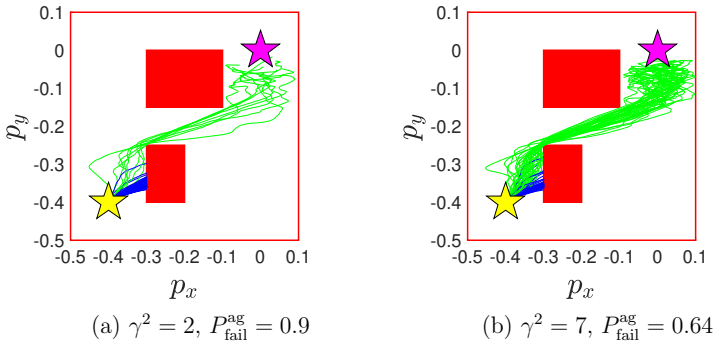
The paper's main claim is Theorem 3: for a control-affine stochastic system whose noise enters through the control channels, if the chance-constrained problem is strictly feasible and the map from the penalty weight $\eta$ to the failure probability of the resulting optimal policy is continuous, then the dual optimum equals the primal optimum. The optimal policy of the soft-constrained dual problem at the right $\eta^*$ is optimal for the original chance-constrained problem. Because the dual objective is evaluated by Feynman-Kac expectations over uncontrolled trajectories and the failure probability by importance sampling, the whole loop—update $\eta$, resample, recompute the policy—can run online. The dissertation also claims analogous path integral solutions for saddle-point policies in zero-sum stochastic differential games, KL-divergence-minimizing deceptive policies, task hierarchies combining simple and optimal controllers, and risk mitigation of stealthy attacks, plus a sample-complexity bound for discrete-time LQR.
Load-bearing premise
The load-bearing premise is that the failure probability of the optimal policy, viewed as a function of the penalty weight $\eta$, is continuous; the paper labels this assumption a conjecture and defers its proof.
Editorial extensions
If this is right
- Chance-constrained motion planning in four- and five-dimensional robot models can be solved online with Monte Carlo rollouts, where grid-based PDE solvers become impractical.
- Saddle-point policies for zero-sum stochastic differential games, including disturbance attenuation and pursuit-evasion, can be computed by the same uncontrolled-trajectory expectations without offline training.
- A deceptive agent can hide deviations from a supervisor by sampling control actions proportional to exponentiated path costs under the reference policy; as the number of samples grows, the sampled actions converge to the optimal deceptive distribution.
- Null-space projection lets a robot execute simple PD-controlled tasks and a path integral-controlled task simultaneously, avoiding local minima that pure PD hierarchies exhibit.
- For discrete-time stochastic LQR, the required number of Monte Carlo samples grows logarithmically in the control-input dimension, in contrast to the exponential growth of exact dynamic programming.
Reading between the lines
- If the continuity assumption behind Theorem 3 holds broadly, the dual-ascent loop becomes a general-purpose safety-constrained solver: hard failure-probability constraints reduce to a one-dimensional search over $\eta$, and the same estimator could be reused for chance-constrained games, which the paper lists as future work.
- The continuity conjecture might be provable from stability of Dirichlet boundary-value problems: if the boundary data $\phi(\cdot;\eta)$ depends continuously on $\eta$ and the linearized PDE has a stable solution, then $P_{\mathrm{fail}}$ would inherit that continuity; a counterexample would require a genuine phase transition in exit probabilities.
- The importance-sampling estimator for $P_{\mathrm{fail}}$ doubles as a stochastic gradient of the dual function, so variance-reduction techniques could yield stronger convergence guarantees for dual ascent than the paper's fixed-step-size update.
- Because the Bretagnolle-Huber inequality is distribution-free, the deception and stealthy-attack results suggest a general template: any task cost can be made stealthy by exponential reweighting under a nominal policy, connecting path integral control to hypothesis testing in continuous spaces.
Signed reviews
Editorial analysis
A structured set of objections, weighed in public.
Referee Report
Summary. The dissertation develops sampling-based ('path integral') methods for six classes of stochastic optimal control problems. Chapter 2 formulates a continuous-time chance-constrained SOC problem, derives a Lagrangian dual whose inner subproblem is an HJB PDE, linearizes the PDE under Assumption 1 (ΣΣᵀ = λ G R⁻¹ Gᵀ), and proposes a Monte Carlo dual-ascent algorithm (Algorithm 1). The central theoretical claim is Theorem 3: under Assumptions 1–3, the duality gap is zero and the dual-ascent policy u*(·;η*) is primal optimal. Chapter 3 extends the framework to two-player zero-sum differential games with a risk-minimizing cost, deriving saddle-point policies from an HJI PDE under Assumption 4. Chapter 4 combines null-space projection with path integral control for hierarchical task control. Chapter 5 formulates deceptive control as a KL-control problem and proposes a weighted-sampling algorithm under deterministic state dynamics. Chapter 6 applies the framework to stealthy attack synthesis and mitigation, and Chapter 7 is announced as a discrete-time LQR treatment with sample complexity analysis but is not present in the submitted text.
Significance. If the assumptions that the central results require are supplied, the chance-constrained result would be a substantial contribution: it offers a sampler-only alternative to grid-based PDE methods for a non-convex constrained problem, is supported by an open-source implementation, and is demonstrated on 4D and 5D systems where finite differences are impractical. The game-theoretic, hierarchical, and deception chapters also translate known linearizability conditions into concrete Monte Carlo algorithms, and the derivations are largely self-contained, starting from the HJB/HJI PDE and the Feynman-Kac representation rather than fitting constants to target outcomes. The main advertised claim, however, is explicitly conditional on a continuity assumption that the manuscript itself labels a conjecture, and two of the core proofs are either deferred to an unavailable appendix or omitted for brevity.
major comments (3)
- [§2.6.2 (Assumption 3; Theorem 3)] The zero-duality-gap claim is conditional on an unproved continuity assumption that the manuscript itself labels a conjecture and defers to future work (§2.9). This is not a routine regularity check: η enters the boundary data of the dual HJB PDE, and Pfail is an exit probability of the resulting diffusion. If η ↦ Pfail(x0,t0,u*(·;η)) has a jump, the complementary slackness statements (a)–(b) need not hold, and Algorithm 1 could terminate at a policy that is either infeasible or suboptimal. Since Theorem 3 is the main advertised contribution, the proof of Assumption 3 must be supplied, or the theorem must be explicitly stated as conditional. The proof of Theorem 3 is also deferred to Lemma 4 in Appendix A.1, and the appendix content is not included in the submitted text, so the argument cannot be checked.
- [§2.5.2 footnote; Theorem 2] The exact indicator terminal cost φ(x;η) = ψ(x)1_{x∈Xs} + η1_{x∈∂Xs} − ηΔ is approximated by a smooth bump function for PDE regularity, yet Theorem 2 asserts existence and uniqueness of the value function for the exact problem, and Theorems 1–3 are stated for the exact indicator. The manuscript does not state regularity conditions under which the linearized PDE has a classical solution for the discontinuous indicator data, nor does it explain how the bump approximation affects the chance constraint or the duality gap. This matters because Algorithm 1 estimates Pfail using the exact indicator, so the theory must be reconciled with the numerical object being evaluated.
- [§3.4.2 (Theorem 8)] The proof of Theorem 8 does not contain the derivation of the saddle-point policies (3.25)–(3.26); it states that the derivation is 'in the same vein' as single-agent settings and omits it. Because these formulas are the main output of Chapter 3, the derivation must be included or a precise external reference with matching assumptions must be supplied. In addition, Remark 3 disclaims existence for the HJI boundary-value problem, which creates tension with Theorem 8's assertion of existence and uniqueness of the saddle-point solution.
minor comments (4)
- [§3.5.1 and §3.5.2] The text twice refers to 'Assumption 1' when the relevant assumption for Chapter 3 is Assumption 4; for example, 'Assumption 1 is satisfied' should read 'Assumption 4 is satisfied'.
- [Throughout] Typos and wording: 'Feyman-Kac' in §2.6.1 should be 'Feynman-Kac'; 'Bratagnolle-Huber' in §5.4 should be 'Bretagnolle–Huber'; 'exits' in §3.4.2 should be 'exists'; 'the the' appears in §2.5.2; and 'Kullback-Leibler (KL) divergence' is sometimes rendered with inconsistent hyphenation.
- [§2.6.3.2 (Theorem 5)] The importance-sampling likelihood ratio expression is written ambiguously: it should be dQ*/dP ≈ (r(i)/r)/(1/N) = N r(i)/r, followed by Pfail ≈ Σ_i (r(i)/r)1_{x(i)(tf)∈∂Xs}. The missing parentheses make the proof hard to follow.
- [Chapter 7] Chapter 7 is listed in the abstract and table of contents as containing a discrete-time LQR path integral solution and a sample complexity analysis, but no content of that chapter is present in the submitted text. The sample complexity claim in the abstract therefore cannot be verified.
Circularity Check
No significant circularity: the derivations are self-contained, proceeding from stated HJB/HJI PDEs and Feynman-Kac representations without fitting parameters to target results; the main caveat is an explicitly conjectured regularity assumption, which is a gap rather than a circular step.
full rationale
The paper's derivation chain is self-contained in the sense required by the circularity analysis. Chapter 2 constructs the dual function by solving the HJB PDE (2.15), linearizes it under the explicitly stated Assumption 1 via the transformation (2.26), uses the Feynman-Kac representation (2.29), and evaluates the dual ascent updates from Monte Carlo estimates of the failure probability; no parameter is fitted to the claimed zero-duality-gap result, and the path-integral solutions are compared against an independent finite-difference baseline in Section 2.7.1. Chapter 3 follows the same structure from the HJI PDE (3.8) under Assumption 4, with existence and uniqueness delegated to standard PDE theory (Friedman) rather than to the author's own work. Chapters 4, 5, and 7 apply the same Feynman-Kac / KL-control machinery with explicit linearizability and stochasticity assumptions; the optimal policies are derived from the stated cost and dynamics, not from the simulation outputs. The principal caveat is Theorem 3, whose strong-duality conclusion depends on Assumption 3, the continuity of eta -> Pfail(x0,t0,u*(.;eta)). The text explicitly says: 'We conjecture that this assumption is valid under mild conditions; a formal analysis is postponed as future work' (Section 2.6.2), and Section 2.9 repeats that proving it is future work. This is an unproved premise or correctness gap, not a circular reduction: the assumption does not assert the theorem's conclusion, and the theorem is not used to define the assumption. Likewise, Remark 3 in Chapter 3 and the omitted derivation in Theorem 8 are omissions, not circularity. The paper contains self-citations (e.g., Patil et al. 2022, 2024, 2023a), but none is load-bearing: the Feynman-Kac representation is a standard external result, the sample-complexity remarks are peripheral, and the linearizability conditions are stated and used explicitly rather than imported as unexamined ansatzes. The simulations in Chapter 2 compare against FDM, and Chapter 7 compares against the Riccati solution, providing external benchmarks. Accordingly, no specific reduction of a claimed prediction to its own inputs can be exhibited, and the appropriate finding is no significant circularity.
Assumptions & free parameters
free parameters (4)
- lambda (PDE linearizing constant) =
varies per problem; e.g. lambda = 1/(1 - 1/gamma^2), lambda = 1/(1 - 1/rv^2)
- alpha (control cost weight in task hierarchy) =
10
- s-hat (diffusion coefficient in task hierarchy) =
0.1
- lambda (KL weighting in deceptive control) =
3, 2, 0.5 in simulations
assumptions (10)
- standard math Feynman-Kac lemma
- standard math Ito formula and Dynkin's formula
- standard math Strong law of large numbers
- standard math Girsanov theorem and Radon-Nikodym likelihood ratios
- standard math Legendre duality between KL divergence and free energy
- ad hoc to paper Assumption 1: Sigma Sigma^T = lambda G R^{-1} G^T
- domain assumption Assumption 2: strict feasibility (Slater-like condition)
- ad hoc to paper Assumption 3: continuity of eta -> Pfail(u*(.; eta))
- ad hoc to paper Assumption 4: Sigma Sigma^T = lambda (Gu Ru^{-1} Gu^T - Gv Rv^{-1} Gv^T)
- ad hoc to paper Assumption 5: deterministic state transition law in deception
Cite this review
Pith. "Pith review of Advancing Frontiers of Path Integral Theory for Stochastic Optimal Control." pith.science (2026). https://pith.science/paper/WLT6CDSY
@misc{pith2026250417154,
  author       = {Pith},
  title        = {Pith review of: Advancing Frontiers of Path Integral Theory for Stochastic Optimal Control},
  year         = {2026},
  howpublished = {\url{https://pith.science/paper/WLT6CDSY}},
  note         = {Machine review of arXiv:2504.17154}
}
read the original abstract
Stochastic Optimal Control (SOC) problems arise in systems influenced by uncertainty, such as autonomous robots or financial models. Traditional methods like dynamic programming are often intractable for high-dimensional, nonlinear systems due to the curse of dimensionality. This dissertation explores the path integral control framework as a scalable, sampling-based alternative. By reformulating SOC problems as expectations over stochastic trajectories, it enables efficient policy synthesis via Monte Carlo sampling and supports real-time implementation through GPU parallelization. We apply this framework to six classes of SOC problems: Chance-Constrained SOC, Stochastic Differential Games, Deceptive Control, Task Hierarchical Control, Risk Mitigation of Stealthy Attacks, and Discrete-Time LQR. A sample complexity analysis for the discrete-time case is also provided. These contributions establish a foundation for simulator-driven autonomy in complex, uncertain environments.
Figures


Figures from the paper (35 more)






Reference graph
Works this paper leans on
-
[1]
Model-based generalization under parameter uncertainty using path integral control
Ian Abraham, Ankur Handa, Nathan Ratliff, Kendall Lowrey, Todd D Murphey, and Dieter Fox. Model-based generalization under parameter uncertainty using path integral control. IEEE Robotics and Automation Letters, 5 0 (2): 0 2864--2871, 2020
2020
-
[2]
Entropic value-at-risk: A new coherent risk measure
Amir Ahmadi-Javid. Entropic value-at-risk: A new coherent risk measure. Journal of Optimization Theory and Applications, 155: 0 1105--1123, 2012
2012
-
[3]
Real-time whole-body control of legged robots with model-predictive path integral control
Juan Alvarez-Padilla, John Z Zhang, Sofia Kwok, John M Dolan, and Zachary Manchester. Real-time whole-body control of legged robots with model-predictive path integral control. arXiv preprint arXiv:2409.10469, 2024
arXiv 2024
-
[4]
Stability analysis for prioritized closed-loop inverse kinematic algorithms for redundant robotic systems
Gianluca Antonelli. Stability analysis for prioritized closed-loop inverse kinematic algorithms for redundant robotic systems. IEEE Transactions on Robotics, 25 0 (5): 0 985--994, 2009
2009
-
[5]
The null-space-based behavioral control for autonomous robotic systems
Gianluca Antonelli, Filippo Arrichiello, and Stefano Chiaverini. The null-space-based behavioral control for autonomous robotic systems. Intelligent Service Robotics, 1: 0 27--39, 2008
2008
-
[6]
Prioritized closed-loop inverse kinematic algorithms for redundant robotic systems with velocity saturations
Gianluca Antonelli, Giovanni Indiveri, and Stefano Chiaverini. Prioritized closed-loop inverse kinematic algorithms for redundant robotic systems with velocity saturations. In 2009 IEEE/RSJ International Conference on Intelligent Robots and Systems, pages 5892--5897. IEEE, 2009
2009
-
[7]
Information-theoretic stochastic optimal control via incremental sampling-based algorithms
Oktay Arslan, Evangelos A Theodorou, and Panagiotis Tsiotras. Information-theoretic stochastic optimal control via incremental sampling-based algorithms. In 2014 IEEE Symposium on Adaptive Dynamic Programming and Reinforcement Learning (ADPRL), pages 1--8. IEEE, 2014
2014
-
[8]
Coherent measures of risk
Philippe Artzner, Freddy Delbaen, Jean-Marc Eber, and David Heath. Coherent measures of risk. Mathematical finance, 9 0 (3): 0 203--228, 1999
1999
Show all 142 references
-
[9]
Data-injection attacks in stochastic control systems: Detectability and performance tradeoffs
Cheng-Zong Bai, Fabio Pasqualetti, and Vijay Gupta. Data-injection attacks in stochastic control systems: Detectability and performance tradeoffs. Automatica, 82: 0 251--260, 2017
2017
-
[10]
H-infinity optimal control and related minimax design problems: a dynamic game approach
Tamer Ba s ar and Pierre Bernhard. H-infinity optimal control and related minimax design problems: a dynamic game approach. Springer Science & Business Media, 2008
2008
-
[11]
Dynamic noncooperative game theory
Tamer Ba s ar and Geert Jan Olsder. Dynamic noncooperative game theory. SIAM, 1998
1998
-
[12]
Dynamic programming and optimal control: Volume I, volume 1
Dimitri Bertsekas. Dynamic programming and optimal control: Volume I, volume 1. Athena scientific, 2012
2012
-
[13]
Nonlinear programming
Dimitri P Bertsekas. Nonlinear programming. Journal of the Operational Research Society, 48 0 (3): 0 334--334, 1997
1997
-
[14]
Bertsekas and S.E
D.P. Bertsekas and S.E. Shreve. Stochastic Optimal Control: The Discrete-Time Case. Athena Scientific, 1996
1996
-
[15]
Storm: An integrated framework for fast joint-space model-predictive control for reactive manipulation
Mohak Bhardwaj, Balakumar Sundaralingam, Arsalan Mousavian, Nathan D Ratliff, Dieter Fox, Fabio Ramos, and Byron Boots. Storm: An integrated framework for fast joint-space model-predictive control for reactive manipulation. In Conference on Robot Learning, pages 750--759. PMLR, 2022
2022
-
[16]
Chance-constrained optimal path planning with obstacles
Lars Blackmore, Masahiro Ono, and Brian C Williams. Chance-constrained optimal path planning with obstacles. IEEE Transactions on Robotics, 27 0 (6): 0 1080--1094, 2011
2011
-
[17]
Markov processes and potential theory
Robert McCallum Blumenthal and Ronald Kay Getoor. Markov processes and potential theory. Courier Corporation, 2007
2007
-
[18]
A variational representation for certain functionals of Brownian motion
Michelle Bou \'e and Paul Dupuis. A variational representation for certain functionals of Brownian motion. The Annals of Probability, 26 0 (4): 0 1641--1659, 1998
1998
-
[19]
Convex optimization
Stephen P Boyd and Lieven Vandenberghe. Convex optimization. Cambridge university press, 2004
2004
-
[20]
Estimation des densit \'e s: risque minimax
Jean Bretagnolle and Catherine Huber. Estimation des densit \'e s: risque minimax. S \'e minaire de probabilit \'e s de Strasbourg , 12: 0 342--363, 1978
1978
-
[21]
Risk sensitive path integral control
Bart van den Broek, Wim Wiegerinck, and Hilbert Kappen. Risk sensitive path integral control. arXiv preprint arXiv:1203.3523, 2012
2012 arXiv
-
[22]
The scenario approach to robust control design
Giuseppe Carlo Calafiore and Marco C Campi. The scenario approach to robust control design. IEEE Transactions on automatic control, 51 0 (5): 0 742--753, 2006
2006
-
[23]
Constrained stochastic optimal control with learned importance sampling: A path integral approach
Jan Carius, Ren \'e Ranftl, Farbod Farshidian, and Marco Hutter. Constrained stochastic optimal control with learned importance sampling: A path integral approach. The International Journal of Robotics Research, 41 0 (2): 0 189--209, 2022
2022
-
[24]
Safe control in the presence of stochastic uncertainties
Albert Chern, Xiang Wang, Abhiram Iyer, and Yorie Nakahira. Safe control in the presence of stochastic uncertainties. In 2021 60th IEEE Conference on Decision and Control (CDC), pages 6640--6645. IEEE, 2021
2021
-
[25]
Elements of information theory
Thomas M Cover. Elements of information theory. John Wiley & Sons, 1999
1999
-
[26]
Generalized N eyman- P earson lemma via convex duality
Jak s a Cvitani \'c and Ioannis Karatzas. Generalized N eyman- P earson lemma via convex duality. Bernoulli, pages 79--97, 2001
2001
-
[27]
Scenario-based trajectory optimization in uncertain dynamic environments
Oscar de Groot, Bruno Brito, Laura Ferranti, Dariu Gavrila, and Javier Alonso-Mora. Scenario-based trajectory optimization in uncertain dynamic environments. IEEE Robotics and Automation Letters, 6 0 (3): 0 5389--5396, 2021
2021
-
[28]
An overview of null space projections for redundant, torque-controlled robots
Alexander Dietrich, Christian Ott, and Alin Albu-Sch \"a ffer. An overview of null space projections for redundant, torque-controlled robots. The International Journal of Robotics Research, 34 0 (11): 0 1385--1400, 2015
2015
-
[29]
Risk-averse receding horizon motion planning
Anushri Dixit, Mohamadreza Ahmadi, and Joel W Burdick. Risk-averse receding horizon motion planning. arXiv preprint arXiv:2204.09596, 2022
2022 arXiv
-
[30]
Deceptive robot motion: synthesis, analysis and experiments
Anca Dragan, Rachel Holladay, and Siddhartha Srinivasa. Deceptive robot motion: synthesis, analysis and experiments. Autonomous Robots, 39: 0 331--345, 2015
2015
-
[31]
Probability: theory and examples, volume 49
Rick Durrett. Probability: theory and examples, volume 49. Cambridge university press, 2019
2019
-
[32]
Partial differential equations, volume 19
Lawrence C Evans. Partial differential equations, volume 19. American Mathematical Society, 2022
2022
-
[33]
Numerical methods for differential games based on partial differential equations
Maurizio Falcone. Numerical methods for differential games based on partial differential equations. International Game Theory Review, 8 0 (02): 0 231--272, 2006
2006
-
[34]
Optimism in reinforcement learning and Kullback-Leibler divergence
Sarah Filippi, Olivier Capp \'e , and Aur \'e lien Garivier. Optimism in reinforcement learning and Kullback-Leibler divergence. In 2010 48th Annual Allerton Conference on Communication, Control, and Computing (Allerton), pages 115--122. IEEE, 2010
2010
-
[35]
Controlled Markov processes and viscosity solutions, volume 25
Wendell H Fleming and Halil Mete Soner. Controlled Markov processes and viscosity solutions, volume 25. Springer Science & Business Media, 2006
2006
-
[36]
Collision probabilities for continuous-time systems without sampling
Kristoffer M Frey, Ted J Steiner, and J How. Collision probabilities for continuous-time systems without sampling. Proceedings of Robotics: Science and Systems. Corvalis, Oregon, USA (July 2020), 2020
2020
-
[37]
Stochastic differential equations and applications, vol
Avner Friedman. Stochastic differential equations and applications, vol. 1. Academic Press, 1975
1975
-
[38]
Numerical treatment of partial differential equations, volume 154
Christian Grossmann, Hans-G \"o rg Roos, and Martin Stynes. Numerical treatment of partial differential equations, volume 154. Springer, 2007
2007
-
[39]
Quantization of dynamical systems and stochastic control theory
Francesco Guerra and Laura M Morato. Quantization of dynamical systems and stochastic control theory. Physical review D, 27 0 (8): 0 1774, 1983
1983
-
[40]
Worst-case stealthy innovation-based linear attack on remote state estimation
Ziyang Guo, Dawei Shi, Karl Henrik Johansson, and Ling Shi. Worst-case stealthy innovation-based linear attack on remote state estimation. Automatica, 89: 0 117--124, 2018
2018
-
[41]
Probability inequalities for sums of bounded random variables
Wassily Hoeffding. Probability inequalities for sums of bounded random variables. In The collected works of Wassily Hoeffding, pages 409--426. Springer, 1994
1994
-
[42]
Chance-constrained LQG with bounded control policies
Peter Hokayem, Debasish Chatterjee, and John Lygeros. Chance-constrained LQG with bounded control policies. In 52nd IEEE Conference on Decision and Control, pages 2471--2476. IEEE, 2013
2013
-
[43]
Automation-assisted capture-the-flag: A differential game approach
Haomiao Huang, Jerry Ding, Wei Zhang, and Claire J Tomlin. Automation-assisted capture-the-flag: A differential game approach. IEEE Transactions on Control Systems Technology, 23 0 (3): 0 1014--1028, 2014
2014
-
[44]
Risk conditioned neural motion planning
Xin Huang, Meng Feng, Ashkan Jasour, Guy Rosman, and Brian Williams. Risk conditioned neural motion planning. In 2021 IEEE/RSJ International Conference on Intelligent Robots and Systems (IROS), pages 9057--9063. IEEE, 2021
2021
-
[45]
Differential games: a mathematical theory with applications to warfare and pursuit, control and optimization
Rufus Isaacs. Differential games: a mathematical theory with applications to warfare and pursuit, control and optimization. Courier Corporation, 1999
1999
-
[46]
Optimization of nonlinear control systems based on the principle of superposition (in japanese)
Tetsuro Itami. Optimization of nonlinear control systems based on the principle of superposition (in japanese). Transactions of the Society of Instrument and Control Engineers, 37 0 (3): 0 193--202, 2001. DOI:10.9746/sicetr1965.37.193
2001 doi
-
[47]
Nonlinear optimal control via M onte- C arlo evaluation of path integrals (in japanese)
Tetsuro Itami. Nonlinear optimal control via M onte- C arlo evaluation of path integrals (in japanese). Transactions of the Institute of Systems, Control and Information Engineers, 16 0 (12): 0 637--648, 2003. DOI: 10.5687/iscie.16.637
2003 doi
-
[48]
Kullback-- Leibler control for discrete-time nonlinear systems on continuous spaces
Kaito Ito and Kenji Kashima. Kullback-- Leibler control for discrete-time nonlinear systems on continuous spaces. SICE Journal of Control, Measurement, and System Integration, 15 0 (2): 0 119--129, 2022 a
2022
-
[49]
Kullback-leibler control for discrete-time nonlinear systems on continuous spaces, 2022 b
Kaito Ito and Kenji Kashima. Kullback-leibler control for discrete-time nonlinear systems on continuous spaces, 2022 b
2022
-
[50]
Optimal stochastic linear systems with exponential performance criteria and their relation to deterministic differential games
David Jacobson. Optimal stochastic linear systems with exponential performance criteria and their relation to deterministic differential games. IEEE Transactions on Automatic control, 18 0 (2): 0 124--131, 1973
1973
-
[51]
Convex risk bounded continuous-time trajectory planning in uncertain nonconvex environments
Ashkan Jasour, Weiqiao Han, and Brian Williams. Convex risk bounded continuous-time trajectory planning in uncertain nonconvex environments. In 2021 Robotics: Science and Systems, 2021
2021
-
[52]
A multilevel approach for stochastic nonlinear optimal control
Ajay Jasra, Jeremy Heng, Yaxian Xu, and Adrian N Bishop. A multilevel approach for stochastic nonlinear optimal control. International Journal of Control, 95 0 (5): 0 1290--1304, 2022
2022
-
[53]
Path integrals and symmetry breaking for optimal control theory
Hilbert J Kappen. Path integrals and symmetry breaking for optimal control theory. Journal of statistical mechanics: theory and experiment, 2005 0 (11): 0 P11011, 2005
2005
-
[54]
Optimal control as a graphical model inference problem
Hilbert J Kappen, Vicen c G \'o mez, and Manfred Opper. Optimal control as a graphical model inference problem. Machine learning, 87: 0 159--182, 2012
2012
-
[55]
Deception in supervisory control
Mustafa O Karabag, Melkior Ornik, and Ufuk Topcu. Deception in supervisory control. IEEE Transactions on Automatic Control, 67 0 (2): 0 738--753, 2021
2021
-
[56]
Exploiting partial observability for optimal deception
Mustafa O Karabag, Melkior Ornik, and Ufuk Topcu. Exploiting partial observability for optimal deception. IEEE Transactions on Automatic Control, 2022
2022
-
[57]
Brownian motion and stochastic calculus, volume 113
Ioannis Karatzas and Steven Shreve. Brownian motion and stochastic calculus, volume 113. Springer Science & Business Media, 2012
2012
-
[58]
Stuxnet worm impact on industrial cyber-physical system security
Stamatis Karnouskos. Stuxnet worm impact on industrial cyber-physical system security. In IECON 2011-37th Annual Conference of the IEEE Industrial Electronics Society, pages 4490--4494. IEEE, 2011
2011
-
[59]
Probabilistic system opacity in discrete event systems
Christoforos Keroglou and Christoforos N Hadjicostis. Probabilistic system opacity in discrete event systems. Discrete Event Dynamic Systems, 28: 0 289--314, 2018
2018
-
[60]
A unified approach for motion and force control of robot manipulators: The operational space formulation
Oussama Khatib. A unified approach for motion and force control of robot manipulators: The operational space formulation. IEEE Journal on Robotics and Automation, 3 0 (1): 0 43--53, 1987
1987
-
[61]
Cyber--physical systems: A perspective at the centennial
Kyoung-Dae Kim and Panganamala R Kumar. Cyber--physical systems: A perspective at the centennial. Proceedings of the IEEE, 100 0 (Special Centennial Issue): 0 1287--1308, 2012
2012
-
[62]
Robust constrained model predictive control using linear matrix inequalities
Mayuresh V Kothare, Venkataramanan Balakrishnan, and Manfred Morari. Robust constrained model predictive control using linear matrix inequalities. Automatica, 32 0 (10): 0 1361--1379, 1996
1996
-
[63]
The performance and limitations of epsilon-stealthy attacks on higher order systems
Enoch Kung, Subhrakanti Dey, and Ling Shi. The performance and limitations of epsilon-stealthy attacks on higher order systems. IEEE Transactions on Automatic Control, 62 0 (2): 0 941--947, 2016
2016
-
[64]
Robust receding horizon control using generalized constraint tightening
Yoshiaki Kuwata, Arthur Richards, and Jonathan How. Robust receding horizon control using generalized constraint tightening. In 2007 American Control Conference, pages 4482--4487. IEEE, 2007
2007
-
[65]
Bandit algorithms
Tor Lattimore and Csaba Szepesv \'a ri. Bandit algorithms. Cambridge University Press, 2020
2020
-
[66]
Reinforcement learning and control as probabilistic inference: Tutorial and review
Sergey Levine. Reinforcement learning and control as probabilistic inference: Tutorial and review. arXiv preprint arXiv:1805.00909, 2018
2018 arXiv
-
[67]
A distributionally robust optimization based method for stochastic model predictive control
Bin Li, Yuan Tan, Ai-Guo Wu, and Guang-Ren Duan. A distributionally robust optimization based method for stochastic model predictive control. IEEE Transactions on Automatic Control, 67 0 (11): 0 5762--5776, 2021
2021
-
[68]
Multiagent inverse reinforcement learning for two-person zero-sum games
Xiaomin Lin, Peter A Beling, and Randy Cogill. Multiagent inverse reinforcement learning for two-person zero-sum games. IEEE Transactions on Games, 10 0 (1): 0 56--68, 2017
2017
-
[69]
Adaptive optimal control for stochastic multiplayer differential games using on-policy and off-policy reinforcement learning
Mushuang Liu, Yan Wan, Frank L Lewis, and Victor G Lopez. Adaptive optimal control for stochastic multiplayer differential games using on-policy and off-policy reinforcement learning. IEEE transactions on neural networks and learning systems, 31 0 (12): 0 5522--5533, 2020
2020
-
[70]
The art of military deception
Mark Lloyd. The art of military deception. Pen and Sword, 2003
2003
-
[71]
The optimal finite-sample error probability in asymmetric binary hypothesis testing
Valentinian Lungu and Ioannis Kontoyiannis. The optimal finite-sample error probability in asymmetric binary hypothesis testing. In 2024 IEEE International Symposium on Information Theory (ISIT). IEEE, 2024
2024
-
[72]
Model predictive path integral control for roll-to-roll manufacturing
Christopher Martin, Apurva Patil, Wei Li, Takashi Tanaka, and Dongmei Chen. Model predictive path integral control for roll-to-roll manufacturing. submitted to Modeling, Estimation and Control Conference, (MECC), 2025
2025
-
[73]
Stochastic game approach for replay attack detection
Fei Miao, Miroslav Pajic, and George J Pappas. Stochastic game approach for replay attack detection. In 52nd IEEE conference on decision and control, pages 1854--1859. IEEE, 2013
2013
-
[74]
Model predictive path integral control for agile unmanned aerial vehicles
Michal Minarik, Robert Penicka, Vojtech Vonasek, and Martin Saska. Model predictive path integral control for agile unmanned aerial vehicles. arXiv preprint arXiv:2407.09812, 2024
2024 arXiv
-
[75]
A time-dependent hamilton-jacobi formulation of reachable sets for continuous dynamic games
Ian M Mitchell, Alexandre M Bayen, and Claire J Tomlin. A time-dependent hamilton-jacobi formulation of reachable sets for continuous dynamic games. IEEE Transactions on automatic control, 50 0 (7): 0 947--957, 2005
2005
-
[76]
Chases and escapes
Paul J Nahin. Chases and escapes. In Chases and Escapes. Princeton University Press, 2012
2012
-
[77]
Trajectory optimization for chance-constrained nonlinear stochastic systems
Yashwanth Kumar Nakka and Soon-Jo Chung. Trajectory optimization for chance-constrained nonlinear stochastic systems. In 2019 IEEE 58th conference on decision and control (CDC), pages 3811--3818. IEEE, 2019
2019
-
[78]
Derivation of the S chr \"o dinger equation from newtonian mechanics
Edward Nelson. Derivation of the S chr \"o dinger equation from newtonian mechanics. Physical review, 150 0 (4): 0 1079, 1966
1966
-
[79]
Dynamical theories of Brownian motion, volume 106
Edward Nelson. Dynamical theories of Brownian motion, volume 106. Princeton university press, 2020
2020
-
[80]
Convex approximations of chance constrained programs
Arkadi Nemirovski and Alexander Shapiro. Convex approximations of chance constrained programs. SIAM Journal on Optimization, 17 0 (4): 0 969--996, 2007
2007
-
[81]
Convex optimization over sequential linear feedback policies with continuous-time chance constraints
Kenshiro Oguri, Masahiro Ono, and Jay W McMahon. Convex optimization over sequential linear feedback policies with continuous-time chance constraints. In 2019 IEEE 58th Conference on Decision and Control (CDC), pages 6325--6331. IEEE, 2019
2019
-
[82]
Acceleration of gradient-based path integral method for efficient optimal and inverse optimal control
Masashi Okada and Tadahiro Taniguchi. Acceleration of gradient-based path integral method for efficient optimal and inverse optimal control. In 2018 IEEE International Conference on Robotics and Automation (ICRA), pages 3013--3020. IEEE, 2018
2018
-
[83]
Stochastic differential equations
Bernt ksendal. Stochastic differential equations. Springer, 2003
2003
-
[84]
Stochastic differential equations: an introduction with applications
Bernt Oksendal. Stochastic differential equations: an introduction with applications. Springer Science & Business Media, 2013
2013
-
[85]
Chance-constrained dynamic programming with application to risk-aware robotic space exploration
Masahiro Ono, Marco Pavone, Yoshiaki Kuwata, and J Balaram. Chance-constrained dynamic programming with application to risk-aware robotic space exploration. Autonomous Robots, 39 0 (4): 0 555--571, 2015
2015
-
[86]
RRTX : Asymptotically optimal single-query sampling-based motion planning with quick replanning
Michael Otte and Emilio Frazzoli. RRTX : Asymptotically optimal single-query sampling-based motion planning with quick replanning. The International Journal of Robotics Research, 35 0 (7): 0 797--822, 2016
2016
-
[87]
Skill learning and task outcome prediction for manipulation
Peter Pastor, Mrinal Kalakrishnan, Sachin Chitta, Evangelos Theodorou, and Stefan Schaal. Skill learning and task outcome prediction for manipulation. In 2011 IEEE I nternational C onference on R obotics and A utomation , pages 3828--3834. IEEE, 2011
2011
-
[88]
Upper bounds for continuous-time end-to-end risks in stochastic robot navigation
Apurva Patil and Takashi Tanaka. Upper bounds for continuous-time end-to-end risks in stochastic robot navigation. In 2022 European Control Conference (ECC), pages 2049--2055. IEEE, 2022
2022
-
[89]
Upper and lower bounds for end-to-end risks in stochastic robot navigation
Apurva Patil and Takashi Tanaka. Upper and lower bounds for end-to-end risks in stochastic robot navigation. IFAC-PapersOnLine, 56 0 (2): 0 5603--5608, 2023
2023
-
[90]
Chance-constrained stochastic optimal control via path integral and finite difference methods
Apurva Patil, Alfredo Duarte, Aislinn Smith, Fabrizio Bisetti, and Takashi Tanaka. Chance-constrained stochastic optimal control via path integral and finite difference methods. In 2022 IEEE 61st Conference on Decision and Control (CDC), pages 3598--3604. IEEE, 2022
2022
-
[91]
Simulator-driven deceptive control via path integral approach
Apurva Patil, Mustafa O Karabag, Takashi Tanaka, and Ufuk Topcu. Simulator-driven deceptive control via path integral approach. In 2023 62nd IEEE Conference on Decision and Control (CDC), pages 271--277. IEEE, 2023 a
2023
-
[92]
Risk-minimizing two-player zero-sum stochastic differential game via path integral control
Apurva Patil, Yujing Zhou, David Fridovich-Keil, and Takashi Tanaka. Risk-minimizing two-player zero-sum stochastic differential game via path integral control. In 2023 62nd IEEE Conference on Decision and Control (CDC), pages 3095--3101. IEEE, 2023 b
2023
-
[93]
Discrete-time stochastic lqr via path integral control and its sample complexity analysis
Apurva Patil, Grani A Hanasusanto, and Takashi Tanaka. Discrete-time stochastic lqr via path integral control and its sample complexity analysis. IEEE Control Systems Letters, 2024
2024
-
[94]
An efficient method for stochastic optimal control with joint chance constraints for nonlinear systems
Joel A Paulson and Ali Mesbah. An efficient method for stochastic optimal control with joint chance constraints for nonlinear systems. International Journal of Robust and Nonlinear Control, 29 0 (15): 0 5017--5037, 2019
2019
-
[95]
Minimax optimal control of stochastic uncertain systems with relative entropy constraints
Ian R Petersen, Matthew R James, and Paul Dupuis. Minimax optimal control of stochastic uncertain systems with relative entropy constraints. IEEE Transactions on Automatic Control, 45 0 (3): 0 398--412, 2000
2000
-
[96]
Linear reinforcement learning in planning, grid fields, and cognitive control
Payam Piray and Nathaniel D Daw. Linear reinforcement learning in planning, grid fields, and cognitive control. Nature communications, 12 0 (1): 0 4942, 2021
2021
-
[97]
Lecture notes on information theory
Yury Polyanskiy and Yihong Wu. Lecture notes on information theory. Lecture Notes for ECE563 (UIUC), 2014
2014
-
[98]
Special issue on cyber-physical systems [scanning the issue]
Radha Poovendran, Krishna Sampigethaya, Sandeep Kumar S Gupta, Insup Lee, K Venkatesh Prasad, David Corman, and James L Paunicka. Special issue on cyber-physical systems [scanning the issue]. Proceedings of the IEEE, 100 0 (1): 0 6--12, 2011
2011
-
[99]
Competitive policy optimization
Manish Prajapat, Kamyar Azizzadenesheli, Alexander Liniger, Yisong Yue, and Anima Anandkumar. Competitive policy optimization. In Uncertainty in Artificial Intelligence, pages 64--74. PMLR, 2021
2021
-
[100]
Boole- B onferroni inequalities and linear programming
Andr \'a s Pr \'e kopa. Boole- B onferroni inequalities and linear programming. Operations Research, 36 0 (1): 0 145--162, 1988
1988
-
[101]
Tendon-driven control of biomechanical and robotic systems: A path integral reinforcement learning approach
Eric Rombokas, Evangelos Theodorou, Mark Malhotra, Emo Todorov, and Yoky Matsuoka. Tendon-driven control of biomechanical and robotic systems: A path integral reinforcement learning approach. In 2012 IEEE International Conference on Robotics and Automation, pages 208--214. IEEE, 2012
2012
-
[102]
A variational principle for quantum mechanics
HH Rosenbrock. A variational principle for quantum mechanics. Physics letters A, 110 0 (7-8): 0 343--346, 1985
1985
-
[103]
A stochastic variational treatment of quantum mechanics
Howard Harry Rosenbrock. A stochastic variational treatment of quantum mechanics. Proceedings of the Royal Society of London. Series A: Mathematical and Physical Sciences, 450 0 (1939): 0 417--437, 1995
1939
-
[104]
Secure networked control systems
Henrik Sandberg, Vijay Gupta, and Karl H Johansson. Secure networked control systems. Annual Review of Control, Robotics, and Autonomous Systems, 5: 0 445--464, 2022
2022
-
[105]
Nonlinear stochastic optimal control with input saturation constraints based on path integrals
Satoshi Satoh and Hilbert J Kappen. Nonlinear stochastic optimal control with input saturation constraints based on path integrals. IEEJ Transactions on Electrical and Electronic Engineering, 15 0 (8): 0 1169--1175, 2020
2020
-
[106]
An iterative method for nonlinear stochastic optimal control based on path integrals
Satoshi Satoh, Hilbert J Kappen, and Masami Saeki. An iterative method for nonlinear stochastic optimal control based on path integrals. IEEE Transactions on Automatic Control, 62 0 (1): 0 262--276, 2016
2016
-
[107]
Trust region policy optimization
John Schulman, Sergey Levine, Pieter Abbeel, Michael Jordan, and Philipp Moritz. Trust region policy optimization. In International conference on machine learning, pages 1889--1897. PMLR, 2015
2015
-
[108]
Synthesis of whole-body behaviors through hierarchical control of behavioral primitives
Luis Sentis and Oussama Khatib. Synthesis of whole-body behaviors through hierarchical control of behavioral primitives. International Journal of Humanoid Robotics, 2 0 (04): 0 505--518, 2005
2005
-
[109]
Large scale multi-robot coordination under network and geographical constraints
Luis Sentis, Mike Mintz, Arun Ayyagari, Craig Battles, Susan Ying, and Oussama Khatib. Large scale multi-robot coordination under network and geographical constraints. In 2009 IEEE International Symposium on Industrial Electronics, pages 1046--1053. IEEE, 2009
2009
-
[110]
Probability of success in stochastic robot navigation with state feedback
Shridhar K Shah, Chetan D Pahlajani, and Herbert G Tanner. Probability of success in stochastic robot navigation with state feedback. In 2011 IEEE/RSJ International Conference on Intelligent Robots and Systems, pages 3911--3916. IEEE, 2011
2011
-
[111]
The MATLAB ODE suite
Lawrence F Shampine and Mark W Reichelt. The MATLAB ODE suite. SIAM journal on scientific computing, 18 0 (1): 0 1--22, 1997
1997
-
[112]
Worst-case stealthy innovation-based linear attacks on remote state estimation under K ullback-- L eibler divergence
Jun Shang, Hao Yu, and Tongwen Chen. Worst-case stealthy innovation-based linear attacks on remote state estimation under K ullback-- L eibler divergence. IEEE Transactions on Automatic Control, 2021
2021
-
[113]
A taxonomy of robot deception and its benefits in HRI
Jaeeun Shim and Ronald C Arkin. A taxonomy of robot deception and its benefits in HRI . In 2013 IEEE international conference on systems, man, and cybernetics, pages 2328--2335. IEEE, 2013
2013
-
[114]
Kinematic control of redundant robot manipulators: A tutorial
Bruno Siciliano. Kinematic control of redundant robot manipulators: A tutorial. Journal of intelligent and robotic systems, 3: 0 201--212, 1990
1990
-
[115]
Lessons learned from the maroochy water breach
Jill Slay and Michael Miller. Lessons learned from the maroochy water breach. In International conference on critical infrastructure protection, pages 73--82. Springer, 2007
2007
-
[116]
A general framework for managing multiple tasks in highly redundant robotic systems
Siciliano B Slotine and B Siciliano. A general framework for managing multiple tasks in highly redundant robotic systems. In proceeding of 5th International Conference on Advanced Robotics, volume 2, pages 1211--1216, 1991
1991
-
[117]
Optimal control and estimation
Robert F Stengel. Optimal control and estimation. Courier Corporation, 1994
1994
-
[118]
Multi-agent path integral control for interaction-aware motion planning in urban canals
Lucas Streichenberg, Elia Trevisan, Jen Jen Chung, Roland Siegwart, and Javier Alonso-Mora. Multi-agent path integral control for interaction-aware motion planning in urban canals. In 2023 IEEE International Conference on Robotics and Automation (ICRA), pages 1379--1385. IEEE, 2023
2023
-
[119]
Phase-dependent trajectory optimization for CPG -based biped walking using path integral reinforcement learning
Norikazu Sugimoto and Jun Morimoto. Phase-dependent trajectory optimization for CPG -based biped walking using path integral reinforcement learning. In 2011 11th IEEE-RAS International Conference on Humanoid Robots, pages 255--260. IEEE, 2011
2011
-
[120]
Pursuit evasion game of two players under an external flow field
Wei Sun and Panagiotis Tsiotras. Pursuit evasion game of two players under an external flow field. In 2015 American Control Conference (ACC), pages 5617--5622, 2015. doi:10.1109/ACC.2015.7172219
2015
-
[121]
Covert vehicle misguidance and its detection: A hypothesis testing game over continuous-time dynamics
Takashi Tanaka, Kenji Sawada, Yohei Watanabe, and Mitsugu Iwamoto. Covert vehicle misguidance and its detection: A hypothesis testing game over continuous-time dynamics. IEEE Control Systems Letters, 2024
2024
-
[122]
Attack models and scenarios for networked control systems
Andr \'e Teixeira, Daniel P \'e rez, Henrik Sandberg, and Karl Henrik Johansson. Attack models and scenarios for networked control systems. In Proceedings of the 1st international conference on High Confidence Networked Systems, pages 55--64, 2012
2012
-
[123]
A generalized path integral control approach to reinforcement learning
Evangelos Theodorou, Jonas Buchli, and Stefan Schaal. A generalized path integral control approach to reinforcement learning. The Journal of Machine Learning Research, 11: 0 3137--3181, 2010 a
2010
-
[124]
Reinforcement learning of motor skills in high dimensions: A path integral approach
Evangelos Theodorou, Jonas Buchli, and Stefan Schaal. Reinforcement learning of motor skills in high dimensions: A path integral approach. In 2010 IEEE International Conference on Robotics and Automation, pages 2397--2403. IEEE, 2010 b
2010
-
[125]
Relative entropy and free energy dualities: Connections to path integral and KL control
Evangelos A Theodorou and Emanuel Todorov. Relative entropy and free energy dualities: Connections to path integral and KL control. The 51st IEEE Conference on Decision and Control (CDC), pages 1466--1473, 2012
2012
-
[126]
Linearly-solvable M arkov decision problems
Emanuel Todorov. Linearly-solvable M arkov decision problems. Advances in N eural I nformation P rocessing S ystems , 19, 2006
2006
-
[127]
Linearly-solvable Markov decision problems
Emanuel Todorov. Linearly-solvable Markov decision problems. Advances in neural information processing systems, pages 1369--1376, 2007
2007
-
[128]
Efficient computation of optimal actions
Emanuel Todorov. Efficient computation of optimal actions. Proceedings of the national academy of sciences, 106 0 (28): 0 11478--11483, 2009
2009
-
[129]
A strictly convergent real-time solution for inverse kinematics of robot manipulators
Yusheng T Tsai and David E Orin. A strictly convergent real-time solution for inverse kinematics of robot manipulators. Journal of robotic systems, 4 0 (4): 0 477--501, 1987
1987
-
[130]
Randomized algorithms for robust controller synthesis using statistical learning theory
Mathukumalli Vidyasagar. Randomized algorithms for robust controller synthesis using statistical learning theory. Automatica, 37 0 (10): 0 1515--1528, 2001
2001
-
[131]
Adaptive dynamic programming for online solution of a zero-sum differential game
Draguna Vrabie and Frank Lewis. Adaptive dynamic programming for online solution of a zero-sum differential game. Journal of Control Theory and Applications, 9 0 (3): 0 353--360, 2011
2011
-
[132]
Robust path integral control on stochastic differential games
D Vrushabh, P Akshay, K Sonam, S Wagh, and Navdeep M Singh. Robust path integral control on stochastic differential games. In 2020 28th Mediterranean Conference on Control and Automation (MED), pages 665--670. IEEE, 2020
2020
-
[133]
Non-gaussian chance-constrained trajectory planning for autonomous vehicles under agent uncertainty
Allen Wang, Ashkan Jasour, and Brian C Williams. Non-gaussian chance-constrained trajectory planning for autonomous vehicles under agent uncertainty. IEEE Robotics and Automation Letters, 5 0 (4): 0 6041--6048, 2020
2020
-
[134]
Cyber deception: Overview and the road ahead
Cliff Wang and Zhuo Lu. Cyber deception: Overview and the road ahead. IEEE Security & Privacy, 16 0 (2): 0 80--85, 2018
2018
-
[135]
Risk-sensitive linear/quadratic/ G aussian control
Peter Whittle. Risk-sensitive linear/quadratic/ G aussian control. Advances in Applied Probability, 13 0 (4): 0 764--777, 1981
1981
-
[136]
Aggressive driving with model predictive path integral control
Grady Williams, Paul Drews, Brian Goldfain, James M Rehg, and Evangelos A Theodorou. Aggressive driving with model predictive path integral control. In 2016 IEEE International Conference on Robotics and Automation (ICRA), pages 1433--1440. IEEE, 2016
2016
-
[137]
Model predictive path integral control: From theory to parallel computation
Grady Williams, Andrew Aldrich, and Evangelos A Theodorou. Model predictive path integral control: From theory to parallel computation. Journal of Guidance, Control, and Dynamics, 40 0 (2): 0 344--357, 2017 a
2017
-
[138]
Information theoretic MPC for model-based reinforcement learning
Grady Williams, Nolan Wagener, Brian Goldfain, Paul Drews, James M Rehg, Byron Boots, and Evangelos A Theodorou. Information theoretic MPC for model-based reinforcement learning. In 2017 IEEE International Conference on Robotics and Automation (ICRA), pages 1714--1721. IEEE, 2017 b
2017
-
[139]
Information-theoretic model predictive control: Theory and applications to autonomous driving
Grady Williams, Paul Drews, Brian Goldfain, James M Rehg, and Evangelos A Theodorou. Information-theoretic model predictive control: Theory and applications to autonomous driving. IEEE Transactions on Robotics, 34 0 (6): 0 1603--1622, 2018
2018
-
[140]
Stochastic calculus of variations
Kunio Yasue. Stochastic calculus of variations. Journal of Functional Analysis, 41 0 (3): 0 327--340, 1981
1981
-
[141]
Sampling complexity of path integral methods for trajectory optimization
Hyung-Jin Yoon, Chuyuan Tao, Hunmin Kim, Naira Hovakimyan, and Petros Voulgaris. Sampling complexity of path integral methods for trajectory optimization. In 2022 American Control Conference (ACC), pages 3482--3487. IEEE, 2022
2022
-
[142]
Reliable approximations of probability-constrained stochastic linear-quadratic control
Zhou Zhou and Randy Cogill. Reliable approximations of probability-constrained stochastic linear-quadratic control. Automatica, 49 0 (8): 0 2435--2439, 2013
2013
Reviewed August 16, 2026 · model on record in the stance chip above.
Discussion (0). Continue with ORCID to comment.