REVIEW 2 major objections 5 minor 52 references
Scattering phase shifts from overlap relations in the $J$-matrix method
T0 review · 2 major / 5 minor · reviewed 2026-08-11 · deepseek-v4-flash
Pith's one-line read A new formula extracts scattering phase shifts directly from square-integrable basis calculations, bypassing large-distance wave-function matching.
desk verdict Clean derivation of a new discrete overlap relation for J-matrix phase shifts, with honest but incomplete numerical support. read the letter →
The pith
A machine-rendered reading of the paper's core claim, the machinery that carries it, and where it could break.
The reading
What carries the argument
The central object is the scattering overlap relation (SOR) in a discrete $L^2$ basis. It is built from the Casoratian $f_N g_{N+1} - f_{N+1} g_N$, the discrete analog of the Wronskian, together with the free tridiagonal recursion for kinetic energy and the inhomogeneity $\alpha_0 = (T_{0,0}-E)g_0 + T_{0,1}g_1$ that defines the irregular solution. These ingredients let the difference between the interacting and free equations telescope to a boundary term at $N$, producing Eq. (36) without ever evaluating the wave function at large radius. The paper also uses the Lippmann-Schwinger equation to generate the coefficients $u_n$ with fine control of energy.
What would settle it
Take a potential whose harmonic-oscillator matrix elements decay slowly or oscillate (e.g., a long-range $1/r$ tail or a hard-core potential) and compute $\tan \delta$ from Eq. (36) at a fixed energy for increasing $N_{\rm pot}$; if the phase shift does not converge or changes by more than the target accuracy when $N_{\rm pot}$ is doubled, the central exactness claim for that potential fails. Alternatively, construct a model where $V_{n,n'}$ is nonzero for $n,n' > N_{\rm pot}$ and show the omitted terms change the result.
Extended reading notes
Core claim
In the J-matrix setting, the scattering phase shift can be computed from an overlap relation that uses only matrix elements of the potential and the coefficients of the scattering wave function in the region where the potential is active. Concretely, if the potential matrix is truncated at $N_{\rm pot}$ and the asymptotic free solutions $f_n$ and $g_n$ (regular and irregular coefficients of the tridiagonal free problem) are known, then $$\tan \delta = -\frac{\sum_{n=0}^{N_{\rm pot}} f_n \sum_m V_{n,m} u_m}{\alpha_0 u_0 + \sum_{n=0}^{N_{\rm pot}} g_n \sum_m V_{n,m} u_m},$$ where $\alpha_0 u_0$ is the discrete inhomogeneity at the first basis state. The paper argues this is the direct analogue of the coordinate-space Green's theorem relation $\tan \delta = -\langle f|V|u\rangle / (g(0)u'(0)-u(0)g'(0)+\langle g|V|u\rangle)$ and that it inherits the robustness of overlap relations to errors in the asymptotic wave function. Numerical tests show it reproduces analytic square-well phase shifts for $\ell=0,\dots,3$ and experimental $^3S_1$ phase shifts for two nucleon-nucleon interactions, with only a modest model space required for a soft interaction.
Load-bearing premise
The formula is exact only under the assumption that the potential matrix elements vanish beyond a cutoff index $N_{\rm pot}$, and the paper concedes there is no theorem guaranteeing this for realistic potentials; if that truncation is inaccurate, Eq. (36) is approximate rather than exact.
Editorial extensions
If this is right
- In any square-integrable basis with tridiagonal kinetic energy (harmonic oscillator, Laguerre), phase shifts can be extracted from a small interior region of the Hamiltonian matrix.
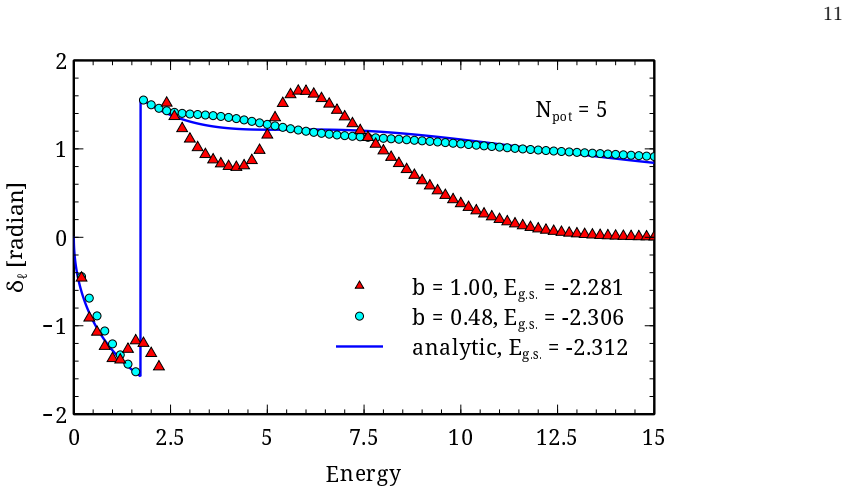
- Soft interactions such as Daejeon-16 allow accurate phase shifts with $N_{\rm pot}=5$, suggesting that truncated many-body spaces may retain scattering information.
- The method extends the coordinate-space overlap-integral technique to configuration-interaction shell-model frameworks without requiring a coordinate-space wave function at large $r$.
- Since only potential matrix elements and local coefficients enter, the approach naturally adapts to ab initio interactions given as matrix elements in harmonic-oscillator space.
- Ground-state energy minimization may serve as a practical guideline for choosing the oscillator length parameter $b$ in truncated calculations, as observed in the appendix.
Reading between the lines
- If the truncation assumption fails for realistic long-range interactions, Eq. (36) becomes an approximation; a convergence diagnostic would be to compare results as $N_{\rm pot}$ increases or to estimate the omitted tail of $V_{n,m}$.
- The same telescoping argument could likely be generalized to coupled channels, involving coupled Casoratians, which the authors list as future work.
- The poor performance for the hard-core Malfliet-Tjon potential suggests the method's efficiency depends strongly on the softness of the interaction, so many-body applications may need softened potentials to get small-$N_{\rm pot}$ phase shifts.
- One could test the method on a potential with known slowly decaying harmonic-oscillator matrix elements to quantify the breakdown regime of the central truncation assumption.
Signed reviews
Editorial analysis
A structured set of objections, weighed in public.
Referee Report
Summary. This paper derives a scattering overlap relation (SOR) for the J-matrix method. In Section III A the authors rederive the familiar coordinate-space integral relation for the phase shift from a Green's theorem argument. In Section III B they repeat the construction in an orthonormal L2 basis whose kinetic-energy matrix is tridiagonal. Assuming the potential matrix is truncated, V_{n,n'} = 0 for n,n' > Npot, and that the scattering coefficients have the free tail u_n = A f_n + B g_n for n > Npot, they obtain Eq. (36): tan δ = -[Σ f_n V_{n,m} u_m]/[α0 u0 + Σ g_n V_{n,m} u_m]. The derivation is a telescoping-sum argument analogous to the Wronskian/Casoratian manipulation in coordinate space. The paper then demonstrates the formula for square-well scattering (l=0,...,3) and for 3S1 nucleon-nucleon phase shifts using Malfliet-Tjon and Daejeon-16 interactions, with the oscillator length chosen by minimizing the ground-state energy.
Significance. The algebraic content of the paper is a useful and largely correct addition to the J-matrix literature. Eq. (36) is transparently derived, is a genuine discrete analog of the coordinate-space overlap relation, and has the attractive feature that the phase shift is obtained from potential matrix elements and coefficients only up to Npot, without an explicit match at large n. The authors are appropriately explicit about the main assumption: there is no theorem that V_{n,n'} eventually vanishes, so the relation is exact only for a model in which the potential is exactly truncated in the basis. The numerical demonstrations are consistent with this: the square-well results reproduce analytic phase shifts, and the LS and diagonalization routes agree internally. The paper does not claim to fit any phase-shift data; b and Npot are chosen by energy minimization and practical convergence, which is a strength. The main weakness is that the numerical tests set Nmax = Npot and therefore do not separately validate the exact infinite-space form of Eq. (36).
major comments (2)
- [III B, Eq. (36), and Sec. IV] The exactness of Eq. (36) rests on the assumptions (i) V_{n,n'} = 0 for n,n' > Npot and (ii) u_n = A f_n + B g_n for n > Npot. The paper explicitly concedes in Section II that there is no theorem guaranteeing (i). The numerical section then sets Nmax = Npot, so the coefficients u_m entering Eq. (36) are the solutions of a truncated LS equation, not the exact coefficients of the infinite-space truncated-potential problem. The excellent square-well agreement therefore validates the combined truncation-plus-formula procedure, not Eq. (36) with exact input coefficients. To support the statement 'we no longer need Nmax > Npot', the authors should either construct the exact finite-dimensional tail-matched solution or report a convergence study of Eq. (36) with Npot fixed and Nmax increasing.
- [IV, Fig. 2] For the Malfliet-Tjon potential, the method requires Npot = 50 and even then 'slight oscillations' persist in the phase shifts, with oscillations growing for smaller Npot. This is acknowledged, but it means the practical claim that the SOR works in a small model space is demonstrated only for soft interactions. A quantitative convergence test (phase shift versus Npot at a few energies, with Nmax = Npot and with Nmax > Npot) would allow the reader to judge how much of the residual error is due to the potential truncation versus the finite-Nmax generation of u_m.
minor comments (5)
- [IV] The word 'reproducs' should be 'reproduces', and in Section II 'no long variational' should be 'no longer variational'.
- [References] References [19] and [44] are the same article (Flores and Nollett) and should be merged or cross-referenced.
- [IV, Daejeon-16 example] Because the 3D1 coupling is omitted, the resulting phase shifts should be described as the single-channel projection of the interaction, not as the physical isoscalar s-wave phase shifts of the full Daejeon-16 potential.
- [III B] The sentence 'we no longer need Nmax > Npot' should be qualified: Eq. (36) requires only coefficients up to Npot, but generating accurate coefficients may still require a larger space or an exact tail-matched treatment.
- [Fig. 1] The caption describes symbols and lines, but a legend would improve readability, especially since four angular momenta are shown.
Circularity Check
No significant circularity: Eq. (36) is a derived identity, not a fit; comparisons are against independent analytic/experimental phase shifts.
full rationale
The central quantity, Eq. (36) for tan δ, is obtained by summing Eqs. (26)-(31), which are just the Schrödinger equation and free recursion, and by using the asymptotic form u_n = A f_n + B g_n for n > Npot. None of these steps injects the target phase shift as an input. The constants A and B are solved for algebraically and the ratio -B/A is then identified with tan δ; the phase shift is not fitted from the data used in the numerical tests. The oscillator length b is chosen to minimize the ground-state energy (Sec. IV and Appendix A), not to match phase shifts, and the comparisons are to analytic square-well solutions and to the Nijmegen partial-wave analysis, which are external to the calculation. The paper's own caveat that there is no theorem guaranteeing V_{n,n'} vanishes for large n (Sec. II) is an accuracy/truncation limitation, not a circularity; likewise the residual oscillations for the Malfliet-Tjon potential and the omitted 3D1 channel in the Daejeon-16 test are validation limitations. The J-matrix free solutions f_n, g_n and the inhomogeneity alpha0 are taken from prior J-matrix literature, but those results are not this paper's claims and are used as standard mathematical tools; the derivation does not depend on a self-citation for its conclusion. The paper is therefore self-contained with respect to its claimed novelty, and no step reduces by construction to its own inputs.
Assumptions & free parameters
free parameters (2)
- harmonic oscillator length parameter b =
0.42 (square well), 1.18 fm (Malfliet-Tjon), 1.83 fm (Daejeon-16)
- potential-space truncation Npot =
10 (square well), 50 (Malfliet-Tjon), 5 (Daejeon-16)
assumptions (4)
- domain assumption The kinetic energy operator has a tridiagonal matrix in the chosen L2 basis.
- domain assumption Potential matrix elements vanish for n or n' > Npot.
- standard math For n > Npot, the scattering coefficients satisfy u_n = A f_n + B g_n, with g_n from the inhomogeneous free recursion.
- domain assumption Single-channel, central, spin-independent potential with no Coulomb interaction.
Cite this review
Pith. "Pith review of Scattering phase shifts from overlap relations in the $J$-matrix method." pith.science (2026). https://pith.science/paper/WMDEVHP6
@misc{pith2026241208825,
  author       = {Pith},
  title        = {Pith review of: Scattering phase shifts from overlap relations in the $J$-matrix method},
  year         = {2026},
  howpublished = {\url{https://pith.science/paper/WMDEVHP6}},
  note         = {Machine review of arXiv:2412.08825}
}
abstract
The scattering problem can be implemented in a square-integrable basis via the so-called $J$-matrix method. While methods to compute the phase shift in the $J$-matrix approach are known, we introduce a novel formula in square-integrable bases analogous to existing integral relations or overlap integrals in a (continuous) position basis. We demonstrate the method in single-channel potential scattering. Such a result is the first step towards a more general approach to scattering and reactions in popular many-body methods such as the configuration-interaction shell model.
Figures


Figures from the paper (1 more)
Reference graph
Works this paper leans on
-
[1]
The scattering of α and β particles by matter and the structure of the atom
Ernest Rutherford. The scattering of α and β particles by matter and the structure of the atom. Philosophical Magazine, 21:669–699, 911
-
[2]
The three-nucleon continuum: achievements, challenges and applications
Walter Gloeckle, H Wita la, D H¨ uber, H Kamada, and J Golak. The three-nucleon continuum: achievements, challenges and applications. Physics Reports, 274(3-4):107–285, 1996
work page 1996
-
[3]
Springer Science & Business Media, 2012
Walter Gl¨ ockle.The quantum mechanical few-body problem. Springer Science & Business Media, 2012
work page 2012
-
[4]
F. Ciesielski and J. Carbonell. Solutions of the Faddeev-Yakubovsky equations for the four nucleon scattering states. Phys. Rev. C, 58:58–74, Jul 1998
work page 1998
-
[5]
White paper: from bound states to the continuum
Calvin W Johnson, Kristina D Launey, Naftali Auerbach, Sonia Bacca, Bruce R Barrett, Carl R Brune, Mark A Caprio, Pierre Descouvemont, WH Dickhoff, Charlotte Elster, et al. White paper: from bound states to the continuum. Journal of Physics G: Nuclear and Particle Physics, 47(12):123001, 2020
work page 2020
-
[6]
Eric J. Heller and Hashim A. Yamani. New L2 approach to quantum scattering: Theory. Phys. Rev. A, 9:1201–1208, Mar 1974
work page 1974
-
[7]
Eric J. Heller and Hashim A. Yamani. J-matrix method: Application to s-wave electron-hydrogen scattering. Phys. Rev. A, 9:1209–1214, Mar 1974
work page 1974
-
[8]
Abdulaziz D Alhaidari, Eric J Heller, Hashim A Yamani, and Mohamed S Abdelmonem. The J-matrix method. Develop- ment and Applications (Springer, Berlin, 2008), 2008. 12
work page 2008
Show all 52 references
-
[9]
Scattering theory of waves and particles
Roger G Newton. Scattering theory of waves and particles. Springer Science & Business Media, 2013
2013
-
[10]
A. M. Shirokov, A. I. Mazur, I. A. Mazur, and J. P. Vary. Shell model states in the continuum. Phys. Rev. C, 94:064320, Dec 2016
2016
-
[11]
I. A. Ivanov, J. Mitroy, and K. Varga. Elastic positronium-atom scattering using the stochastic variational method. Phys. Rev. Lett., 87:063201, Jul 2001
2001
-
[12]
Overlap integrals and single-particle wave functions in direct interaction theories
Tore Berggren. Overlap integrals and single-particle wave functions in direct interaction theories. Nuclear Physics, 72(2):337–351, 1965
1965
-
[13]
Form factors for nuclear stripping reactions
WT Pinkston and GR Satchler. Form factors for nuclear stripping reactions. Nuclear Physics, 72(3):641–656, 1965
1965
-
[14]
Introduction to the quantum theory of scattering, volume 26
Leonard S Rodberg, Roy M Thaler, and Raphael Morton Thaler. Introduction to the quantum theory of scattering, volume 26. Academic Press, 1967
1967
-
[15]
One nucleon overlap integrals for light nuclei
NK Timofeyuk. One nucleon overlap integrals for light nuclei. Nuclear Physics A, 632(1):19–38, 1998
1998
-
[16]
Phase-shift calculation using continuum-discretized states
Y Suzuki, W Horiuchi, and K Arai. Phase-shift calculation using continuum-discretized states. Nuclear Physics A, 823(1- 4):1–15, 2009
2009
-
[17]
Kievsky, M
A. Kievsky, M. Viviani, Paolo Barletta, C. Romero-Redondo, and E. Garrido. Variational description of continuum states in terms of integral relations. Phys. Rev. C, 81:034002, Mar 2010
2010
-
[18]
Kenneth M. Nollett. Ab initio calculations of nuclear widths via an integral relation. Phys. Rev. C, 86:044330, Oct 2012
2012
-
[19]
Flores and Kenneth M
Abraham R. Flores and Kenneth M. Nollett. Variational Monte Carlo calculations of n +3 H scattering. Phys. Rev. C, 108:034001, Sep 2023
2023
-
[20]
Theory of the nuclear shell model
RD Lawson. Theory of the nuclear shell model. Clarendon Press Oxford, 1980
1980
-
[21]
Gaussian basis sets for molecular calculations
Thom H Dunning Jr and P Jeffrey Hay. Gaussian basis sets for molecular calculations. In Methods of electronic structure theory, pages 1–27. Springer, Boston MA, 1977
1977
-
[22]
J- matrix method: Extensions to arbitrary angular momentum and to Coulomb scattering
Hashim A Yamani and Louis Fishman. J- matrix method: Extensions to arbitrary angular momentum and to Coulomb scattering. Journal of Mathematical Physics, 16(2):410–420, 1975
1975
-
[23]
V. S. Vasilevsky and F. Arickx. Algebraic model for quantum scattering: Reformulation, analysis, and numerical strategies. Phys. Rev. A, 55:265–286, Jan 1997
1997
-
[24]
P-matrix and J-matrix approaches: Coulomb asymptotics in the harmonic oscillator representation of scattering theory
JM Bang, AI Mazur, AM Shirokov, Yu F Smirnov, and SA Zaytsev. P-matrix and J-matrix approaches: Coulomb asymptotics in the harmonic oscillator representation of scattering theory. Annals of Physics, 280(2):299–335, 2000
2000
-
[25]
H. A. Yamani, A. D. Alhaidari, and M. S. Abdelmonem. J-matrix method of scattering in any L2 basis. Phys. Rev. A, 64:042703, Sep 2001
2001
-
[26]
Eric J. Heller. Theory of J-matrix Green’s functions with applications to atomic polarizability and phase-shift error bounds. Phys. Rev. A, 12:1222–1231, Oct 1975
1975
-
[27]
Broad and William P
John T. Broad and William P. Reinhardt. One- and two-electron photoejection from H −: A multichannel J-matrix calculation. Phys. Rev. A, 14:2159–2173, Dec 1976
1976
-
[28]
Note on the use of harmonic-oscillator wavefunctions in scattering calculations
J R´ evai, M Sotona, and J Zofka. Note on the use of harmonic-oscillator wavefunctions in scattering calculations. Journal of Physics G: Nuclear Physics, 11(6):745, 1985
1985
-
[29]
Vasilevsky, A
V. Vasilevsky, A. V. Nesterov, F. Arickx, and J. Broeckhove. Algebraic model for scattering in three- s-cluster systems. i. theoretical background. Phys. Rev. C, 63:034606, Feb 2001
2001
-
[30]
Loosely bound three-body nuclear systems in the J-matrix approach
Yu A Lurie and Andrey M Shirokov. Loosely bound three-body nuclear systems in the J-matrix approach. Annals of Physics, 312(2):284–318, 2004
2004
-
[31]
A. M. Shirokov, A. I. Mazur, S. A. Zaytsev, J. P. Vary, and T. A. Weber. Nucleon-nucleon interaction in the J-matrix inverse scattering approach and few-nucleon systems. Phys. Rev. C, 70:044005, Oct 2004
2004
-
[32]
The 5H resonance structure studied with a three-cluster J-matrix model
J Broeckhove, Frans Arickx, P Hellinckx, VS Vasilevsky, and A V Nesterov. The 5H resonance structure studied with a three-cluster J-matrix model. Journal of Physics G: Nuclear and Particle Physics, 34(9):1955, 2007
1955
-
[33]
A. M. Shirokov, A. I. Mazur, J. P. Vary, and E. A. Mazur. Inverse scattering J-matrix approach to nucleon-nucleus scattering and the shell model. Phys. Rev. C, 79:014610, Jan 2009
2009
-
[34]
Description of resonant states in the shell model
IA Mazur, AM Shirokov, AI Mazur, and JP Vary. Description of resonant states in the shell model. Physics of Particles and Nuclei, 48:84–89, 2017
2017
-
[35]
A. M. Shirokov, A. I. Mazur, I. A. Mazur, E. A. Mazur, I. J. Shin, Y. Kim, L. D. Blokhintsev, and J. P. Vary. Nucleon- α scattering and resonances in 5He and 5Li with JISP16 and Daejeon16 NN interactions. Phys. Rev. C, 98:044624, Oct 2018
2018
-
[36]
Description of continuum states within the no-core shell model: single-state HORSE method
AI Mazur, AM Shirokov, IA Mazur, LD Blokhintsev, Y Kim, IJ Shin, and JP Vary. Description of continuum states within the no-core shell model: single-state HORSE method. Physics of Atomic Nuclei, 82:537–548, 2019
2019
-
[37]
Description of continuum spectrum states of light nuclei in the shell model
AM Shirokov, AI Mazur, IJ Shin, Y Kim, P Maris, and JP Vary. Description of continuum spectrum states of light nuclei in the shell model. Physics of Particles and Nuclei, 50(5), 2019
2019
-
[38]
I. A. Mazur, I. J. Shin, Y. Kim, A. I. Mazur, A. M. Shirokov, P. Maris, and J. P. Vary. SS-HORSE extension of the no-core shell model: Application to resonances in 7He. Phys. Rev. C, 106:064320, Dec 2022
2022
-
[39]
Properties of a potential energy matrix in oscillator basis
Yu A Lashko, VS Vasilevsky, and GF Filippov. Properties of a potential energy matrix in oscillator basis. Annals of Physics, 409:167930, 2019
2019
-
[40]
Clustering in structure and reactions using configuration interaction tech- niques
Konstantinos Kravvaris and Alexander Volya. Clustering in structure and reactions using configuration interaction tech- niques. Phys. Rev. C, 100:034321, Sep 2019
2019
-
[41]
B. V. Noumerov. A Method of Extrapolation of Perturbations. Monthly Notices of the Royal Astronomical Society, 84(8):592–602, 06 1924
1924
-
[42]
B. Numerov. Note on the numerical integration of d2x/dt2 = f(x, t). Astronomische Nachrichten, 230(19):359–364, 1927
1927
-
[43]
A. M. Lane and R. G. Thomas. R-matrix theory of nuclear reactions. Rev. Mod. Phys., 30:257–353, Apr 1958
1958
-
[44]
Flores and Kenneth M
Abraham R. Flores and Kenneth M. Nollett. Variational Monte Carlo calculations of n +3 H scattering. Phys. Rev. C, 13 108:034001, Sep 2023
2023
-
[45]
Computing the confluent hypergeometric function, M (a, b, x)
Keith E Muller. Computing the confluent hypergeometric function, M (a, b, x). Numerische Mathematik, 90(1):179–196, 2001
2001
-
[46]
Numerical methods for the computation of the confluent and Gauss hypergeometric functions
John W Pearson, Sheehan Olver, and Mason A Porter. Numerical methods for the computation of the confluent and Gauss hypergeometric functions. Numerical Algorithms, 74(3):821–866, 2017
2017
-
[47]
V. G. J. Stoks, R. A. M. Klomp, M. C. M. Rentmeester, and J. J. de Swart. Partial-wave analysis of all nucleon-nucleon scattering data below 350 MeV. Phys. Rev. C, 48:792–815, Aug 1993
1993
-
[48]
Three-nucleon calculations with realistic forces
RA Malfliet and JA Tjon. Three-nucleon calculations with realistic forces. Annals of Physics, 61(2):425–450, 1970
1970
-
[49]
G. L. Greene, E. G. Kessler, R. D. Deslattes, and H. B¨ orner. New determination of the deuteron binding energy and the neutron mass. Phys. Rev. Lett., 56:819–822, Feb 1986
1986
-
[50]
N3lo nn interaction adjusted to light nuclei in ab exitu approach
AM Shirokov, IJ Shin, Y Kim, M Sosonkina, P Maris, and JP Vary. N3lo nn interaction adjusted to light nuclei in ab exitu approach. Physics Letters B, 761:87–91, 2016
2016
-
[51]
D. R. Entem and R. Machleidt. Accurate charge-dependent nucleon-nucleon potential at fourth order of chiral perturbation theory. Phys. Rev. C, 68:041001, Oct 2003
2003
-
[52]
Ab initio no core shell model.Progress in Particle and Nuclear Physics, 69:131–181, 2013
Bruce R Barrett, Petr Navr´ atil, and James P Vary. Ab initio no core shell model.Progress in Particle and Nuclear Physics, 69:131–181, 2013
2013
Reviewed August 11, 2026 · model on record in the stance chip above.
Discussion (0). Continue with ORCID to comment.