When VR Meets BCI: (Un)Observable Brainwave-aware Privacy Reconstruction in the Metaverse via Unrestricted Inbuilt Motion Sensors
Pith reviewed 2026-06-27 12:49 UTC · model grok-4.3
The pith
VR motion sensors can reconstruct brain EEG signals to reveal what users perceive.
A machine-rendered reading of the paper's core claim, the machinery that carries it, and where it could break.
Core claim
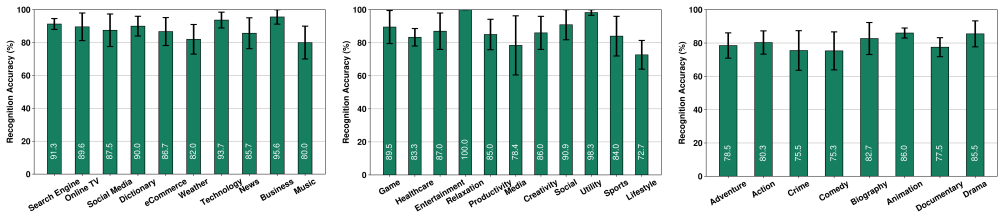
BraVeSpy demonstrates the feasibility of reconstructing brain EEG-correlated representations from variations of inbuilt motion sensors in VR headsets, revealing unobservable privacy by unveiling perceptive images in the brain with 52.0%-67.2% accuracy and inferring user activity-related sensitive information with over 85.0% accuracy.
What carries the argument
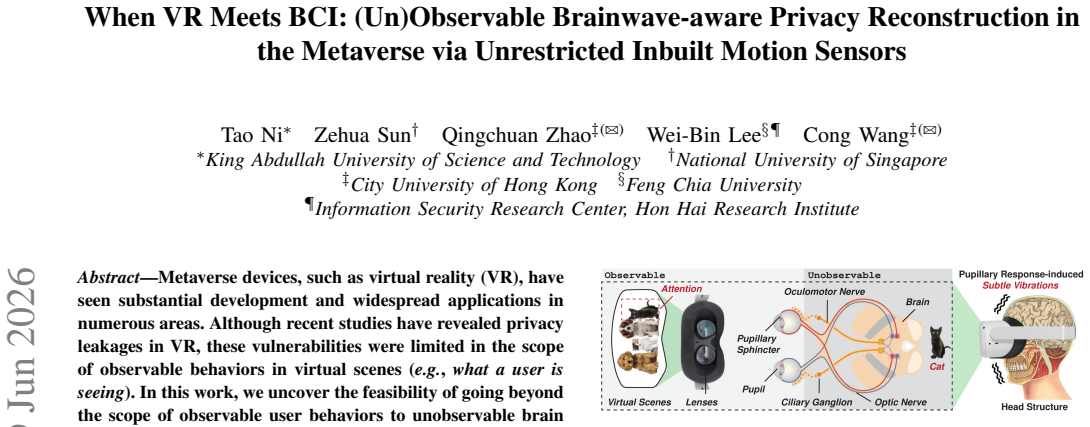
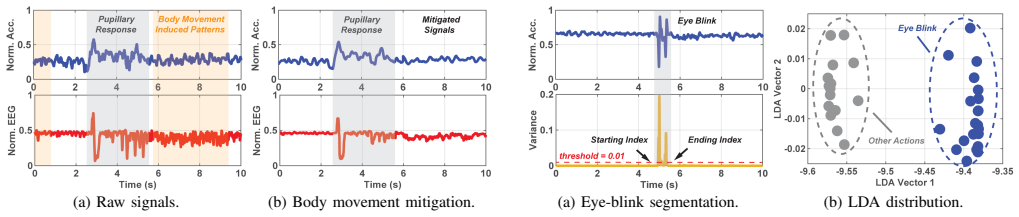
Pupillary response-induced vibrations captured by VR inbuilt motion sensors, which are used to reconstruct EEG signals correlated with perceptions.
If this is right
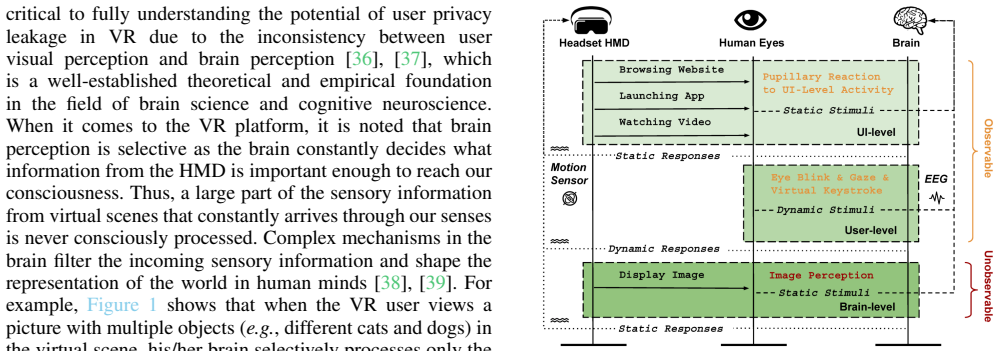
- Observable behaviors in VR are no longer the only privacy concern; unobservable brain states can also be accessed.
- High accuracy inference of sensitive information such as apps, videos, and keystrokes becomes possible from motion data alone.
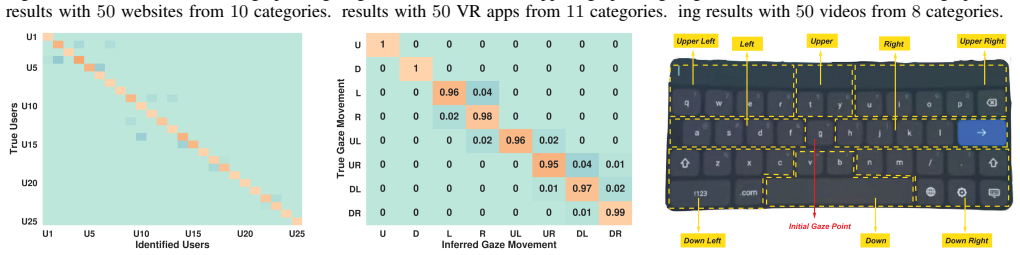
- User de-anonymization, gaze tracking, and virtual keystroke inference exceed 96% accuracy using this method.
Where Pith is reading between the lines
- This could mean that future VR devices need hardware-level protections against sensor data leakage.
- The method might apply to other head-mounted devices with accelerometers.
- Countermeasures like adding noise to motion data could be tested to mitigate the leakage.
Load-bearing premise
Pupillary responses induce subtle vibrations in the VR headset that motion sensors can detect and that these are highly correlated with visual stimuli and brain perceptions.
What would settle it
An experiment that simultaneously records motion sensor data and actual EEG signals during VR perception tasks and shows no meaningful correlation or reconstruction capability.
Figures






read the original abstract
Metaverse devices, such as virtual reality (VR), have seen substantial development and widespread applications in numerous areas. Although recent studies have revealed privacy leakages in VR, these vulnerabilities were limited in the scope of observable behaviors in virtual scenes (e.g., what a user is seeing). In this work, we uncover the feasibility of going beyond the scope of observable user behaviors to unobservable brain EEG-correlated representations (e.g., what a user is perceiving) by leveraging unrestricted motion sensors in VR headsets to reconstruct brain EEG signals, a seemingly neglected but promising vector. The insight is that the inbuilt motion sensors (e.g., accelerometers) in the VR headset can capture subtle vibrations induced by pupillary responses, which are highly correlated with users' visual stimuli and in-brain perceptions. Therefore, we design and implement BraVeSpy to systematically investigate and demonstrate the feasibility of this severe privacy leakage originating from brain EEG-correlated representations reconstructed from variations of inbuilt motion sensors. Our extensive evaluation results from different VR devices show that BraVeSpy, for the first time in the Metaverse, can reveal unobservable privacy, where we successfully unveiled perceptive images in the brain with 52.0%-67.2% accuracy. In particular, we also find that BraVeSpy outperforms the current approaches that are limited to coarse-grained inference of observable behaviors and achieves over 85.0% accuracy in inferring user activity-related sensitive information, such as fingerprinting websites, apps, and streaming videos, and over 96.0% accuracy in user de-anonymization, gaze movement tracking, and virtual keystroke inference.
Editorial analysis
A structured set of objections, weighed in public.
Referee Report
Summary. The paper introduces BraVeSpy, a system that uses unrestricted inbuilt motion sensors (e.g., accelerometers) in VR headsets to capture subtle vibrations induced by pupillary responses. These vibrations are claimed to be highly correlated with users' visual stimuli and in-brain EEG representations, enabling reconstruction of unobservable perceptive images (52.0%-67.2% accuracy) as well as inference of activity-related sensitive information (>85% accuracy for website/app/video fingerprinting) and other tasks (>96% for de-anonymization, gaze tracking, and keystroke inference). The work positions this as a novel privacy vector beyond observable behaviors in the Metaverse.
Significance. If the core mechanism and reported accuracies are rigorously validated, the result would represent a meaningful advance in VR/Metaverse privacy research by demonstrating leakage of EEG-correlated unobservable information through commodity sensors. The distinction from prior work limited to observable behaviors is a clear strength, and the breadth of evaluated tasks (image reconstruction plus multiple inference scenarios across devices) would be notable if supported by appropriate controls and statistics.
major comments (2)
- [Abstract] Abstract: the central claim that pupillary responses induce vibrations in the VR headset that are detectable above noise by accelerometers and uniquely correlated with in-brain perception lacks any quantitative model of vibration amplitude, frequency content, or transmission path through headset padding. No controls isolating pupil-induced signals from head motion, breathing, or scene-driven behavioral changes are described, so the reported 52.0%-67.2% image reconstruction accuracy cannot yet be attributed to the claimed vector.
- [Abstract] Abstract: accuracy figures (52.0%-67.2% for perceptive images, >85% for activity inference, >96% for de-anonymization) are stated without any information on experimental design, participant numbers, data processing pipeline, statistical controls, or validation methods. This prevents assessment of whether the numbers support the claims and is load-bearing for the soundness of the privacy-leakage result.
Simulated Author's Rebuttal
We thank the referee for the detailed and constructive review of our manuscript. The comments focus on the abstract, and we address each point below with plans for revision where appropriate.
read point-by-point responses
-
Referee: [Abstract] Abstract: the central claim that pupillary responses induce vibrations in the VR headset that are detectable above noise by accelerometers and uniquely correlated with in-brain perception lacks any quantitative model of vibration amplitude, frequency content, or transmission path through headset padding. No controls isolating pupil-induced signals from head motion, breathing, or scene-driven behavioral changes are described, so the reported 52.0%-67.2% image reconstruction accuracy cannot yet be attributed to the claimed vector.
Authors: We acknowledge that the abstract, as a concise summary, does not include a quantitative physical model of vibration propagation or explicit descriptions of controls for confounds such as head motion or breathing. The manuscript's core contribution is an empirical demonstration of reconstruction accuracy from motion sensor data across multiple VR devices and tasks, supported by the observed correlations in the evaluation. We agree that strengthening the discussion of signal isolation and potential confounds would improve the paper. We will revise the manuscript to add a dedicated paragraph on observed signal characteristics and any control measures used during data collection. revision: yes
-
Referee: [Abstract] Abstract: accuracy figures (52.0%-67.2% for perceptive images, >85% for activity inference, >96% for de-anonymization) are stated without any information on experimental design, participant numbers, data processing pipeline, statistical controls, or validation methods. This prevents assessment of whether the numbers support the claims and is load-bearing for the soundness of the privacy-leakage result.
Authors: The abstract reports the headline accuracy results due to length limits, while the full manuscript details the experimental design, participant cohort, data processing steps, and validation procedures in the dedicated Evaluation section. We agree that the abstract would benefit from a brief reference to the experimental scale to aid readers. We will revise the abstract to include a short clause on the number of participants and devices evaluated, along with a pointer to the methods. revision: yes
Circularity Check
No derivation chain or self-referential reductions present
full rationale
The paper is an empirical feasibility study demonstrating an attack via motion sensor data to infer brain-correlated perceptions. No equations, model derivations, fitted parameters renamed as predictions, or load-bearing self-citations appear in the abstract or described claims. The central results (52-67.2% image reconstruction accuracy, >85% activity inference) are presented as experimental outcomes rather than outputs forced by construction from inputs. The key assumption (pupillary vibrations inducing detectable accelerometer signals) is stated as an insight but is not derived from prior self-work or reduced tautologically. This is a standard non-circular empirical paper.
Axiom & Free-Parameter Ledger
Reference graph
Works this paper leans on
-
[1]
Oculus Quest 2 Store: VR Games, Apps, & More,
M. Quest, “Oculus Quest 2 Store: VR Games, Apps, & More,” 2023, https://www.oculus.com/experiences/quest
2023
-
[2]
An empirical study on Oculus virtual reality applications: Security and privacy perspectives,
H. Guo, H.-N. Dai, X. Luo, Z. Zheng, G. Xu, and F. He, “An empirical study on Oculus virtual reality applications: Security and privacy perspectives,” inProceedings of the IEEE/ACM 46th International Conference on Software Engineering (ICSE), 2024
2024
-
[3]
Practicality of accelerometer side channels on smartphones,
A. J. Aviv, B. Sapp, M. Blaze, and J. M. Smith, “Practicality of accelerometer side channels on smartphones,” inProceedings of the Annual Computer Security Applications Conference (ACSAC), 2012
2012
-
[4]
Pin Skimmer: Inferring PINs through the camera and microphone,
L. Simon and R. Anderson, “Pin Skimmer: Inferring PINs through the camera and microphone,” inProceedings of ACM Workshop on Security and Privacy in Smartphones and Mobile Devices, 2013
2013
-
[5]
Keylis- tener: Inferring keystrokes on QWERTY keyboard of touch screen through acoustic signals,
L. Lu, J. Yu, Y . Chen, Y . Zhu, X. Xu, G. Xue, and M. Li, “Keylis- tener: Inferring keystrokes on QWERTY keyboard of touch screen through acoustic signals,” inProeedings of IEEE International Con- ference on Computer Communications (INFOCOM), 2019
2019
-
[6]
Magneticspy: Exploiting magnetometer in mobile devices for website and application fingerprinting,
N. Matyunin, Y . Wang, T. Arul, K. Kullmann, J. Szefer, and S. Katzenbeisser, “Magneticspy: Exploiting magnetometer in mobile devices for website and application fingerprinting,” inProc. of ACM Workshop on Privacy in the Electronic Society, 2019
2019
-
[7]
Magthief: Stealing private app usage data on mobile devices via built-in magnetometer,
H. Pan, L. Yang, H. Li, C.-W. You, X. Ji, Y .-C. Chen, Z. Hu, and G. Xue, “Magthief: Stealing private app usage data on mobile devices via built-in magnetometer,” inProceedings of IEEE Inter- national Conference on Sensing, Communication, and Networking (SECON), 2021
2021
-
[8]
Deepmag: Sniffing mobile apps in magnetic field through deep convolutional neural networks,
R. Ning, C. Wang, C. Xin, J. Li, and H. Wu, “Deepmag: Sniffing mobile apps in magnetic field through deep convolutional neural networks,” inProceedings of IEEE International Conference on Pervasive Computing and Communications (PerCom), 2018
2018
-
[9]
Speechless: Analyzing the threat to speech privacy from smartphone motion sensors,
S. A. Anand and N. Saxena, “Speechless: Analyzing the threat to speech privacy from smartphone motion sensors,” inProceedings of IEEE Symposium on Security and Privacy (SP), 2018
2018
-
[10]
Learning-based practical smartphone eavesdropping with built-in accelerometer,
Z. Ba, T. Zheng, X. Zhang, Z. Qin, B. Li, X. Liu, and K. Ren, “Learning-based practical smartphone eavesdropping with built-in accelerometer,” inProceedings of Network and Distributed System Security Symposium (NDSS), 2020
2020
-
[11]
AccEar: Accelerometer acoustic eaves- dropping with unconstrained vocabulary,
P. Hu, H. Zhuang, P. S. Santhalingam, R. Spolaor, P. Pathak, G. Zhang, and X. Cheng, “AccEar: Accelerometer acoustic eaves- dropping with unconstrained vocabulary,” inProceedings of IEEE Symposium on Security and Privacy (SP), 2022
2022
-
[12]
Holologger: Keystroke inference on mixed reality head-mounted displays,
S. Luo, X. Hu, and Z. Yan, “Holologger: Keystroke inference on mixed reality head-mounted displays,” inProceedings of IEEE Conference on Virtual Reality and 3D User Interfaces (VR), 2022
2022
-
[13]
Going through the motions: AR/VR keylogging from user head motions,
C. Slocum, Y . Zhang, N. Abu-Ghazaleh, and J. Chen, “Going through the motions: AR/VR keylogging from user head motions,” inProceedings of USENIX Security Symposium, 2023
2023
-
[14]
Privacy leakage via unrestricted motion-position sensors in the age of virtual reality: A study of snooping typed input on virtual keyboards,
Y . Wu, C. Shi, T. Zhang, P. Walker, J. Liu, N. Saxena, and Y . Chen, “Privacy leakage via unrestricted motion-position sensors in the age of virtual reality: A study of snooping typed input on virtual keyboards,” inProceedings of IEEE Symposium on Security and Privacy (SP), 2023
2023
-
[15]
It’s all in your head (set): Side-channel attacks on AR/VR systems,
Y . Zhang, C. Slocum, J. Chen, and N. Abu-Ghazaleh, “It’s all in your head (set): Side-channel attacks on AR/VR systems,” inProceedings of USENIX Security Symposium, 2023
2023
-
[16]
A keylogging inference attack on air-tapping keyboards in virtual en- vironments,
¨U. Meteriz-Yıldıran, N. F. Yıldıran, A. Awad, and D. Mohaisen, “A keylogging inference attack on air-tapping keyboards in virtual en- vironments,” inProceedings of IEEE Conference on Virtual Reality and 3D User Interfaces (VR), 2022
2022
-
[17]
Eyes on your typing: Snooping finger mo- tions on virtual keyboards,
S. Lee and W. Choi, “Eyes on your typing: Snooping finger mo- tions on virtual keyboards,” inProceedings of IEEE Symposium on Security and Privacy (SP), 2025
2025
-
[18]
Xr devices send wifi packets when they should not: Cross-building keylogging attacks via non-cooperative wireless sensing,
C. V . J. F. H. Khalili and N. S. O. Abari, “Xr devices send wifi packets when they should not: Cross-building keylogging attacks via non-cooperative wireless sensing,” inProceedings of Network and Distributed System Security Symposium (NDSS), 2026
2026
-
[19]
Penetration vision through vir- tual reality headsets: Identifying 360 videos from head movements,
A. Nguyen, X. Zhang, and Z. Yan, “Penetration vision through vir- tual reality headsets: Identifying 360 videos from head movements,” inProceedings of USENIX Security Symposium, 2024
2024
-
[20]
De- anonymization attacks on metaverse,
Y . Meng, Y . Zhan, J. Li, S. Du, H. Zhu, and X. S. Shen, “De- anonymization attacks on metaverse,” inProceedings of IEEE Con- ference on Computer Communications (INFOCOM), 2023
2023
-
[21]
Unique identification of 50,000+ virtual reality users from head & hand motion data,
V . Nair, W. Guo, J. Mattern, R. Wang, J. F. O’Brien, L. Rosenberg, and D. Song, “Unique identification of 50,000+ virtual reality users from head & hand motion data,” inProceedings of USENIX Security Symposium, 2023
2023
-
[22]
Can virtual reality protect users from keystroke inference attacks?
Z. Yang, Z. Sarwar, I. Hwang, R. Bhaskar, B. Y . Zhao, and H. Zheng, “Can virtual reality protect users from keystroke inference attacks?” inProceedings of USENIX Security Symposium, 2024
2024
-
[23]
Face-Mic: Inferring live speech and speaker identity via subtle facial dynamics captured by AR/VR motion sensors,
C. Shi, X. Xu, T. Zhang, P. Walker, Y . Wu, J. Liu, N. Saxena, Y . Chen, and J. Yu, “Face-Mic: Inferring live speech and speaker identity via subtle facial dynamics captured by AR/VR motion sensors,” inProceedings of Annual International Conference on Mobile Computing and Networking, 2021
2021
-
[24]
Speak up, i’m listening: Extracting speech from zero-permission VR sensors,
D. Cayir, R. Mohamed, R. Lazzeretti, M. Angelini, A. Acar, M. Conti, Z. B. Celik, and S. Uluagac, “Speak up, i’m listening: Extracting speech from zero-permission VR sensors,” inProceedings of Network and Distributed System Security Symposium (NDSS), 2025
2025
-
[25]
Passive vital sign monitoring via facial vibrations leverag- ing AR/VR headsets,
T. Zhang, C. Shi, P. Walker, Z. Ye, Y . Wang, N. Saxena, and Y . Chen, “Passive vital sign monitoring via facial vibrations leverag- ing AR/VR headsets,” inProceedings of Annual International Con- ference on Mobile Systems, Applications and Services (MobiSys), 2023
2023
-
[26]
FaceReader: Unobtrusively mining vital signs and vital sign embedded sensitive info via AR/VR motion sensors,
T. Zhang, Z. Ye, A. T. Mahdad, M. M. R. R. Akanda, C. Shi, Y . Wang, N. Saxena, and Y . Chen, “FaceReader: Unobtrusively mining vital signs and vital sign embedded sensitive info via AR/VR motion sensors,” inProceedings of ACM SIGSAC Conference on Computer and Communications Security (CCS), 2023
2023
-
[27]
Harnessing vital sign vibration harmonics for effortless and inbuilt xr user authentication,
T. Zhang, Q. Ji, M. M. Rahman, R. Akanda, Z. Ye, A. T. Mahdad, C. Shi, Y . Wang, N. Saxena, and Y . Chen, “Harnessing vital sign vibration harmonics for effortless and inbuilt xr user authentication,” inProceedings of ACM SIGSAC Conference on Computer and Communications Security (CCS), 2025
2025
-
[28]
BPSniff: Continuously surveilling private blood pressure informa- tion in the metaverse via unrestricted inbuilt motion sensors,
Z. Ye, A. T. Mahdad, Y . Wang, C. Shi, Y . Chen, and N. Saxena, “BPSniff: Continuously surveilling private blood pressure informa- tion in the metaverse via unrestricted inbuilt motion sensors,” in Proceedings of IEEE Symposium on Security and Privacy (SP), 2025
2025
-
[29]
Side-channel inference of user activities in AR/VR using GPU profiling,
S. Son, C. Mukherjee, R. M. Aburas, B. Gulmezoglu, and Z. B. Celik, “Side-channel inference of user activities in AR/VR using GPU profiling,” inProceedings of Network and Distributed System Security Symposium (NDSS), 2026
2026
-
[30]
VR-Spy: A side-channel attack on virtual key-logging in VR headsets,
A. Al Arafat, Z. Guo, and A. Awad, “VR-Spy: A side-channel attack on virtual key-logging in VR headsets,” inProc. of IEEE VR, 2021
2021
-
[31]
Remote keylogging attacks in multi-user VR applications,
Z. Su, K. Cai, R. Beeler, L. Dresel, A. Garcia, I. Grishchenko, Y . Tian, C. Kruegel, and G. Vigna, “Remote keylogging attacks in multi-user VR applications,” inProceedings of USENIX Security Symposium, 2024
2024
-
[32]
Hid- den Reality: Caution, your hand gesture inputs in the immersive virtual world are visible to all!
S. R. K. Gopal, D. Shukla, J. D. Wheelock, and N. Saxena, “Hid- den Reality: Caution, your hand gesture inputs in the immersive virtual world are visible to all!” inProceedings of USENIX Security Symposium, 2023
2023
-
[33]
Virtual keymysteries unveiled: Detecting keystrokes in VR with external side-channels,
H. Khalili, A. Chen, T. Papaiakovou, T. Jacques, H.-J. Chien, C. Liu, A. Ding, A. Hass, S. Zonouz, and N. Sehatbakhsh, “Virtual keymysteries unveiled: Detecting keystrokes in VR with external side-channels,” inProceedings of IEEE Symposium on Security and Privacy (SP) Workshops, 2024
2024
-
[34]
Eavesdropping on controller acoustic emanation for keystroke inference attack in virtual reality,
S. Luo, A. Nguyen, H. Farooq, K. Sun, and Z. Yan, “Eavesdropping on controller acoustic emanation for keystroke inference attack in virtual reality,” inProceedings of Network and Distributed System Security Symposium (NDSS), 2024
2024
-
[35]
Non-intrusive and un- constrained keystroke inference in VR platforms via infrared side channel,
T. Ni, Y . Du, Q. Zhao, and C. Wang, “Non-intrusive and un- constrained keystroke inference in VR platforms via infrared side channel,” inProceedings of Network and Distributed System Security Symposium (NDSS), 2025
2025
-
[36]
How the brain decides what we see,
J. Smythies, “How the brain decides what we see,”Journal of the Royal Society of Medicine, 2005
2005
-
[37]
Perception is far from perfection: the role of the brain and mind in constructing realities,
I. E. Dror, “Perception is far from perfection: the role of the brain and mind in constructing realities,”Behavioral and Brain Sciences, 2005
2005
-
[38]
Bistability of pre- frontal states gates access to consciousness,
A. Dwarakanath, V . Kapoor, J. Werner, S. Safavi, L. A. Fedorov, N. K. Logothetis, and T. I. Panagiotaropoulos, “Bistability of pre- frontal states gates access to consciousness,”Neuron, 2023
2023
-
[39]
Neuroarchitecture: How the perception of our surroundings impacts the brain,
S. Abbas, N. Okdeh, R. Roufayel, H. Kovacic, J.-M. Sabatier, Z. Fa- jloun, and Z. Abi Khattar, “Neuroarchitecture: How the perception of our surroundings impacts the brain,”Biology, 2024
2024
-
[40]
Neurochemistry of visual attention,
D. E. L. Lockhofen and C. Mulert, “Neurochemistry of visual attention,”Frontiers in neuroscience, 2021
2021
-
[41]
Eyeblink recognition improves fatigue prediction from single- channel forehead EEG in a realistic sustained attention task,
L.-W. Ko, O. Komarov, W.-K. Lai, W.-G. Liang, and T.-P. Jung, “Eyeblink recognition improves fatigue prediction from single- channel forehead EEG in a realistic sustained attention task,”Journal of neural engineering, 2020
2020
-
[42]
Simultaneous eye blink characterization and elimination from low-channel pre- frontal EEG signals enhances driver drowsiness detection,
M. Shahbakhti, M. Beiramvand, I. Rejer, P. Augustyniak, A. Broniec-W ´ojcik, M. Wierzchon, and V . Marozas, “Simultaneous eye blink characterization and elimination from low-channel pre- frontal EEG signals enhances driver drowsiness detection,”IEEE Journal of Biomedical and Health Informatics (JBHI), 2021
2021
-
[43]
More than a feeling: scalp EEG and eye signals in conscious tactile perception,
M. M. Gusso, K. L. Christison-Lagay, D. Zuckerman, G. Chan- drasekaran, S. I. Kronemer, J. Z. Ding, N. C. Freedman, P. Nohama, and H. Blumenfeld, “More than a feeling: scalp EEG and eye signals in conscious tactile perception,”Consciousness and Cognition, 2022
2022
-
[44]
Dreamd- iffusion: Generating high-quality images from brain EEG signals,
Y . Bai, X. Wang, Y .-p. Cao, Y . Ge, C. Yuan, and Y . Shan, “Dreamd- iffusion: Generating high-quality images from brain EEG signals,” arXiv preprint arXiv:2306.16934, 2023
arXiv 2023
-
[45]
Seeing through the brain: image reconstruction of visual perception from human brain signals,
Y .-T. Lan, K. Ren, Y . Wang, W.-L. Zheng, D. Li, B.-L. Lu, and L. Qiu, “Seeing through the brain: image reconstruction of visual perception from human brain signals,”arXiv preprint arXiv:2308.02510, 2023
arXiv 2023
-
[46]
Brain- supervised image editing,
K. M. Davis, C. de la Torre-Ortiz, and T. Ruotsalo, “Brain- supervised image editing,” inProceedings of IEEE/CVF Conference on Computer Vision and Pattern Recognition (CVPR), 2022
2022
-
[47]
Methodological aspects of eeg and body dynamics measurements during motion,
P. M. Reis, F. Hebenstreit, F. Gabsteiger, V . von Tscharner, and M. Lochmann, “Methodological aspects of eeg and body dynamics measurements during motion,”Frontiers in Human Neuroscience, 2014
2014
-
[48]
Eye movements and the control of actions in everyday life,
M. F. Land, “Eye movements and the control of actions in everyday life,”Progress in Retinal and Eye Research, 2006
2006
-
[49]
Combining eye tracking, pupil dilation and EEG analysis for predicting web users click intention,
G. Slanzi, J. A. Balazs, and J. D. Vel ´asquez, “Combining eye tracking, pupil dilation and EEG analysis for predicting web users click intention,”Information Fusion, 2017
2017
-
[50]
Infrared camera-based non-contact mea- surement of brain activity from pupillary rhythms,
S. Park and M. Whang, “Infrared camera-based non-contact mea- surement of brain activity from pupillary rhythms,”Frontiers in physiology, 2018
2018
-
[51]
GAZEploit: Remote keystroke inference attack by gaze estimation from avatar views in VR/MR devices,
H. Wang, Z. Zhan, H. Shan, S. Dai, M. Panoff, and S. Wang, “GAZEploit: Remote keystroke inference attack by gaze estimation from avatar views in VR/MR devices,” inProceedings of ACM SIGSAC Conference on Computer and Communications Security (CCS), 2024
2024
-
[52]
Dangers behind charging VR devices: Hidden side channel attacks via charging cables,
J. Li, Y . Meng, Y . Zhan, L. Zhang, and H. Zhu, “Dangers behind charging VR devices: Hidden side channel attacks via charging cables,”IEEE Transactions on Information Forensics and Security (TIFS), 2024
2024
-
[53]
SAFARI: Speech-associated facial authentication for AR/VR settings via robust vibration signa- tures,
T. Zhang, Q. Ji, Z. Ye, M. M. R. R. Akanda, A. T. Mahdad, C. Shi, Y . Wang, N. Saxena, and Y . Chen, “SAFARI: Speech-associated facial authentication for AR/VR settings via robust vibration signa- tures,” inProceedings of ACM SIGSAC Conference on Computer and Communications Security (CCS), 2024
2024
-
[54]
Soundlock: A novel user authentication scheme for VR devices using auditory-pupillary re- sponse
H. Zhu, M. Xiao, D. Sherman, and M. Li, “Soundlock: A novel user authentication scheme for VR devices using auditory-pupillary re- sponse.” inProceedings of Network and Distributed System Security Symposium (NDSS), 2023
2023
-
[55]
OpenX software development kit (SDK) sources project,
Khronos, “OpenX software development kit (SDK) sources project,” https://github.com/KhronosGroup/OpenXR-SDK-Source, 2023
2023
-
[56]
Oculus mobile SDK,
M. Quest, “Oculus mobile SDK,” https://developer.oculus.com/dow nloads/package/oculus-mobile-sdk/, 2021
2021
-
[57]
OpenX software development kit (SDK) sources project,
Khronos, “OpenX software development kit (SDK) sources project,” https://immersiveweb.dev/, 2023
2023
-
[58]
I know what you enter on gear VR,
Z. Ling, Z. Li, C. Chen, J. Luo, W. Yu, and X. Fu, “I know what you enter on gear VR,” inProceedings of IEEE Conference on Communications and Network Security (CNS), 2019
2019
-
[59]
Exploring the unprecedented privacy risks of the metaverse,
V . Nair, G. M. Garrido, and D. Song, “Exploring the unprecedented privacy risks of the metaverse,”arXiv:2207.13176, 2022
arXiv 2022
-
[60]
Pupillary light reflex,
R. Kardon, “Pupillary light reflex,”Current opinion in ophthalmol- ogy, 1995
1995
-
[61]
Pupillary light reflex as a new prognostic marker in patients with heart failure,
K. Nozaki, K. Kamiya, Y . Matsue, N. Hamazaki, R. Matsuzawa, S. Tanaka, E. Maekawa, T. Kishi, A. Matsunaga, T. Masudaet al., “Pupillary light reflex as a new prognostic marker in patients with heart failure,”Journal of Cardiac Failure, 2019
2019
-
[62]
Recognition of empathy from synchronization between brain activity and eye movement,
J. Zhang, S. Park, A. Cho, and M. Whang, “Recognition of empathy from synchronization between brain activity and eye movement,” Sensors, 2023
2023
-
[63]
Brain2image: Converting brain signals into images,
I. Kavasidis, S. Palazzo, C. Spampinato, D. Giordano, and M. Shah, “Brain2image: Converting brain signals into images,” inProceedings of ACM International Conference on Multimedia (MM), 2017
2017
-
[64]
Thoughtviz: Visualizing human thoughts using generative adver- sarial network,
P. Tirupattur, Y . S. Rawat, C. Spampinato, and M. Shah, “Thoughtviz: Visualizing human thoughts using generative adver- sarial network,” inProceedings of ACM International Conference on Multimedia (MM), 2018
2018
-
[65]
It’s the human that matters: accurate user orientation estimation for mobile com- puting applications,
N. Mohssen, R. Momtaz, H. Aly, and M. Youssef, “It’s the human that matters: accurate user orientation estimation for mobile com- puting applications,” inProceedings of International Conference on Mobile and Ubiquitous Systems (MobiQuitous), 2014
2014
-
[66]
Adaptive detection of Ahead-sEMG based on short-time energy of local-detail difference and recognition in advance of upper-limb movements,
X. Li, S. Liang, S. Yan, J. Ryu, and Y . Wu, “Adaptive detection of Ahead-sEMG based on short-time energy of local-detail difference and recognition in advance of upper-limb movements,”Biomedical Signal Processing and Control, 2023
2023
-
[67]
A novel Kullback– Leibler divergence minimization-based adaptive student’s t-filter,
Y . Huang, Y . Zhang, and J. A. Chambers, “A novel Kullback– Leibler divergence minimization-based adaptive student’s t-filter,” IEEE Transactions on Signal Processing, 2019
2019
-
[68]
Linear discriminant analysis,
P. Xanthopoulos, P. M. Pardalos, T. B. Trafalis, P. Xanthopoulos, P. M. Pardalos, and T. B. Trafalis, “Linear discriminant analysis,” Robust data mining, 2013
2013
-
[69]
A simple method for reconstructing a high-quality NDVI time-series data set based on the Savitzky–Golay filter,
J. Chen, P. J ¨onsson, M. Tamura, Z. Gu, B. Matsushita, and L. Ek- lundh, “A simple method for reconstructing a high-quality NDVI time-series data set based on the Savitzky–Golay filter,”Remote sensing of Environment, 2004
2004
-
[70]
Nearest neighbor value interpolation,
O. Rukundo and H. Cao, “Nearest neighbor value interpolation,” arXiv preprint arXiv:1211.1768, 2012
Pith/arXiv arXiv 2012
-
[71]
The effects of the irregular sample and missing data in time series analysis,
D. M. Kreindler and C. J. Lumsden, “The effects of the irregular sample and missing data in time series analysis,” inNonlinear Dynamical Systems Analysis for the Behavioral Sciences Using Real Data, 2016
2016
-
[72]
Image-to-image translation with conditional adversarial networks,
P. Isola, J.-Y . Zhu, T. Zhou, and A. A. Efros, “Image-to-image translation with conditional adversarial networks,” inProceedings of IEEE/CVF Conference on Computer Vision and Pattern Recognition (CVPR), 2017
2017
-
[73]
U-net: Convolutional net- works for biomedical image segmentation,
O. Ronneberger, P. Fischer, and T. Brox, “U-net: Convolutional net- works for biomedical image segmentation,” inProceedings of Inter- national Conference on Medical Image Computing and Computer- Assisted Intervention (MICCAI), 2015
2015
-
[74]
An image is worth 16x16 words: Transformers for image recognition at scale,
A. Dosovitskiy, L. Beyer, A. Kolesnikov, D. Weissenborn, X. Zhai, T. Unterthiner, M. Dehghani, M. Minderer, G. Heigold, S. Gelly et al., “An image is worth 16x16 words: Transformers for image recognition at scale,”arXiv preprint arXiv:2010.11929, 2020
Pith/arXiv arXiv 2010
-
[75]
MOABB: trustworthy algorithm benchmarking for BCIs,
V . Jayaram and A. Barachant, “MOABB: trustworthy algorithm benchmarking for BCIs,”Journal of neural engineering, 2018
2018
-
[76]
Website fingerprinting at internet scale
A. Panchenko, F. Lanze, J. Pennekamp, T. Engel, A. Zinnen, M. Henze, and K. Wehrle, “Website fingerprinting at internet scale.” inProceedings of Network and Distributed System Security Sympo- sium (NDSS), 2016
2016
-
[77]
Beauty and the burst: Remote identification of encrypted video streams,
R. Schuster, V . Shmatikov, and E. Tromer, “Beauty and the burst: Remote identification of encrypted video streams,” inProceedings of USENIX Security Symposium, 2017
2017
-
[78]
Your eyes reveal your secrets: An eye movement based password inference on smartphone,
Y . Wang, W. Cai, T. Gu, and W. Shao, “Your eyes reveal your secrets: An eye movement based password inference on smartphone,”IEEE Transactions on Mobile Computing, 2019
2019
-
[79]
Eyetell: Video-assisted touchscreen keystroke inference from eye move- ments,
Y . Chen, T. Li, R. Zhang, Y . Zhang, and T. Hedgpeth, “Eyetell: Video-assisted touchscreen keystroke inference from eye move- ments,” inProceedings of IEEE Symposium on Security and Privacy (SP), 2018
2018
-
[80]
Your eyes tell you have used this password before: Identifying password reuse from gaze and keystroke dynam- ics,
Y . Abdrabou, J. Sch ¨utte, A. Shams, K. Pfeuffer, D. Buschek, M. Khamis, and F. Alt, “Your eyes tell you have used this password before: Identifying password reuse from gaze and keystroke dynam- ics,” inProceedings of ACM CHI Conference on Human Factors in Computing Systems, 2022
2022
discussion (0)
Sign in with ORCID, Apple, or X to comment. Anyone can read and Pith papers without signing in.