Linear optimal protocol for physical constraints in weakly driven processes
Pith reviewed 2026-06-28 12:30 UTC · model grok-4.3
The pith
The optimal protocol minimizing irreversible work is a linear ramp at constant speed.
A machine-rendered reading of the paper's core claim, the machinery that carries it, and where it could break.
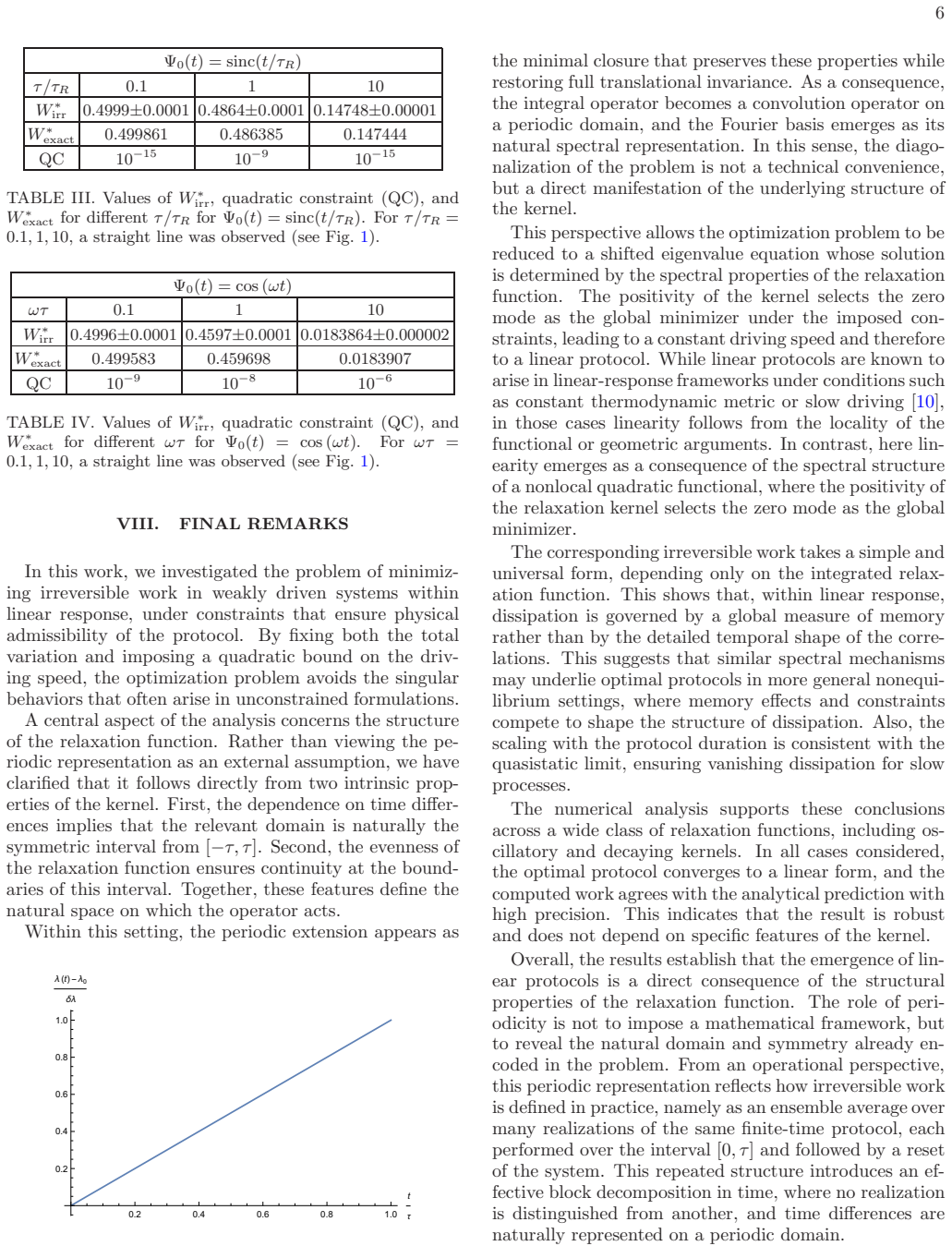
Core claim
Within the linear-response regime the minimization of irreversible work under constraints on the protocol derivative reduces to a shifted eigenvalue problem whose global minimum is the zero Fourier mode of the relaxation operator; this mode yields constant driving speed, hence a linear protocol, and the associated optimal work is fixed solely by the integrated relaxation function.
What carries the argument
The relaxation kernel viewed as an integral operator on a symmetric interval with periodic closure, which is diagonalized by Fourier modes.
If this is right
- The minimal dissipated work is determined by the integral of the relaxation function alone, independent of its detailed shape.
- Any deviation from constant driving speed increases the irreversible work.
- The optimality holds for every even, time-translation-invariant relaxation kernel.
- The result supplies an immediate practical way to compute the minimal work cost from measured relaxation data.
Where Pith is reading between the lines
- Many experimental protocols that already use linear ramps may be close to optimal without further tuning.
- The same Fourier approach could be tested on model systems with known exact relaxation functions to confirm the integral dependence.
- Extensions to mildly nonlinear driving would require checking whether the zero-mode dominance survives beyond linear response.
Load-bearing premise
Representing the relaxation kernel periodically over a symmetric time interval consistently restores continuous translational invariance without altering the physics of the original problem.
What would settle it
A direct numerical comparison showing that any non-constant protocol derivative yields strictly higher irreversible work than the constant-speed linear protocol for the same relaxation kernel and constraints.
Figures
read the original abstract
The minimization of irreversible work in weakly driven systems within linear response under physical constraints on the protocol derivative is studied. The problem reduces to a shifted eigenvalue equation involving the relaxation function. Owing to its dependence on time differences and its evenness, the relaxation kernel is naturally defined over a symmetric interval, where a periodic representation arises as a consistent closure that restores continuous translational invariance. Also, it shows how the irreversible work is defined in practice. Within this framework, the operator becomes diagonal in a Fourier basis. The global optimal solution is the zero mode, yielding a constant driving speed and a linear protocol. The corresponding optimal work depends only on the integrated relaxation function. Numerical results obtained via genetic programming confirm the robustness of this solution across different kernels.
Editorial analysis
A structured set of objections, weighed in public.
Referee Report
Summary. The paper examines minimization of irreversible work for weakly driven systems in linear response, subject to constraints on the protocol derivative. It reduces the problem to a shifted eigenvalue equation involving the relaxation function. Due to the kernel's dependence on time differences and evenness, a periodic representation is introduced as a consistent closure restoring continuous translational invariance on a symmetric interval, allowing the operator to be diagonalized in a Fourier basis. The global optimum is identified as the zero mode, corresponding to constant driving speed and thus a linear protocol; the optimal work is shown to depend only on the integrated relaxation function. Genetic programming numerics are used to confirm robustness across kernels.
Significance. If the periodic closure is rigorously justified without altering the spectrum or minimizer, the result supplies a simple, explicit optimal protocol (linear with constant speed) whose work cost is determined solely by an integrated property of the relaxation function, independent of other details. This constitutes a parameter-free prediction within the linear-response regime. The genetic-programming confirmation of robustness across different kernels is a concrete strength that supports the analytic claim.
major comments (1)
- [derivation of the shifted eigenvalue equation and periodic closure] The central claim that the zero mode is globally optimal rests on the periodic representation of the even, time-difference relaxation kernel being a consistent closure that restores translational invariance and permits Fourier diagonalization. The manuscript must demonstrate that this representation does not modify the quadratic form of the irreversible work or shift the eigenvalues relative to the original finite-interval operator with decaying (causal) boundary conditions; otherwise the identification of the zero mode as the global minimizer under the derivative constraints is not guaranteed.
Simulated Author's Rebuttal
We thank the referee for their careful reading of our manuscript and for pointing out the need for a more rigorous justification of the periodic closure. We respond to the major comment below.
read point-by-point responses
-
Referee: The central claim that the zero mode is globally optimal rests on the periodic representation of the even, time-difference relaxation kernel being a consistent closure that restores translational invariance and permits Fourier diagonalization. The manuscript must demonstrate that this representation does not modify the quadratic form of the irreversible work or shift the eigenvalues relative to the original finite-interval operator with decaying (causal) boundary conditions; otherwise the identification of the zero mode as the global minimizer under the derivative constraints is not guaranteed.
Authors: We agree that an explicit demonstration is necessary to confirm that the periodic representation does not alter the quadratic form or the relevant eigenvalues. In the original manuscript, we motivated the periodic closure based on the time-translation invariance and evenness of the kernel, which naturally suggests extending the domain periodically to restore translational invariance for diagonalization in Fourier space. To address the referee's concern, we will revise the manuscript to include a detailed appendix showing that for an even kernel K(|t-s|), the quadratic form ∫∫ u(t) K(|t-s|) u(s) dt ds is preserved under the periodic extension when u is the protocol derivative satisfying the constraints, because the evenness ensures symmetry. Furthermore, we will demonstrate that the zero mode (constant u) has the same eigenvalue in both the finite-interval and periodic cases, as it corresponds to the integrated relaxation function, and that it is the minimizer since the operator is positive definite with the zero mode being the ground state. This will be added as a new section or appendix in the revised version. revision: yes
Circularity Check
No significant circularity; derivation proceeds from explicit modeling choice
full rationale
The paper models the even, time-difference relaxation kernel over a symmetric interval and adopts a periodic representation explicitly as a closure to restore translational invariance, enabling Fourier diagonalization of the operator. The zero-mode solution and the expression for optimal work in terms of the integrated relaxation function then follow directly as the lowest-eigenvalue outcome within that chosen representation. No equation reduces by construction to a fitted input, no parameter is renamed as a prediction, and no load-bearing step rests on a self-citation chain. The periodic closure is presented as an assumption rather than derived from the target result, rendering the chain self-contained against external benchmarks.
Axiom & Free-Parameter Ledger
axioms (3)
- domain assumption Linear response theory applies to the weakly driven processes under study
- domain assumption The relaxation kernel depends only on time differences and is even
- ad hoc to paper A periodic representation of the kernel is a consistent closure that restores continuous translational invariance
Reference graph
Works this paper leans on
-
[1]
It remains only the constant eigenfunction v(t) = c0, c 0 = α 2 β0 − α 1
Case A: α 1 ̸= β n for all n ≥ 1 In this case, cn = 0, for n ≥ 1. It remains only the constant eigenfunction v(t) = c0, c 0 = α 2 β0 − α 1 . (14) Also, α 1 is free, while α 2 = c0(β0 − α 1), with c0 to be determined by the first constraint
-
[2]
(15) Also, α 1 = βm, while α 2 = c0(β0 − βm), with c0 to be determined by the first constraint
Case B: α 1 = β m The solution reduces to a single mode m v(t) = c0 + cm cos ( mπt τ ) , c 0 = α 2 β0 − βm . (15) Also, α 1 = βm, while α 2 = c0(β0 − βm), with c0 to be determined by the first constraint. 4 B. Constraints To determine the Lagrange multipliers, we impose: ∫ τ 0 v(t) dt = δλ, (16) ∫ τ 0 v(t)2 dt = C. (17)
-
[3]
Mean constraint c0 = δλ τ
Case A: α 1 ̸= β n for all n ≥ 1 a. Mean constraint c0 = δλ τ . (18) b. Quadratic constraint C = ∫ τ 0 v(t)2dt = δλ2 τ . (19) For this case, the number C is fixed by the parameters δλ and τ of the system, which are previously chosen by the agent that performs the work. In practice, it is a com- patibility condition for obtaining the zero-mode solution to t...
-
[4]
Mean constraint c0 = δλ τ
Case B: α 1 = β m a. Mean constraint c0 = δλ τ . (20) b. Quadratic constraint C = τ c2 0 + τ 2 c2 m. (21) Thus C = δλ2 τ + τ 2 c2 m. (22) In this case, cm can be adjusted according to the previ- ously chosen C. The eigenfunction depends now on an adjusted single mode m. The quadratic constraint plays a dual role in the present formulation. On the one hand...
-
[5]
1, 1, 10, a straight line was observed (see Fig. 1). 6 Ψ 0(t) = sinc( t/τ R) τ /τ R 0. 1 1 10 W ∗ irr 0.4999± 0.0001 0.4864± 0.0001 0.14748± 0.00001 W ∗ exact 0.499861 0.486385 0.147444 QC 10− 15 10− 9 10− 15 TABLE III. Values of W ∗ irr, quadratic constraint (QC), and W ∗ exact for different τ /τ R for Ψ 0(t) = sinc( t/τ R). For τ /τ R =
-
[6]
1, 1, 10, a straight line was observed (see Fig. 1). Ψ 0(t) = cos ( ωt ) ωτ 0. 1 1 10 W ∗ irr 0.4996± 0.0001 0.4597± 0.0001 0.0183864± 0.000002 W ∗ exact 0.499583 0.459698 0.0183907 QC 10− 9 10− 8 10− 6 TABLE IV. Values of W ∗ irr, quadratic constraint (QC), and W ∗ exact for different ωτ for Ψ 0(t) = cos ( ωt ). For ωτ =
-
[7]
1, 1, 10, a straight line was observed (see Fig. 1). VIII. FINAL REMARKS In this work, we investigated the problem of minimiz- ing irreversible work in weakly driven systems within linear response, under constraints that ensure physical admissibility of the protocol. By fixing both the total variation and imposing a quadratic bound on the driv- ing speed, ...
-
[8]
S. Deffner and M. V. S. Bonan¸ ca, EPL (Europhysics Let- ters) 131, 20001 (2020) , arXiv:2006.13761
-
[9]
S. Blaber and D. A. Sivak, Journal of Physics Commu- nications 7, 033001 (2023) , arXiv:2212.00706
-
[10]
Optimal Control in Soft and Active Matter
J. Alvarado, E. G. Teich, D. A. Sivak, and J. Bechhoe- fer, Annual Review of Condensed Matter Physics 17, 327 (2026), arXiv:2504.08676
work page internal anchor Pith review Pith/arXiv arXiv 2026
-
[11]
P. Naz´ e and M. V. S. Bonan¸ ca, Journal of Statistical Mechanics: Theory and Experiment 2020, 13206 (2020) , arXiv:1902.10217
-
[12]
Schmiedl and U
T. Schmiedl and U. Seifert, Physical Review Letters 98, 108301 (2007) , arXiv:0701554 [cond-mat]
2007
-
[13]
Optimal protocols for minimal work processes in underdamped stochastic thermodynamics
A. Gomez-Marin, T. Schmiedl, and U. Seifert, The Journal of Chemical Physics 129, 44101 (2008) , arXiv:0803.0269
work page internal anchor Pith review Pith/arXiv arXiv 2008
-
[14]
P. Naz´ e, Journal of Statistical Mechanics: Theory and Experiment 2024, 073205 (2024) , arXiv:2305.08597
-
[15]
Naz´ e, Physical Review E 112, 024116 (2025) , arXiv:2305.17802
P. Naz´ e, Physical Review E 112, 024116 (2025) , arXiv:2305.17802
-
[16]
P. Muratore-Ginanneschi and J. Sanders, What is a min- imum work transition in stochastic thermodynamics? (2026), arXiv:2603.11995v1
-
[17]
D. A. Sivak and G. E. Crooks, Physical Review Letters 108, 190602 (2012) , arXiv:1201.4166
work page internal anchor Pith review Pith/arXiv arXiv 2012
- [18]
-
[19]
Koza, Statistics and Computing 4, 87 (1994)
J. Koza, Statistics and Computing 4, 87 (1994)
1994
-
[20]
G. Guarnieri, J. Eisert, and H. J. Miller, Physical Review Letters 133, 070405 (2024) , arXiv:2307.01885
-
[21]
M. V. S. Bonan¸ ca and S. Deffner, Physical Review E 98, 42103 (2018) , arXiv:1803.07050
work page internal anchor Pith review Pith/arXiv arXiv 2018
-
[22]
Naz´ e,BCWD (2026)
P. Naz´ e,BCWD (2026). Appendix A: Periodic extension of the Euler-Lagrange equat ion Importantly, the periodic extension does not modify the variationa l problem on the original interval. Let K denote the operator defined on [0 , τ ] by (Kv)(t) = ∫ τ 0 Ψ 0(t − u) v(u) du, (A1) and let ˜K denote the operator obtained by periodically extending the kernel an...
2026
discussion (0)
Sign in with ORCID, Apple, or X to comment. Anyone can read and Pith papers without signing in.