REVIEW 3 major objections 5 minor 93 references
Spectral Survival Analysis
T0 review · 3 major / 5 minor · reviewed 2026-08-07 · deepseek-v4-flash
Pith's one-line read Spectral rank-regression methods reach stationary points of CoxPH and DeepSurv losses: a Markov-chain stationary distribution yields the per-sample scores, and the network is fit to those scores by regression.
desk verdict Promising spectral scaling for deep Cox models, but the App. G Δ_i=1 choice means the experiments don't validate the claim that the method optimizes the Cox partial likelihood. read the letter →
The pith
A machine-rendered reading of the paper's core claim, the machinery that carries it, and where it could break.
The reading
What carries the argument
The carrying mechanism is Theorem 1: the stationary point of the intrinsic-score subproblem satisfies the balance equations (flow into each state equals flow out) of a continuous-time Markov chain with transition rates $\boldsymbol{P}_{ji}(\boldsymbol{\pi}) = \mu_{ji} + \Delta_{ji}(\boldsymbol{\pi})$, where $\mu_{ji}$ sums weighted at-risk contributions over the winner/loser sets induced by the observed event order, and $\Delta_{ji}$ adds the KL-divergence and dual corrections that keep the chain recurrent. This turns the score update into a spectral computation — the power method applied to the chain's transition matrix — and leaves the parameter update in Eq. (11b) as a max-entropy regression of the network onto the scores. Because the transition matrix depends on the scores themselves, the procedure iterates between computing the stationary distribution and updating the rates, with the weights $\boldsymbol{W}_{ji}$ carrying the generality to CoxPH variants including DeepSurv.
What would settle it
A deciding experiment: take a small, heavily censored dataset, run the spectral method to convergence, and evaluate the gradient of the true Cox negative log-partial-likelihood (Eq. 4, with genuine indicators $\Delta_i$) at the returned scores and parameters; if that gradient norm is far from zero, the method is converging to a different objective than the one claimed. A sharper check compares the spectral solution with the exact minimizer of Eq. 5 on the same data to see whether any concordance gap is explained by the censoring surrogate.
Extended reading notes
Core claim
On the paper's own terms, the central claim is that minimizing the CoxPH and DeepSurv negative log-partial-likelihood can be decoupled from fitting the neural network. The objective is reformulated with auxiliary per-sample intrinsic scores $\boldsymbol{\pi}_i$ — quantities proportional to the probability that sample $i$ experiences an event before other at-risk samples — and solved by ADMM. Theorem 1 proves that the score-update subproblem has a stationary point satisfying the balance equations of a continuous-time Markov chain with transition rates $\boldsymbol{P}_{ji}(\boldsymbol{\pi}) = \mu_{ji} + \Delta_{ji}(\boldsymbol{\pi})$, where $\mu_{ji}$ collects weighted contributions from the risk sets and $\Delta_{ji}$ is a corrective term from the KL-divergence and dual constraints. The scores can therefore be computed by power iteration on the chain, while the network update reduces to a max-entropy regression against those scores. The introduction of weights $\boldsymbol{W}_{ji}$ is the technical departure from prior spectral ranking work, and it is what lets the same theorem cover Weighted CoxPH, heterogeneous Cox models, Deep Heterogeneous Hazard models, the Accelerated Failure Time model, and counting-process arrival rates, in addition to plain CoxPH and DeepSurv.
Load-bearing premise
The load-bearing premise is that the implementation's treatment of censored samples as events — setting $\Delta_i = 1$ for all samples to keep censored intrinsic scores away from zero, as described in App. G — is a faithful stand-in for the true Cox partial likelihood; the theorem covers the unmodified objective, so if this surrogate shifts the optimum, the spectral method is not solving the loss the paper claims to solve.
Editorial extensions
If this is right
- Deep Cox models can be trained in full batch on datasets that previously forced subsampling or patch extraction, because the memory bottleneck moves from the Siamese partial likelihood to score computation plus a standard regression fit.
- The mini-batch bias in partial-likelihood training, quantified in the paper's Lemma 1 and Corollary 1, is sidestepped: the score step consumes the full data, and the fitted loss is a decomposable regression loss.
- Because the formulation is weighted, the same solver covers Weighted CoxPH, heterogeneous Cox models, Deep Heterogeneous Hazard models, the Accelerated Failure Time model, and counting-process arrival-rate regression.
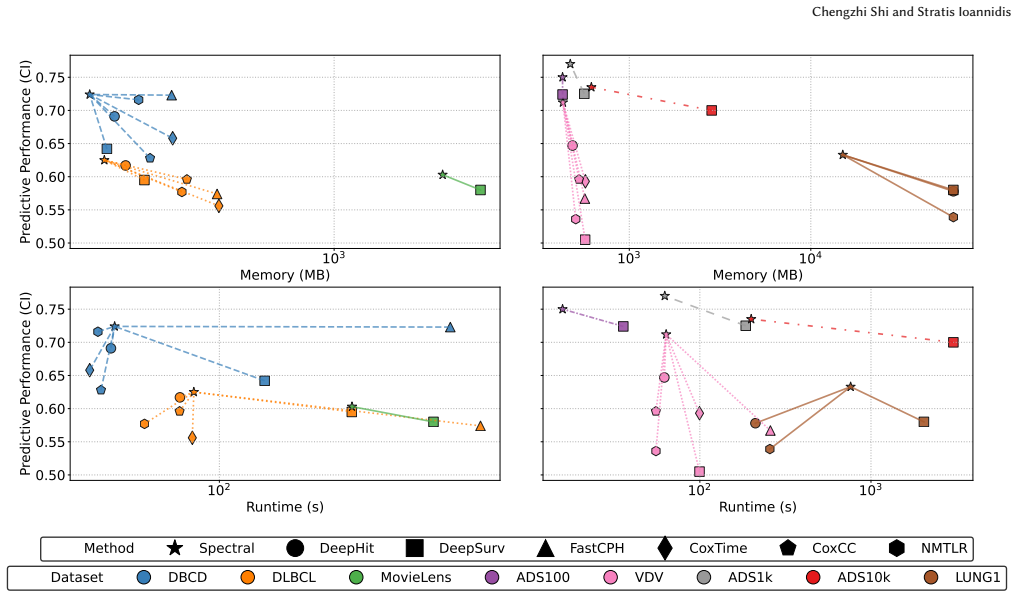
- On the LUNG1 CT dataset, competing methods exhaust 80 GB of memory even at 20% mini-batches, whereas the spectral method fits the entire scan in 15 GB and reports higher concordance, including against legacy methods that used hand-crafted patches and radiomic features.
Reading between the lines
- Extension: because the Cox partial likelihood is the Plackett-Luce ranking likelihood in survival disguise, other exchangeable ranking models (Bradley-Terry, Mallows, generalized Plackett-Luce) may admit the same Markov-chain spectral treatment for censored or partially observed orders.
- Extension: the alternating scheme used for DHH and AFT — fix baseline hazards as weights, solve the weighted spectral problem, re-estimate baselines with a Breslow estimator — is a general template, so any hazard model whose likelihood becomes a weighted Cox loss once baseline rates are fixed could reuse the solver.
- Extension: the intrinsic scores are per-sample quantities proportional to relative event probability, which suggests testing whether they transfer across datasets or tasks, for instance as initialization or pretraining signals when outcome data are sparse.
Editorial analysis
A structured set of objections, weighed in public.
Referee Report
Summary. This paper proposes Spectral Survival Analysis, an ADMM-based method that adapts spectral ranking regression to the Cox proportional hazards partial likelihood and to DeepSurv. The central claim is that the intrinsic scores obtained in the π-update are the stationary distribution of a continuous-time Markov chain, so that the CoxPH/DeepSurv loss can be decoupled from network fitting and solved by spectral iterations plus standard regression. The paper derives a weighted extension, applies it to several CoxPH variants and counting processes, and reports experiments on eight datasets including the full 3D CT-scan LUNG1 dataset, where it claims superior predictive performance and memory usage relative to existing deep survival methods.
Significance. The connection between the Cox partial likelihood and Plackett-Luce ranking is a genuine and interesting observation, and the reported ability to train on full LUNG1 CT scans with modest memory is striking. The paper ships public code and includes a substantial experimental comparison. However, the central claim is not supported as stated, because the implementation changes the objective by setting Δ_i=1 for all samples in Appendix G, and the theoretical result is not self-contained. If the objective mismatch can be resolved, the spectral approach could be a valuable contribution to scalable survival analysis; as it stands, the empirical results do not validate the claim that the method solves the stated CoxPH/DeepSurv objective.
major comments (3)
- [App. G and Eq. (8)] Appendix G states 'we set Δ_i=1 for all samples and treat it as regularization that keeps the intrinsic scores away from 0.' In the objective (8), Δ_i is the event indicator: it multiplies every numerator log-term, and Theorem 1's transition rates in Eq. (13b) inherit it through the factors Δ_ℓ in μ_ji. Setting Δ_i=1 for censored samples converts the Cox partial likelihood into a different loss in which censored observations contribute numerator log-terms as though they were events. Therefore Algorithm 1 as executed does not compute stationary points of Eq. (8), and the experimental results in Tables 2-7 do not validate the paper's central claim. A revision would need either to prove properties of the modified loss (e.g., that its stationary points coincide with, or bound, those of Eq. (8)) or to present experiments with the true censoring indicators.
- [App. E and Theorem 1] The proof of Theorem 1 in App. E derives the balance equations only for the simplified problem in Eq. (45), and then invokes 'Theorem 4.2 from [81]' without stating that theorem or showing how it applies. Since Theorem 1 is the paper's main theoretical contribution, the proof should be self-contained or should include a full statement of the cited theorem. In addition, Eq. (13b) defines the denominator as sum_{t∈R_ℓ} W_{t,i} π_t, but the derivative computation in Eq. (42) and the rearrangement in Eqs. (46)-(48) give sum_{t∈R_ℓ} W_{t,ℓ} π_t; as written, the transition rates are incorrect.
- [Sec. 4.3 and Table 10] The complexity analysis states that Algorithm 1 has memory complexity O(n^2)+O(PB), but Table 10 reports Spectral using only 1424 MB on MovieLens with n=100,000. A dense n×n transition matrix would require tens of gigabytes. The implementation must therefore exploit a sparse or implicit representation of the transition matrix, but this is not described in Sec. 4.3 or App. G. The O(n^2) memory claim is misleading as a scalability argument for large n, and the reported memory numbers cannot be reconciled with the stated complexity.
minor comments (5)
- [Throughout] There are numerous typographical errors, including 'staionary' in Sec. 1, 'Ror completeness' in Sec. 2, 'inlcuding' in Sec. 2, 'compareable' in Sec. 5.1, 'textsc-Spectral' in Sec. 5.2, and 'event' for 'even' in the Table 4 caption.
- [References] Reference [62] is a self-citation with a placeholder arXiv identifier (arXiv:XXXX.XXXXX); it should be removed or replaced with a proper citation.
- [Eq. (12b)] The notation Δ_ji(π) in Eq. (12b) is easily confused with the event indicator Δ_i; renaming the transition-rate correction term would improve readability.
- [App. G] The statement that direct optimization of the partial likelihood forces censored samples to have intrinsic score 0 is the motivation for the Δ_i=1 deviation; this claim should be made precise and analyzed formally, since it is the basis for a structural change to the objective.
- [Fig. 3 caption] The caption of Fig. 3 refers to 'ADS100K' but the corresponding dataset in Table 1 and Table 2 is ADS10k; please check and make the notation consistent.
Circularity Check
No significant circularity: the spectral method is derived from the stated CoxPH/DeepSurv objective, and the self-cited spectral-ranking theorem is independent support; the App. G \u0394_i=1 change is a soundness gap, not a circular reduction.
full rationale
The central derivation chain is not equivalent to its inputs by construction. Theorem 1's balance equations are obtained by differentiating the augmented Lagrangian (Eq. 10) for the weighted CoxPH/DeepSurv loss (Eq. 8), rearranging the first-order condition into Eq. (49), and then invoking Theorem 4.2 from Yildiz et al. [81] only to connect the simplified problem (45) to the full stationarity condition (44); that cited theorem is a parameter-free lemma about Plackett-Luce spectral ranking, stated in App. B, and it does not assume the present CoxPH result. The extension to censoring and weights is new content, and the empirical benchmarks are external to the fitted parameters. The one in-scope concern is App. G, which says 'we set \u0394_i = 1 for all samples and treat it as regularization that keeps the intrinsic scores away from 0.' This modifies the loss actually optimized relative to Eq. (8) and is not analyzed in Theorem 1; that is a missing-support/soundness issue for the experimental validation, but it is not a case of a prediction reducing by construction to its inputs. Self-citations to [81,83] are present and load-bearing for the proof technique, but they are published, restated, parameter-free results, so they do not make the derivation circular.
Assumptions & free parameters
free parameters (2)
- ADMM penalty rho =
1
- Power method max iterations =
50-200
assumptions (4)
- domain assumption Cox proportional hazards assumption: λ(t|x_i) = λ0(t) e^{θ^T x_i}
- domain assumption Independent censoring and standard i.i.d. survival data assumptions
- standard math Spectral Plackett-Luce theorem (Theorem 1 of [52], Theorem B.1 of [83])
- domain assumption ADMM convergence for non-convex objectives
invented entities (1)
-
Intrinsic scores π_i
Cite this review
Pith. "Pith review of Spectral Survival Analysis." pith.science (2026). https://pith.science/paper/WMXKLCBO
@misc{pith2026250522641,
  author       = {Pith},
  title        = {Pith review of: Spectral Survival Analysis},
  year         = {2026},
  howpublished = {\url{https://pith.science/paper/WMXKLCBO}},
  note         = {Machine review of arXiv:2505.22641}
}
read the original abstract
Survival analysis is widely deployed in a diverse set of fields, including healthcare, business, ecology, etc. The Cox Proportional Hazard (CoxPH) model is a semi-parametric model often encountered in the literature. Despite its popularity, wide deployment, and numerous variants, scaling CoxPH to large datasets and deep architectures poses a challenge, especially in the high-dimensional regime. We identify a fundamental connection between rank regression and the CoxPH model: this allows us to adapt and extend the so-called spectral method for rank regression to survival analysis. Our approach is versatile, naturally generalizing to several CoxPH variants, including deep models. We empirically verify our method's scalability on multiple real-world high-dimensional datasets; our method outperforms legacy methods w.r.t. predictive performance and efficiency.
Figures


Figures from the paper (1 more)

Reference graph
Works this paper leans on
-
[81]
Ilkay Yildiz, Jennifer Dy, Deniz Erdogmus, Jayashree Kalpathy-Cramer, Susan Ostmo, J. Peter Campbell, Michael F. Chiang, and Stratis Ioannidis. 2020. Fast and Accurate Ranking Regression. In Proceedings of the Twenty Third International Conference on Artificial Intelligence and Statistics (Proceedings of Machine Learning Research, Vol. 108), Silvia Chiapp...
work page 2020
-
[1]
Odd Aalen. 1978. Nonparametric Inference for a Family of Counting Processes. The Annals of Statistics 6, 4 (1978), 701–726. http://www.jstor.org/stable/2958850
arXiv 1978
-
[2]
2008.Survival and Event History Analysis: A Process Point of View
Odd Aalen, Ørnulf Borgan, and Hakon Gjessing. 2008.Survival and Event History Analysis: A Process Point of View . Springer. doi:10.1007/978-0-387-68560-1
-
[3]
Hugo JWL Aerts, Emmanuel Rios Velazquez, Ralph TH Leijenaar, Chintan Parmar, Patrick Grossmann, Sara Carvalho, Johan Bussink, René Monshouwer, Benjamin Haibe-Kains, Derek Rietveld, et al. 2014. Decoding tumour phenotype by nonin- vasive imaging using a quantitative radiomics approach. Nature communications 5, 1 (2014), 4006
2014
-
[4]
Nicola Barbieri, Fabrizio Silvestri, and Mounia Lalmas. 2016. Improving post- click user engagement on native ads via survival analysis. In Proceedings of the 25th International Conference on World Wide Web . 761–770
2016
-
[5]
Stephen Boyd, Neal Parikh, Eric Chu, Borja Peleato, Jonathan Eckstein, et al. 2011. Distributed optimization and statistical learning via the alternating direction method of multipliers. Foundations and Trends® in Machine learning 3, 1 (2011), 1–122
2011
-
[6]
Ralph Allan Bradley and Milton E Terry. 1952. Rank analysis of incomplete block designs: I. The method of paired comparisons. Biometrika 39, 3/4 (1952), 324–345
1952
-
[7]
Anna Braghetto, Francesca Marturano, Marta Paiusco, Marco Baiesi, and Andrea Bettinelli. 2022. Radiomics and deep learning methods for the prediction of 2-year overall survival in LUNG1 dataset. Scientific Reports 12 (08 2022), 14132. doi:10.1038/s41598-022-18085-z
Show all 93 references
-
[8]
Buchanan, Michael G
Ashley L. Buchanan, Michael G. Hudgens, Stephen R. Cole, Bryan Lau, and Adaora A. Adimora. 2014. Worth the weight: using inverse probability weighted Cox models in AIDS research. AIDS research and human retroviruses 30 12 (2014), 1170–7. https://api.semanticscholar.org/CorpusI...
2014
-
[9]
Christopher J. C. Burges, Tal Shaked, Erin Renshaw, Ari Lazier, Matt Deeds, Nicole Hamilton, and Gregory N. Hullender. 2005. Learning to rank using gradient descent. Proceedings of the 22nd international conference on Machine learning (2005). https://api.semanticscholar.org/Co...
2005
-
[10]
Zhe Cao, Tao Qin, Tie-Yan Liu, Ming-Feng Tsai, and Hang Li. 2007. Learning to rank: from pairwise approach to listwise approach. In International Conference on Machine Learning. https://api.semanticscholar.org/CorpusID:207163577
2007
-
[11]
Kevin J Carroll. 2003. On the use and utility of the Weibull model in the analysis of survival data. Controlled clinical trials 24, 6 (2003), 682–701
2003
-
[12]
Changyou Chen, Jianyi Zhang, Yi Xu, Liqun Chen, Jiali Duan, Yiran Chen, Son Tran, Belinda Zeng, and Trishul Chilimbi. 2022. Why do We Need Large Batchsizes in Contrastive Learning? A Gradient-Bias Perspective. In Advances in Neural Information Processing Systems , S. Koyejo, S...
2022
-
[13]
Xi Leslie Chen, Abhratanu Dutta, Sindhu Ernala, Stratis Ioannidis, Shankar Kalya- naraman, Israel Nir, and Udi Weinsberg. 2023. Gateway Entities in Problematic Trajectories. In Proceedings of the ACM Web Conference 2023 . 2840–2851
2023
-
[14]
Ying Qing Chen, Nicholas P Jewell, and Jingrong Yang. 2003. Accelerated hazards model: method, theory and applications. Handbook of Statistics 23 (2003), 431– 441
2003
-
[15]
Davide Chicco. 2021. Siamese neural networks: An overview. Artificial neural networks (2021), 73–94
2021
-
[16]
Pawel Chilinski and Ricardo Silva. 2020. Neural Likelihoods via Cumulative Distribution Functions. In Proceedings of the 36th Conference on Uncertainty in Artificial Intelligence (UAI) (Proceedings of Machine Learning Research, Vol. 124) , Jonas Peters and David Sontag (Eds.)....
2020
-
[17]
Travers Ching, Xun Zhu, and Lana X Garmire. 2018. Cox-nnet: an artificial neural network method for prognosis prediction of high-throughput omics data. PLoS computational biology 14, 4 (2018), e1006076
2018
-
[18]
Antonio Ciampi and Jamshid Etezadi-Amoli. 1985. A general model for testing the proportional hazards and the accelerated failure time hypotheses in the analysis of censored survival data with covariates. Communications in Statistics-theory and Methods 14 (1985), 651–667
1985
-
[19]
Alicia Curth, Changhee Lee, and Mihaela van der Schaar. 2021. SurvITE: Learning Heterogeneous Treatment Effects from Time-to-Event Data.CoRR abs/2110.14001 (2021). arXiv:2110.14001 https://arxiv.org/abs/2110.14001
2021 arXiv
-
[20]
Daniela-Emanuela Danacica and Ana-Gabriela Babucea. 2010. Using survival analysis in economics. survival 11 (2010), 15
2010
-
[21]
Cameron Davidson-Pilon. 2019. lifelines: survival analysis in Python. Journal of Open Source Software 4, 40 (2019), 1317
2019
-
[22]
Hazel Doughty, Dima Damen, and Walterio Mayol-Cuevas. 2018. Who’s better? who’s best? pairwise deep ranking for skill determination. In Proceedings of the IEEE conference on computer vision and pattern recognition . 6057–6066
2018
-
[23]
Fader and Bruce G
Peter S. Fader and Bruce G. S. Hardie. 2007. How to project customer retention. Journal of Interactive Marketing 21, 1 (2007), 76–90
2007
-
[24]
Stephane Fotso. 2018. Deep Neural Networks for Survival Analysis Based on a Multi-Task Framework. arXiv:1801.05512 [stat.ML]
2018 arXiv
-
[25]
Malte Ganssauge, Rema Padman, Pradip Teredesai, and Ameet Karambelkar
-
[26]
Michael F Gensheimer and Balasubramanian Narasimhan. 2019. A scalable discrete-time survival model for neural networks. PeerJ 7 (2019), e6257
2019
-
[27]
Peter Campbell, Michael F
Yuan Guo, Jennifer Dy, Deniz Erdoğmuş, Jayashree Kalpathy-Cramer, Susan Ostmo, J. Peter Campbell, Michael F. Chiang, and Stratis Ioannidis. 2019. Vari- ational Inference from Ranked Samples with Features. In Proceedings of The Eleventh Asian Conference on Machine Learning (Pro...
2019
-
[28]
Yuan Guo, Peng Tian, Jayashree Kalpathy-Cramer, Susan Ostmo, J Peter Camp- bell, Michael F Chiang, Deniz Erdogmus, Jennifer G Dy, and Stratis Ioannidis
-
[29]
Christoph Haarburger, Philippe Weitz, Oliver Rippel, and Dorit Merhof. 2019. Image-Based Survival Prediction for Lung Cancer Patients Using CNNS. In 2019 IEEE 16th International Symposium on Biomedical Imaging (ISBI 2019) . 1197–1201. doi:10.1109/ISBI.2019.8759499
2019
-
[30]
Bo Han. 2018. DATELINE: Deep Plackett-Luce model with uncertainty measure- ments. arXiv preprint arXiv:1812.05877 (2018)
2018 arXiv
-
[31]
Maxwell Harper and Joseph A
F. Maxwell Harper and Joseph A. Konstan. 2015. The MovieLens Datasets: History and Context. ACM Trans. Interact. Intell. Syst. 5, 4, Article 19 (Dec. 2015), 19 pages. doi:10.1145/2827872
2015 doi
-
[32]
Kaiming He, Xiangyu Zhang, Shaoqing Ren, and Jian Sun. 2015. Deep Residual Learning for Image Recognition. CoRR abs/1512.03385 (2015). arXiv:1512.03385 http://arxiv.org/abs/1512.03385
2015 arXiv
-
[33]
Xiangbin Hu, Jian Huang, Li Liu, Defeng Sun, and Xingqiu Zhao. 2021. Subgroup analysis in the heterogeneous Cox model. Statistics in medicine 40, 3 (2021), 739–757
2021
-
[34]
Stephen P Jenkins. 2005. Survival analysis. Unpublished manuscript, Institute for Social and Economic Research, University of Essex, Colchester, UK 42 (2005), 54–56
2005
-
[35]
Bingzhong Jing, Tao Zhang, Zixian Wang, Ying Jin, Kuiyuan Liu, Wenze Qiu, Liangru Ke, Ying Sun, Caisheng He, Dan Hou, Linquan Tang, Xing Lv, and Chaofeng Li. 2019. A deep survival analysis method based on ranking. Artificial Intelligence in Medicine 98 (2019), 1–9. doi:10.1016...
2019 doi
-
[36]
Thorsten Joachims. 2002. Optimizing search engines using clickthrough data. In Proceedings of the Eighth ACM SIGKDD International Conference on Knowledge Discovery and Data Mining (Edmonton, Alberta, Canada) (KDD ’02). Association for Computing Machinery, New York, NY, USA, 13...
2002 doi
-
[37]
Yogesh Kalakoti, Shashank Yadav, and Durai Sundar. 2021. SurvCNN: A Discrete Time-to-Event Cancer Survival Estimation Framework Using Image Representa- tions of Omics Data. Cancers 13, 13 (2021). doi:10.3390/cancers13133106
2021 doi
-
[38]
E. L. Kaplan and Paul Meier. 1992. Nonparametric Estimation from Incomplete Observations. Springer New York, New York, NY, 319–337. doi:10.1007/978-1- 4612-4380-9_25
1992 doi
-
[39]
Jared Katzman, Uri Shaham, Alexander Cloninger, Jonathan Bates, Tingting Jiang, and Yuval Kluger. 2018. DeepSurv: personalized treatment recommender system using a Cox proportional hazards deep neural network. BMC Medical Research Methodology 18 (2018)
2018
-
[40]
Diederik P Kingma and Jimmy Ba. 2014. Adam: A method for stochastic opti- mization. arXiv preprint arXiv:1412.6980 (2014)
2014 arXiv
-
[41]
Günter Klambauer, Thomas Unterthiner, Andreas Mayr, and Sepp Hochre- iter. 2017. Self-Normalizing Neural Networks. CoRR abs/1706.02515 (2017). arXiv:1706.02515 http://arxiv.org/abs/1706.02515
2017 arXiv
-
[42]
Jacek Kuczynski and Henryk Wozniakowski. 1992. Estimating the Largest Eigen- value by the Power and Lanczos Algorithms with a Random Start.SIAM J. Matrix Anal. Appl. 13 (1992), 1094–1122. https://api.semanticscholar.org/CorpusID: 45335210
1992
-
[44]
Håvard Kvamme, Ørnulf Borgan, and Ida Scheel. 2019. Time-to-Event Prediction with Neural Networks and Cox Regression.Journal of Machine Learning Research 20, 129 (2019), 1–30. http://jmlr.org/papers/v20/18-424.html
2019
-
[45]
William R Lane, Stephen W Looney, and James W Wansley. 1986. An application of the Cox proportional hazards model to bank failure. Journal of Banking & Finance 10, 4 (1986), 511–531
1986
-
[46]
Jean-Dominique Lebreton, Roger Pradel, and Jean Clobert. 1993. The statistical analysis of survival in animal populations. Trends in Ecology & Evolution 8, 3 (1993), 91–95
1993
-
[47]
Changhee Lee, William Zame, Jinsung Yoon, and Mihaela Van Der Schaar. 2018. Deephit: A deep learning approach to survival analysis with competing risks. In Proceedings of the AAAI conference on artificial intelligence , Vol. 32
2018
-
[48]
Hyunjun Lee, Junhyun Lee, Taehwa Choi, Jaewoo Kang, and Sangbum Choi
-
[49]
Ismael Lemhadri, Feng Ruan, and Rob Tibshirani. 2021. LassoNet: Neural Net- works with Feature Sparsity. In Proceedings of The 24th International Confer- ence on Artificial Intelligence and Statistics (Proceedings of Machine Learning Research, Vol. 130), Arindam Banerjee and K...
2021
-
[50]
Kung-Yee Liang, Steven G Self, and Xinhua Liu. 1990. The Cox proportional hazards model with change point: An epidemiologic application. Biometrics (1990), 783–793
1990
-
[51]
DY Lin. 2007. On the Breslow estimator.Lifetime data analysis 13 (2007), 471–480
2007
-
[52]
Lucas Maystre and Matthias Grossglauser. 2015. Fast and accurate inference of Plackett–Luce models. Advances in neural information processing systems 28 (2015)
2015
-
[53]
Pooya Mobadersany, Safoora Yousefi, Mohamed Amgad, David A Gutman, Jill S Barnholtz-Sloan, José E Velázquez Vega, Daniel J Brat, and Lee AD Cooper. 2018. Predicting cancer outcomes from histology and genomics using convolutional networks. Proceedings of the National Academy of...
2018
-
[54]
Paul A Murtaugh, Rolland E Dickson, Gooitzen M Van Dam, Michael Malinchoc, Patricia M Grambsch, Alice L Langworthy, and Chris H Gips. 1994. Primary biliary cirrhosis: prediction of short–term survival based on repeated patient visits. Hepatology 20, 1 (1994), 126–134
1994
-
[55]
Tapio Pahikkala, Evgeni Tsivtsivadze, Antti Airola, Jouni Järvinen, and Jorma Boberg. 2009. An efficient algorithm for learning to rank from preference graphs. Machine Learning 75 (2009), 129–165
2009
-
[56]
Plackett
Robin L. Plackett. 1975. The Analysis of Permutations. Journal of The Royal Statistical Society Series C-applied Statistics 24 (1975), 193–202
1975
-
[57]
Prentice
Ross L. Prentice. 1992.Introduction to Cox (1972) Regression Models and Life-Tables. Springer New York, New York, NY, 519–526. doi:10.1007/978-1-4612-4380-9_36 Spectral Survival Analysis
1972 doi
-
[58]
Jakob Richter, Katrin Madjar, and Jörg Rahnenführer. 2019. Model-based opti- mization of subgroup weights for survival analysis. Bioinformatics 35, 14 (07 2019), i484–i491. doi:10.1093/bioinformatics/btz361
2019 doi
-
[59]
David Rindt, Robert Hu, David Steinsaltz, and Dino Sejdinovic. 2022. Survival regression with proper scoring rules and monotonic neural networks. In Interna- tional Conference on Artificial Intelligence and Statistics . PMLR, 1190–1205
2022
-
[60]
Andreas Rosenwald, George Wright, Wing C Chan, Joseph M Connors, Elias Campo, Richard I Fisher, Randy D Gascoyne, H Konrad Muller-Hermelink, Er- lend B Smeland, Jena M Giltnane, et al . 2002. The use of molecular profiling to predict survival after chemotherapy for diffuse lar...
2002
-
[61]
David W Scott. 2015. Multivariate density estimation: theory, practice, and visual- ization. John Wiley & Sons
2015
-
[62]
Chengzhi Shi and Stratis Ioannidis. 2025. Spectral Survival Analysis. arXiv preprint arXiv:XXXX.XXXXX (2025)
2025
-
[63]
Noah Simon, Jerome Friedman, Trevor Hastie, and Rob Tibshirani. 2011. Regu- larization paths for Cox’s proportional hazards model via coordinate descent. Journal of statistical software 39, 5 (2011), 1
2011
-
[64]
Weijing Tang, Jiaqi Ma, Qiaozhu Mei, and Ji Zhu. 2022. Soden: A scalable continuous-time survival model through ordinary differential equation networks. The Journal of Machine Learning Research 23, 1 (2022), 1516–1544
2022
-
[65]
National Lung Screening Trial Research Team. 2011. The national lung screening trial: overview and study design. Radiology 258, 1 (2011), 243–253
2011
-
[66]
Peng Tian, Yuan Guo, Jayashree Kalpathy-Cramer, Susan Ostmo, John Peter Campbell, Michael F Chiang, Jennifer Dy, Deniz Erdogmus, and Stratis Ioannidis
-
[67]
Khoa A Tran, Olga Kondrashova, Andrew Bradley, Elizabeth D Williams, John V Pearson, and Nicola Waddell. 2021. Deep learning in cancer diagnosis, prognosis and treatment selection. Genome Medicine 13, 1 (2021), 1–17
2021
-
[68]
Johannes (Hans) van Houwelingen, Tako Bruinsma, Augustinus Hart, Laura van ’t Veer, and Lodewyk Wessels. 2006. Cross-validated Cox regression on microarray gene expression data. Statistics in medicine 25 (09 2006), 3201–16. doi:10.1002/sim.2353
2006 doi
-
[69]
Laura J Van’t Veer, Hongyue Dai, Marc J Van De Vijver, Yudong D He, Au- gustinus AM Hart, Mao Mao, Hans L Peterse, Karin Van Der Kooy, Matthew J Marton, Anke T Witteveen, et al. 2002. Gene expression profiling predicts clinical outcome of breast cancer. nature 415, 6871 (2002)...
2002
-
[70]
Jane-Ling Wang et al. 2005. Smoothing hazard rates. Encyclopedia of biostatistics 7 (2005), 4986–4997
2005
-
[71]
Shidan Wang, Alyssa Chen, Lin Yang, Ling Cai, Yang Xie, Junya Fujimoto, Adi Gazdar, and Guanghua Xiao. 2018. Comprehensive analysis of lung cancer pathology images to discover tumor shape and boundary features that predict survival outcome. Scientific reports 8, 1 (2018), 10393
2018
-
[72]
L. J. Wei. 1992. The accelerated failure time model: a useful alternative to the Cox regression model in survival analysis. Statistics in medicine 11 14-15 (1992), 1871–9
1992
-
[73]
Andrew Wey, John Connett, and Kyle Rudser. 2015. Combining paramet- ric, semi-parametric, and non-parametric survival models with stacked survival models. Biostatistics 16, 3 (02 2015), 537–549. doi:10.1093/ biostatistics/kxv001 arXiv:https://academic.oup.com/biostatistics/art...
2015
-
[74]
Veronika Weyer-Elberich and Harald Binder. 2015. A weighting approach for judging the effect of patient strata on high-dimensional risk prediction signatures. BMC bioinformatics 16 (09 2015), 294. doi:10.1186/s12859-015-0716-8
2015 doi
-
[75]
Matthew Witten and William Satzer. 1992. Gompertz survival model parameters: Estimation and sensitivity. Applied Mathematics Letters 5, 1 (1992), 7–12. doi:10. 1016/0893-9659(92)90125-S
1992
-
[76]
Ken Kwong-Kay Wong. 2011. Using cox regression to model customer time to churn in the wireless telecommunications industry. Journal of Targeting, Measurement and Analysis for Marketing 19 (2011), 37–43
2011
-
[77]
Ruofan Wu, Jiawei Qiao, Mingzhe Wu, Wen Yu, Ming Zheng, Tengfei Liu, Tianyi Zhang, and Weiqiang Wang. 2023. Neural Frailty Machine: Beyond proportional hazard assumption in neural survival regressions.Advances in Neural Information Processing Systems 36 (2023), 5569–5597
2023
-
[78]
Fang Xia, Jing Ning, and Xuelin Huang. 2018. Empirical Comparison of the Breslow Estimator and the Kalbfleisch Prentice Estimator for Survival Functions. Journal of biometrics & biostatistics 9 (2018). https://api.semanticscholar.org/ CorpusID:53022398
2018
-
[79]
Xuelin Yang, Louis Abraham, Sejin Kim, Petr Smirnov, Feng Ruan, Benjamin Haibe-Kains, and Robert Tibshirani. 2022. FastCPH: Efficient Survival Analysis for Neural Networks. arXiv preprint arXiv:2208.09793 (2022)
2022 arXiv
-
[80]
Jiawen Yao, Xinliang Zhu, Jitendra Jonnagaddala, Nicholas Hawkins, and Junzhou Huang. 2020. Whole slide images based cancer survival prediction using attention guided deep multiple instance learning networks. Medical Image Analysis 65 (2020), 101789. doi:10.1016/j.media.2020.101789
2020
-
[82]
Ilkay Yıldız, Jennifer Dy, Deniz Erdoğmuş, Susan Ostmo, J Peter Campbell, Michael F Chiang, and Stratis Ioannidis. 2022. Spectral Ranking Regression. ACM Transactions on Knowledge Discovery from Data (TKDD) 16, 6 (2022), 1–38
2022
-
[83]
Peter Campbell, Michael F
Ilkay Yildiz, Jennifer Dy, Deniz Erdogmus, Susan Ostmo, J. Peter Campbell, Michael F. Chiang, and Stratis Ioannidis. 2021. Deep Spectral Ranking. In Pro- ceedings of The 24th International Conference on Artificial Intelligence and Statistics (Proceedings of Machine Learning Re...
2021
-
[84]
Qingyan Yin, Wangwang Chen, Chunxia Zhang, and Zhi Wei. 2022. A convolu- tional neural network model for survival prediction based on prognosis-related cascaded Wx feature selection. Laboratory Investigation 102, 10 (2022), 1064– 1074
2022
-
[85]
Ya Zhang, Yi Wei, and Jianbiao Ren. 2014. Multi-touch attribution in online advertising with survival theory. In 2014 ieee international conference on data mining. IEEE, 687–696
2014
-
[86]
Langendijk, Stefan Both, Raymond N.J
Sunyi Zheng, Jiapan Guo, Johannes A. Langendijk, Stefan Both, Raymond N.J. Veldhuis, Matthijs Oudkerk, Peter M.A. van Ooijen, Robin Wijsman, and Nanna M. Sijtsema. 2023. Survival prediction for stage I-IIIA non-small cell lung cancer using deep learning. Radiotherapy and Oncol...
2023
-
[87]
Sunyi Zheng, Jiapan Guo, Johannes A Langendijk, Stefan Both, Raymond NJ Veldhuis, Matthijs Oudkerk, Peter MA van Ooijen, Robin Wijsman, and Nanna M Sijtsema. 2023. Survival prediction for stage I-IIIA non-small cell lung cancer using deep learning. Radiotherapy and oncology 18...
2023
-
[88]
Xinliang Zhu, Jiawen Yao, and Junzhou Huang. 2016. Deep convolutional neural network for survival analysis with pathological images. In2016 IEEE International Conference on Bioinformatics and Biomedicine (BIBM) . IEEE, 544–547
2016
-
[89]
Xinliang Zhu, Jiawen Yao, Feiyun Zhu, and Junzhou Huang. 2017. Wsisa: Making survival prediction from whole slide histopathological images. In Proceedings of the IEEE conference on computer vision and pattern recognition . 7234–7242
2017
-
[90]
Δ𝑖 log Í 𝑗∈R(𝑇𝑖) I[𝑗∈B]𝑒𝜽⊤𝒙𝑗 Í 𝑗∈R(𝑇𝑖)𝑒𝜽⊤𝒙𝑗 # =− 1 𝑛 𝑛∑︁ 𝑖=1 Δ𝑖 EB|𝑖∈B
Blaz Zupan, Janez Demsar, Michael Kattan, J. Beck, and Ivan Bratko. 1999. Ma- chine learning for survival analysis: a case study on recurrence of prostate cancer. Artif Intell Med (01 1999). Chengzhi Shi and Stratis Ioannidis A Non-Parametric and Parametric Survival Analysis M...
1999
-
[2017]
AMIA Annual Symposium Proceedings 2016 (02 2017), 1784–1793
Exploring Dynamic Risk Prediction for Dialysis Patients. AMIA Annual Symposium Proceedings 2016 (02 2017), 1784–1793
2016
-
[2018]
Experimental Design under the Bradley-Terry Model.. InIJCAI. 2198–2204
-
[2019]
In Proceedings of the 25th ACM SIGKDD International Conference on Knowledge Discovery & Data Mining
A severity score for retinopathy of prematurity. In Proceedings of the 25th ACM SIGKDD International Conference on Knowledge Discovery & Data Mining . 1809–1819
-
[2023]
In ECAI 2023
Towards Flexible Time-to-Event Modeling: Optimizing Neural Networks via Rank Regression. In ECAI 2023. IOS Press, 1340–1347
2023
Reviewed August 7, 2026 · model on record in the stance chip above.
Discussion (0). Sign in to comment.