REVIEW 2 major objections 6 minor 36 references
Unconstrained Foreground Object Search
T0 review · 2 major / 6 minor · reviewed 2026-08-14 · deepseek-v4-flash
Pith's one-line read This paper introduces unconstrained foreground object search: given a background image with a hole, retrieve semantically compatible foreground objects of any class by ranking cosine similarity in a shared embedding space.
desk verdict New task and a clever noisy-label mining idea, but the headline CAIS result is a constrained-retrieval number, not evidence for unconstrained search; worth reviewing nonetheless. read the letter →
The pith
A machine-rendered reading of the paper's core claim, the machinery that carries it, and where it could break.
The reading
What carries the argument
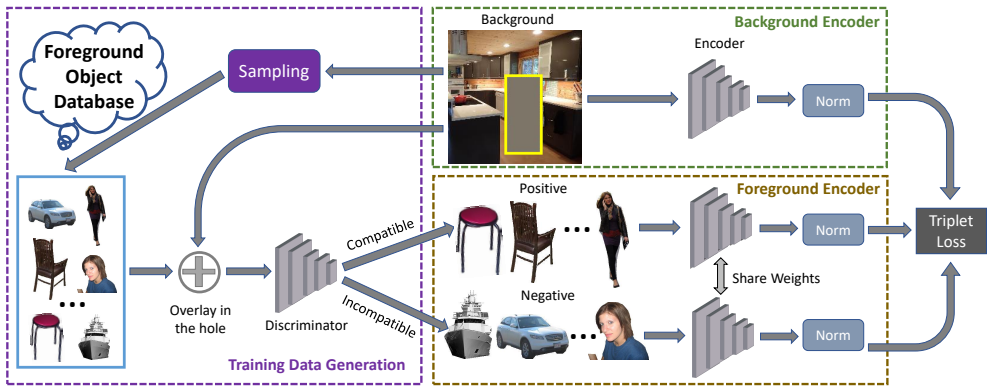
The central object is a shared embedding space built from two encoders derived from the VGG-19 network up to its fc6 layer, producing 4096-dimensional unit vectors; compatibility between a background with a hole and a candidate object is their cosine similarity. The foreground encoder keeps its pretrained weights fixed, while the background encoder is fine-tuned so that triplets—background, positive object, negative object—obey a margin constraint: positive similarity minus negative similarity must exceed a margin. The other load-bearing mechanism is the cost-free training-data pipeline: a separately trained discriminator, which sees the object overlaid in the hole and outputs a compatibility score, is used to harvest many noisy positive and negative labels per background, and nearest-neighbor search over an index of object embeddings makes retrieval fast at test time.
What would settle it
Collect human ratings of compatibility for every candidate object across all eight CAIS categories for the 80 test backgrounds, instead of using the assigned category as ground truth, and recompute mAP for the top 100 retrievals; if UFO Search no longer beats the best adapted class-constrained baseline on this multi-label ground truth, the paper's quantitative advantage rests on the proxy rather than on unconstrained semantic compatibility.
Extended reading notes
Core claim
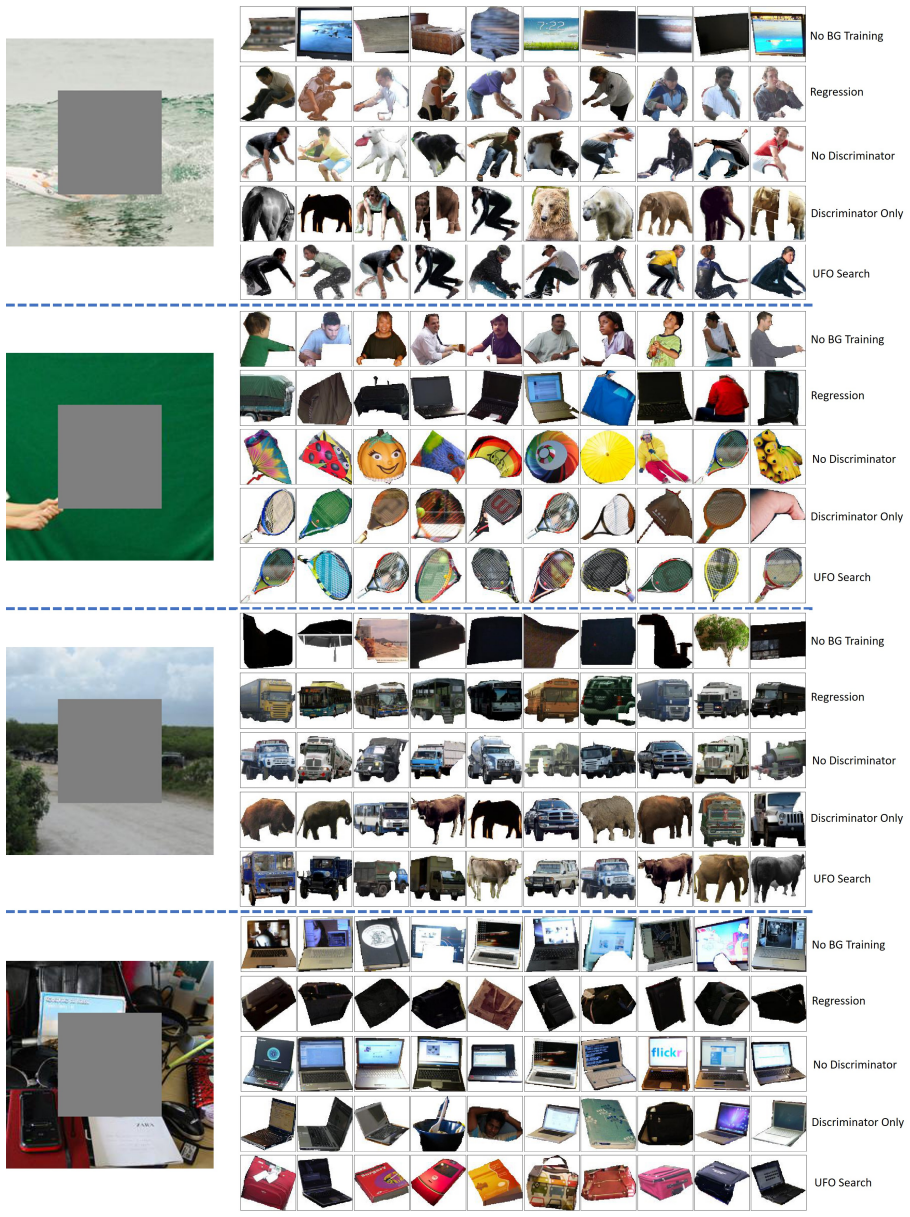
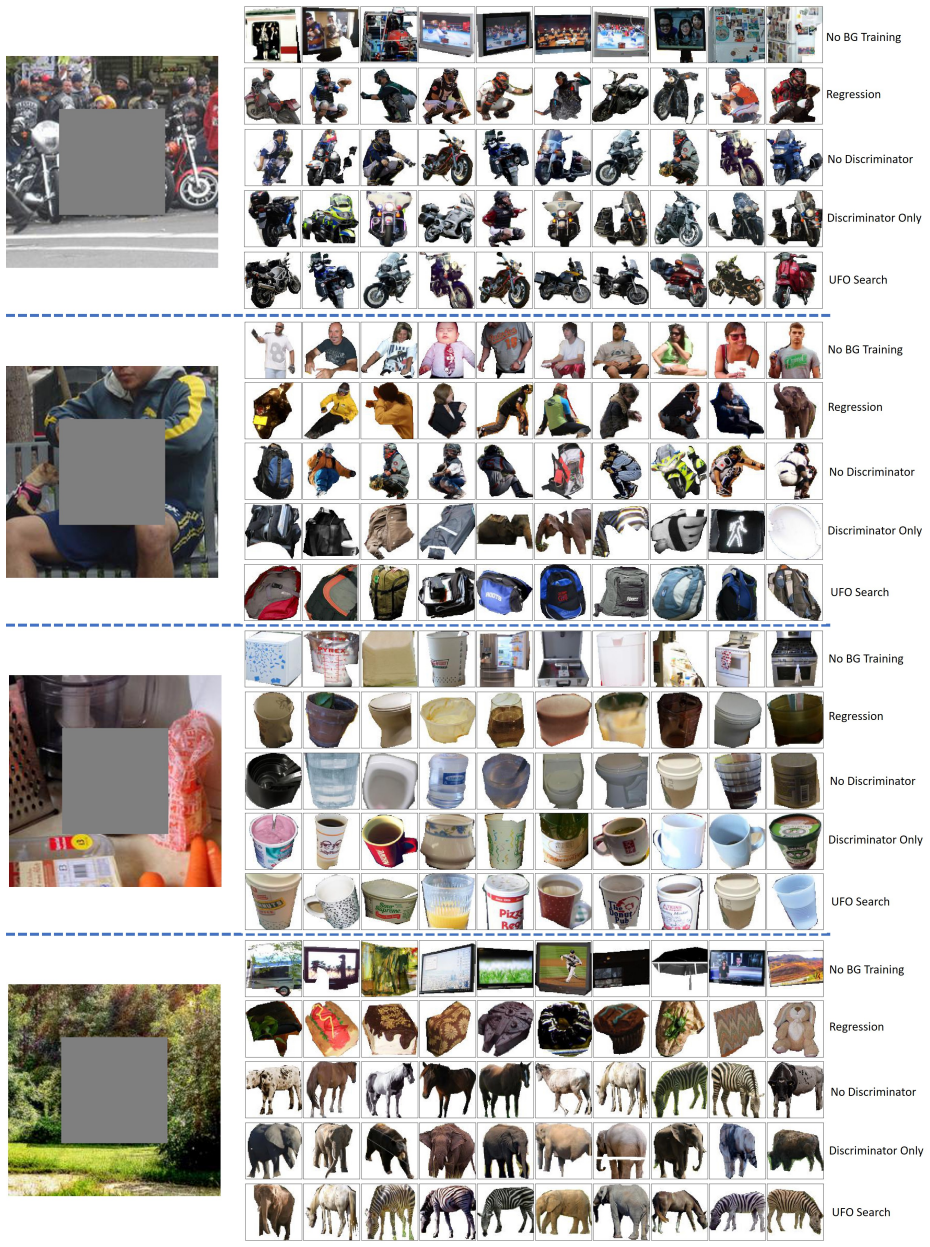
The paper claims that unconstrained foreground object compatibility can be learned directly as a metric-learning problem. A background encoder and a foreground encoder, both derived from a deep convolutional network pretrained for image classification, project their inputs into a shared space; compatible pairs have high cosine similarity and incompatible pairs low similarity. Training uses triplets of a background, a compatible object, and an incompatible object, with a margin-based hinge loss. Because only one truly compatible object is known per background, the paper introduces a pretrained discriminator that judges whether an overlaid object looks compatible, and uses its confident predictions to label many extra positive and negative foregrounds per background; two sampling heuristics (objects from similar scenes and objects similar to the original) make this labeling tractable. The experiments report that this approach outperforms shape-based, low-level-realism, and adapted class-constrained search baselines on the CAIS benchmark, and outperforms all ablated variants in a 79-category user study on MS-COCO.
Load-bearing premise
The quantitative comparison on CAIS assumes that each background hole has essentially one correct object category among the eight available categories, so mAP treats any object from another category as wrong; if that single-category proxy mislabels genuinely compatible objects, the reported advantage over constrained baselines is not a clean measurement of unconstrained compatibility.
Editorial extensions
If this is right
- Editors can explore object placement across categories in one search, since no class label is needed at query time.
- Retrieval is fast enough for interactive tools: the paper reports under 0.1 seconds to return the top 25 objects from a database of over 10,000 candidates.
- The same triplet-trained embedding can serve downstream hole-filling and compositing pipelines, leaving low-level harmonization to post-processing.
- The noisy-label training pipeline removes the need for manually annotated compatible-object pairs, making it scalable to much larger databases.
- Ranking with triplets shapes the space better than regressing to the original object's feature, and training the background encoder matters more than any other design choice.
Reading between the lines
- The method's semantic-compatibility focus means its retrieved objects will often need color and lighting adjustment before they look natural; the natural product is not a finished composite but a ranked shortlist fed into harmonization or inpainting, and the paper's own examples only hint at this pipeline.
- Because the foreground encoder is never fine-tuned, the object database can be swapped or expanded without retraining; one could index stock-photo libraries directly and test whether the embedding transfers to unseen object styles and renderings.
- A natural stress test is multi-label evaluation: if ground truth allows several very different categories per hole, the margin between UFO Search and class-constrained methods may shrink or grow, depending on whether the discriminator's labels favor diversity.
- The discriminator's confidence thresholds (0.8 and 0.3) are the main hidden dials; a sensitivity study varying them would show how much of the gain comes from the quality versus quantity of generated training triplets.
Signed reviews
Editorial analysis
A structured set of objections, weighed in public.
Referee Report
Summary. The paper introduces the problem of unconstrained foreground object (UFO) search: given a background image with a hole, retrieve foreground objects from any semantic class that are semantically compatible with the context. The proposed method uses two VGG-19 encoders, a fixed ImageNet-pretrained foreground encoder and a trainable background encoder, projecting both into a shared embedding space and ranking candidates by cosine similarity. Training uses a triplet loss, with positives and negatives generated by a separately trained compatibility discriminator and a sampling speed-up. Experiments on CAIS (quantitative mAP) and MS-COCO (user study P@K) compare against constrained search baselines and ablated variants, reporting modest improvements, e.g., 32.17% vs. 30.68% mAP over CFO-C on CAIS and 41.83 vs. 38.50 P@5 over the best ablated variant on MS-COCO.
Significance. The problem formulation is novel and practically motivated, addressing a real gap in image-editing workflows. The training-data generation scheme—using a discriminator to create noisy but diverse positives without manual annotation—is creative and, if validated, offers a scalable way to learn compatibility beyond a single semantic class. The qualitative results, particularly the MS-COCO examples showing multi-class retrievals, are compelling. However, the quantitative evidence for the central unconstrained-search claim is weakened by the evaluation protocol, which relies on a constrained ground-truth metric and lacks statistical reliability measures. If the evaluation concerns are addressed, the work would be a solid contribution to the compositing and object-retrieval literature.
major comments (2)
- [Section 4.1, Table 1] The CAIS mAP evaluation does not measure unconstrained compatibility. The ground-truth positive set for each hole is defined as objects of the single category assigned to that hole, so any compatible object from another category is automatically scored as a false positive. Even if the assertion that 'most background images with holes unambiguously match only one object category from the eight foreground object categories represented' is true, the metric rewards only retrieval of that one category; if the assertion is false, the ground truth is incomplete and noisy. Either way, the reported 1.49-point mAP advantage over CFO-C (32.17 vs. 30.68) demonstrates improvement in constrained retrieval, not in unconstrained search. The MS-COCO user study (Section 4.2) is the appropriate evidence for the unconstrained claim but is limited to 120 backgrounds with 3 raters each and no confidence intervals. The authors should either re-define the CAIS ground truth (e.g., using human ratings of compatiby across categories) or reframe the quantitative claim and rely on the user study as the primary support for unconstrained search.
- [Section 4.1 and Section 4.2] No error bars, confidence intervals, or significance tests are reported for any aggregate result. In Table 1, UFO Search is best on only four of eight categories, and the overall 1.49-point gain over CFO-C on 80 test images could easily be within noise. In Table 2, the gains over the best ablated variant are 3 to 4 percentage points on 120 backgrounds, yet without per-background variance or inter-rater agreement (e.g., Fleiss' kappa) it is unclear whether the improvements are statistically reliable. The manuscript should include bootstrap or permutation tests, or at minimum report standard deviations across backgrounds, before claiming the experiments 'demonstrate the advantage' of the method.
minor comments (6)
- [Section 4.1, 'Overall Results'] The sentence listing the four baselines repeats 'CFO-C' twice: it should read 'Shape, RealismCNN [35], CFO-C, and CFO-D.'
- [Section 4.2, 'Overall Results'] The reference 'Table E' should be 'Table 2'.
- [Supplementary Material, Section C] The citations 'CAIS [13]' should be 'CAIS [33]' in the opening sentence of Section C and in the caption of Figure 6.
- [Figure 2] The caption includes 'Share Weights' between the two encoders, but the text states that the foreground encoder weights are fixed while the background encoder is trained; please clarify that these encoders do not share weights and that the annotation refers to the architecture derivation.
- [Section 3.2] The triplet loss equation is given inline; numbering it would improve clarity for later reference.
- [Section 4.2] The user-study protocol is described as asking users to select incompatible objects, but the reported P@K is the percentage of compatible objects; please state explicitly how incompatible selections are converted to a compatibility score.
Circularity Check
No significant circularity: the UFO search pipeline is trained and evaluated against external benchmarks, and the self-citations are not load-bearing.
full rationale
The paper's central claim is that unconstrained foreground object search can be learned by jointly embedding background images and foreground objects in a shared VGG-19 feature space and ranking by cosine similarity. The derivation chain is self-contained: the foreground encoder uses fixed ILSVRC-pretrained VGG-19 weights, the background encoder is trained with a triplet loss on positives and negatives generated by an independently trained discriminator, and retrieval is nearest-neighbor search in that learned space. Nothing in the method defines compatibility in terms of the evaluation metric or fits a parameter to the test set. The CAIS evaluation uses an external dataset (Zhao et al. [33]) and the MS-COCO user study uses external annotations; neither evaluation target is an input to the training objective. The main weakness noted in the manuscript is the CAIS proxy that treats each hole as matching only one assigned object category, which is a validity caveat for the quantitative comparison, not a circularity in the derivation. The paper cites two works with author overlap: [33] (a coauthor is shared) is used as the dataset and constrained-search baseline, and [34] (same authors) is cited only in the appendix as a possible post-processing harmonization step. Neither citation supplies a load-bearing premise for the central claim, so any circularity score is low. No equation or fitted parameter is renamed as a prediction, and no uniqueness theorem or ansatz is imported from prior author work to force the method. Thus the central derivation does not reduce to its own inputs.
Assumptions & free parameters
free parameters (3)
- Triplet loss margin M =
0.3
- Discriminator thresholds thigh and tlow =
thigh=0.8, tlow=0.3
- Sampling counts KC and KG =
not reported
assumptions (5)
- domain assumption Semantic compatibility between a background and an object can be represented by proximity in a learned 4096-dimensional L2-normalized embedding space with cosine similarity.
- domain assumption VGG-19 features pretrained on ImageNet provide a sufficiently semantic fixed representation for foreground objects for compatibility search.
- domain assumption A discriminator trained with one positive (the original object in the hole) and random negatives can identify enough additional compatible objects to improve encoder training.
- domain assumption In CAIS, most holes unambiguously match exactly one of the eight categories, allowing category-restricted ground truth to serve as a valid proxy for unconstrained compatibility.
- domain assumption User labels from three annotators, with any negative vote marking an object incompatible, are a reliable measurement of compatibility.
Cite this review
Pith. "Pith review of Unconstrained Foreground Object Search." pith.science (2026). https://pith.science/paper/WO2WBOAN
@misc{pith2026190803675,
  author       = {Pith},
  title        = {Pith review of: Unconstrained Foreground Object Search},
  year         = {2026},
  howpublished = {\url{https://pith.science/paper/WO2WBOAN}},
  note         = {Machine review of arXiv:1908.03675}
}
read the original abstract
Many people search for foreground objects to use when editing images. While existing methods can retrieve candidates to aid in this, they are constrained to returning objects that belong to a pre-specified semantic class. We instead propose a novel problem of unconstrained foreground object (UFO) search and introduce a solution that supports efficient search by encoding the background image in the same latent space as the candidate foreground objects. A key contribution of our work is a cost-free, scalable approach for creating a large-scale training dataset with a variety of foreground objects of differing semantic categories per image location. Quantitative and human-perception experiments with two diverse datasets demonstrate the advantage of our UFO search solution over related baselines.
Figures


Figures from the paper (7 more)




Reference graph
Works this paper leans on
-
[33]
Compositing-aware image search
Hengshuang Zhao, Xiaohui Shen, Zhe Lin, Kalyan Sunkavalli, Brian Price, and Jiaya Jia. Compositing-aware image search. In Proceedings of the European Conference on Computer Vision (ECCV), pages 502–516, 2018
work page 2018
-
[35]
Learning a discriminative model for the perception of realism in composite images
Jun-Yan Zhu, Philipp Krahenbuhl, Eli Shechtman, and Alexei A Efros. Learning a discriminative model for the perception of realism in composite images. In Proceedings of the IEEE International Conference on Computer Vision , pages 3943–3951, 2015
work page 2015
-
[1]
Learning attribute representations with local- ization for flexible fashion search
Kenan E Ak, Ashraf A Kassim, Joo Hwee Lim, and Jo Yew Tham. Learning attribute representations with local- ization for flexible fashion search. In Proceedings of the IEEE Conference on Computer Vision and Pattern Recog- nition, pages 7708–7717, 2018
work page 2018
-
[2]
Compositional GAN: Learning Image-Conditional Binary Composition
Samaneh Azadi, Deepak Pathak, Sayna Ebrahimi, and Trevor Darrell. Compositional gan: Learning conditional image composition. arXiv preprint arXiv:1807.07560, 2018
work page Pith review arXiv 2018
-
[3]
Spatial context in recogni- tion
Moshe Bar and Shimon Ullman. Spatial context in recogni- tion. Perception, 25(3):343–352, 1996
work page 1996
-
[4]
PatchMatch: A randomized correspon- dence algorithm for structural image editing
Connelly Barnes, Eli Shechtman, Adam Finkelstein, and Dan B Goldman. PatchMatch: A randomized correspon- dence algorithm for structural image editing. ACM Trans- actions on Graphics (Proc. SIGGRAPH), 28(3), Aug. 2009
work page 2009
-
[5]
Inside-outside net: Detecting objects in context with skip pooling and recurrent neural networks
Sean Bell, C Lawrence Zitnick, Kavita Bala, and Ross Gir- shick. Inside-outside net: Detecting objects in context with skip pooling and recurrent neural networks. In Proceed- ings of the IEEE conference on computer vision and pattern recognition, pages 2874–2883, 2016
work page 2016
-
[6]
An empirical study of context in object detection
Santosh K Divvala, Derek Hoiem, James H Hays, Alexei A Efros, and Martial Hebert. An empirical study of context in object detection. In Computer Vision and Pattern Recogni- tion, 2009. CVPR 2009. IEEE Conference on , pages 1271–
work page 2009
Show all 36 references
-
[7]
Scene completion using millions of photographs
James Hays and Alexei A Efros. Scene completion using millions of photographs. In ACM Transactions on Graphics (TOG), volume 26, page 4. ACM, 2007
2007
-
[8]
Globally and locally consistent image completion
Satoshi Iizuka, Edgar Simo-Serra, and Hiroshi Ishikawa. Globally and locally consistent image completion. ACM Transactions on Graphics (ToG), 36(4):107, 2017
2017
-
[9]
Billion- scale similarity search with gpus
Jeff Johnson, Matthijs Douze, and Herv ´e J ´egou. Billion- scale similarity search with gpus. arXiv preprint arXiv:1702.08734, 2017
2017 arXiv
-
[10]
Adam: A method for stochastic optimization
Diederik P Kingma and Jimmy Ba. Adam: A method for stochastic optimization. arXiv preprint arXiv:1412.6980 , 2014
2014 arXiv
-
[11]
Photo clip art
Jean-Franc ¸ois Lalonde, Derek Hoiem, Alexei A Efros, Carsten Rother, John Winn, and Antonio Criminisi. Photo clip art. ACM transactions on graphics (TOG) , 26(3):3, 2007
2007
-
[12]
St-gan: Spatial transformer generative adversarial networks for image compositing
Chen-Hsuan Lin, Ersin Yumer, Oliver Wang, Eli Shechtman, and Simon Lucey. St-gan: Spatial transformer generative adversarial networks for image compositing
-
[13]
Microsoft coco: Common objects in context
Tsung-Yi Lin, Michael Maire, Serge Belongie, James Hays, Pietro Perona, Deva Ramanan, Piotr Doll´ar, and C Lawrence Zitnick. Microsoft coco: Common objects in context. In European conference on computer vision , pages 740–755. Springer, 2014
2014
-
[14]
Automatic differentiation in pytorch
Adam Paszke, Sam Gross, Soumith Chintala, Gregory Chanan, Edward Yang, Zachary DeVito, Zeming Lin, Al- ban Desmaison, Luca Antiga, and Adam Lerer. Automatic differentiation in pytorch. 2017
2017
-
[15]
Context encoders: Feature learning by inpainting
Deepak Pathak, Philipp Krahenbuhl, Jeff Donahue, Trevor Darrell, and Alexei A Efros. Context encoders: Feature learning by inpainting. In Proceedings of the IEEE Con- ference on Computer Vision and Pattern Recognition, pages 2536–2544, 2016
2016
-
[16]
Pois- son image editing
Patrick P ´erez, Michel Gangnet, and Andrew Blake. Pois- son image editing. ACM Transactions on graphics (TOG) , 22(3):313–318, 2003
2003
-
[17]
Data-driven detection of prominent objects
Jose A Rodriguez-Serrano, Diane Larlus, and Zhenwen Dai. Data-driven detection of prominent objects. IEEE transactions on pattern analysis and machine intelligence , 38(10):1969–1982, 2016
1969
-
[18]
Imagenet large scale visual recognition challenge
Olga Russakovsky, Jia Deng, Hao Su, Jonathan Krause, San- jeev Satheesh, Sean Ma, Zhiheng Huang, Andrej Karpathy, Aditya Khosla, Michael Bernstein, et al. Imagenet large scale visual recognition challenge. International Journal of Computer Vision, 115(3):211–252, 2015
2015
-
[19]
Very deep convo- lutional networks for large-scale image recognition
Karen Simonyan and Andrew Zisserman. Very deep convo- lutional networks for large-scale image recognition. arXiv preprint arXiv:1409.1556, 2014
2014 arXiv
-
[20]
Context-based vi- sion: recognizing objects using information from both 2 d and 3 d imagery
Thomas M Strat and Martin A Fischler. Context-based vi- sion: recognizing objects using information from both 2 d and 3 d imagery. IEEE Transactions on Pattern Analysis and Machine Intelligence, 13(10):1050–1065, 1991
1991
-
[21]
Seeing what is not there: Learning context to determine where objects are missing
Jin Sun and David W Jacobs. Seeing what is not there: Learning context to determine where objects are missing. In 2017 IEEE Conference on Computer Vision and Pattern Recognition (CVPR), pages 1234–1242. IEEE, 2017
2017
-
[22]
Multi-scale image harmonization
Kalyan Sunkavalli, Micah K Johnson, Wojciech Matusik, and Hanspeter Pfister. Multi-scale image harmonization. In ACM Transactions on Graphics (TOG) , volume 29, page
-
[23]
Where and who? automatic semantic-aware person composition
Fuwen Tan, Crispin Bernier, Benjamin Cohen, Vicente Or- donez, and Connelly Barnes. Where and who? automatic semantic-aware person composition. In 2018 IEEE Win- ter Conference on Applications of Computer Vision (WACV), pages 1519–1528. IEEE, 2018
2018
-
[24]
Error- tolerant image compositing
Michael W Tao, Micah K Johnson, and Sylvain Paris. Error- tolerant image compositing. In European Conference on Computer Vision, pages 31–44. Springer, 2010
2010
-
[25]
Contextual priming for object detection
Antonio Torralba. Contextual priming for object detection. International journal of computer vision , 53(2):169–191, 2003
2003
-
[26]
80 million tiny images: A large data set for nonparametric ob- ject and scene recognition
Antonio Torralba, Rob Fergus, and William T Freeman. 80 million tiny images: A large data set for nonparametric ob- ject and scene recognition. IEEE transactions on pattern analysis and machine intelligence, 30(11):1958–1970, 2008
1958
-
[27]
Deep image harmonization
Yi-Hsuan Tsai, Xiaohui Shen, Zhe Lin, Kalyan Sunkavalli, Xin Lu, and Ming-Hsuan Yang. Deep image harmonization. In IEEE Conference on Computer Vision and Pattern Recog- nition (CVPR), volume 2, 2017
2017
-
[28]
Unsupervised learning of visual representations using videos
Xiaolong Wang and Abhinav Gupta. Unsupervised learning of visual representations using videos. In Proceedings of the IEEE International Conference on Computer Vision , pages 2794–2802, 2015
2015
-
[29]
Get out of my picture! internet-based inpainting
Oliver Whyte, Josef Sivic, and Andrew Zisserman. Get out of my picture! internet-based inpainting. In BMVC, vol- ume 2, page 5, 2009
2009
-
[30]
High-resolution image inpainting using multi- scale neural patch synthesis
Chao Yang, Xin Lu, Zhe Lin, Eli Shechtman, Oliver Wang, and Hao Li. High-resolution image inpainting using multi- scale neural patch synthesis. In The IEEE Conference on Computer Vision and Pattern Recognition (CVPR) , vol- ume 1, page 3, 2017
2017
-
[31]
Context driven scene parsing with attention to rare classes
Jimei Yang, Brian Price, Scott Cohen, and Ming-Hsuan Yang. Context driven scene parsing with attention to rare classes. In Proceedings of the IEEE conference on computer vision and pattern recognition, pages 3294–3301, 2014
2014
-
[32]
Generative image inpainting with contex- tual attention
Jiahui Yu, Zhe Lin, Jimei Yang, Xiaohui Shen, Xin Lu, and Thomas S Huang. Generative image inpainting with contex- tual attention. arXiv preprint, 2018
2018
-
[34]
Guided image inpainting: Replacing an image re- gion by pulling content from another image
Yinan Zhao, Brian Price, Scott Cohen, and Danna Gu- rari. Guided image inpainting: Replacing an image re- gion by pulling content from another image. arXiv preprint arXiv:1803.08435, 2018
2018 arXiv
-
[36]
Faithful completion of images of scenic landmarks using internet images
Zhe Zhu, Hao-Zhi Huang, Zhi-Peng Tan, Kun Xu, and Shi- Min Hu. Faithful completion of images of scenic landmarks using internet images. IEEE transactions on visualization and computer graphics, 22(8):1945–1958, 2015. Appendix This document supplements our methods and results p...
1945
Reviewed August 14, 2026 · model on record in the stance chip above.
Discussion (0). Continue with ORCID to comment.