REVIEW 4 major objections 6 minor 41 references
NeurOptimisation: The Spiking Way to Evolve
T0 review · 4 major / 6 minor · reviewed 2026-08-06 · deepseek-v4-flash
Pith's one-line read The paper claims that NeurOptimiser, a fully spike-based, asynchronous framework, solves BBOB problems up to 40 dimensions using coordination that emerges from local spiking events rather than a central program, with milliwatt-scale power…
desk verdict Real engineering contribution with public code, but the central claims about full spike-basing, decentralisation, and milliwatt power are ahead of the implemented architecture; re-scope and it is worth engaging seriously. read the letter →
The pith
A machine-rendered reading of the paper's core claim, the machinery that carries it, and where it could break.
The reading
What carries the argument
The central object is the Neuromorphic Heuristic Unit (NHU): one spiking neuron per coordinate of a candidate solution, each following the generalised transition $v^{t+1} \leftarrow h_d(v^t)$ if $\Phi(v^t, \ldots) \neq 1$ and $v^{t+1} \leftarrow h_s(v^t)$ otherwise, with $\Phi$ the spiking condition, typically $|v_{1,j}| \geq \vartheta_j$. Here $h_d$ supplies the exploration dynamics (linear systems, LIF, or Izhikevich models), $h_s$ acts as the perturbation heuristic (stochastic reset, reset toward a best state, directional displacement, or differential-evolution mutation), and the bidirectional map $T$ translates between problem-space coordinates and neuromorphic states. The mechanism works because the spiking condition is simultaneously a selection predicate and a communication event: a spike both resets or perturbs the unit and propagates through a bulk spike-contraction layer to activate neighbouring units, so search and coordination are the same event.
What would settle it
Run the same NeurOptimiser configurations on a Loihi 2 chip and measure energy per optimisation step; if measured power for the n=90, d=40, m=89 worst case is not in the roughly watt-level range of the estimate, the power-feasibility claim fails. A cheaper check is to instrument the CPU simulation to record total emitted spikes and compare that count with the n(n-1)md synaptic-event formula used in the estimate.
Extended reading notes
Core claim
On its own terms, the paper's central claim is that the search operator of a metaheuristic can be realised by spiking neuron dynamics rather than by an external program. Each candidate solution is a set of $d$ neurons; their internal states evolve under a dynamic rule $h_d$, and when the spiking condition $\Phi$ triggers, a spike-triggered rule $h_s$ applies a heuristic perturbation, such as a reset toward the best-so-far state or a differential-evolution-style mutation. Local and global coordination, including neighbourhood information, global best sharing, and spike propagation, emerge from asynchronous message passing encoded as spikes rather than from a central loop. The authors argue that this is the first complete and reproducible integration of neuromorphic heuristic-based optimisers, and they report that on BBOB up to 40 dimensions the heterogeneous variants converge reliably on separable, unimodal, and moderately conditioned problems, with runtime linear in population size and dimension, per-unit steps under 12 ms, and power estimates from milliwatts to about 1.35 W in the tested worst case.
Load-bearing premise
The load-bearing premise is that counting events in a CPU simulation and pricing each one with the Loihi chip's published per-event energies gives a realistic picture of real neuromorphic hardware; if real spike counts or per-event costs are substantially different, the milliwatt feasibility claim collapses.
Editorial extensions
If this is right
- If NeurOptimiser is right, general-purpose optimisation can run on event-driven neuromorphic hardware without a CPU orchestrator, making the same algorithm deployable in low-power embedded settings.
- The spike-triggered rule is pluggable: both simple resets and differential-evolution mutations are expressible, so established metaheuristic operators can be ported onto spiking substrates rather than re-designed from scratch.
- Coordination by spike propagation means communication cost scales with actual spiking activity rather than with a fixed synchronisation schedule, so sparse firing directly lowers energy consumption.
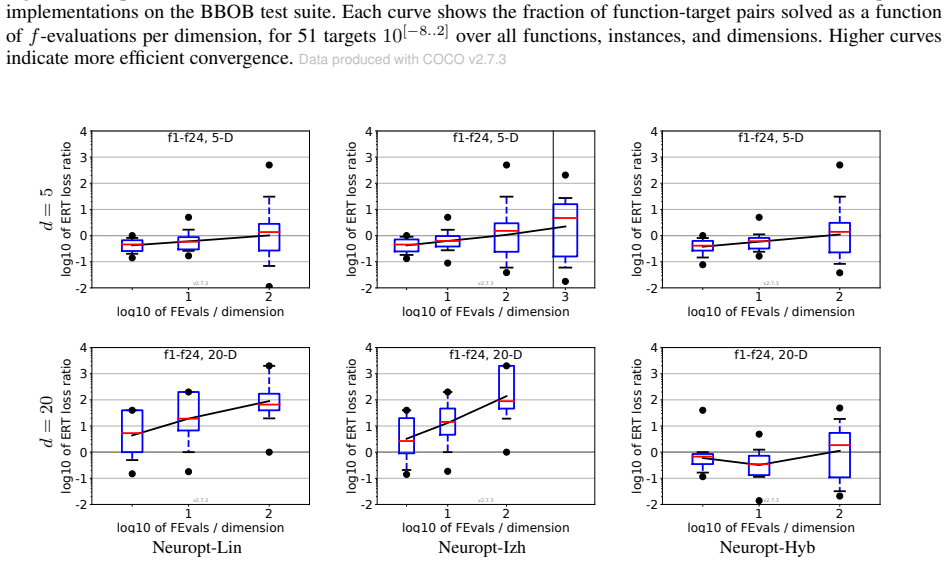
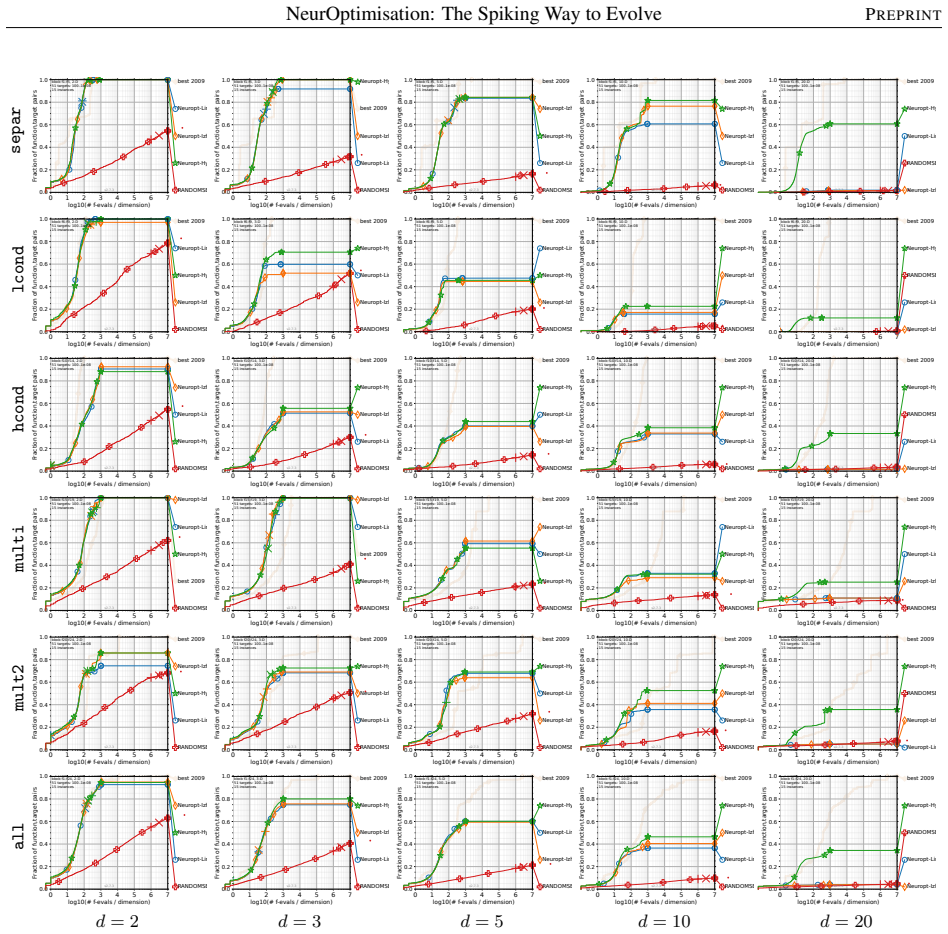
- Heterogeneous populations that mix linear and Izhikevich neuron dynamics proved more robust than homogeneous ones on multimodal and ill-conditioned BBOB problems, pointing to neuron-model diversity as a search resource.
- Runtime and resource usage scale linearly with population size and dimension, supporting the feasibility of large asynchronous populations on neuromorphic hardware.
Reading between the lines
- Editorial inference: the paper attributes the high-dimensional ECDF plateaus to constrained evaluation budgets rather than algorithmic stagnation; a direct test would run the same variants with budgets comparable to the BBOB 2009 reference and check whether the plateaus lift.
- The analytical power model assumes worst-case dense connectivity, so a testable extension is to measure actual emitted spikes on the hardware or in simulation and recompute the per-step energy with measured synaptic-event counts, which could bring the estimate below the milliwatt levels already reported.
- A natural next step the paper leaves implicit is adaptive spike-threshold tuning tied to local convergence, which could reduce superfluous spiking and further lower the energy estimate.
- The framework defines a design space for choosing $h_d$, $h_s$, and $\Phi$; a promising untested direction is learning which neuron-model or mutation combination suits a given problem class, turning the NHU configuration itself into a search problem.
Editorial analysis
A structured set of objections, weighed in public.
Referee Report
Summary. The manuscript introduces NeurOptimiser, a framework that combines spiking neuron models with metaheuristic search. A population of Neuromorphic Heuristic Units (NHUs) encodes candidate solutions into neuron states, applies a dynamic rule h_d and a spike-triggered rule h_s (fixed reset or DE/current-to-rand/1), and communicates through a spike matrix, a Neighbour Manager, and a High-Level Selector. The authors implement the system in Intel's Lava framework with Loihi 2 as target, evaluate on noiseless BBOB functions in 2--40 dimensions against BBOB 2009 and RANDOMSEARCH, and estimate power consumption from Loihi per-event costs. They claim this is a fully spike-based, fully decentralised, low-energy optimisation framework.
Significance. The paper is a useful proof of concept: it shows that spike-triggered heuristic rules can drive a population-based search on standard benchmark functions, it ships reproducible code and data, and it benchmarks against external references rather than fitted baselines. The internal-dynamics visualisations (Figs. 6--9) are a strength. However, the significance as claimed in the abstract and conclusion ('fully spike-based', 'fully decentralised', 'milliwatt-level') is not supported by the described implementation, since several coordinating components operate on real-valued position/fitness matrices and all results come from CPU simulation rather than Loihi 2 deployment. The contribution is better framed as a CPU-simulated, spike-triggered heuristic framework with a Loihi target.
major comments (4)
- [Section 4.3 (Algorithms 6 and 8)] The claim that coordination arises 'without external orchestration' (Section 7) is contradicted by the architecture. Algorithm 6 collects every NHU's PPP and f_p, performs a global argmin over all units, and broadcasts the real-valued global best ggg; Algorithm 8 centrally builds and redistributes neighbourhood matrices P_n and F_n from all units. These are central coordination processes operating on floating-point data, not native spiking mechanisms.
- [Section 4.2 (Algorithms 2, 4, 5) and Eq. (21b)] The 'fully spike-based' claim is not supported: candidate positions are real-valued; the Selector evaluates f on the host CPU and maintains ppp in floating point; Sender/Receiver exchange real-valued position and fitness arrays; and the DE mutation in Eq. (21b) is an arithmetic update on real-valued state vectors, with spikes only determining whether the rule fires. Spikes act as event triggers around CPU heuristics rather than as the substrate of the search, so the strongest formulation in Section 7 ('spiking dynamics ... search engine') is an overstatement.
- [Section 6 (Figure 13)] The power feasibility claim is based on an analytical estimate, not a measurement. The formula E_step = 23.6 N_syn + 89.7 n pJ multiplies Loihi per-event costs from [41] by the algorithm's event count and divides by an assumed Delta_t_sim = 0.5 ms; no Loihi 2 chip was used. Moreover, the worst-case estimate reported in Figure 13 is 1.35 W, which contradicts the 'milliwatt-level' wording in the abstract and Section 7. The data support sub-watt estimates for small configurations, but not the stated milliwatt-level feasibility claim.
- [Sections 5 and 6] All experiments are CPU simulations; Loihi 2 is only 'targeted'. Statements in Section 6 ('we anticipate further gains') and Section 7 ('suitability ... for practical NC hardware deployments') go beyond the evidence. The authors should confine conclusions to spike-triggered heuristics in simulation and describe the Loihi deployment as future work, or add a measured deployment.
minor comments (6)
- [Section 3.3, Eqs. (21a)--(21b)] Two equations are listed but the text says they correspond to three strategies ('current-to-best, rand-to-best, and current-to-rand'); align the number of equations with the description.
- [Section 3.2, Eq. (13)] The spike-triggered rule h_s in Eq. (13) appears to return a complex scalar ϑ1 + ϑ2 r1 e^{i2πr2}, while the state space V is real and two-dimensional; clarify the intended construction, for example as a vector in polar coordinates.
- [Section 5 vs. Figures 6--9] The first experiment is described as using 1000×d steps, but the captions of Figures 6--9 say 1000 steps; reconcile this inconsistency.
- [Section 3.4, Eq. (22)] The random value r introduced in the encoding must be retained for deterministic invertibility; specify where this per-step random value is stored and how T^{-1} accesses it, since the algorithm as written does not keep r in the state.
- [Figure 13 caption] There is a typo ('Averate') in the caption of Figure 13, and the caption does not clearly map the parenthetical power values to the (n, d) settings, making the figure harder to read.
- [Table 1] The header row for f1 appears garbled ('f111 12 12 ...') in the preprint; ensure the table renders correctly.
Circularity Check
No significant circularity found: the framework is benchmarked against external BBOB baselines and its core claims do not reduce to fitted parameters or to self-citations.
full rationale
The paper's core contribution is an implemented framework whose components are defined independently of the benchmark results. The spiking neuron dynamics (Section 3.2), spike-triggered heuristics (Section 3.3), and coordination processes (Section 4) are all specified through explicit equations and algorithms rather than through fitted parameters. Performance claims are validated against the external BBOB 2009 reference and RANDOMSEARCH baselines using COCO and IOH, and the power feasibility estimate uses per-event costs reported in an external Loihi hardware paper multiplied by the algorithm's own event counts; this is a scaling calculation, not a prediction derived from fitted data. The self-citation [7] supplies the 'Nheuristics' vocabulary and design-space framing, but no experimental result or architectural constraint in this paper is forced by that citation; the paper could stand without it. The only noticeable internal tension is that the High-Level Selector (Algorithm 6) and Neighbour Manager (Algorithm 8) are central, non-spiking coordinators that exchange real-valued position and fitness arrays, which sits uneasily with the abstract's 'without external orchestration' wording. However, this is an internal-consistency or correctness concern about the strength of the claim, not a circularity in the derivation, and it does not make any result equivalent to its inputs by construction. Accordingly, the circularity score remains 0.
Assumptions & free parameters
free parameters (9)
- F (DE scale factor) =
not reported
- alpha (encoding gain in T) =
not reported in experiments (text suggests alpha=1)
- alpha_thr (threshold base) =
not reported
- Delta t (integration step) =
0.01
- Izhikevich parameters a,b,c,d =
from [31]
- reference weights w1, w2 =
0.5 each
- number of NHUs, n =
30 (up to 90 in scaling)
- neighbourhood size, m =
10 (up to 89 in scaling)
- sigma (noise std in fixed h_s) =
not reported
assumptions (3)
- domain assumption The BBOB noiseless suite is an adequate benchmark for continuous black-box optimization
- domain assumption Loihi per-event energy costs from [41] (23.6 pJ per synaptic event, 81 pJ per neuron update, 8.7 pJ per spike) transfer to this Lava simulation workload
- ad hoc to paper Spiking condition (15a) with l2-norm and threshold (16b) interacts with h_d and h_s to produce useful search
invented entities (2)
-
Neuromorphic Heuristic Unit (NHU)
-
Tensor Contraction Layer
Cite this review
Pith. "Pith review of NeurOptimisation: The Spiking Way to Evolve." pith.science (2026). https://pith.science/paper/WO67PQ2I
@misc{pith2026250708320,
  author       = {Pith},
  title        = {Pith review of: NeurOptimisation: The Spiking Way to Evolve},
  year         = {2026},
  howpublished = {\url{https://pith.science/paper/WO67PQ2I}},
  note         = {Machine review of arXiv:2507.08320}
}
read the original abstract
The increasing energy footprint of artificial intelligence systems urges alternative computational models that are both efficient and scalable. Neuromorphic Computing (NC) addresses this challenge by empowering event-driven algorithms that operate with minimal power requirements through biologically inspired spiking dynamics. We present the NeurOptimiser, a fully spike-based optimisation framework that materialises the neuromorphic-based metaheuristic paradigm through a decentralised NC system. The proposed approach comprises a population of Neuromorphic Heuristic Units (NHUs), each combining spiking neuron dynamics with spike-triggered perturbation heuristics to evolve candidate solutions asynchronously. The NeurOptimiser's coordination arises through native spiking mechanisms that support activity propagation, local information sharing, and global state updates without external orchestration. We implement this framework on Intel's Lava platform, targeting the Loihi 2 chip, and evaluate it on the noiseless BBOB suite up to 40 dimensions. We deploy several NeurOptimisers using different configurations, mainly considering dynamic systems such as linear and Izhikevich models for spiking neural dynamics, and fixed and Differential Evolution mutation rules for spike-triggered heuristics. Although these configurations are implemented as a proof of concept, we document and outline further extensions and improvements to the framework implementation. Results show that the proposed approach exhibits structured population dynamics, consistent convergence, and milliwatt-level power feasibility. They also position spike-native MHs as a viable path toward real-time, low-energy, and decentralised optimisation.
Figures


Figures from the paper (10 more)



Reference graph
Works this paper leans on
-
[41]
Loihi: A neuromorphic manycore processor with on-chip learning,
M. Davies, N. Srinivasa, T.-H. Lin, G. Chinya, Y . Cao, S. H. Choday, G. Dimou, P. Joshi, N. Imam, S. Jain, Y . Liao, C.-K. Lin, A. Lines, R. Liu, D. Mathaikutty, S. McCoy, A. Paul, J. Tse, G. Venkataramanan, Y .-H. Weng, A. Wild, Y . Yang, and H. Wang, “Loihi: A neuromorphic manycore processor with on-chip learning,” IEEE Micro, vol. 38, no. 1, p. 82–99,...
work page 2018
-
[1]
An electromagnetic perspec- tive of artificial intelligence neuromorphic chips,
E.-P. Li, H. Ma, M. Ahmed, T. Tao, Z. Gu, M. Chen, Q. Chen, D. Li, and W. Chen, “An electromagnetic perspec- tive of artificial intelligence neuromorphic chips,”Electromagnetic Science, vol. 1, no. 3, p. 18, 2023
work page 2023
-
[2]
Sanaullah, S. Koravuna, U. Rückert, and T. Jungeblut, “Exploring spiking neural networks: a comprehen- sive analysis of mathematical models and applications,”Frontiers in Computational Neuroscience, vol. 17, p. 1215824, 2023
work page 2023
-
[3]
Spiking Neural Networks: A Survey,
J. D. Nunes, M. Carvalho, D. Carneiro, and J. S. Cardoso, “Spiking Neural Networks: A Survey,”IEEE Access, vol. 10, p. 60738–60764, 2022
work page 2022
-
[4]
Neuromorphic artificial intelligence sys- tems,
D. Ivanov, A. Chezhegov, M. Kiselev, A. Grunin, and D. Larionov, “Neuromorphic artificial intelligence sys- tems,”Frontiers in Neuroscience, vol. 16, p. 959626, 2022
work page 2022
-
[5]
A survey on evolutionary computation for complex continuous optimization,
Z.-H. Zhan, L. Shi, K. C. Tan, and J. Zhang, “A survey on evolutionary computation for complex continuous optimization,”Artificial Intelligence Review, vol. 55, no. 1, pp. 59–110, 2022
work page 2022
-
[6]
Large-scale evolutionary optimization: A review and comparative study,
J. Liu, R. Sarker, S. Elsayed, D. Essam, and N. Siswanto, “Large-scale evolutionary optimization: A review and comparative study,”Swarm and Evolutionary Computation, vol. 85, p. 101466, 2024
work page 2024
-
[7]
E. Talbi, “Neuromorphic-based metaheuristics: A new generation of low power, low latency and small footprint optimization algorithms,” 2025. [Online]. Available: https://arxiv.org/abs/2505.16362
work page Pith review arXiv 2025
Show all 41 references
-
[8]
Lava: A software framework for neuromorphic computing,
Intel Neuromorphic Computing Lab, “Lava: A software framework for neuromorphic computing,” https://github. com/lava-nc, 2023, accessed: 2025-03-28
2023
-
[9]
COCO: A platform for comparing continuous optimizers in a black-box setting,
N. Hansen, A. Auger, R. Ros, O. Mersmann, T. Tušar, and D. Brockhoff, “COCO: A platform for comparing continuous optimizers in a black-box setting,”Optimization Methods and Software, vol. 36, pp. 114–144, 2021
2021
-
[10]
A ferroelectric memristor-based transient chaotic neural network for solving combinatorial optimization problems,
Z. Lin and Z. Fan, “A ferroelectric memristor-based transient chaotic neural network for solving combinatorial optimization problems,”Symmetry, vol. 15, no. 1, p. 59, 2022
2022
-
[11]
Organic memristor-based flexible neural networks with bio-realistic synaptic plasticity for complex combinatorial optimization,
H. Kim, M. Kim, A. Lee, H. Park, J. Jang, J. Bae, I. M. Kang, E. Kim, and S. Lee, “Organic memristor-based flexible neural networks with bio-realistic synaptic plasticity for complex combinatorial optimization,”Advanced Science, vol. 10, no. 19, p. 2300659, 2023
2023
-
[12]
Neuromorphic swarm on RRAM compute-in-memory processor for solving QUBO problem,
A. S. Lele, M. Chang, S. D. Spetalnick, B. Crafton, A. Raychowdhury, and Y . Fang, “Neuromorphic swarm on RRAM compute-in-memory processor for solving QUBO problem,”2023 60th ACM/IEEE Design Automation Conference (DAC), vol. 00, pp. 1–6, 2023
2023
-
[13]
Solving QUBO on the Loihi 2 Neuromorphic Processor,
A. Pierro, P. Stratmann, G. A. F. Guerra, S. Risbud, T. Shea, A. R. Mangalore, and A. Wild, “Solving QUBO on the Loihi 2 Neuromorphic Processor,”arXiv, 2024
2024
-
[14]
Towards spike-based machine intelligence with neuromorphic computing,
K. Roy, A. Jaiswal, and P. Panda, “Towards spike-based machine intelligence with neuromorphic computing,” Nature, vol. 575, no. 7784, pp. 607–617, 2019
2019
- [15]
-
[16]
Evolutionary optimization for neuromorphic systems,
C. D. Schuman, J. P. Mitchell, R. M. Patton, T. E. Potok, and J. S. Plank, “Evolutionary optimization for neuromorphic systems,” inProceedings of the 2020 Annual Neuro-Inspired Computational Elements Workshop, ser. NICE’20. New York, NY , USA: ACM, 2020. [Online]. Available: h...
2020
-
[17]
Real-time evolution and deployment of neu- romorphic computing at the edge,
C. D. Schuman, S. R. Young, B. P. Maldonado, and B. C. Kaul, “Real-time evolution and deployment of neu- romorphic computing at the edge,” in2021 12th International Green and Sustainable Computing Conference (IGSC). IEEE, 2021, pp. 1–8
2021
-
[18]
A swarm optimization solver based on ferroelectric spiking neural networks,
Y . Fang, Z. Wang, J. Gomez, S. Datta, A. I. Khan, and A. Raychowdhury, “A swarm optimization solver based on ferroelectric spiking neural networks,”Frontiers in Neuroscience, vol. 13, p. 855, 2019
2019
-
[19]
Swarm intelligence algorithm based on spiking neural-oscillator networks, coupling interactions and search performances,
T. Sasaki and H. Nakano, “Swarm intelligence algorithm based on spiking neural-oscillator networks, coupling interactions and search performances,”Nonlinear Theory and Its Applications, IEICE, vol. 14, no. 2, p. 267–291, 2023. 23 NeurOptimisation: The Spiking Way to EvolvePREPRINT
2023
-
[20]
Advancements in algorithms and neuromorphic hard- ware for spiking neural networks,
A. Javanshir, T. Nguyen, M. Mahmud, and A. Kouzani, “Advancements in algorithms and neuromorphic hard- ware for spiking neural networks,”Neural Computation, vol. 34, no. 6, p. 1289–1328, 2022
2022
-
[21]
Neuromorphic bayesian optimization in Lava,
S. Snyder, S. R. Risbud, and M. Parsa, “Neuromorphic bayesian optimization in Lava,” inProc. International Conference on Neuromorphic Systems, ser. ICONS ’23. New York, NY , USA: ACM, 2023. [Online]. Available: https://doi.org/10.1145/3589737.3605998
2023
-
[22]
Asynchronous neuromorphic optimization in Lava,
S. Snyder, S. Risbud, and M. Parsa, “Asynchronous neuromorphic optimization in Lava,” inProc. Great Lakes Symposium on VLSI 2024, ser. GLSVLSI ’24. New York, NY , USA: ACM, 2024, p. 776–778. [Online]. Available: https://doi.org/10.1145/3649476.3660383
2024
-
[23]
Parallelized multi-agent bayesian optimization in Lava,
S. Snyder, D. Gobin, V . Clerico, S. R. Risbud, and M. Parsa, “Parallelized multi-agent bayesian optimization in Lava,” inProc. International Conference on Neuromorphic Systems, 2024, pp. 295–298
2024
-
[24]
Hyper-heuristics to customise metaheuristics for continuous optimisation,
J. Cruz-Duarte, I. Amaya, J. Ortiz-Bayliss, S. Conant-Pablos, H. Terashima-Marín, and Y . Shi, “Hyper-heuristics to customise metaheuristics for continuous optimisation,”Swarm Evol. Comput., vol. 66, p. 100935, 2021
2021
-
[25]
Recent advances in selection hyper-heuristics,
J. H. Drake, A. Kheiri, E. Özcan, and E. K. Burke, “Recent advances in selection hyper-heuristics,”European Journal of Operational Research, vol. 285, pp. 405–428, 2020, https://linkinghub.elsevier.com/retrieve/pii/S0377221719306526. [Online]. Available: https://doi.org/10.101...
2020 doi
-
[26]
Talbi,Metaheuristics: from design to implementation
E.-G. Talbi,Metaheuristics: from design to implementation. John Wiley & Sons, 2009
2009
-
[27]
Towards a generalised metaheuristic model for continuous optimisation problems,
J. M. Cruz-Duarte, J. C. Ortiz-Bayliss, I. Amaya, Y . Shi, H. Terashima-Marín, and N. Pillay, “Towards a generalised metaheuristic model for continuous optimisation problems,”Mathematics, vol. 8, pp. 1–23, 11 2020. [Online]. Available: https://www.mdpi.com/2227-7390/8/11/2046
2020
-
[28]
Differential evolution mutations: Taxonomy, comparison and convergence analysis,
A. W. Mohamed, A. A. Hadi, and A. K. Mohamed, “Differential evolution mutations: Taxonomy, comparison and convergence analysis,”IEEE Access, vol. 9, pp. 68 629–68 662, 2021
2021
-
[29]
Spiking neural networks and their applications: A review,
K. Yamazaki, V .-K. V o-Ho, D. Bulsara, and N. Le, “Spiking neural networks and their applications: A review,” Brain Sciences, vol. 12, no. 7, p. 863, 2022
2022
-
[30]
Opportunities for neuromorphic computing algorithms and applications,
C. D. Schuman, S. R. Kulkarni, M. Parsa, J. P. Mitchell, P. Date, and B. Kay, “Opportunities for neuromorphic computing algorithms and applications,”Nature Computational Science, vol. 2, no. 1, p. 10–19, 2022
2022
-
[31]
Simple model of spiking neurons,
E. M. Izhikevich, “Simple model of spiking neurons,”IEEE Transactions on Neural Networks, vol. 14, no. 6, p. 1569, 2003
2003
-
[32]
H. S. Steven,Nonlinear dynamics and chaos: with applications to physics, biology, chemistry, and engineering. CHAPMAN & HALL CRC, 2024
2024
-
[33]
Tornado: An Autonomous Chaotic Algorithm for Large Scale Global Optimization,
N. Aslimani, E.-G. Talbi, and R. Ellaia, “Tornado: An Autonomous Chaotic Algorithm for Large Scale Global Optimization,” Mar. 2020, working paper or preprint. [Online]. Available: https://inria.hal.science/hal-02499326
2020
-
[34]
A review of computational models for gamma oscillation dynamics: from spiking neurons to neural masses,
Z. Liu, F. Han, and Q. Wang, “A review of computational models for gamma oscillation dynamics: from spiking neurons to neural masses,”Nonlinear Dynamics, vol. 108, no. 3, p. 1849–1866, 2022
2022
-
[35]
Spiking neural networks for nonlinear regression,
A. Henkes, J. K. Eshraghian, and H. Wessels, “Spiking neural networks for nonlinear regression,”Royal Society Open Science, vol. 11, no. 5, p. 231606, 2024
2024
-
[36]
Tensor Contraction Layers for Parsimo- nious Deep Nets,
J. Kossaifi, A. Khanna, Z. Lipton, T. Furlanello, and A. Anandkumar, “Tensor Contraction Layers for Parsimo- nious Deep Nets,”2017 IEEE Conference on Computer Vision and Pattern Recognition Workshops (CVPRW), pp. 1940–1946, 2017
2017
-
[37]
Neuroptimisation: The spiking way to evolve - experiment codes and dataset,
J. M. Cruz-Duarte and E.-G. Talbi, “Neuroptimisation: The spiking way to evolve - experiment codes and dataset,” Jul. 2025. [Online]. Available: https://doi.org/10.5281/zenodo.15858610
2025 doi
-
[38]
Real-parameter black-box optimization benchmarking 2009: Noiseless functions definitions,
S. Finck, N. Hansen, R. Ros, and A. Auger, “Real-parameter black-box optimization benchmarking 2009: Noiseless functions definitions,” INRIA, Tech. Rep. RR-6829, 2009, updated version as of Feb. 2019. [Online]. Available: https://inria.hal.science/inria-00362633v2
2009
-
[39]
IOHexperimenter: Benchmarking Platform for Iterative Optimization Heuristics,
J. de Nobel, F. Ye, D. Vermetten, H. Wang, C. Doerr, and T. Bäck, “IOHexperimenter: Benchmarking Platform for Iterative Optimization Heuristics,”arXiv, Nov. 2021. [Online]. Available: https://arxiv.org/abs/2111.04077
2021 arXiv
-
[40]
Benchmarking the pure random search on the bbob-2009 testbed,
A. Auger and R. Ros, “Benchmarking the pure random search on the bbob-2009 testbed,” inProc. 11th Annual Conference Companion on Genetic and Evolutionary Computation Conference: Late Breaking Papers, 2009, pp. 2479–2484
2009
Reviewed August 6, 2026 · model on record in the stance chip above.
Discussion (0). Continue with ORCID to comment.