New features in the Z2xZ2 3HDM two component DM model
Pith reviewed 2026-05-21 18:05 UTC · model grok-4.3
The pith
A Z2xZ2-symmetric three-Higgs-doublet model permits two inert doublets to both act as dark matter and contribute comparably to the observed relic density.
A machine-rendered reading of the paper's core claim, the machinery that carries it, and where it could break.
Core claim
The Z2xZ2 symmetry stabilizes two inert Higgs doublets whose masses and couplings can be arranged so that both particles remain in thermal equilibrium long enough to produce a combined relic density matching observation, while the vacuum analysis shows that the desired inert configuration can be the global minimum without additional mixing or decay channels.
What carries the argument
The Z2xZ2 discrete symmetry that assigns opposite charges to the two inert doublets, forbidding vacuum expectation values for them and preventing mixing with the active doublet, thereby ensuring their individual stability as dark matter particles.
If this is right
- Both dark matter particles participate in annihilation and co-annihilation processes that together set the relic density, altering the expected rates compared with single-component scenarios.
- Direct and indirect detection experiments receive contributions from two distinct particles, producing characteristic mass and coupling patterns that differ from single-particle models.
- Collider searches gain sensitivity to pair production of the heavier inert state followed by decays into the lighter one plus visible particles.
- The vacuum competition analysis restricts the allowed quartic couplings, which in turn limits the possible mass splittings between the two dark matter candidates.
Where Pith is reading between the lines
- Direct detection bounds must be reinterpreted as limits on the sum of two independent scattering cross sections rather than a single effective rate.
- Similar vacuum analyses applied to other multi-component dark matter models could uncover additional viable regions that single-component assumptions miss.
- Cosmological evolution of the early universe could select among the competing minima, offering a potential link between the relic density and the choice of vacuum.
Load-bearing premise
The chosen Z2xZ2 symmetry must remain unbroken in the vacuum so that the two inert doublets stay stable and do not develop mixing or decay modes that would invalidate the two-component dark matter interpretation.
What would settle it
Observation of a decay channel for one of the inert scalars into standard-model particles, or a direct-detection signal whose rate and mass spectrum cannot be reproduced by any combination of two particles with the couplings predicted by the model.
Figures
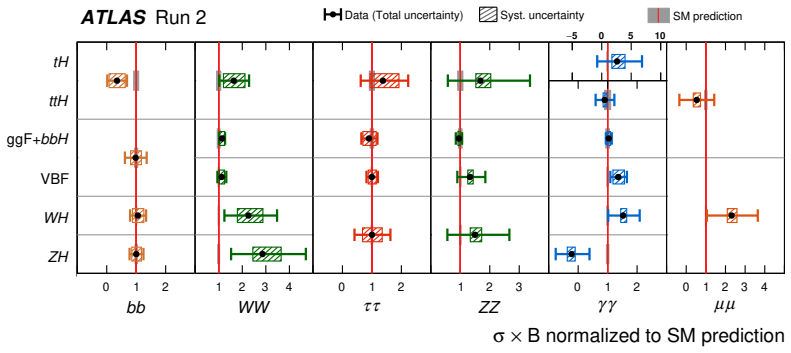


read the original abstract
We investigate the constraints and phenomenology of a three Higgs doublet model (3HDM) with a $\Z2\times\Z2$ symmetry, featuring two inert scalar doublets that give rise to a two-component dark matter (DM) scenario. We analyze the model's vacuum structure, exploring the competition between different symmetry-breaking minima, and subject it to comprehensive theoretical and current experimental constraints. Our analysis reveals previously unexplored regions of parameter space with viable dark matter candidates. Notably, we identify scenarios where both DM particles contribute comparably to the observed relic density, offering distinctive experimental signatures that could guide future searches.
Editorial analysis
A structured set of objections, weighed in public.
Referee Report
Summary. The manuscript studies a three-Higgs-doublet model with an exact Z2×Z2 symmetry that leaves two scalar doublets inert, realizing a two-component dark matter scenario. It examines the vacuum structure by comparing competing symmetry-breaking minima, applies theoretical constraints (bounded-from-below, unitarity) and experimental limits (collider, relic density, direct detection), and reports previously unexplored parameter regions in which both inert doublets remain stable and contribute comparably to the observed relic density, yielding distinctive experimental signatures.
Significance. If the vacuum analysis rigorously establishes that the global minimum preserves the full Z2×Z2 symmetry (zero vevs for both inert doublets) throughout the newly identified viable regions, the work would usefully extend the phenomenology of multi-component dark matter in extended Higgs sectors. The identification of comparable relic-density contributions from both particles is a concrete, falsifiable prediction that could guide future direct-detection and collider searches.
major comments (1)
- [Vacuum structure analysis] Vacuum structure analysis (as described in the abstract and main text): The headline claim that both DM particles remain stable and contribute comparably to the relic density requires explicit verification that the reported global minimum preserves the full Z2×Z2 symmetry with vanishing vevs for the two inert doublets. The abstract notes that competition between minima is explored, yet no quantitative statement is given on the fraction of scanned points for which the desired minimum is global or on the size of any induced mixing operators. This is load-bearing; if even a subset of the new regions admits a deeper minimum that breaks one Z2 factor, the two-component interpretation and the associated relic-density calculation become invalid.
minor comments (1)
- [Abstract] The abstract states that 'comprehensive theoretical and experimental constraints were applied' but supplies no quantitative information on the relic-density computation method, the specific observables entering the fit, or the post-scan cuts. These details should be stated explicitly in the methods section.
Simulated Author's Rebuttal
We thank the referee for the careful reading of our manuscript and for highlighting the importance of rigorously establishing the vacuum structure. We address the major comment point by point below and will incorporate the requested clarifications in a revised version.
read point-by-point responses
-
Referee: Vacuum structure analysis (as described in the abstract and main text): The headline claim that both DM particles remain stable and contribute comparably to the relic density requires explicit verification that the reported global minimum preserves the full Z2×Z2 symmetry with vanishing vevs for the two inert doublets. The abstract notes that competition between minima is explored, yet no quantitative statement is given on the fraction of scanned points for which the desired minimum is global or on the size of any induced mixing operators. This is load-bearing; if even a subset of the new regions admits a deeper minimum that breaks one Z2 factor, the two-component interpretation and the associated relic-density calculation become invalid.
Authors: We agree that explicit confirmation that the Z2×Z2-preserving minimum is global is essential to support the two-component DM interpretation. Our analysis in the manuscript does compare the potential values of competing minima (including those that break one or both Z2 factors) for each scanned point to ensure the inert doublets remain stable. We acknowledge, however, that a quantitative summary—such as the fraction of viable points for which the desired minimum is global, or bounds on any induced mixing—was not provided. In the revised manuscript we will add a dedicated paragraph in the vacuum structure section reporting that, for all points in the newly identified viable regions that satisfy the full set of theoretical and experimental constraints, the Z2×Z2-symmetric minimum with vanishing vevs for both inert doublets is the global minimum. We will also state that no deeper symmetry-breaking minima were found and that the exact Z2×Z2 symmetry precludes induced mixing operators between the two inert sectors. These additions will directly address the load-bearing nature of the claim. revision: yes
Circularity Check
No significant circularity; standard phenomenological scan with independent vacuum and relic-density calculations
full rationale
The paper performs a parameter-space scan of a Z2×Z2-symmetric 3HDM, analyzes competing minima for vacuum stability, and computes relic densities for two inert doublets under the assumption that the chosen vacuum preserves the discrete symmetries. No equation or result is shown to be defined in terms of itself, no fitted parameter is relabeled as a prediction, and no load-bearing claim reduces to a self-citation chain. The vacuum-structure analysis and relic-density computation are presented as separate numerical steps subject to external constraints, making the derivation self-contained against benchmarks outside the fitted values.
Axiom & Free-Parameter Ledger
Lean theorems connected to this paper
-
IndisputableMonolith/Foundation/RealityFromDistinction.leanreality_from_one_distinction unclear?
unclearRelation between the paper passage and the cited Recognition theorem.
We analyze the model’s vacuum structure, exploring the competition between different symmetry-breaking minima... both DM particles contribute comparably to the observed relic density
-
IndisputableMonolith/Foundation/AlexanderDuality.leanalexander_duality_circle_linking unclear?
unclearRelation between the paper passage and the cited Recognition theorem.
The necessary and sufficient conditions for the Z2×Z2 3HDM to be bounded from below are only known along neutral directions
What do these tags mean?
- matches
- The paper's claim is directly supported by a theorem in the formal canon.
- supports
- The theorem supports part of the paper's argument, but the paper may add assumptions or extra steps.
- extends
- The paper goes beyond the formal theorem; the theorem is a base layer rather than the whole result.
- uses
- The paper appears to rely on the theorem as machinery.
- contradicts
- The paper's claim conflicts with a theorem or certificate in the canon.
- unclear
- Pith found a possible connection, but the passage is too broad, indirect, or ambiguous to say the theorem truly supports the claim.
Reference graph
Works this paper leans on
-
[1]
R. Boto, P. N. Figueiredo, J. C. Rom˜ ao and J. P. Silva,JHEP11, 108 (2024), https://doi.org/10.1007/JHEP11(2024)108. [2]PlanckCollaboration, N. Aghanim et al.,Astron. Astrophys.641(2020) A6,http: //arxiv.org/abs/1807.06209arXiv:1807.06209. [Erratum:Astron.Astrophys. 652, C4 (2021)]
work page internal anchor Pith review Pith/arXiv arXiv doi:10.1007/jhep11(2024)108 2024
- [2]
- [3]
-
[4]
Natural Multi-Higgs Model with Dark Matter and CP Violation
B. Grzadkowski, O. M. Ogreid, and P. Osland,Phys. Rev. D80(2009) 055013, http://arxiv.org/abs/0904.2173[arXiv:0904.2173]
work page internal anchor Pith review Pith/arXiv arXiv 2009
-
[5]
K. Kannike, Eur. Phys. J. C72, 2093 (2012)https://doi.org/10.1140/epjc/ s10052-012-2093-z, [arXiv:1205.37819]
-
[6]
J. Hernandez-Sanchez, V. Keus, S. Moretti, D. Rojas-Ciofalo, and D. Sokolowska, http://arxiv.org/abs/2012.11621 [arXiv:2012.11621]
- [7]
- [8]
-
[9]
The oblique parameters in multi-Higgs-doublet models
W. Grimus, L. Lavoura, O. M. Ogreid, and P. Osland,Nucl. Phys. B801(2008) 81--96, http://arxiv.org/abs/0802.4353 [arXiv:0802.4353]. [11]ATLASCollaboration, G. Aad et al.,Nature607(2022), no. 7917 52--59, http://arxiv.org/abs/2207.00092 [arXiv:2207.00092]. [Erratum: Nature 612, E24 (2022)]
work page internal anchor Pith review Pith/arXiv arXiv 2008
-
[10]
H. Bahl, T. Biek¨ otter, S. Heinemeyer, C. Li, S. Paasch, G. Weiglein, and J. Wittbrodt,Comput. Phys. Commun.291(2023) 108803, http: //arxiv.org/abs/2210.09332 [arXiv:2210.09332]. [13]CMSCollaboration, A. M. Sirunyan et al.,Phys. Rev. D99(2019), no. 11 112003, http://arxiv.org/abs/1901.00174 [arXiv:1901.00174]
-
[11]
G. Aadet al.[ATLAS], Phys. Lett. B 842, 137963 (2023) https: //doi.org/10.1016/j.physletb.2023.137963 [arXiv:2301.10731]. [15]LZCollaboration, J. Aalbers et al.,Phys. Rev. Lett.131(2023), no. 4 041002, http://arxiv.org/abs/2207.03764 [arXiv:2207.03764]. [16]Fermi-LATCollaboration, M. Ackermann et al.,Phys. Rev. Lett.115(2015), no. 23 231301, http://arxiv....
-
[12]
D. Fontes and J. C. Rom~ ao,Comput. Phys. Commun.256(2020) 107311, http://arxiv.org/abs/1909.05876 [arXiv:1909.05876]
-
[13]
D. Fontes and J. C. Rom~ ao,JHEP06(2021) 016, http://arxiv.org/abs/ 2103.06281 [arXiv:2103.06281]. [Erratum: JHEP 12, 005 (2021)]
-
[14]
D. Fontes and J. C. Rom~ ao, http://arxiv.org/abs/2504.01865 [arXiv:2504.01865]
-
[15]
A Precision Search for WIMPs with Charged Cosmic Rays
A. Reinert and M. W. Winkler,JCAP01(2018) 055, http://arxiv.org/ abs/1712.00002 [arXiv:1712.00002]. 10
work page internal anchor Pith review Pith/arXiv arXiv 2018
discussion (0)
Sign in with ORCID, Apple, or X to comment. Anyone can read and Pith papers without signing in.