Impact of parity-violating deep-inelastic scattering on the weak mixing angle and high-x parton distributions
Pith reviewed 2026-06-25 18:58 UTC · model grok-4.3
The pith
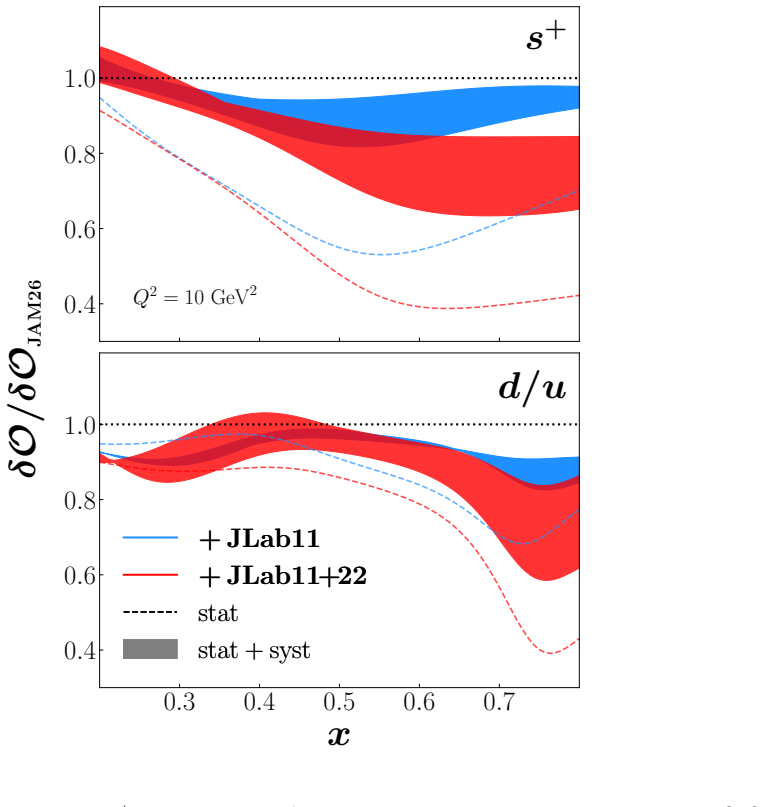
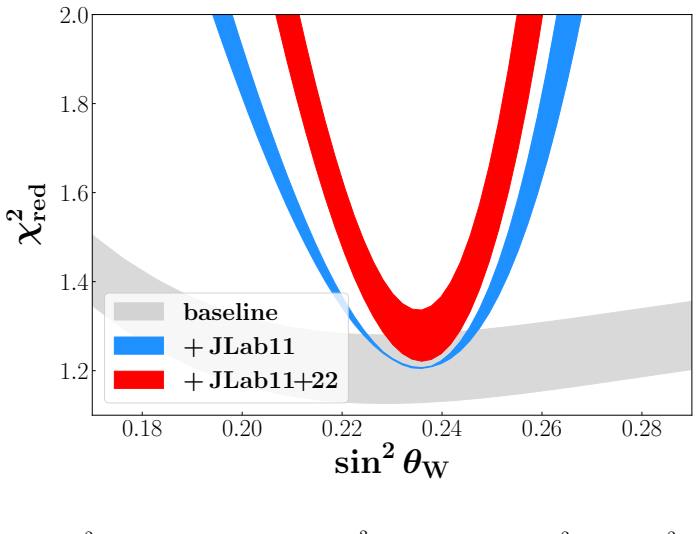
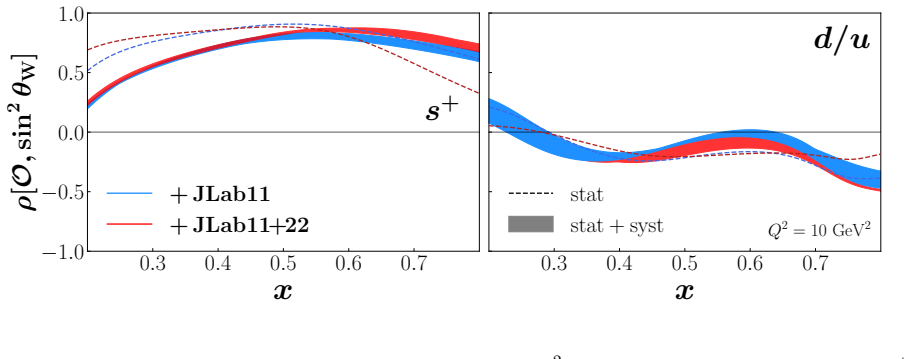
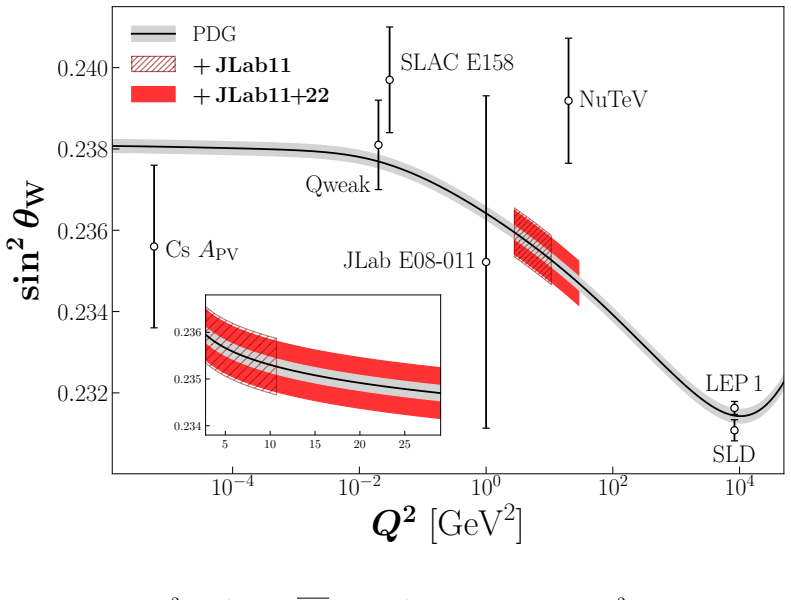
Including future parity-violating deep-inelastic scattering data can constrain the weak mixing angle at low Q² and the high-x strange quark and d/u parton distributions.
A machine-rendered reading of the paper's core claim, the machinery that carries it, and where it could break.
Core claim
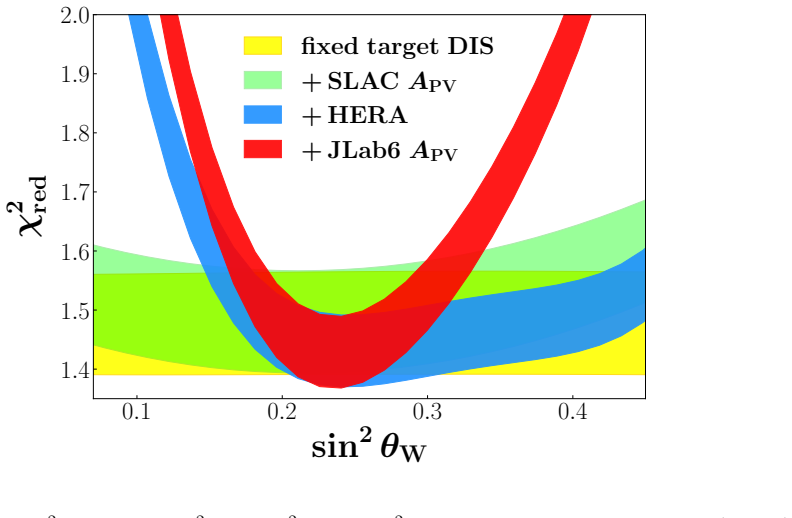
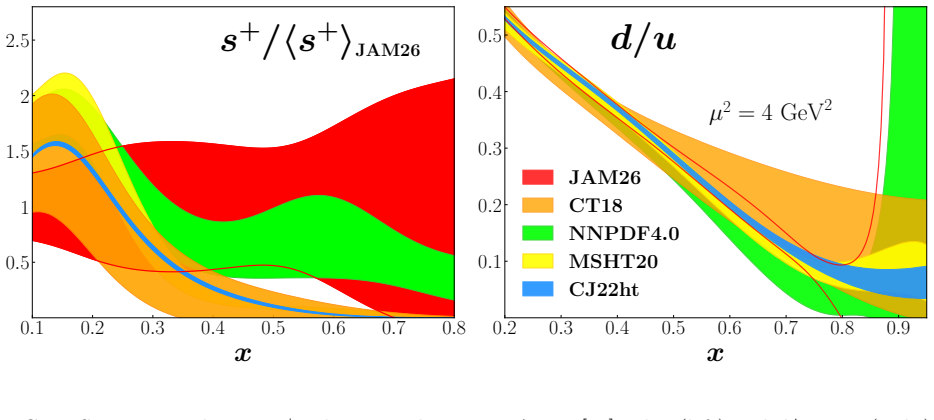
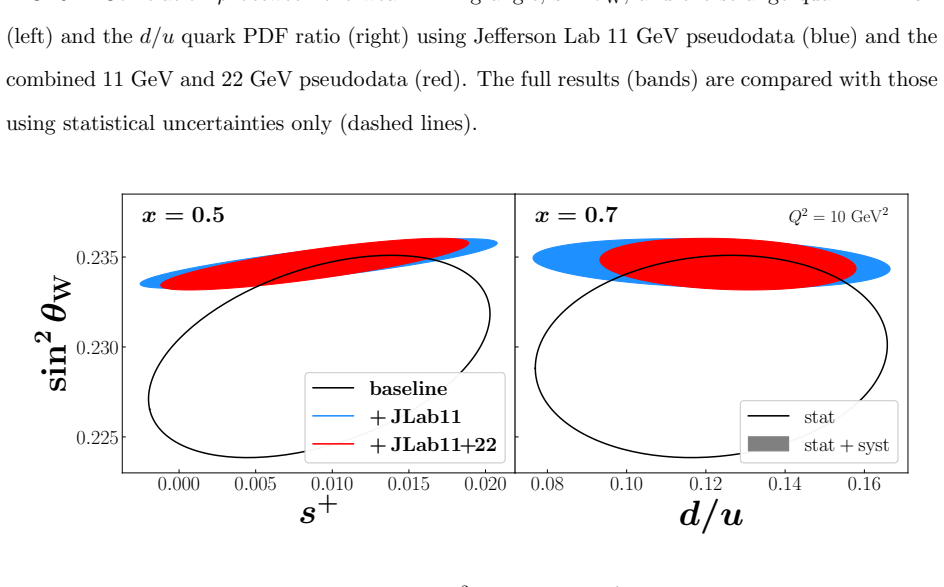
Incorporating simulated PVDIS pseudodata for 11 GeV and 22 GeV kinematics into the JAM global QCD analysis yields important constraints on sin²θ_W at low Q² and on the high-x strange quark PDF and d/u ratio, while revealing strong correlations that require simultaneous QCD and electroweak fitting for an unbiased determination of the weak mixing angle.
What carries the argument
The JAM global QCD analysis framework applied to parity-violating deep-inelastic scattering pseudodata with factorized QED+QCD radiative corrections and higher-twist uncertainties in γZ exchange.
If this is right
- Future PVDIS data would constrain sin²θ_W at low momentum transfers.
- Such data would limit the high-x strange quark distribution.
- The d/u PDF ratio at large x would be better determined.
- Simultaneous fitting of PDFs and electroweak parameters is required to prevent bias in sin²θ_W.
Where Pith is reading between the lines
- The method could be extended to include data from other facilities to further reduce uncertainties on sin²θ_W.
- If actual data deviates from the pseudodata assumptions, it could indicate new physics beyond the standard model or underestimated higher-twist effects.
- Improved high-x PDFs from this approach would benefit predictions for other high-energy processes at colliders.
Load-bearing premise
The pseudodata generated for the projected 11 GeV and 22 GeV Jefferson Lab experiments, including their assigned uncertainties, accurately represent the statistical and systematic features of real future measurements.
What would settle it
A real measurement of the parity-violating asymmetry in electron-proton and electron-deuteron scattering at the simulated kinematics that produces a value of sin²θ_W differing by more than the quoted uncertainty from the value obtained in the joint fit would challenge the paper's conclusions on the necessity of simultaneous analysis.
Figures
read the original abstract
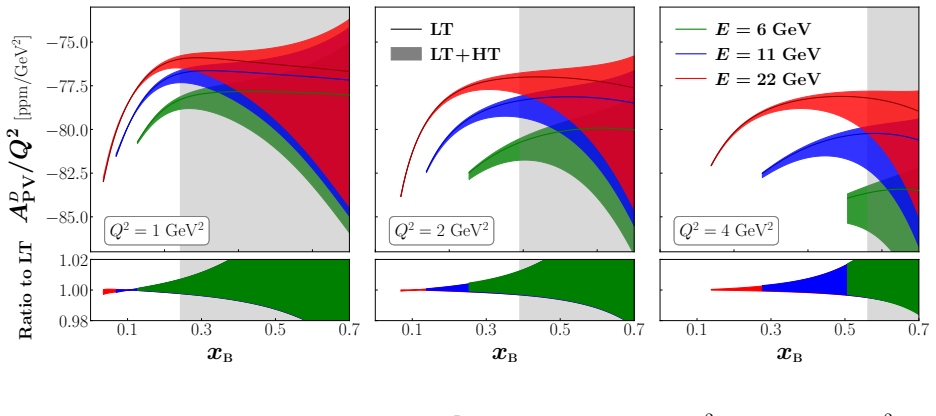
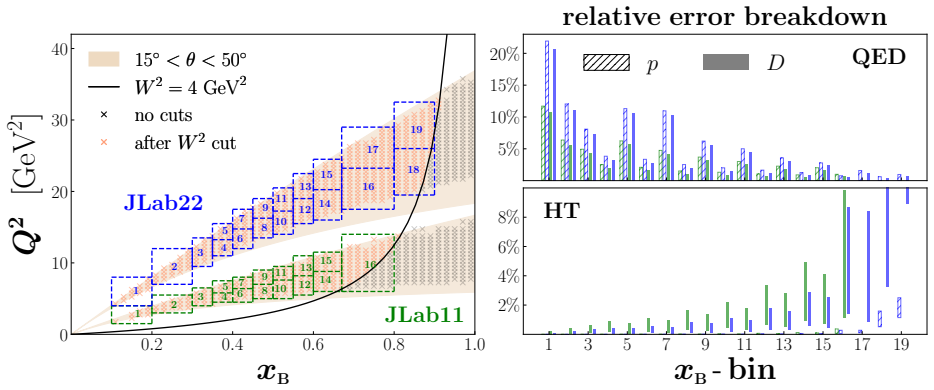
We discuss the impact of neutral current parity-violating deep-inelastic scattering (PVDIS) of electrons from protons and deuterons on the determination of the weak mixing angle, $\sin^{2}{\theta_{\rm W}}$, and parton distribution functions (PDFs) at large parton momentum fractions $x$. Using the JAM global QCD analysis framework, we study the effect of incorporating pseudodata simulated for 11 GeV and 22 GeV Jefferson Lab kinematics, accounting for radiative corrections in a factorized QED+QCD approach and uncertainties from higher twist corrections in $\gamma Z$ exchange. We find that including future PVDIS pseudodata could yield important constraints on the value of $\sin^{2}{\theta_{\rm W}}$ at low $Q^2$ and on the high-$x$ behavior of the strange quark and $d/u$ PDF ratio. The strong correlation between $\sin^{2}{\theta_{\rm W}}$ and the $x$ dependence of the PDFs demonstrates the necessity for simultaneous analysis of QCD and electroweak quantities to ensure an unbiased determination of the weak mixing angle from PVDIS data.
Editorial analysis
A structured set of objections, weighed in public.
Referee Report
Summary. The manuscript uses the JAM global QCD analysis framework to study the impact of simulated parity-violating deep-inelastic scattering (PVDIS) pseudodata at 11 GeV and 22 GeV Jefferson Lab kinematics on the weak mixing angle sin²θ_W and high-x PDFs. Accounting for factorized QED+QCD radiative corrections and higher-twist uncertainties in γZ exchange, it concludes that such data could yield important constraints on sin²θ_W at low Q² and on the high-x strange quark distribution and d/u ratio, while strong correlations between sin²θ_W and PDF x-dependence require simultaneous QCD+EW fits for unbiased results.
Significance. If the pseudodata model is shown to be faithful, the work would usefully illustrate the interplay between electroweak parameters and high-x PDFs in future JLab measurements and reinforce the value of joint analyses. The adoption of the established JAM framework and the factorized treatment of radiative corrections are methodological strengths that support reproducibility within the global-fit community.
major comments (2)
- [Pseudodata simulation section] Pseudodata generation procedure: The manuscript provides no explicit description of how the PVDIS pseudodata are constructed, including the assigned statistical and systematic uncertainties, the concrete implementation of the factorized QED+QCD radiative corrections, and the size and correlations of the higher-twist uncertainties in γZ exchange. Because the headline claims about constraints on sin²θ_W and high-x strange/d/u PDFs rest directly on these inputs (abstract), the absence of these details prevents evaluation of whether the reported error ellipses and correlations are robust.
- [Global analysis and results section] Fitting procedure and uncertainty propagation: No information is given on how the pseudodata are incorporated into the JAM fit, how the simultaneous QCD+EW parameter variation is performed, or how uncertainties are propagated to produce the quoted sin²θ_W–PDF correlations. This is load-bearing for the central claim that simultaneous analysis is necessary, as the strength of the reported correlations is generated by the simulation itself.
minor comments (1)
- [Abstract] The abstract states that the data 'could yield important constraints' without any quantitative measure (e.g., reduction in uncertainty on sin²θ_W or on the high-x d/u ratio); adding even approximate improvement factors would improve clarity.
Simulated Author's Rebuttal
We thank the referee for their careful reading of the manuscript and for highlighting the need for greater methodological detail. We address each major comment below and have revised the manuscript to incorporate the requested information on pseudodata construction and the fitting procedure.
read point-by-point responses
-
Referee: [Pseudodata simulation section] Pseudodata generation procedure: The manuscript provides no explicit description of how the PVDIS pseudodata are constructed, including the assigned statistical and systematic uncertainties, the concrete implementation of the factorized QED+QCD radiative corrections, and the size and correlations of the higher-twist uncertainties in γZ exchange. Because the headline claims about constraints on sin²θ_W and high-x strange/d/u PDFs rest directly on these inputs (abstract), the absence of these details prevents evaluation of whether the reported error ellipses and correlations are robust.
Authors: We agree that the pseudodata generation procedure requires a more explicit description to allow full evaluation of the results. In the revised manuscript we have added a dedicated subsection that specifies: (i) the central values generated from the baseline JAM PDFs together with the input value of sin²θ_W, (ii) the statistical uncertainties assigned according to projected JLab luminosities, beam energies, and detector acceptances at 11 and 22 GeV, (iii) the systematic uncertainties and their correlations, (iv) the concrete implementation of the factorized QED+QCD radiative corrections, and (v) the magnitude and correlation structure of the higher-twist uncertainties in the γZ interference term. These additions directly address the concern that the headline claims rest on unspecified inputs. revision: yes
-
Referee: [Global analysis and results section] Fitting procedure and uncertainty propagation: No information is given on how the pseudodata are incorporated into the JAM fit, how the simultaneous QCD+EW parameter variation is performed, or how uncertainties are propagated to produce the quoted sin²θ_W–PDF correlations. This is load-bearing for the central claim that simultaneous analysis is necessary, as the strength of the reported correlations is generated by the simulation itself.
Authors: We acknowledge that the description of the global-fit procedure was insufficient. The revised manuscript now includes an expanded account of how the PVDIS pseudodata are added to the existing JAM dataset, the joint parameterization of the PDF coefficients and the electroweak parameter sin²θ_W, the χ² minimization performed with simultaneous variation of all parameters, and the Hessian-based uncertainty propagation used to extract the sin²θ_W–PDF correlation matrix. These details make transparent why a simultaneous QCD+EW analysis is required to obtain unbiased results. revision: yes
Circularity Check
No circularity: forward simulation of future pseudodata yields independent projections
full rationale
The paper simulates PVDIS pseudodata for specified JLab kinematics, applies factorized radiative corrections and higher-twist uncertainties, then incorporates the pseudodata into the JAM global fit to project constraints on sin²θ_W and high-x PDFs. The reported correlations and necessity of simultaneous QCD+EW fitting are direct numerical outputs of this procedure rather than reductions of any fitted parameter or self-citation to the target result by construction. No self-definitional steps, fitted-input predictions, or load-bearing self-citations appear; the JAM framework supplies an external baseline and the pseudodata generation is an independent modeling choice. The analysis is therefore self-contained against external benchmarks.
Axiom & Free-Parameter Ledger
axioms (1)
- domain assumption The JAM global QCD analysis framework provides a reliable baseline for PDF extraction against which PVDIS pseudodata effects can be assessed.
Reference graph
Works this paper leans on
-
[1]
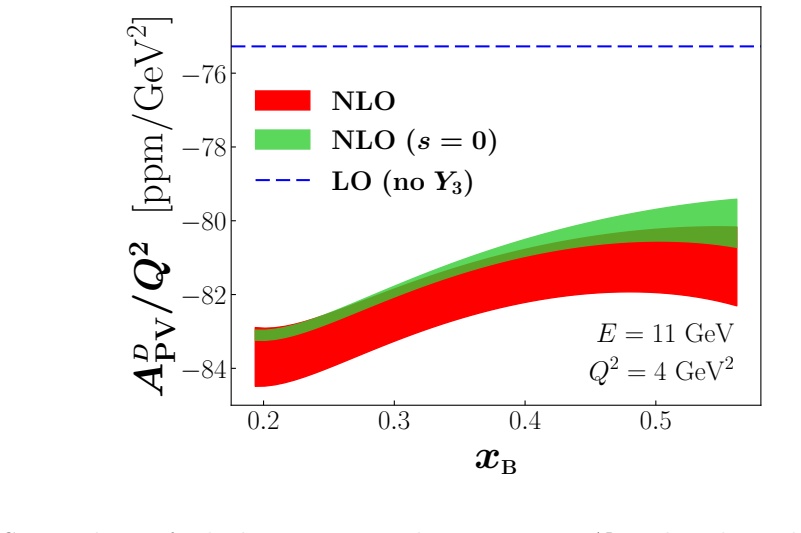
At large values ofQ 2 ≫M 2, one also hasr 2 ≈1,Y 1 ≈1, andY 3 ≈ 1−(1−y) 2 / 1 + (1−y) 2 , which also givesR i ≈0. The parity-violating asymmetry then simplifies to APV ≈ GF Q2 2 √ 2πα P q eq 2ge Agq V q+ + 2ge V gq A Y3 q− P q e2 q q+ .(15) For the case of an isoscalar deuteron target, neglecting sea quark asymmetries (s − = c− = 0), the deuteron parity-v...
-
[2]
=δ(1−ξ),(22a) De/e(ζ, µ2
-
[3]
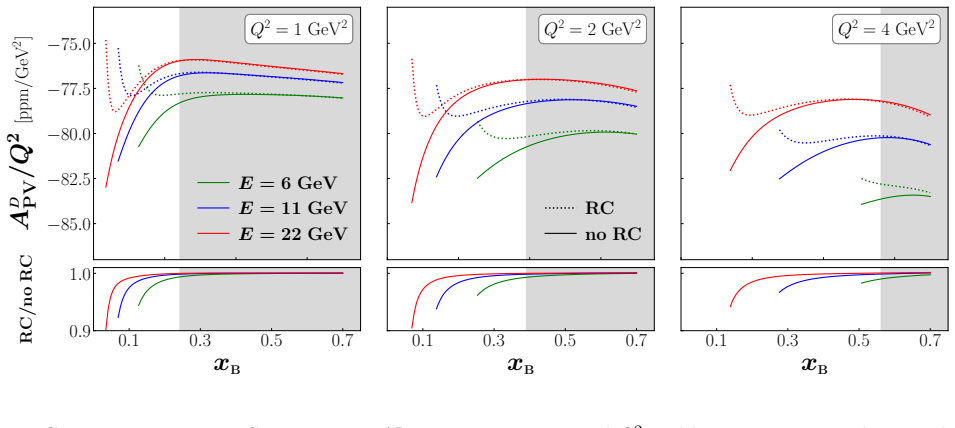
=δ(1−ζ).(22b) The effect of the QED corrections to the parity-violating asymmetry can be seen in Fig. 4. Generally, as the inelasticityybecomes larger, the radiative phase space, governed by (ξ, ζ), becomes larger and therefore also the cross sections. The unpolarized cross section dσ U U grows much faster in magnitude than the polarized cross section dσ ...
-
[4]
S. Schaelet al., Phys. Rep.427, 257 (2006), arXiv:hep-ex/0509008
Pith/arXiv arXiv 2006
-
[5]
V. M. Abazovet al., Phys. Rev. D84, 012007 (2011), arXiv:1104.4590 [hep-ex]
Pith/arXiv arXiv 2011
-
[6]
T. A. Aaltonenet al., Phys. Rev. D89, 072005 (2014), arXiv:1402.2239 [hep-ex]
Pith/arXiv arXiv 2014
-
[7]
S. Chatrchyanet al., Phys. Rev. D84, 112002 (2011), arXiv:1110.2682 [hep-ex]
Pith/arXiv arXiv 2011
-
[8]
T. A. Aaltonenet al., Phys. Rev. D97, 112007 (2018), arXiv:1801.06283 [hep-ex]
Pith/arXiv arXiv 2018
-
[9]
A. M. Sirunyanet al., Eur. Phys. J. C78, 701 (2018), arXiv:1806.00863 [hep-ex]
Pith/arXiv arXiv 2018
-
[10]
G. P. Zelleret al., Phys. Rev. Lett.88, 091802 (2002), [Erratum: Phys. Rev. Lett.90, 239902 (2003)], arXiv:hep-ex/0110059
Pith/arXiv arXiv 2002
-
[11]
J. T. Londergan and A. W. Thomas, Phys. Rev. D67, 111901 (2003), arXiv:hep-ph/0303155
Pith/arXiv arXiv 2003
-
[12]
S. A. Kulagin, Phys. Rev. D67, 091301 (2003), arXiv:hep-ph/0301045
Pith/arXiv arXiv 2003
- [13]
-
[14]
Masonet al., Phys
D. Masonet al., Phys. Rev. Lett.99, 192001 (2007)
2007
-
[15]
I. C. Cloet, W. Bentz, and A. W. Thomas, Phys. Rev. Lett.102, 252301 (2009), arXiv:0901.3559 [nucl-th]
Pith/arXiv arXiv 2009
-
[16]
W. Bentz, I. C. Cloet, J. T. Londergan, and A. W. Thomas, Phys. Lett. B693, 462 (2010), arXiv:0908.3198 [nucl-th]
Pith/arXiv arXiv 2010
-
[17]
P. A. Zylaet al.(Particle Data Group), PTEP2020, 083C01 (2020)
2020
-
[18]
C. Y. Prescottet al., Phys. Lett. B77, 347 (1978)
1978
-
[19]
C. Y. Prescottet al., Phys. Lett. B84, 524 (1979)
1979
-
[20]
J. Arringtonet al., J. Phys. G50, 110501 (2023), arXiv:2209.13357 [nucl-ex]
arXiv 2023
-
[21]
J. D. Bjorken, Phys. Rev. D18, 3239 (1978). 27
1978
-
[22]
A. Kusina, T. Stavreva, S. Berge, F. I. Olness, I. Schienbein, K. Kovarik, T. Jezo, J. Y. Yu, and K. Park, Phys. Rev. D85, 094028 (2012), arXiv:1203.1290 [hep-ph]
Pith/arXiv arXiv 2012
-
[23]
A. Accardi, L. T. Brady, W. Melnitchouk, J. F. Owens, and N. Sato, Phys. Rev. D93, 114017 (2016), arXiv:1602.03154 [hep-ph]
Pith/arXiv arXiv 2016
-
[24]
H. L. Lai, P. M. Nadolsky, J. Pumplin, D. Stump, W. K. Tung, and C. P. Yuan, JHEP04, 089 (2007), arXiv:hep-ph/0702268
Pith/arXiv arXiv 2007
- [25]
-
[26]
A. Airapetianet al., Phys. Lett. B666, 446 (2008), arXiv:0803.2993 [hep-ex]
Pith/arXiv arXiv 2008
-
[27]
P. Jimenez-Delgado, W. Melnitchouk, and J. F. Owens, J. Phys. G40, 093102 (2013), arXiv:1306.6515 [hep-ph]
Pith/arXiv arXiv 2013
-
[28]
T. Anderson, W. Melnitchouk, and N. Sato, Phys. Rev. D112, 094011 (2025), arXiv:2501.00665 [hep-ph]
arXiv 2025
-
[29]
V. Khachatryanet al., Eur. Phys. J. C76, 469 (2016), arXiv:1603.01803 [hep-ex]
Pith/arXiv arXiv 2016
- [30]
-
[31]
G. Aadet al., Phys. Rev. Lett.109, 012001 (2012), arXiv:1203.4051 [hep-ex]
Pith/arXiv arXiv 2012
-
[32]
M. Aaboudet al., Eur. Phys. J. C77, 367 (2017), arXiv:1612.03016 [hep-ex]
Pith/arXiv arXiv 2017
-
[33]
Aadet al., JHEP05, 068 (2014), arXiv:1402.6263 [hep-ex]
G. Aadet al., JHEP05, 068 (2014), arXiv:1402.6263 [hep-ex]
Pith/arXiv arXiv 2014
-
[34]
C. Adolphet al., Phys. Lett. B764, 1 (2017), arXiv:1604.02695 [hep-ex]
Pith/arXiv arXiv 2017
-
[35]
C. Adolphet al., Phys. Lett. B767, 133 (2017), arXiv:1608.06760 [hep-ex]
Pith/arXiv arXiv 2017
-
[36]
S. Catani, D. de Florian, G. Rodrigo, and W. Vogelsang, Phys. Rev. Lett.93, 152003 (2004), arXiv:hep-ph/0404240
Pith/arXiv arXiv 2004
-
[37]
D. A. Mason,Measurement of the strange—antistrange asymmetry at NLO in QCD from NuTeV dimuon data, Ph.D. thesis, Oregon U. (2006)
2006
-
[38]
M. Goncharovet al., Phys. Rev. D64, 112006 (2001), arXiv:hep-ex/0102049
Pith/arXiv arXiv 2001
-
[39]
F. Olness, J. Pumplin, D. Stump, J. Huston, P. M. Nadolsky, H. L. Lai, S. Kretzer, J. F. Owens, and W. K. Tung, Eur. Phys. J. C40, 145 (2005), arXiv:hep-ph/0312323
Pith/arXiv arXiv 2005
-
[40]
S. J. Brodsky and B.-Q. Ma, Phys. Lett. B381, 317 (1996), arXiv:hep-ph/9604393
Pith/arXiv arXiv 1996
-
[41]
R. S. Sufian, T. Liu, G. F. de T´ eramond, H. G. Dosch, S. J. Brodsky, A. Deur, M. T. Islam, and B.-Q. Ma, Phys. Rev. D98, 114004 (2018), arXiv:1809.04975 [hep-ph]
Pith/arXiv arXiv 2018
- [42]
-
[43]
J. Alwall and G. Ingelman, Phys. Rev. D70, 111505 (2004), arXiv:hep-ph/0407364
Pith/arXiv arXiv 2004
-
[44]
W. Melnitchouk and M. Malheiro, Phys. Lett. B451, 224 (1999), arXiv:hep-ph/9901321
Pith/arXiv arXiv 1999
-
[45]
A. I. Signal and A. W. Thomas, Phys. Lett. B191, 205 (1987)
1987
-
[46]
Burkardt and B
M. Burkardt and B. J. Warr, Phys. Rev. D45, 958 (1992)
1992
-
[47]
T.-J. Houet al., Phys. Rev. D103, 014013 (2021), arXiv:1912.10053 [hep-ph]
Pith/arXiv arXiv 2021
-
[48]
R. D. Ballet al., Eur. Phys. J. C82, 428 (2022), arXiv:2109.02653 [hep-ph]
arXiv 2022
- [49]
-
[50]
Y.-B. Yang, J. Liang, Y.-J. Bi, Y. Chen, T. Draper, K.-F. Liu, and Z. Liu, Phys. Rev. Lett. 121, 212001 (2018), arXiv:1808.08677 [hep-lat]
Pith/arXiv arXiv 2018
-
[51]
C. Alexandrouet al., Phys. Rev. D101, 094513 (2020), arXiv:2003.08486 [hep-lat]
arXiv 2020
-
[52]
C. Cocuzza, W. Melnitchouk, N. Sato, and A. W. Thomas, (2026), arXiv:2605.00666 [hep- ph]
Pith/arXiv arXiv 2026
-
[53]
A. Accardi, X. Jing, J. F. Owens, and S. Park, Phys. Rev. D107, 113005 (2023), arXiv:2303.11509 [hep-ph]
arXiv 2023
-
[54]
W. Melnitchouk and A. W. Thomas, Phys. Lett. B377, 11 (1996), arXiv:nucl-th/9602038
Pith/arXiv arXiv 1996
-
[55]
D. Abramset al., Phys. Rev. Lett.128, 132003 (2022), arXiv:2104.05850 [hep-ex]
arXiv 2022
-
[56]
S. Tkachenkoet al., Phys. Rev. C89, 045206 (2014), [Addendum: Phys. Rev. C90, 059901 (2014)], arXiv:1402.2477 [nucl-ex]
Pith/arXiv arXiv 2014
-
[57]
S. Li, A. Accardi, M. Cerutti, I. P. Fernando, C. E. Keppel, W. Melnitchouk, P. Mon- aghan, G. Niculescu, M. I. Niculescu, and J. F. Owens, Phys. Rev. D109, 074036 (2024), arXiv:2309.16851 [hep-ph]
arXiv 2024
-
[58]
C. Cocuzza, C. E. Keppel, H. Liu, W. Melnitchouk, A. Metz, N. Sato, and A. W. Thomas, Phys. Rev. Lett.127, 242001 (2021), arXiv:2104.06946 [hep-ph]
arXiv 2021
-
[59]
T. J. Hague, J. Arrington, S. Li, and S. N. Santiesteban, Phys. Rev. C110, L041302 (2024), arXiv:2312.13499 [nucl-ex]
arXiv 2024
-
[60]
C. Cocuzza, T. J. Hague, W. Melnitchouk, N. Sato, and A. W. Thomas, (2026), arXiv:2602.16589 [hep-ph]
arXiv 2026
-
[61]
V. A. Radescu, in12th International Workshop on Deep Inelastic Scattering (DIS 2004) (2004) pp. 386–391, arXiv:hep-ex/0408006. 29
Pith/arXiv arXiv 2004
-
[62]
K. S. McFarlandet al., in33rd Rencontres de Moriond: Electroweak Interactions and Unified Theories(1998) pp. 19–24, arXiv:hep-ex/9806013
Pith/arXiv arXiv 1998
-
[63]
R. A. Johnsonet al., in17th International Workshop on Weak Interactions and Neutrinos (1999) pp. 62–66, arXiv:hep-ex/9904028
Pith/arXiv arXiv 1999
-
[64]
K. S. McFarlandet al., eConfC020620, SABT01 (2002), arXiv:hep-ex/0210010
Pith/arXiv arXiv 2002
-
[65]
B. G. Ticeet al., Phys. Rev. Lett.112, 231801 (2014), arXiv:1403.2103 [hep-ex]
Pith/arXiv arXiv 2014
-
[66]
J. M. Cruz-Martinez, M. Fieg, T. Giani, P. Krack, T. M¨ akel¨ a, T. R. Rabemananjara, and J. Rojo, Eur. Phys. J. C84, 369 (2024), arXiv:2309.09581 [hep-ph]
arXiv 2024
-
[67]
Heweset al., Instruments5, 31 (2021), arXiv:2103.13910 [physics.ins-det]
V. Heweset al., Instruments5, 31 (2021), arXiv:2103.13910 [physics.ins-det]
arXiv 2021
-
[68]
D. Wanget al., Phys. Rev. C91, 045506 (2015), arXiv:1411.3200 [nucl-ex]
Pith/arXiv arXiv 2015
-
[69]
L. W. Mo and Y.-S. Tsai, Rev. Mod. Phys.41, 205 (1969)
1969
-
[70]
D. Y. Bardin and N. M. Shumeiko, Nucl. Phys.B127, 242 (1977)
1977
-
[71]
B. Badelek, D. Y. Bardin, K. Kurek, and C. Scholz, Z. Phys. C66, 591 (1995), arXiv:hep- ph/9403238
arXiv 1995
-
[72]
T. Liu, W. Melnitchouk, J.-W. Qiu, and N. Sato, Phys. Rev. D104, 094033 (2021), arXiv:2008.02895 [hep-ph]
arXiv 2021
-
[73]
T. Liu, W. Melnitchouk, J.-W. Qiu, and N. Sato, JHEP11, 157 (2021), arXiv:2108.13371 [hep-ph]
arXiv 2021
-
[74]
O. W. Greenberg and D. Bhaumik, Phys. Rev. D4, 2048 (1971)
2048
-
[75]
Nachtmann, Nucl
O. Nachtmann, Nucl. Phys.B63, 237 (1973)
1973
-
[76]
Georgi and H
H. Georgi and H. D. Politzer, Phys. Rev. D14, 1829 (1976)
1976
-
[77]
R. K. Ellis, W. Furmanski, and R. Petronzio, Nucl. Phys.B212, 29 (1983)
1983
-
[78]
M. A. G. Aivazis, F. I. Olness, and W.-K. Tung, Phys. Rev. D50, 3085 (1994), arXiv:hep- ph/9312318
arXiv 1994
-
[79]
E. Moffat, T. C. Rogers, W. Melnitchouk, N. Sato, and F. Steffens, Phys. Rev. D99, 096008 (2019), arXiv:1901.09016 [hep-ph]
Pith/arXiv arXiv 2019
-
[80]
I. Schienbeinet al., J. Phys. G35, 053101 (2008), arXiv:0709.1775 [hep-ph]
Pith/arXiv arXiv 2008
discussion (0)
Sign in with ORCID, Apple, or X to comment. Anyone can read and Pith papers without signing in.